
Life, 1886-01-28 · page 10 of 16
Life — January 28, 1886 — page 10: what you’re looking at
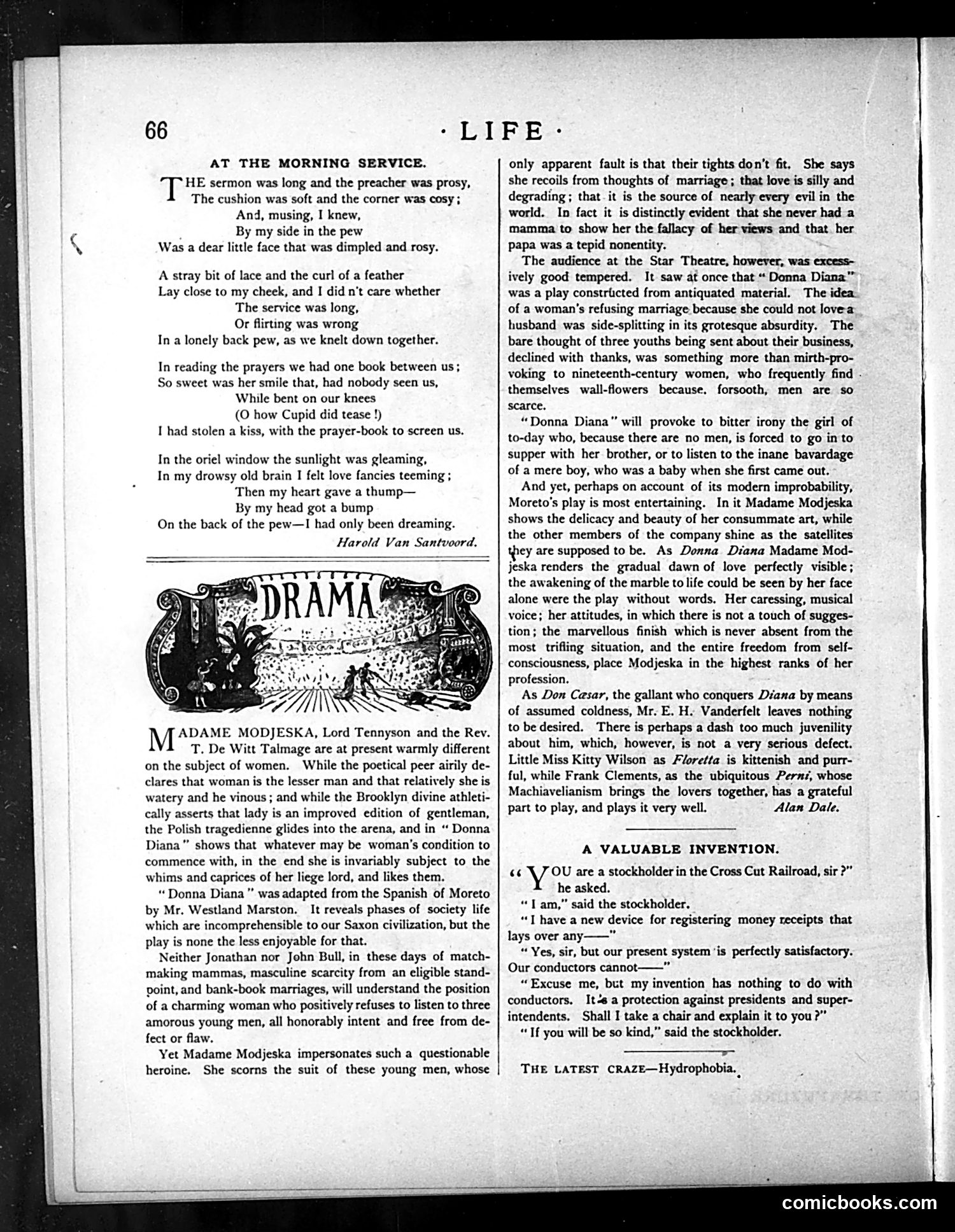
What you’re looking at
This page contains two distinct pieces of social satire: **"At the Morning Service"** is a humorous poem by Harold Van Santvoord about a man distracted during church by flirtation with an attractive young woman in the pew. The joke culminates when he dreams of stealing a kiss behind a prayer-book—only to bump his head on the pew, revealing it was all fantasy. The satire gently mocks romantic daydreaming and the tension between proper religious conduct and human desire. **The Drama section** reviews actress Madame Modjeska in "Donna Diana," a Spanish play where a woman refuses three suitors because she won't marry without love. The critic sarcastically notes this premise seems absurd to 1890s audiences: modern women would *welcome* marriage proposals since eligible men are scarce, yet here's a character rejecting multiple options. The satire targets both the outdated Spanish play and contemporary marriage-market desperation among women with limited romantic prospects. Both pieces mock human nature—male distraction and female romantic idealism—from a Victorian perspective.
📄 Transcribed text from this page (OCR, searchable)
Machine-transcribed from the original scan — historical spelling and the odd misread are preserved.
‘LIFE: AT THE MORNING SERVICE. HE sermon was long and the preacher was prosy, The cushion was soft and the corner was cosy; And, musing, I knew, By my side in the pew Was a dear little face that was dimpled and rosy. A stray bit of lace and the curl of a feather Lay close to my cheek, and I did n't care whether The service was long, Or flirting was wrong In a lonely back pew, as we knelt down together. In reading the prayers we had one book between us; So sweet was her smile that, had nobody seen us, While bent on our knees (O how Cupid did tease !) I had stolen a kiss, with the prayer-book to screen us. In the oriel window the sunlight was gleaming, In my drowsy old brain I felt love fancies teeming ; Then my heart gave a thump— By my head got a bump On the back of the pew—I had only been dreaming. Harold Van Santvoord. ADAME MODJESKA, Lord Tennyson and the Rev. T. De Witt Talmage are at present warmly different ‘on the subject of women. While the poetical peer airily de- clares that woman is the lesser man and that relatively she is watery and he vinous ; and while the Brooklyn divine athleti- cally asserts that lady is an improved edition of gentleman, the Polish tragedienne glides into the arena, and in “ Donna Diana" shows that whatever may be woman's condition to commence with, in the end she is invariably subject to the whims and caprices of her liege lord, and likes them. “Donna Diana” was adapted from the Spanish of Moreto by Mr. Westland Marston. It reveals phases of society life which are incomprehensible to our Saxon civilization, but the play is none the less enjoyable for that. Neither Jonathan nor John Bull, in these days of match- making mammas, masculine scarcity from an eligible stand- point, and bank-book marriages, will understand the position of a charming woman who positively refuses to listen to three amorous young men, all honorably intent and free from de- fect or flaw. Yet Madame Modjeska impersonates such a questionable heroine. She scorns the suit of these young men, whose only apparent fault is that their tights don’t fit, She says she recoils from thoughts of marriage; that love is silly and degrading; that it is the source of nearly every evil in the world. In fact it is distinctly evident that she never had a mamma to show her the fallacy of her views and that. her papa was a tepid nonentity. The audience at the Star Theatre, however, was excess ively good tempered. It saw at once that “ Donna Diana” was a play constricted from antiquated material. The idea. of a woman's refusing marriage because she could not lovea: husband was side-splitting in its grotesque absurdity. The bare thought of three youths being sent about their business, declined with thanks, was something more than mirth-pro- voking to nineteenth-century women, who frequently find - themselves wall-flowers because. forsooth, men are so scarce, “Donna Diana” will provoke to bitter irony the girl of to-day who, because there are no men, is forced to go in to supper with her brother, or to listen to the inane bavardage of a mere boy, who was a baby when she first came out. And yet, perhaps on account of its modern improbability, Moreto’s play is most entertaining. In it Madame Modjeska shows the delicacy and beauty of her consummate art, while the other members of the company shine as the satellites they are supposed to be. As Donna Diana Madame Mod- jeska renders the gradual dawn of love perfectly visible; the awakening of the marble to life could be seen by her face alone were the play without words. Her caressing, musical voice; her attitudes, in which there is not a touch of sugges- tion; the marvellous finish which is never absent from the most trifling situation, and the entire freedom from self- consciousness, place Modjeska in the highest ranks of her profession. As Don Casar, the gallant who conquers Diana by means of assumed coldness, Mr. E. H. Vanderfelt leaves nothing to bedesired. There is perhaps a dash too much juvenility about him, which, however, is not a very serious defect. Little Miss Kitty Wilson as Floretta is kittenish and purr- ful, while Frank Clements, as the ubiquitous Perms, whose Machiavelianism brings the lovers together, has a grateful part to play, and plays it very well. Alan Dale. A VALUABLE INVENTION. “ OU are a stockholder in the Cross Cut Railroad, sir ?” he asked. “Tam,” said the stockholder. “T have a new device for registering money receipts that lays over any ——” “Yes, sir, but our present system ‘is perfectly satisfactory. Our conductors cannot——” “Excuse me, but my invention has nothing to do with conductors. It-¢ a protection against presidents and super- intendents. Shall I take a chair and explain it to you ?” “Tf you will be so kind,” said the stockholder. — THE LATEST CRAZE—Hydrophobia. |