
Life, 1886-01-28 · page 2 of 16
Life — January 28, 1886 — page 2: what you’re looking at
What you’re looking at
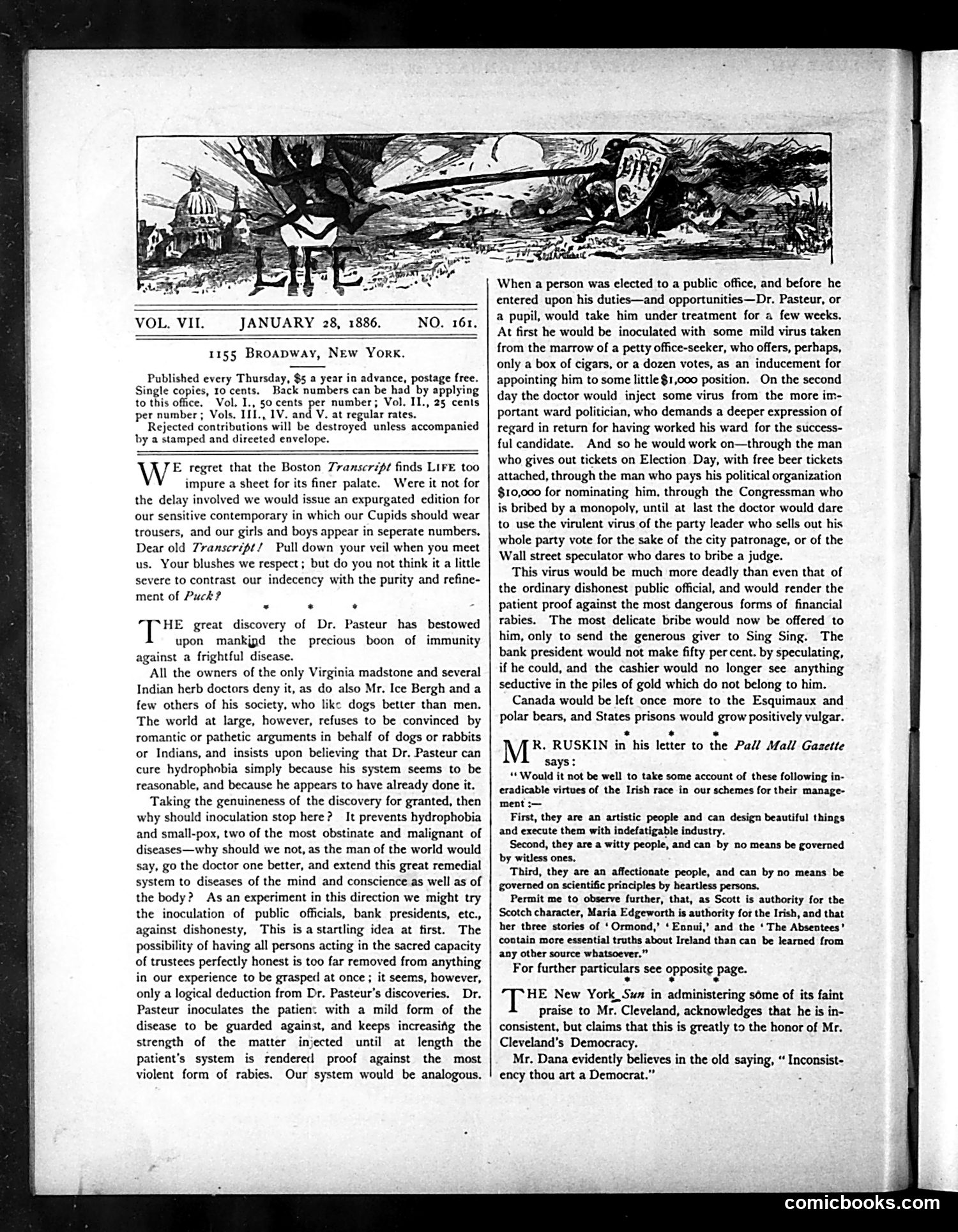
The header cartoon depicts a chaotic scene with a skeletal figure (likely representing disease or death) looming over a cityscape, while a classical building (possibly representing government or institutions) sits to the left. The accompanying editorial discusses Dr. Pasteur's recent discovery of inoculation against rabies. The writer satirizes the idea of using similar medical principles to "inoculate" public officials against corruption—injecting them with a mild form of political dishonesty so they develop immunity to bribes and patronage. The satire critiques widespread graft: politicians accepting bribes from office-seekers, Wall Street speculators, and monopolies in exchange for favors. The piece mockingly suggests this corruption is so endemic that officials should simply be vaccinated against it rather than reformed.
📄 Transcribed text from this page (OCR, searchable)
Machine-transcribed from the original scan — historical spelling and the odd misread are preserved.
VOL. VII. JANUARY 28, 1886. NO. 1155 Broapway, New York. Published every Thursday, $5 a year in advance, postage free. Single copies, 10 cents. Back numbers can be had by applying to this ofice. Vol. I., s0 cents per number; Vol. II., 25 cents per number; Vols. If1., IV. and Vat regular rates. Rejected Contributions will be destroyed unless accompanied by a stamped and direeted envelope. E regret that the Boston 7ranscript finds LIFE too impure a sheet for its finer palate. Were it not for the delay involved we would issue an expurgated edition for our sensitive contemporary in which our Cupids should wear trousers, and our girls and boys appear in seperate numbers. Dear old 7ranscript/ Pull down your veil when you meet us. Your blushes we respect ; but do you not think it a little severe to contrast our indecency with the purity and refine- ment of Puck? .- . . TH great discovery of Dr. Pasteur has bestowed upon mankjpd the precious boon of immunity against a frightful disease. All the owners of the only Virginia madstone and several Indian herb doctors deny it, as do also Mr. Ice Bergh and a few others of his society, who likc dogs better than men. The world at large, however, refuses to be convinced by romantic or pathetic arguments in behalf of dogs or rabbits or Indians, and insists upon believing that Dr. Pasteur can cure hydrophobia simply because his system seems to be reasonable, and because he appears to have already done it. Taking the genuineness of the discovery for granted, then why should inoculation stop here? It prevents hydrophobia and small-pox, two of the most obstinate and malignant of diseases—why should we not, as the man of the world would say, go the doctor one better, and extend this great remedial system to diseases of the mind and conscience as well as of the body? As an experiment in this direction we might try the inoculation of public officials, bank presidents, etc., against dishonesty, This is a startling idea at first. The possibility of having all persons acting in the sacred capacity of trustees perfectly honest is too far removed from anything in our experience to be grasped at once ; it seems, however, only a logical deduction from Dr. Pasteur’s discoveries. Dr. Pasteur inoculates the patient with a mild form of the disease to be guarded against, and keeps increasifg the strength of the matter injected until at length the patient’s system is rendered proof against the most violent form of rabies. Our system would be analogous. When a person was elected to a public office, and before he entered upon his duties—and opportunities—Dr. Pasteur, or a pupil, would take him under treatment for a few weeks. At first he would be inoculated with some mild virus taken from the marrow of a petty office-seeker, who offers, perhaps, only a box of cigars, or a dozen votes, as an inducement for appointing him to some little $1,000 position. On the second day the doctor would inject some virus from the more im- portant ward politician, who demands a deeper expression of regard in return for having worked his ward for the success- ful candidate. And so he would work on—through the man who gives out tickets on Election Day, with free beer tickets attached, through the man who pays his political organization $10,000 for nominating him, through the Congressman who is bribed by a monopoly, until at last the doctor would dare to use the virulent virus of the party leader who sells out his whole party vote for the sake of the city patronage, or of the Wall street speculator who dares to bribe a judge. This virus would be much more deadly than even that of the ordinary dishonest public official, and would render the patient proof against the most dangerous forms of financial rabies. The most delicate bribe would now be offered to him, only to send the generous giver to Sing Sing. The bank president would not make fifty per cent. by speculating, if he could, and the cashier would no longer see anything seductive in the piles of gold which do not belong to him. Canada would be left once more to the Esquimaux and polar bears, and States prisons would grow positively vulgar. . . . R. RUSKIN in his letter to the Pal! Mall Gazette says: “* Would it not be well to take some account of these following in- eradicable virtues of the Irish race in our schemes for their manage- ment :— First, they are an artistic people and can design beautiful things and execute them with indefatigable industry. Second, they are a witty people, and can by no means be governed by witless ones, ‘Third, they are an affectionate people, and can by no means be governed on scientific principles by heartless persons. Permit me to observe further, that, as Scott is authority for the Scotch character, Maria Edgeworth is authority for the Irish, and that her three stories of ‘Ormond,’ ‘Ennui,’ and the ‘ The Absentees’ contain more essential truths about Ireland than can be learned from any other source whatsoever.” For further particulars see opposite page. . . . HE New York Sun in administering some of its faint praise to Mr. Cleveland, acknowledges that he is in- consistent, but claims that this is greatly to the honor of Mr. Cleveland’s Democracy. Mr. Dana evidently believes in the old saying, “ Inconsist- ency thou art a Democrat.” comicbooks.com