
A complete issue · 16 pages · 1885
Life — December 3, 1885
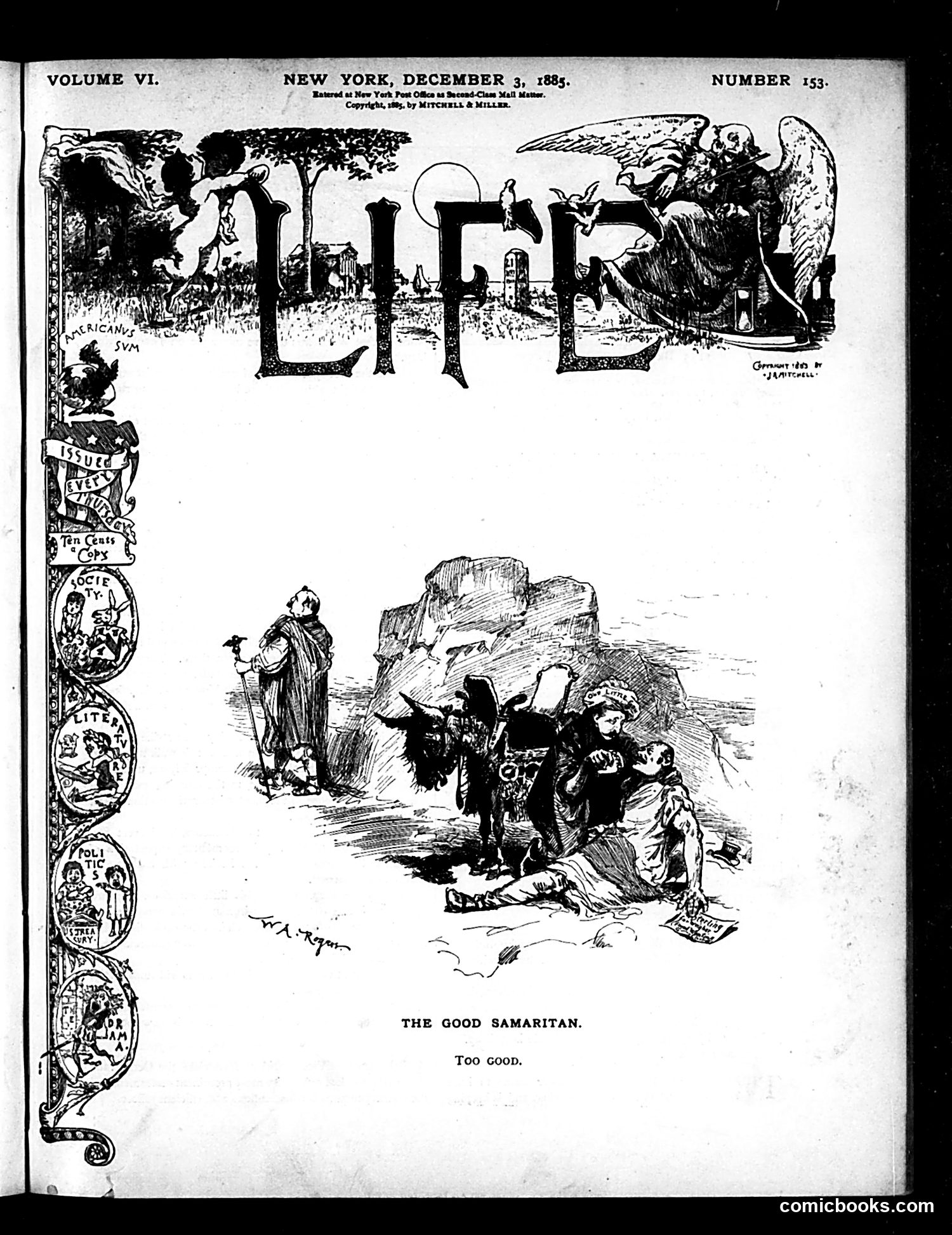
This is a satirical illustration accompanying the biblical parable of the Good Samaritan. The sketch shows a figure helping others in distress near rocky terrain, evoking the New Testament story where a Samaritan assists a traveler beaten by robbers, contrasting with those who passed by without helping. The caption "Too Good" suggests ironic social commentary—likely criticizing either excessive or performative charity, or perhaps mocking those who claimed moral superiority while ignoring real suffering around them. The illustration's somewhat crowded, chaotic composition may emphasize the gap between charitable ideals and practical reality in 1880s America. Without additional context from the article text, the specific target of satire remains somewhat unclear, but the overall message questions the authenticity or adequacy of contemporary charitable practices.
The page contains political commentary rather than a traditional cartoon. The text critiques the Democratic Party's response to President Cleveland's appointment of C. H. Sterling to the Port Wardenship, replacing Mr. Hill. The editors sarcastically attack Democratic papers claiming friendship while actually attacking the administration. Key criticisms include: editors prioritizing personal gain over party welfare; the *Sun* editor being untrustworthy; Hill's election as governor representing a Democratic political failure; and Cleveland's $1,000 contribution to the Democratic campaign being insufficient. The piece also mocks wealthy individuals' anxiety about approaching economic reckoning, and includes commentary on European political instability under figures like Bismarck and the Russian Tsar. The tone is bitterly partisan, defending Cleveland while attacking Democratic opponents.
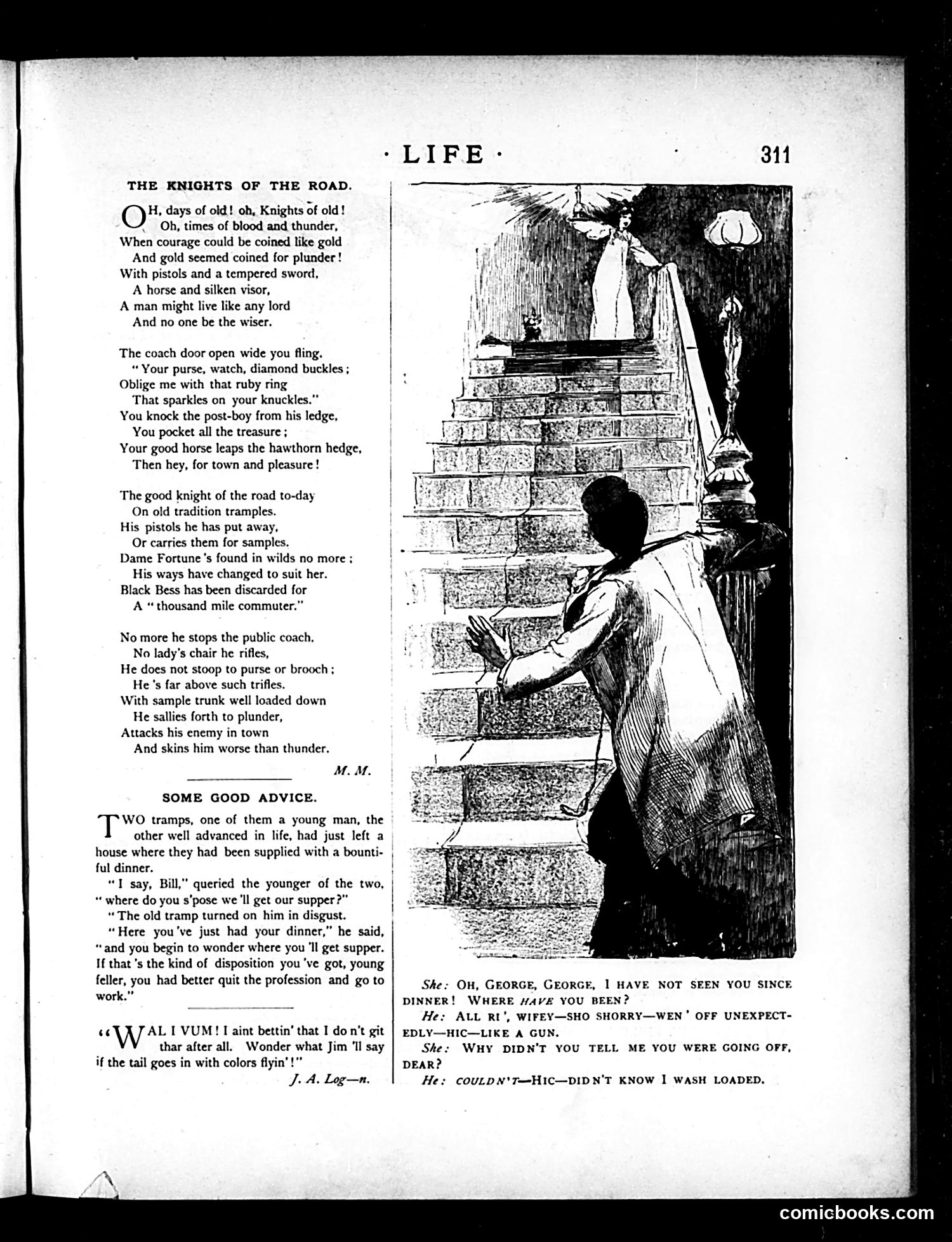
This page contains two pieces of social satire about vagrants and tramps—common figures in late 19th/early 20th-century American life. "The Knights of the Road" (poem with illustration) romanticizes highway robbers and highwaymen as outdated figures whose "ways have changed to suit her." The illustration shows a tramp on city steps, suggesting the old criminal lifestyle has devolved into urban poverty. "Some Good Advice" (below) depicts two tramps discussing survival after a meal. The older tramp advises the younger to abandon the "profession" and find legitimate work—satirizing the rationalization that vagrancy represents a "profession" rather than desperation. The dialogue's tone mocks both tramps' worldviews while commenting on contemporary poverty and homelessness as a persistent social problem.
The top illustration shows a procession of animals carrying various objects, appearing to satirize a parade or ceremonial march, though the specific reference isn't entirely clear from the image alone. The text consists of brief satirical items on various topics: - **Political commentary**: References to Jones (possibly a Lieutenant-Governor elect) and a shipping dispute - **Press criticism**: Jokes about newspapers, including the *Toronto Globe* misplacing a comma in "Rose Coghlan" and the democratic nature of journalism - **Social observations**: Notes on vaccination debates in Maine, suicide rates in Berlin, and the Swedish government's control of drinking establishments - **Legal matters**: A suit by Cyrus W. Field against A. Oakey Hall and J.G. Bennett The satire targets journalism, politics, and social institutions of the period through brief, pointed comments rather than sustained narrative.
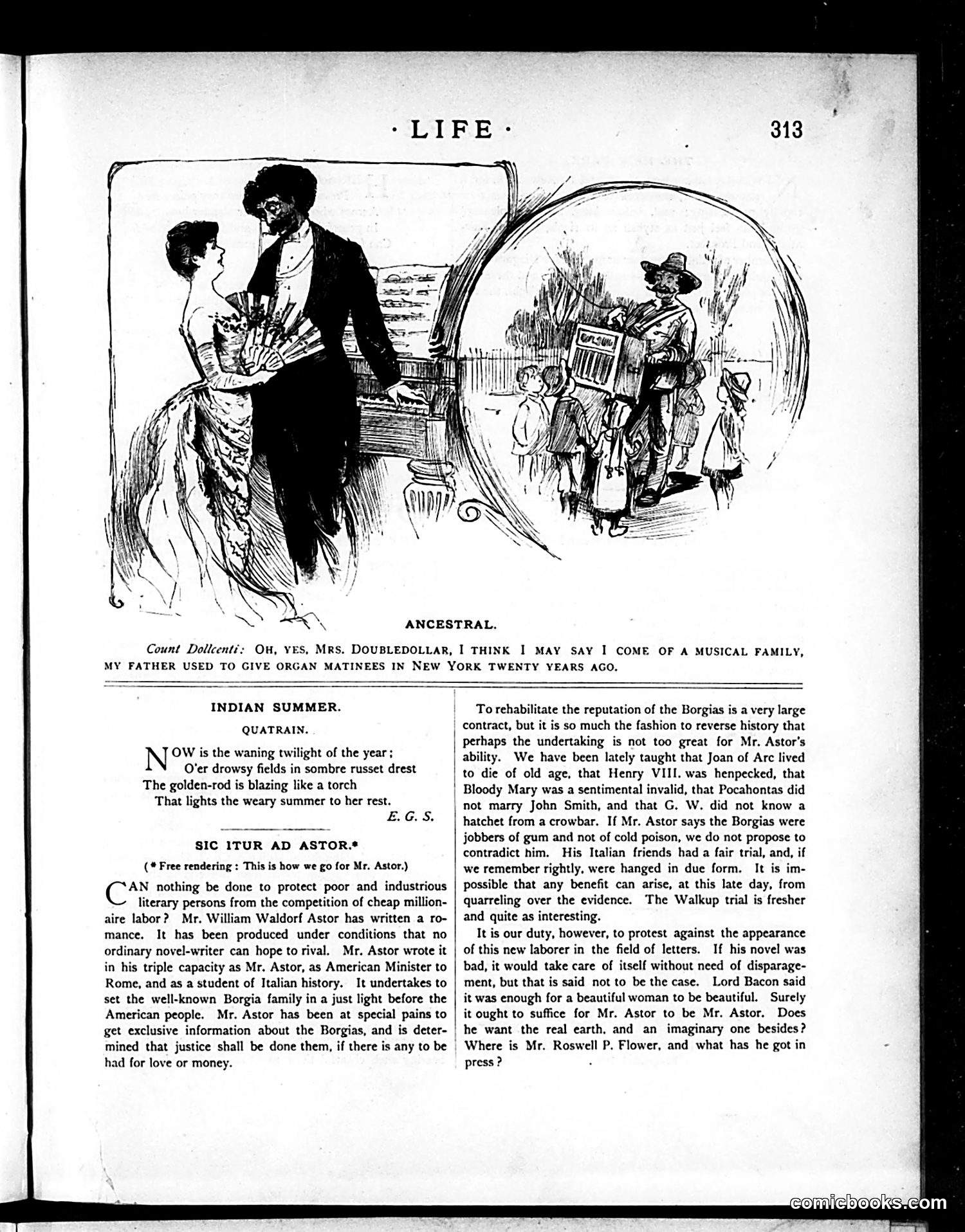
**"Ancestral" Cartoon:** The left panel shows an elegantly dressed couple conversing, while the right panel depicts a circus or street performance with a showman and children. The caption has Count Dollicetti claiming musical family ancestry, referencing organ matinee performances in New York twenty years prior—suggesting his "noble" background is actually from lowbrow popular entertainment. **"Sic Itur Ad Astor" Article:** This defends William Waldorf Astor's novel against criticism. The piece argues his work deserves protection from "cheap millionaires" and cheap labor competition. It addresses disputes over the Borgia family's historical reputation and references controversies involving figures like Lord Bacon and Roswell P. Flower—though specific context remains unclear.
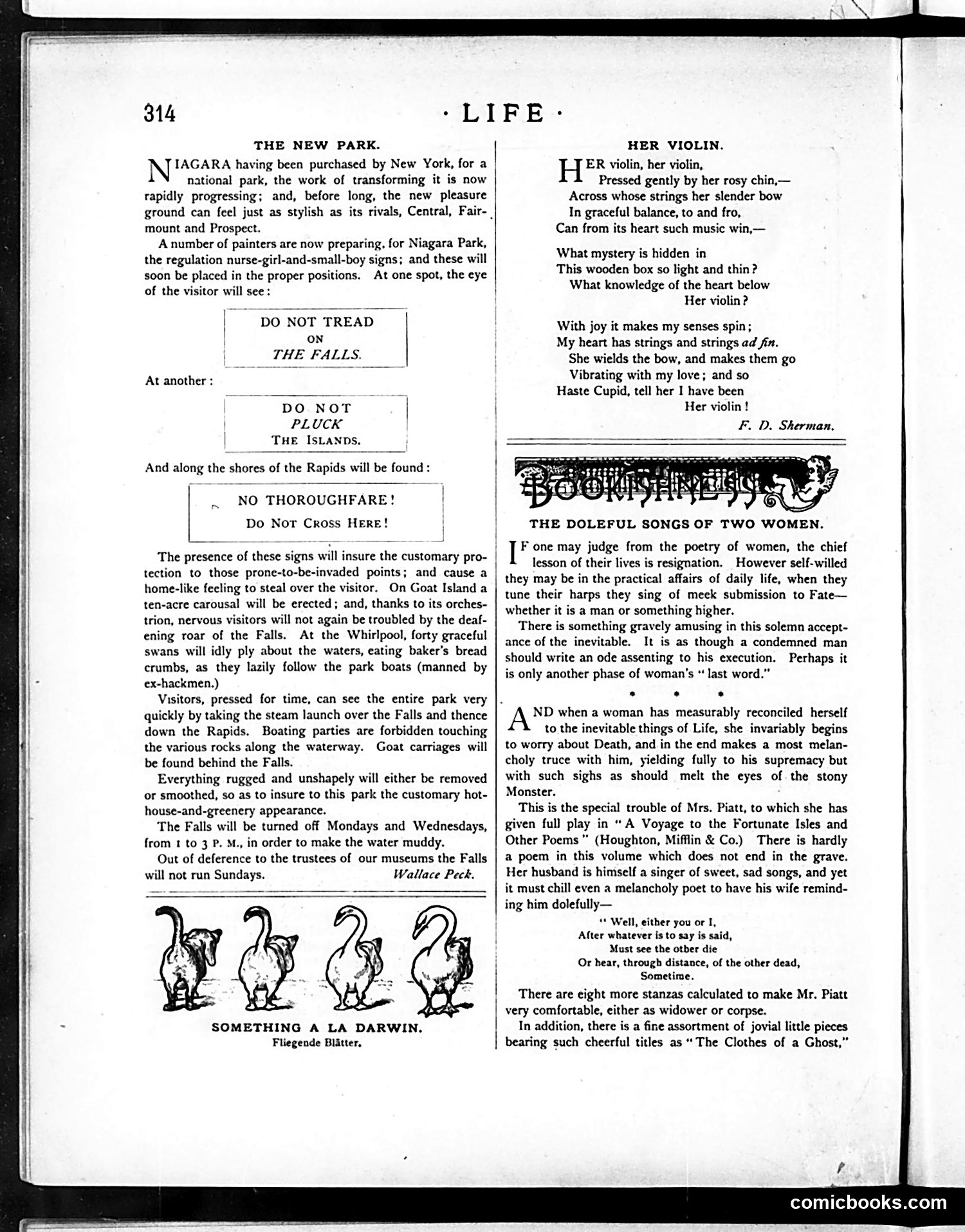
This page contains three distinct literary/artistic pieces rather than political cartoons: 1. **"The New Park"** (left column): A prose piece about Niagara Park's development, mentioning planned regulatory signs like "DO NOT TREAD ON THE FALLS" and "NO THOROUGHFARE." This appears satirical commentary on over-regulation of natural attractions. 2. **"Her Violin"** (top right): A romantic poem by F.D. Sherman about a woman playing violin, using extended metaphors about heartstrings and love. 3. **"The Doleful Songs of Two Women"** (bottom right): A literary essay discussing resigned acceptance of fate in women's poetry, specifically referencing Mrs. Piatt's work. 4. **"Something à la Darwin"** (bottom): A small illustration showing four monkeys in descending evolutionary stages—a common Victorian satirical reference to evolutionary theory. The page is primarily literary rather than politically satirical.
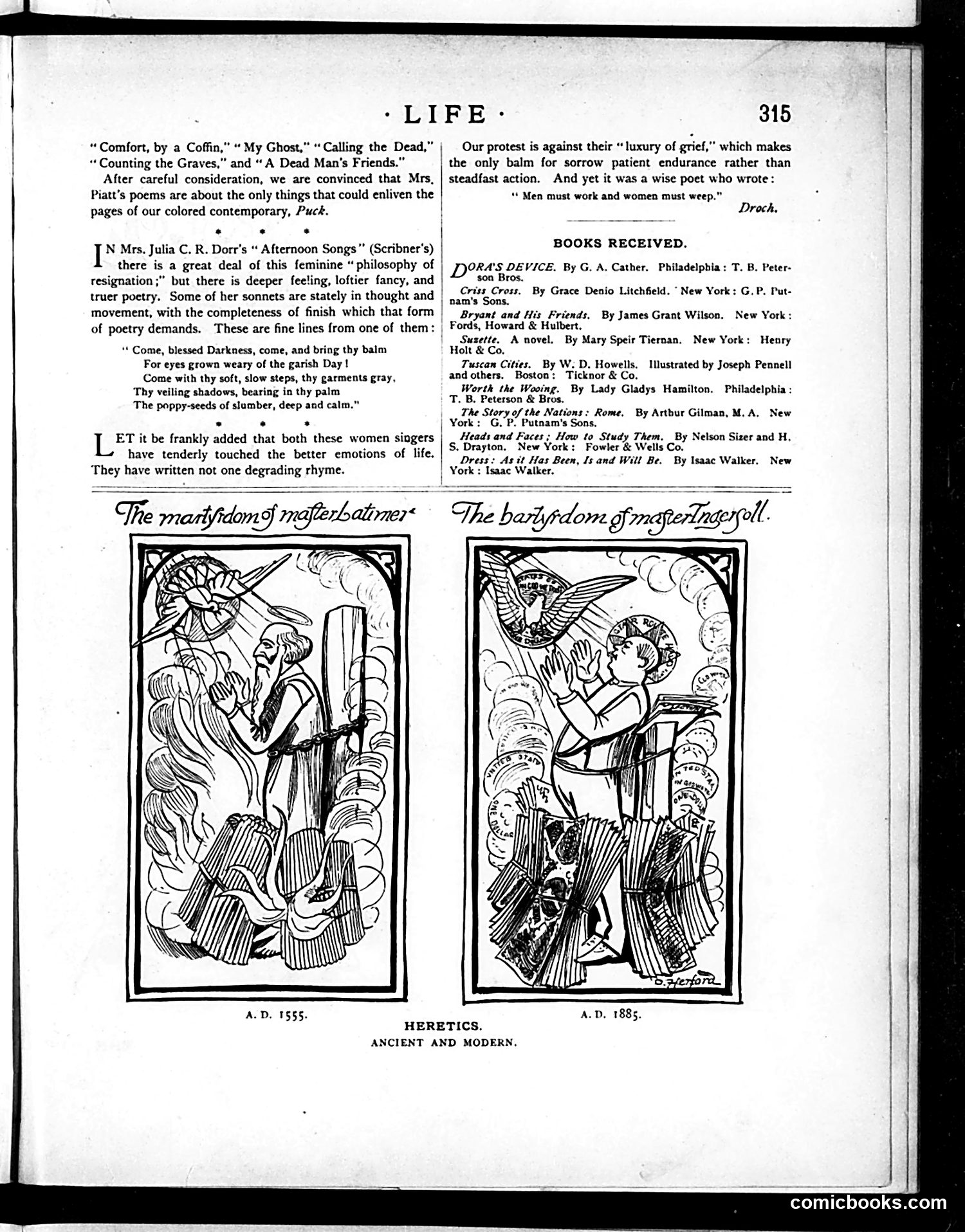
This page contains two woodcut illustrations labeled "Heretics: Ancient and Modern," dated A.D. 1555 and A.D. 1885. They appear to be comparative religious satire rather than political commentary. The left image (1555) depicts a martyrdom scene with flames and divine light, showing religious persecution during the Reformation era. The right image (1885) portrays what appears to be a modern figure rejecting or being attacked by a dove (likely representing the Holy Spirit or religious authority). The juxtaposition suggests the magazine is satirizing contemporary religious conflict or heresy accusations of the 1880s by comparing them to historical religious persecution. However, without additional context about specific 1880s religious controversies, the exact target of this satire remains unclear. The page also contains a "Books Received" section listing recent publications.
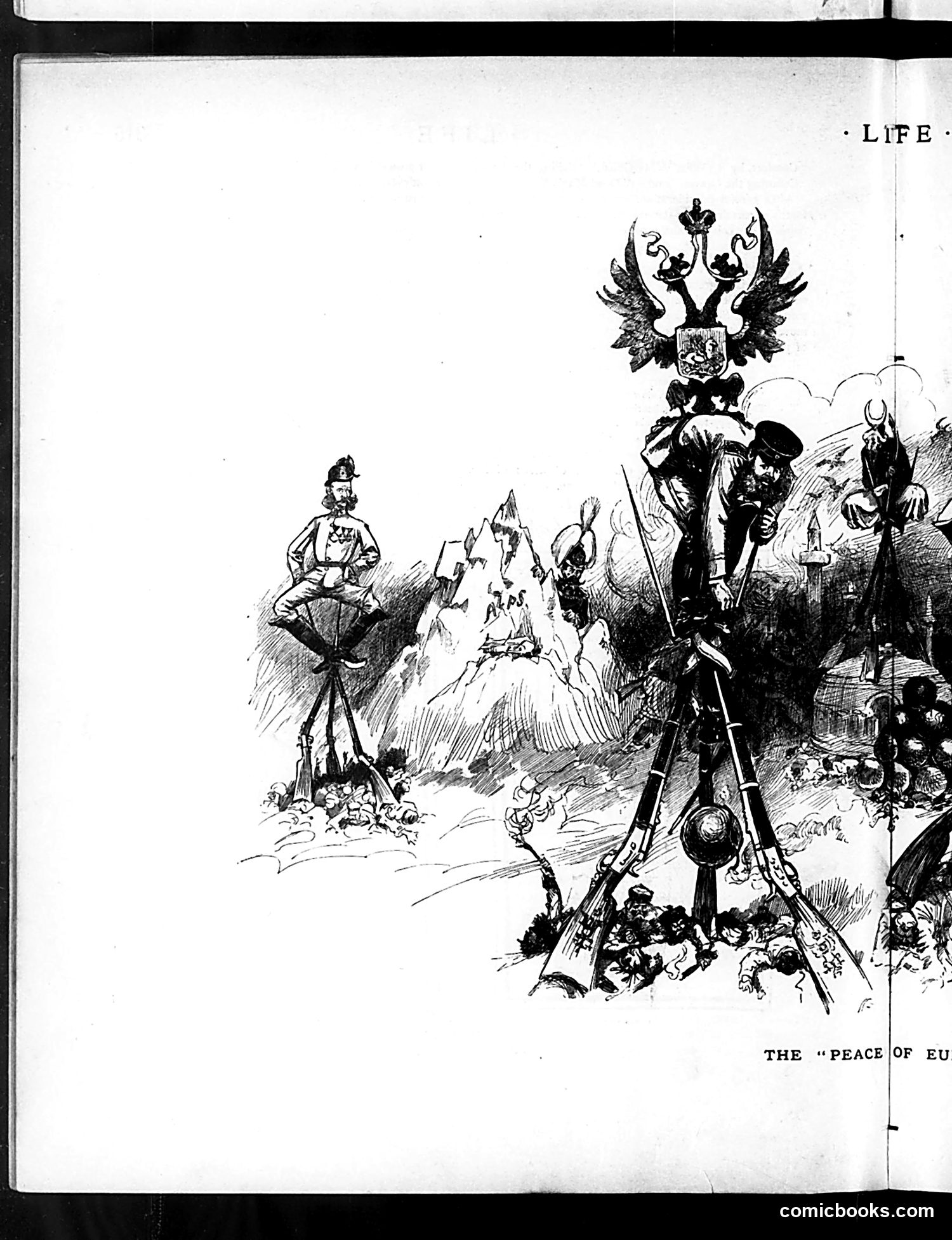
This political cartoon satirizes European diplomatic negotiations, likely from the early 20th century based on the style. The central image depicts a military officer standing atop a mountain of weapons and skulls, suggesting the destructive foundation of European "peace." Above looms a double-headed eagle emblem (the Russian imperial coat of arms), indicating Russia's central role in these negotiations. The contrast is stark: on the left, a lone military figure; on the right, multiple diplomats and political leaders conferring. The cartoon critiques how peace settlements were built on military might and past bloodshed rather than genuine conflict resolution. The title references "The Peace of Eu[rope]"—likely mocking hollow peace agreements that merely masked underlying tensions and military preparation rather than achieving lasting peace.
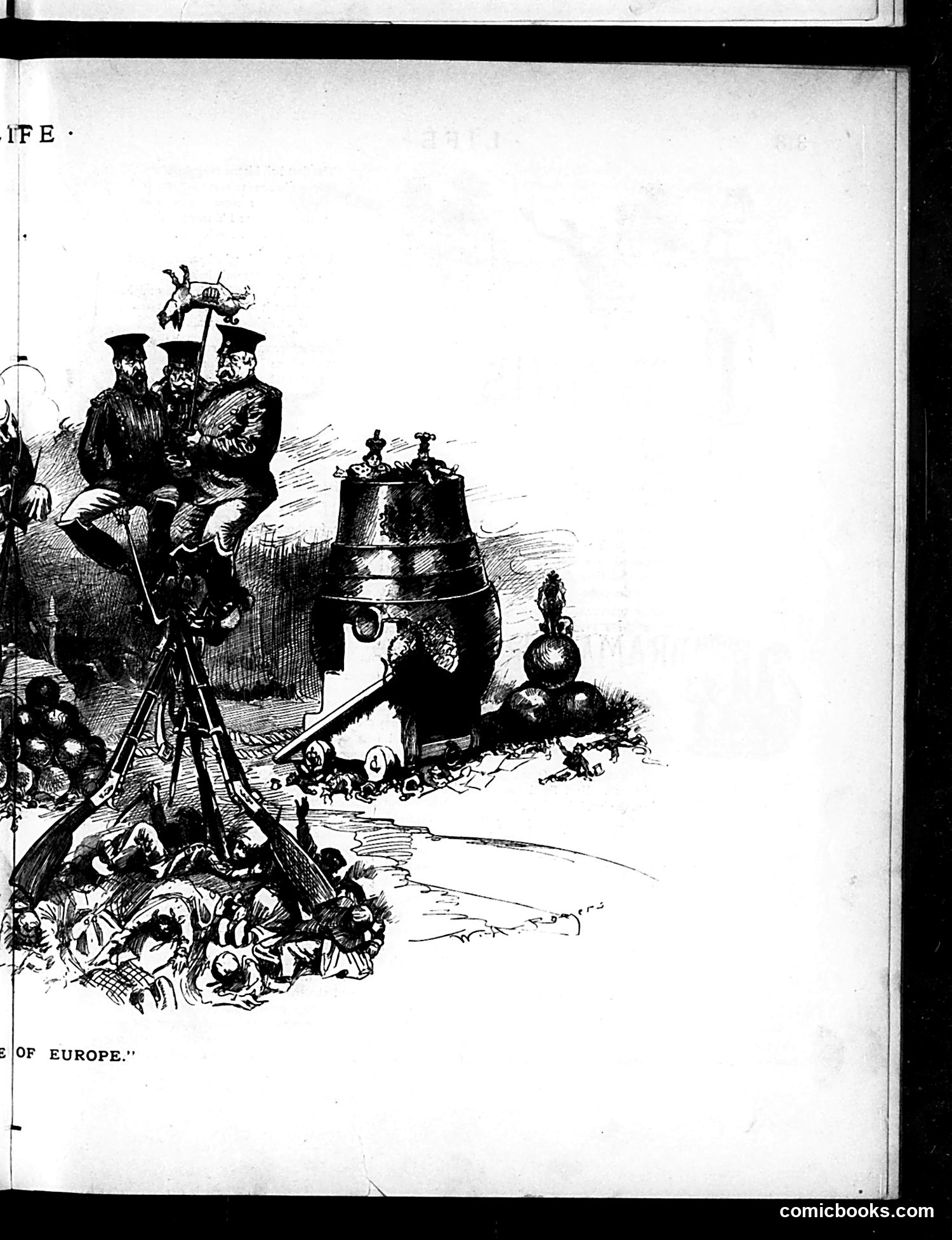
This appears to be a satirical cartoon titled "...OF EUROPE" (partial text visible). The image depicts military or political leaders sitting atop fortifications and weapons of war, surrounded by the destruction and casualties of conflict below them—bodies, wreckage, and suffering masses. The satire suggests that European military/political leaders are literally built upon and sustained by warfare and human suffering. The contrast between the comfortable, secure figures perched above and the carnage beneath them critiques how political elites profit from or remain insulated from the human cost of war. Without the full caption or publication date, the specific historical moment is unclear, but the style suggests early-to-mid 20th century commentary on European militarism and its devastating consequences.
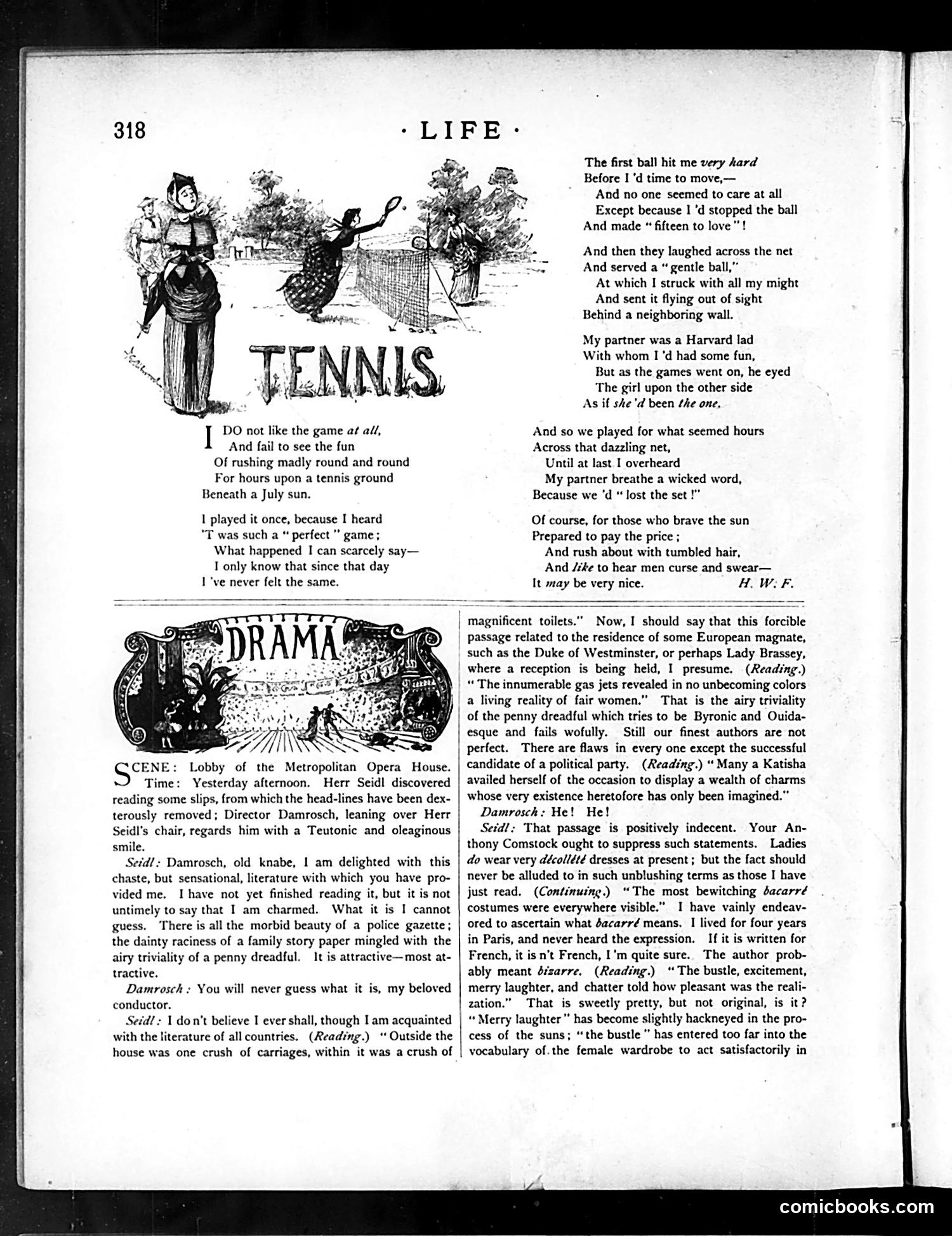
This page contains two unrelated pieces: **"Tennis"** (top): A humorous poem mocking tennis as a tedious, pointless sport. The narrator plays once and finds it exhausting and socially awkward—particularly when a Harvard-educated partner becomes distracted by a girl on the opposing team, abandoning the match focus. **"Drama"** (bottom): A satirical sketch set at the Metropolitan Opera House lobby, featuring two German conductors—Herr Seidl and Director Damrosch. Damrosch has given Seidl mysterious newspaper clippings with headlines removed. Seidl hilariously misinterprets the purple prose as either high European literature or penny-dreadful melodrama, critiquing its overwrought descriptions of women's clothing and the invented word "dacarré." The satire targets both sensationalist journalism's breathless style and authors who invent French-sounding words to seem sophisticated. Comstock references the famous anti-obscenity crusader.
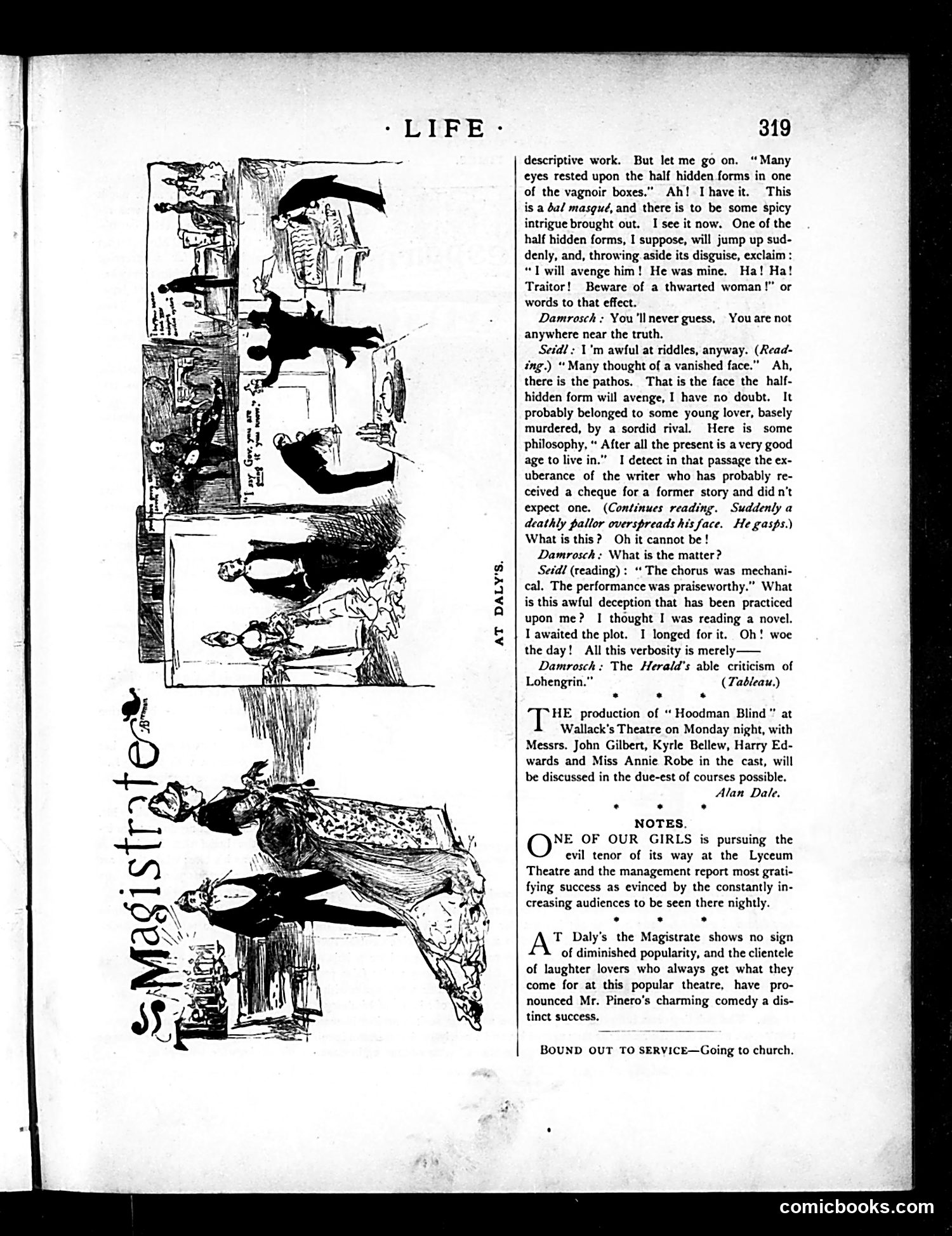
This page satirizes dramatic criticism and opera pretension through a dialogue between two figures identified as **Damrosch** and **Seidl**—likely conductor Walter Damrosch and conductor Anton Seidl, prominent New York musical figures of the era. The joke: Seidl dramatically reads what he believes is a novel, complete with melodramatic plotting (masked balls, murder, vengeance). Damrosch reveals the "twist"—it's actually a *Herald* newspaper review of the opera *Lohengrin*, not fiction. The satire mocks: - Overwrought opera/theater criticism full of purple prose - The pretentiousness of music critics who mistake verbose writing for substance - The gap between dramatic expectation and mundane reality The accompanying illustrations show theatrical scenes. The page also briefly reviews current Broadway productions ("Hoodman Blind," "One of Our Girls," "The Magistrate"). The humor relies on readers recognizing these prominent musical figures and appreciating the jab at contemporary critical writing.
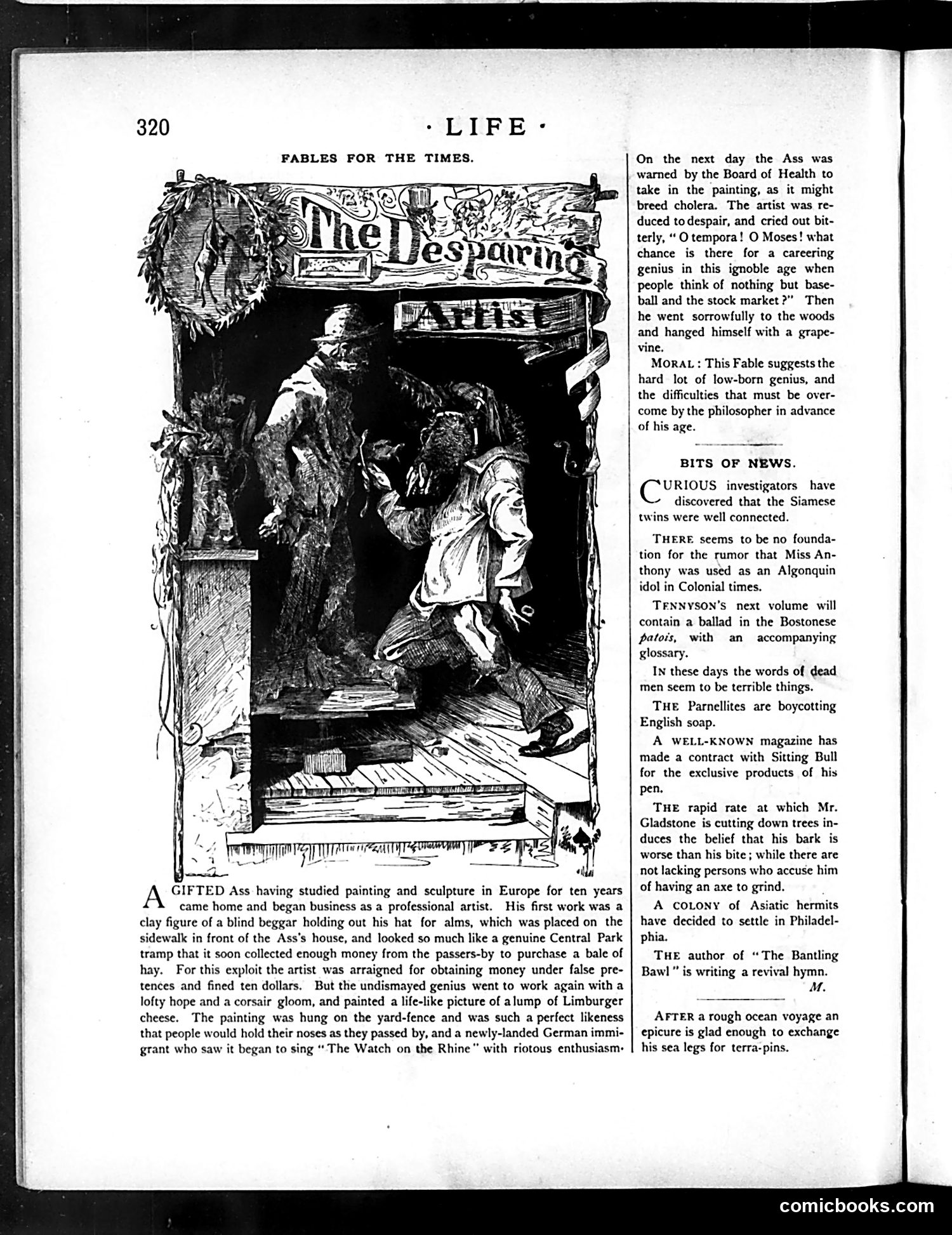
This fable mocks pretentious artists and society's indifference to "high" art. An ass (donkey, used as a figure of ridicule) creates two sculptures: a beggar figure so realistic it deceives people into giving money, and a painting of Limburger cheese so lifelike people hold their noses. The satire targets multiple targets simultaneously: the artist faces legal prosecution for his first work's success, then health department censorship for the second—suggesting authorities care nothing for artistic merit. The moral—that genius struggles in an "ignoble age" focused on "baseball and the stock market"—is itself mocked. The artist's dramatic suicide over these trivial setbacks parodies Romantic notions of tortured genius. The cartoon suggests that claims of artistic victimization ring hollow, and that artists blaming society for their failures are ridiculous. It's a jab at both pretentious artists and the sentimental cult of misunderstood genius.
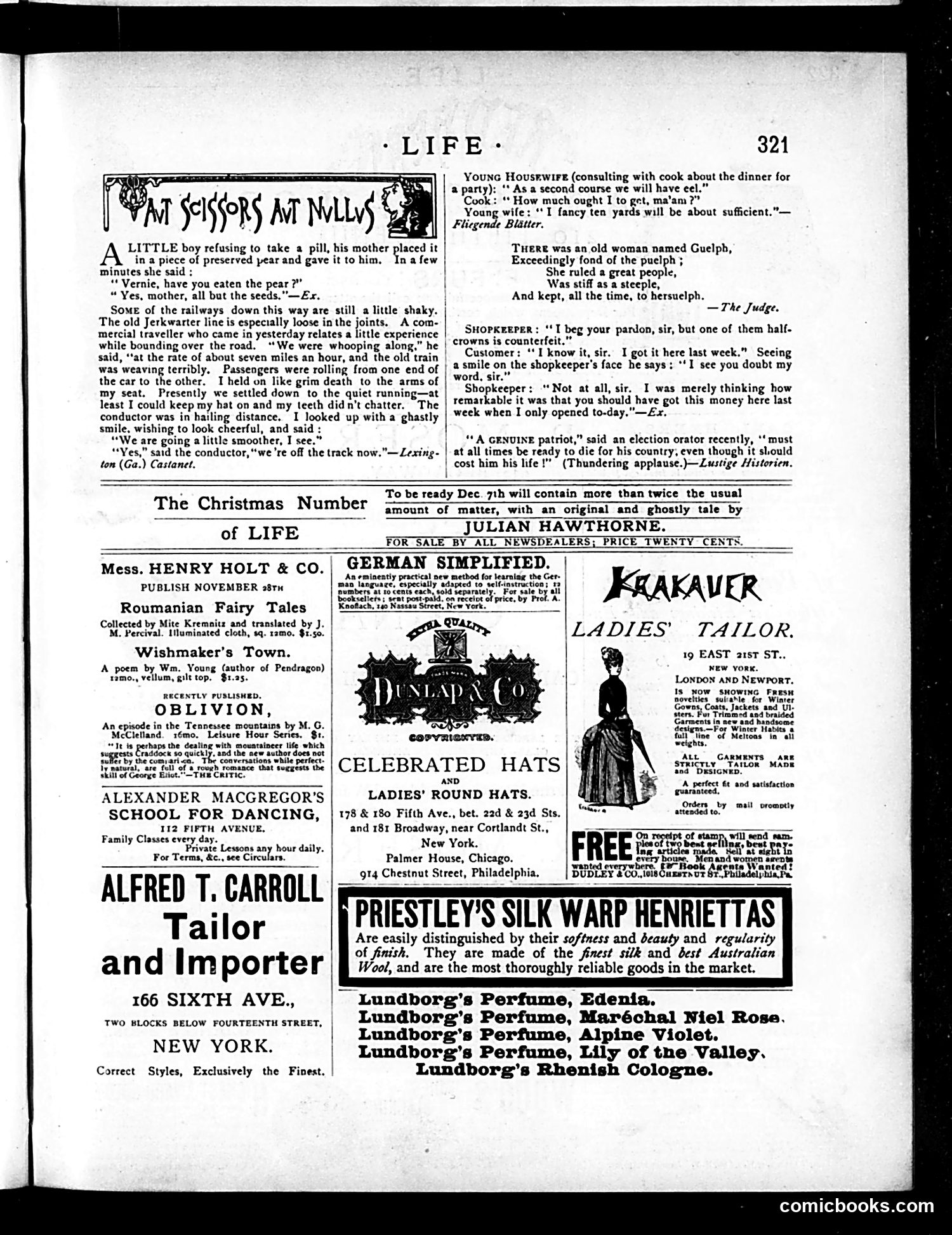
This page contains six brief humorous anecdotes typical of Life's satirical format, plus advertisements: **The Cartoons/Jokes:** 1. **The Pear & Pill**: A child refuses medicine, so mother hides it in preserved pear. Child eats the pear but leaves seeds—missing the point entirely. Simple domestic humor about childhood obedience. 2. **The Shaky Train**: A rattling rail journey becomes smoother; the conductor reveals they've derailed. The joke: comfort/safety is illusory. 3. **The Eel Recipe**: A housewife orders "ten yards" of eel for dinner—confusing measurement units. Absurdist domestic humor. 4. **The Counterfeit Coin**: A customer admits passing counterfeit money; the shopkeeper notes the shop only opened that day. The customer is caught in an obvious lie. 5. **The Old Woman Guelph**: A nonsense poem (likely about Queen Victoria, given "ruled a great people") mocking someone stiff and remote. "Guelph" is a forced rhyme. 6. **The Patriotic Orator**: A politician ironically claims patriots must die for country "even though it should cost him his life"—redundant absurdity exposing political rhetoric as empty. The page is primarily **advertising and announcements** for books, tailoring, and dancing schools.
This page is **almost entirely advertisements** with no editorial cartoons or satirical content. It's a typical back page of *Life* magazine from 1885, dominated by commercial notices for luxury goods aimed at affluent New York readers. The ads target wealthy consumers: Redfern's exclusive ladies' tailor and fur department, upscale florist Carl Beers, merchant tailors, fine china and glassware from a Carlsbad factory opening, toilet soaps and jewelry, sporting goods (guns/rifles for hunting season), and luxury items like Sultana's "imperialte" beauty tea (marketed with orientalist mystique about sultans and wrinkled faces). **No political satire or caricatures appear here.** The two small illustrated female heads flanking the Redfern's ad are simply decorative headings, not editorial commentary. This page reflects the magazine's business model: *Life* funded itself through advertising to elite readerships while publishing satire elsewhere in the magazine.
This is primarily an **advertising page** from Life magazine, not a satirical cartoon page. The page contains numerous advertisements for consumer goods and services typical of the 1880s-90s era. The most notable advertisement is **Allen's Cocaine Tablets**, prominently displayed as a remedy for "sore throat, neuralgia, nervousness, headache, colds and sleeplessness"—positioned as beneficial for "vocalists, actors and elocutionists." This reflects the **pre-regulation era** when cocaine was legally sold as a patent medicine without awareness of its addictive properties or dangers. Other ads include dress patterns, wines, floral arrangements, and a "Home Exerciser" gymnasium device. The page also advertises holiday gift books, including *Lalla Rookh* and *American Etchings*. The single illustration shows a **horse-drawn carriage or sleigh scene**, appearing to be part of Thorley's Floral Establishment advertisement. Modern readers would be struck by the casual marketing of cocaine as a legitimate therapeutic product—a striking reminder of how medical understanding and regulation have evolved.
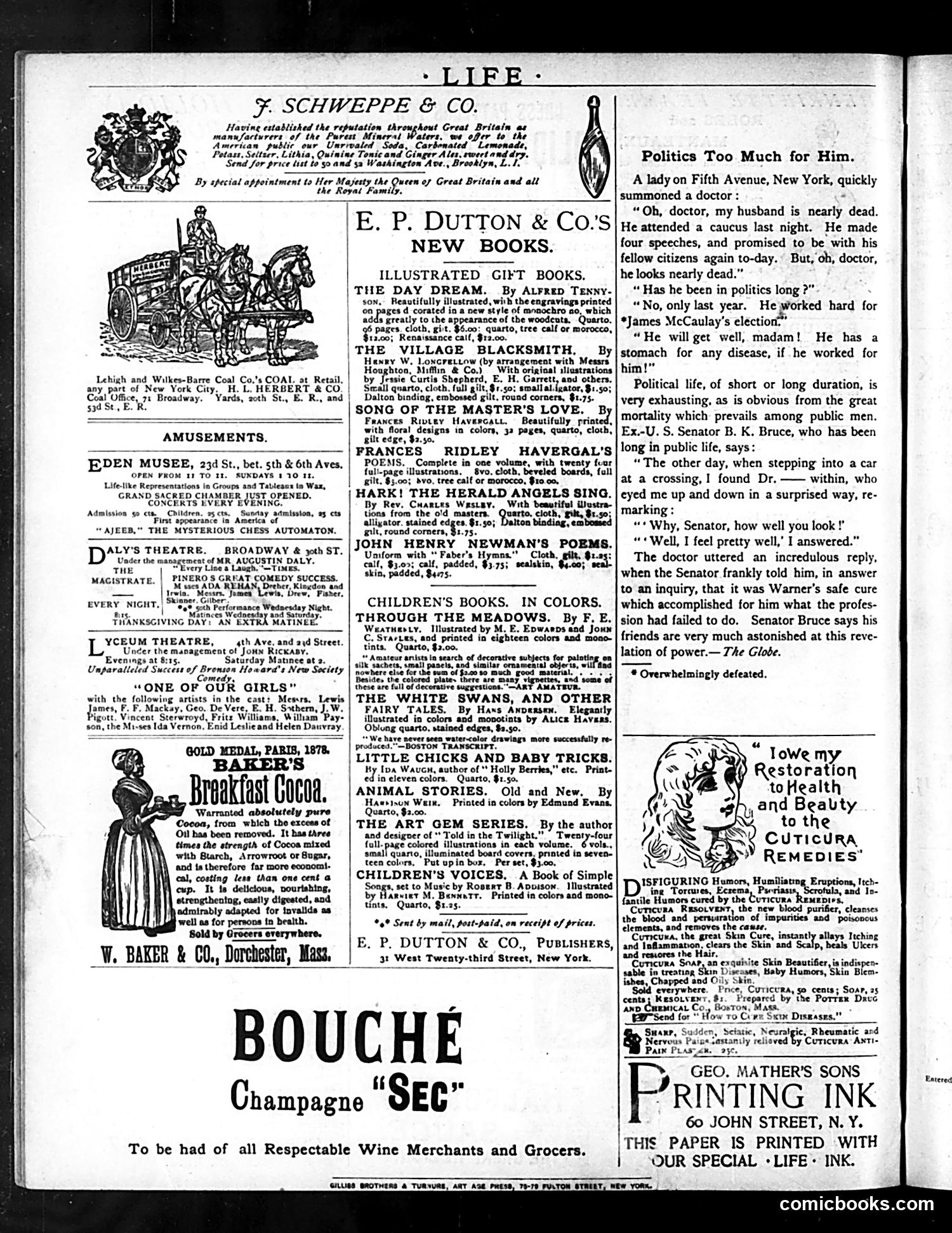
This is primarily an **advertising and announcements page** from Life magazine. The main political content appears in a single humor column titled "**Politics Too Much for Him**." The joke satirizes a newly politicized husband whose wife becomes alarmed after he attends a political caucus. When the wife claims he's "nearly dead," the implication is that political engagement has exhausted him. The humor escalates when Senator B. K. Bruce (an actual Reconstruction-era Senator, likely Black, based on historical records) encounters the husband and comments that politics is indeed very taxing, even for career politicians. The satire mocks how politics—particularly electoral participation and caucus meetings—drains men. It's a gentle jab at the intensity of late 19th-century political campaigns and the obsessive nature of political engagement, presented through the domestic anxiety of a concerned wife. The rest of the page consists of book advertisements (E.P. Dutton), theater listings, and product ads (cocoa, champagne, printing ink), typical of Life's format.