
Life, 1885-12-03 · page 6 of 16
Life — December 3, 1885 — page 6: what you’re looking at
What you’re looking at
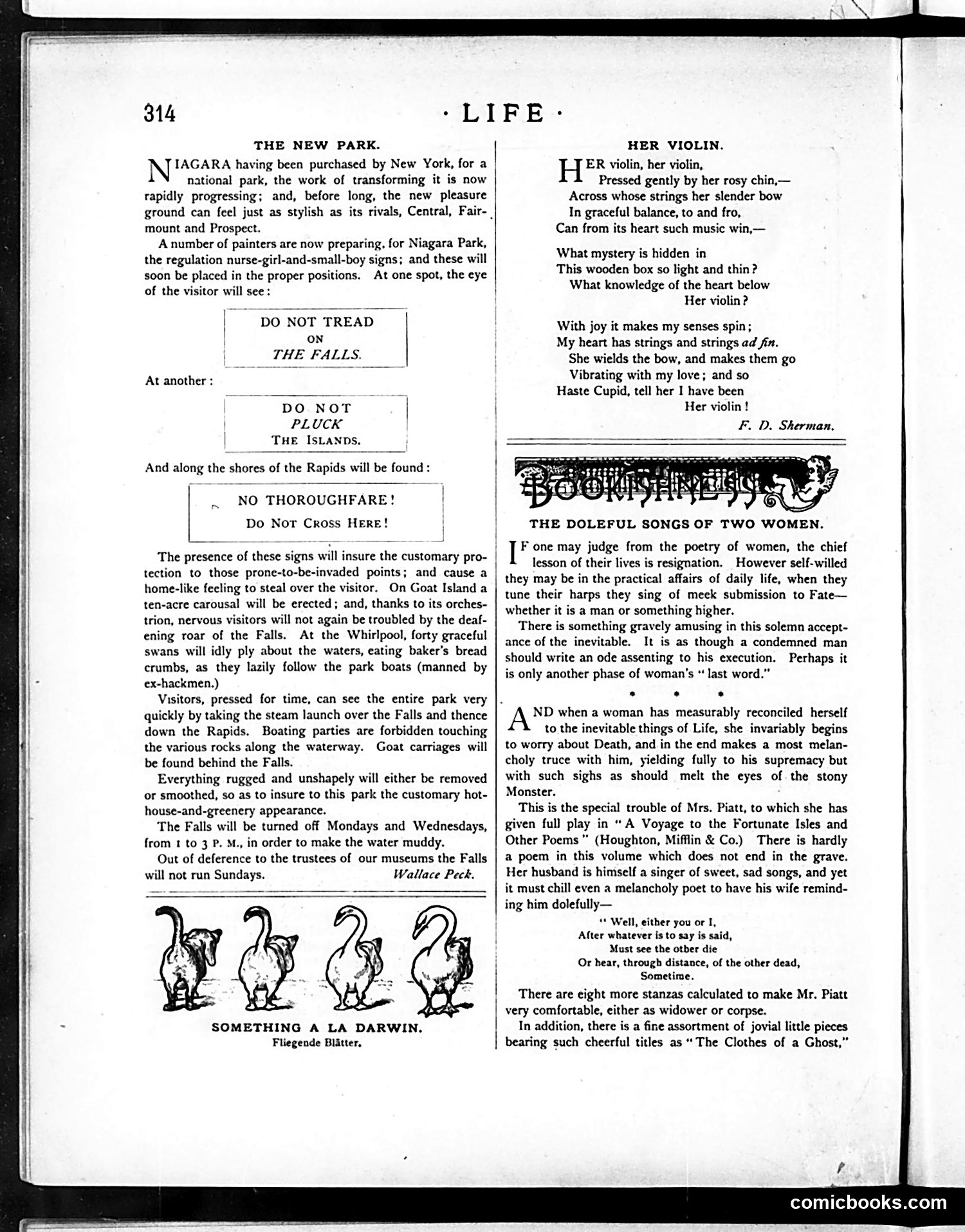
This page contains three distinct literary/artistic pieces rather than political cartoons: 1. **"The New Park"** (left column): A prose piece about Niagara Park's development, mentioning planned regulatory signs like "DO NOT TREAD ON THE FALLS" and "NO THOROUGHFARE." This appears satirical commentary on over-regulation of natural attractions. 2. **"Her Violin"** (top right): A romantic poem by F.D. Sherman about a woman playing violin, using extended metaphors about heartstrings and love. 3. **"The Doleful Songs of Two Women"** (bottom right): A literary essay discussing resigned acceptance of fate in women's poetry, specifically referencing Mrs. Piatt's work. 4. **"Something à la Darwin"** (bottom): A small illustration showing four monkeys in descending evolutionary stages—a common Victorian satirical reference to evolutionary theory. The page is primarily literary rather than politically satirical.
📄 Transcribed text from this page (OCR, searchable)
Machine-transcribed from the original scan — historical spelling and the odd misread are preserved.
- LIFE: THE NEW PARK. N IAGARA having been purchased by New York, for a national park, the work of transforming it is now rapidly progressing; and, before long, the new pleasure ground can feel just as stylish as its rivals, Central, Fair- | mount and Prospect. Anumber of painters are now preparing, for Niagara Park, the regulation nurse-girl-and-small-boy signs; and these will soon be placed in the proper positions. At one spot, the eye of the visitor will see: | Do NOT TREAD | on THE FALLS. At another : DO NOT PLUCK THE IsLANDs. And along the shores of the Rapids will be found: NO THOROUGHFARE! Do Nor Cross HERE! The presence of these signs will insure the customary pro- tection to those prone-to-be-invaded points; and cause a | home-like feeling to steal over the visitor. On Goat Island a ten-acre carousal will be erected; and, thanks to its orches- trion, nervous visitors will not again be troubled by the deaf- ening roar of the Falls. At the Whirlpool, forty graceful swans will idly ply about the waters, eating baker's bread crumbs, as they lazily follow the park boats (manned by ex-hackmen.) Visitors, pressed for time, can see the entire park very quickly by taking the steam launch over the Falls and thence down the Rapids. Boating parties are forbidden touching the various rocks along the waterway. Goat carriages will be found behind the Falls. Everything rugged and unshapely will either be removed or smoothed, so as to insure to this park the customary hot- house-and-greenery appearance. The Falls will be turned off Mondays and Wednesdays, from 1 to 3 P. M., in order to make the water muddy. Out of deference to the trustees of our museums the Falls will not run Sundays. Wallace Peck. SOMETHING A LA DARWIN. Fliegende Blitter. HER VIOLIN. ER violin, her violin, Pressed gently by her rosy chin,— Across whose strings her slender bow In graceful balance, to and fro, Can from its heart such music win,— What mystery is hidden in This wooden box so light and thin? What knowledge of the heart below Her violin? With joy it makes my senses spin; My heart has strings and strings ad fin. She wields the bow, and makes them go Vibrating with my love; and so Haste Cupid, tell her I have been Her violin! F. D. Sherman. THE DOLEFUL SONGS OF TWO WOMEN. F one may judge from the poetry of women, the chief lesson of their lives is resignation. However self-willed they may be in the practical affairs of daily life, when they tune their harps they sing of meck submission to Fate— whether it is a man or something higher. There is something gravely amusing in this solemn accept- ance of the inevitable. It is as though a condemned man should write an ode assenting to his execution. Perhaps it is only another phase of woman's “ last word.” . . * ’ Ave when a woman has measurably reconciled herself to the inevitable things of Life, she invariably begins to worry about Death, and.in the end makes a most melan- choly truce with him, yielding fully to his supremacy but with such sighs as should melt the eyes of. the stony Monster. This is the special trouble of Mrs. Piatt, to which she has given full play in “ A Voyage to the Fortunate Isles and Other Poems" (Houghton, Mifflin & Co.) There is hardly a poem in this volume which does not end in the grave. Her husband is himself a singer of sweet, sad songs, and yet it must chill even a melancholy poet to have his wife remind- ing him dolefully— “Well, either you or I, After whatever is to say is said, Must see the otber die Or hear, through distance, of the other dead, Sometime. There are eight more stanzas calculated to make Mr. Piatt very comfortable, either as widower or corpse. In addition, there is a fine assortment of jovial little pieces bearing such cheerful titles as “The Clothes of a Ghost,” comicbooks.com