
Life, 1885-12-03 · page 3 of 16
Life — December 3, 1885 — page 3: what you’re looking at
What you’re looking at
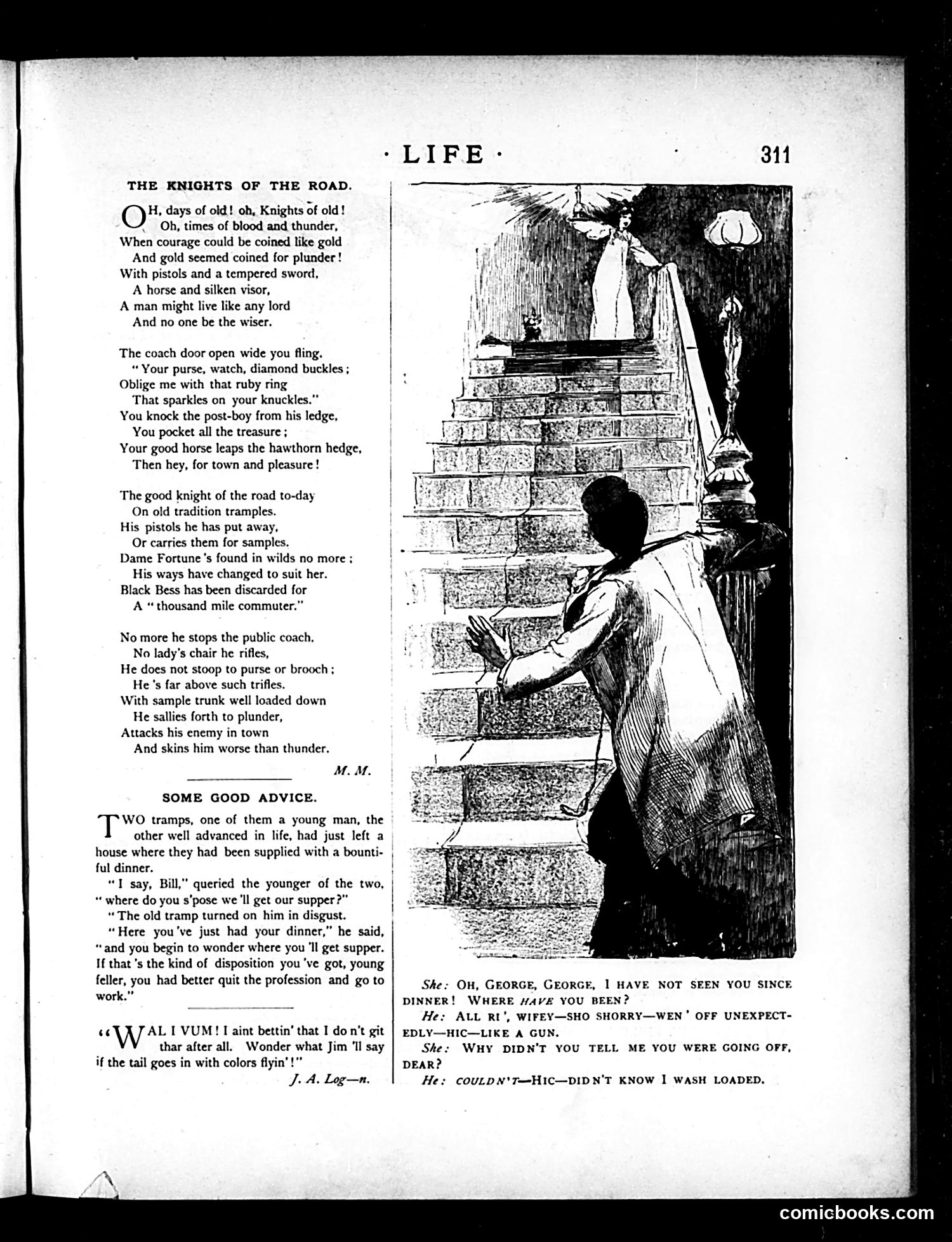
This page contains two pieces of social satire about vagrants and tramps—common figures in late 19th/early 20th-century American life. "The Knights of the Road" (poem with illustration) romanticizes highway robbers and highwaymen as outdated figures whose "ways have changed to suit her." The illustration shows a tramp on city steps, suggesting the old criminal lifestyle has devolved into urban poverty. "Some Good Advice" (below) depicts two tramps discussing survival after a meal. The older tramp advises the younger to abandon the "profession" and find legitimate work—satirizing the rationalization that vagrancy represents a "profession" rather than desperation. The dialogue's tone mocks both tramps' worldviews while commenting on contemporary poverty and homelessness as a persistent social problem.
📄 Transcribed text from this page (OCR, searchable)
Machine-transcribed from the original scan — historical spelling and the odd misread are preserved.
THE KNIGHTS OF THE ROAD. H, days of old! oh, Knights of old! Oh, times of blood and thunder, When courage could be coined like gold And gold seemed coined for plunder ! With pistols and a tempered sword, A horse and silken visor, A man might live like any lord And no one be the wiser. The coach door open wide you fling, “Your purse, watch, diamond buckles ; Oblige me with that ruby ring That sparkles on your knuckles.” You knock the post-boy from his ledge, You pocket all the treasure ; Your good horse leaps the hawthorn hedge, Then hey, for town and pleasure ! The good knight of the road to-day On old tradition tramples. His pistols he has put away, Or carries them for samples. Dame Fortune's found in wilds no more ; His ways have changed to suit her. Black Bess has been discarded for A “thousand mile commuter.” No more he stops the public coach, No lady's chair he rifles, He does not stoop to purse or brooch ; He's far above such trifles. With sample trunk well loaded down He sallies forth to plunder, Attacks his enemy in town And skins him worse than thunder. M.M. SOME GOOD ADVICE. WO tramps, one of them a young man, the other well advanced in life, had just left a house where they had been supplied with a bounti- ful dinner. “T say, Bill,” queried the younger of the two, “ where do you s'pose we ‘ll get our supper?” “The old tramp turned on him in disgust. “Here you've just had your dinner,” he said, “and you begin to wonder where you ‘Il get supper. If that’s the kind of disposition you ‘ve got, young feller, you had better quit the profession and go to work.” “cc ALI VUM! 1 aint bettin’ that I don’t git thar after all. Wonder what Jim ‘Il say if the tail goes in with colors flyin’!” J. A. Log—n. She: OH, GEORGE, GEORGE, 1 HAVE NOT SEEN YOU SINCE DINNER! WHERE HAVE YOU BEEN? He: AUL RU', WIFEY—SHO SHORRY—WEN ' OFF UNEXPECT- EDLY—HIC—LIKE A GUN. She: WHY DIDN'T YOU TELL DEAR? He: COULDN'T—HIC—DIDN'T KNOW I WASH LOADED. ME YOU WERE GOING OFF, comicbooks.com