
A complete issue · 16 pages · 1885
Life — October 29, 1885
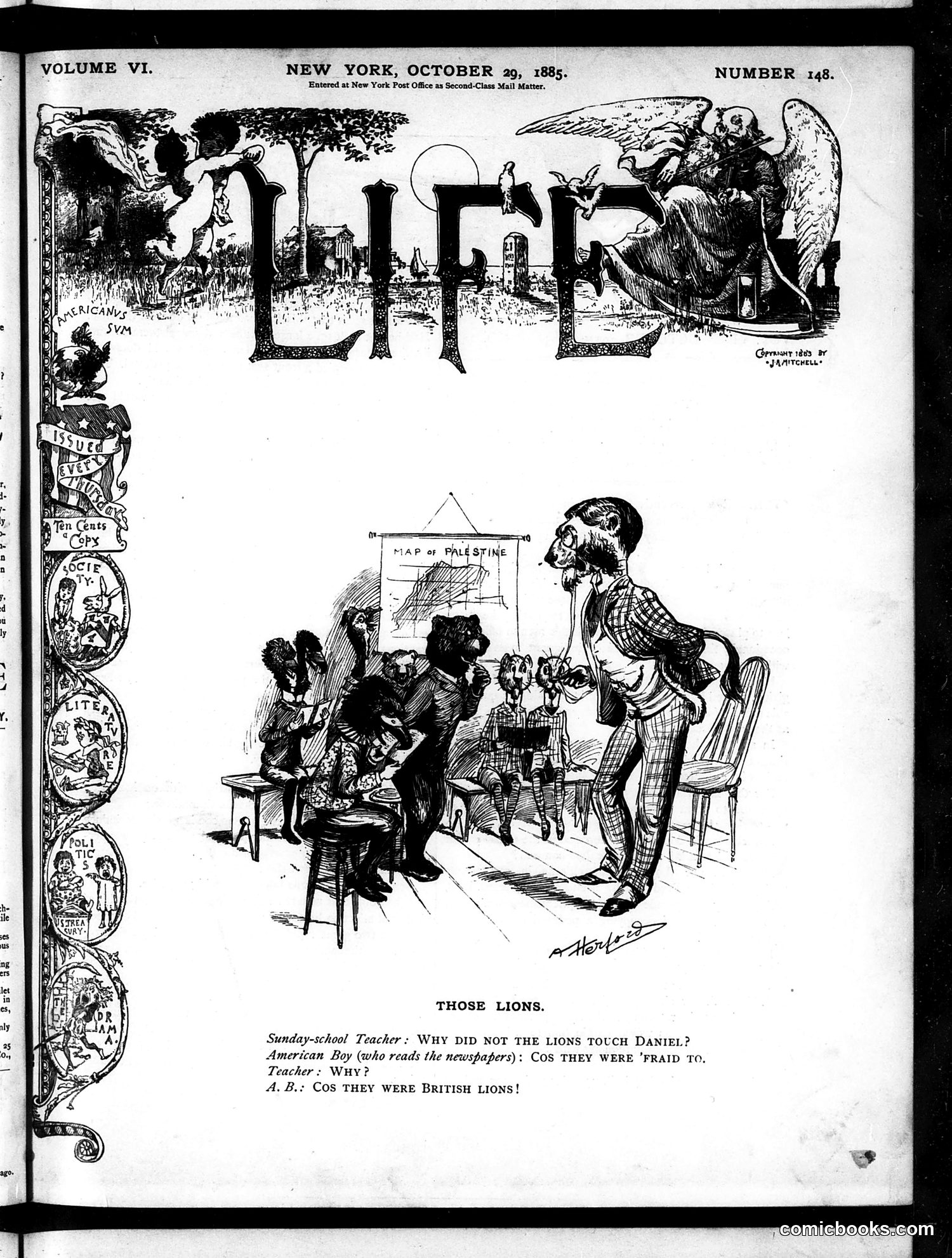
This satirical cartoon from *Life* magazine (October 29, 1885) makes a joke about British imperial power using the biblical story of Daniel in the lion's den. The setup presents a Sunday-school teacher asking an American boy why the lions didn't touch Daniel. The boy, who reads newspapers, answers that the lions were "afraid to"—because they were **British lions**. The joke satirizes British military and political dominance during this era. By equating British power with dangerous lions, the cartoon suggests Britain's imperial strength made other nations reluctant to confront it. The American boy's newspaper-reading knowledge drives the humor, implying that British dominance was so obvious even children reading current events understood it.
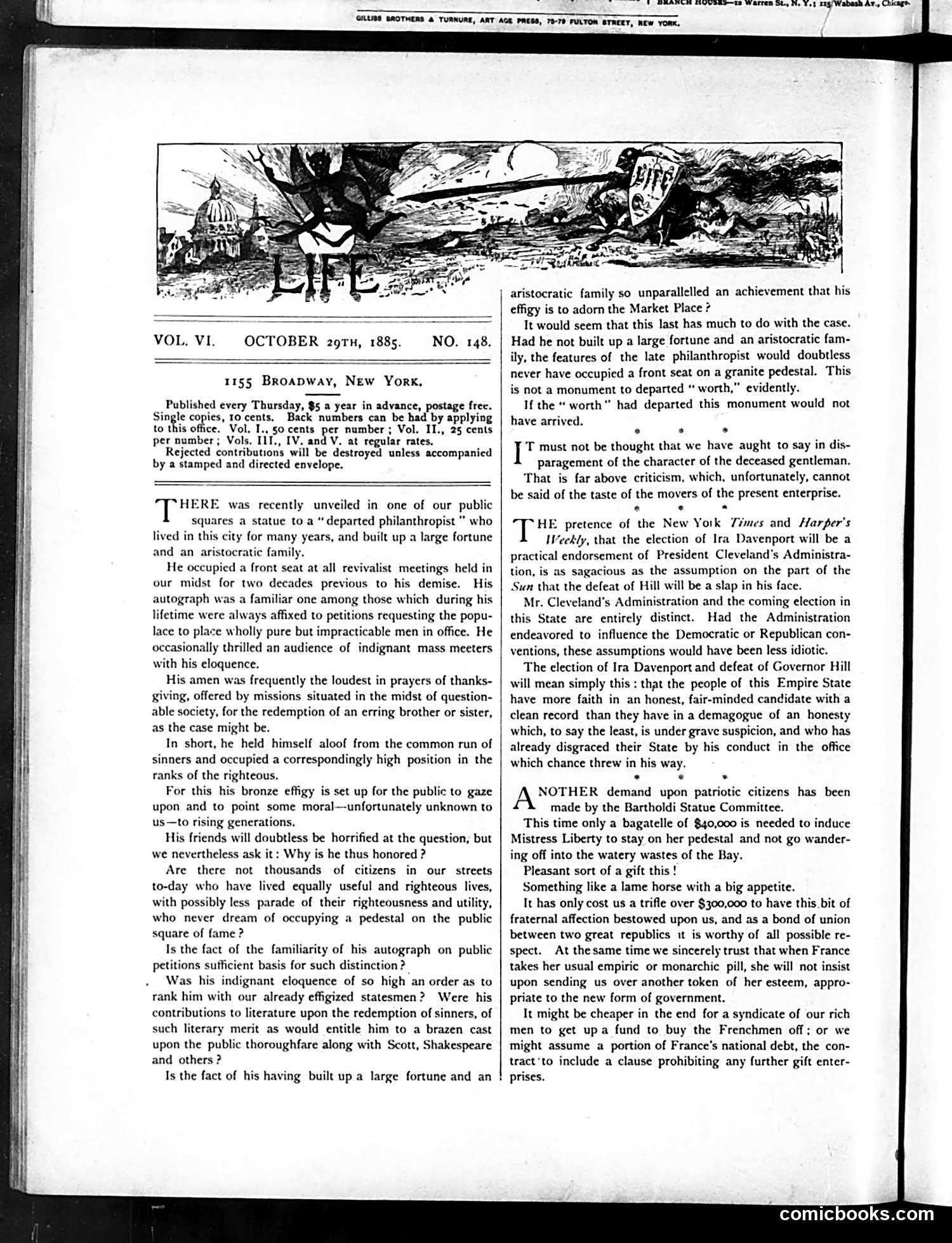
The page's masthead illustration depicts a landscape with "LIFE" prominently displayed, suggesting the magazine's satirical mission. The text criticizes an unnamed wealthy man who recently erected a public monument—likely a statue—celebrating himself. The author mocks this as vulgar self-aggrandizement, questioning whether his fortune and "aristocratic family" warrant such public honor. The piece suggests his supposed moral virtue (piety, charity work) doesn't justify a "pedestal of fame." The text then shifts to contemporary politics, dismissing predictions that Democratic candidate Ira Davenport's election would embarrass President Cleveland's administration. It argues New York voters trust Davenport's honesty over his opponent's record. Finally, it satirizes a fundraising effort seeking $40,000 to prevent the Statue of Liberty from being moved, calling this an excessive expense for such a symbolic gesture.
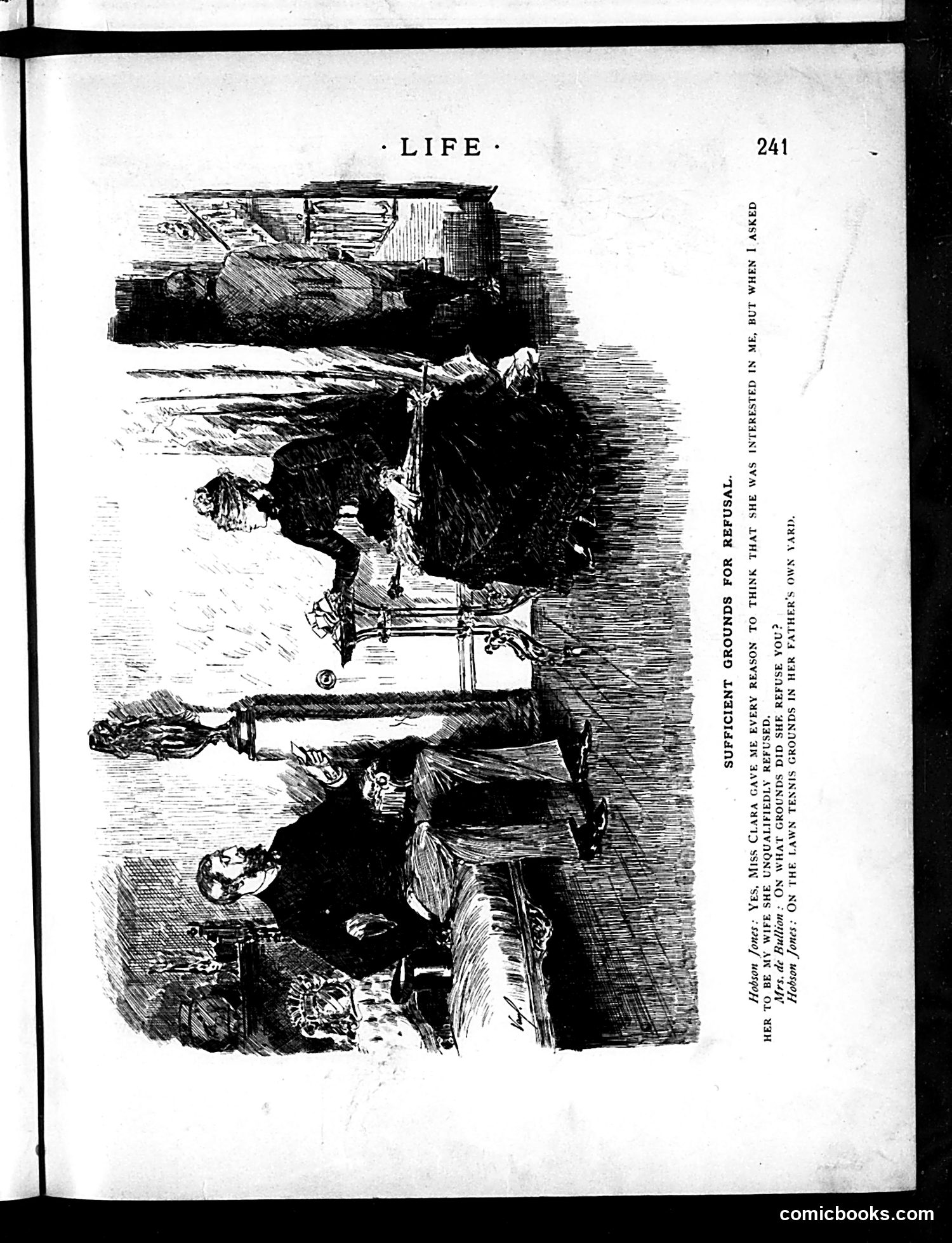
This page from Life magazine (page 241) presents a sketch titled "Sufficient Grounds for Reversal." The caption reads: "Here's how Mrs. Clara gave every reason to think his she was interested in he but when she discovered he'd rather reverse herself, Fisher here on the lawn seeing his father's own yard." The sketch depicts what appears to be a domestic scene with two figures and possibly a third. However, the OCR text is heavily corrupted and difficult to parse with confidence. The satirical point seems to involve romantic or marital misunderstanding—likely poking fun at courtship dynamics or a woman's changing interest based on discovering something unflattering about a suitor. Without clearer text or identification of "Mrs. Clara" and the male figure, the specific historical reference remains unclear. The "reversal" likely contains the joke's punchline.
The page presents satirical commentary on current events rather than visual cartoons. The header illustration shows silhouetted animals in a procession. Key targets include: - **Stedman and Rollin Milton Squire**: References "professional jealousy" causing Squire's omission from "Poets of America" - **General Carr**: Criticized for inability to control "traitors" governing the country - **Gen. Hazen's war book**: Predicted to receive harsh reception due to unreliability - **Prince Bismarck**: Warned that Levy the cornetist will prove a worthy rival - **"Johnny" Davenport**: Mocked as an unsuitable gubernatorial candidate despite national notoriety - **U.S. Navy ships**: References converting *Priscilla* and *Puritan* to swift cruisers - **Prince of Wales**: Suspicious announcement about his colonelcy suggests Kentucky "blood" (heritage) concerns The satire employs gossip-column style commentary on American political and cultural figures.
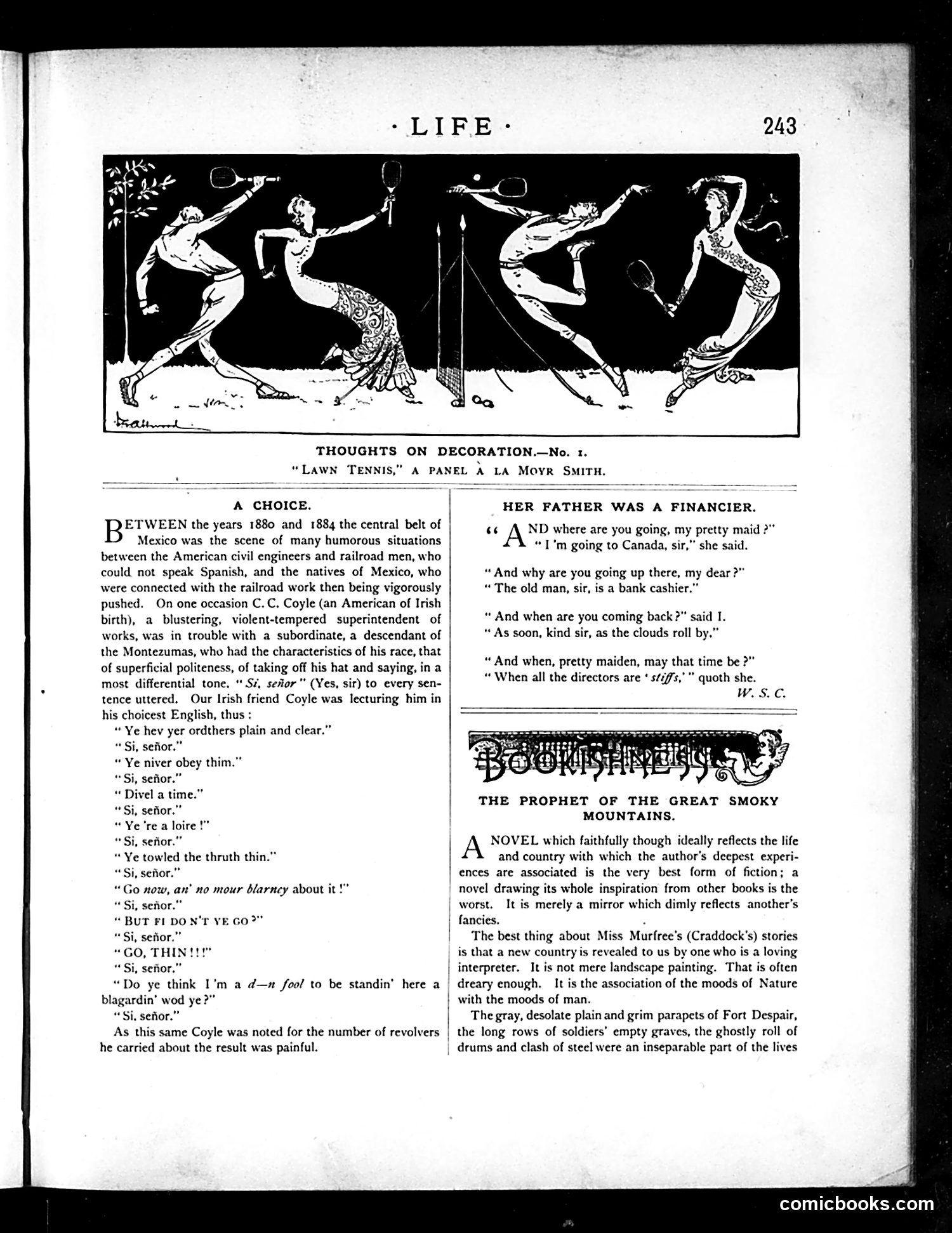
**The Cartoon ("Thoughts on Decoration - No. 1: 'Lawn Tennis'")** This illustration by K. Moyr Smith depicts five figures playing lawn tennis in exaggerated, dynamic poses. The satire appears to target the absurdity of athletic fashion and form rather than any specific political figure. The stylized, contorted bodies mock both the pretensions of "proper" sporting behavior and perhaps the growing trend of women's participation in athletics during this era—a socially controversial topic. **Text Content** The page includes anecdotal humor about a Mexican railroad superintendent and a brief literary review of "The Prophet of the Great Smoky Mountains." These appear to be typical magazine filler rather than political commentary, reflecting Life's mix of social satire, humor, and book reviews.
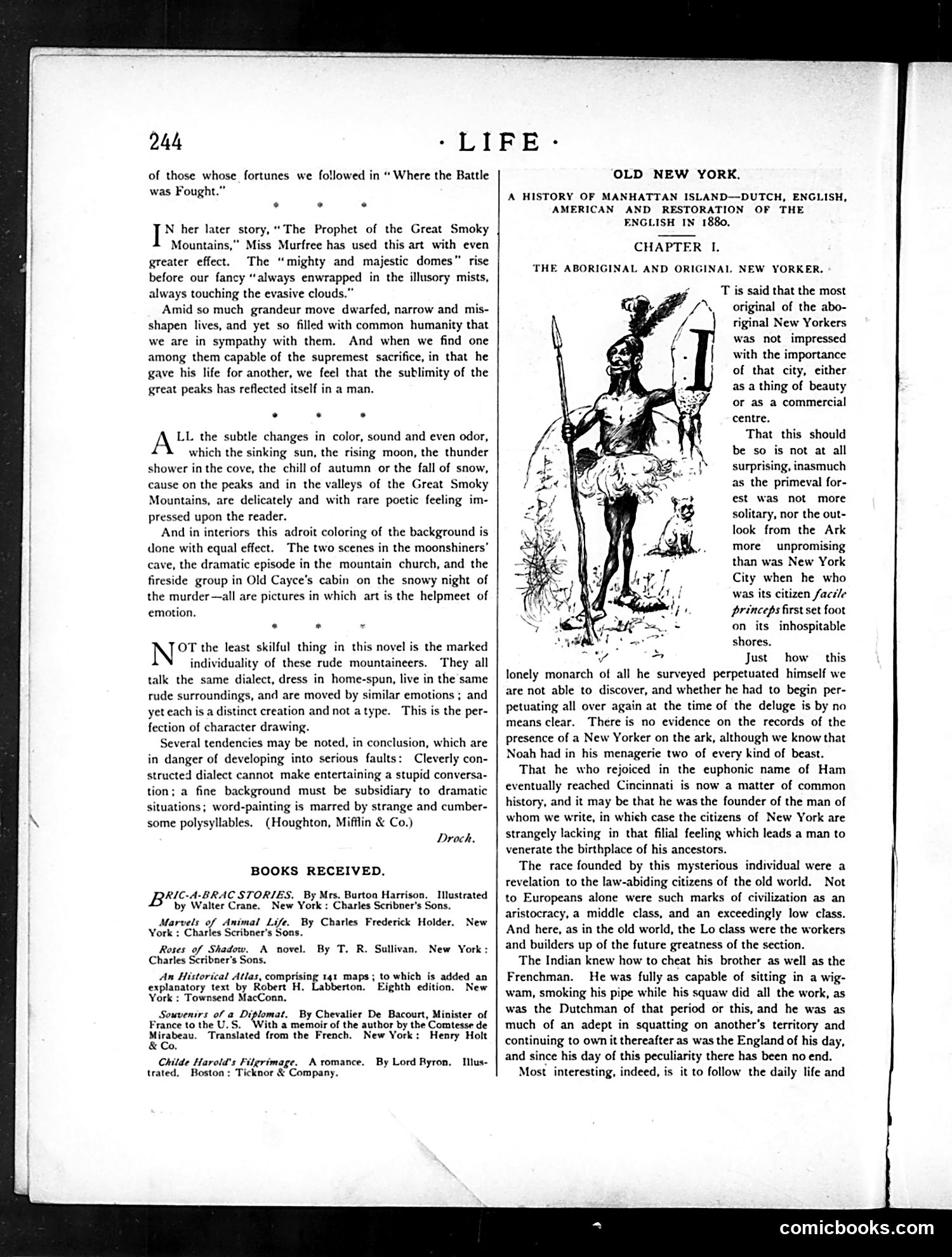
This page features a literary critique and historical essay rather than political satire. The illustration depicts an Indigenous figure—described in the text as "the aboriginal and original new Yorker"—standing with a shield and spear, likely representing a Native American who inhabited Manhattan before European settlement. The accompanying text argues that the original New York inhabitants showed little regard for the land as a commercial center or aesthetic treasure. The essay traces how subsequent populations—Dutch, English, and Americans—shaped the city's character. The piece appears to be part of a larger historical series examining Manhattan's transformation, with the native figure serving as a symbolic starting point for discussing the island's colonial and commercial development.
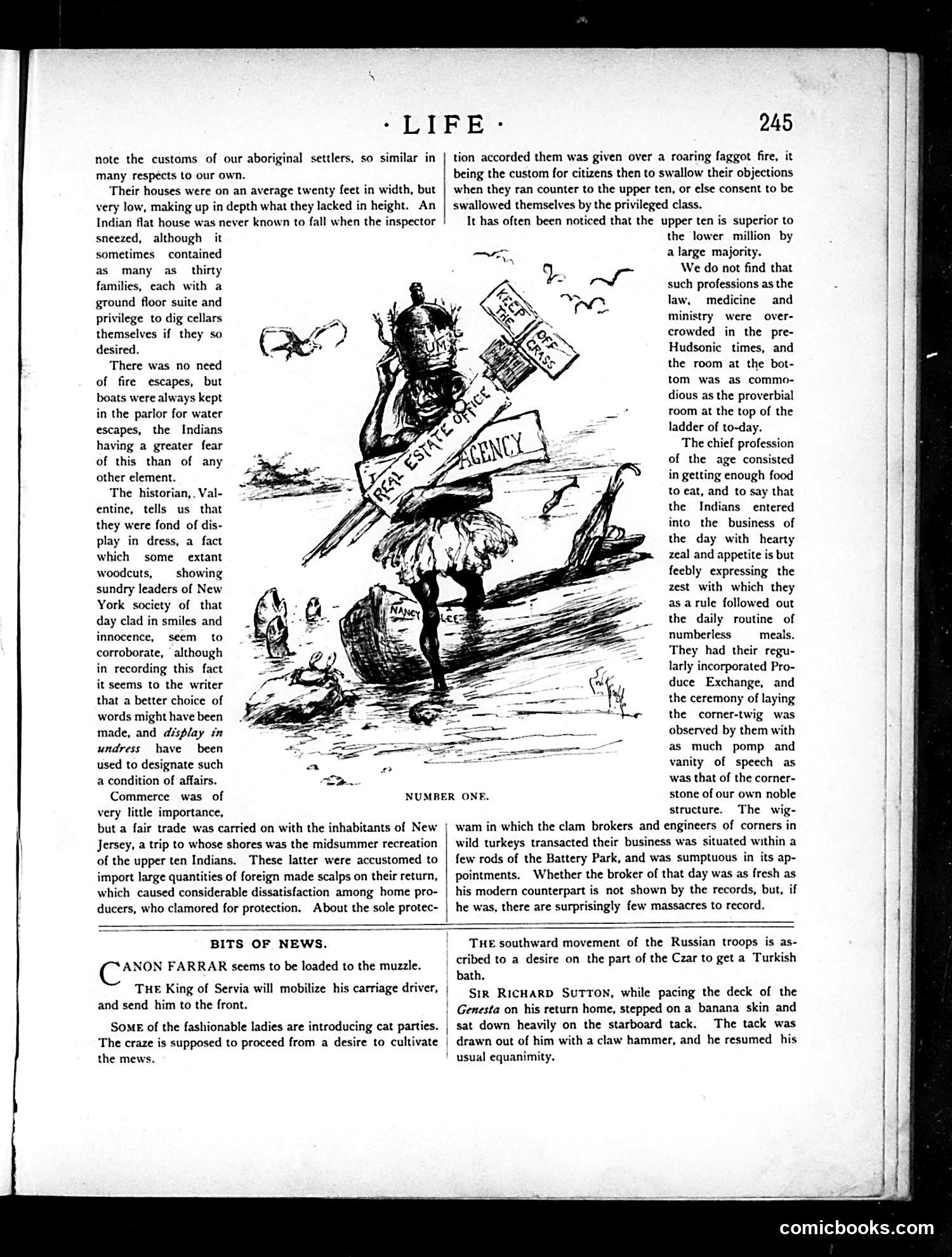
This cartoon satirizes **real estate speculation and financial excess** in what appears to be **early 20th-century New York City**. The central figure—a bloated, money-laden businessman weighted down by signs reading "REAL ESTATE AGENCY" and carrying property deeds—represents the speculative real estate broker or developer. He's depicted as literally collapsing under the burden of accumulated wealth and transactions, a visual metaphor for the unsustainable bubble of property speculation. The cartoonist mocks how real estate dealers had grown grotesquely fat on rapid urban development and speculation, particularly concerning land near lower Manhattan (Battery Park area is mentioned in the text). The satire suggests these speculators were simultaneously greedy and unstable—their fortunes built on inflated values rather than genuine worth.
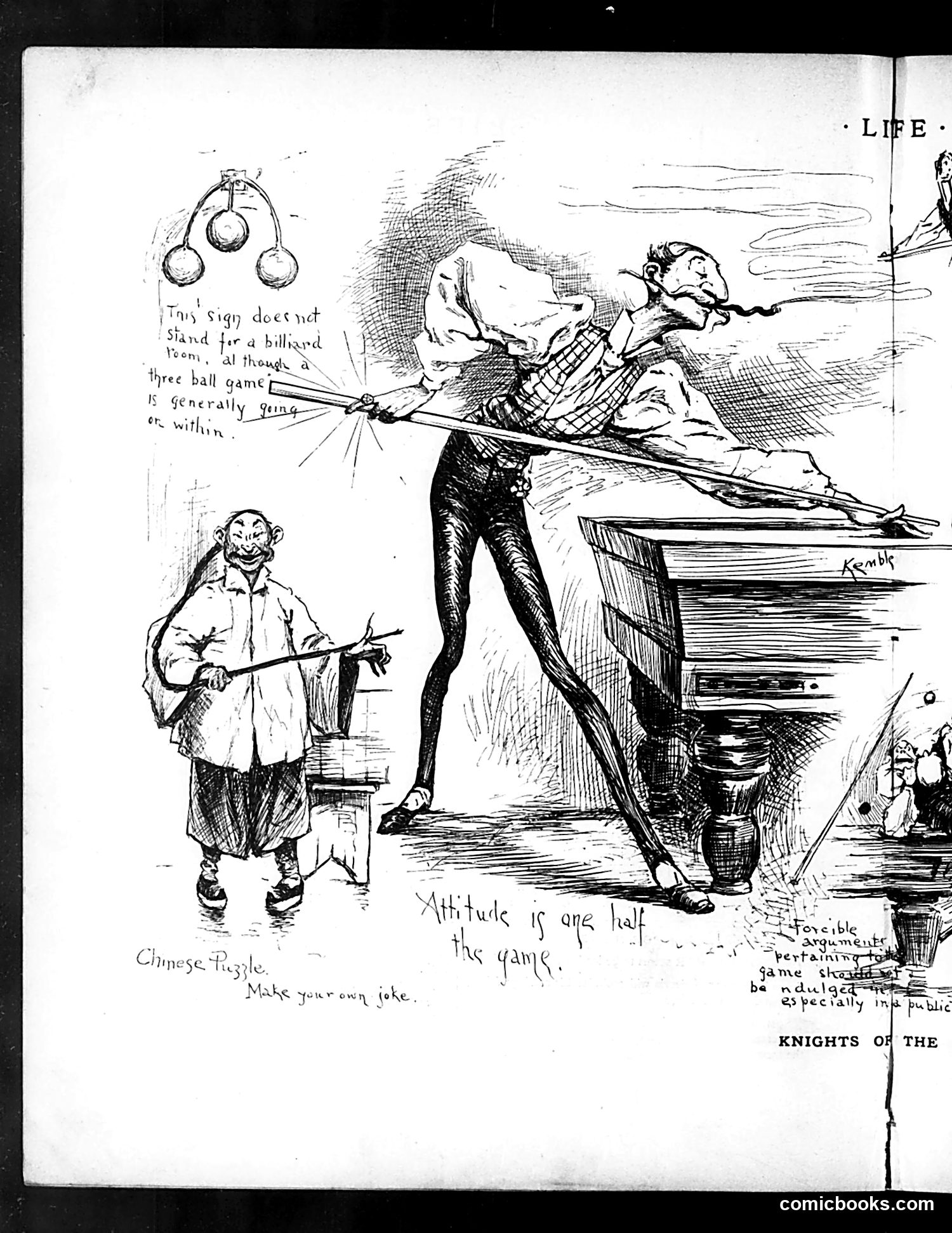
This page contains three separate satirical illustrations about games and leisure: 1. **Top illustration**: Shows a tall, thin man fishing with a three-ball billiard/pool sign overhead. Text explains the sign "does not stand for a billiard item, though a three ball game is generally going on within"—likely mocking someone's dishonest or fraudulent activities disguised as legitimate recreation. 2. **Bottom left**: Labeled "Chinese Puzzle. Make your own joke"—a caricatured Asian figure, reflecting period xenophobia common to early 20th-century American satire. 3. **Center**: A tall, lanky man with exaggerated features plays a game of attitude. The caption "Attitude is one half the game" suggests satire about pretension or affectation in sports or social competition. The cartoons appear to critique various forms of deception, social attitudes, and gaming culture of the era.
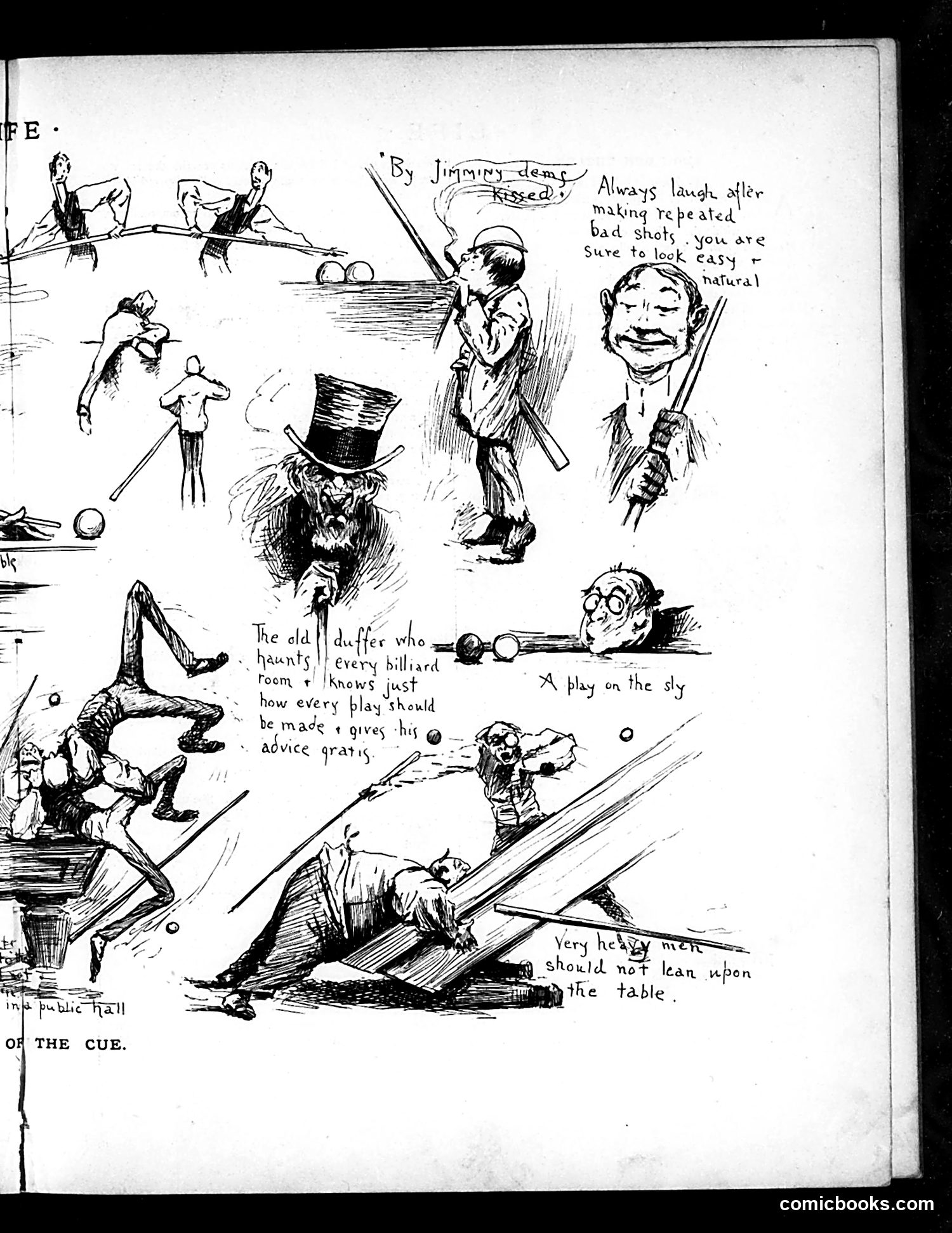
This page offers humorous sketches about billiards (pool) etiquette and technique. The cartoons depict various characters offering unsolicited advice to players: - "By Jimmy dens kissed" advises always laughing after bad shots to appear natural and skilled - A character in a top hat represents "the old duffer who haunts every billiards room" and offers free advice on how every shot should be made - The caption "A play on the sly" appears to reference sneaky or underhanded moves - The final note warns that "very heavy men should not lean upon the table" The humor satirizes the stereotype of know-it-all billiards hall regulars who freely dispense unwanted commentary and instruction to actual players, a common social irritant of the era.
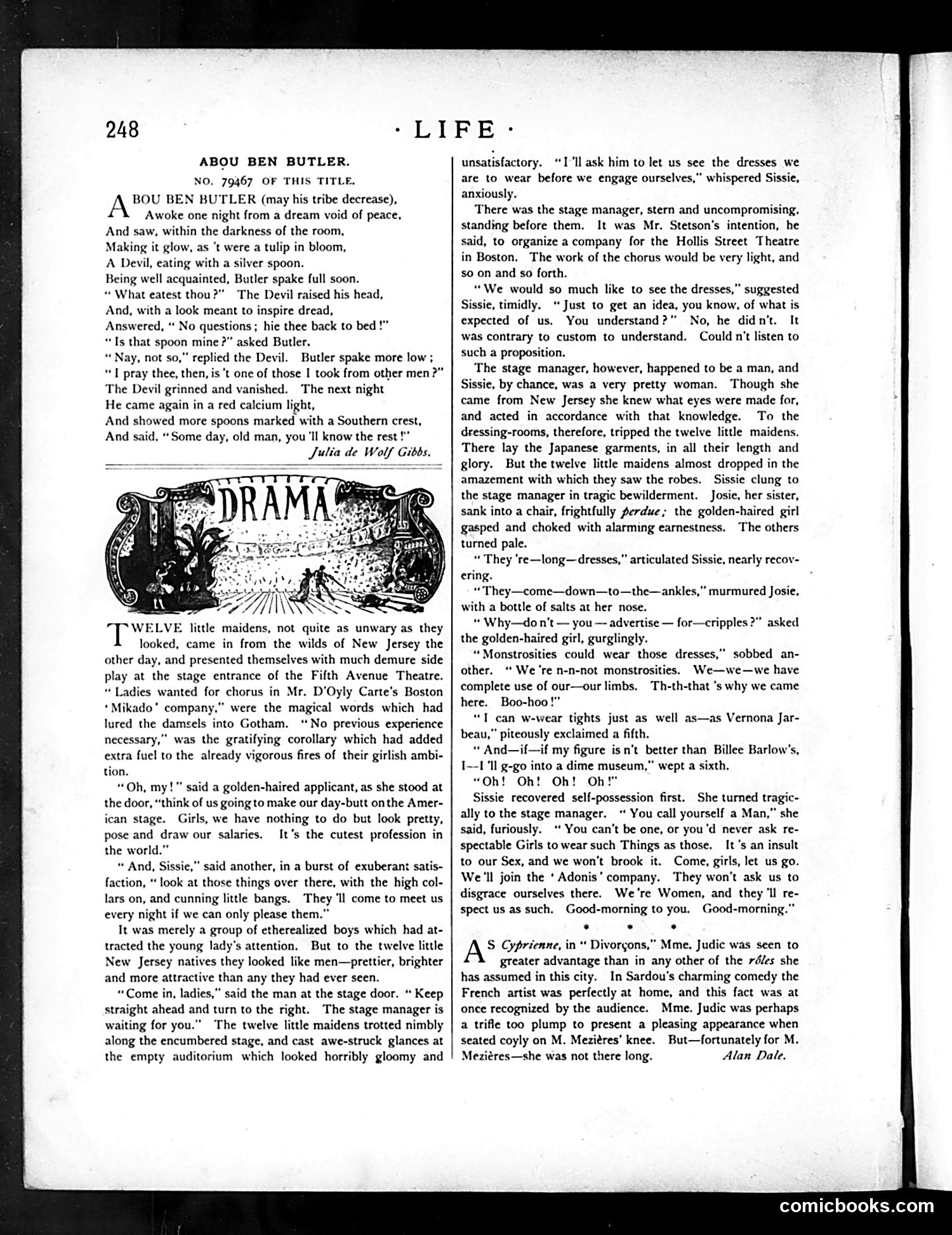
This page contains two pieces of social satire from *Life* magazine: **"Abou Ben Butler"** (top): A poem mocking General Benjamin Butler, a controversial Civil War figure and Reconstruction politician. The satire suggests Butler accumulated wealth through questionable means—the devil shows him stolen "spoons" (valuables) marked with "Southern crests," implying Butler plundered the South. Butler was historically accused of corruption and theft during his military governorship of New Orleans. **"The Twelve Little Maidens"** (bottom): A humorous story satirizing naive young women from New Jersey auditioning for a Boston theater production. The joke centers on their shock upon discovering Japanese kimonos for the chorus—apparently scandalously short or revealing by Victorian standards. The satire mocks both the girls' innocence and the theater industry's exploitative practices. Both pieces use comedy to critique contemporary figures and social practices of the era.
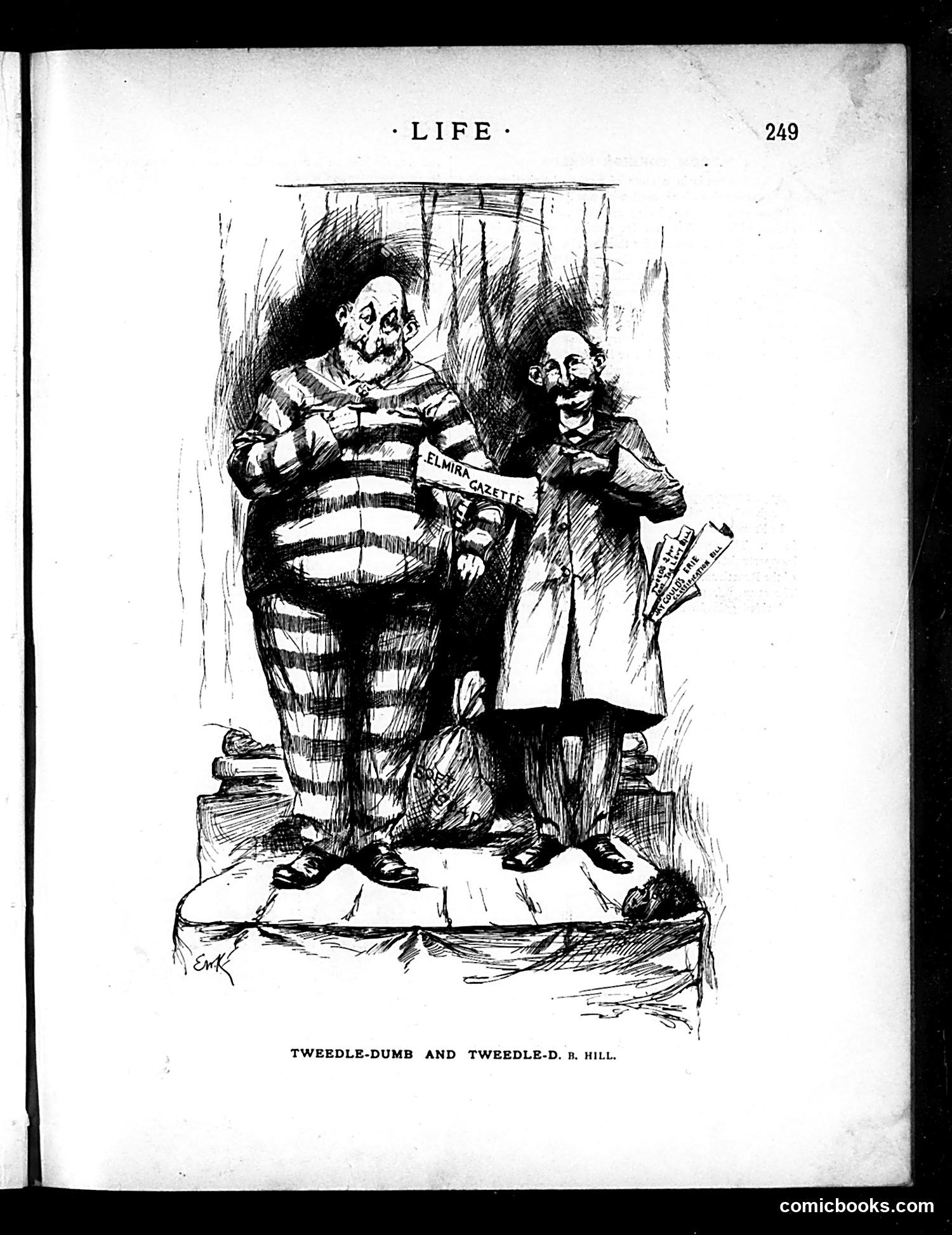
This cartoon satirizes two political figures using the "Tweedledee and Tweedledee" reference—a literary allusion to indistinguishable twins who are essentially identical. The caption identifies one as "D. B. Hill" (likely David B. Hill, a prominent 19th-century New York politician). The central figure, depicted as portly and barrel-chested, wears a sash labeled "ELMIRA GAZETTE," suggesting a connection to local journalism or political machinery. The second figure, dressed formally on the right, holds what appears to be political documents or publications. The satire suggests these two politicians are interchangeable or duplicitous—offering no real distinction between them despite their different appearances. The exaggerated caricatures and satirical framing mock their political posturing or hypocrisy, typical of *Life* magazine's sharp editorial commentary on American politics.
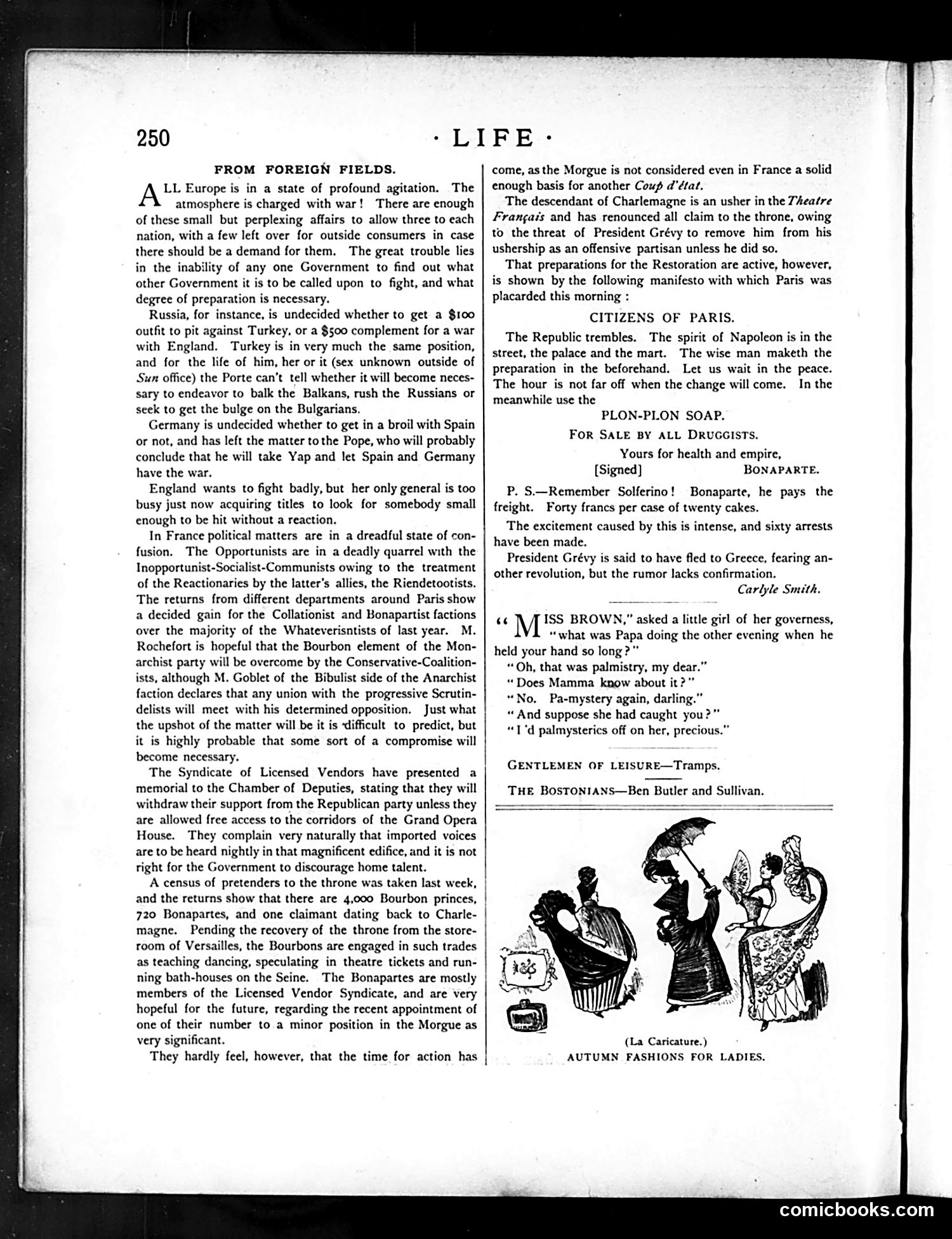
This is satirical commentary on chaotic European geopolitics. The piece mocks the uncertainty plaguing major powers—Russia and Turkey can't decide whom to fight; Germany defers to the Pope on Spanish conflicts; England lacks generals willing to engage anyone. The French section parodies actual political factionalism through invented party names ("Inopportunist-Socialist-Communists," "Riendetootists"), skewering the fractious nature of French politics. Most absurdly, the text catalogs French throne pretenders: 4,000 Bourbon princes now work as dance instructors and bath-house operators; Bonapartes hope their colleague's morgue appointment signals restoration prospects; Charlemagne's descendant works as a theatre usher and abandoned his claim to avoid dismissal. The satire's point: European politics is so dysfunctional and claims to power so devalued that former royalty accept menial employment. No serious restoration is possible when the throne sits neglected in a Versailles storeroom.
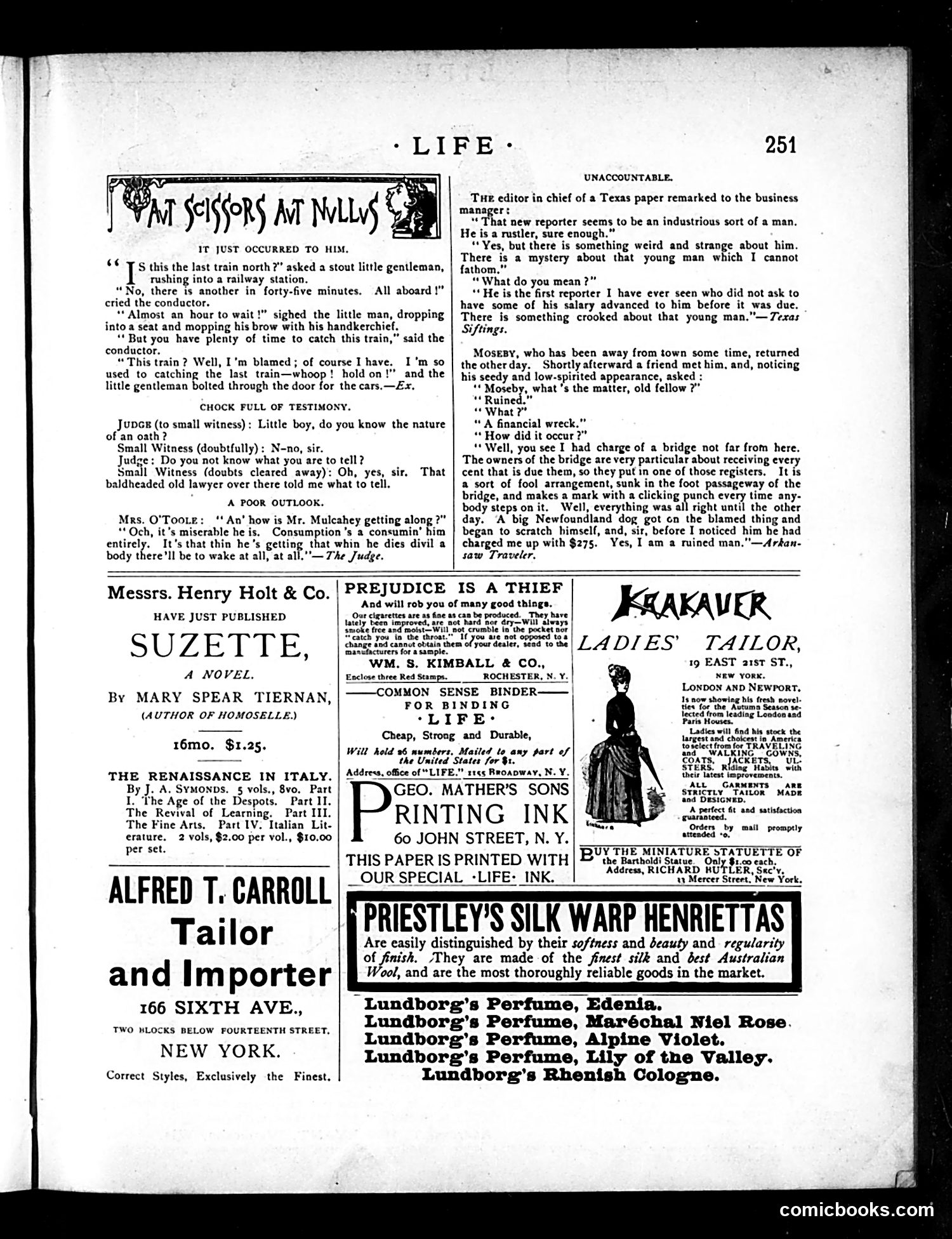
This page is primarily **advertisements and short humorous anecdotes** rather than political cartoons. The content includes: **Main Humor Pieces:** - "It Just Occurred to Him": A man rushes to catch what he thinks is the last train, unaware another departs in 45 minutes—satire on absent-mindedness. - "Unaccountable": A Texas newspaper editor finds a reporter suspicious because he *doesn't* ask for advance salary—unusual enough to seem dishonest. - "Chock Full of Testimony": A judge questions a child witness about oaths; the child learned about them from a "baldheaded old lawyer." - "A Poor Outlook": A man's financial ruin traced to a dog triggering a footbridge toll-counter 275 times. These are **gentle satires** on bureaucratic absurdity, human nature, and journalistic culture—typical of Life's humor style. There are no identified political figures or events; the satire is social and observational rather than topical.
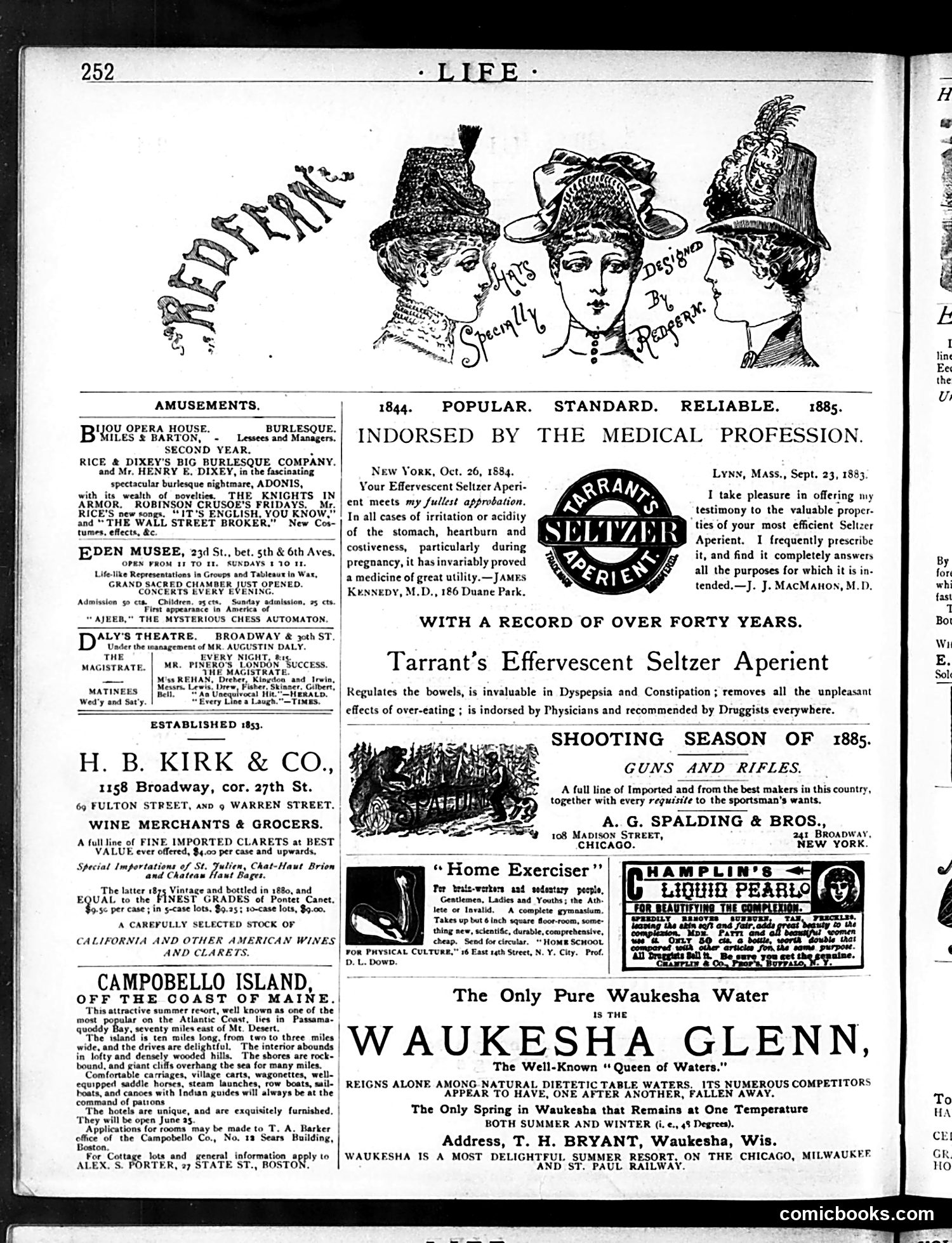
This page is primarily **advertising and entertainment listings**, not political satire. The top features fashion illustrations of women's hats labeled "Reliable" and other style terms—typical 1880s millinery advertisements. The main content includes: **Theater advertisements** for burlesques and plays at Manhattan venues (Bijou Opera House, Daly's Theatre), reflecting popular 1880s entertainment. **Patent medicine ads**, particularly **Tarrant's Effervescent Seltzer Aperient**—a digestive remedy endorsed by physicians, claiming forty years of use. This reflects the era's widespread promotion of commercial remedies with medical testimonials. **Sporting goods** by A.G. Spalding & Bros. for the 1885 shooting season. **Resort and real estate** promotions for Campobello Island, Maine, and luxury wine merchants. The page exemplifies late-19th-century American consumer culture: there is **no political cartoon or satire visible**—it's a standard magazine advertising section marketing leisure, entertainment, fashion, and dubious health products to affluent readers.
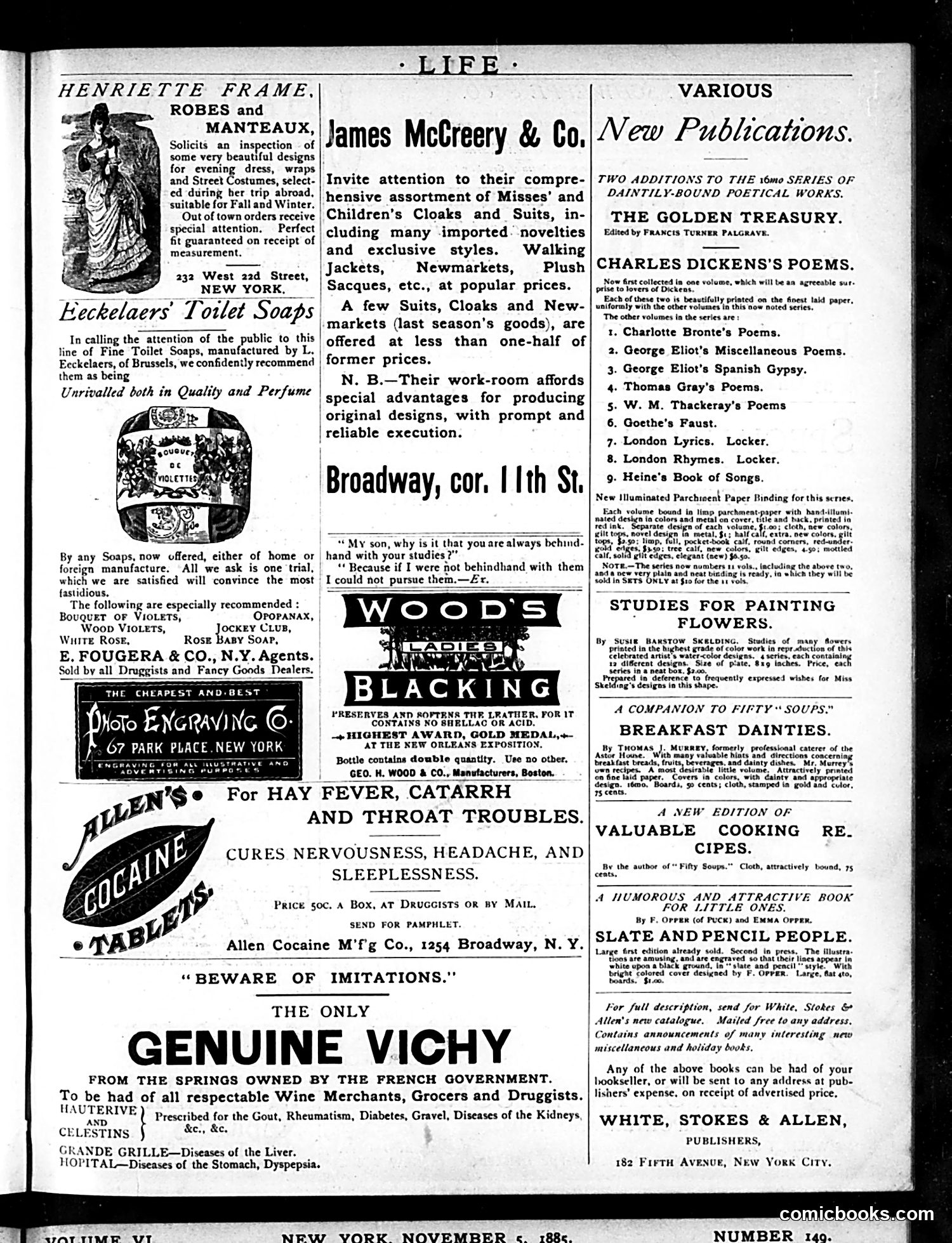
This is primarily an **advertising page** with one small joke. The advertisements showcase products of the 1880s: clothing (Henriette Frame's dresses, James McCreery & Co.'s children's wear), toiletries (Ecckelaers soaps), and patent medicines (Allen's Cocaine Tablets for hay fever and nervousness, Vichy water). The single cartoon/joke appears midpage: a father asks his son why he's always behind with studies. The son responds that if he *weren't* behind with them, he couldn't pursue them—a pun playing on "pursue" (chase after) versus "pursue" (continue with). It's mild wordplay humor typical of Life's satirical style. **Notable context for modern readers:** The Allen Cocaine Tablets advertisement is striking—cocaine was legally sold as a medicinal product in the 1880s before regulation. This reflects the era's pre-FDA standards and naive understanding of the drug's dangers. The French Vichy water advertisement appeals to European prestige, common in American luxury advertising of this period.
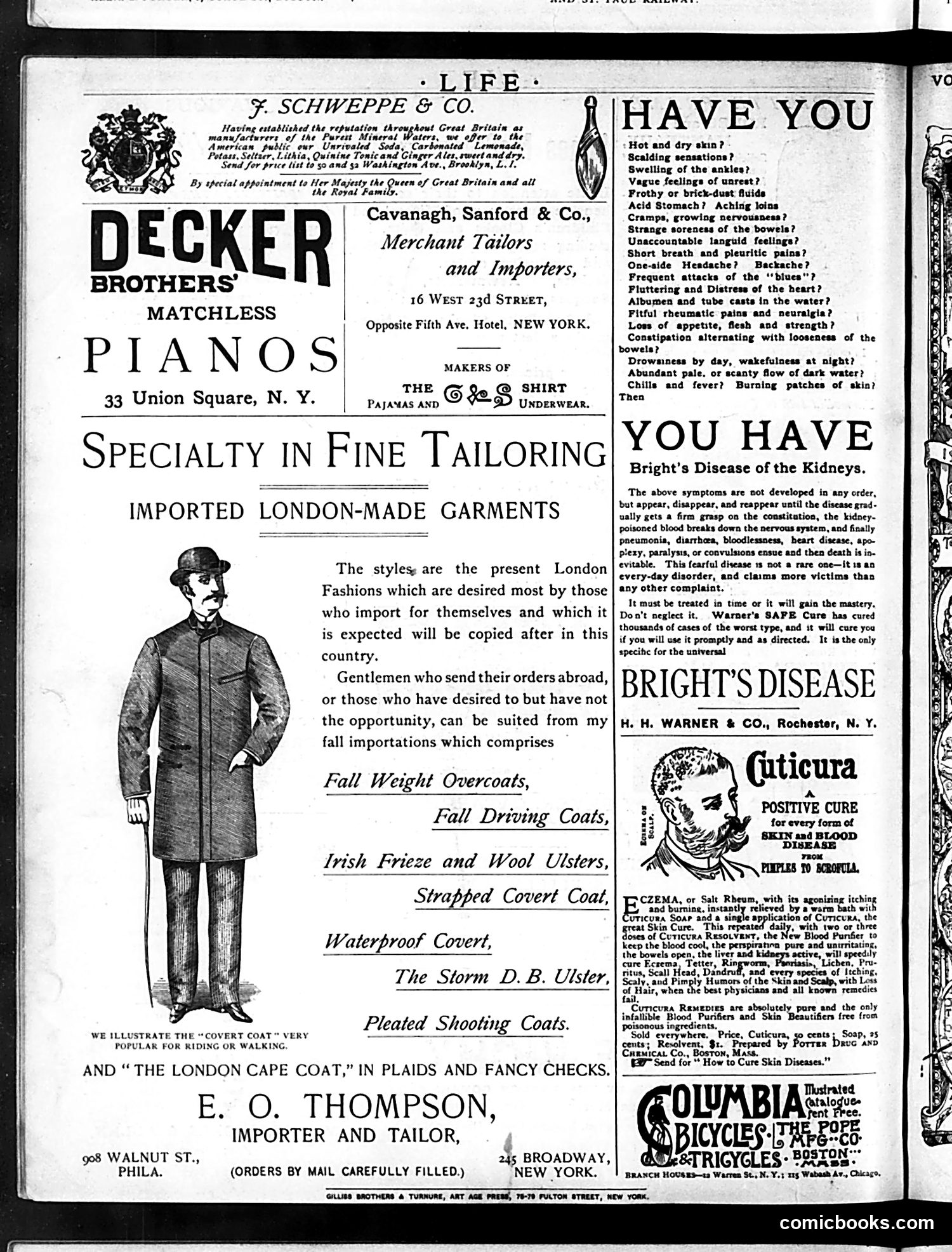
This page is primarily **advertising**, not political satire. It contains commercial notices for tailors, pianos, beverages, and—most notably—patent medicines. The significant content is a medical advertisement for **Warner's Safe Cure for Bright's Disease** (kidney failure). The ad lists exhaustive symptoms—from "hot and dry skin" to "chills and fever"—designed to convince readers they have this serious condition, then promises a cure. This reflects late-19th-century **medical quackery**: patent medicines made exaggerated claims about treating incurable diseases with unproven remedies. Below that, **Cuticura** advertises a "positive cure" for eczema and skin diseases, similarly overstating its efficacy. These ads exploit contemporary medical anxiety and lack of regulation. Modern readers should recognize this as **predatory marketing**—exploiting genuine health concerns with false promises, a practice eventually curtailed by FDA regulations and truth-in-advertising laws. The tailoring and piano ads reflect ordinary period commerce with no satirical content.