
Life, 1885-10-29 · page 2 of 16
Life — October 29, 1885 — page 2: what you’re looking at
What you’re looking at
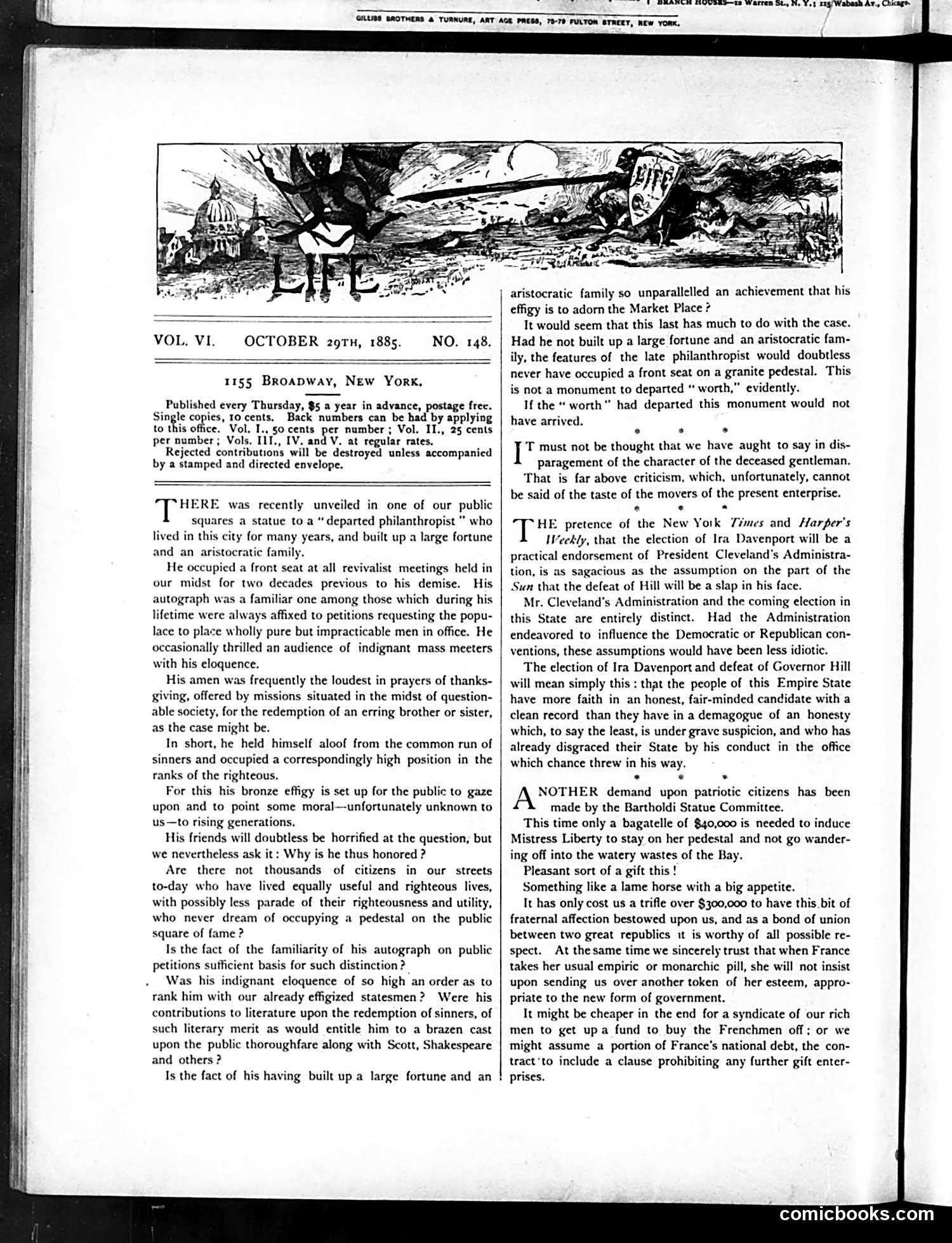
The page's masthead illustration depicts a landscape with "LIFE" prominently displayed, suggesting the magazine's satirical mission. The text criticizes an unnamed wealthy man who recently erected a public monument—likely a statue—celebrating himself. The author mocks this as vulgar self-aggrandizement, questioning whether his fortune and "aristocratic family" warrant such public honor. The piece suggests his supposed moral virtue (piety, charity work) doesn't justify a "pedestal of fame." The text then shifts to contemporary politics, dismissing predictions that Democratic candidate Ira Davenport's election would embarrass President Cleveland's administration. It argues New York voters trust Davenport's honesty over his opponent's record. Finally, it satirizes a fundraising effort seeking $40,000 to prevent the Statue of Liberty from being moved, calling this an excessive expense for such a symbolic gesture.
📄 Transcribed text from this page (OCR, searchable)
Machine-transcribed from the original scan — historical spelling and the odd misread are preserved.
Te nar eee eee wee 595 SRE ERDOES Eig CRITE GULISS BROTWERS & TURNURE, ART AGE PRESS, 70-70 FULTON STREET, NEW YORK. VOL. VI. OCTOBER 2orTh, 1885. NO. 148. 1155 Broapway, New York. Published every Thursday, $5 a year in advance, postage free. Single copies, ro cents. Back numbers can be had by applying to this office. Vol. I. 0 cents per number ; Vol. II., 25 cents per number; Vols. I1T., IV. and V. at regular rates, Rejected contributions will be destroyed unless accompanied by a stamped and directed envelope. HERE was recently unveiled in one of our public squares a statue to a “departed philanthropist ” who lived in this city for many years, and built up a large fortune and an aristocratic family. He occupied a front seat at all revivalist meetings held in our midst for two decades previous to his demise. His autograph was a familiar one among those which during his lifetime were always affixed to petitions requesting the popu- lace to place wholly pure but impracticable men in office. He occasionally thrilled an audience of indignant mass meeters | with his eloquence. His amen was frequently the loudest in prayers of thanks- giving, offered by missions situated in the midst of question- able society, for the redemption of an erring brother or sister, as the case might be. In short, he held himself aloof from the common run of sinners and occupied a correspondingly high position in the ranks of the righteous. For this his bronze effigy is set up for the public to gaze upon and to point some moral—unfortunately unknown to us—to rising generations. His friends will doubtless be horrified at the question, but we nevertheless ask it: Why is he thus honored ? Are there not thousands of citizens in our streets to-day who have lived equally useful and righteous lives, with possibly less parade of their righteousness and utility, who never dream of occupying a pedestal on the public square of fame ? Is the fact of the familiarity of his autograph on public petitions sufficient basis for such distinction ? Was his indignant eloquence of so high an order as to rank him with our already effigized statesmen? Were his contributions to literature upon the redemption of sinners, of such literary merit as would entitle him to a brazen cast upon the public thoroughfare along with Scott, Shakespeare and others ? Is the fact of his having built up a large fortune and an | aristocratic family so unparalleled an achievement that his effigy is to adorn the Market Place ? It would seem that this last has much to do with the case. Had he not built up a large fortune and an aristocratic fam- ily, the features of the late philanthropist would doubtless never have occupied a front seat on a granite pedestal. This is not a monument to departed “ worth,” evidently. If the “ worth” had departed this monument would not have arrived. ° * * T must not be thought that we have aught to say in dis- paragement of the character of the deceased gentleman. That is far above criticism, which, unfortunately, cannot be said of the taste of the movers of the present enterprise. * * « HE pretence of the New York 7émes and Harper's IVeekly, that the election of Ira Davenport will be a practical endorsement of President Cleveland's Administra- tion, is as sagacious as the assumption on the part of the Sun that the defeat of Hill will be a slap in his face. Mr. Cleveland's Administration and the coming election in this State are entirely distinct. Had the Administration endeavored to influence the Democratic or Republican con- ventions, these assumptions would have been less idiotic. The election of Ira Davenport and defeat of Governor Hill will mean simply this : that the people of this Empire State have more faith in an honest, fair-minded candidate with a clean record than they have in a demagogue of an honesty which, to say the least, is under grave suspicion, and who has already disgraced their State by his conduct in the office which chance threw in his way. . * . NOTHER demand upon patriotic citizens has been made by the Bartholdi Statue Committee. This time only a bagatelle of $40,000 is needed to induce Mistress Liberty to stay on her pedestal and not go wander- ing off into the watery wastes of the Bay. Pleasant sort of a gift this ! Something like a lame horse with a big appetite. It has only cost us a trifle over $300,000 to have this.bit of fraternal affection bestowed upon us, and as a bond of union between two great republics it is worthy of all possible re- spect. At the same time we sincerely trust that when France takes her usual empiric or monarchic pill, she will not insist upon sending us over another token of her esteem, appro- priate to the new form of government. It might be cheaper in the end for a syndicate of our rich men to get upa fund to buy the Frenchmen off; or we might assume a portion of France's national debt, the con- tract'to include a clause prohibiting any further gift enter- ! prises. comicbooks.com