
Life, 1885-10-29 · page 6 of 16
Life — October 29, 1885 — page 6: what you’re looking at
What you’re looking at
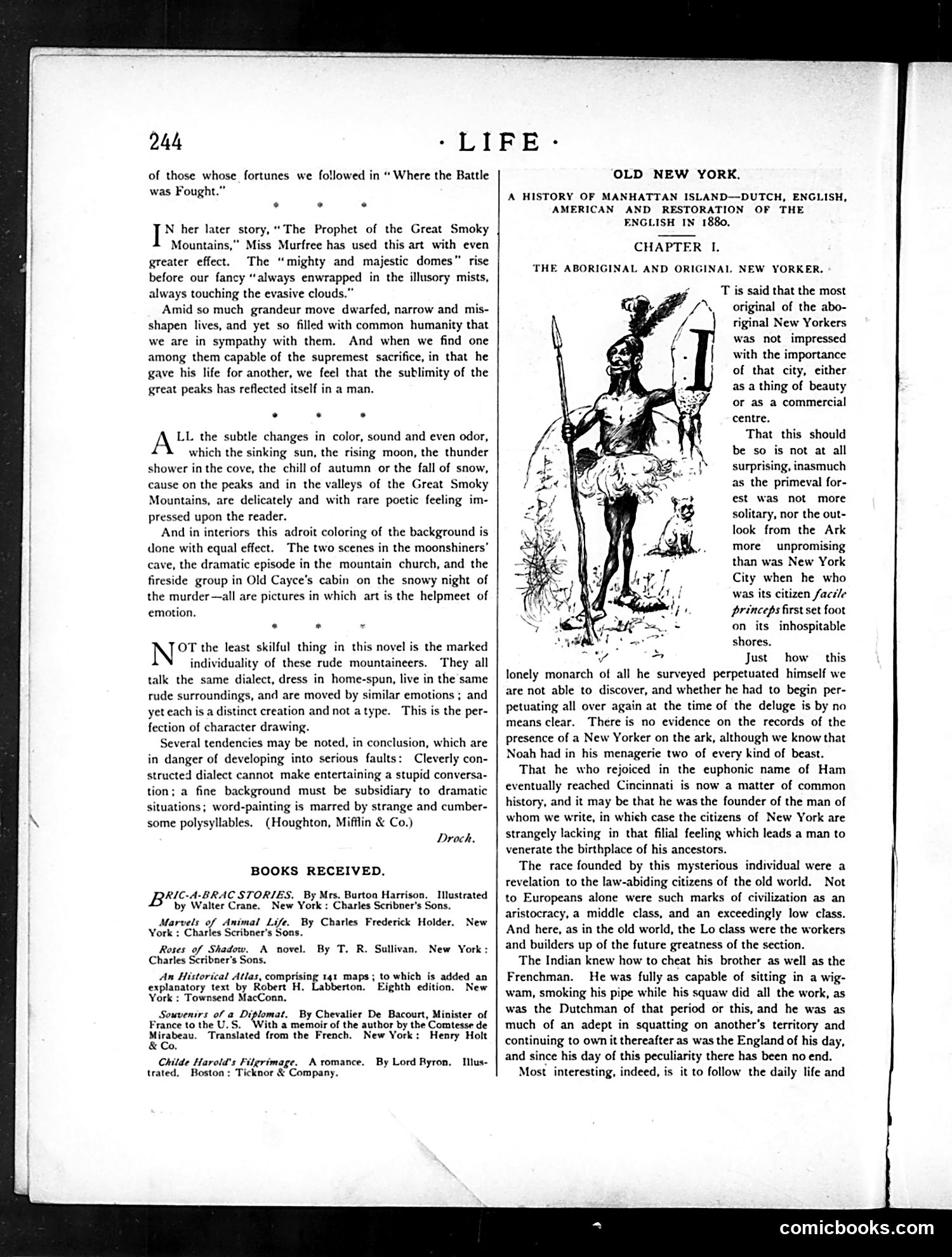
This page features a literary critique and historical essay rather than political satire. The illustration depicts an Indigenous figure—described in the text as "the aboriginal and original new Yorker"—standing with a shield and spear, likely representing a Native American who inhabited Manhattan before European settlement. The accompanying text argues that the original New York inhabitants showed little regard for the land as a commercial center or aesthetic treasure. The essay traces how subsequent populations—Dutch, English, and Americans—shaped the city's character. The piece appears to be part of a larger historical series examining Manhattan's transformation, with the native figure serving as a symbolic starting point for discussing the island's colonial and commercial development.
📄 Transcribed text from this page (OCR, searchable)
Machine-transcribed from the original scan — historical spelling and the odd misread are preserved.
-LIFE- of those whose fortunes we followed in “ Where the Battle was Fought.” * ° . N her later story, The Prophet of the Great Smoky Mountains,” Miss Murfree has used this art with even greater effect. The “mighty and majestic domes” rise before our fancy “always enwrapped in the illusory mists, always touching the evasive clouds.” Amid so much grandeur move dwarfed, narrow and mis- shapen lives, and yet so filled with common humanity that we are in sympathy with them. And when we find one among them capable of the supremest sacrifice, in that he gave his life for another, we feel that the sublimity of the great peaks has reflected itself in a man. A L the subtle changes in color, sound and even odor, which the sinking sun, the rising moon, the thunder shower in the cove, the chill of autumn or the fall of snow, cause on the peaks and in the valleys of the Great Smoky Mountains, are delicately and with rare poetic feeling im- pressed upon the reader. And in interiors this adroit coloring of the background is done with equal effect. The two scenes in the moonshiners’ cave, the dramatic episode in the mountain church, and the fireside group in Old Cayce’s cabin on the snowy night of the murder—all are pictures in which art is the helpmeet of emotion. * * OT the least skilful thing in this novel is the marked individuality of these rude mountaineers. They all talk the same dialect, dress in home-spun, live in the same rude surroundings, and are moved by similar emotions ; and yet each is a distinct creation and not atype. This is the per- fection of character drawing. Several tendencies may be noted, in conclusion, which are in danger of developing into serious faults: Cleverly con- structed dialect cannot make entertaining a stupid conversa- tion; a fine background must be subsidiary to dramatic situations; word-painting is marred by strange and cumber- some polysyllables. (Houghton, Mifflin & Co.) Droch. BOOKS RECEIVED. Illustrated by Walter Crane. New York : Charles Scribner's Sons, Marvels of Animal Life. By Charles Frederick Holder. York : Charles Scribner's Sons. Roses of Shadow. A novel. Charles Scribner's Sons. An Historical Atlas, comprising 141 maps ; to which is added an explanatory text by Robert H, Labberton. Eighth edition. New York : Townsend MacConn, Souvenirs of a Diplomat, By Chevalier De Bacourt, Minister of France to the U.S. ‘ith a memoir of the author by the Comtesse de Mirabeau. Translated from the French. New York: Henry Holt & Co, Childe Harold's Filgrimage. M romance. trated. Boston : Ticknor & Company. BRICA BRAC STORIES. By Mrs, Burton Harrison, New By T. R. Sullivan. New York: By Lord Byron. Ilus- OLD NEW YORK. A HISTORY OF MANHATTAN ISLAND—DUTCH, ENGLISH, AMERICAN AND RESTORATION OF THE ENGLISH IN 1880. CHAPTER I. THE ABORIGINAL AND ORIGINAL NEW YORKER. T is said that the most original of the abo- riginal New Yorkers was not impressed with the importance of that city, either as a thing of beauty or as a commercial centre. That this should be so is not at all surprising, inasmuch as the primeval for- est was not more solitary, nor the out- look from the Ark more unpromising than was New York City when he who was its citizen facile princeps first set foot on its inhospitable shores. v Just how _ this lonely monarch of all he surveyed perpetuated himself we are not able to discover, and whether he had to begin per- petuating all over again at the time of the deluge is by no means clear. There is no evidence on the records of the presence of a New Yorker on the ark, although we know that Noah had in his menagerie two of every kind of beast. That he who rejoiced in the euphonic name of Ham eventually reached Cincinnati is now a matter of common history, and it may be that he was the founder of the man of whom we write, in which case the citizens of New York are strangely lacking in that filial feeling which leads a man to venerate the birthplace of his ancestors. The race founded by this mysterious individual were a revelation to the law-abiding citizens of the old world. Not to Europeans alone were such marks of civilization as an aristocracy, a middle class, and an exceedingly low class. And here, as in the old world, the Lo class were the workers and builders up of the future greatness of the section. The Indian knew how to cheat his brother as well as the Frenchman. He was fully as capable of sitting in a wig- wam, smoking his pipe while his squaw did all the work, as was the Dutchman of that period or this, and he was as much of an adept in squatting on another's territory and continuing to own it thereafter as was the England of his day, and since his day of this peculiarity there has been no end. Most interesting, indeed, is it to follow the daily life and comicbooks.com