
Life, 1885-10-29 · page 10 of 16
Life — October 29, 1885 — page 10: what you’re looking at
What you’re looking at
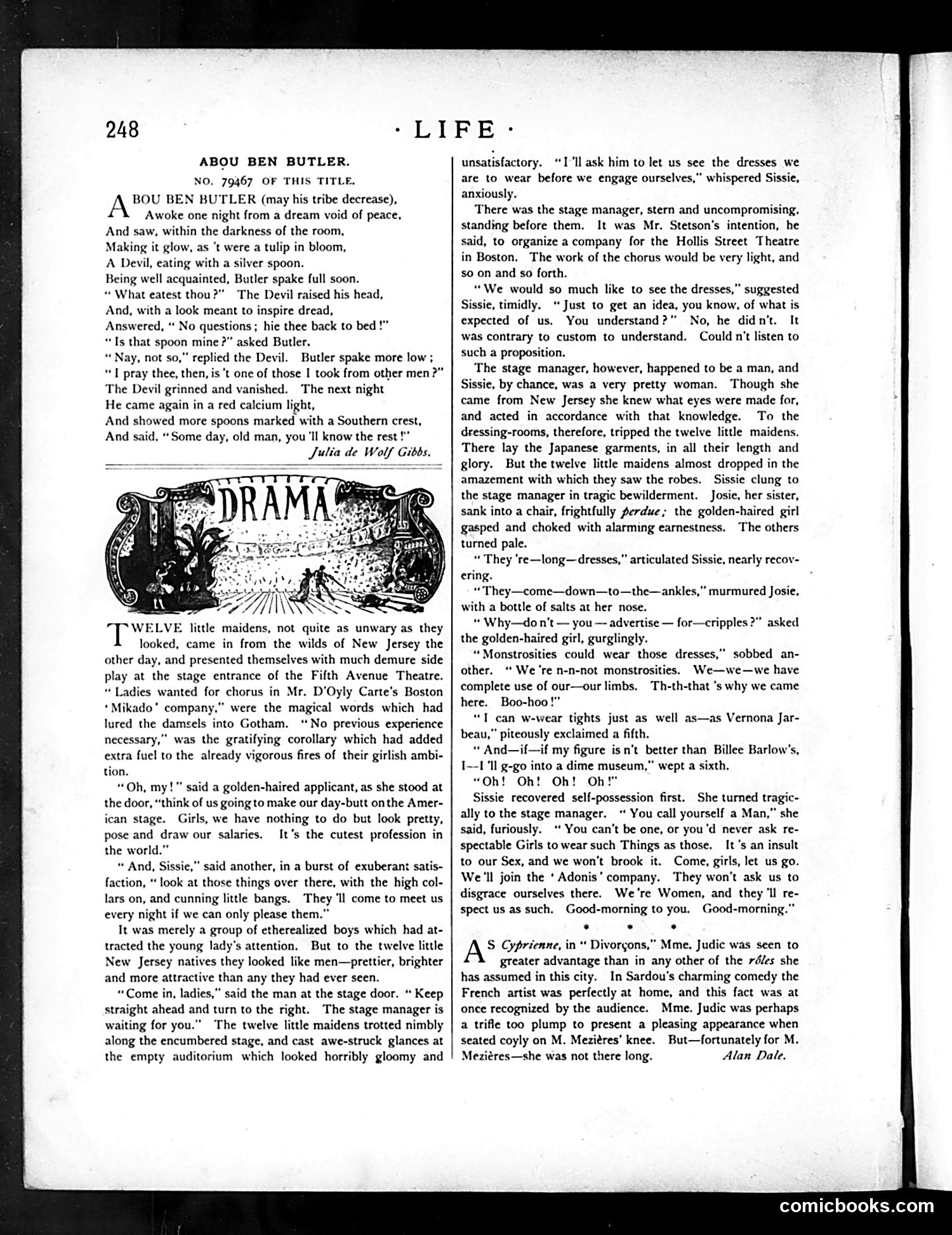
This page contains two pieces of social satire from *Life* magazine: **"Abou Ben Butler"** (top): A poem mocking General Benjamin Butler, a controversial Civil War figure and Reconstruction politician. The satire suggests Butler accumulated wealth through questionable means—the devil shows him stolen "spoons" (valuables) marked with "Southern crests," implying Butler plundered the South. Butler was historically accused of corruption and theft during his military governorship of New Orleans. **"The Twelve Little Maidens"** (bottom): A humorous story satirizing naive young women from New Jersey auditioning for a Boston theater production. The joke centers on their shock upon discovering Japanese kimonos for the chorus—apparently scandalously short or revealing by Victorian standards. The satire mocks both the girls' innocence and the theater industry's exploitative practices. Both pieces use comedy to critique contemporary figures and social practices of the era.
📄 Transcribed text from this page (OCR, searchable)
Machine-transcribed from the original scan — historical spelling and the odd misread are preserved.
248 ABOU BEN BUTLER. NO. 79467 OF THIS TITLE. A BOU BEN BUTLER (may his tribe decrease), Awoke one night from a dream void of peace, And saw, within the darkness of the room, Making it glow, as ‘t were a tulip in bloom, A Devil, eating with a silver spoon. Being well acquainted, Butler spake full soon. “ What eatest thou?” The Devil raised his head, And, with a look meant to inspire dread, Answered, “ No questions ; hie thee back to bed!” “Ts that spoon mine ?” asked Butler. “ Nay, not so,” replied the Devil. Butler spake more low ; “T pray thee, then, is ‘t one of those I took from other men?” The Devil grinned and vanished. The next night He came again in a red calcium light, And showed more spoons marked with a Southern crest, And said, Some day, old man, you ‘ll know the rest!" Julia de Wolf Gibbs. WELVE little maidens, not quite as unwary as they looked, came in from the wilds of New Jersey the other day, and presented themselves with much demure side play at the stage entrance of the Fifth Avenue Theatre. “Ladies wanted for chorus in Mr. D’Oyly Carte’s Boston ‘Mikado’ company,” were the magical words which had lured the damsels into Gotham. ‘No previous experience necessary,” was the gratifying corollary which had added extra fuel to the already vigorous fires of their girlish ambi- tion. “Oh, my!” said a golden-haired applicant, as she stood at the door, “think of us going to make our day-butt onthe Amer- ican stage. Girls, we have nothing to do but look pretty, pose and draw our salaries. It’s the cutest profession in the world.” “ And, Sissie,” said another, in a burst of exuberant satis- faction, “ look at those things over there, with the high col- lars on, and cunning little bangs. They ‘Il come to meet us every night if we can only please them.” It was merely a group of etherealized boys which had at- tracted the young lady's attention. But to the twelve little New Jersey natives they looked like men—prettier, brighter and more attractive than any they had ever seen. “Come in, ladies,” said the man at the stage door. “ Keep straight ahead and turn to the right. The stage manager is waiting for you.” The twelve little maidens trotted nimbly along the encumbered stage, and cast awe-struck glances at the empty auditorium which looked horribly gloomy and - LIFE: unsatisfactory. “I'll ask him to let us see the dresses we are to wear before we engage ourselves,” whispered Sissie, anxiously. There was the stage manager, stern and uncompromising, standing before them. It was Mr. Stetson’s intention, he said, to organize a company for the Hollis Street Theatre in Boston. The work of the chorus would be very light, and so on and so forth. “We would so much like to see the dresses,” suggested Sissie, timidly, “Just to get an idea, you know, of what is expected of us. You understand?” No, he didn’t. It was contrary to custom to understand. Could n't listen to such a proposition. The stage manager, however, happened to be a man, and Sissie, by chance, was a very pretty woman. Though she came from New Jersey she knew what eyes were made for, and acted in accordance with that knowledge. To the dressing-rooms, therefore, tripped the twelve little maidens. There lay the Japanese garments, in all their length and glory. But the twelve little maidens almost dropped in the amazement with which they saw the robes. Sissie clung to the stage manager in tragic bewilderment. Josie, her sister, sank into a chair, frightfully perdue,; the golden-haired girl gasped and choked with alarming earnestness. The others turned pale. “ They ‘re—long—dresses,” articulated Sissie, nearly recov- ering. “ They—come—down—to—the—ankles,” murmured Josie, with a bottle of salts at her nose. “ Why—do n't — you — advertise — for—cripples ?” asked the golden-haired girl, gurglingly. “Monstrosities could wear those dresses,” sobbed an- other, “ We're n-n-not monstrosities. We—we—we have complete use of our—our limbs. Th-th-that 's why we came here. Boo-hoo !"” “T can w-wear tights just as well as—as Vernona Jar- beau,” piteously exclaimed a fifth. “ And—if—if my figure isn’t better than Billee Barlow's, I'll g-go into a dime museum,” wept a sixth. “Oh! Oh! Oh! Oh!" Sissie recovered self-possession first. She turned tragic- ally to the stage manager. “ You call yourself a Man,” she said, furiously. ‘* You can’t be one, or you'd never ask re- spectable Girls to wear such Things as those. It's an insult to our Sex, and we won't brook it. Come, girls, let us go. We'll join the ‘ Adonis’ company. They won't ask us to disgrace ourselves there. We're Women, and they ‘ll re- spect us as such. Good-morning to you. Good-morning.” . . . S Cyprienne, in“ Divorgons,” Mme. Judic was seen to greater advantage than in any other of the ré/es she has assumed in this city. In Sardou's charming comedy the French artist was perfectly at home, and this fact was at once recognized by the audience. Mme. Judic was perhaps a trifle too plump to present a pleasing appearance when seated coyly on M. Meziéres’ knee. But—fortunately for M. Meziéres—she was not there long. Alan Dale. comicbooks.com