
A complete issue · 16 pages · 1885
Life — August 27, 1885
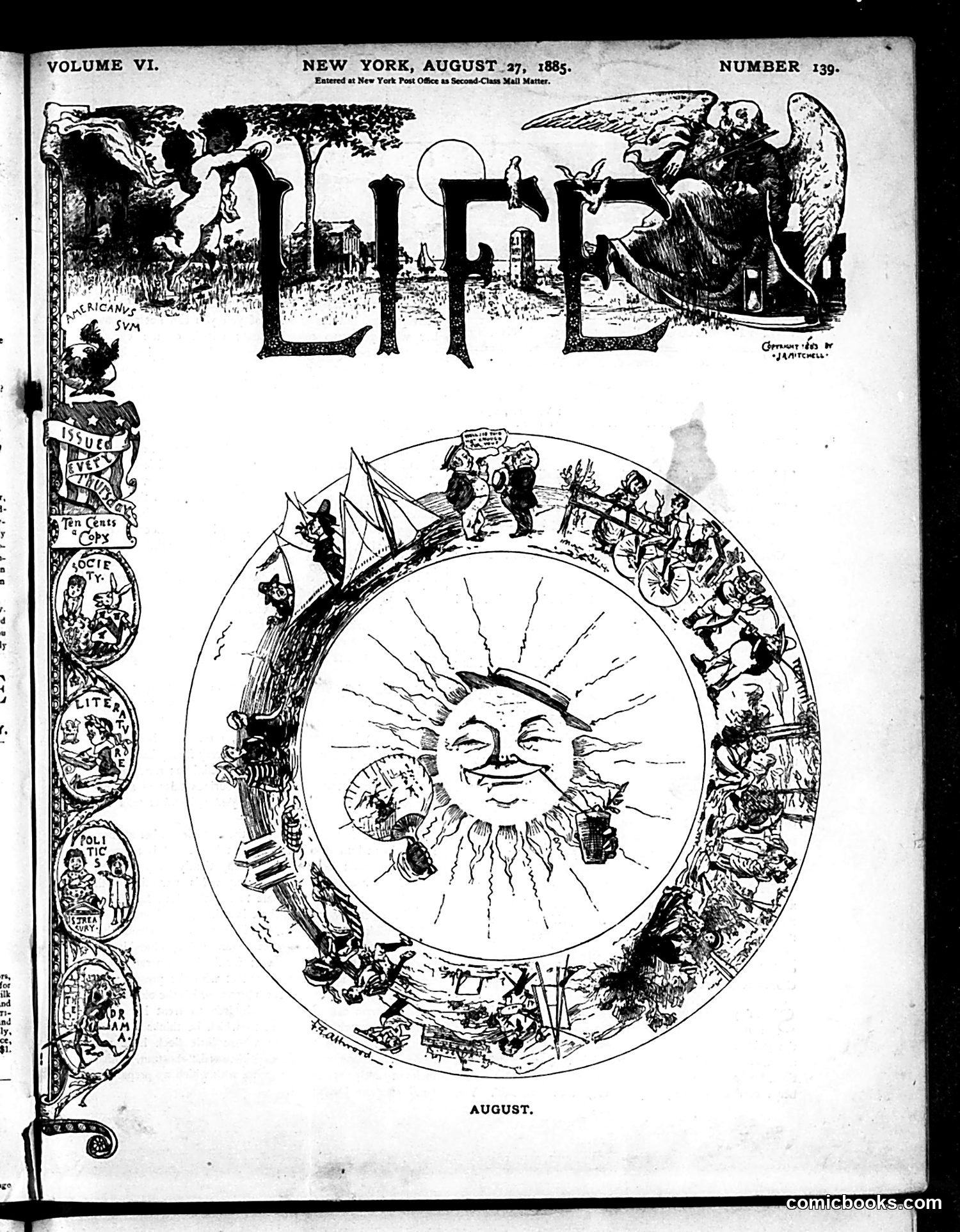
This is the cover/masthead for Life magazine's August 1885 issue. The central illustration depicts a large wheel divided into twelve segments representing the months, with a smiling personified sun at the center. The outer ring contains small vignettes illustrating various seasonal activities and human pursuits associated with August and throughout the year—likely depicting leisure, work, romance, and social activities typical of each season. The decorative left border shows smaller circular medallions with additional illustrated scenes. The elaborate ornamental design was characteristic of late Victorian periodical aesthetics. This appears to be purely decorative/thematic rather than political satire—a clever visual metaphor for the calendar year and Life magazine's coverage of contemporary American social life.
The masthead cartoon appears to depict a dramatic landscape scene with classical architectural elements (a domed building, possibly referencing Rome or Washington D.C.) alongside what seems to be a comet or celestial phenomenon streaking across the sky. The exact satirical target is unclear from the image quality, though the juxtaposition of classical architecture with astronomical imagery suggests commentary on American politics or a contemporary astronomical event. The text articles address Secretary Whitney's government freight policies and Secretary Lamar's vacation timing—both attacked as prioritizing personal interests over public duty. The "Seat yourself upon a piazza" essay discusses marital harmony and women's role in domestic life, reflecting 1880s gender attitudes. The specific figures in the cartoon cannot be definitively identified from the reproduction.
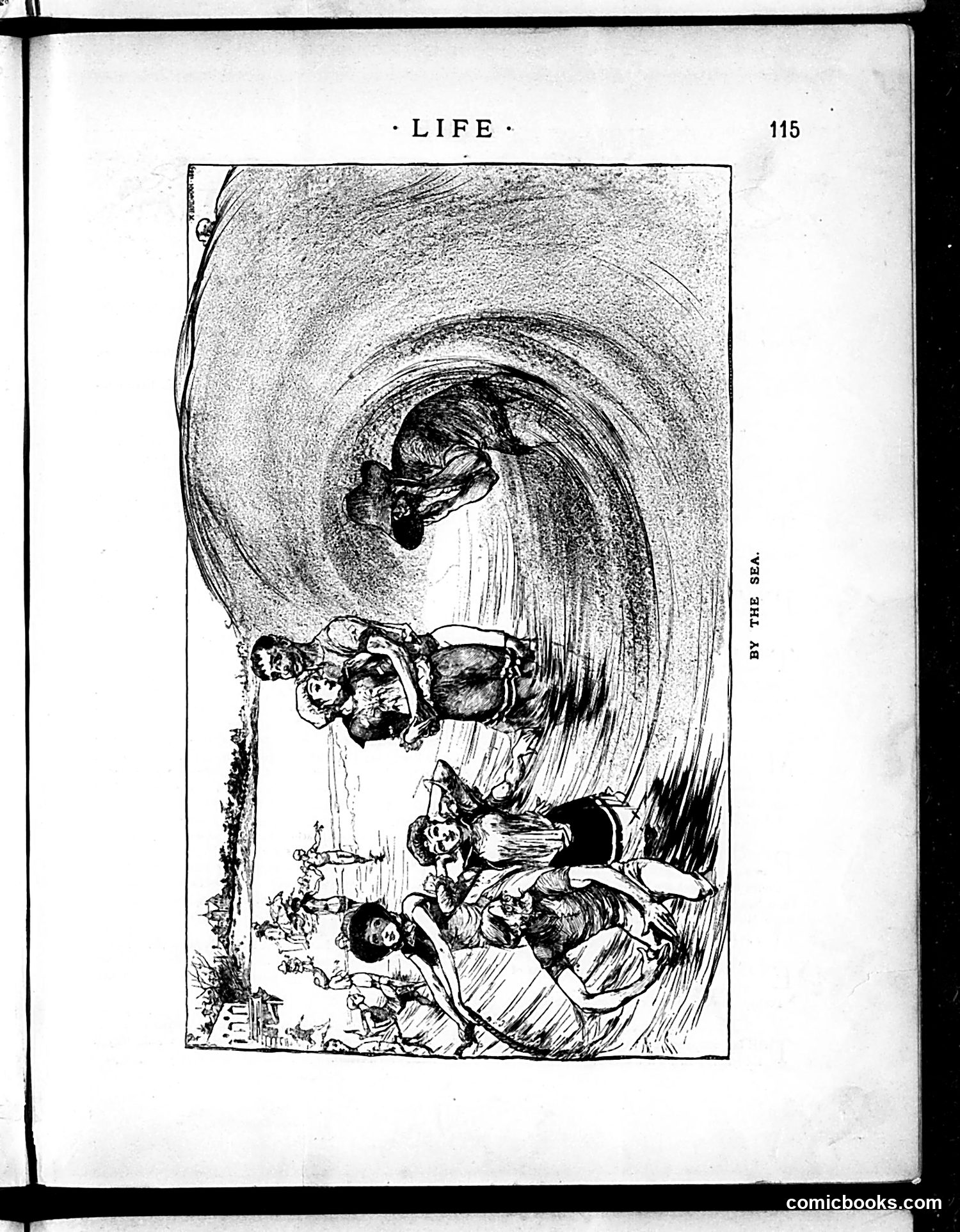
The page header reads "LIFE" with page number 115, and the right margin indicates "BY THE SEA." This appears to be a satirical illustration showing a seaside scene. The image depicts several figures in what seems to be a beach or coastal setting, with dramatic wave illustrations in the background. The drawing style is typical of early 20th-century political cartoon work—detailed cross-hatching and expressive line work. However, without clearer visibility of faces, character details, or accompanying caption text (which may be cut off or illegible in this reproduction), I cannot definitively identify specific political figures or explain the precise satirical point. The composition suggests commentary on leisure activities, class dynamics, or social behavior at the seaside, but the exact subject remains unclear from this image alone.
**The Cartoon ("By the Way"):** The masthead illustration shows various figures in a procession, though specific identities are unclear from the image quality. This appears to be a general satirical commentary rather than focusing on particular named individuals. **The Text Content:** This page consists of brief satirical "notes" on contemporary topics: - **Parliament's dissolution** is mocked for leaving "unpleasantly conspicuous dregs" - **The Tribune's criticism** of government administration is itself criticized as naive - **Madame Modjeska** translating Shakespeare into Polish is noted with a Bacon quote - **Princess Beatrice** becoming a Royal Highness is questioned - Various brief jabs at public figures and institutions The overall tone is gossipy, witty commentary on early 20th-century British and American society, politics, and notable people.
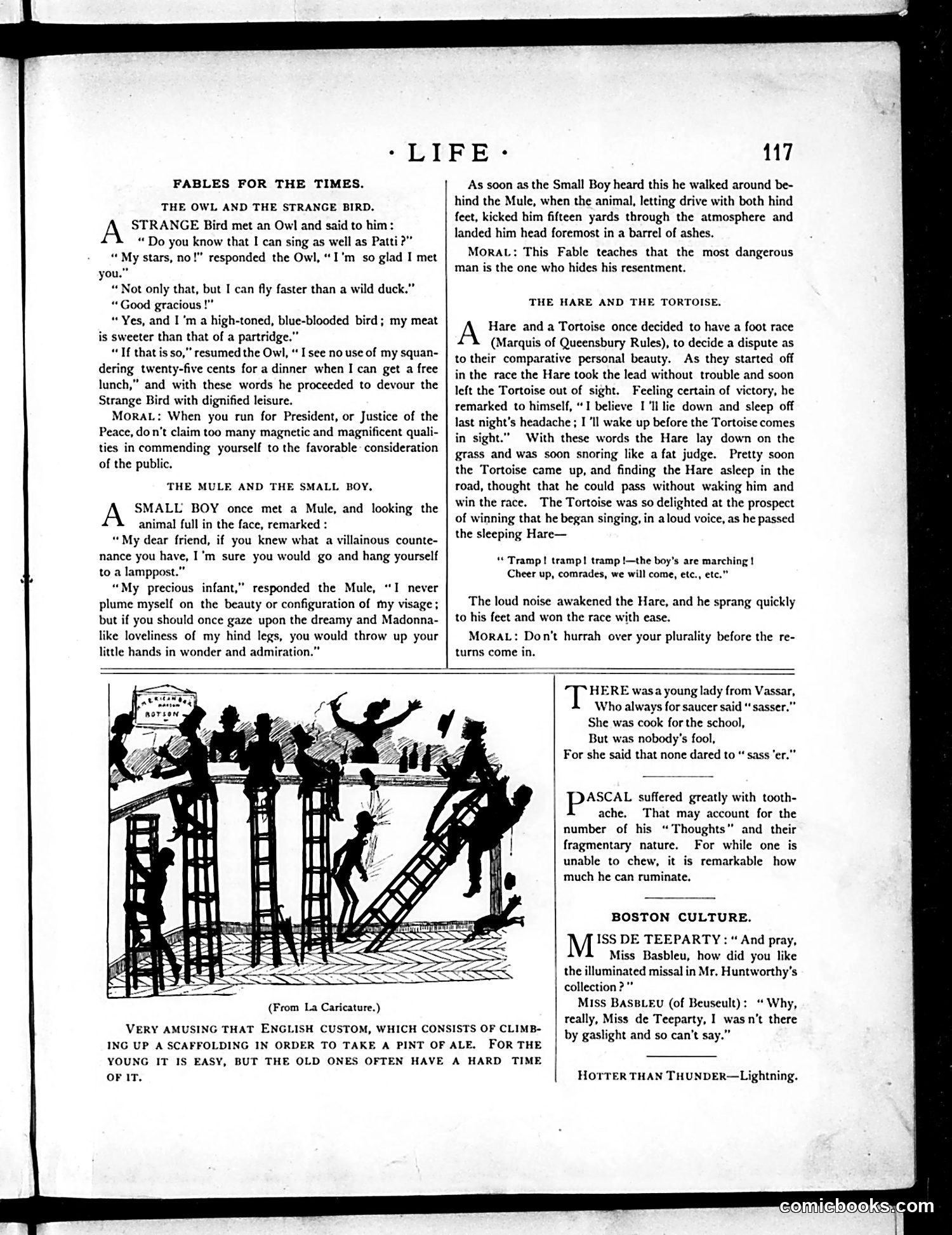
This page contains fables and satirical sketches rather than political cartoons. The main illustration shows an "amusing English custom" of climbing scaffolding to obtain ale—a working-class leisure activity the magazine presents as humorously crude. The text includes classic fables ("The Owl and the Strange Bird," "The Hare and the Tortoise," "The Mule and the Small Boy") repurposed as social commentary. The morals critique vanity, overconfidence, and self-aggrandizement among the upper classes. Additional brief satirical pieces mock Boston society ("Boston Culture") and include wordplay about a saucy cook from Vassar and Pascal's toothache. The page represents Life's typical approach: combining traditional fables with contemporary social observation to critique American manners and pretension.
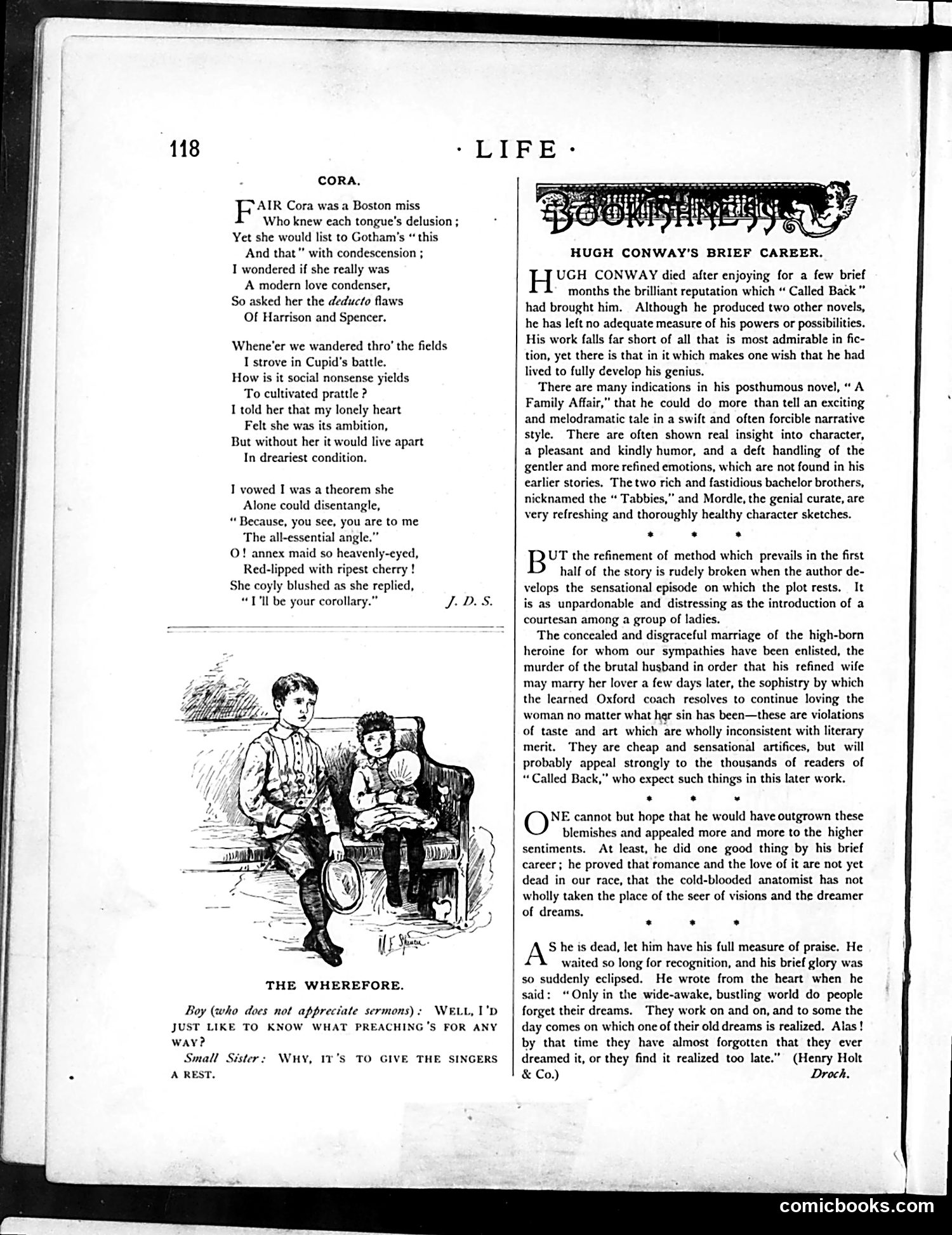
This page contains literary content rather than political satire. The left side features "Cora," a poem by J.D.S. about a Boston woman, accompanied by an illustration titled "The Wherefore" showing a man and woman in a carriage. The right side reviews Hugh Conway's novel "Called Back," discussing his brief literary career and the book's sensational plot involving a murder, a widow, and romantic complications. The reviewer criticizes the story's melodramatic elements and questionable morality, noting it appeals to popular taste despite violating literary standards. The content is primarily cultural criticism rather than political satire. It reflects late 19th-century attitudes about literature, propriety, and popular entertainment versus artistic merit.
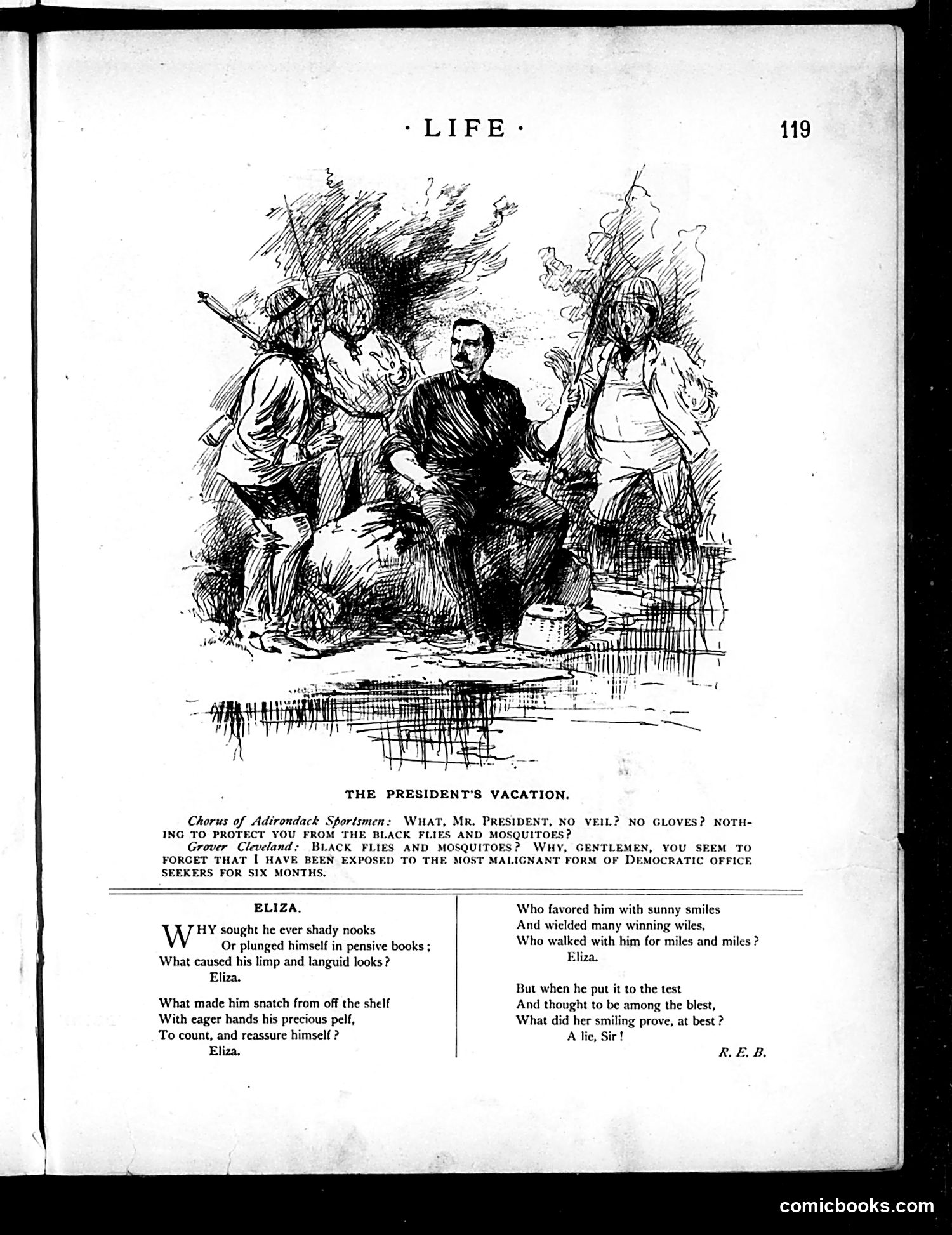
This satirical cartoon mocks a sitting president (identity unclear from image alone) for taking a vacation while facing serious political problems. The chorus of "Adirondack Sportsmen" sarcastically questions why the president lacks protective gear against "black flies and mosquitoes"—a dismissive way of saying he's ignoring real threats to Democratic Party governance. Grover Cleveland's response suggests the president has been "exposed to the most malignant form of Democratic office seekers for six months," implying exhaustion from patronage demands. The poem "Eliza" below reinforces the mockery: it questions why the president sought refuge in books and counting his money rather than addressing his actual responsibilities—suggesting he's abandoned his duties for selfish leisure.
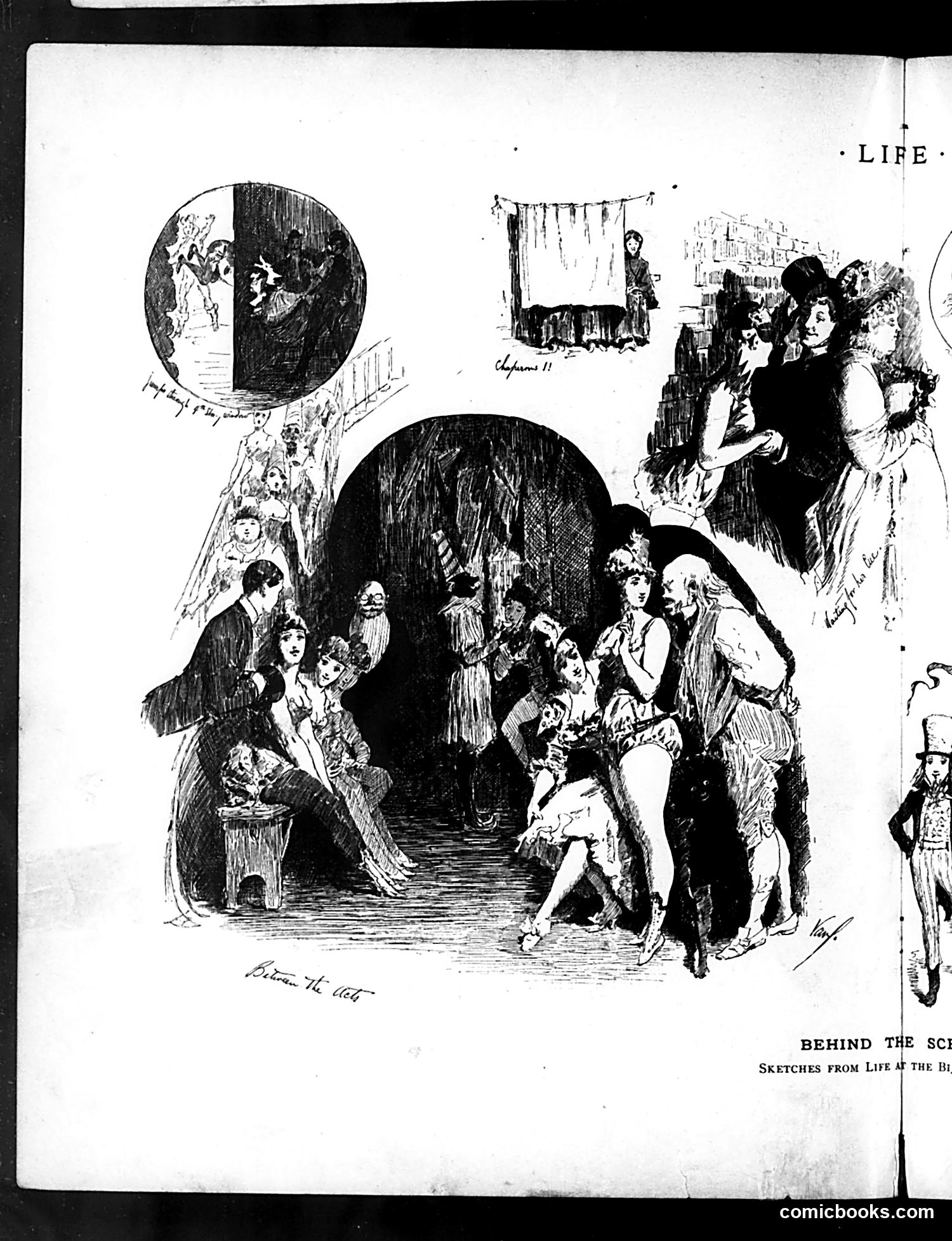
This page from *Life* magazine shows theatrical sketches titled "Behind the Scenes" with the subtitle "Sketches from Life at the [cut off]." The drawings depict backstage theater scenes with performers, stagehands, and theatrical personnel in various states of activity and costume. The central large sketch shows a crowded backstage area with formally dressed figures, children, and performers in elaborate costumes gathered around what appears to be a stage entrance or curtain. Additional smaller sketches show related theatrical moments. Without the complete text and full context, the specific satirical point is unclear. However, the work appears to be mocking or commenting on theatrical life—possibly the chaos, pretension, or social dynamics of stage production. The detailed character work suggests commentary on theater culture of the era, though the exact targets remain uncertain without additional publication details.
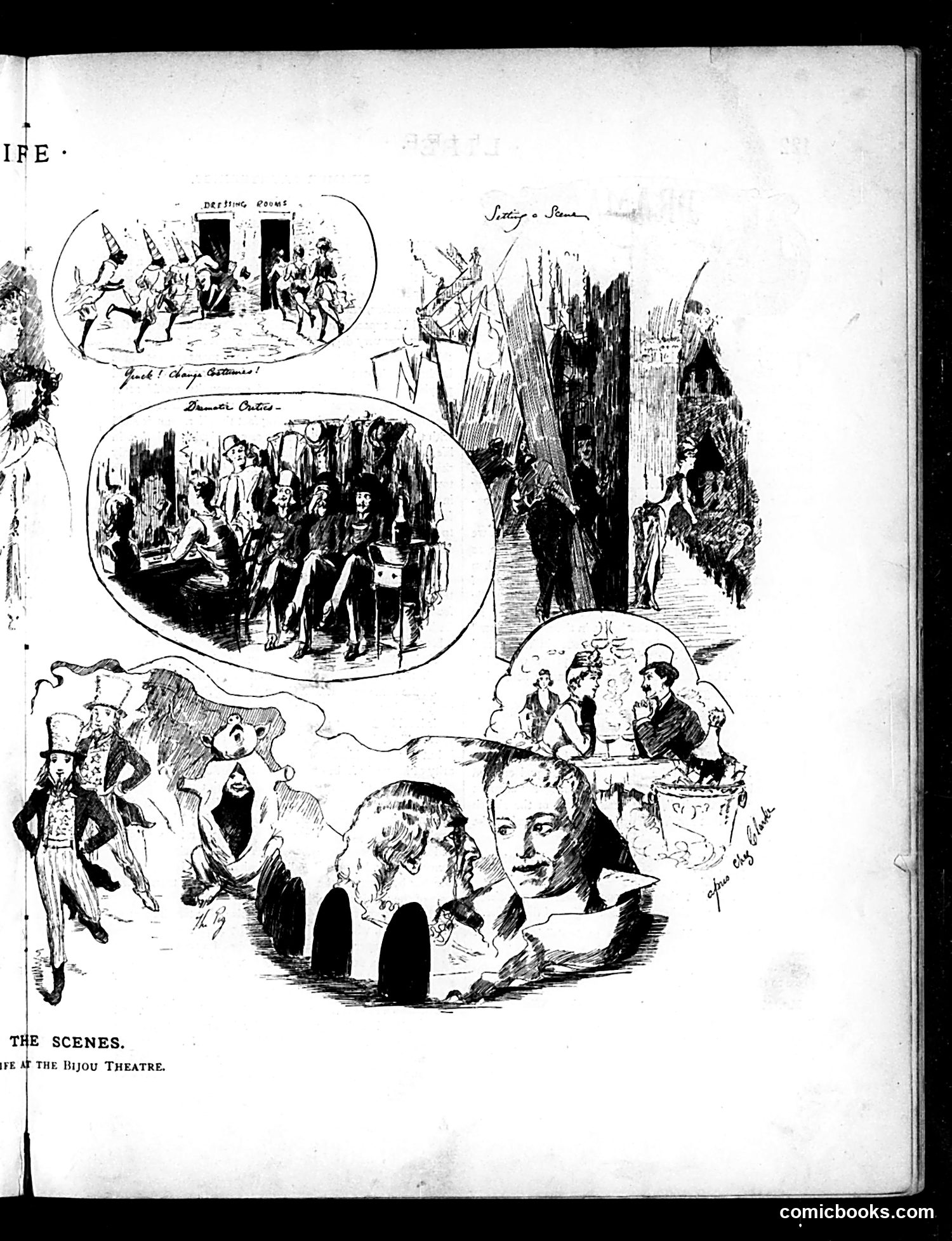
This page presents theatrical sketches from "Life at the Bijou Theatre," a satirical commentary on stage performances of the era. The page contains multiple vignettes depicting: **Upper panels**: Scenes labeled "Dressing Room" and "Dramatis Personae" showing backstage and cast activities, with exaggerated character types common to Victorian/Edwardian theater. **Lower sections**: Character studies and a street scene, featuring distinctive facial caricatures typical of period satire—emphasizing prominent noses, facial hair, and expressions to mock particular theatrical personalities or stock character types. The overall satire likely mocks the pretensions and melodrama of contemporary theater productions, popular entertainment foibles, and perhaps specific performers or productions. Without identifying specific individuals or dates visible on this page, the humor targets theatrical conventions and character archetypes familiar to Life's readers.
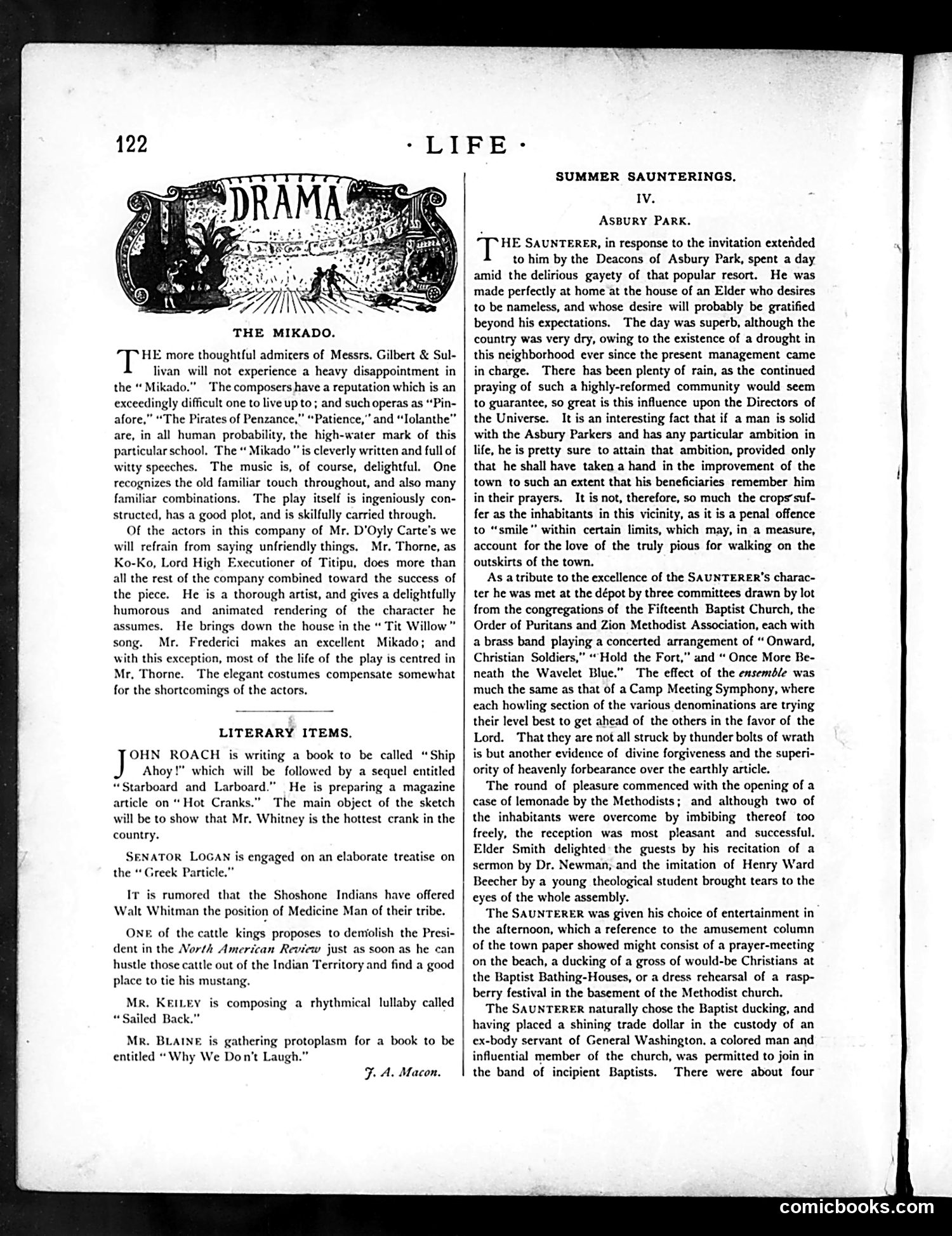
This page contains two sections: a theater review of Gilbert & Sullivan's "The Mikado" and satirical "Literary Items." **The Mikado Review**: A favorable critique praising the opera's clever construction and witty dialogue, though noting it doesn't surpass Gilbert & Sullivan's earlier works ("Pinafore," "Pirates of Penzance"). The actor Mr. Thorne, playing Ko-Ko, receives particular praise for his comedic performance in the "Tit Willow" song. **Literary Items**: Brief satirical jabs at contemporary figures, likely American politicians and intellectuals. References include Senator Logan writing on Greek grammar, a cattle baron planning to attack the President in print, and James Blaine supposedly compiling reasons "Why We Don't Laugh"—all presented as absurd or hypocritical pursuits. The humor relies on readers' familiarity with these public figures and assumes sophisticated knowledge of current events and personalities.
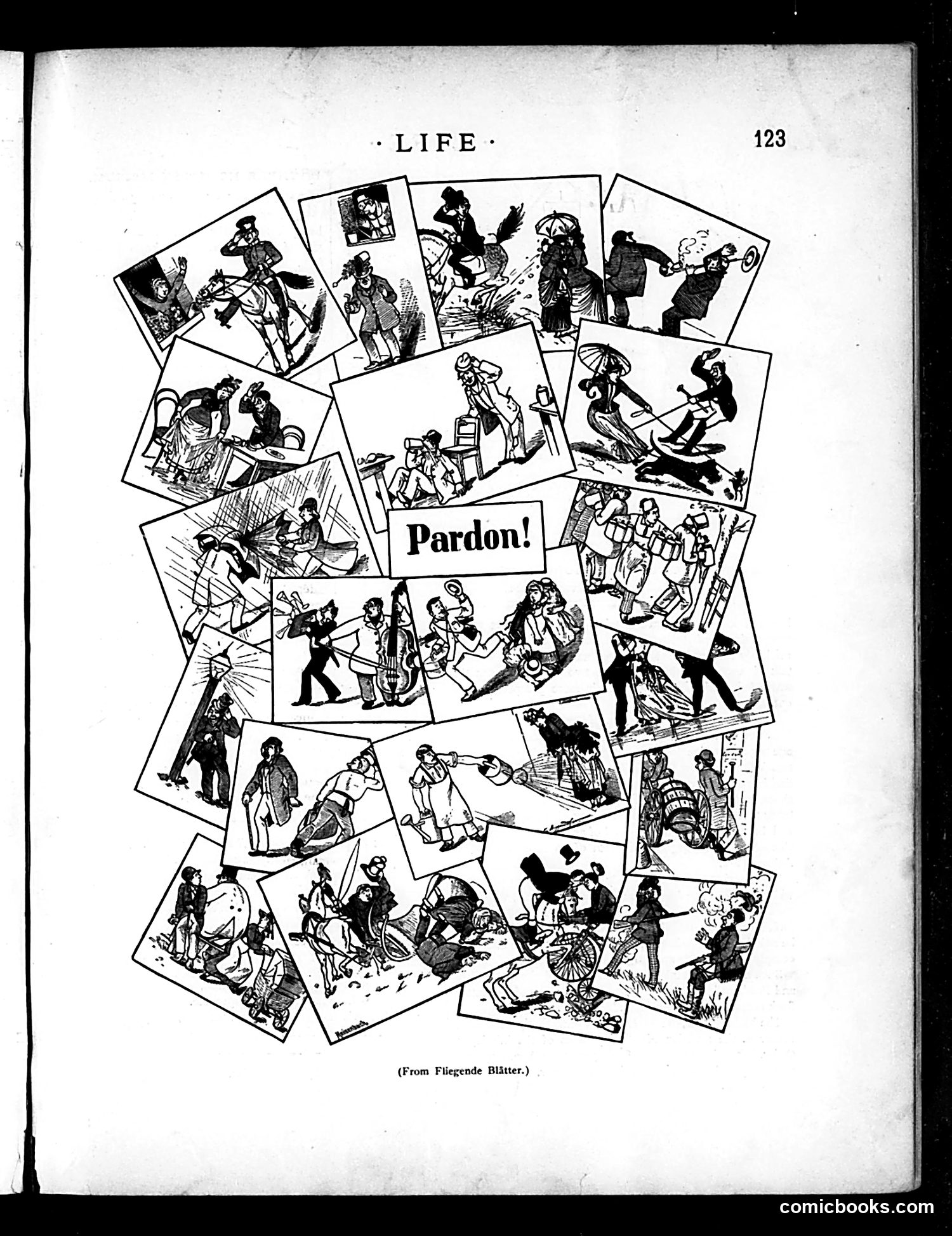
This page from *Life* magazine reproduces a series of vignettes from the German satirical publication *Fliegende Blätter* ("Flying Leaves"). The title "Pardon!" suggests the central theme: characters repeatedly seeking forgiveness or apologizing across various comic scenarios. The loosely-arranged panels depict slapstick situations—people in awkward social predicaments, physical mishaps, and embarrassing encounters. The humor relies on visual gags showing characters caught in compromising or undignified positions, necessitating apologies to those around them. This appears to be light comedic satire targeting everyday human folly and social embarrassment rather than specific political figures or events. The reproduced German content reflects *Life*'s practice of sharing European satirical humor with American readers.
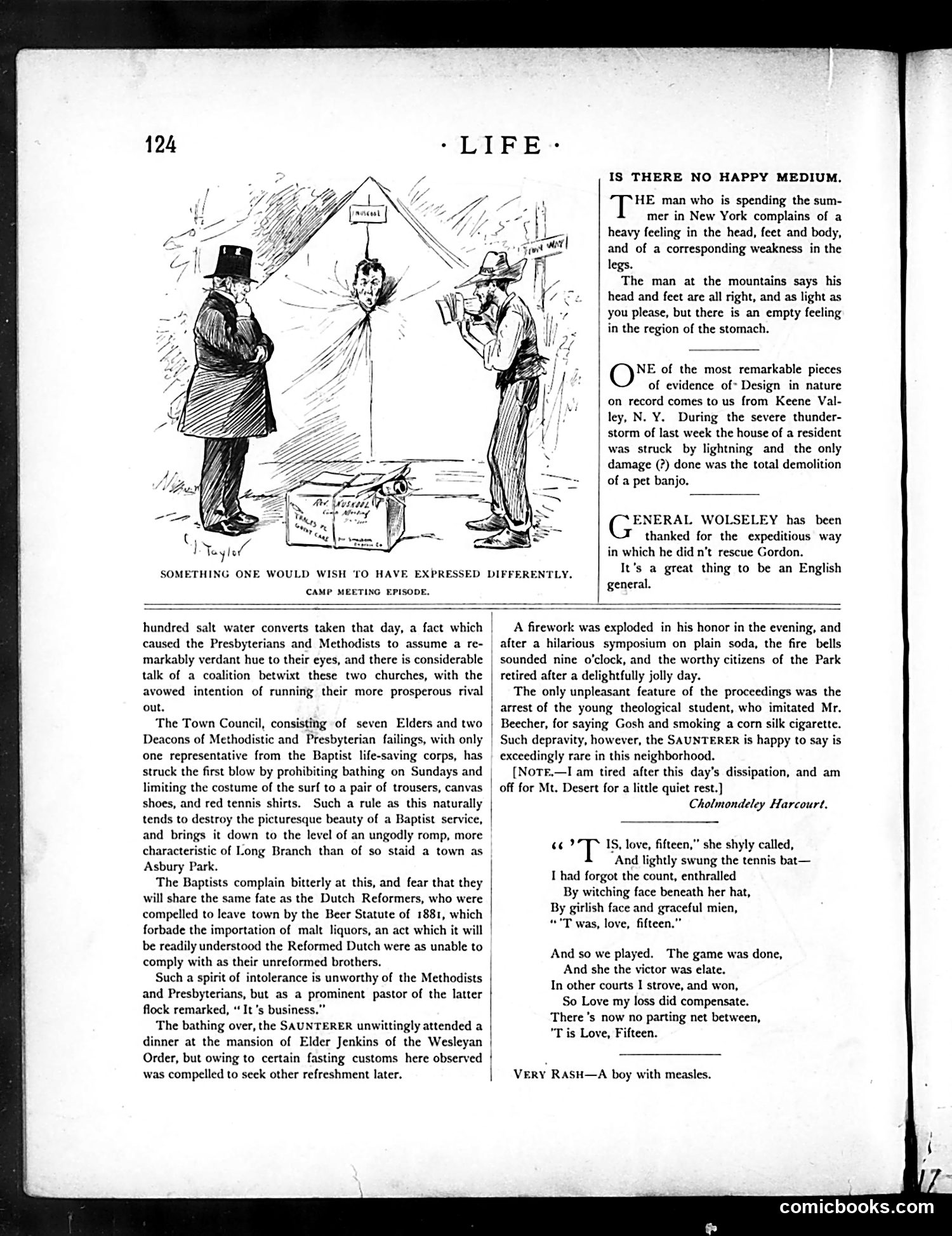
This page contains multiple satirical pieces mocking American social hypocrisy, particularly religious intolerance. **Main Cartoon** ("Camp Meeting Episode"): Depicts three figures at what appears to be a religious camp meeting, with the caption suggesting awkward religious expression. The accompanying text satirizes Asbury Park's Methodist and Presbyterian leadership for imposing strict bathing restrictions on Sundays—ostensibly moral but actually targeting rival Baptists. The satire highlights the absurdity: these churches banned swimming costumes and malt liquors while claiming piety, driving away other denominations (referencing the 1881 "Beer Statute" against Dutch Reformers). **Sidebar Jokes**: Mock General Wolseley for not rescuing Gordon (likely referencing the Khartoum campaign); praise a lightning strike that demolished only a banjo; and joke about a theological student arrested for saying "Gosh" while smoking. **Poem**: A lighter piece about tennis and romance. The overall message: religious institutions are hypocritical when they use morality as cover for commercial or social rivalry.
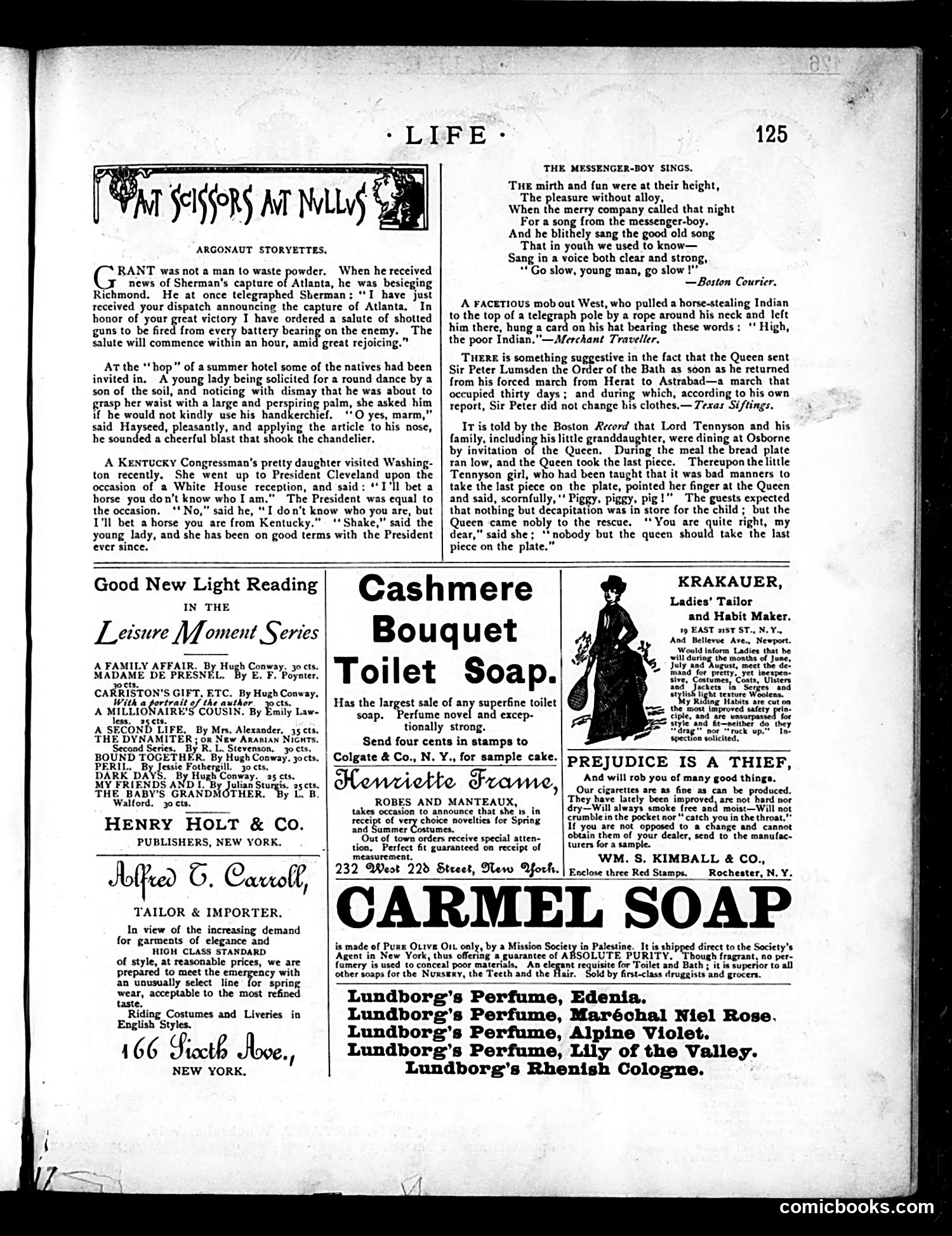
This page contains four brief humorous anecdotes typical of *Life* magazine's satirical humor, plus advertisements. **The content:** The stories mock rural simplicity and social awkwardness. The opening anecdote references General Grant and Sherman's Civil War victories (Atlanta's capture, 1864). The "Hayseed" story ridicules a country person who misunderstands a lady's request to use a handkerchief before touching her waist—he uses it to blow his nose instead. The Kentucky congressman's daughter is outwitted by President Cleveland when she boasts about her origins. The "Messenger-Boy" section quotes a song about restraint. Other items mock lynch mobs, make light of a British military officer's hygiene, and recount an (likely fictional) anecdote where Queen Victoria graciously accepts criticism from Tennyson's young granddaughter about bread etiquette. **The satire:** These pieces target rural ignorance, pretension, and social pretense—common *Life* targets. The lynching reference, though darkly humorous by modern standards, appears presented as absurdist farce rather than serious commentary. The page is otherwise dominated by period advertisements for books, soap, and tailoring services.
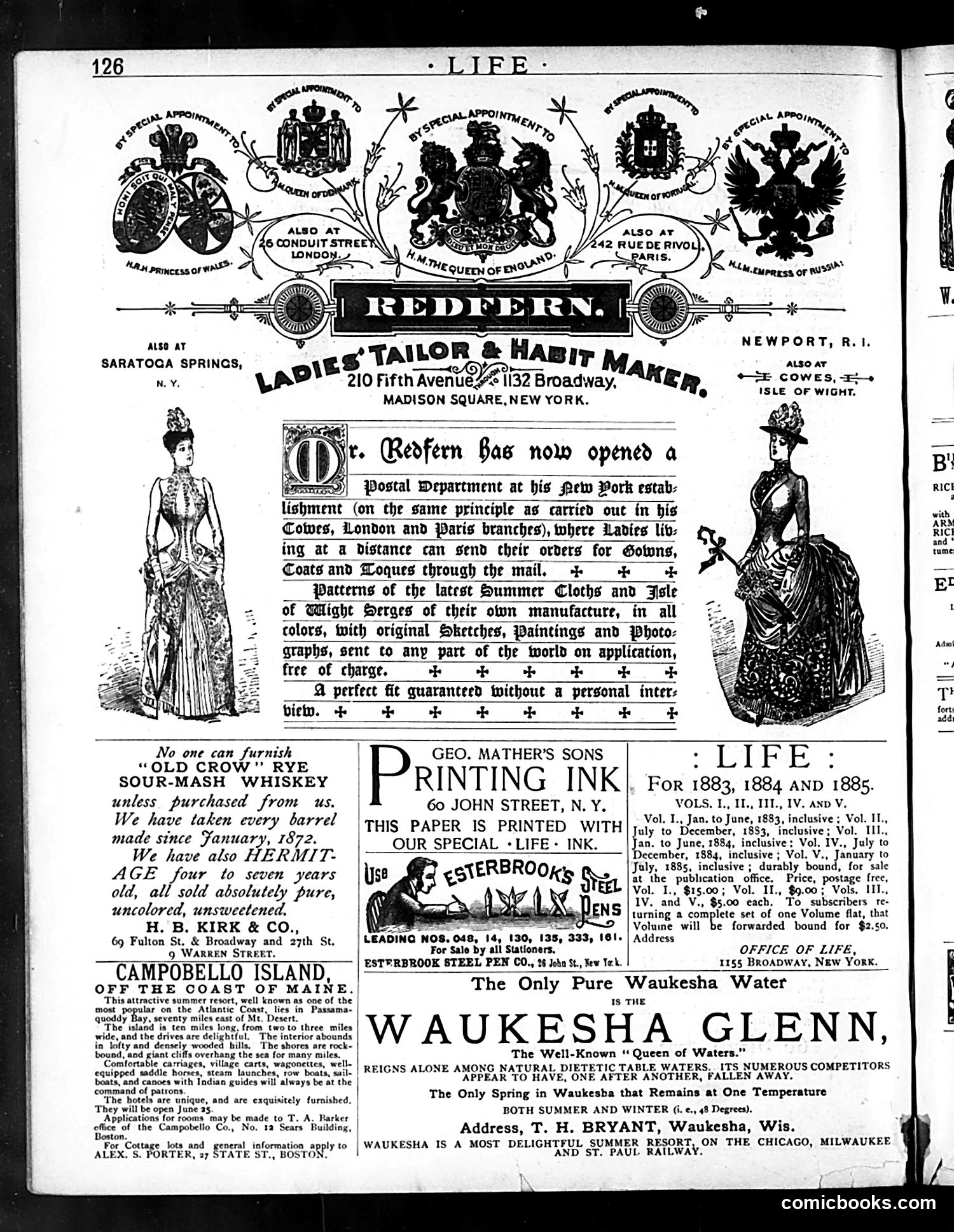
This page is primarily **advertising**, not editorial content or satire. It features high-end commercial promotions typical of 1880s Life magazine. The top section advertises **Redfern**, a prestigious ladies' tailor and dressmaker with locations in London, Paris, New York, and fashionable American resorts (Newport, Saratoga Springs). The accompanying illustrations show elaborately dressed women modeling the era's formal attire. Redfern's innovation—a postal department allowing distant customers to order garments by mail with patterns and sketches—was noteworthy for the period. Remaining advertisements promote: - **Old Crow whiskey** (emphasizing age and purity) - **Printing ink** by Geo. Mather's Sons - **Campobello Island resort** (Maine vacation destination) - **Waukesha Glenn water** (mineral water claiming superiority among "natural dietetic table waters") - **Life magazine** subscription volumes There is **no political cartoon or satire** on this page—it's a straightforward commercial section reflecting late-19th-century consumer culture and leisure-class marketing.
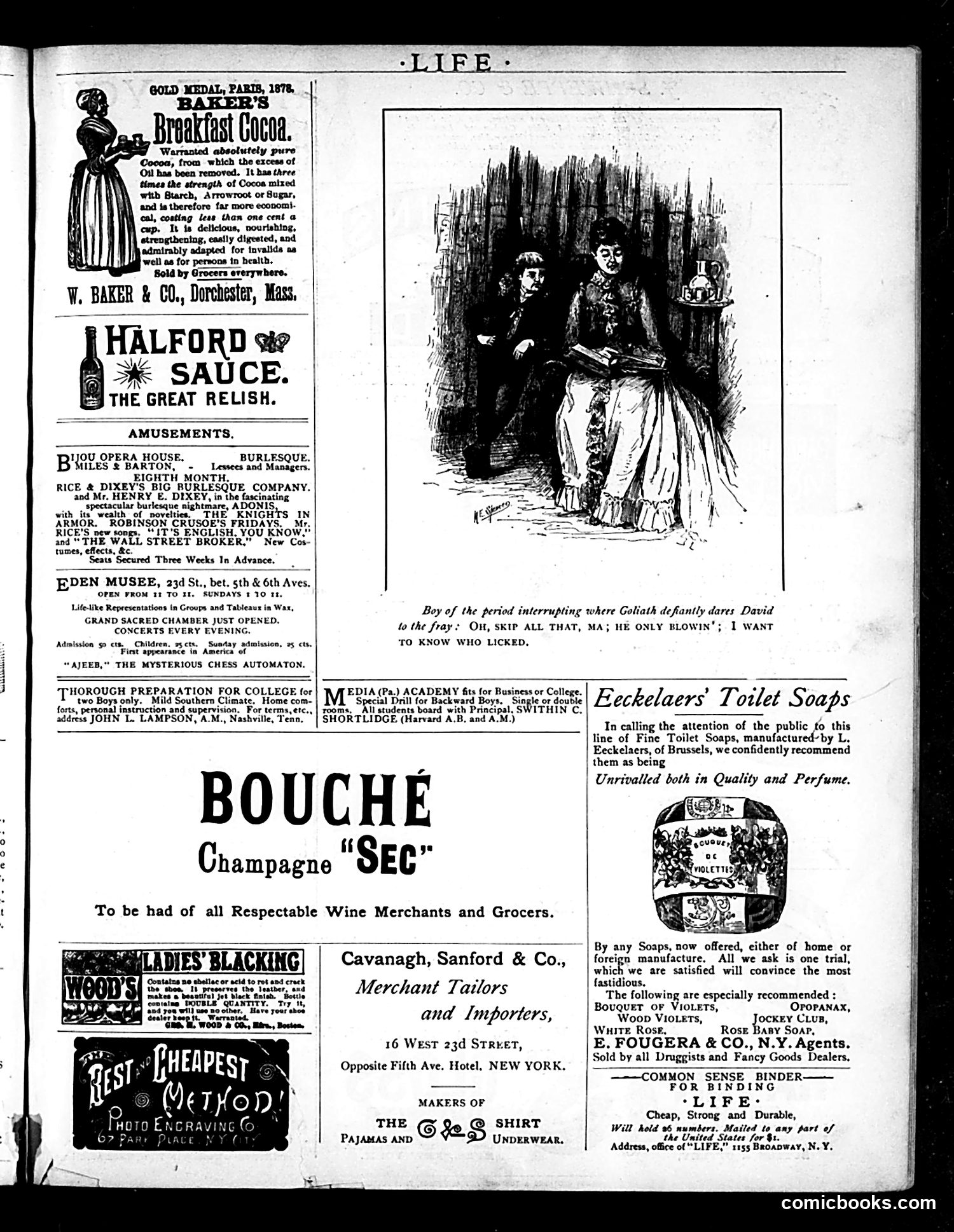
This page is primarily **advertising**, typical of 19th-century magazines. However, it contains one small cartoon sketch with satirical intent. The central image depicts a boy interrupting biblical storytelling, asking: "Oh, skip all that, Ma; he only blowin'; I want to know who licked." The reference is to the David and Goliath story—the boy wants to skip the moral/religious narrative and get straight to the combat outcome. **The satire**: This mocks contemporary American impatience with lengthy moralizing and religious instruction. The boy's colloquial language ("blowin'") and dismissive attitude suggest that modern youth—or perhaps modern Americans generally—prefer action and results over edifying tales. It's a gentle jab at both Victorian sentimentality and the erosion of traditional religious education's appeal. The remainder of the page consists of advertisements for cocoa, champagne, theatrical performances, soaps, tailoring services, and educational institutions—representative of Life magazine's revenue model and readership interests.
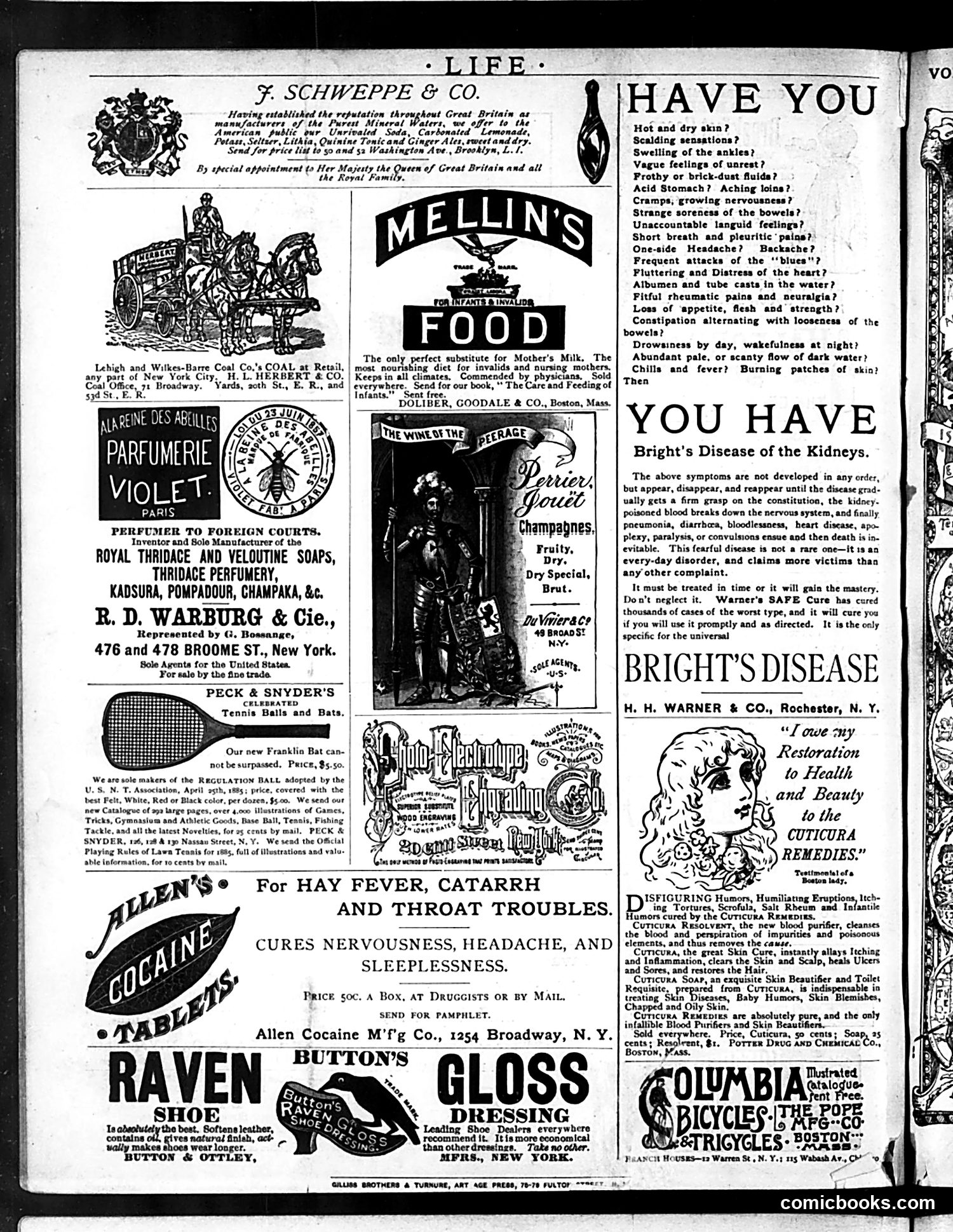
This is primarily a **commercial advertising page**, not a satirical cartoon. The content consists entirely of period advertisements for various patent medicines and consumer goods. The notable items include: **Allen's Cocaine Tablets** — advertised openly for hay fever, nervousness, and sleeplessness. Cocaine was legal and widely marketed as medicine in the 1880s-90s, before federal regulations restricted it. **Warner's Safe Cure** — a prominent advertisement for treating "Bright's Disease of the Kidneys," listing an exhaustive symptom checklist designed to convince readers they suffered from this condition. This exemplifies the era's aggressive medical marketing, where vague ailments were diagnosed and sold "cures." **Mellin's Food** — infant formula marketed as a "perfect substitute" for mother's milk. The page reflects **late 19th-century advertising practices**: unregulated medical claims, drugs we'd now consider dangerous sold without restriction, and marketing designed to create disease anxiety in consumers. There is no satire here—these are genuine advertisements from Life magazine's business content.