
Life, 1885-08-27 · page 6 of 16
Life — August 27, 1885 — page 6: what you’re looking at
What you’re looking at
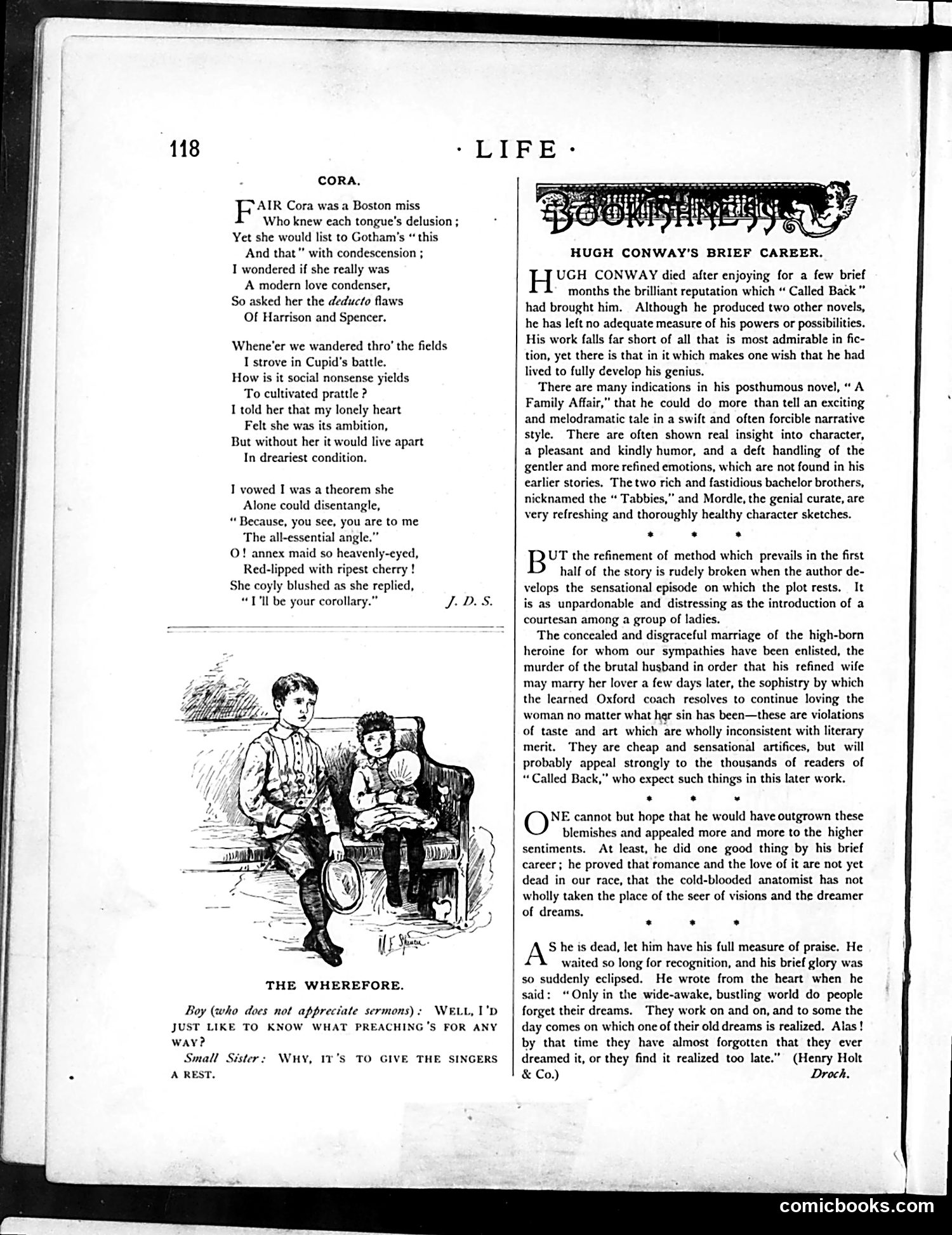
This page contains literary content rather than political satire. The left side features "Cora," a poem by J.D.S. about a Boston woman, accompanied by an illustration titled "The Wherefore" showing a man and woman in a carriage. The right side reviews Hugh Conway's novel "Called Back," discussing his brief literary career and the book's sensational plot involving a murder, a widow, and romantic complications. The reviewer criticizes the story's melodramatic elements and questionable morality, noting it appeals to popular taste despite violating literary standards. The content is primarily cultural criticism rather than political satire. It reflects late 19th-century attitudes about literature, propriety, and popular entertainment versus artistic merit.
📄 Transcribed text from this page (OCR, searchable)
Machine-transcribed from the original scan — historical spelling and the odd misread are preserved.
CORA. AIR Cora was a Boston miss Who knew each tongue’s delusion ; Yet she would list to Gotham’s “ this And that” with condescension ; I wondered if she really was A modern love condenser, So asked her the deducto flaws Of Harrison and Spencer. Whene'er we wandered thro’ the fields I strove in Cupid's battle. How is it social nonsense yields To cultivated prattle ? I told her that my lonely heart Felt she was its ambition, But without her it would live apart In dreariest condition. I vowed I was a theorem she Alone could disentangle, “ Because, you see, you are to me The all-essential angle.” O! annex maid so heavenly-eyed, Red-lipped with ripest cherry ! She coyly blushed as she replied, “T'll be your corollary.” J-D.S. THE WHEREFORE. Boy (who does not appreciate sermons): WELL, I'D JUST LIKE TO KNOW WHAT PREACHING 'S FOR ANY way? Small Sister: A REST. WHY, IT'S TO GIVE THE SINGERS HUGH CONWAY'S BRIEF CAREER. HY CONWAY died after enjoying for a few brief months the brilliant reputation which “ Called Back” had brought him. Although he produced two other novels, he has left no adequate measure of his powers or possibilities. His work falls far short of all that is most admirable in fic- tion, yet there is that in it which makes one wish that he had lived to fully develop his genius. There are many indications in his posthumous novel, “ A Family Affair,” that he could do more than tell an exciting and melodramatic tale in a swift and often forcible narrative style. There are often shown real insight into character, a pleasant and kindly humor, and a deft handling of the gentler and more refined emotions, which are not found in his earlier stories, The two rich and fastidious bachelor brothers, nicknamed the “ Tabbies,” and Mordle, the genial curate, are very refreshing and thoroughly healthy character sketches. * * . But the refinement of method which prevails in the first half of the story is rudely broken when the author de- velops the sensational episode on which the plot rests, It is as unpardonable and distressing as the introduction of a courtesan among a group of ladies. The concealed and disgraceful marriage of the high-born heroine for whom our sympathies have been enlisted, the murder of the brutal husband in order that his refined wife may marry her lover a few days later, the sophistry by which the learned Oxford coach resolves to continue loving the woman no matter what her sin has been—these are violations of taste and art which are wholly inconsistent with literary merit. They are cheap and sensational artifices, but will probably appeal strongly to the thousands of readers of “Called Back,” who expect such things in this later work. . . . NE cannot but hope that he would have outgrown these blemishes and appealed more and more to the higher sentiments. At least, he did one good thing by his brief career ; he proved that romance and the love of it are not yet dead in our race, that the cold-blooded anatomist has not wholly taken the place of the seer of visions and the dreamer of dreams. * . . S he is dead, let him have his full measure of praise. He waited so long for recognition, and his brief glory was so suddenly eclipsed. He wrote from the heart when he said: “Only in the wide-awake, bustling world do people forget their dreams. They work on and on, and to some the day comes on which one of their old dreams is realized. Alas! by that time they have almost forgotten that they ever dreamed it, or they find it realized too late.” (Henry Holt & Co.) Droch, comicbooks.com