
Life, 1885-08-27 · page 2 of 16
Life — August 27, 1885 — page 2: what you’re looking at
What you’re looking at
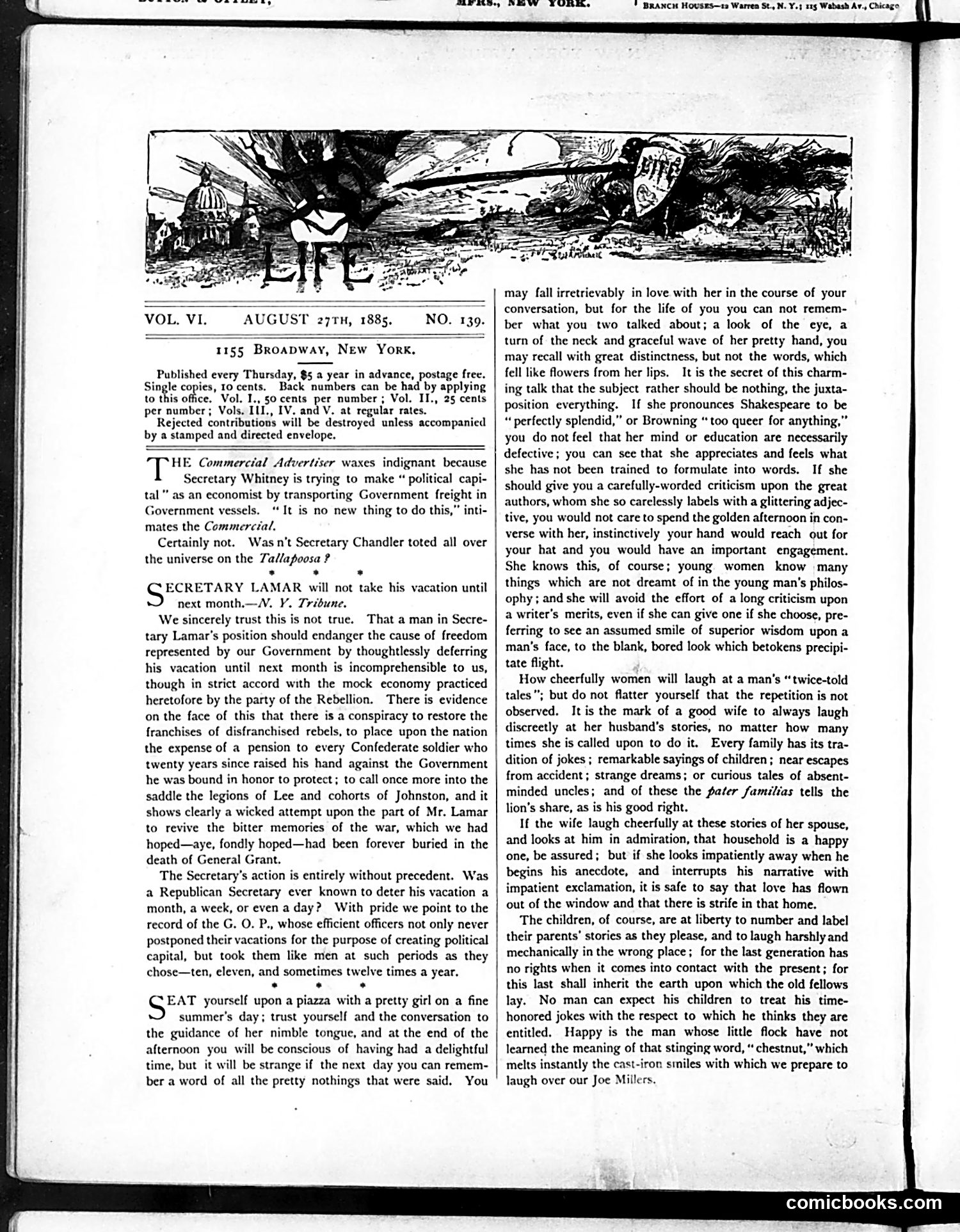
The masthead cartoon appears to depict a dramatic landscape scene with classical architectural elements (a domed building, possibly referencing Rome or Washington D.C.) alongside what seems to be a comet or celestial phenomenon streaking across the sky. The exact satirical target is unclear from the image quality, though the juxtaposition of classical architecture with astronomical imagery suggests commentary on American politics or a contemporary astronomical event. The text articles address Secretary Whitney's government freight policies and Secretary Lamar's vacation timing—both attacked as prioritizing personal interests over public duty. The "Seat yourself upon a piazza" essay discusses marital harmony and women's role in domestic life, reflecting 1880s gender attitudes. The specific figures in the cartoon cannot be definitively identified from the reproduction.
📄 Transcribed text from this page (OCR, searchable)
Machine-transcribed from the original scan — historical spelling and the odd misread are preserved.
a een VOL. VI. 77TH, 1885. NO. 139. AUG UST 2 1155 Broapway, New York. Published every Thursday, $5 a year in advance, postage free. Single copies, 10 cents. Back numbers can be had by applying to this office. Vol. I., 50 cents per number ; Vol. II., 25 cents per number; Vols. IU., IV. and V. at regular rates. Rejected contributions will be destroyed unless accompanied by a stamped and directed envelope. HE Commercial Advertiser waxes indignant because Secretary Whitney is trying to make “ political capi- tal” as an economist by transporting Government freight in Government vessels. ‘It is no new thing to do this,” inti- mates the Commercial, Certainly not. Was n't Secretary Chandler toted all over the universe on the Za//apoosa ? . . * ECRETARY LAMAR will not take his vacation until next month.—. Y. Tribune. We sincerely trust this is not true. That a man in Secre- tary Lamar’s position should endanger the cause of freedom represented by our Government by thoughtlessly deferring his vacation until next month is incomprehensible to us, though in strict accord with the mock economy practiced heretofore by the party of the Rebellion. There is evidence on the face of this that there is a conspiracy to restore the franchises of disfranchised rebels, to place upon the nation the expense of a pension to every Confederate soldier who twenty years since raised his hand against the Government he was bound in honor to protect; to call once more into the saddle the legions of Lee and cohorts of Johnston, and it shows clearly a wicked attempt upon the part of Mr. Lamar to revive the bitter memories of the war, which we had hoped—aye, fondly hoped—had been forever buried in the death of General Grant. The Secretary's action is entirely without precedent. Was a Republican Secretary ever known to deter his vacation a month, a week, or even a day? With pride we point to the record of the G. O. P., whose efficient officers not only never postponed their vacations for the purpose of creating political capital, but took them like men at such periods as they chose—ten, eleven, and sometimes twelve times a year. . . . EAT yourself upon a piazza with a pretty girl on a fine summer's day; trust yourself and the conversation to the guidance of her nimble tongue, and at the end of the afternoon you will be conscious of having had a delightful time, but it will be strange if the next day you can remem- ber a word of all the pretty nothings that were said. You mw SURE. may fall irretrievably in love with her in the course of your conversation, but for the life of you you can not remem- ber what you two talked about; a look of the eye, a turn of the neck and graceful wave of her pretty hand, you may recall with great distinctness, but not the words, which fell like flowers from her lips. It is the secret of this charm- ing talk that the subject rather should be nothing, the juxta- position everything. If she pronounces Shakespeare to be “ perfectly splendid,” or Browning “too queer for anything,” you do not feel that her mind or education are necessarily defective; you can see that she appreciates and feels what she has not been trained to formulate into words. If she should give you a carefully-worded criticism upon the great authors, whom she so carelessly labels with a glittering adjec- tive, you would not care to spend the golden afternoon in con- verse with her, instinctively your hand would reach out for your hat and you would have an important engagement. She knows this, of course; young women know many things which are not dreamt of in the young man's philos- ophy ; and she will avoid the effort of a long criticism upon a writer's merits, even if she can give one if she choose, pre- ferring to see an assumed smile of superior wisdom upon a man’s face, to the blank, bored look which betokens precipi- tate flight. How cheerfully women will laugh at a man’s “twice-told tales"; but do not flatter yourself that the repetition is not observed. It is the mark of a good wife to always laugh discreetly at her husband's stories, no matter how many times she is called upon to do it. Every family has its tra- dition of jokes ; remarkable sayings of children; near escapes from accident; strange dreams; or curious tales of absent- minded uncles; and of these the pater familias tells the lion’s share, as is his good right. If the wife laugh cheerfully at these stories of her spouse, and looks at him in admiration, that household is a happy one, be assured; but if she looks impatiently away when he begins his anecdote, and interrupts his narrative with impatient exclamation, it is safe to say that love has flown out of the window and that there is strife in that home. The children, of course, are at liberty to number and label their parents’ stories as they please, and to laugh harshly and mechanically in the wrong place; for the last generation has no rights when it comes into contact with the present; for this last shall inherit the earth upon which the old fellows lay. No man can expect his children to treat his time- honored jokes with the respect to which he thinks they are entitled. Happy is the man whose little flock have not learned the meaning of that stinging word, “ chestnut,” which melts instantly the cast-iron smiles with which we prepare to laugh over our Joe Millers. comicbooks.com * BRANCH HOUSES—ta Warren St., N. Y.; 11g Wabash Av., Chicago