
A complete issue · 16 pages · 1885
Life — August 20, 1885
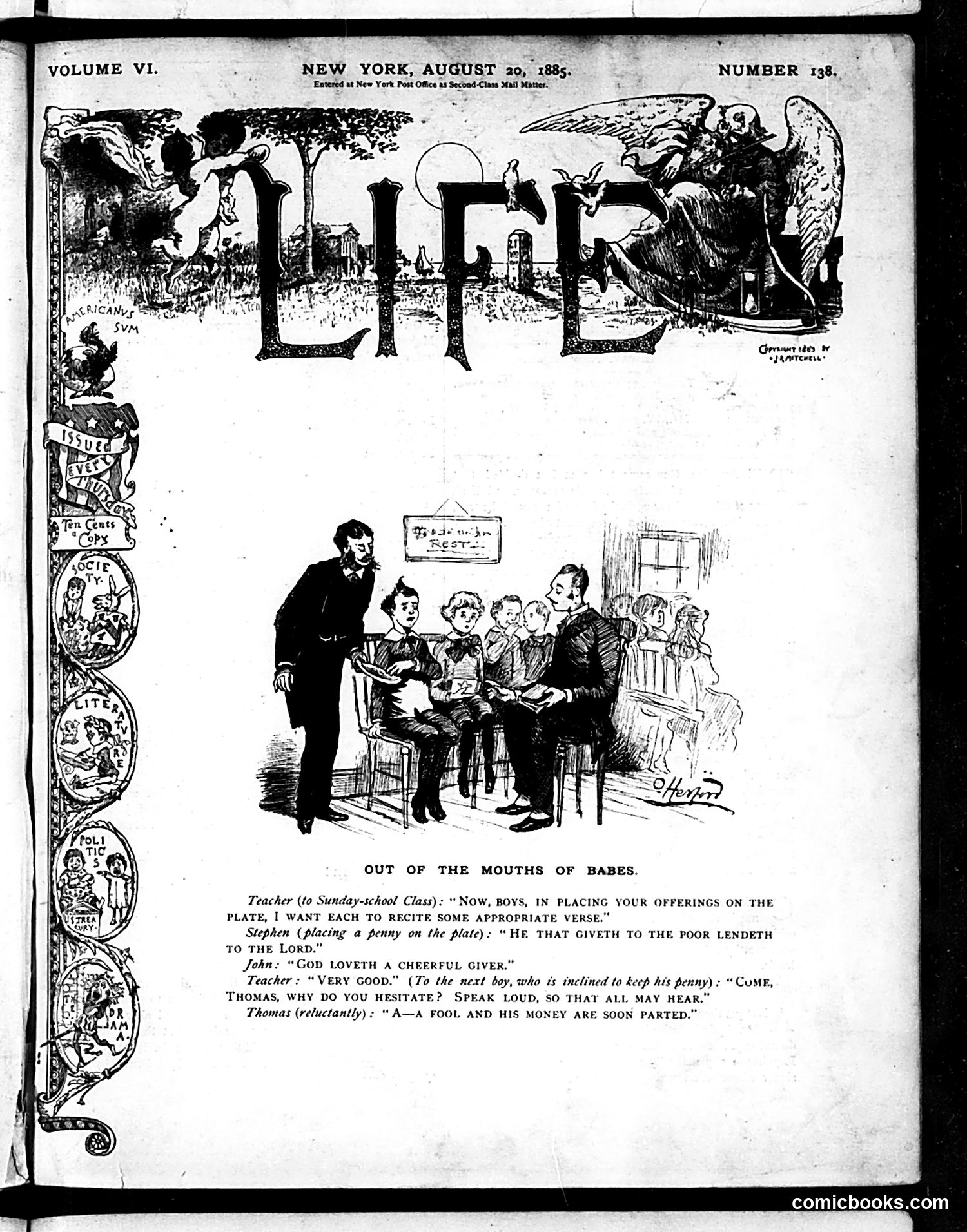
This cartoon satirizes Sunday school instruction on charitable giving. A teacher instructs boys to contribute money to the poor while reciting the biblical maxim "He that giveth to the poor lendeth to the Lord" and "God loveth a cheerful giver." When asked to contribute, Stephen dutifully places a penny on the collection plate. But Thomas, asked why he hesitates, bluntly responds: "A—a fool and his money are soon parted"—a common proverb questioning the wisdom of giving. The humor lies in the child's practical cynicism undermining the teacher's pious rhetoric. The cartoon mocks both sentimental religious instruction and exposes the tension between moral ideals and everyday skepticism about charity—suggesting even children recognize the contradiction.
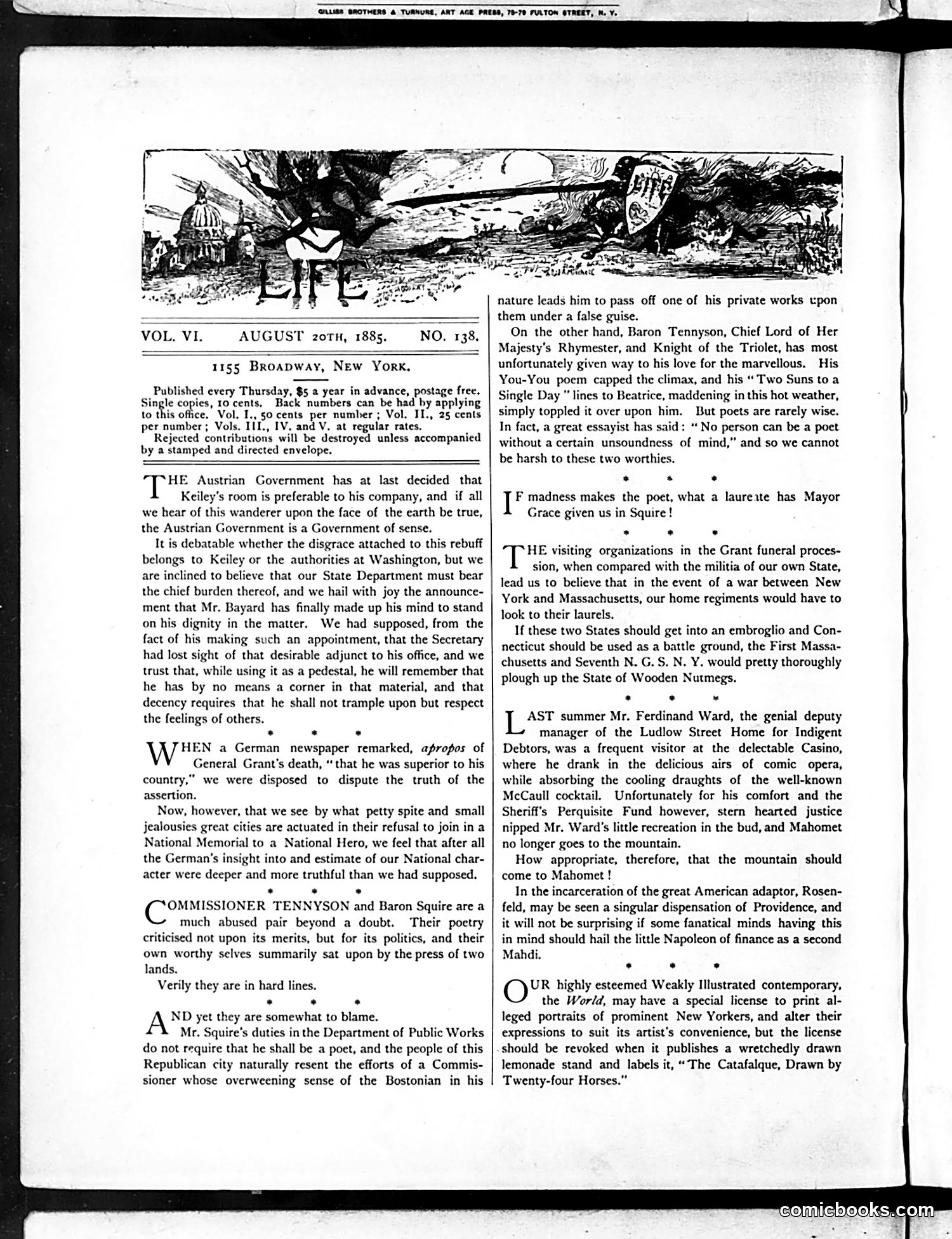
The page contains several short satirical pieces rather than a single cartoon. Key targets include: 1. **Austrian Government/Kelley's Room**: Criticism of the State Department's decision regarding an official's office space, mocking bureaucratic incompetence. 2. **Commissioner Tennyson and Baron Squire**: These figures are ridiculed for poor poetry that merits criticism, though the author notes they deserve some blame for their own inadequacies. 3. **Ferdinand Ward**: A cautionary anecdote about the deputy manager of a debtors' home who frequented casinos and was arrested, illustrating hypocrisy and moral failing. 4. **The World newspaper**: Satire about their practice of publishing unflattering portraits of prominent New Yorkers under the title "The Catafalgue, Drawn by Twenty-four Horses." The page exemplifies Life's style of short-form political and social satire targeting government officials, literary figures, and media outlets.
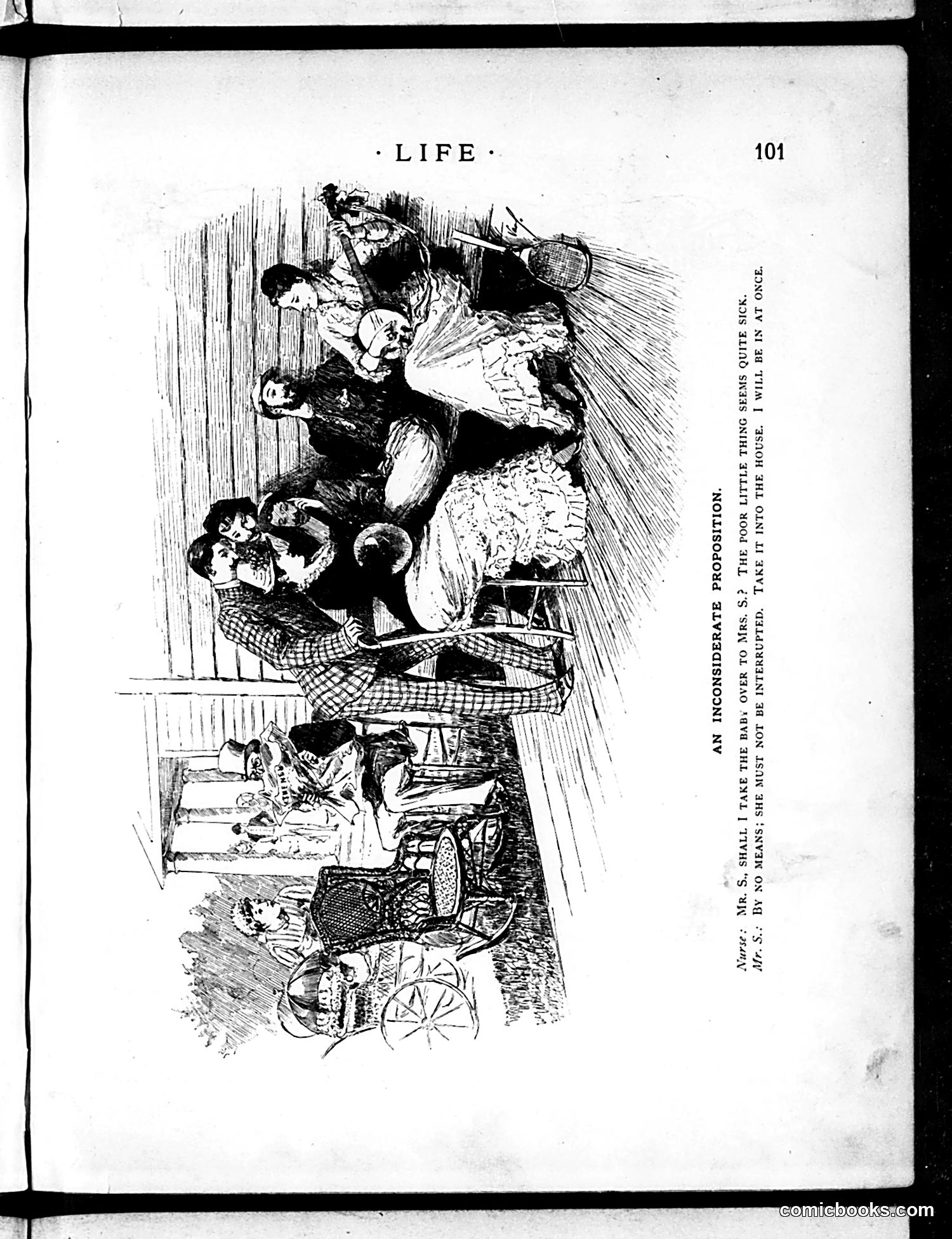
This is a satirical cartoon titled "An Inconsiderate Proposition" showing a domestic scene where a man proposes to a woman while children and household items surround them in disarray. The caption reads: "Mr. S. shall take the bird over to Mrs. S. by no means. She must not be entrusted. That it would be entrusted. That it would be to much to one." The satire appears to mock marital dynamics and domestic responsibility—specifically, a husband's inconsiderate proposal or request made amid household chaos. The children, scattered belongings, and cramped interior suggest the woman already bears significant domestic burden. The joke targets husbands who make unreasonable demands of wives already overwhelmed by household management, suggesting the proposed arrangement is impractical given her existing obligations.
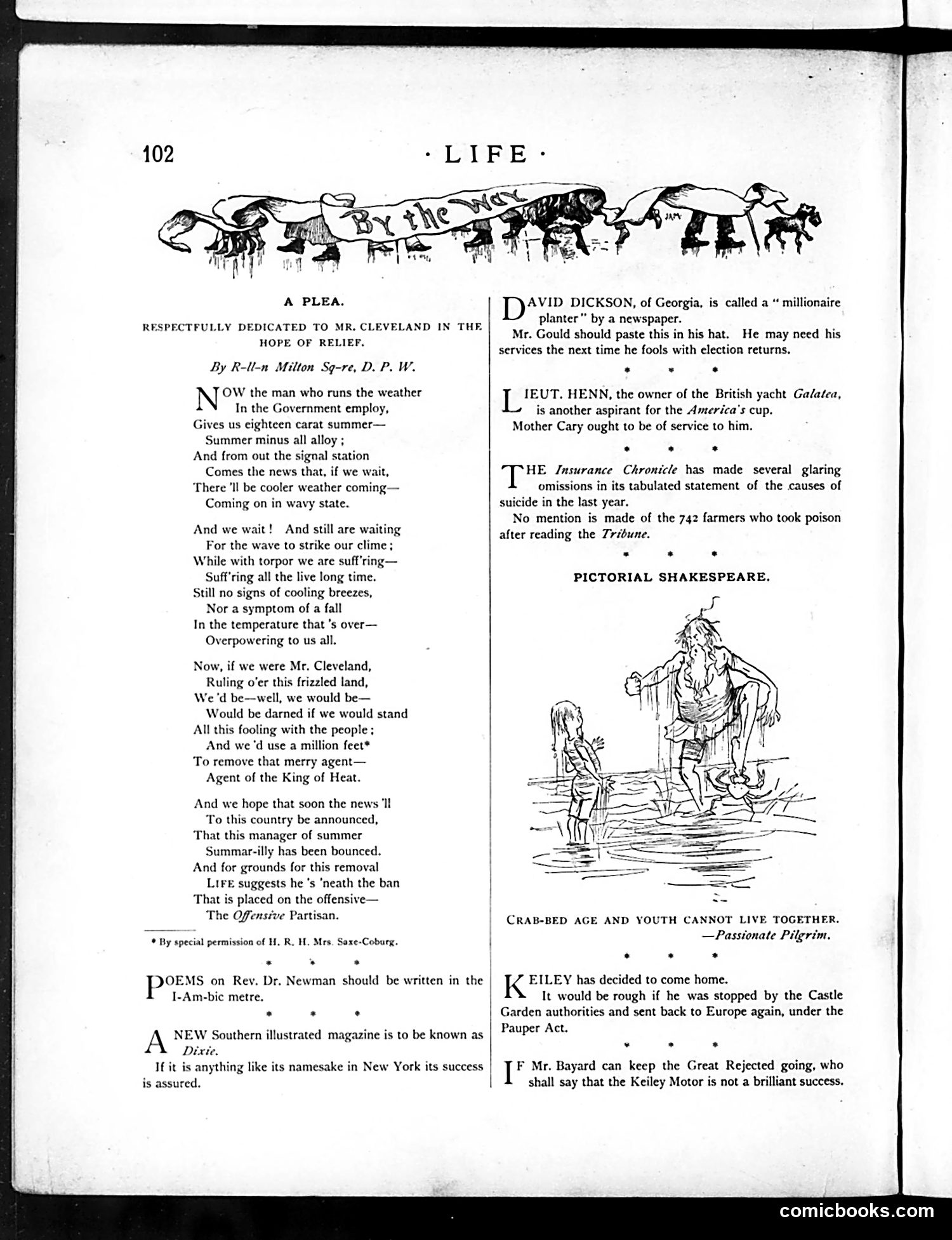
This page contains political commentary and satirical notes rather than a single unified cartoon. **"A Plea"** is a poem by R. H. Milton Spire criticizing President Cleveland's weather management during summer heat. It's satirical complaint that Cleveland, despite his government position, hasn't delivered cooler temperatures or relief from oppressive conditions—treating natural phenomena as if they were his administrative responsibility. The right column contains brief satirical jabs at contemporary figures: David Dickson (Georgia planter), Lieut. Henn (yacht owner), and complaints about the Insurance Chronicle's reporting on farmer suicides. **"Pictorial Shakespeare"** shows a sketch of an old figure with a young person—illustrating the "Passionate Pilgrim" with implied commentary on age and youth relations. The overall page is editorial commentary typical of Life's satirical approach to current events and public figures.
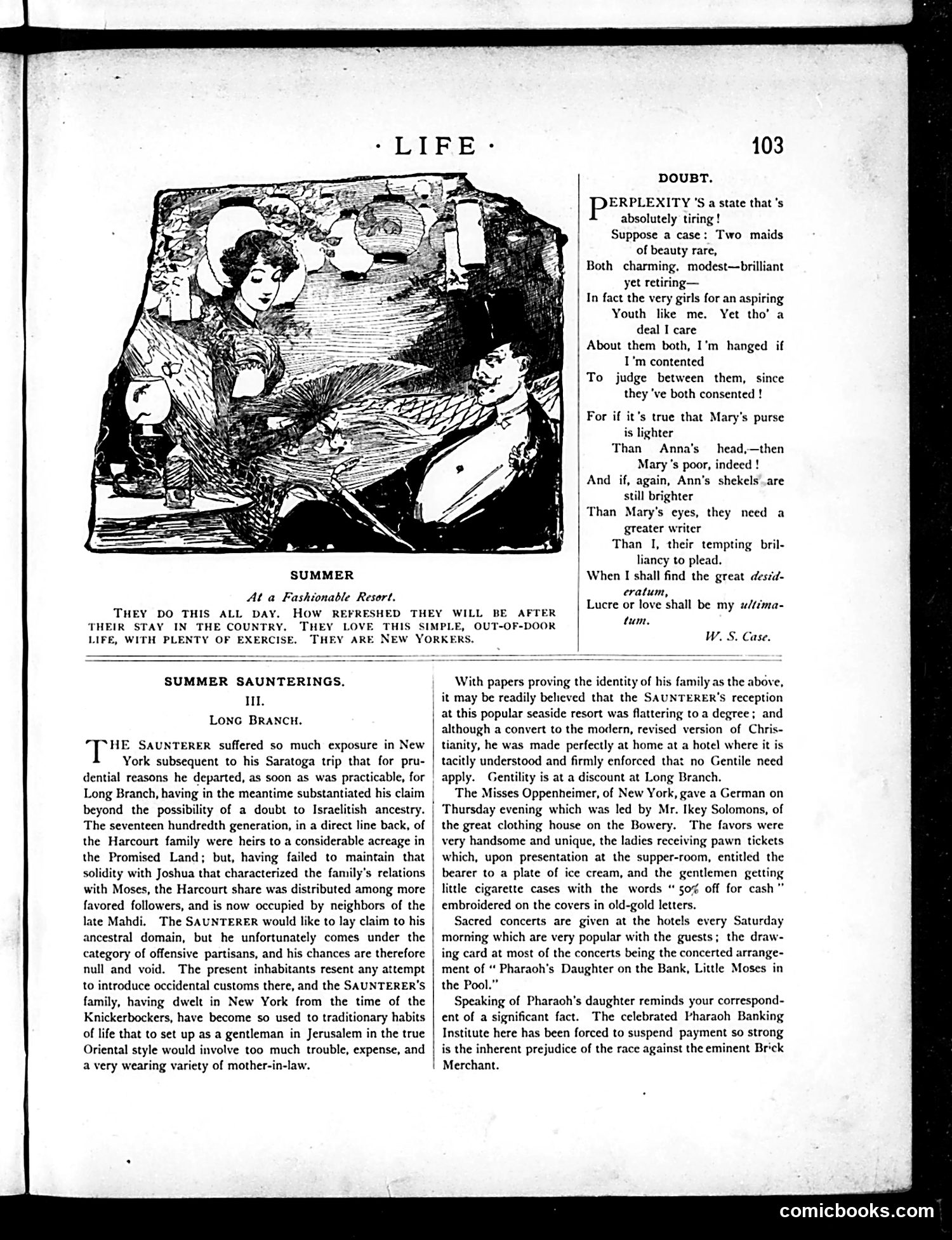
The main illustration depicts a fashionable seaside resort scene where two elegantly dressed women recline while a man in formal attire (top hat) attends to them. The caption indicates these are New Yorkers enjoying "simple, out-of-door life" at a fashionable resort. The satire appears to mock the pretensions of wealthy New Yorkers who claim to enjoy rustic simplicity while maintaining aristocratic trappings—the women are elaborately dressed and adorned, the man formally attired, suggesting this "simple" lifestyle is anything but. The accompanying text discusses the Saunterer's summer experiences and social observations about New York's wealthy elite, their genealogical pretensions, and their resort behaviors, reinforcing the satirical critique of artificial gentility among the upper classes.
This page contains **no political cartoon**. Instead, it features: 1. **A poem titled "In Summer"** by M.E.W.—a romantic verse about two lovers in moonlight, with themes of passion and uncertainty. 2. **A book review section** titled "Bookshelf: A Novel of the Old School," discussing John Eaten Cooke's novel "The Maurice Mystery." The reviewer praises Cooke's earlier historical works and notes this mystery novel appeals to readers seeking romance and intrigue without excessive sensationalism. 3. **Social notes** about Asbury Park activities, including anecdotes about drowning rescues, an auctioneer's accident, and a bankrupt businessman's settlement. The page is primarily **literary content**—poetry, book criticism, and society gossip—rather than satirical imagery.
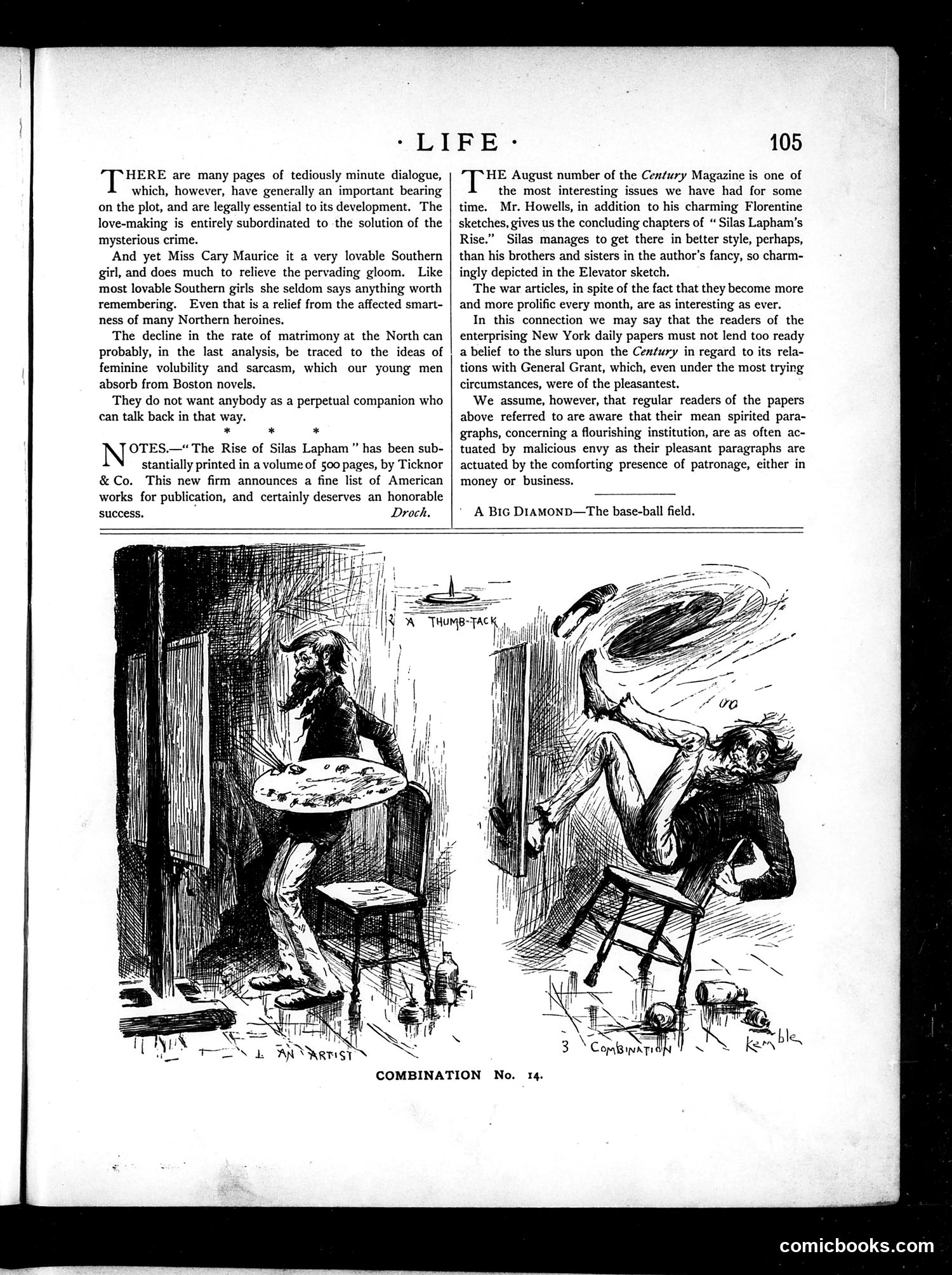
This page contains two satirical cartoons about artists struggling with their craft. The left panel shows an artist at work on a small canvas, standing on a stool. The right panel depicts another artist in an exaggerated pose, apparently wrestling with or being overwhelmed by a large, irregular shape (labeled "a thumb-tack" and "a diamond"). The title "A Big Diamond" appears to mock artistic pretension—suggesting artists tackle ambitious projects they're unprepared for, or that they struggle to execute even simple subjects convincingly. The cartoons satirize both the difficulty of artistic work and perhaps the gap between artists' ambitions and their actual abilities. The exaggerated poses emphasize the physical and mental strain involved.
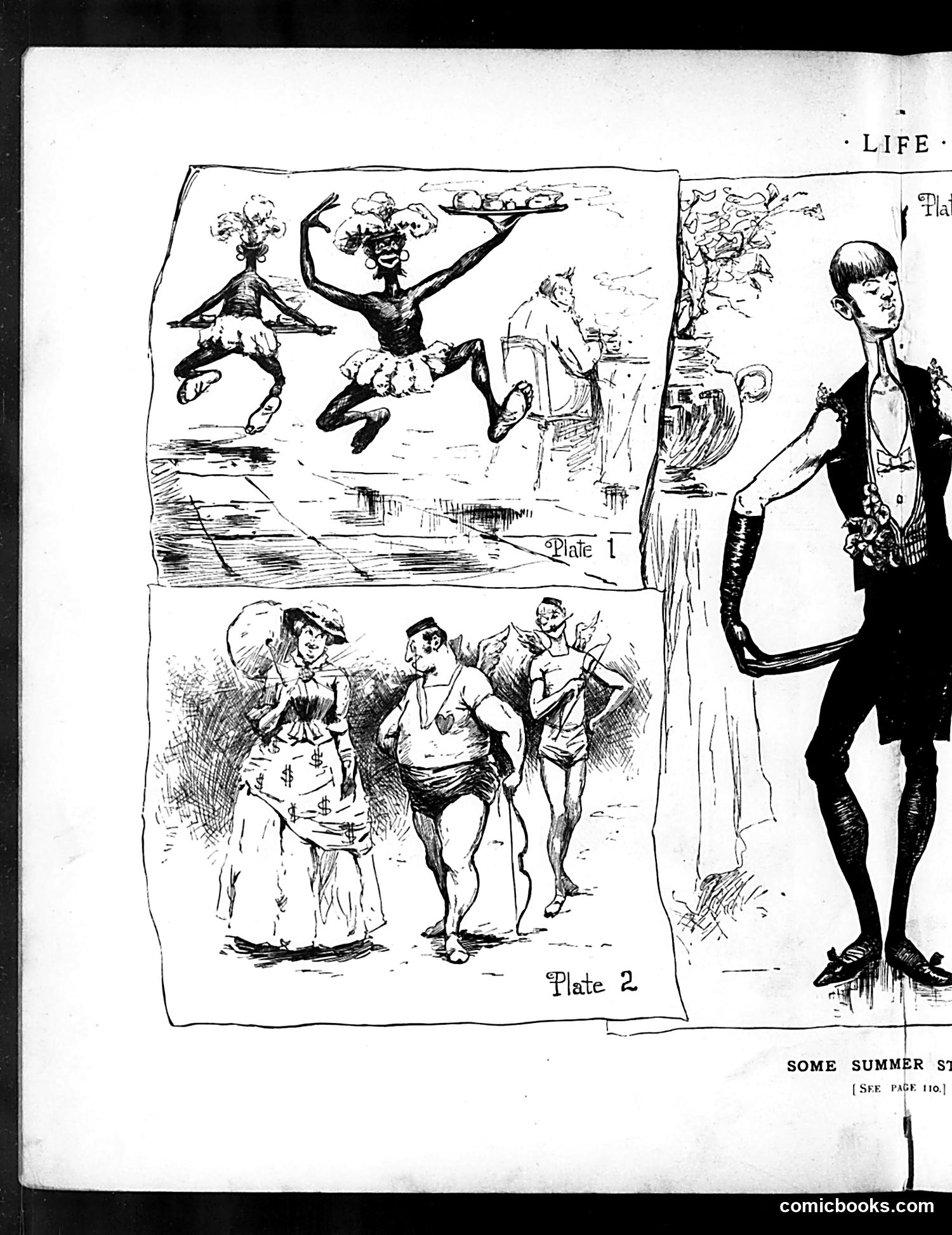
This page from *Life* magazine contains two satirical cartoon plates labeled "Plate 1" and "Plate 2," plus a formal figure on the right. **Plate 1** depicts two figures in exaggerated, comedic poses—appearing to be performers or dancers in absurd positions, likely satirizing theatrical or vaudeville entertainment of the era. **Plate 2** shows three figures in casual dress with dollar signs visible on clothing, apparently satirizing materialism or financial concerns among ordinary people. The well-dressed gentleman on the right, shown in formal evening wear with a monocle and stern expression, appears to represent upper-class respectability or authority, contrasting with the scenes of lower-class behavior or entertainment depicted in the plates. The page heading references "SOME SUMMER ST[UFF]" (text cut off), suggesting seasonal content. Without the full caption or title, the exact satirical target remains somewhat unclear, though the theme appears to involve class contrasts and social behavior.
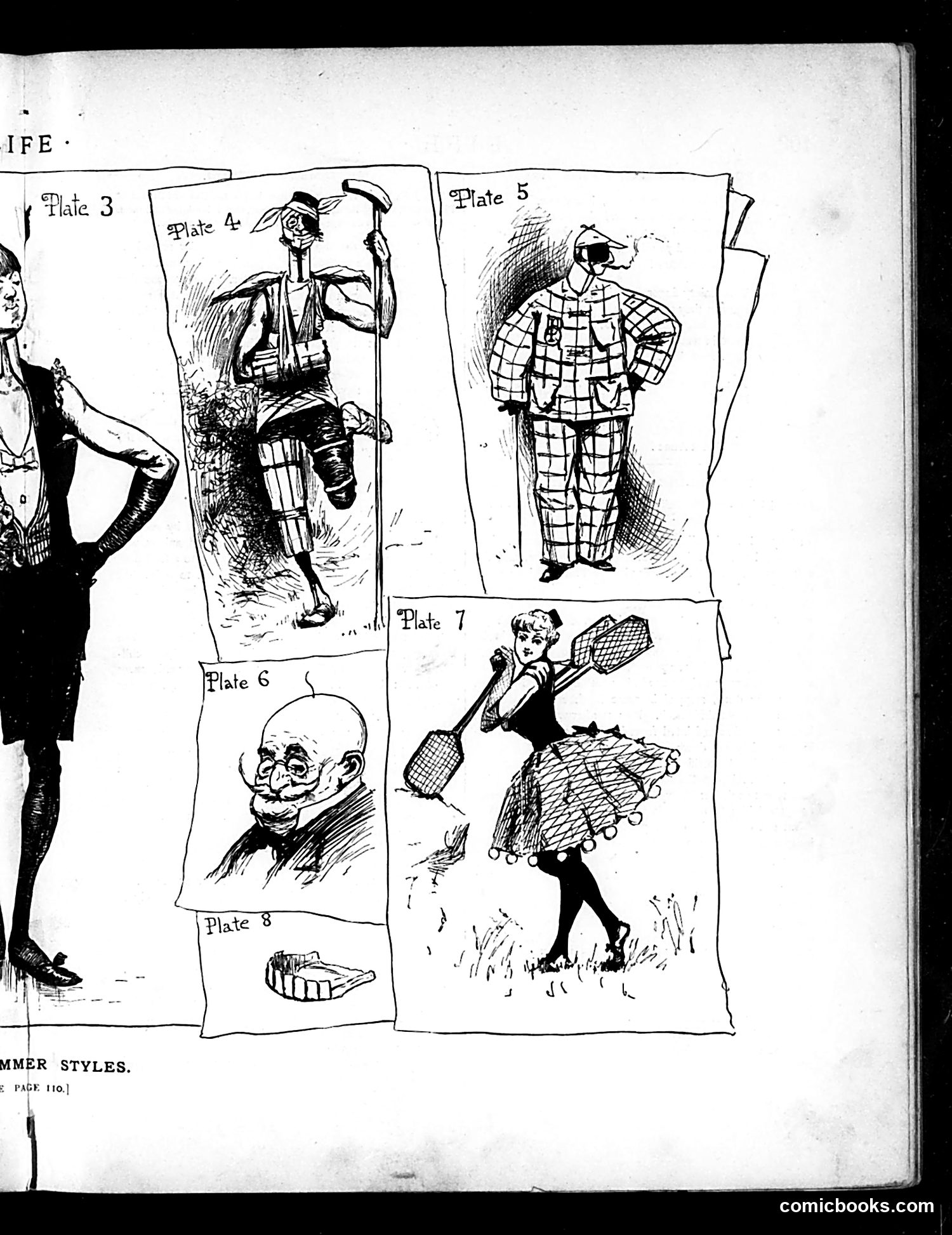
This page from *Life* magazine presents eight illustrated plates labeled "Summer Styles," appearing to be fashion or costume satire. The drawings mock various summer attire and personas: **Plate 4** depicts a figure in athletic/hiking gear with climbing equipment. **Plate 5** shows someone in an oversized checked suit. **Plate 6** features a bald man's head (portrait style). **Plate 7** illustrates a woman in a polka-dot dress wielding what appears to be a net or paddle. **Plate 8** displays what looks like a shoe or footwear detail. The overall tone suggests satirical commentary on contemporary summer fashion choices and leisure activities, likely mocking exaggerated or ridiculous interpretations of seasonal dress. Without visible byline or date, the specific targets remain unclear, though the cartooning style appears early 20th-century.
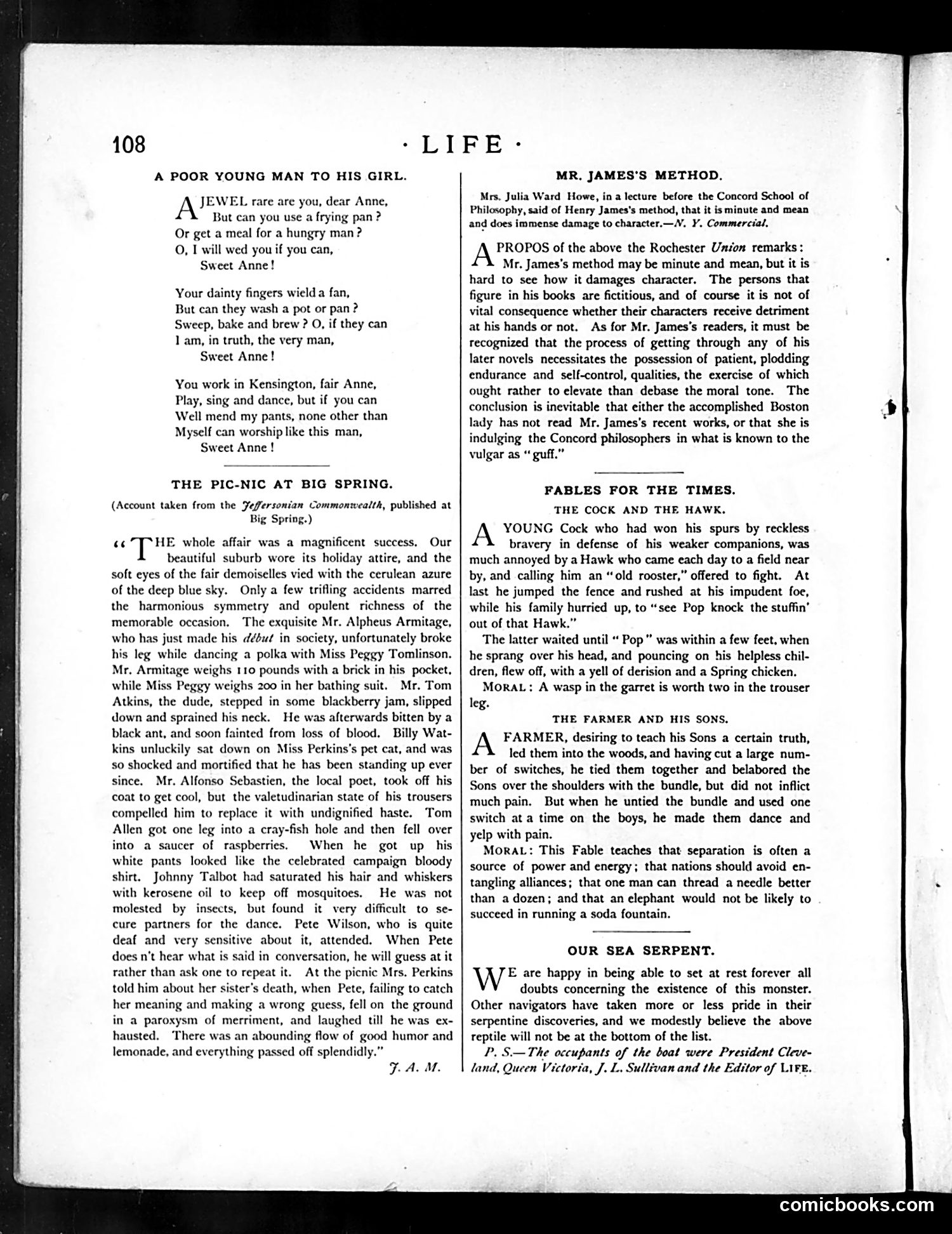
This page contains three distinct pieces of satire: 1. **"A Poor Young Man to His Girl"**: A poem mocking courtship expectations, where the suitor values Anne only for domestic skills (cooking, cleaning, mending) rather than her accomplishments in music and dance. It satirizes utilitarian marriage attitudes. 2. **"The Pic-nic at Big Spring"**: A humorous account of a disastrous picnic where every attendee suffers comic mishaps—broken legs, fainting spells, torn clothing, insect bites, and social embarrassment. The excessive cataloging of accidents parodies overwrought, sentimental newspaper accounts of social events. 3. **"Mr. James's Method"**: A critical commentary on Henry James's writing style, defending him against charges by Julia Ward Howe that his "minute and mean" method damages character. The editor argues his complex novels actually require and elevate moral discipline. These pieces collectively satirize American social conventions, journalistic excess, and literary criticism of the era.
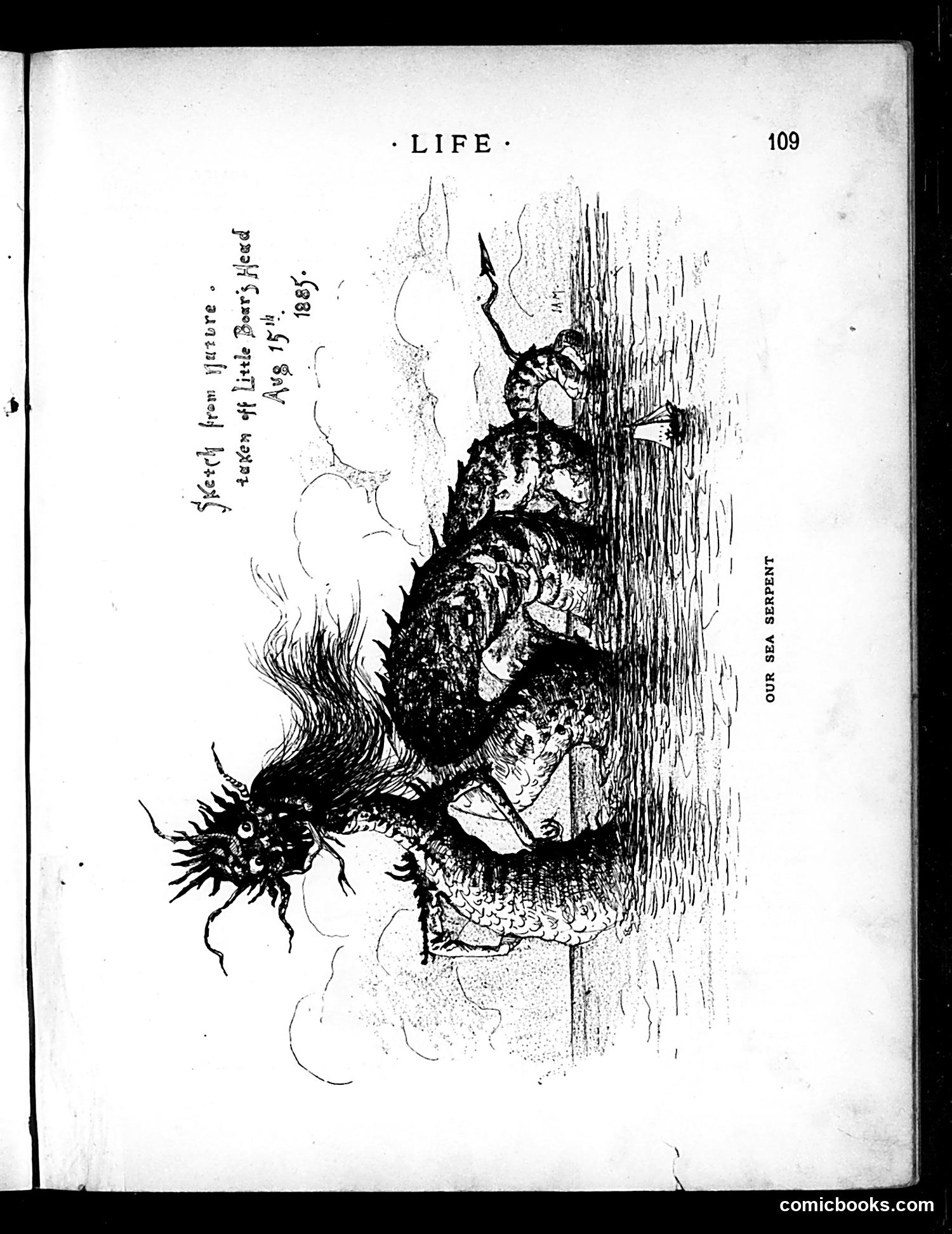
This appears to be a satirical illustration from *Life* magazine depicting a sea serpent—a legendary creature that periodically captured public imagination. The title "Our Sea Serpent" suggests this is commentary on contemporary discussions or sightings of the mythical beast. The detailed engraving shows a fantastical, spiky creature emerging from turbulent waters, rendered in the dramatic style typical of 19th-century illustration. The satire likely mocks either: 1. **Credulous public belief** in sea serpent sightings despite lack of scientific evidence 2. **Sensationalist newspaper coverage** that promoted unverified monster claims 3. **A specific recent "sighting"** that had captured media attention Without clearer OCR text or dating, the exact contemporary reference remains unclear, but the cartoon ridicules public gullibility regarding pseudoscientific phenomena—a recurring *Life* magazine theme.
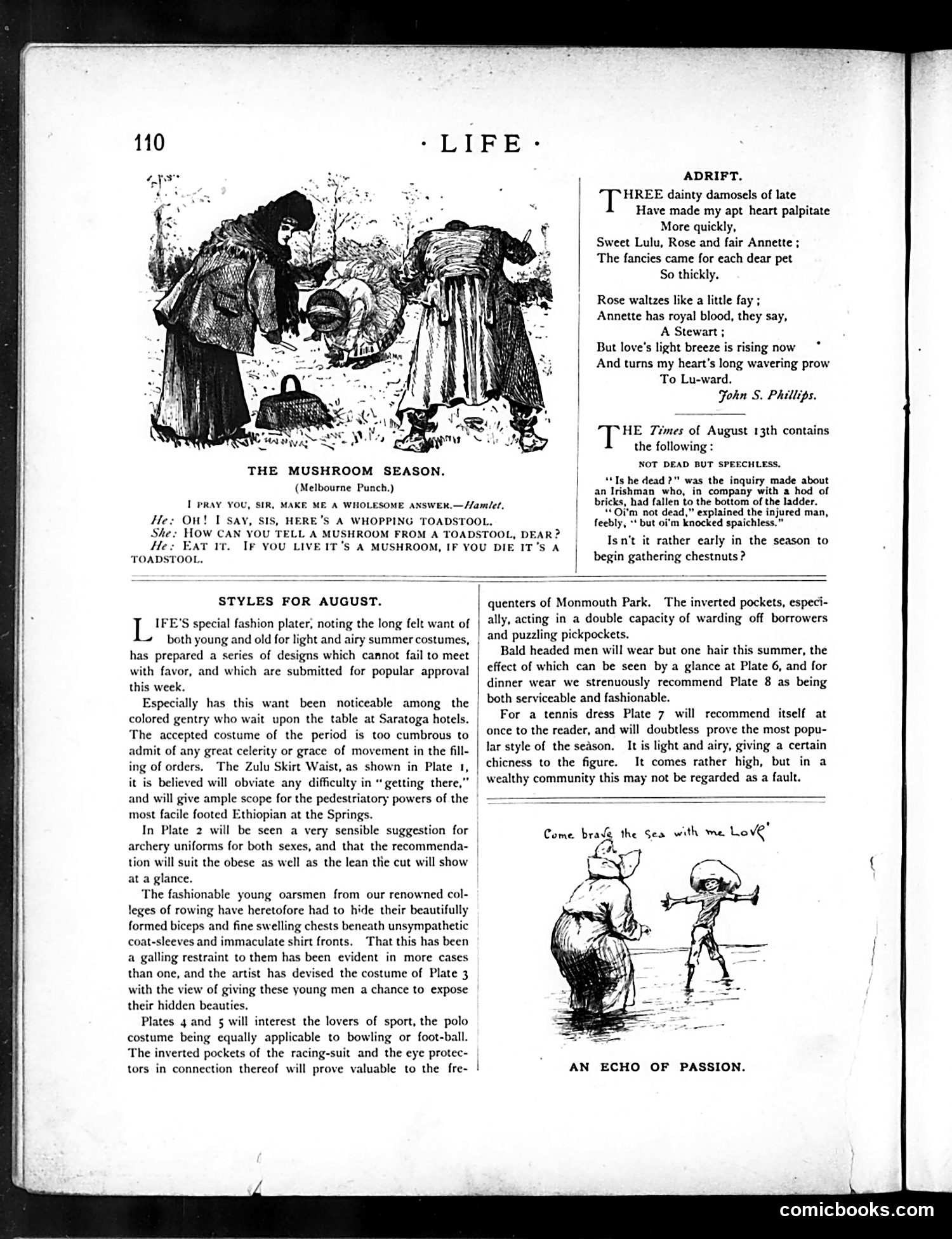
**Top Cartoon ("The Mushroom Season"):** A couple discusses edible mushrooms versus poisonous toadstools. The man proposes the crude test: eat it—if you survive, it's a mushroom; if you die, it's a toadstool. This is dark humor mocking dangerous folk wisdom about distinguishing the two. **"Styles for August" Section:** This is satirical fashion commentary targeting African American hotel workers ("colored gentry who wait upon the table at Saratoga hotels"). The "Zulu Skirt Waist" mocks their actual work uniforms while pretending to offer fashion advice. References to "bald headed men," polo costumes, and other impractical designs are absurdist comedy. The inverted pockets joke about "warding off borrowers and puzzling pickpockets" contains ethnic stereotyping typical of period satire. **Other Content:** Includes a poem about romantic indecision and a brief Irish joke playing on dialect humor. The page reflects 19th-century American satirical magazine conventions—witty but often containing racial caricature and condescending humor about working-class and immigrant populations.
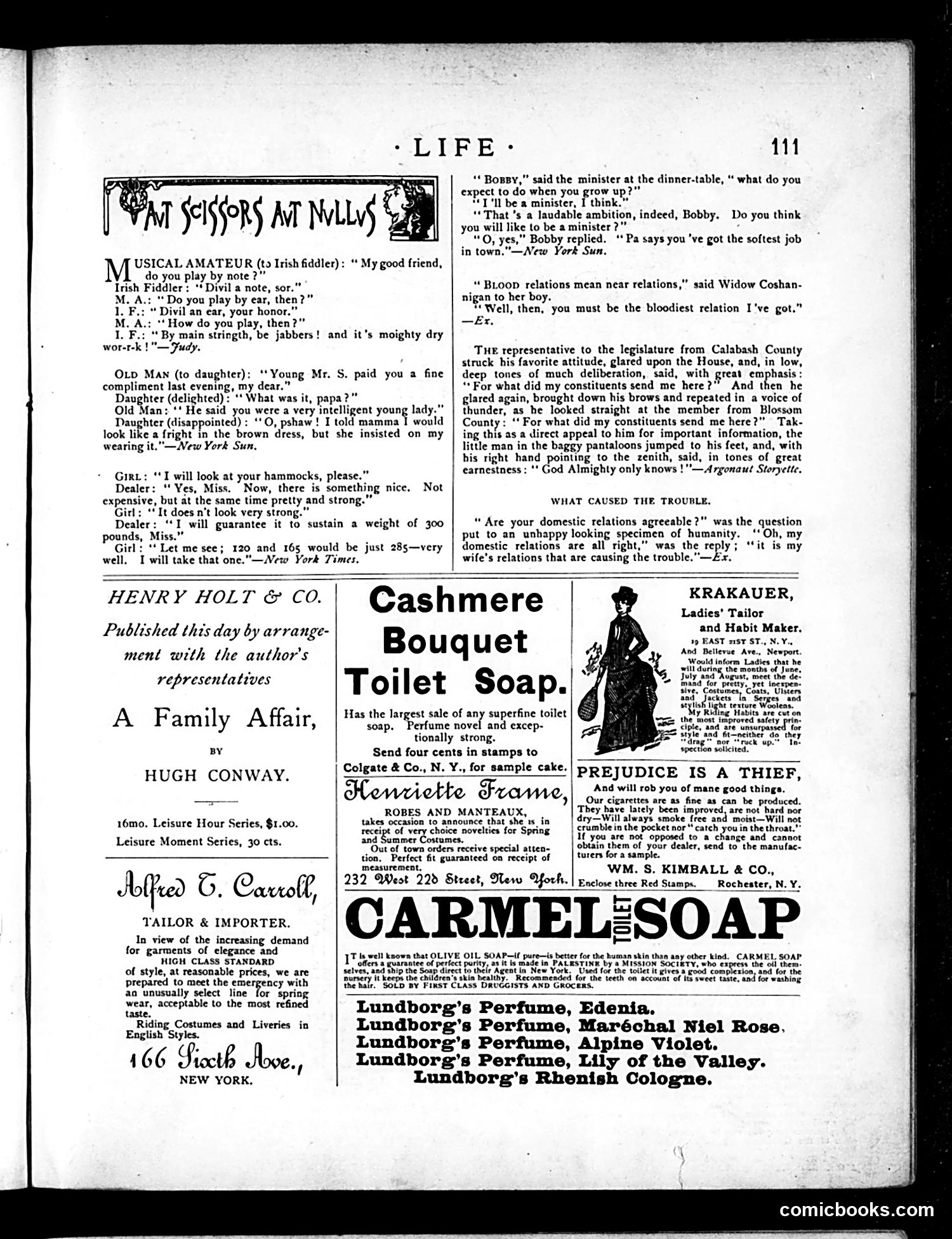
This page contains several short humorous anecdotes satirizing American social life and hypocrisy. The "scissors at nulls" cartoons mock everyday pretensions: - A child's candid remark that ministry offers "the softest job in town" satirizes clerical work as undemanding - A Irish fiddler's inability to read music plays on ethnic stereotypes - A legislator's bombastic self-importance ("For what did my constituents send me here?") is deflated when a colleague responds "God Almighty only knows!"—mocking pompous politicians - A husband's marital troubles stem from his wife's *relations*, not domestic issues—a joke about troublesome in-laws These brief satirical pieces exemplify *Life*'s format: poking fun at clergy, politicians, ethnic groups, and middle-class social anxieties. The page is primarily advertising for soaps and perfumes, with one book notice for Hugh Conway's "A Family Affair."
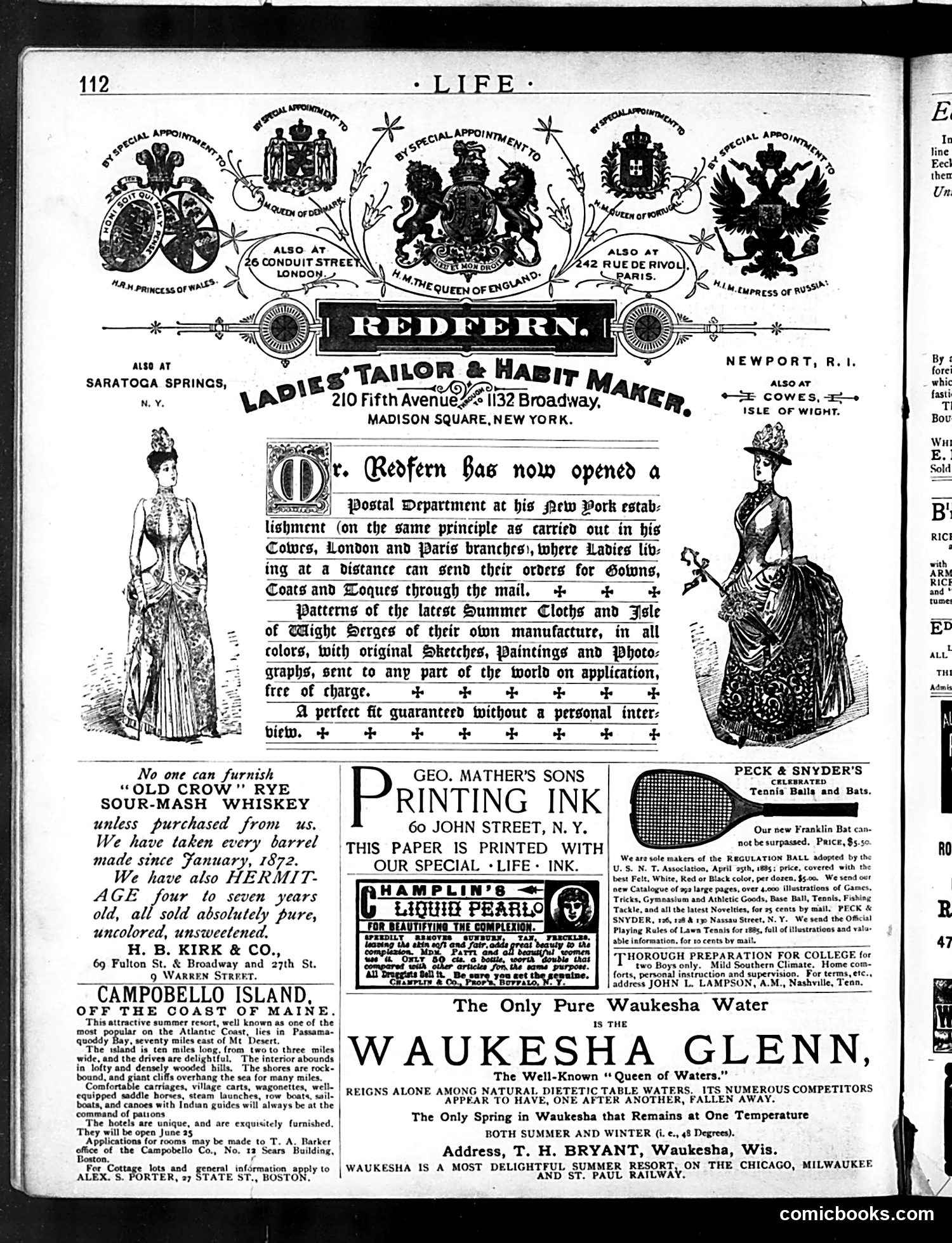
This page is primarily **advertising**, not political satire. It features: **Fashion/Tailoring**: Redfern, a prestigious ladies' tailor with branches in London, Paris, and Cowes (Isle of Wight), advertises custom garment services via mail, targeting wealthy women who can't visit in person. **Beverages**: H.B. Kirk & Co. promotes "Old Crow" rye whiskey and Hermitage bourbon, emphasizing authenticity and purity since 1872. Waukesha Glenn mineral water is advertised as the superior natural spring water. **Sporting Goods**: Peck & Snyder sells tennis equipment (the paper itself is printed with "Life Ink"). **Tourism**: Advertisements for Campobello Island resort (Maine) and educational preparation for college boys. The decorative header features royal crests—"By Special Appointment" to various European monarchs—a common marketing device indicating prestige and elite patronage. This reflects the Gilded Age's aspirational marketing to wealthy Americans.
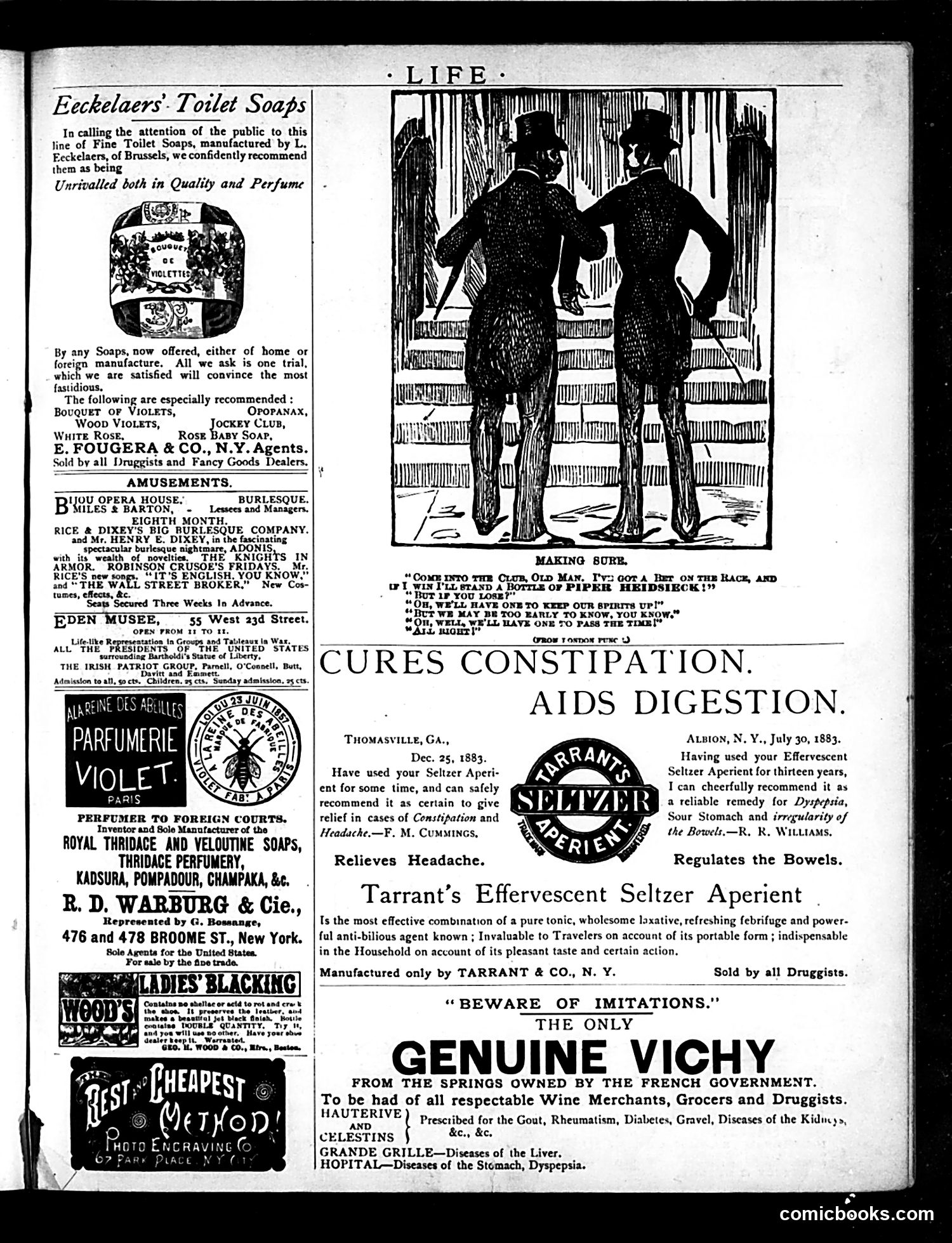
This page is primarily **advertisements and theater listings** from an 1883 issue of *Life* magazine. The only cartoon appears in the middle-right: two men at a racetrack discuss betting on horses and drinking champagne ("Piper Heidsieck"). The joke is simple—one man bets on a race and proposes they celebrate with champagne whether they win or lose, covering all outcomes. The bulk of the page advertises patent medicines, soaps, and services typical of the era: Tarrant's Seltzer (marketed for digestion and constipation), Vichy water (promoted for gout and kidney disease), and luxury European soaps and perfumes. The theater listings mention "Rice & Dixey's Big Burlesque Company" and Eden Musée's wax figures, including Irish patriotic figures (Parnell, O'Connell, Butt)—reflecting contemporary interest in Irish nationalism. The page reflects Victorian consumer culture and the prevalence of unregulated patent medicine advertising.
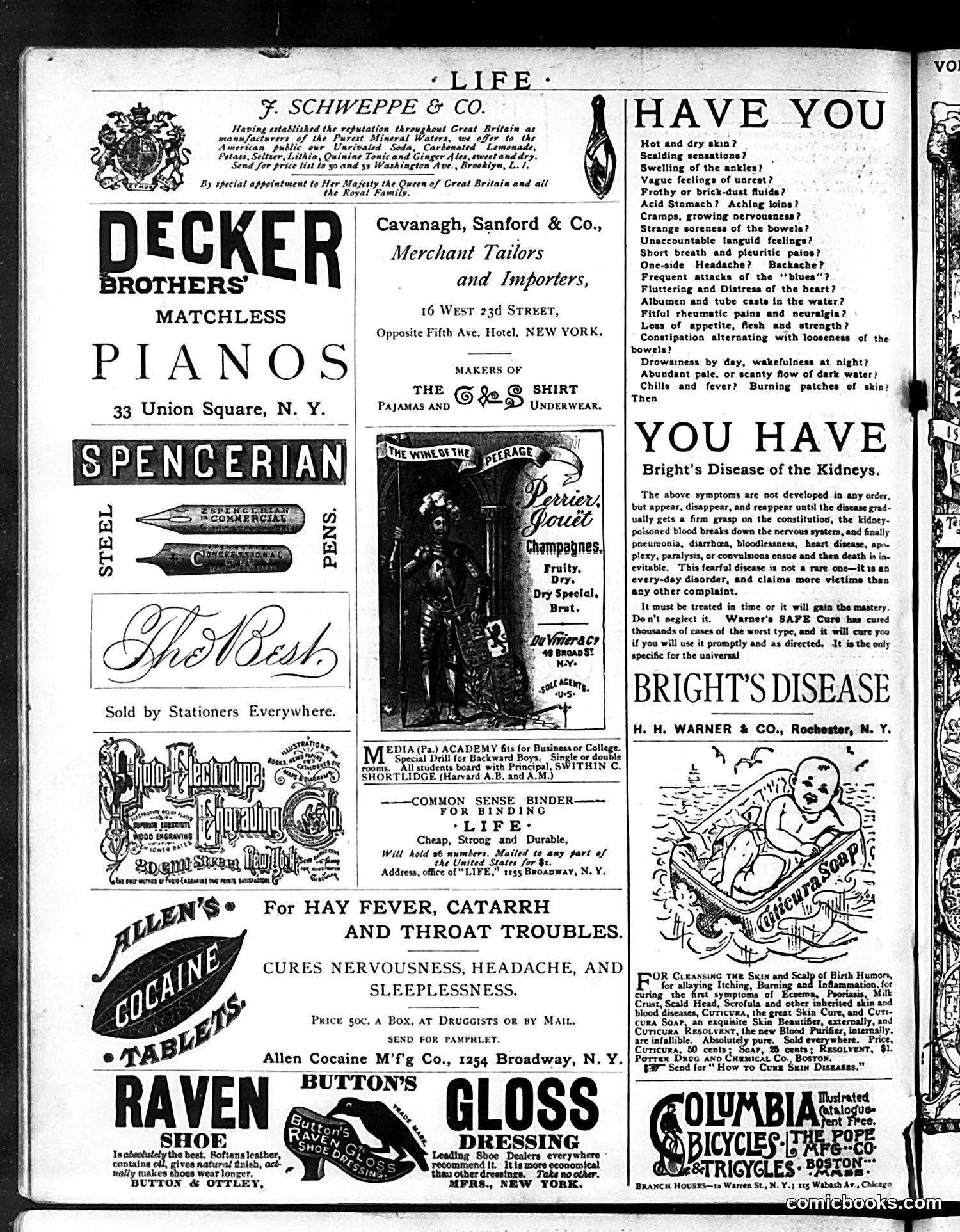
This page is primarily **advertisements**, not editorial or satirical content. However, it reveals important historical context about 1890s patent medicine culture. The most prominent ad is **H.H. Warner & Co.'s "Bright's Disease" cure**—a fraudulent medical claim. The ad lists dozens of vague symptoms (fatigue, digestive issues, joint pain) and declares them all evidence of kidney disease, then promises Warner's "SAFE Cure" as the only remedy. This exemplifies the **snake oil medicine epidemic** of the era: unregulated companies made unsubstantiated health claims to frighten consumers into buying ineffective (sometimes harmful) products. Other ads include Allen's cocaine tablets "for hay fever" and various shoe polishes and patent medicines—all typical of unregulated American advertising before the 1906 Pure Food and Drug Act. **For modern readers:** This page documents how companies exploited public health anxiety and medical ignorance before government regulation, consumer protection laws, or FDA oversight existed.