
Life, 1885-08-20 · page 2 of 16
Life — August 20, 1885 — page 2: what you’re looking at
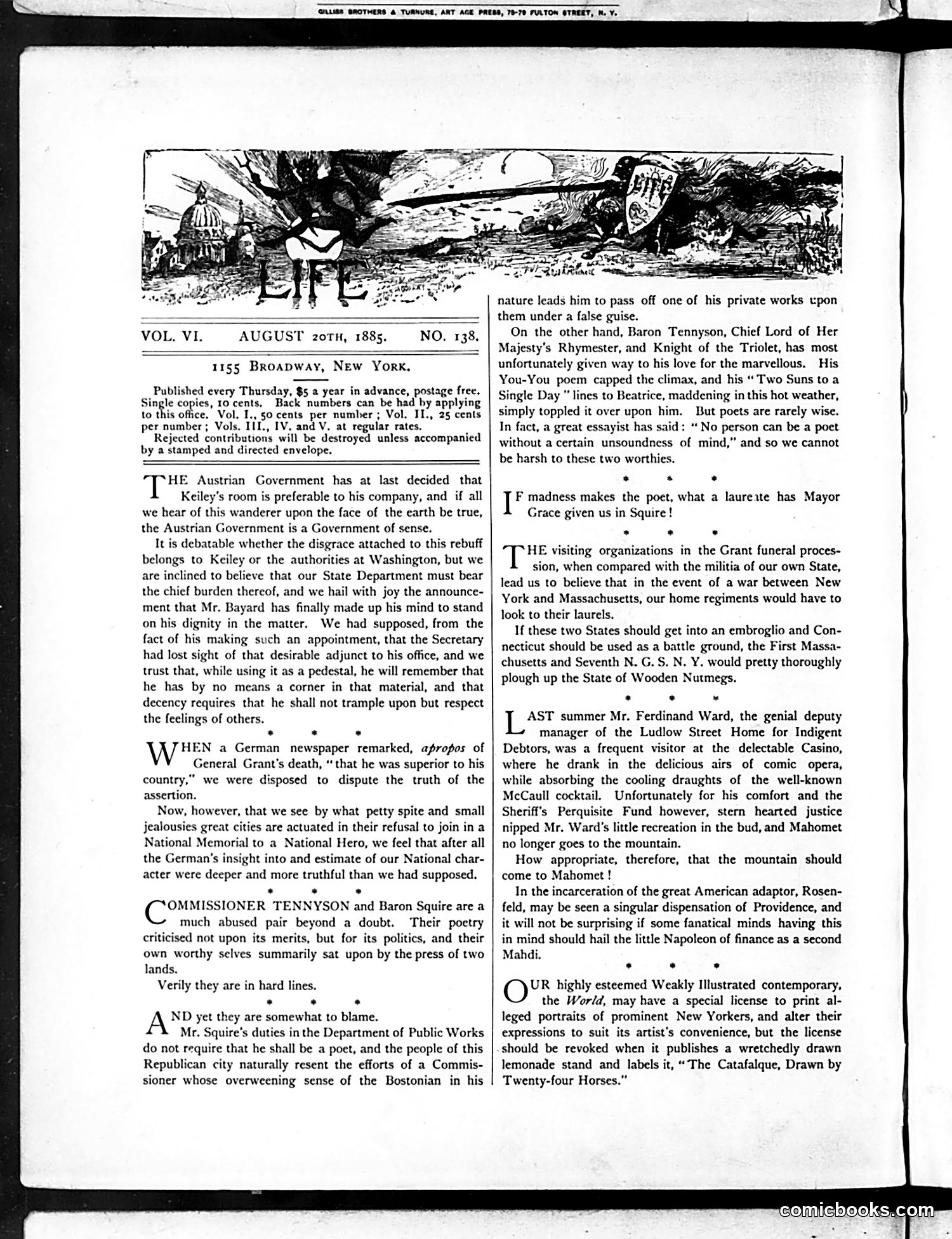
What you’re looking at
The page contains several short satirical pieces rather than a single cartoon. Key targets include: 1. **Austrian Government/Kelley's Room**: Criticism of the State Department's decision regarding an official's office space, mocking bureaucratic incompetence. 2. **Commissioner Tennyson and Baron Squire**: These figures are ridiculed for poor poetry that merits criticism, though the author notes they deserve some blame for their own inadequacies. 3. **Ferdinand Ward**: A cautionary anecdote about the deputy manager of a debtors' home who frequented casinos and was arrested, illustrating hypocrisy and moral failing. 4. **The World newspaper**: Satire about their practice of publishing unflattering portraits of prominent New Yorkers under the title "The Catafalgue, Drawn by Twenty-four Horses." The page exemplifies Life's style of short-form political and social satire targeting government officials, literary figures, and media outlets.
📄 Transcribed text from this page (OCR, searchable)
Machine-transcribed from the original scan — historical spelling and the odd misread are preserved.
AUGUST 2orn, 1885. VOL. VI. 1155 BROADway, New York, Published every Thursday, $5 a year in advance, postage free. Single copies, 10 cents. Back numbers can be had by applying to this office. Vol. I., §0 cents per number ; Vol. II., 25 cents per number; Vols. III, IV. and V. at regular rates. Rejected contributions will be destroyed unless accompanied by a stamped and directed envelope. HE Austrian Government has at last decided that Keiley’s room is preferable to his company, and if all we hear of this wanderer upon the face of the earth be true, the Austrian Government is a Government of sense. It is debatable whether the disgrace attached to this rebuff belongs to Keiley or the authorities at Washington, but we are inclined to believe that our State Department must bear the chief burden thereof, and we hail with joy the announce- ment that Mr. Bayard has finally made up his mind to stand on his dignity in the matter. We had supposed, from the fact of his making such an appointment, that the Secretary had lost sight of that desirable adjunct to his office, and we trust that, while using it as a pedestal, he will remember that he has by no means a corner in that material, and that decency requires that he shall not trample upon but respect the feelings of others. . . . HEN a German newspaper remarked, apropos of General Grant's death, “that he was superior to his country,” we were disposed to dispute the truth of the assertion. Now, however, that we see by what petty spite and small jealousies great cities are actuated in their refusal to join in a National Memorial to a National Hero, we feel that after all the German's insight into and estimate of our National char- acter were deeper and more truthful than we had supposed. . . . OMMISSIONER TENNYSON and Baron Squire are a much abused pair beyond a doubt. Their poetry criticised not upon its merits, but for its politics, and their own worthy selves summarily sat upon by the press of two lands. Verily they are in hard lines. . . . ND yet they are somewhat to blame. Mr. Squire's duties in the Department of Public Works do not require that he shall be a poet, and the people of this Republican city naturally resent the efforts of a Commis- sioner whose overweening sense of the Bostonian in his nature leads him to pass off one of his private works upon them under a false guise. On the other hand, Baron Tennyson, Chief Lord of Her Majesty's Rhymester, and Knight of the Triolet, has most unfortunately given way to his love for the marvellous. His You-You poem capped the climax, and his “ Two Suns to a Single Day " lines to Beatrice, maddening in this hot weather, simply toppled it over upon him. But poets are rarely wise. In fact, a great essayist has said: ‘‘ No person can be a poet without a certain unsoundness of mind,” and so we cannot be harsh to these two worthies. . . . F madness makes the poet, what a laureate has Mayor Grace given us in Squire! . . . HE visiting organizations in the Grant funeral proces- sion, when compared with the militia of our own State, lead us to believe that in the event of a war between New York and Massachusetts, our home regiments would have to look to their laurels, If these two States should get into an embroglio and Con- necticut should be used as a battle ground, the First Massa- chusetts and Seventh N. G. S. N. Y. would pretty thoroughly plough up the State of Wooden Nutmegs. * * * AST summer Mr. Ferdinand Ward, the genial deputy manager of the Ludlow Street Home for Indigent Debtors, was a frequent visitor at the delectable Casino, where he drank in the delicious airs of comic opera, while absorbing the cooling draughts of the well-known McCaull cocktail. Unfortunately for his comfort and the Sheriff's Perquisite Fund however, stern hearted justice nipped Mr. Ward's little recreation in the bud, and Mahomet no longer goes to the mountain. How appropriate, therefore, that the mountain should come to Mahomet ! In the incarceration of the great American adaptor, Rosen- feld, may be seen a singular dispensation of Providence, and it will not be surprising if some fanatical minds having this in mind should hail the little Napoleon of finance as a second Mahdi. . . . UR highly esteemed Weakly Illustrated contemporary, the World, may have a special license to print al- leged portraits of prominent New Yorkers, and alter their expressions to suit its artist’s convenience, but the license should be revoked when it publishes a wretchedly drawn lemonade stand and labels it, “The Catafalque, Drawn by Twenty-four Horses.”