
A complete issue · 16 pages · 1885
Life — August 6, 1885
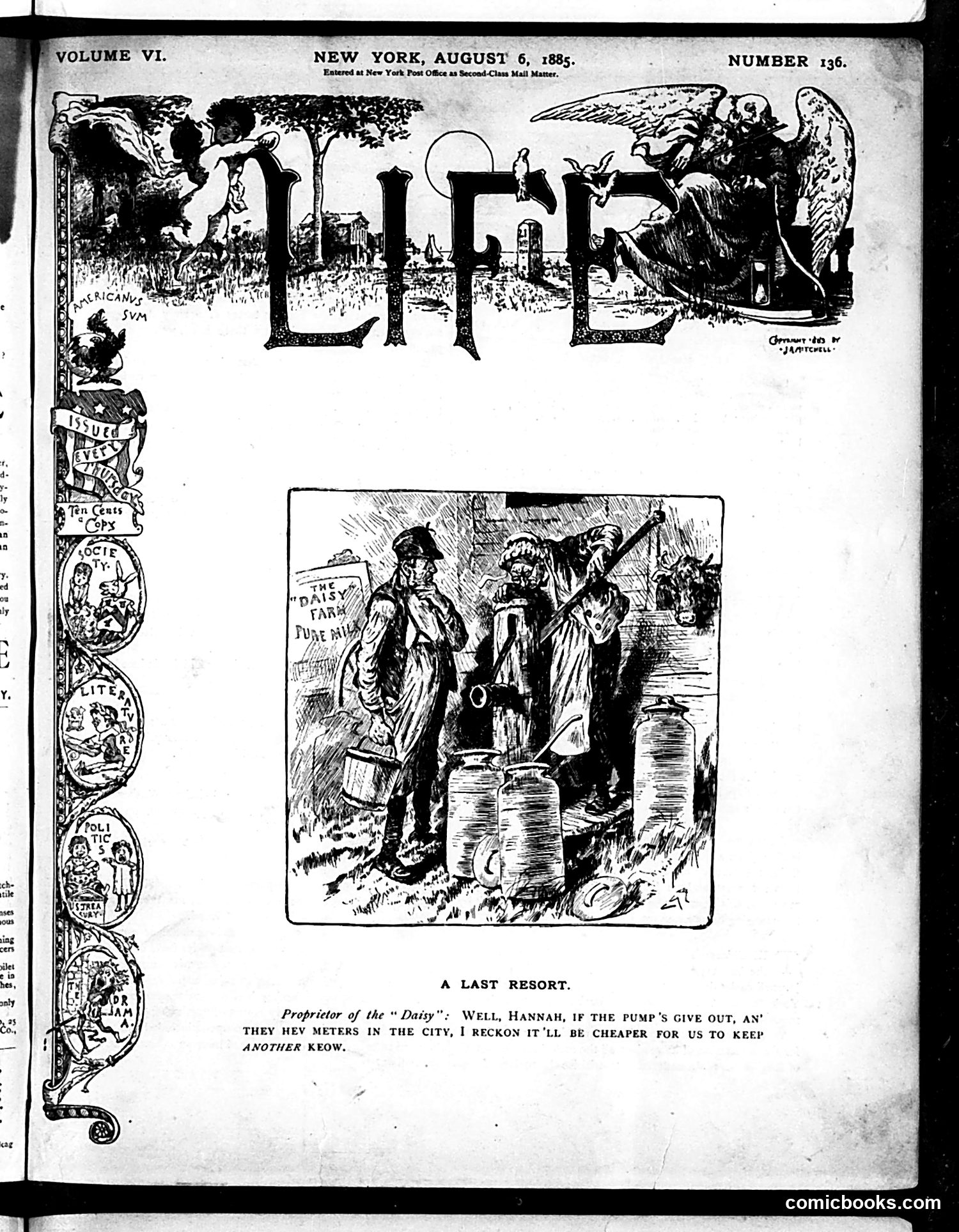
This cartoon satirizes the proprietor of the "Daisy" dairy farm during what appears to be a public health crisis or contamination scare. The figure, dressed as a wealthy businessman, stands amid large milk containers while discussing desperate measures with associates. The caption suggests that if their pump fails and dairy meters stop working (preventing milk distribution to the city), they'll resort to keeping contaminated milk themselves rather than discarding it—implying deliberate poisoning of their own supply as economically preferable to loss. The satire targets both unscrupulous dairy operators and urban food safety concerns prevalent in 1880s America, when milk contamination and adulteration were genuine public health threats. The cartoon exposes the callous prioritization of profit over consumer safety.
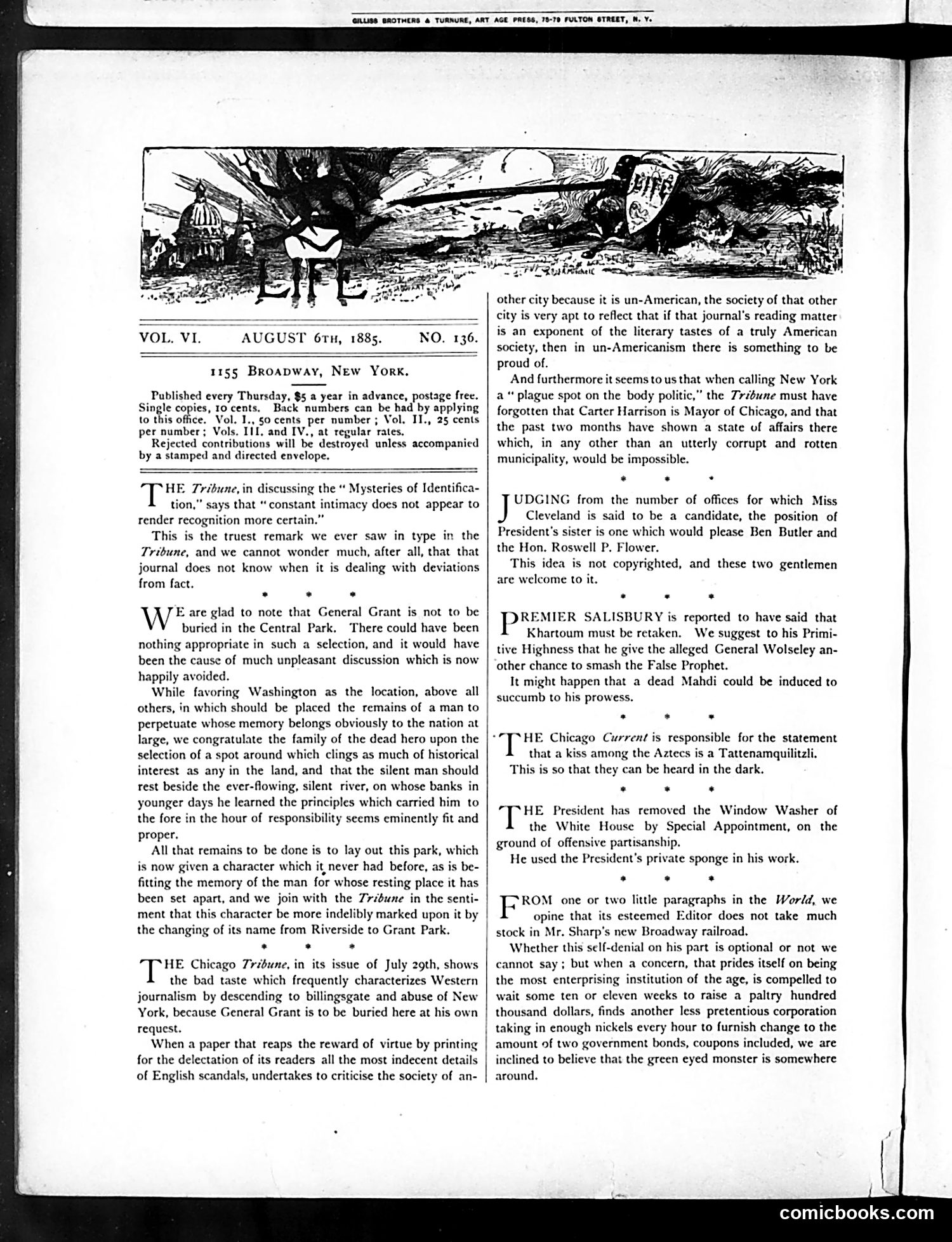
The cartoon at the top shows a figure sitting contemplatively beside what appears to be a river or body of water, with architectural structures visible in the background—likely illustrating the editorial discussion below about General Grant's burial location. The main text debates where General Ulysses S. Grant should be buried. The *Life* editors argue against burying him in Central Park, contending that Washington D.C. would be more appropriate given Grant's national significance. They advocate instead for renaming Riverside Park (where Grant was actually buried) to "Grant Park" as a suitable memorial. The page also contains brief satirical notes on other contemporary political matters, including references to Chicago politics and presidential appointments.
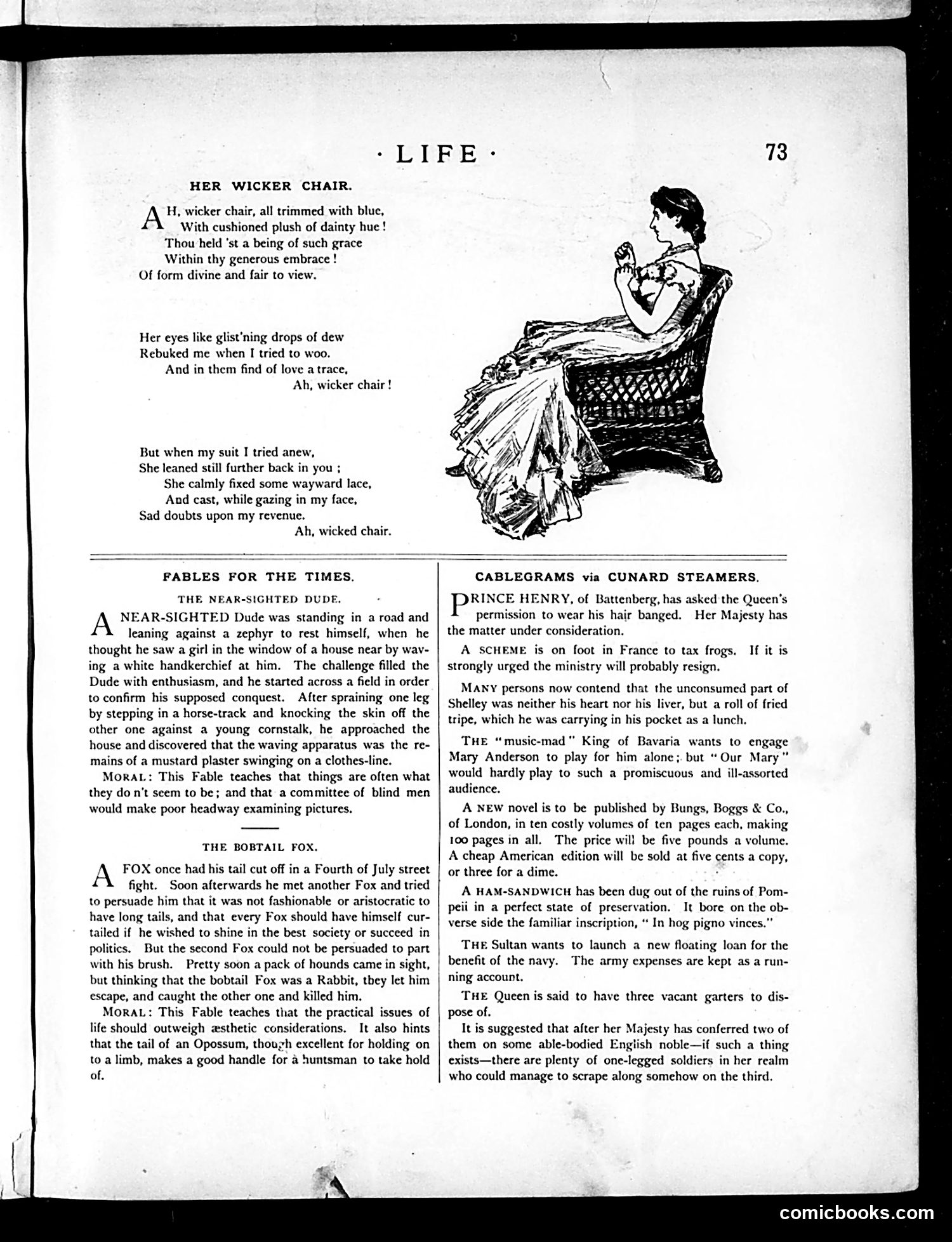
**"Her Wicker Chair"** is a sentimental poem illustrated with a sketch of a woman seated in a wicker chair. The verse romanticizes both the chair and the woman, with references to her eyes and rejected suitor. This appears to be lighthearted romantic poetry rather than political satire. **Below are two fables**: "The Near-Sighted Dude" mocks a foolish man who mistakes objects at a distance, and "The Bobtail Fox" satirizes a fox with a docked tail attempting to gain society acceptance. Both fables end with morals about aesthetic and practical considerations. The right column contains gossip items titled "Cableograms via Cunard Steamers," including anecdotes about European royalty and cultural figures, written in a humorous, scandalmongering tone typical of society journalism from this era.
This page contains primarily **literary content rather than political cartoons**. The main features are: 1. **"August"** — A seasonal poem about summer activities (harvesting corn, ice vendors, fashionable dress) 2. **"An Idyl of Apple-Jack"** — A sentimental verse about a boy named John who loves apples but loses his sweetheart 3. **Several brief editorial notices** mentioning Secretary Manning dismissing crooked scientists, and Mr. Evarts as a possible 1888 Presidential candidate 4. **"A Remonstrance"** — A humorous complaint letter addressing editorial errors, signed "R.S.V.P.," criticizing the *Post* for printing mistakes and asking why the editor holds grudges The page is characteristic of Life's satirical humor: light social commentary, poetry, and reader letters rather than visual political cartoons. The references suggest late 1880s publication.
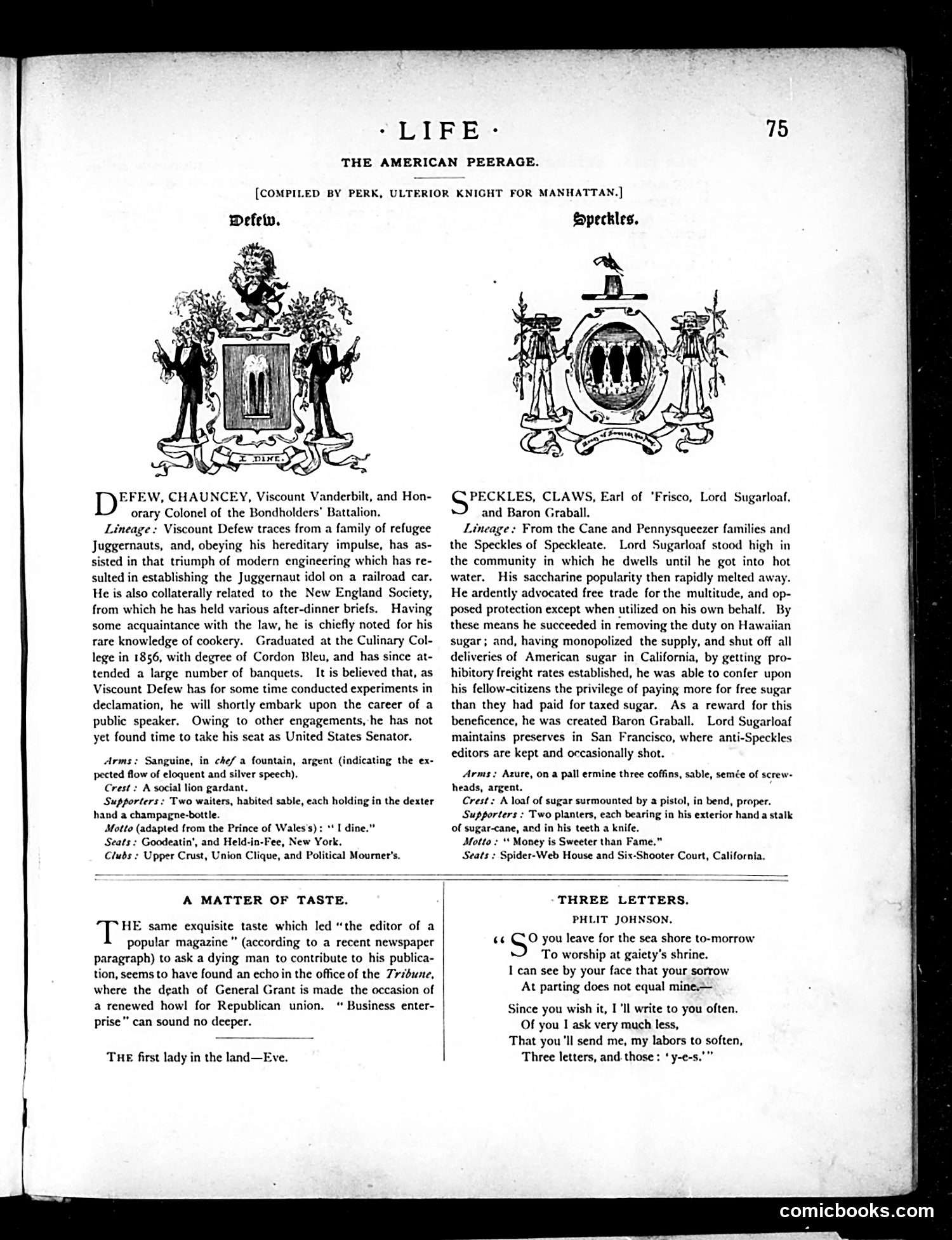
This page satirizes wealthy American industrialists by giving them mock-noble titles in the style of British peerage. The two coats-of-arms at top represent fictional "Defew" and "Speckles" families. The left entry describes Viscount Defew (Vanderbilt), mocking his railroad fortune and Engineering prominence while sarcastically praising his "rare knowledge of cookery." The right entry describes Earl Speckles (Sugarloaf), ridiculing his monopolistic sugar business and freight-rate manipulation before his creation as "Baron Graball." The satire targets the Gilded Age tendency of wealthy Americans to adopt aristocratic pretensions while engaging in ruthless monopolistic practices. The absurd heraldry and mock-genealogies mock the idea that American "captains of industry" constitute a new nobility.
This page contains literary content rather than political cartoons. The left column features a poem titled "HER FIRST ATTEMPT" by H.S. Keller about a woman on roller skates—a humorous piece about physical mishap ("Her left foot takes a sudden tack, / Her right one tacketh too"). The right side includes a book review section called "AN INTERRUPTED CRITIQUE" by literary critic Orestes Penfeather, who sarcastically discusses George Eliot's work. The review mocks overly earnest literary analysis, particularly praising Eliot's subtle writing style while poking fun at pretentious criticism. A decorative "BOOKISHNESS" header separates sections. The page also advertises "MORE SUMMER FICTION" from publisher Ticknor & Co., promoting novels set in Paris during the Franco-Prussian War. Overall, this appears to be a literary and cultural commentary page rather than political satire.
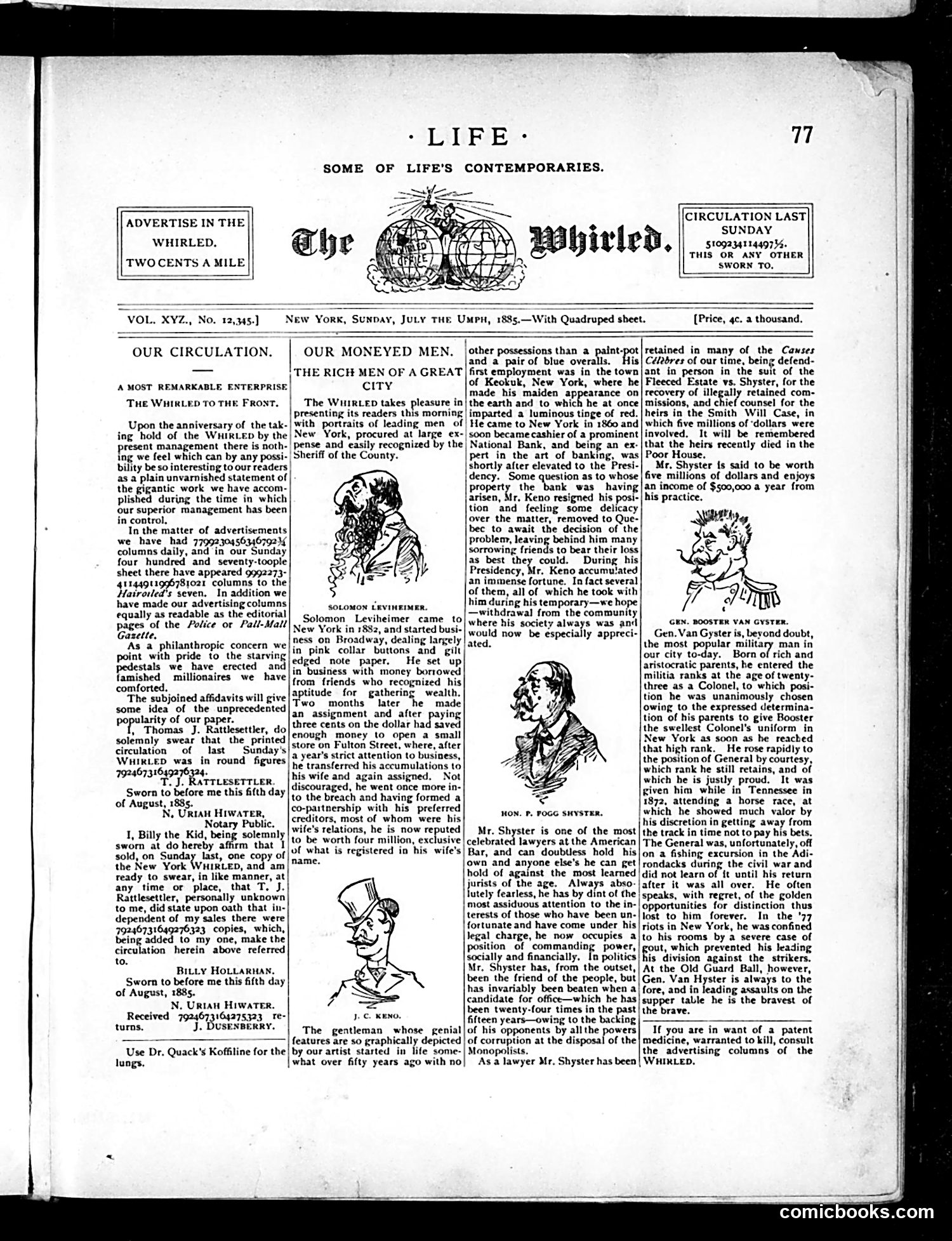
This page features portraits of five wealthy New York men labeled as "Some of Life's Contemporaries." The accompanying text provides biographical sketches of each figure, including Solomon Leiheimer, General Van Oyster, Hon. P. Fogg Shyster, and J.C. Keno. The satire appears to mock wealthy businessmen and lawyers of the era, using exaggerated or ridiculous names (Shyster, Keno) that suggest dishonesty or gambling. The text criticizes their accumulation of wealth, their social climbing, and their questionable business practices—including references to corruption, monopolies, and legal maneuvering. This is social satire targeting the Gilded Age wealthy class, exposing them as morally questionable despite their prominence and success.
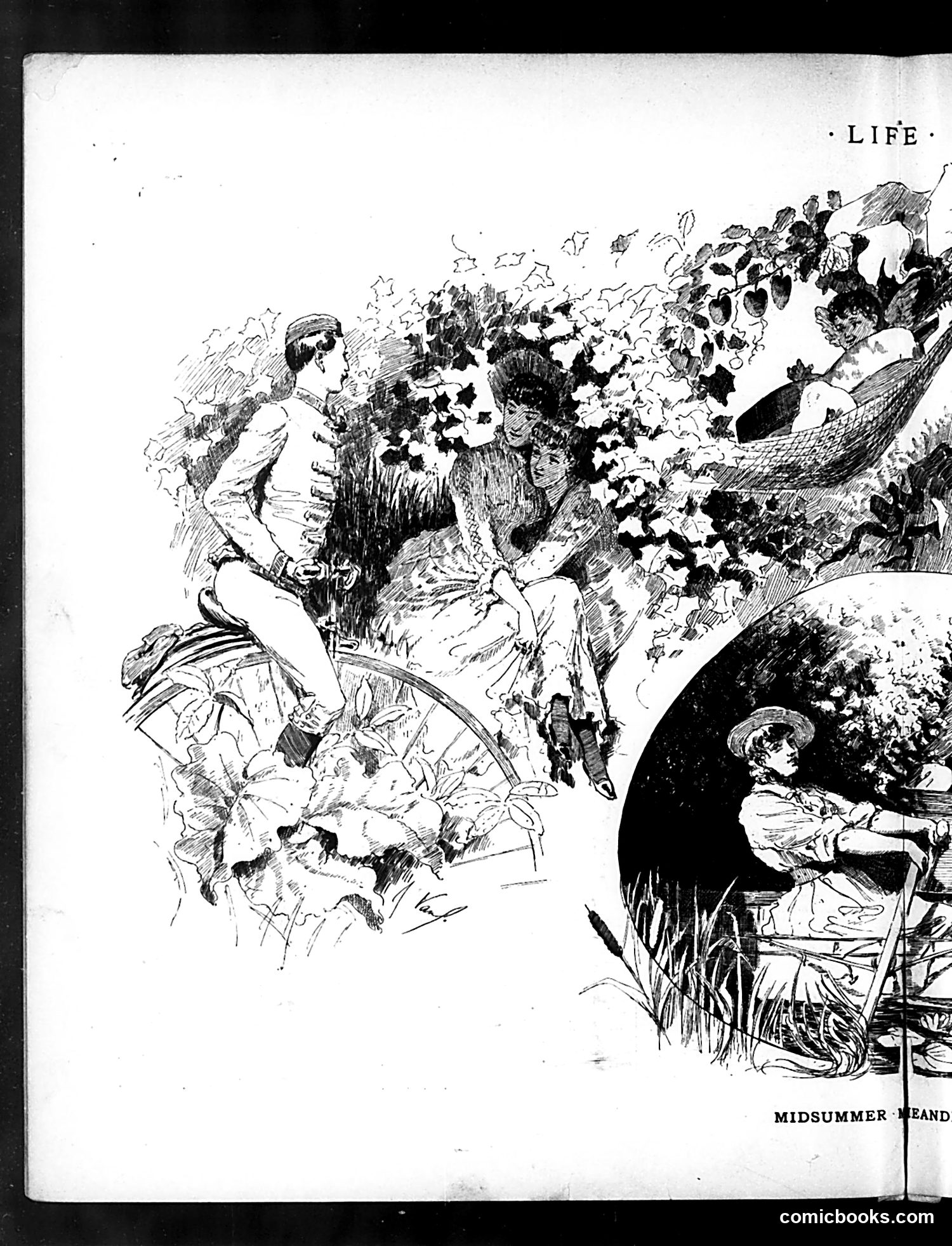
This appears to be a satirical illustration titled "Midsummer Meand" (possibly "Midsummer Meandering"). The sketch depicts a romantic garden scene with well-dressed figures among flowering vines and ivy-covered structures. On the left, a young man in period dress appears to be courting or flirting with women in the garden setting. On the right, a separate scene shows a figure reclining beneath an umbrella or parasol. The satire likely mocks upper-class summer social rituals and romantic pursuits of the era—the leisurely outdoor courtship and leisure activities of wealthy Americans. The ornate setting and fashionable dress emphasize the artificiality and pretension of "high society" romance and summer entertainment. Without additional context or visible byline, the specific targets remain somewhat unclear.
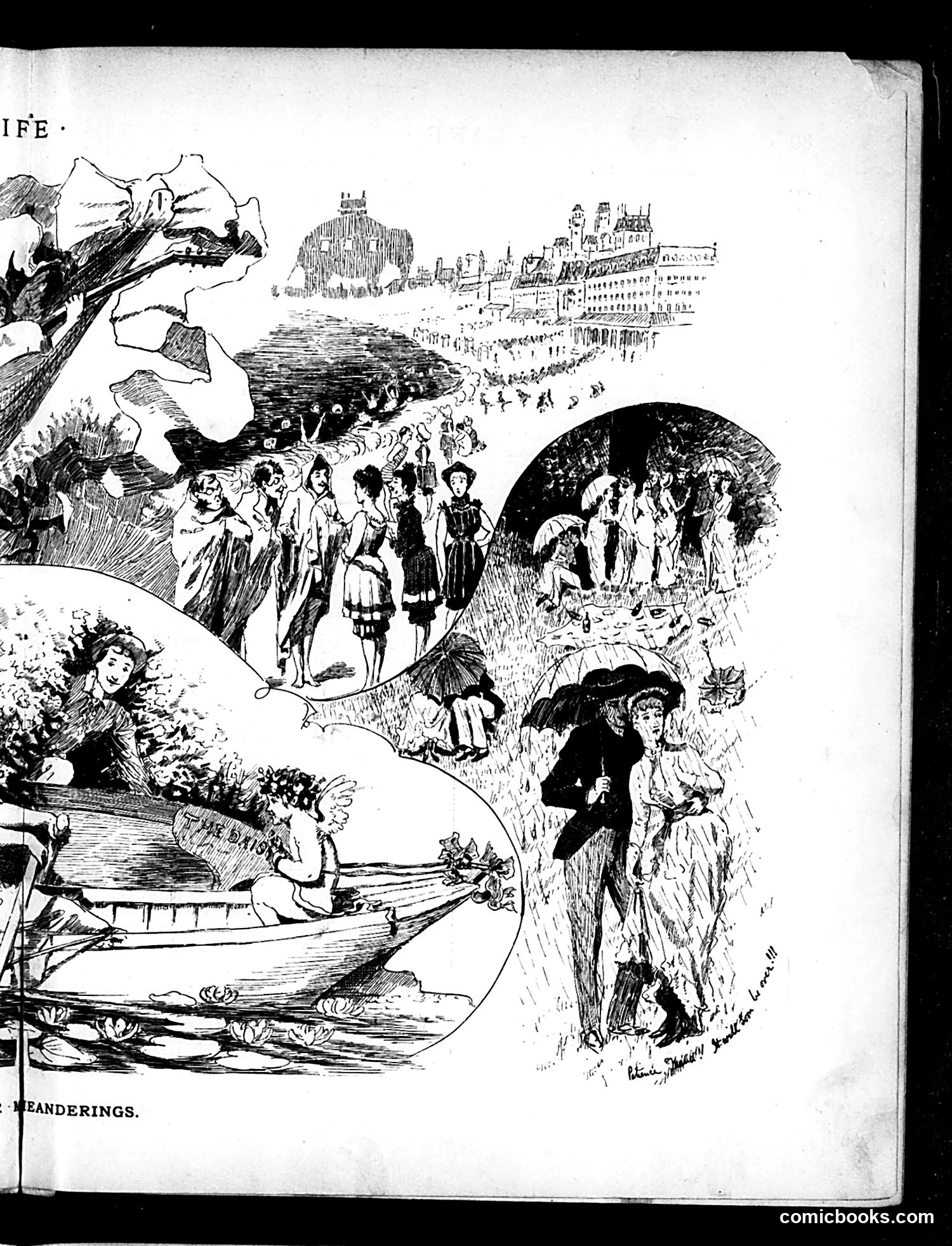
This appears to be a satirical illustration titled "Meanderings" depicting various scenes of leisure and social activity. The image shows multiple vignettes: a woman in a boat (lower left), well-dressed figures strolling in groups, couples with umbrellas, and a cityscape with buildings and crowds in the background. The satire likely mocks the contrasts between different classes or social activities of the era—from intimate boating scenes to public promenading. The winding, meandering composition suggests the aimless nature of leisure pursuits among the upper classes. The detailed pen-and-ink style was typical of Life's social commentary illustrations. Without clearer identifying text or specific historical context visible, the exact targets of satire remain somewhat unclear, though the general critique appears aimed at fashionable society and its pastimes.
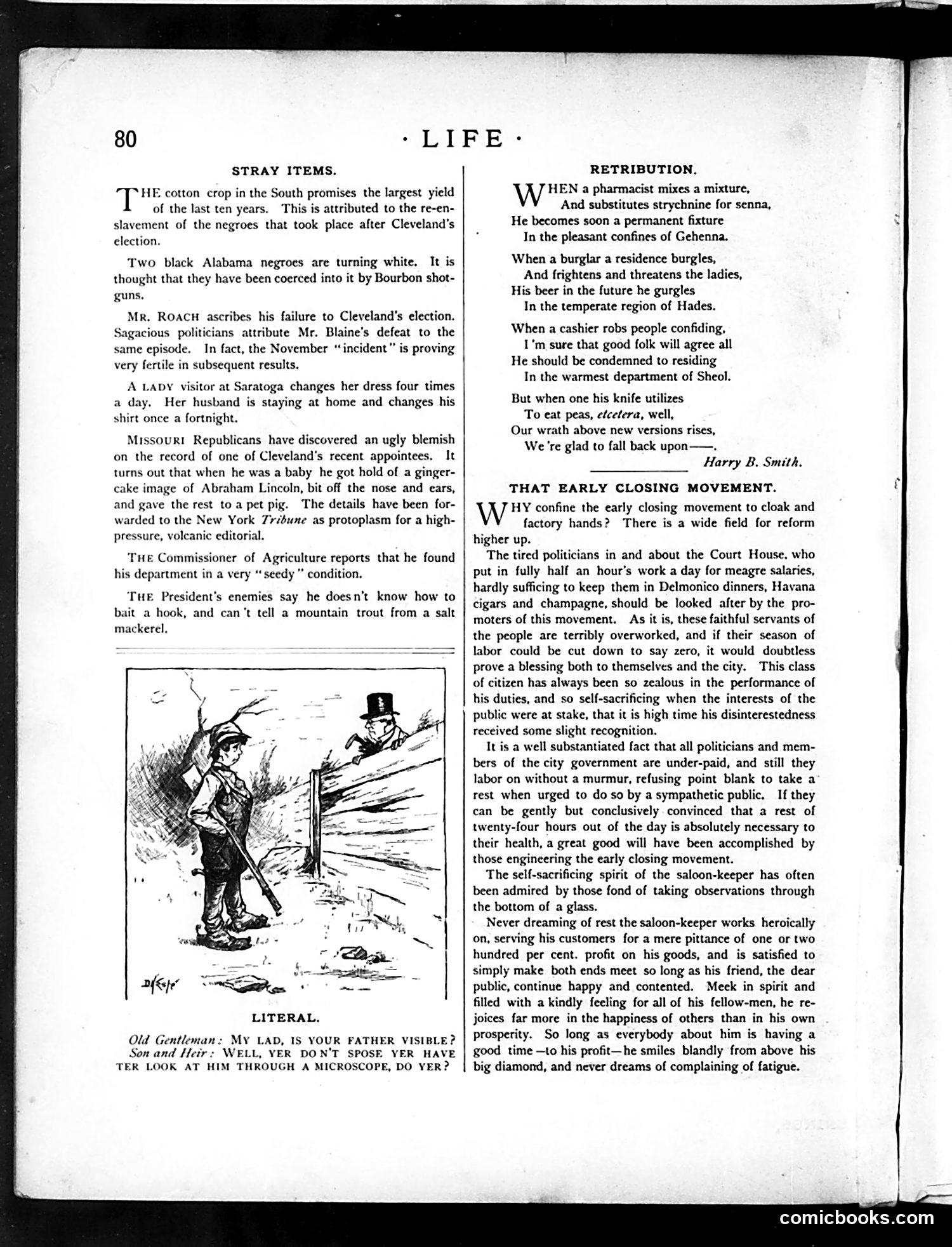
This page from Life magazine contains politically charged humor targeting post-Cleveland election America (likely 1884-1885). **"Stray Items"** section mocks Republicans and Cleveland's opponents through absurdist complaints: blaming Cleveland for Southern cotton prosperity, attacking his appointees with trivial scandals (a baby eating a Lincoln cake figure), and ridiculing his lack of outdoor skills. **The cartoon "Literal"** shows a visual pun: a boy claims his father isn't "visible" because he'd need a microscope to see him—implying the father is extremely small or insignificant, likely satirizing an absent or negligible political figure. **"Retribution"** and **"That Early Closing Movement"** employ heavy irony to criticize city politicians and government workers as lazy, underpaid, and overworked (sarcastically). The closing movement section mocks politicians' claims of self-sacrifice while working minimal hours for substantial perks (Delmonico dinners, Havana cigars). Overall, the page reflects Life's satirical stance against political corruption and pretense of the Gilded Age.
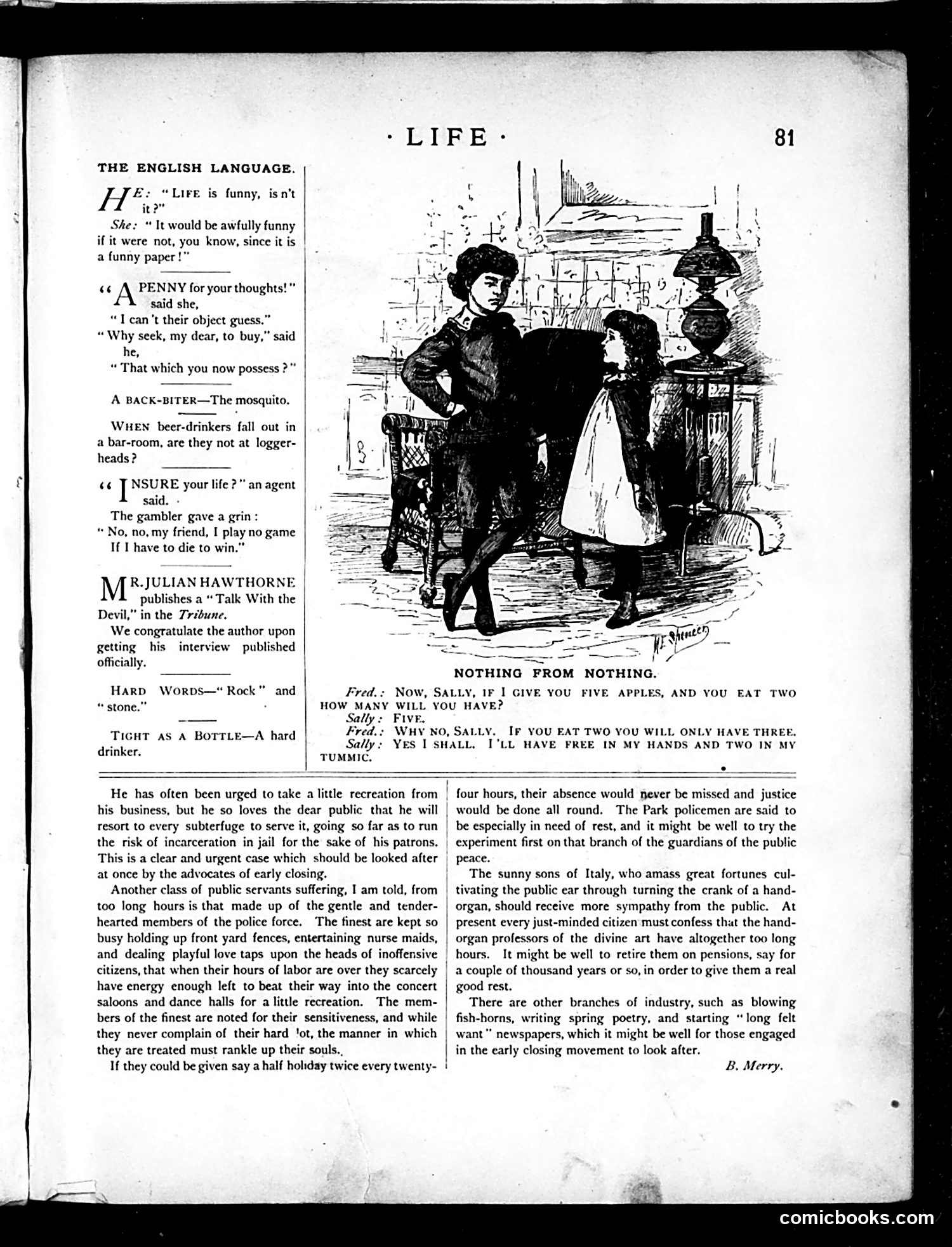
This page combines short humorous pieces with social commentary. The main cartoon depicts a domestic scene with the caption "Nothing from Nothing"—illustrating a math lesson where Fred attempts to teach Sally basic arithmetic using apples. The joke plays on her literal interpretation: if he gives her five apples and she eats two, she'll have three left, yet she insists she'll have five in her hands and two in her stomach. The surrounding text mocks various professions' demands for shorter hours. The author (B. Merry) sarcastically argues that police, street musicians (Italian hand-organ grinders), and others deserve half-holidays or pensions, presenting absurdly exaggerated cases to ridicule the "early closing movement"—labor advocates pushing for reduced working hours. The satire suggests such reforms are impractical and that certain workers' complaints are overblown. Various wordplay jokes fill the margins, typical of Life's format.
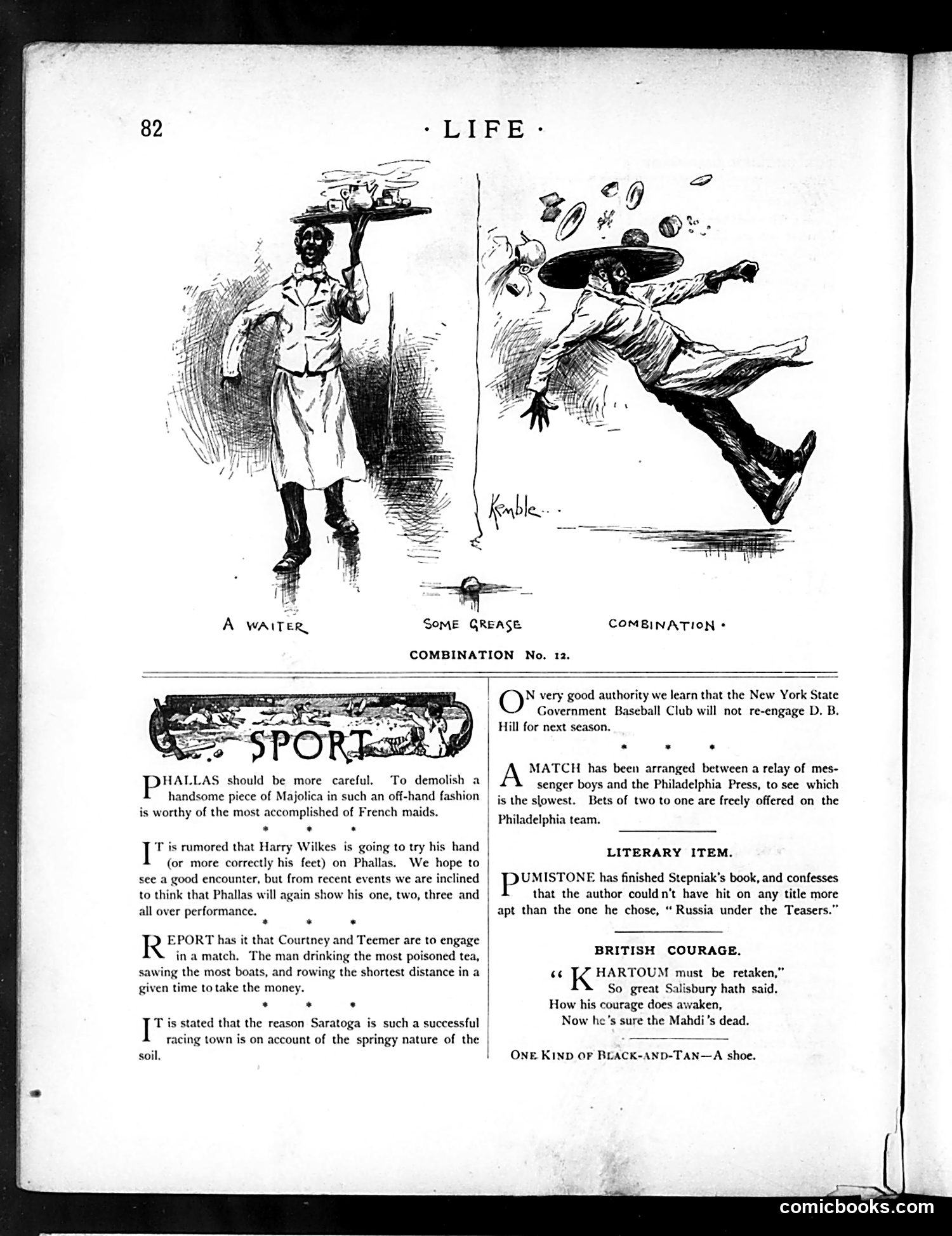
This page satirizes incompetence and mishaps in contemporary American life, circa 1880s. The top cartoon shows "Combination No. 12"—a waiter dropping plates, creating a collision of disaster. The joke plays on the term "combination," mocking how various failures combine into chaos. The text items below mock specific figures and events: - **D.B. Hill** and a baseball club dispute - **Harry Wilkes** (likely a horse or athlete) attempting something physical - **Courtney and Teemer**—apparently competitors in some endurance contest involving tea and rowing - **Saratoga** racing town gossip - **Salisbury and the Mahdi**—British imperial politics, mocking British bravery claims after the Mahdi's death in Sudan The "British Courage" section satirizes politicians' sudden boldness once danger passes. Throughout, Life employs wordplay and innuendo to ridicule public figures, sports personalities, and political events of the moment in characteristically sharp satirical style.
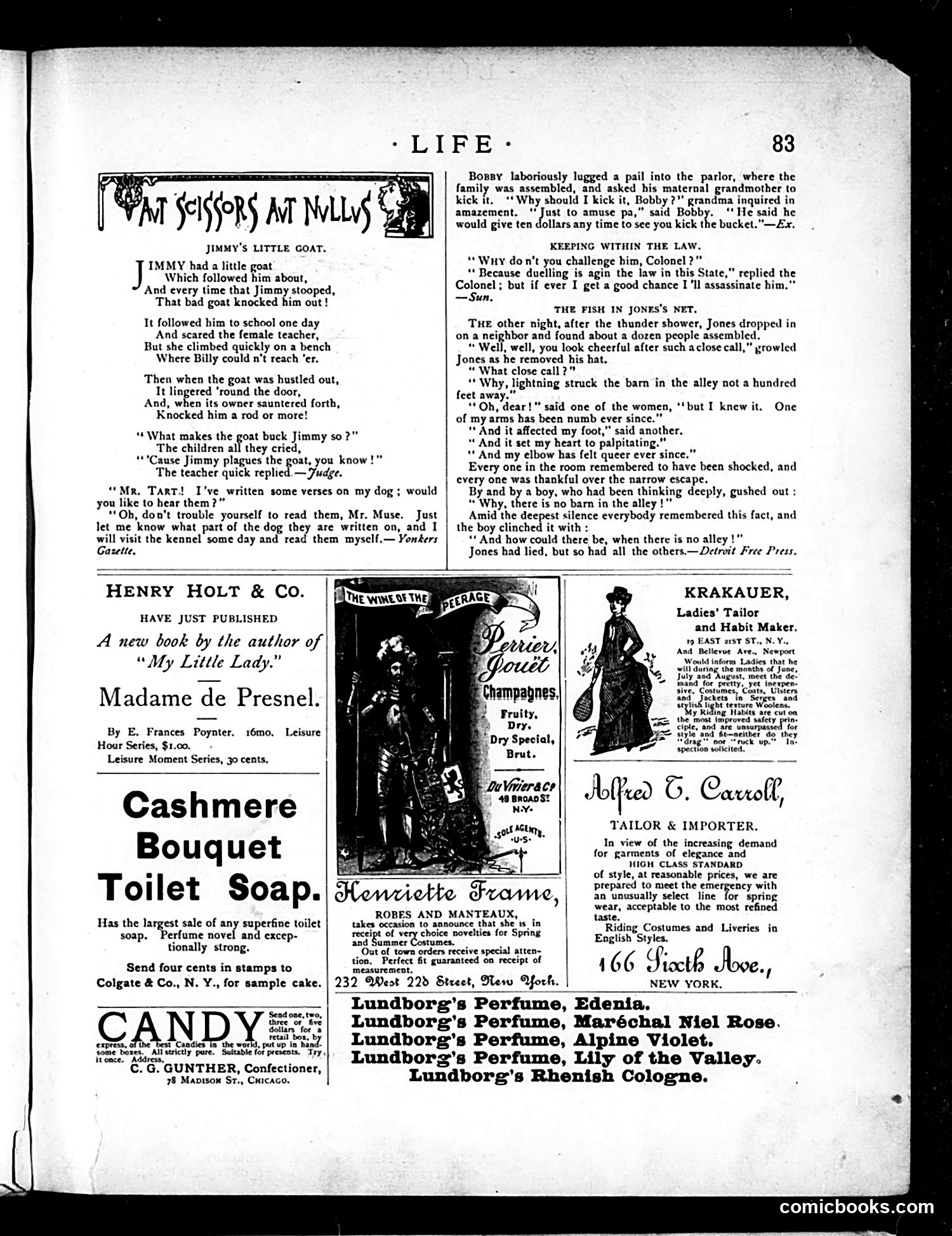
This page from *Life* magazine contains three humorous anecdotal pieces that use satire about human nature and absurdity: 1. **"Keeping Within the Law"**: A Colonel and other character discuss dueling—satirizing how people exploit legal technicalities (dueling is illegal, but "assassination" supposedly isn't) to circumvent laws they oppose. 2. **"The Fish in Jones's Net"**: After a lightning strike, Jones lies about a barn being in an alley. Over the course of the evening, various neighbors falsely claim they were shocked by the lightning, exaggerating injuries. A boy eventually reveals Jones fabricated the entire story—no barn, no alley. The satire mocks people's tendency to echo others' claims without questioning them, and their desire to participate in shared narratives even when false. 3. **Shorter comic verses** mock stubbornness (a goat that bucks Jimmy) and crude wordplay (a man who punts dog-related jokes "on the dog"). The rest comprises advertisements for books, perfumes, soaps, and clothing tailors. This appears to be a typical *Life* humor page mixing satire with period advertising.
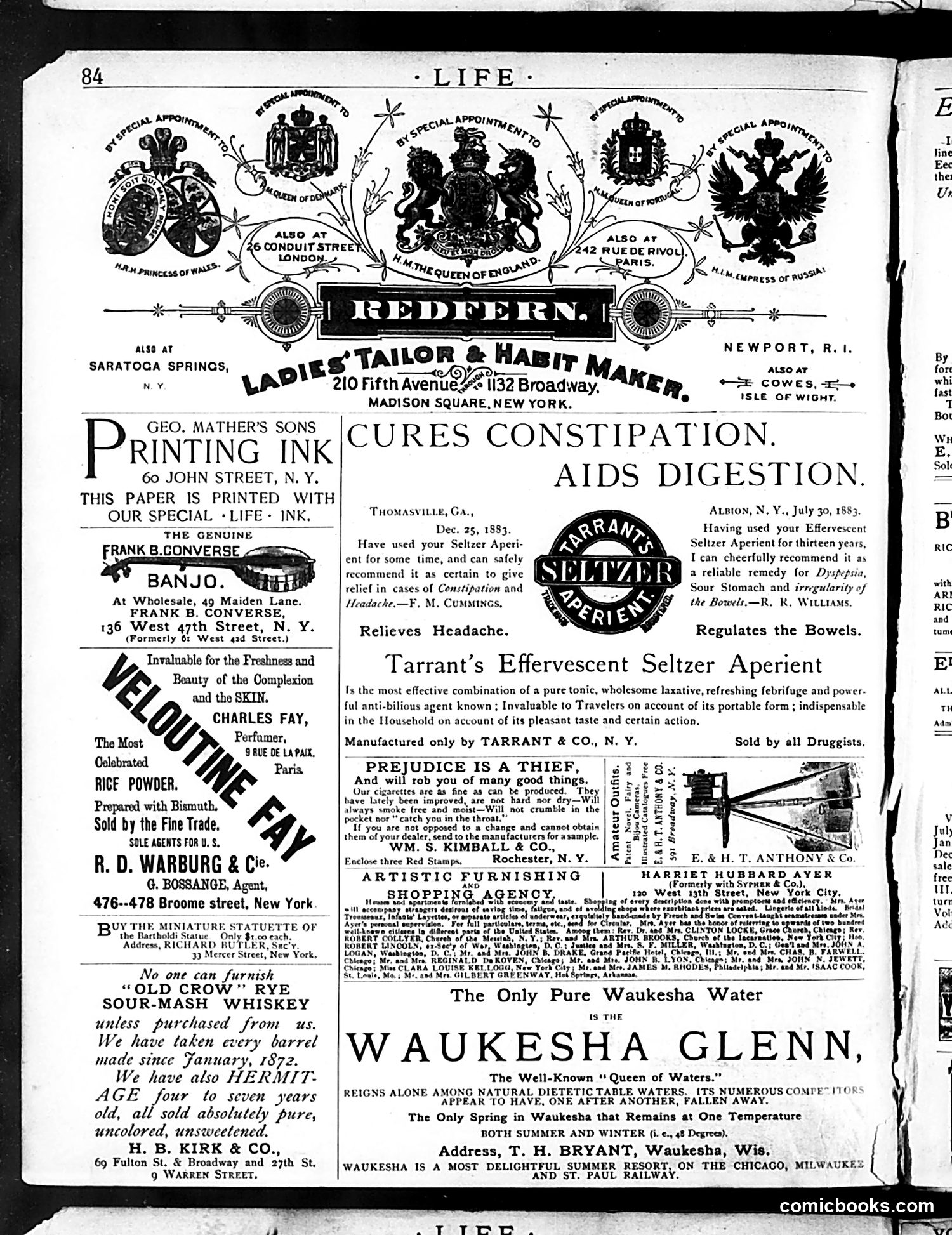
This is primarily an **advertising page** rather than a satirical cartoon page. The dominant content consists of product advertisements from the 1880s, including: - **Redfern** (ladies' tailor and hat maker), with royal warrant symbols suggesting elite clientele - **Tarrant's Effervescent Seltzer Aperient** (a digestive/laxative remedy), featuring testimonial letters praising its treatment of constipation and dyspepsia - Various other patent medicines and luxury goods (rice powder, whiskey, photographic equipment, water) The page reflects **late Victorian consumer culture and medical advertising practices**. The testimonials use real names and places to build credibility for remedies that modern readers would recognize as dubious—marketing digestive aids and "effervescent" products as cure-alls. There are **no political cartoons or satirical commentary** visible. This appears to be a standard commercial page from *Life* magazine's advertising section, showcasing the products and pharmaceutical claims typical of the 1880s before modern food and drug regulation.
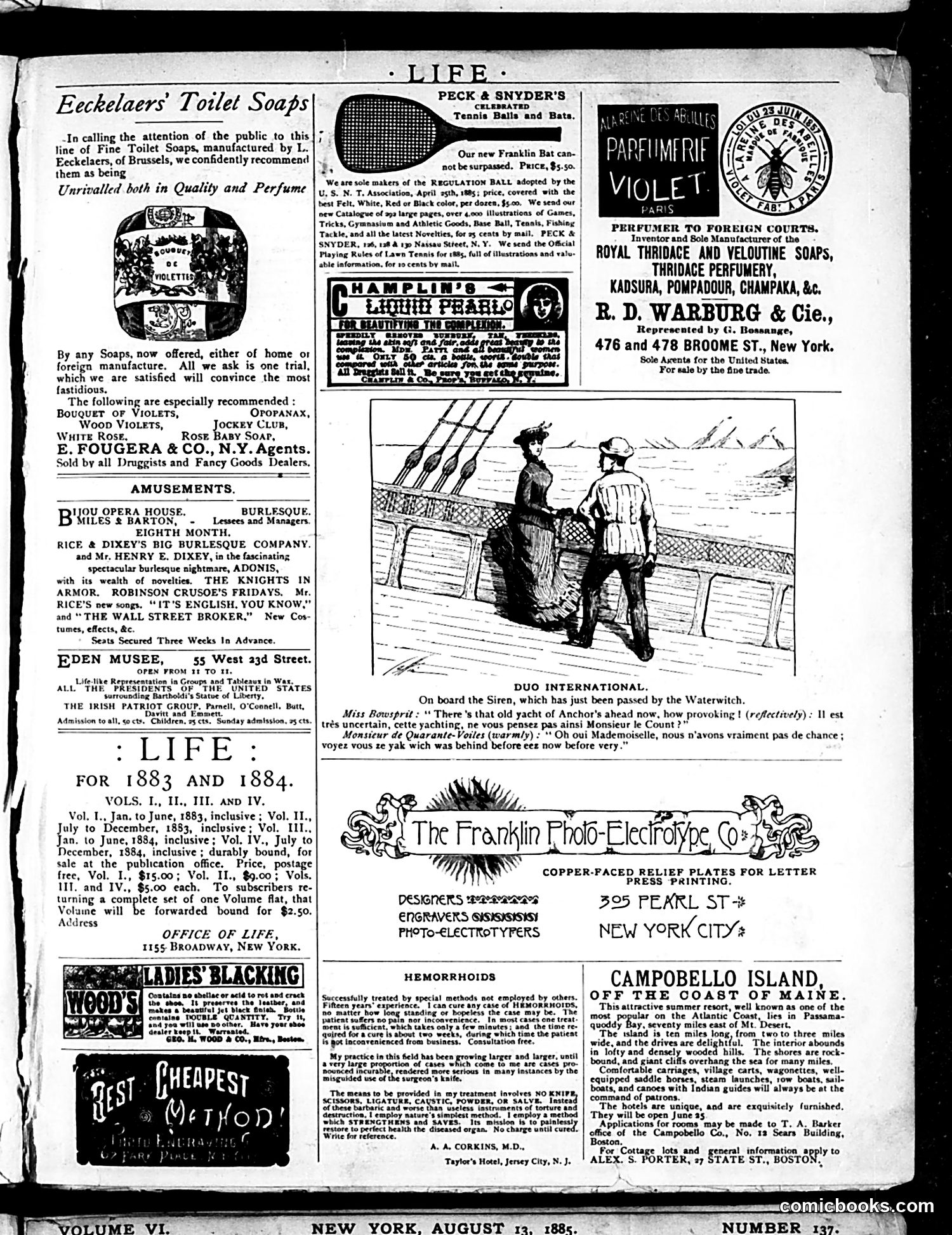
This page is primarily **advertisements** with one satirical cartoon titled "Duo International." The cartoon depicts two wealthy yacht passengers—Miss Bowsprit and Monsieur de Quarante-Voiles—conversing aboard the ship *Siren* as they pass another yacht. The satire targets **pretentious international society** and linguistic affectation. Miss Bowsprit speaks French-inflected English ("ne vous pensez pas ainsi"), while the French count responds with exaggerated, fractured English ("ze yak wich was behind before eez now before very"), mangling "Waterwitch" into absurd phonetics. The joke appears to be **mutual incompetence**: wealthy cosmopolitans trying to impress each other across language barriers, both failing comically. The concern about "that old yacht of Anchor's ahead" suggests competitive vanity among the leisure class. The humor derives from the pretension of international high society and how their linguistic posturing undermines rather than enhances their sophistication.
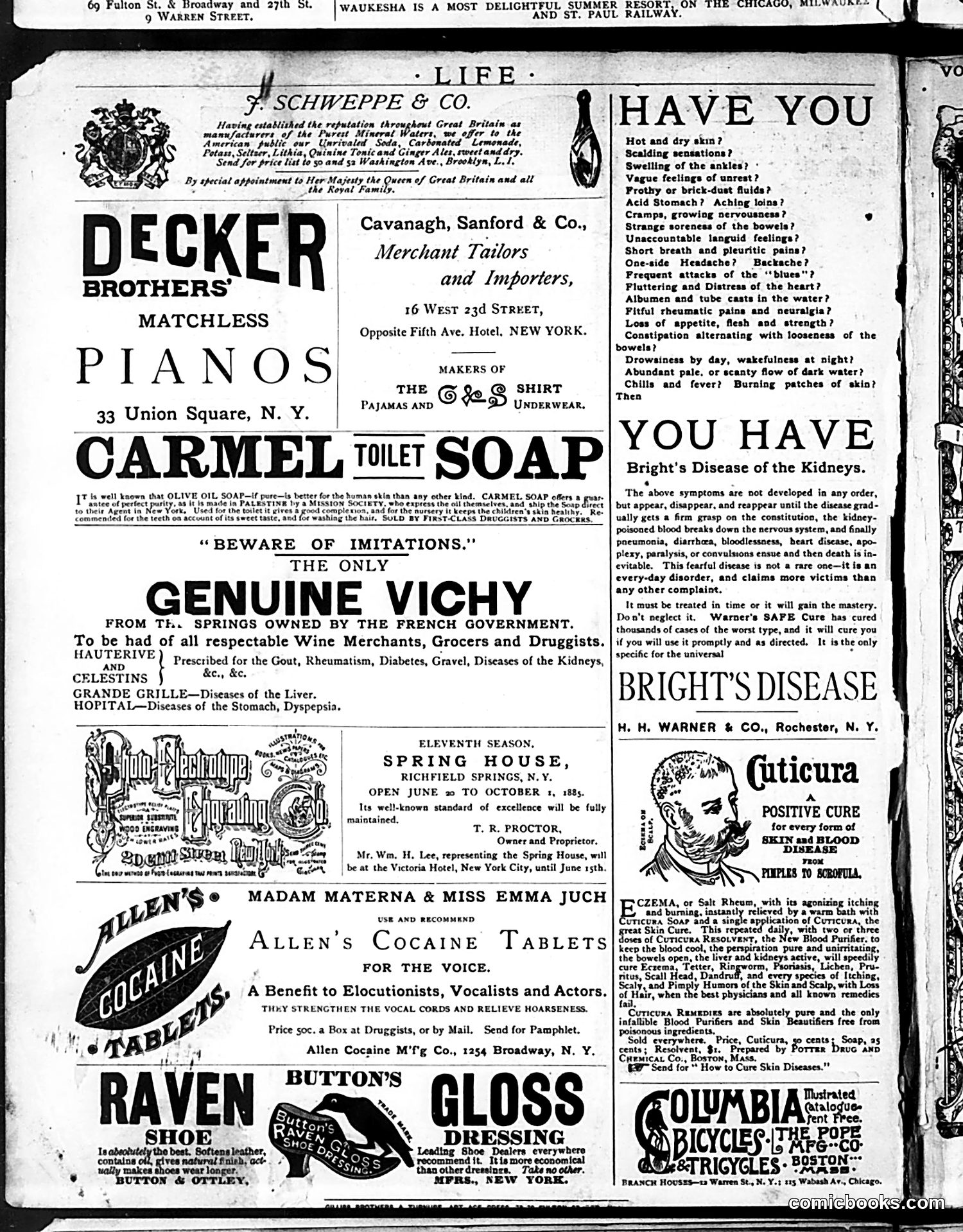
This is primarily a **advertising page**, not a political cartoon. The page showcases patent medicines and consumer products typical of 1880s America, revealing the era's medical practices and marketing strategies. Key advertisements include: **Medical Products:** - **Warner's Safe Cure** for Bright's Disease (kidney ailment), listing an exhaustive symptom checklist—a sales tactic exploiting hypochondria - **Cuticura** for skin conditions, using testimonials from performers (Madam Materna & Emma Juch) - **Allen's Cocaine Tablets** "for the voice"—cocaine was legal, marketed to singers and speakers **Consumer Goods:** - Decker Brothers pianos, Carmel soap, Raven shoe polish, Button's shoe dressing The satire lies in **juxtaposition**: the left column's extensive symptom list for Bright's Disease appears designed to make readers believe they're sick, then sells them the cure. This reflects how patent medicines exploited medical anxiety before FDA regulation. The cocaine tablets demonstrate how differently dangerous substances were viewed in this era.