
Life, 1885-08-06 · page 6 of 16
Life — August 6, 1885 — page 6: what you’re looking at
What you’re looking at
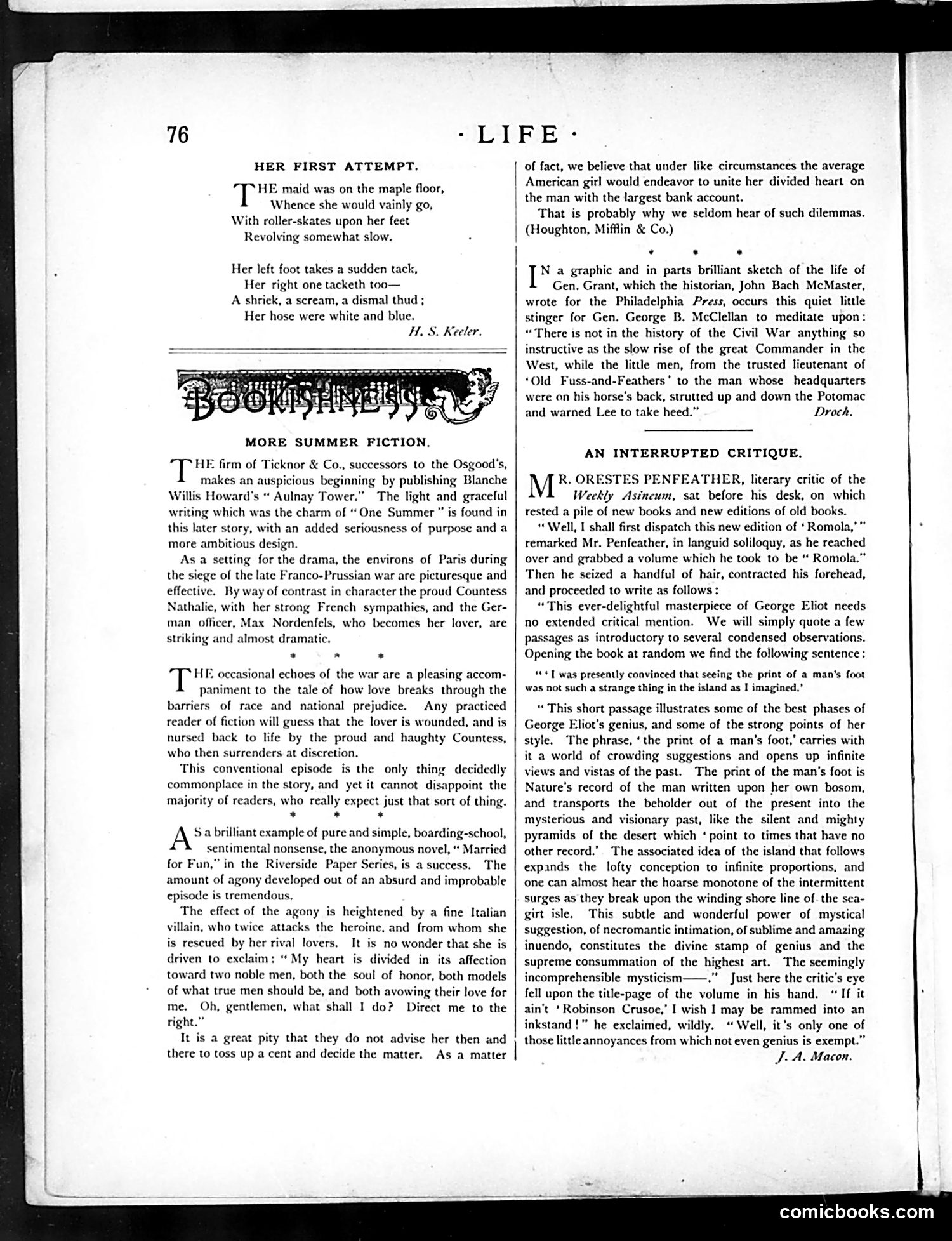
This page contains literary content rather than political cartoons. The left column features a poem titled "HER FIRST ATTEMPT" by H.S. Keller about a woman on roller skates—a humorous piece about physical mishap ("Her left foot takes a sudden tack, / Her right one tacketh too"). The right side includes a book review section called "AN INTERRUPTED CRITIQUE" by literary critic Orestes Penfeather, who sarcastically discusses George Eliot's work. The review mocks overly earnest literary analysis, particularly praising Eliot's subtle writing style while poking fun at pretentious criticism. A decorative "BOOKISHNESS" header separates sections. The page also advertises "MORE SUMMER FICTION" from publisher Ticknor & Co., promoting novels set in Paris during the Franco-Prussian War. Overall, this appears to be a literary and cultural commentary page rather than political satire.
📄 Transcribed text from this page (OCR, searchable)
Machine-transcribed from the original scan — historical spelling and the odd misread are preserved.
LEE < HER FIRST ATTEMPT. HE maid was on the maple floor, Whence she would vainly go, With roller-skates upon her feet Revolving somewhat slow. Her left foot takes a sudden tack, Her right one tacketh too— A shriek, a scream, a dismal thud ; Her hose were white and blue. H.S. Keeler. MORE SUMMER FICTION. HE firm of Ticknor & Co., successors to the Osgood’s, makes an auspicious beginning by publishing Blanche is Howard's “ Aulnay Tower.” The light and graceful ng which was the charm of “One Summer” is found in this later story, with an added seriousness of purpose and a more ambitious design. As a setting for the drama, the environs of Paris during the siege of the late Franco-Prussian war are picturesque and effective. By way of contrast in character the proud Countess Nathalie, with her strong French sympathies, and the Ger- man officer, Max Nordenfels, who becomes her lover, are ing and almost dramatic. * a . HE occasional echoes of the war are a pleasing accom- paniment to the tale of how love breaks through the barriers of race and national prejudice. Any practiced reader of fiction will guess that the lover is wounded, and is nursed back to life by the proud and haughty Countess, who then surrenders at discretion. This conventional episode is the only thing decidedly commonplace in the story, and yet it cannot disappoint the majority of readers, who really expect just that sort of thing. . * . A Sa brilliant example of pure and simple, boarding-school, sentimental nonsense, the anonymous novel, “ Married for Fun,” in the Riverside Paper Series, is a success. The amount of agony developed out of an absurd and improbable episode is tremendous, The effect of the agony is heightened by a fine Italian villain, who twice attacks the heroine, and from whom she is rescued by her rival lovers. It is no wonder that she is driven to exclaim: My heart is divided in its affection toward two noble men, both the soul of honor, both models of what true men should be, and both avowing their love for me. Oh, gentlemen, what shall I do? Direct me to the right.” It is a great pity that they do not advise her then and there to toss up a cent and decide the matter. As a matter of fact, we believe that under like circumstances the average | American girl would endeavor to unite her divided heart on | the man with the largest bank account. That is probably why we seldom hear of such dilemmas. | (Houghton, Mifflin & Co.) . . . I* a graphic and in parts brilliant sketch of the life of Gen. Grant, which the historian, John Bach McMaster, wrote for the Philadelphia Press, occurs this quict little stinger for Gen. George B. McClellan to meditate upon: “There is not in the history of the Civil War anything so instructive as the slow rise of the great Commander in the West, while the little men, from the trusted lieutenant of ‘Old Fuss-and-Feathers’ to the man whose headquarters were on his horse's back, strutted up and down the Potomac and warned Lee to take heed.” Droch, AN INTERRUPTED CRITIQUE. R. ORESTES PENFEATHER, literary critic of the Weekly Asineum, sat before his desk, on which rested a pile of new books and new editions of old books. “Well, I shall first dispatch this new edition of ‘ Romola,' remarked Mr. Penfeather, in languid soliloquy, as he reached over and grabbed a volume which he took to be “ Romola.” Then he seized a handful of hair, contracted his forehead, and proceeded to write as follows “This ever-delightful masterpiece of George Eliot needs no extended critical mention. We will simply quote a few passages as introductory to several condensed observations. Opening the book at random we find the following sentence : “««T was presently convinced that seeing the print of a man’s foot was not such a strange thing in the island as I imagined.’ “ This short passage illustrates some of the best phases of George Eliot's genius, and some of the strong points of her style. The phrase, ‘the print of a man’s foot,’ carries with it a world of crowding suggestions and opens up infinite views and vistas of the past. The print of the man’s foot is Nature's record of the man written upon her own bosom, and transports the beholder out of the present into the mysterious and visionary past, like the silent and mighty pyramids of the desert which ‘point to times that have no other record.’ The associated idea of the island that follows expands the lofty conception to infinite proportions, and one can almost hear the hoarse monotone of the intermittent surges as they break upon the winding shore line of. the sea- girt isle. This subtle and wonderful power of mystical suggestion, of necromantic intimation, of sublime and amazing inuendo, constitutes the divine stamp of genius and the supreme consummation of the highest art. The seemingly incomprehensible mysticism——.” Just here the critic's eye fell upon the title-page of the volume in his hand. “If it ain't ‘Robinson Crusoe,’ | wish I may be rammed into an inkstand !” he exclaimed, wildly. “Well, it’s only one of those little annoyances from which not even genius is exempt.” J. A. Macon. comicbooks.com