
A complete issue · 16 pages · 1885
Life — July 30, 1885
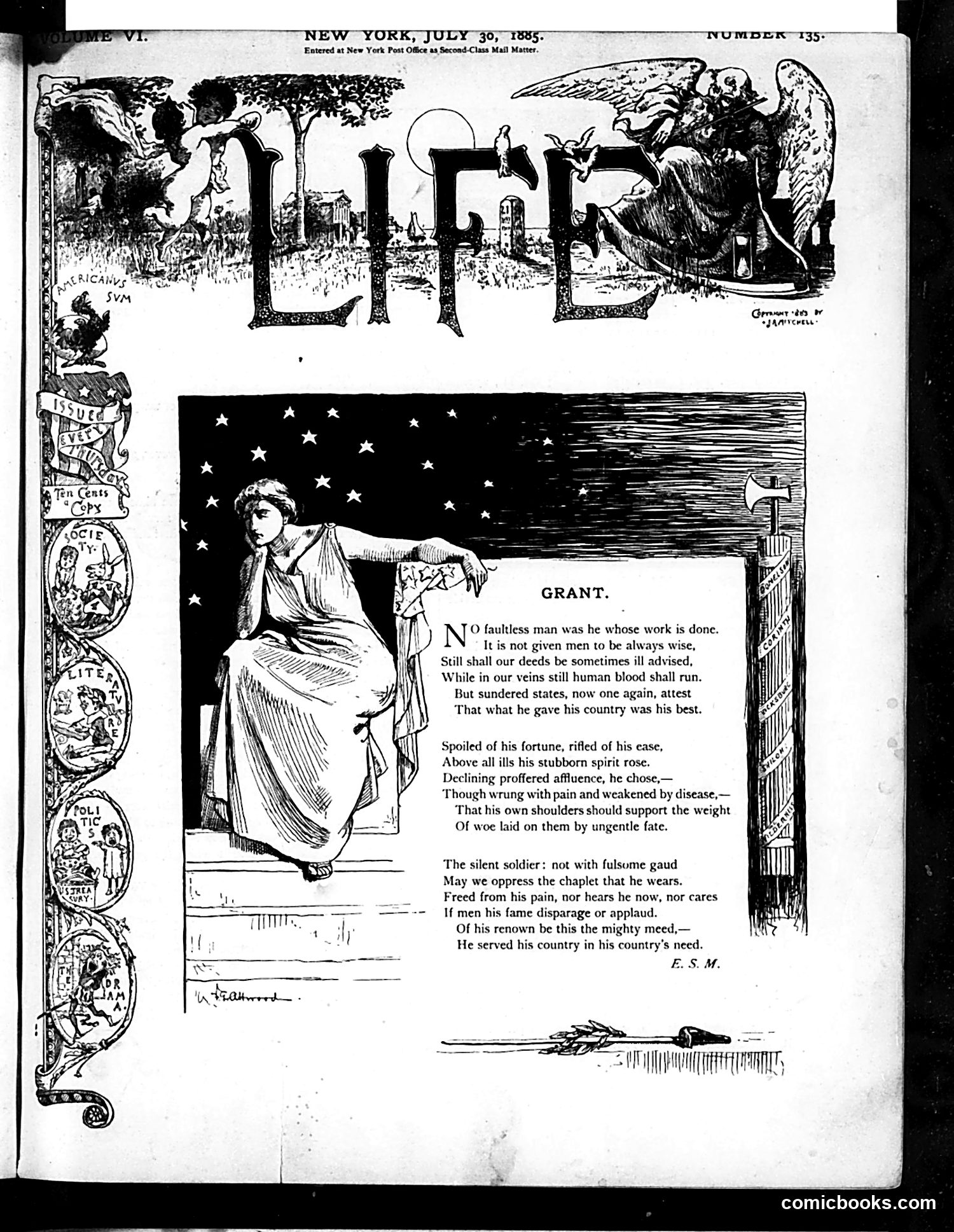
This is the cover/feature page of *Life* magazine from July 30, 1885. The main illustration depicts a robed female figure (representing America or Liberty) seated before a starry background, gazing downward pensively beside a cross. The poem below, titled "GRANT," eulogizes President Ulysses S. Grant, who died July 23, 1885. The verses praise Grant's military service and sacrifice, noting he gave "his country...his best" despite personal hardship and declining health. Lines like "Though wrung with pain and weakened by disease" reference Grant's final illness (throat cancer). The satire appears gentle rather than critical—this is a respectful memorial piece mourning the loss of the Civil War general and former president, presented as a national tragedy. The melancholic allegorical imagery emphasizes America's grief.
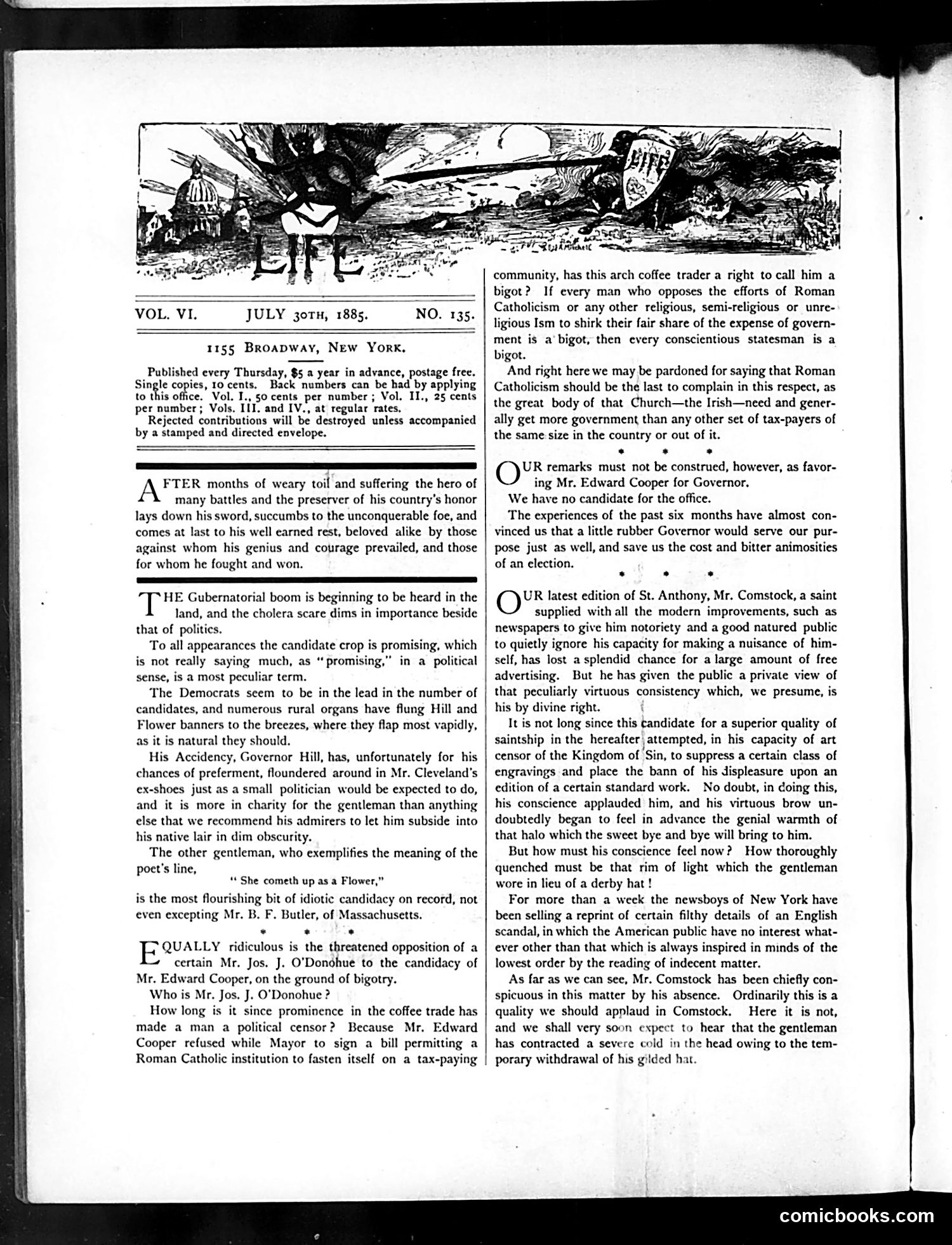
The page's header illustration depicts a figure slumped in a chair beneath a moon—likely representing a deceased political figure or candidate, though the specific identity isn't clear from the image alone. The text discusses the 1885 gubernatorial race and criticizes candidate Edward Cooper, apparently for refusing to sign a bill supporting a Roman Catholic institution. The authors attack this as bigotry while simultaneously mocking Cooper's opponent, Mr. O'Donohue, as an "arch coffee trader" unfit for office. The satire targets the election's religious divisions and questions both candidates' fitness for governor, suggesting the campaign represents base political maneuvering rather than substantive governance. The tone is cynical about New York politics generally.
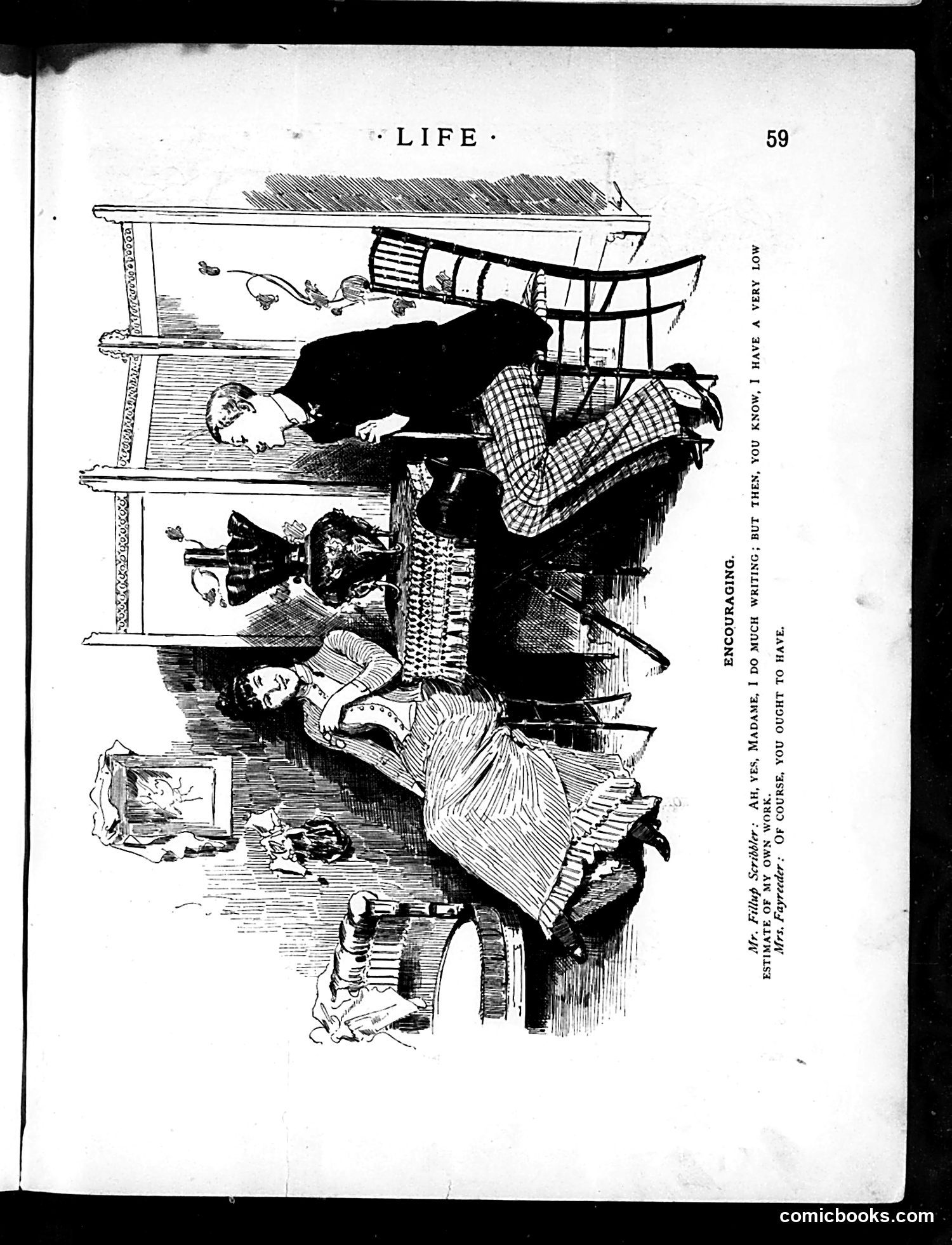
This appears to be a satirical cartoon titled "Encouraging" by Fitz-Schoonover, depicting a domestic scene rotated 90 degrees. The caption reads: "Mr. Fitz Schoonover: 'Ahem! Marmer, I do wish these bites you know, I have a very bad...' Estimated one-half inch written but there's right to fare." The cartoon shows a woman reclining while a man stands nearby, with furniture and domestic objects scattered about. The satire appears to mock domestic life or marital communication—possibly critiquing how spouses discuss minor complaints or ailments. The woman's dismissive posture and the man's apparent frustration suggest commentary on domestic discord or selective listening between partners. The specific context of "bites" suggests either literal insect problems or metaphorical irritations in the household.
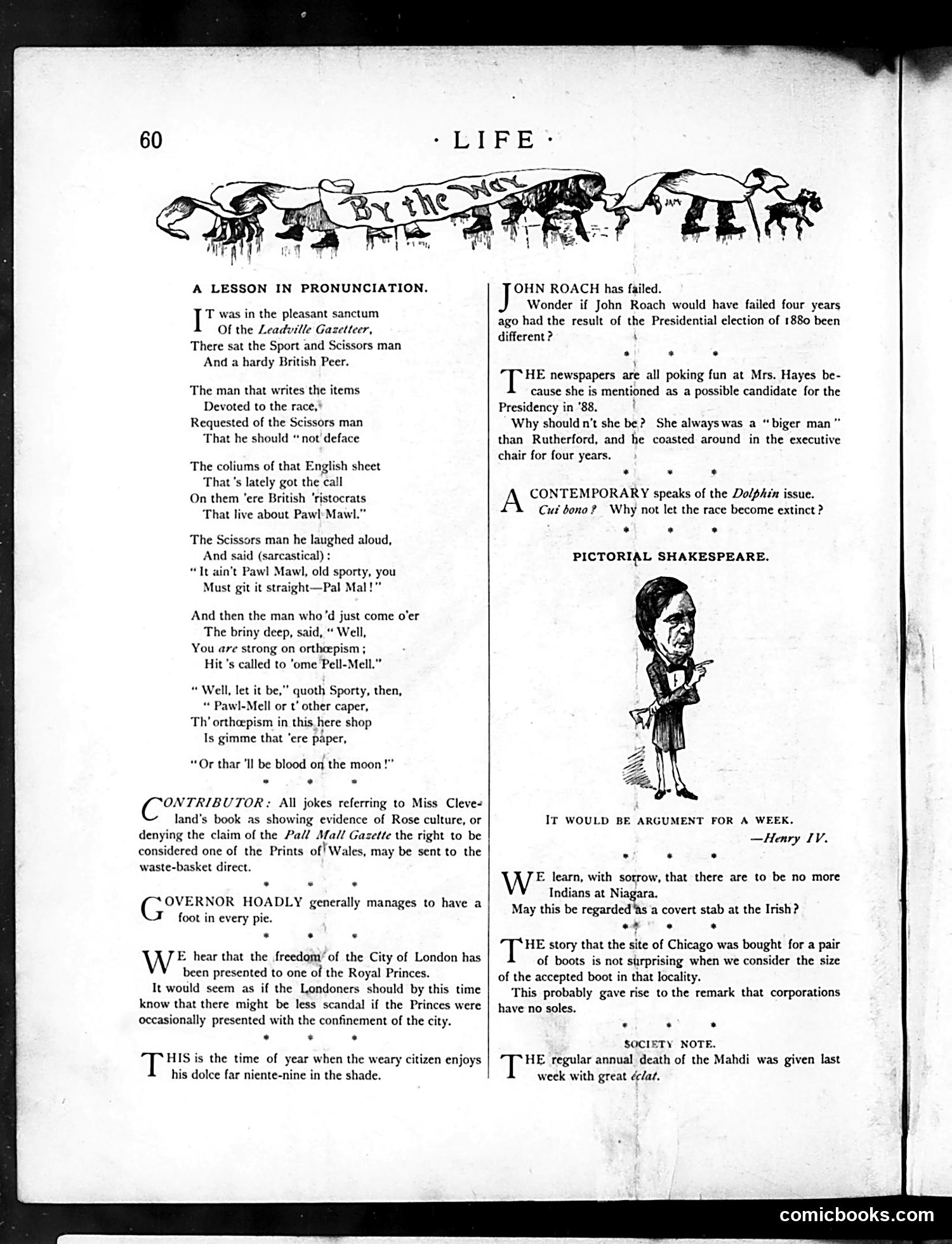
This page contains several brief satirical items typical of *Life* magazine's format. **"A Lesson in Pronunciation"** is a humorous poem mocking British pronunciation and journalistic conventions, particularly targeting the *Leadville Gazette* and debates over how to pronounce place names like "Pall Mall." The right column includes political commentary: a jab at John Roach's failed business ventures, speculation about Mrs. Hayes as a presidential candidate in '88, and a quip about the *Dolphin* magazine's race suicide commentary. **"Pictorial Shakespeare"** features a caricature (likely of a contemporary figure, though unclear who specifically) alongside a Henry IV quote, suggesting commentary on current events through Shakespearean comparison. The page's tone is typical of *Life*'s irreverent, gossipy approach to politics and society during the Gilded Age.
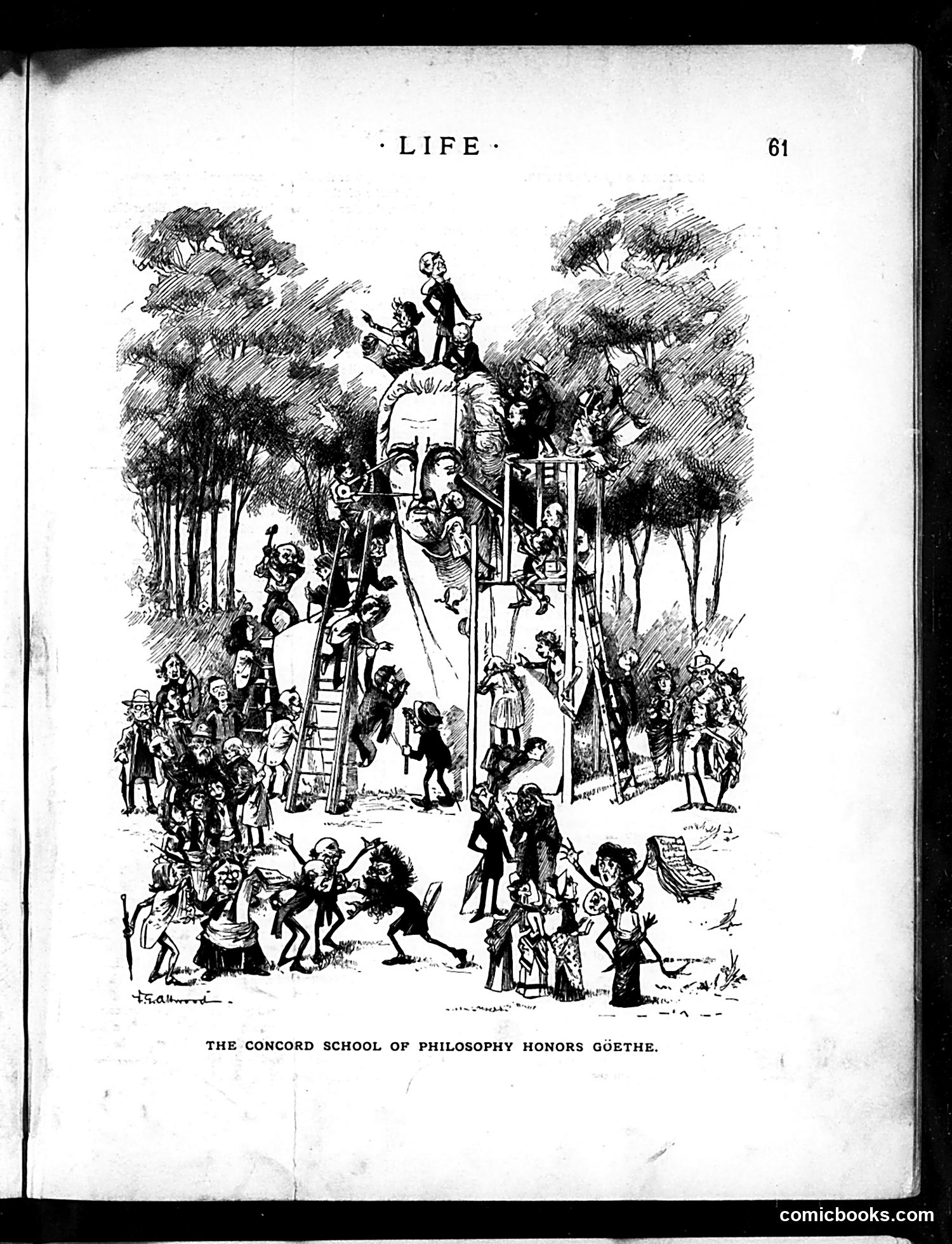
This satirical cartoon mocks the Concord School of Philosophy, a real 19th-century educational institution in Concord, Massachusetts. The drawing depicts a giant head of German poet/philosopher Goethe being worshipped or celebrated by numerous small figures climbing ladders and gathered around it like pilgrims at a shrine. The satire targets the school's perceived pretentiousness and excessive reverence for European intellectualism. The exaggerated scale—treating Goethe as an idol—suggests mockery of American philosophers who uncritically elevated foreign philosophical traditions. The crowds of devoted followers amplify this critique of cultish admiration for "high" Continental thought, positioning the Concord School as overly earnest and somewhat ridiculous in its philosophical earnestness.
This page contains two distinct sections: **Main Article**: A gossip column about Newport society, focusing on a pseudo-aristocrat calling himself an "Earl" (apparently the former Bunco Billie, an ex-convict). The piece satirizes social climbing and the gullibility of wealthy New Yorkers who accept dubious nobility claims. The satire targets both the fraud's audacity and high society's willingness to be deceived for status. **"Summer Bric-a-Brac" Section**: A book review praising F. Anstey's "The Tinted Venus," noting its satirical humor about an antique statue coming to life in modern London—comparing it favorably to Anstey's "Ansty's" other works. The overall theme mocks 1890s elite pretension and social fraud.
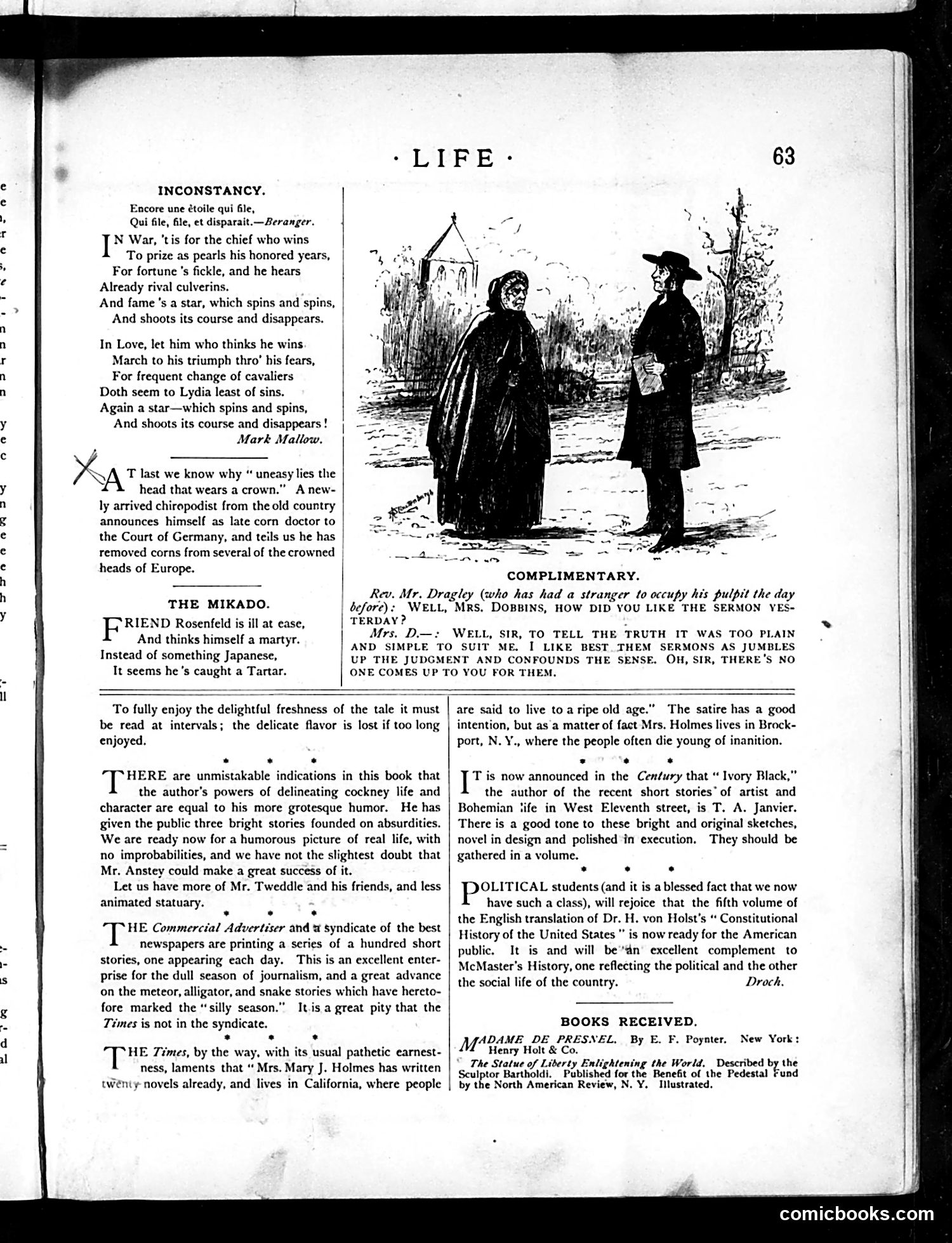
The cartoon depicts a clergyman (Rev. Mr. Dragley) receiving a compliment from Mrs. Dobbins about his sermon. Mrs. Dobbins praises his preaching as appealingly simple rather than theologically complex—she likes "best them sermons as jumbles in the judgment and confounds the sense." The satire targets both the clergyman's vanity and public taste in religious instruction. The joke hinges on Mrs. Dobbins inadvertently insulting the reverend while appearing complimentary: she's essentially saying his sermons are intellectually insubstantial but pleasantly entertaining. This reflects late 19th-century anxieties about whether American sermons prioritized accessible entertainment over serious moral instruction, mocking both clergy seeking popular approval and audiences preferring simplicity to substance.
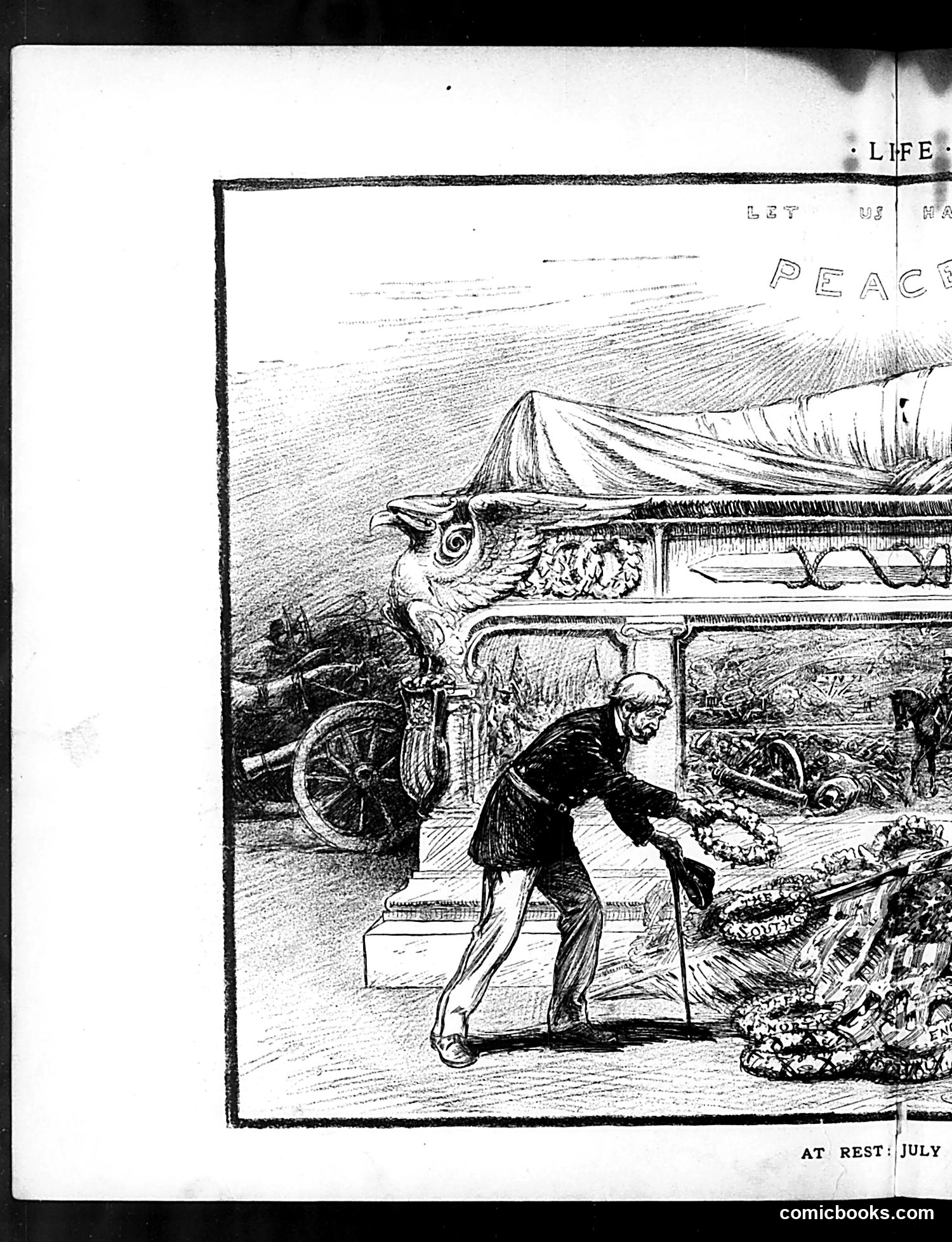
This Life magazine illustration depicts a man in formal dress bent over, appearing to labor or struggle with agricultural work in a field. The scene shows farming equipment and implements in the background. Text fragments visible include "PEACE" and "AT REST: JULY," suggesting this comments on summer leisure or rest. The cartoon likely satirizes the contrast between urban/political figures and manual labor, or comments on someone of high social standing being forced into humble work. The formal clothing combined with field labor creates the satirical tension. Without clearer identification of the specific figure or more complete text, I cannot definitively explain which politician or event this references, though the composition suggests commentary on unexpected role reversal or humbling circumstances for a prominent person.
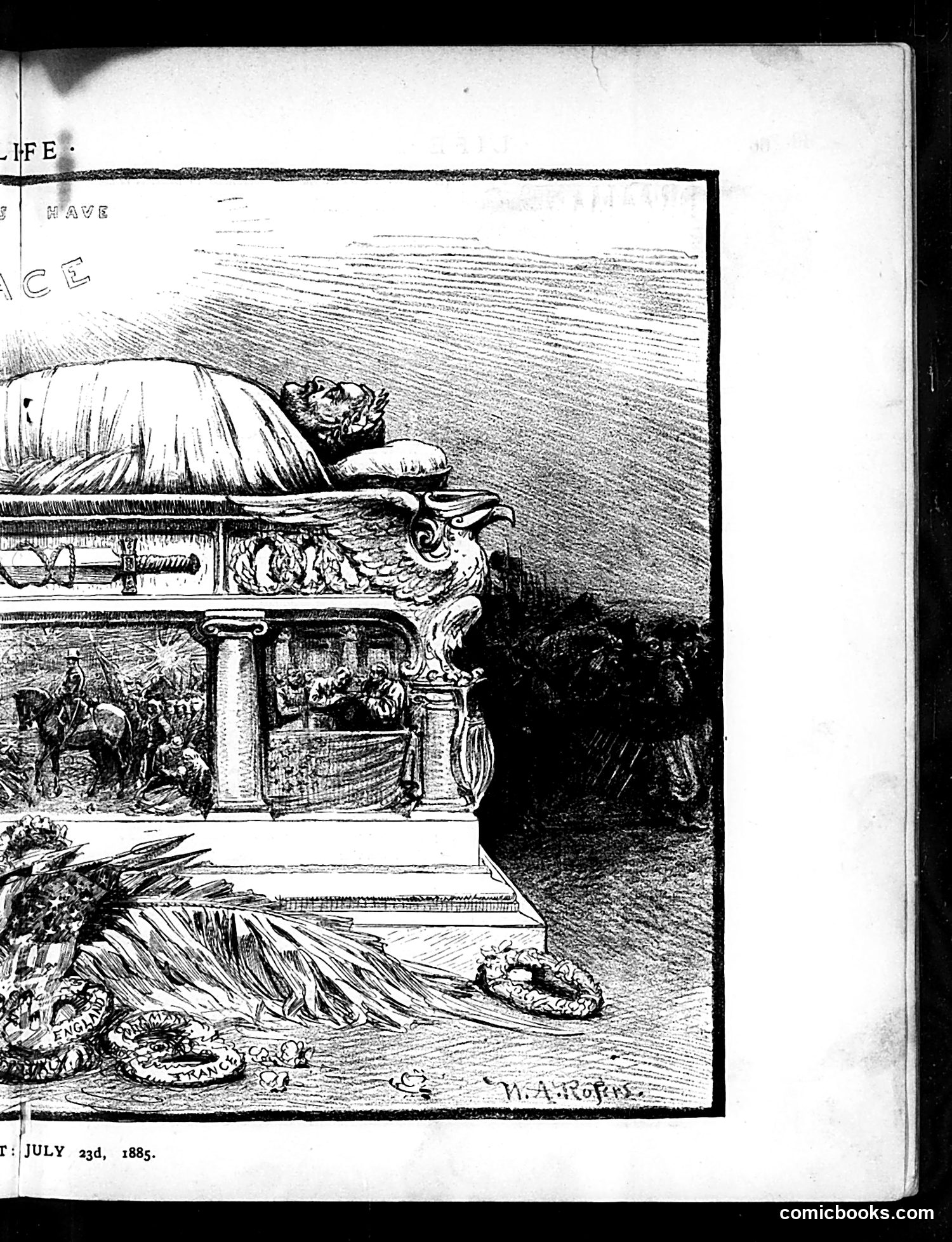
This political cartoon depicts an ornate classical monument or tomb with a reclining figure on top. The elaborate architectural structure features decorative elements including what appears to be a lion or sphinx head. The scene includes draped fabric and fallen wreaths or garlands at the base, suggesting a funeral or memorial context. Without clearer text identifying the specific figure being memorialized or the political event referenced, the exact subject remains uncertain. The July 1885 date and elaborate funeral imagery suggest this commemorates a significant contemporary death or the "death" of a political movement or policy. The ornate, classical style emphasizes the importance attributed to whatever is being mourned or satirized.
This page satirizes the theatrical competition surrounding Gilbert and Sullivan's newly popular opera *The Mikado*. The humor centers on multiple theater managers scrambling to produce American versions while navigating copyright injunctions—a real legal threat at the time. The satire mocks the chaos: managers claim the opera will be "withdrawn," then deny it; one theater plans to present "both acts simultaneously" to "get ahead of the possibilities of an injunction"; another seeks an American adaptation to dodge English copyright claims. The closing joke about achieving success "in one way or another" in "law courts of the Union" directly references the legal battles over theatrical rights. The page also includes an unrelated brief note denying Edwin Booth's rumored involvement in a comic pirate adaptation, and a sentimental tennis poem. The *Mikado* section captures a moment when international copyright protection was weak and American theaters exploited this legally gray area.
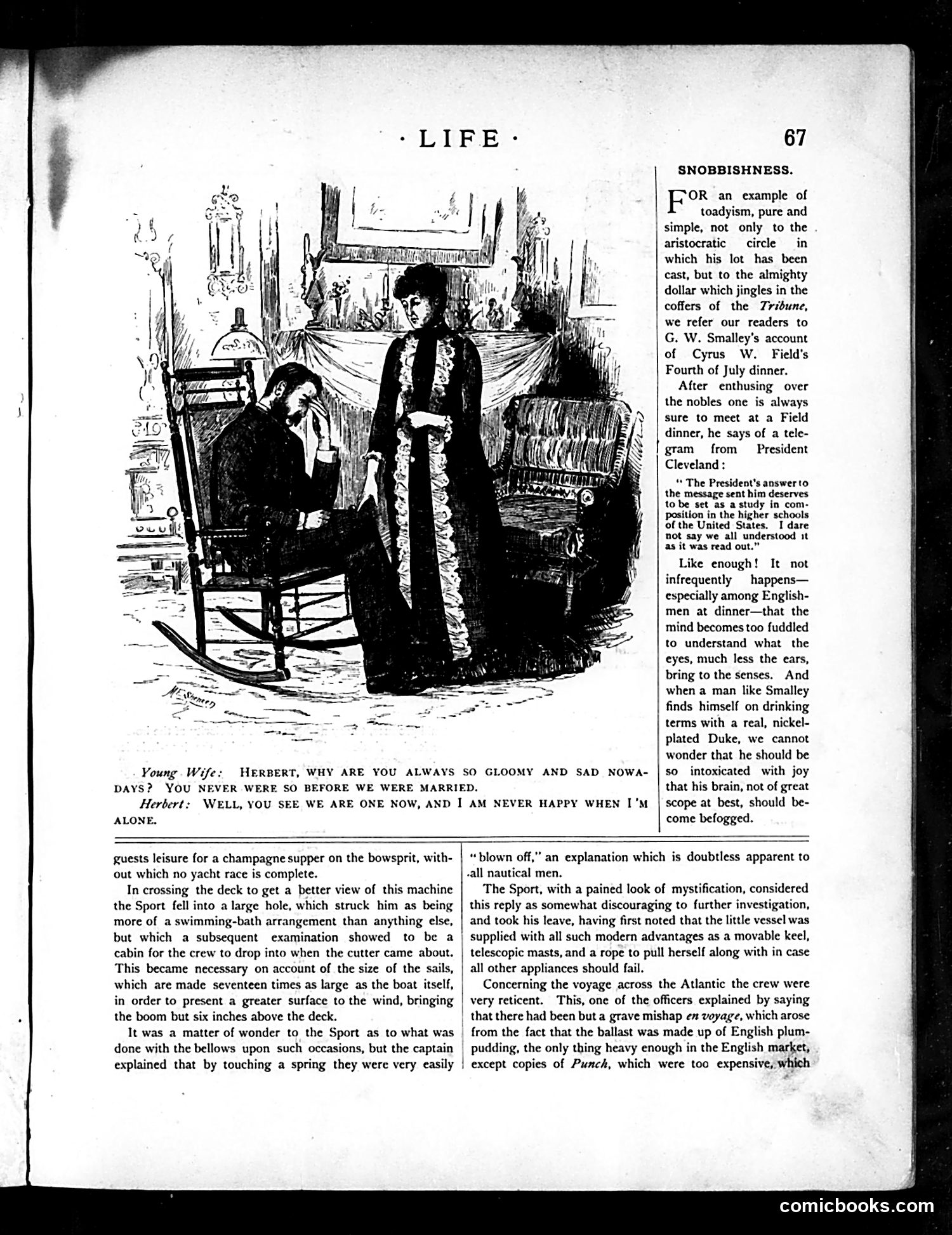
This page contains two satirical pieces mocking American social pretension and English snobbery. **"Snobbishness" section**: Life attacks journalist G.W. Smalley's fawning account of Cyrus W. Field's Fourth of July dinner. The magazine ridicules Smalley for gushing over aristocratic guests while condescending to President Cleveland's telegram, claiming he couldn't understand it. Life sarcastically suggests Smalley was too drunk (having been "intoxicated with joy" meeting a "nickel-plated Duke") to comprehend anything. The piece skewers both American toadyism toward European nobility and the Tribune newspaper's apparent support for such social climbing. **Comic strip below**: A domestic scene where Herbert explains his gloominess to his young wife—he's unhappy because they're now "one" and he's "never happy when I'm alone." The joke plays on the paradox of marriage: togetherness as suffocating constraint. The page also contains humorous nautical descriptions mocking incompetent yacht enthusiasts, complete with absurd technical details (English plum-pudding ballast).
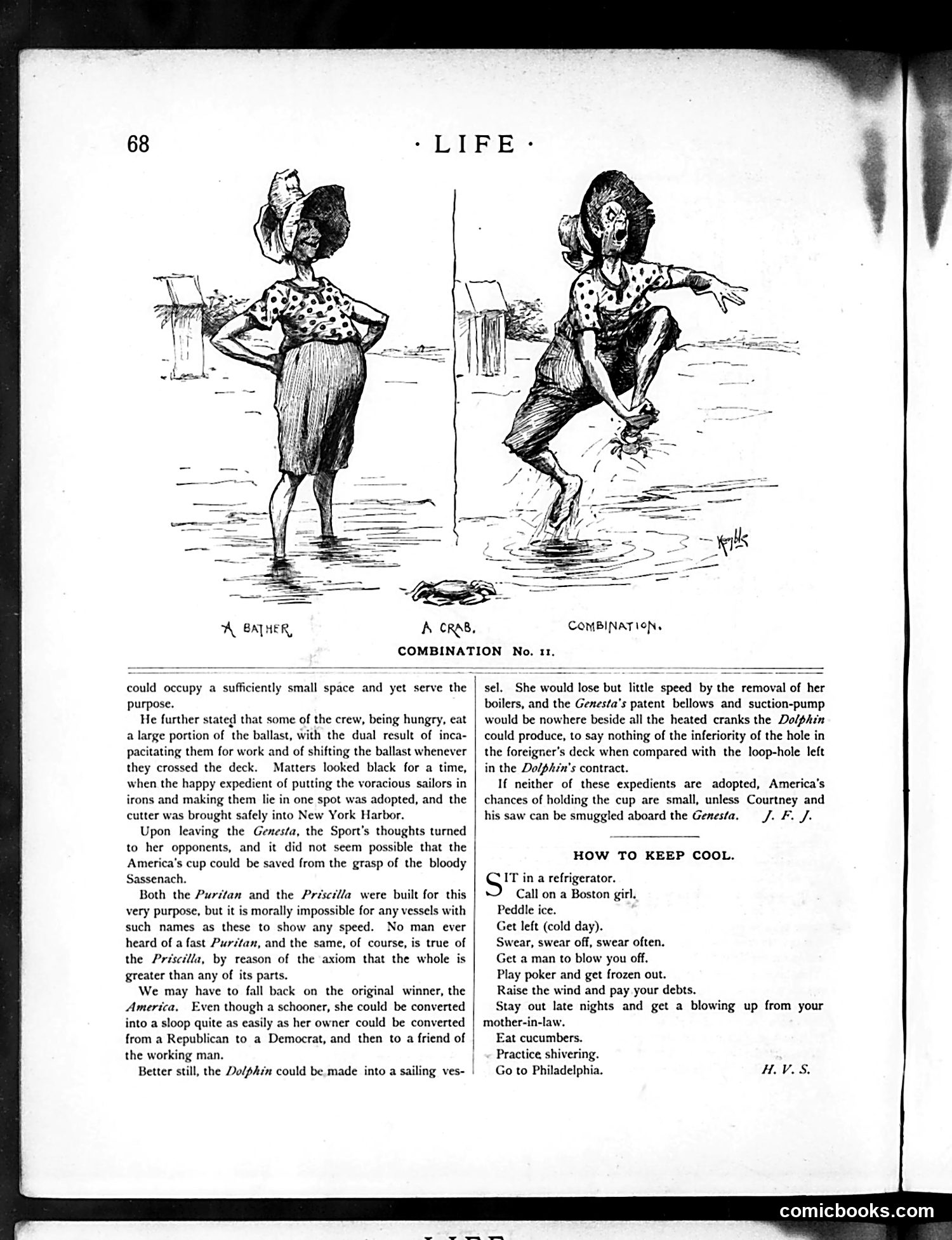
This cartoon mocks the 1885 America's Cup yacht race challenge. The titled illustration shows two women in an absurd "combination" pose—one standing primly ("A Bather"), one crouching awkwardly ("A Crab")—satirizing proposed yacht designs to compete against the British challenger *Genesta*. The accompanying text humorously debates converting various vessels (the *Puritan*, *Priscilla*, *Dolphin*, or original *America*) into competitive racing boats. The satire targets American overconfidence and silly improvisation: vessels with "slow" names can't possibly be fast; the British are "bloody Sassenachs" (insulting term for English); and there's absurd mention of smuggling someone named Courtney and "his saw" aboard. The "How to Keep Cool" section below pivots to unrelated humor about staying calm during summer heat—typical period filler humor for *Life* magazine.
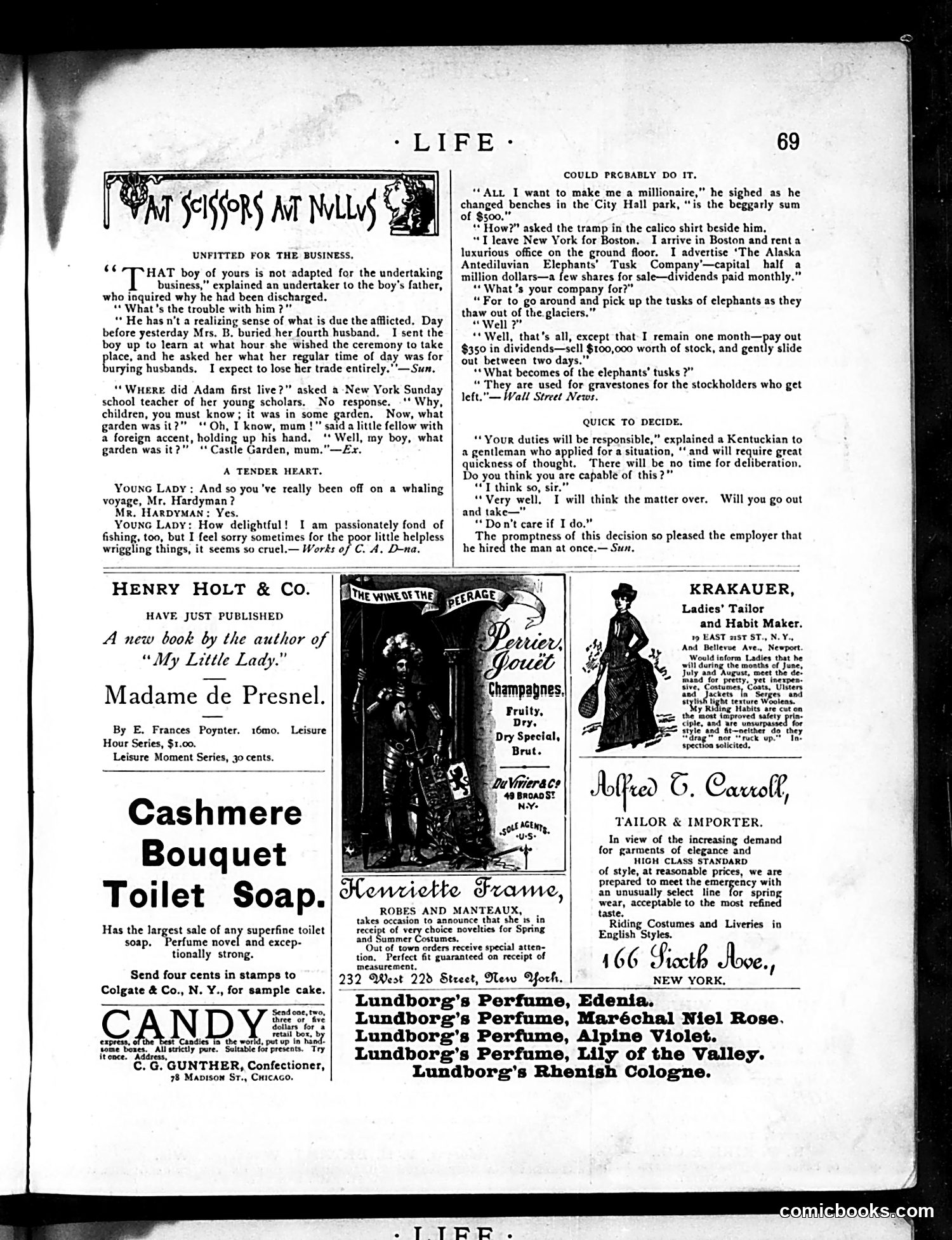
This page contains three satirical anecdotes typical of Life's humor: **"Unfitted for the Business"** mocks a widow who has buried four husbands—the joke being the undertaker expects repeat business from her, while she treats it as routine. The satire targets both the widow's marital misfortune and the undertaker's mercenary callousness. **"A Tender Heart"** features a young lady claiming to love fishing while sympathizing with "poor little helpless wriggling things." The irony: she's contradicting herself—enjoying killing fish while pitying their suffering. It satirizes sentimental hypocrisy. **"Could Probably Do It"** depicts two park bench drifters discussing a stock swindle scheme. One proposes an elaborate con: advertise a fake "Alaska Antediluvian Elephants' Tusk Company," collect investment money, then disappear. The punchline—tusks become gravestones for defrauded stockholders—satirizes Gilded Age investment fraud and the gullibility of speculators. The remaining content is period advertising for books, toiletries, and tailoring services. No political figures are caricatured here.
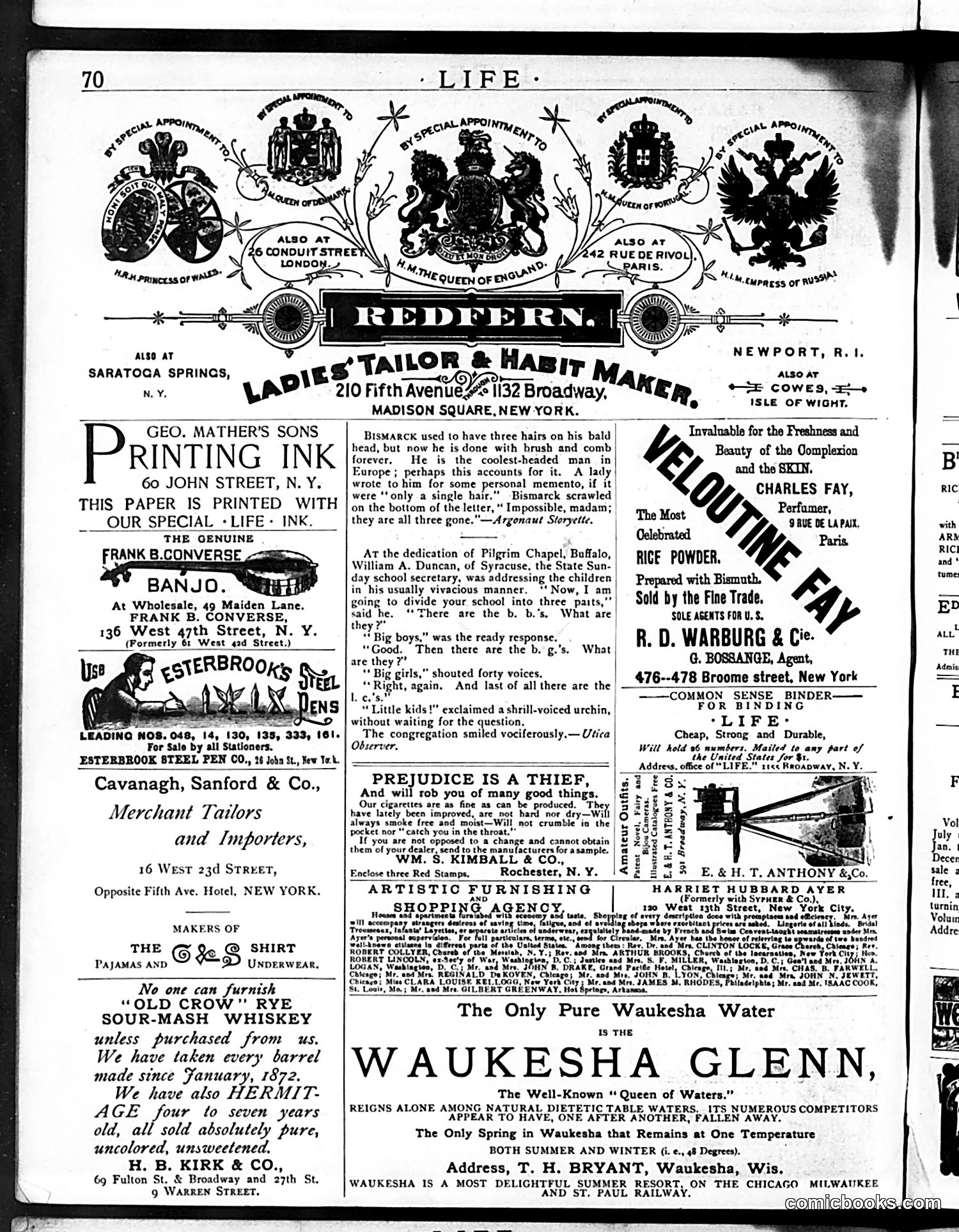
This page is primarily **advertising**, not political content. The upper section displays royal/aristocratic emblems for "Redfern," a fashionable ladies' tailor with locations in London, Paris, New York, and other elite resorts—reflecting late-19th-century upper-class commerce. The small humorous pieces are mild **social comedy**: 1. **The Bismarck anecdote** mocks the Prussian chancellor's famous bald head through a joke about him having exhausted his three remaining hairs and now being permanently "done with brush and comb." 2. **The Sunday school story** is gentle observational humor: a teacher dividing children into "b.b.'s" (bad boys), "b.g.'s" (bad girls), and a third group, but a sharp-witted child interrupts with "little kids!"—deflating the teacher's organizational scheme. Neither item is overtly political. This appears to be a typical late-19th-century *Life* page mixing genteel advertising with light domestic humor aimed at the magazine's affluent readership.
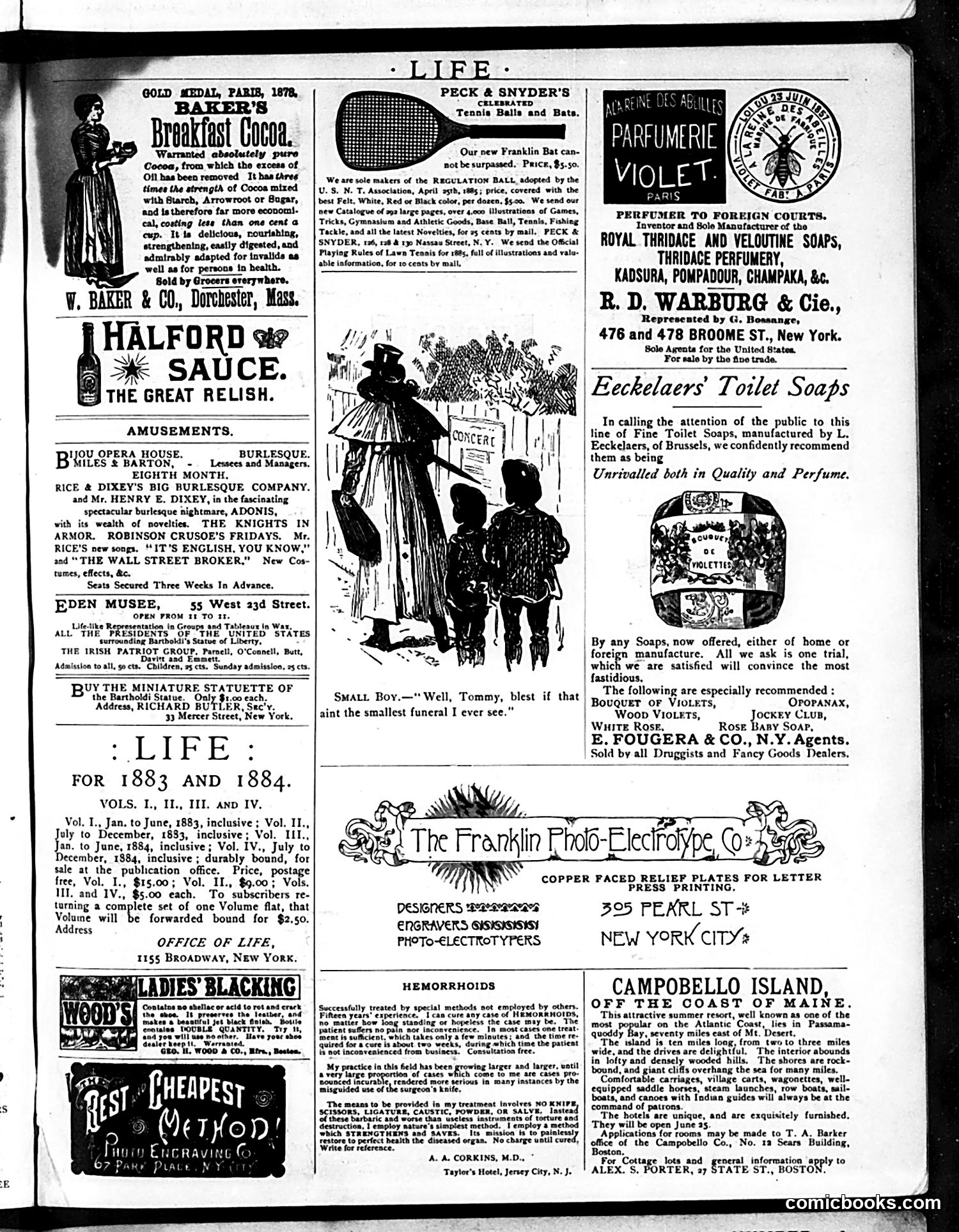
This is primarily an **advertising and announcement page** from Life magazine, not a political cartoon page. The main content consists of: **Notable Advertisement:** A small cartoon appears mid-page showing a child at a funeral, with dialogue: "Well, Tommy, blest if that ain't the smallest funeral I ever see." This appears to be **social satire about Victorian funeral customs**—mocking the absurdity of elaborate funeral ceremonies even for trivial occasions. **Other Content:** The page is dominated by period advertisements for consumer products (cocoa, sauce, toilet soaps, tennis equipment) and announcements for theatrical productions, wax museums, and Life magazine subscriptions. **Context:** The reference to "Bartholdi's Statue of Liberty" in the Eden Musée advertisement and the mention of Irish patriots (Parnell, Davitt) reflects contemporary 1883-1884 topics, but this page itself lacks significant political commentary—it's primarily commercial in nature.
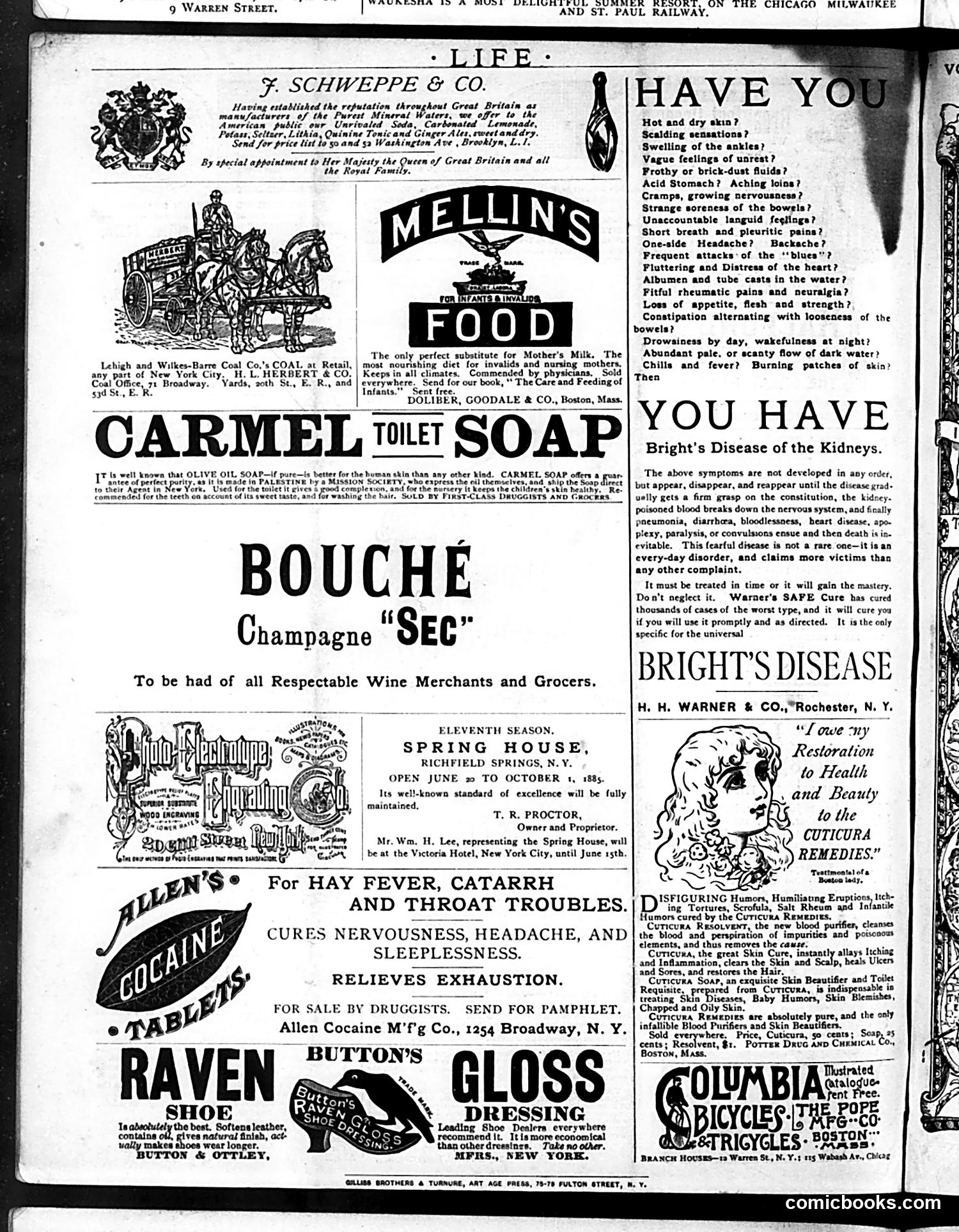
This is primarily a **patent medicine advertisement page** from Life magazine, circa 1885. The layout is typical of the era: multiple competing remedies dominating the space. The most notable content is the large **"Bright's Disease of the Kidneys"** advertisement by Warner's Safe Cure. It employs a classic patent-medicine tactic: listing vague, overlapping symptoms (fatigue, headaches, digestive issues) that could describe almost any illness, then claiming a single product cures them all. The advertisement exploits real kidney disease—which was indeed serious and poorly understood—to sell an ineffective remedy. The surrounding ads (cocaine tablets for hay fever, "Carmel Toilet Soap," champagne, coal) reflect what passed for legitimate commerce in the 1880s. Cocaine was legal and openly marketed for medicinal purposes. **The satire isn't explicit here**—this appears to be genuine advertising rather than satirical content. The page represents how Life magazine (primarily a humor publication) funded itself while also documenting the era's widespread medical fraud and unregulated patent-medicine industry.