
Life, 1885-07-30 · page 2 of 16
Life — July 30, 1885 — page 2: what you’re looking at
What you’re looking at
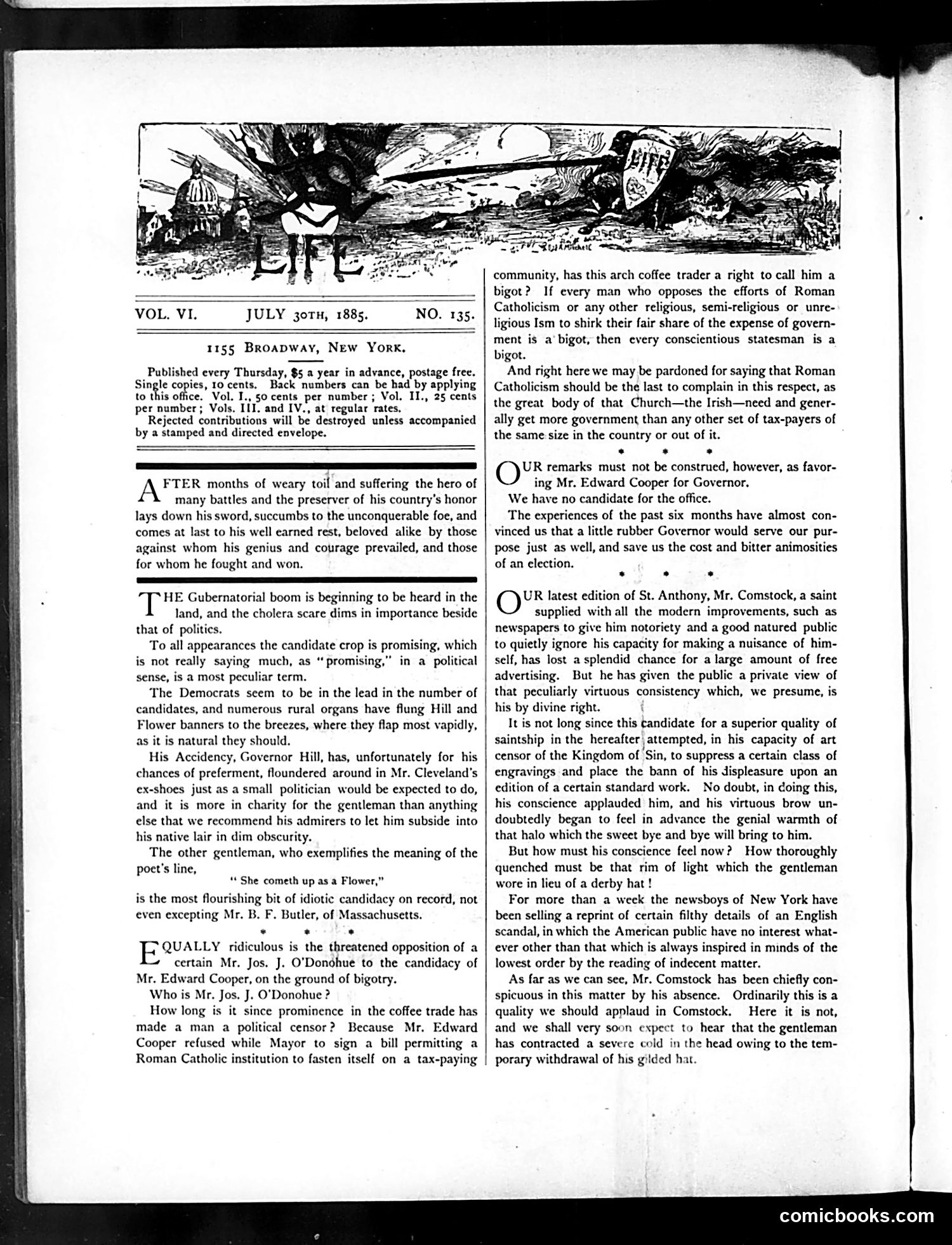
The page's header illustration depicts a figure slumped in a chair beneath a moon—likely representing a deceased political figure or candidate, though the specific identity isn't clear from the image alone. The text discusses the 1885 gubernatorial race and criticizes candidate Edward Cooper, apparently for refusing to sign a bill supporting a Roman Catholic institution. The authors attack this as bigotry while simultaneously mocking Cooper's opponent, Mr. O'Donohue, as an "arch coffee trader" unfit for office. The satire targets the election's religious divisions and questions both candidates' fitness for governor, suggesting the campaign represents base political maneuvering rather than substantive governance. The tone is cynical about New York politics generally.
📄 Transcribed text from this page (OCR, searchable)
Machine-transcribed from the original scan — historical spelling and the odd misread are preserved.
VOL. VI. JULY 30TH, 1885. 1155 Broapway, New York. Published every Thursday, $5 a year in advance, postage free. Single copies, 10 cents. Back numbers can be had by applying to this office. Vol. I., 50 cents per number ; Vol. II., 25 cents per number; Vols. III. and IV., at regular rates. Rejected contributions will be destroyed unless accompanied by a stamped and directed envelope. ATT months of weary toil and suffering the hero of many battles and the preserver of his country’s honor lays down his sword, succumbs to the unconquerable foe, and comes at last to his well earned rest, beloved alike by those against whom his genius and courage prevailed, and those for whom he fought and won. HE Gubernatorial boom is beginning to be heard in the land, and the cholera scare dims in importance beside that of politics. To all appearances the candidate crop is promising, which is not really saying much, as “promising,” in a_ political sense, is a most peculiar term. The Democrats seem to be in the lead in the number of candidates, and numerous rural organs have flung Hill and Flower banners to the breezes, where they flap most vapidly, as it is natural they should. His Accidency, Governor Hill, has, unfortunately for his chances of preferment, floundered around in Mr. Cleveland's ex-shoes just as a small politician would be expected to do, and it is more in charity for the gentleman than anything else that we recommend his admirers to let him subside into his native lair in dim obscurity. The other gentleman, who exemplifies the meaning of the poct’s line, “She cometh up as a Flower,” is the most flourishing bit of idiotic candidacy on record, not even excepting Mr. B. F. Butler, of Massachusetts. . . . QUALLY ridiculous is the threatened opposition of a certain Mr. Jos. J. O'Donohue to the candidacy of Mr. Edward Cooper, on the ground of bigotry. Who is Mr. Jos. J. O'Donohue ? How long is it since prominence in the coffee trade has made a man a political censor? Because Mr. Edward Cooper refused while Mayor to sign a bill permitting a community, has this arch coffee trader a right to call him a bigot? If every man who opposes the efforts of Roman Catholicism or any other religious, semi-religious or unre- ligious Ism to shirk their fair share of the expense of govern- ment is a‘ bigot, then every conscientious statesman is a bigot. And right here we may be pardoned for saying that Roman Catholicism should be the last to complain in this respect, as the great body of that Church—the Irish—need and gener- ally get more government than any other set of tax-payers of the same size in the country or out of it. . * . UR remarks must not be construed, however, as favor- ing Mr. Edward Cooper for Governor. We have no candidate for the office. The experiences of the past six months have almost con- vinced us that a little rubber Governor would serve our pur- pose just as well, and save us the cost and bitter animosities | of an election. * . * Ov’ latest edition of St. Anthony, Mr. Comstock, a saint supplied with all the modern improvements, such as newspapers to give him notoriety and a good natured public to quietly ignore his capacity for making a nuisance of him- | self, has lost a splendid chance for a large amount of free advertising. But he has given the public a private view of that peculiarly virtuous consistency which, we presume, is his by divine right. It is not long since this candidate for a superior quality of saintship in the hereafter attempted, in his capacity of art censor of the Kingdom of ‘Sin, to suppress a certain class of engravings and place the bann of his displeasure upon an edition of a certain standard work. No doubt, in doing this, his conscience applauded him, and his virtuous brow un- doubtedly began to feel in advance the genial warmth of that halo which the sweet bye and bye will bring to him. But how must his conscience feel now? How thoroughly quenched must be that rim of light which the gentleman wore in lieu of a derby hat! For more than a week the newsboys of New York have been selling a reprint of certain filthy details of an English scandal, in which the American public have no interest what- ever other than that which is always inspired in minds of the lowest order by the reading of indecent matter. As far as we can see, Mr. Comstock has been chiefly con- spicuous in this matter by his absence. Ordinarily this is a quality we should applaud in Comstock. Here it is not, and we shall very soon expect to hear that the gentleman has contracted a severe cold in the head owing to the tem- Roman Catholic institution to fasten itself on a tax-paying | porary withdrawal of his gilded hat. comicbooks.com