
A complete issue · 16 pages · 1885
Life — July 23, 1885
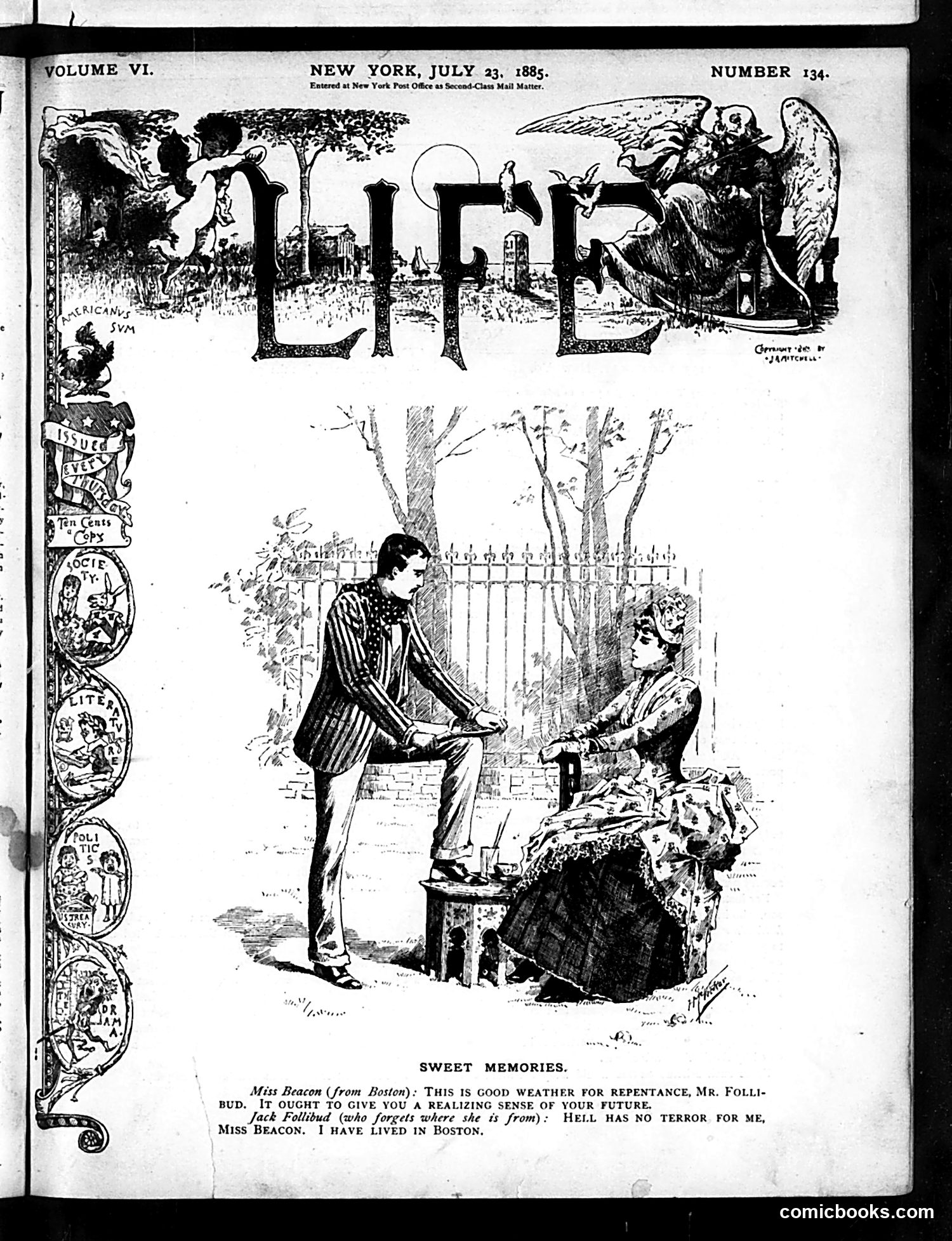
The main illustration, titled "Sweet Memories," depicts a romantic encounter between a man and woman in a garden setting. The dialogue reveals social satire about courtship and geography: A man named Mr. Follibee addresses "Miss Beacon" (from Boston), suggesting this good weather should prompt her to reflect on their future together. Miss Beacon responds dismissively, claiming Boston holds no terror for her—implying she has no intention of relocating there or deepening their relationship. The satire likely mocks romantic misunderstandings and the social pressures around courtship and marriage in the 1880s, particularly the tension between a suitor's hopes and a woman's independence. The specific Boston reference may suggest regional attitudes about New England propriety or marriage prospects.
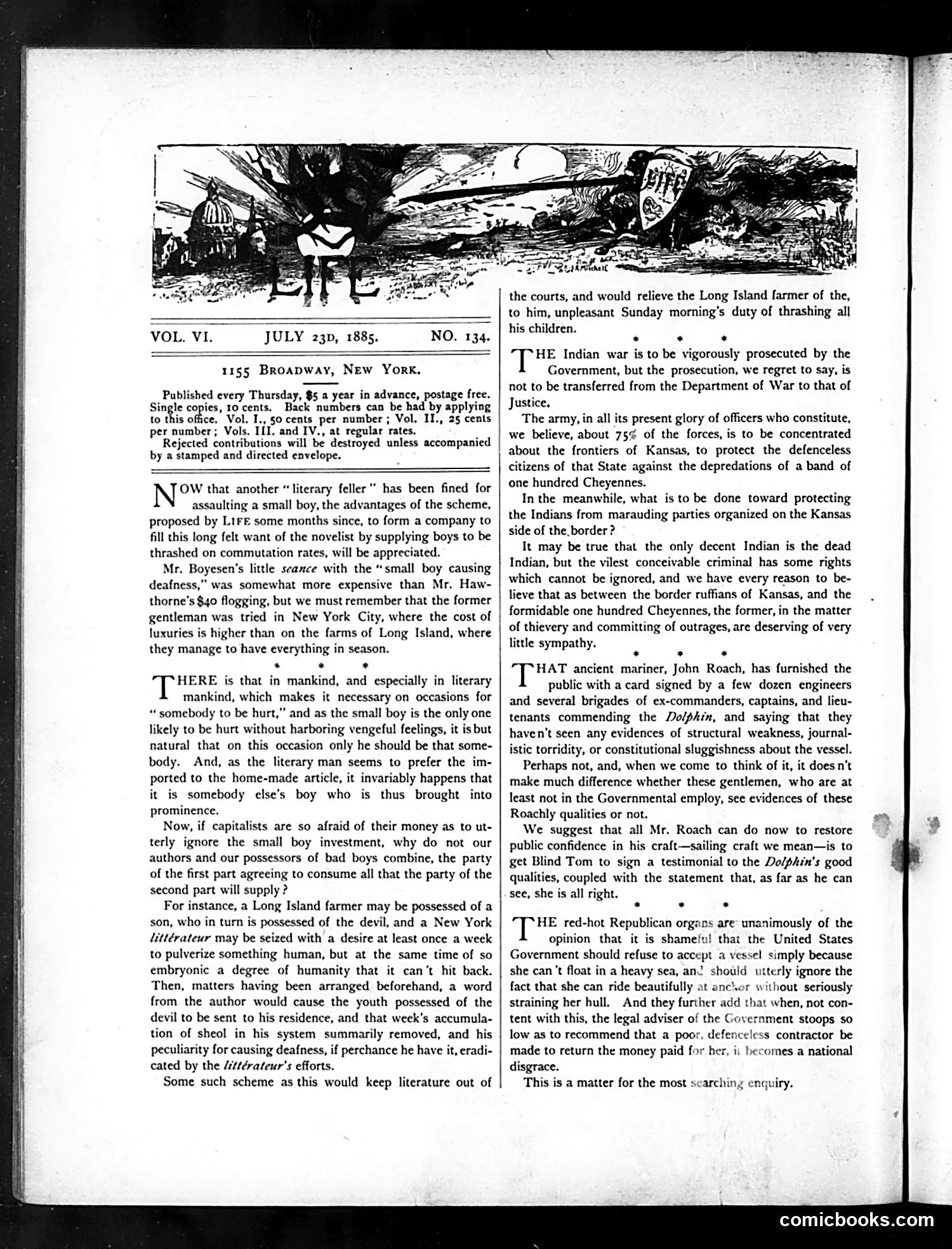
The header illustration depicts a chaotic scene with figures and a carriage, likely satirizing a contemporary incident, though the specific reference is unclear from the image alone. The text critiques a "literary feller" (writer) fined for assaulting a boy—apparently part of a scheme where publishers hired boys to be thrashed to generate sensational newspaper stories. The satire targets both unethical authors and capitalists exploiting child labor for profit and publicity. A separate section discusses the Indian Wars on the Kansas frontier, criticizing government handling of Cheyenne conflicts and praising Captain John Roach's maritime engineering while questioning his vessel's worthiness. The final paragraph addresses Republican newspaper criticism of accepting a defective naval vessel, satirizing partisan politics around government contracts and national disgrace.
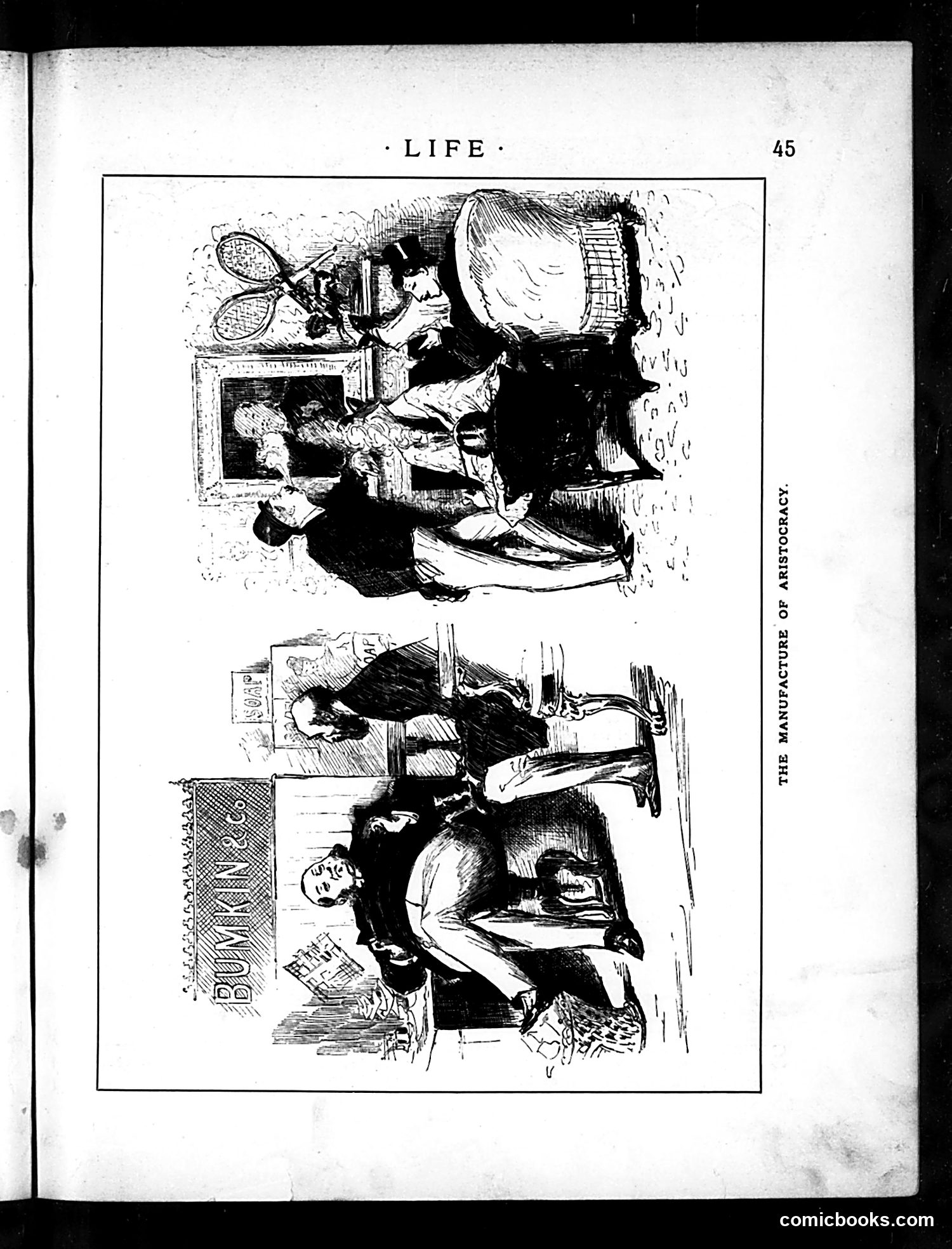
This page contains two satirical cartoons about the production of social reformers. The top cartoon shows a figure operating what appears to be a manufacturing machine with various inputs (scissors, tools, documents), suggesting reformers are artificially "manufactured" rather than organically developed. The bottom cartoon depicts someone at a desk or workstation, likely representing the mass-production aspect of creating reformers—implying the process is mechanized and formulaic rather than genuine. The title suggests satire of the Progressive Era's reform movements, mocking the notion that reformers are produced like factory goods rather than emerging from authentic conviction. The cartoons critique what appears to be insincere or commercialized reform activism, suggesting reformers follow predictable templates rather than individual principles.
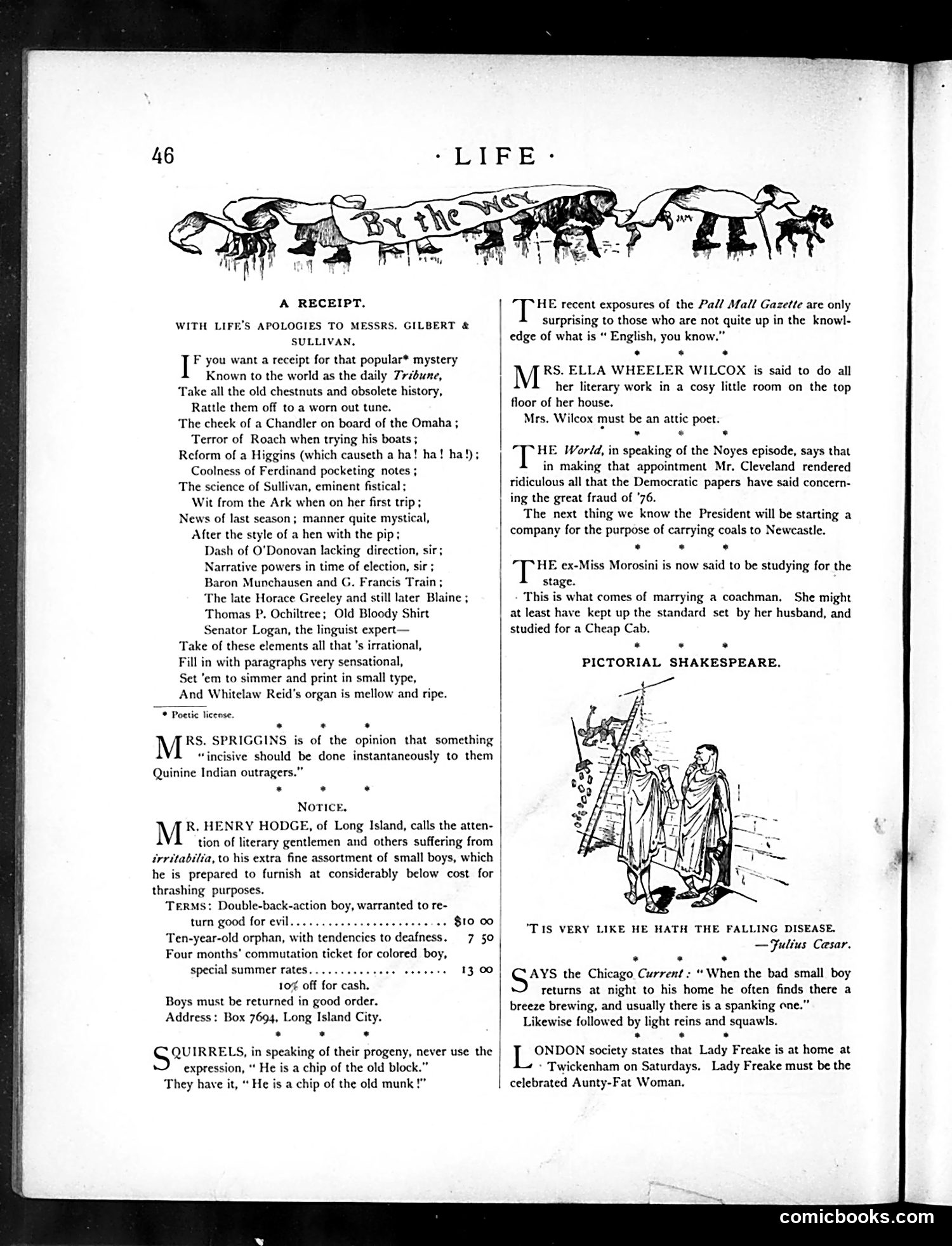
This page contains satirical notes and commentary rather than a political cartoon. The main illustration labeled "PICTORIAL SHAKESPEARE" shows figures in classical dress with the caption "TIS VERY LIKE HE HATH THE FALLING DISEASE" (from Julius Caesar). The text includes social commentary on contemporary figures and events, including references to: - The Pall Mall Gazette's recent exposés - Mrs. Ella Wheeler Wilcox (a popular poet) - A Democratic political fraud allegation involving Cleveland - Various humorous notices about eccentric individuals The "Receipt" section mockingly lists remedies for the Tribune newspaper's ailments using antiquated or absurd treatments. Overall, this represents Life's typical satirical format: pointed social criticism delivered through witty, caustic commentary rather than visual political cartoons.
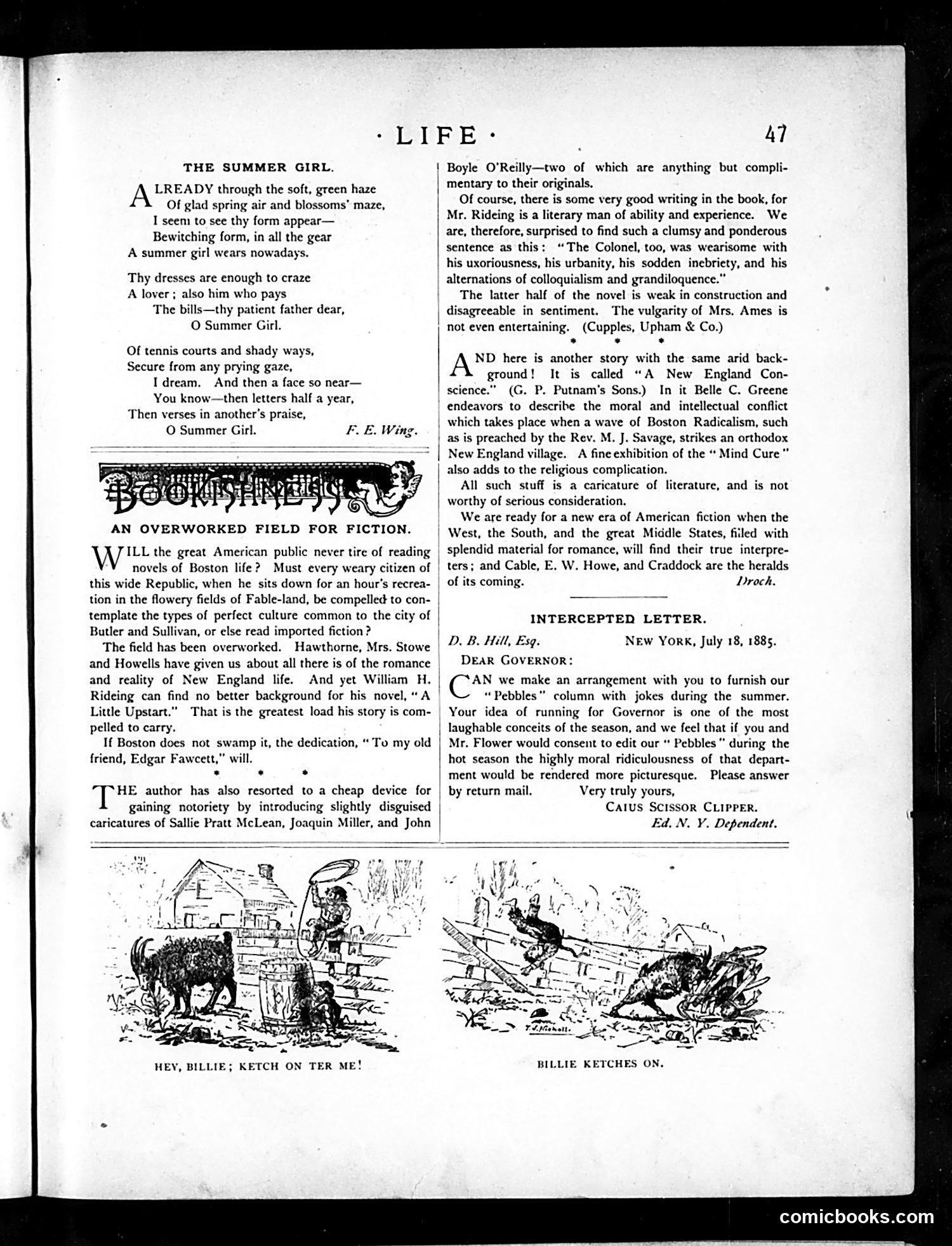
This page contains two main sections: **"The Summer Girl" poem** by F.E. Wing describes fashionable young women of the era in idealized terms—their light clothing, freedom from scrutiny, and leisurely pursuits like tennis. **"An Overworked Field for Fiction"** critiques American literary fiction, noting Boston's dominance in the novel market. The author argues regional American settings (West, South, Middle States) offer untapped material for future writers like Cable, Howe, and Craddock. **Two cartoon sketches** at bottom show a character named Billie—likely a domestic servant or farmhand—in comedic situations ("Hey, Billie; Ketch on Ter Me!" and "Billie Ketches On"). These appear to be humorous vignettes about working-class mishaps. The "Intercepted Letter" is satirical correspondence mocking the idea of running moral content in a summer publication.
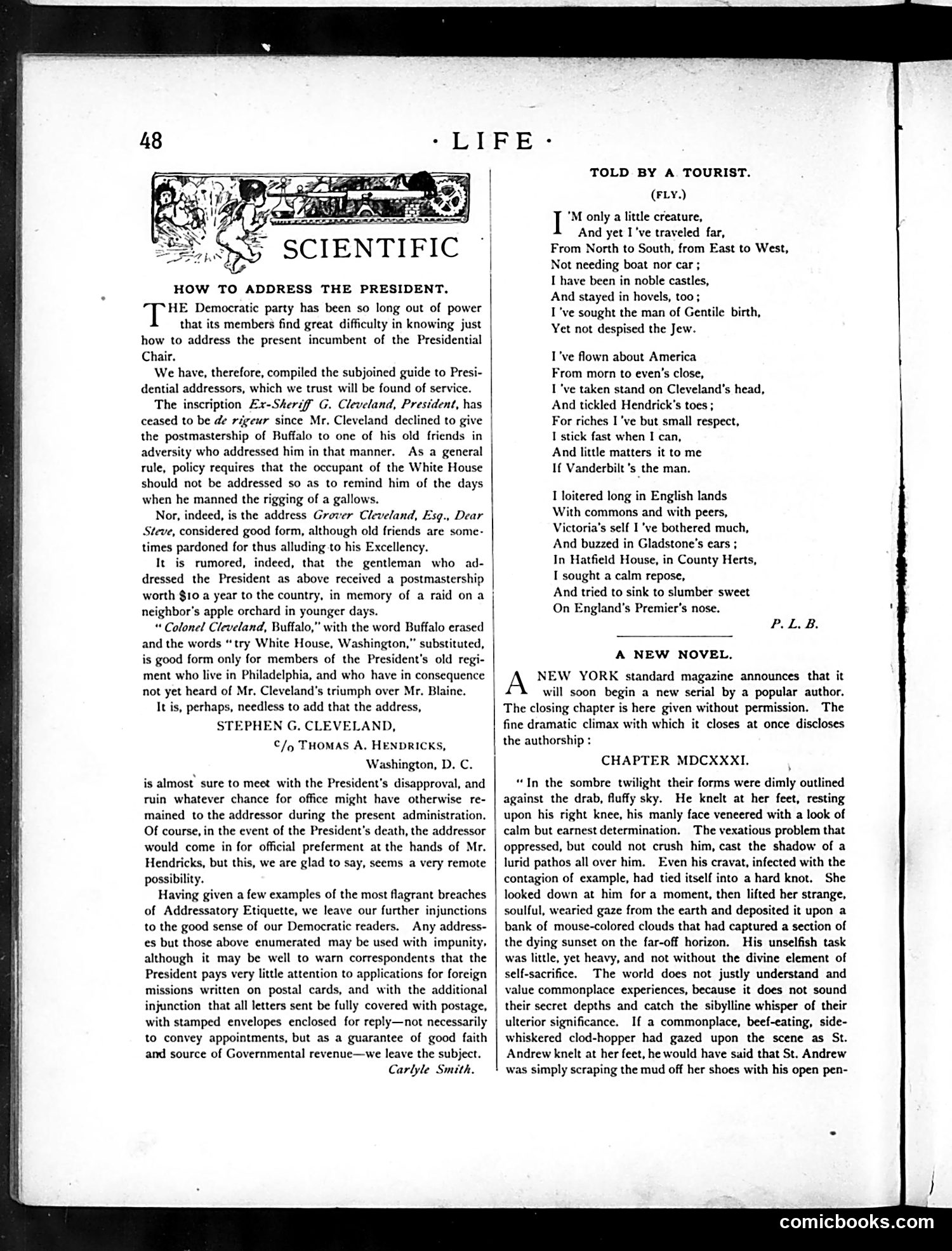
This page contains a satirical article titled "How to Address the President," mocking Democratic Party members' supposed confusion about properly addressing President Cleveland. The humor derives from suggesting they've been out of power so long they've forgotten protocol. The satire proposes absurd alternative addresses like "Colonel Cleveland, Buffalo" (referencing Cleveland's Buffalo roots) and critiques a postmaster who allegedly sent Cleveland a postcard worth $10 to the country as a "memory of a raid on a neighbor's apple orchard"—likely alluding to some embarrassing incident in Cleveland's past. The piece satirizes Democratic incompetence and clumsiness while simultaneously poking fun at Cleveland himself, suggesting he's an unconventional figure requiring unusual addressal procedures.
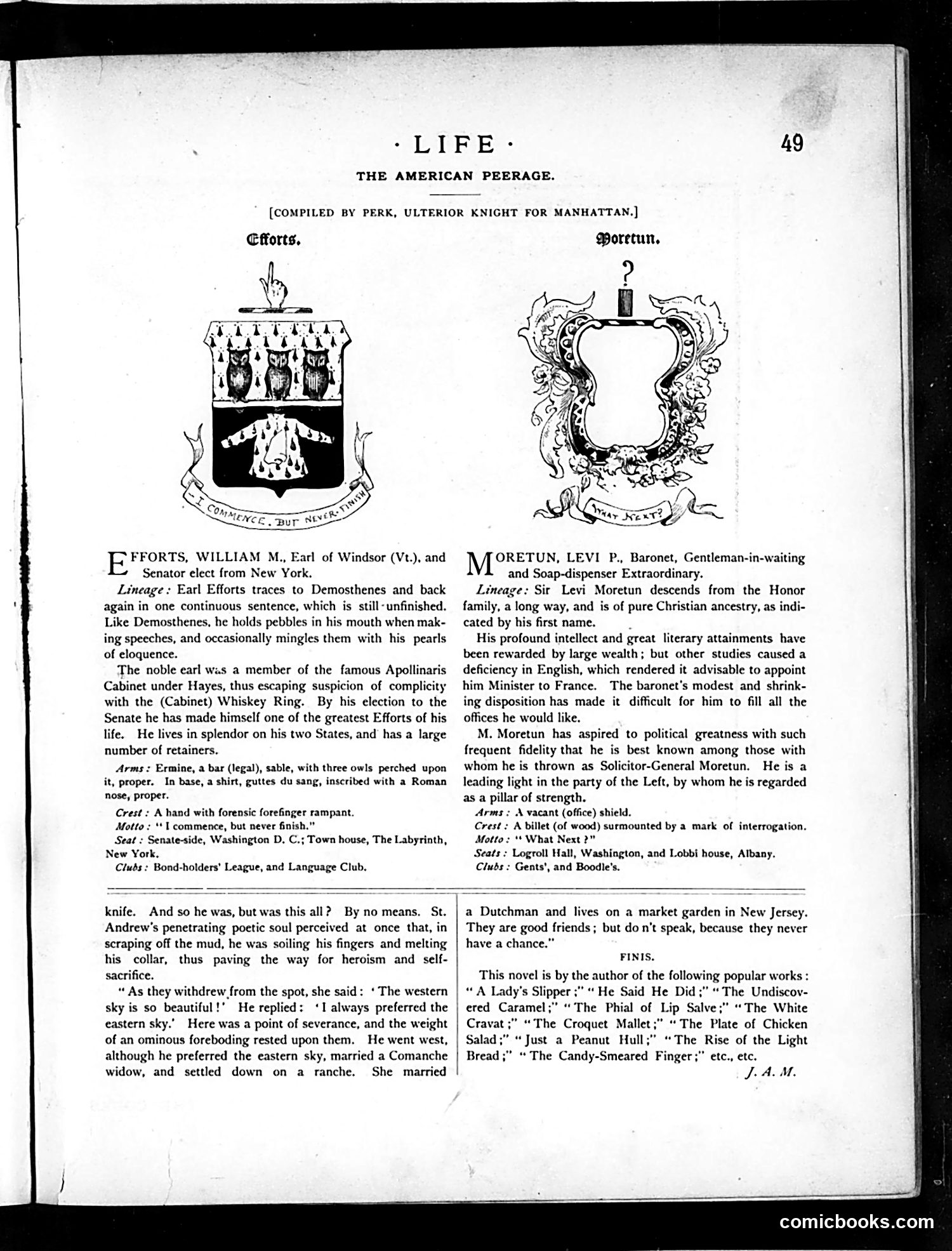
This page from *Life* magazine presents two heraldic coats of arms satirizing prominent American figures as if they were European nobility: **Efforts** (left): William M. Effortsworth, Earl of Windsor, Vermont—a satirical jab at someone's pretentious social climbing, with owls and a fireplace depicted in the heraldry. **Moretun** (right): Levi P. Moretun, a Baronet and "Soap-dispenser Extraordinary"—mocking wealth obtained through mundane commercial enterprise, suggesting nouveau riche absurdity. The satire ridicules wealthy Americans who adopt aristocratic airs despite humble origins. The text's mock-genealogical format parodies European peerage traditions, contrasting genuine nobility with American industrial fortunes. This reflects *Life*'s recurring theme: critiquing the pretensions of the American wealthy class attempting to purchase respectability through conspicuous consumption and assumed gentility.
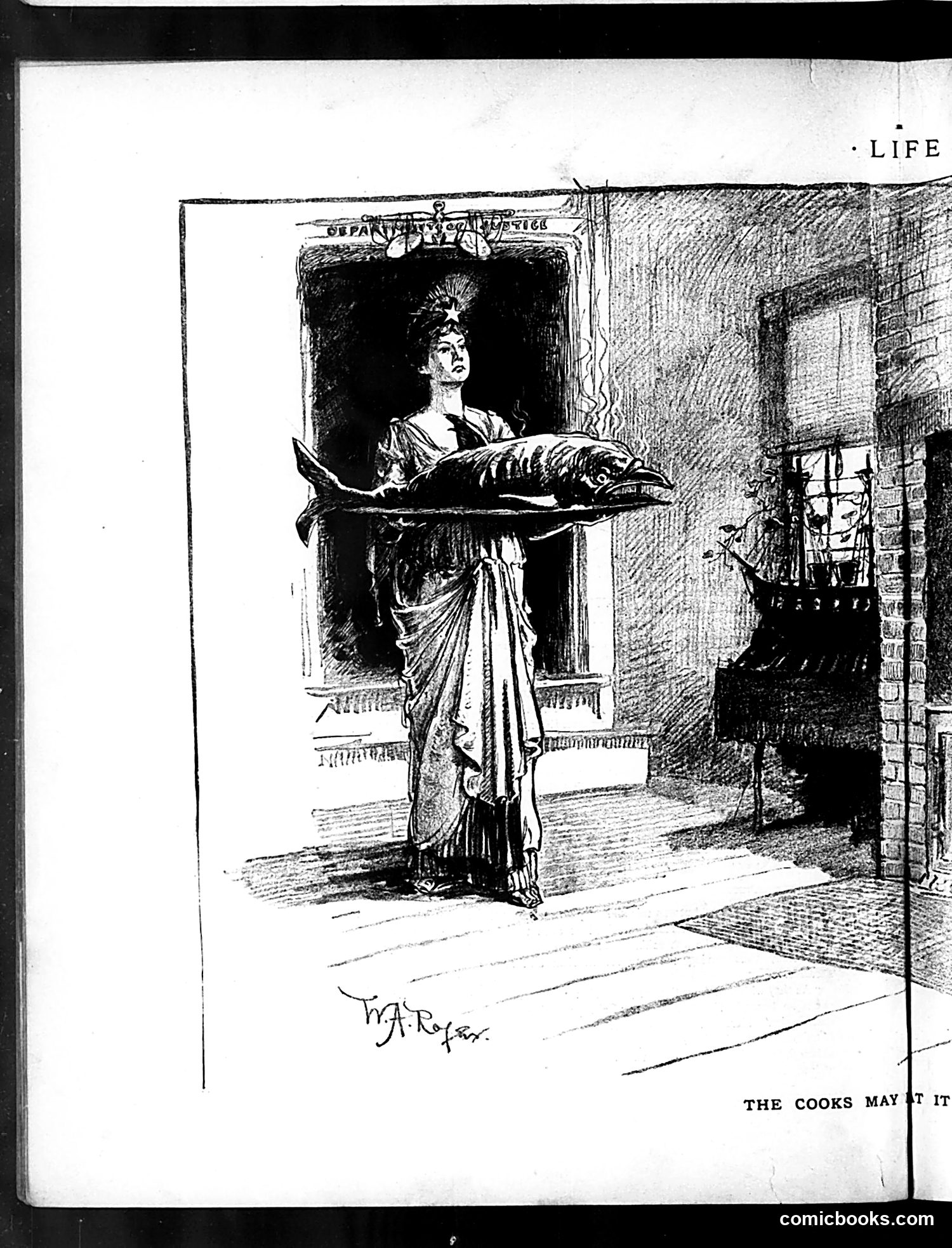
This is a satirical illustration titled "THE COOKS MAY IT" (likely "THE COOK'S MAY TRY IT"). The sketch shows a classical female figure in draped clothing holding an enormous fish, standing in what appears to be a Department of Justice hallway or office. The satire likely comments on the Department of Justice's activities or authority during this era. The oversized fish suggests either abundance, waste, or perhaps a metaphorical "catch"—possibly referencing government actions or legal proceedings. The classical female figure may represent Justice or government authority itself. The artist's signature reads "W.A. Rogers," a prominent Life magazine cartoonist. Without the publication date, the specific historical reference remains unclear, though the style suggests early 20th century.
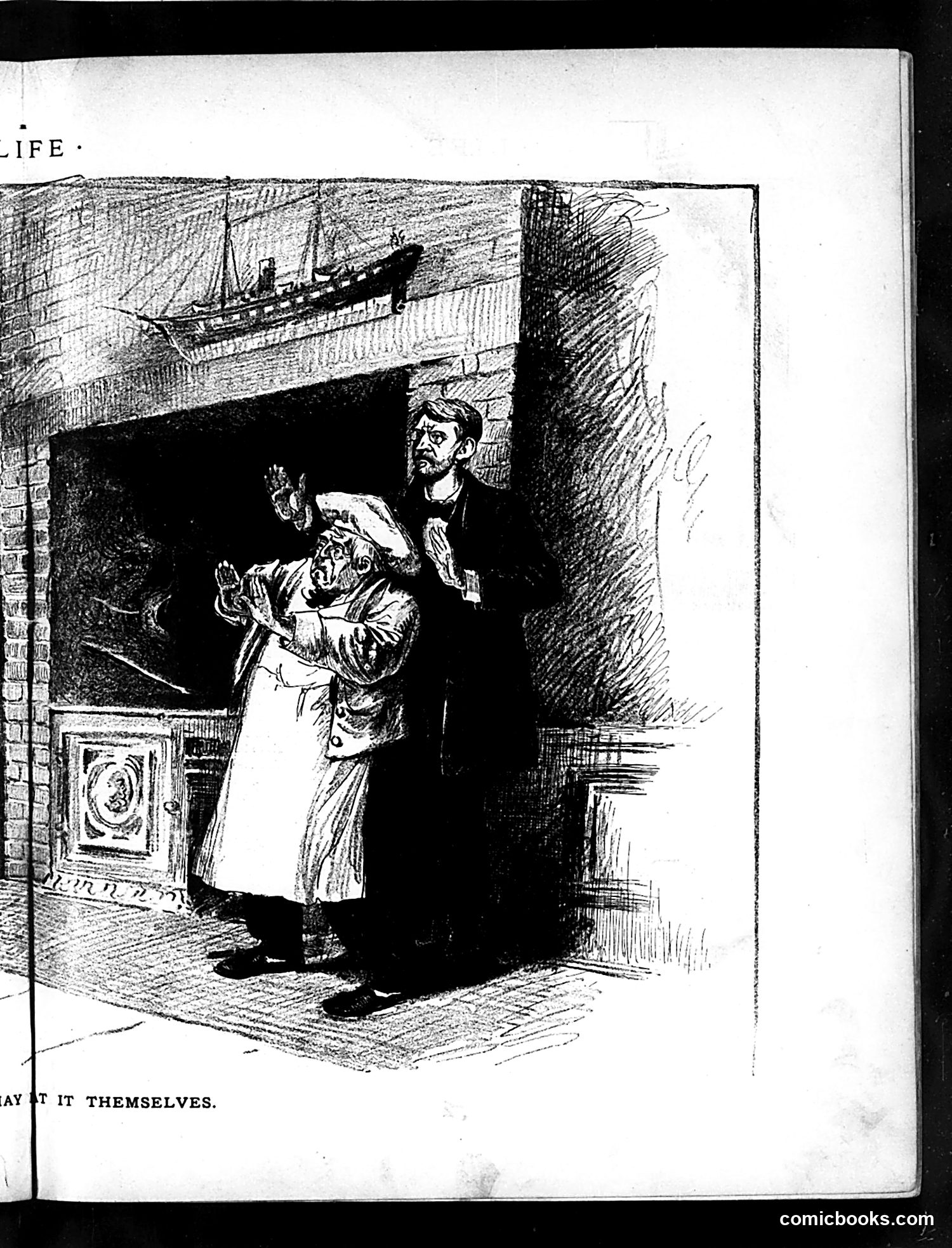
This appears to be a satirical cartoon from *Life* magazine depicting a man in formal dress (dark coat) holding a child while gazing out a window. Through the window, a steamship is visible on the water. The caption reads "...AT IT THEMSELVES," though the full caption is partially cut off at the left margin. The cartoon likely satirizes parental responsibility or domestic life—the man appears to be contemplating escape (the ship) while burdened with childcare duties. The incomplete caption suggests this is part of a multi-panel sequence or story. Without the complete caption or surrounding context, I cannot definitively identify the specific political or social reference, though the imagery suggests commentary on family obligations versus personal freedom or desire to travel.
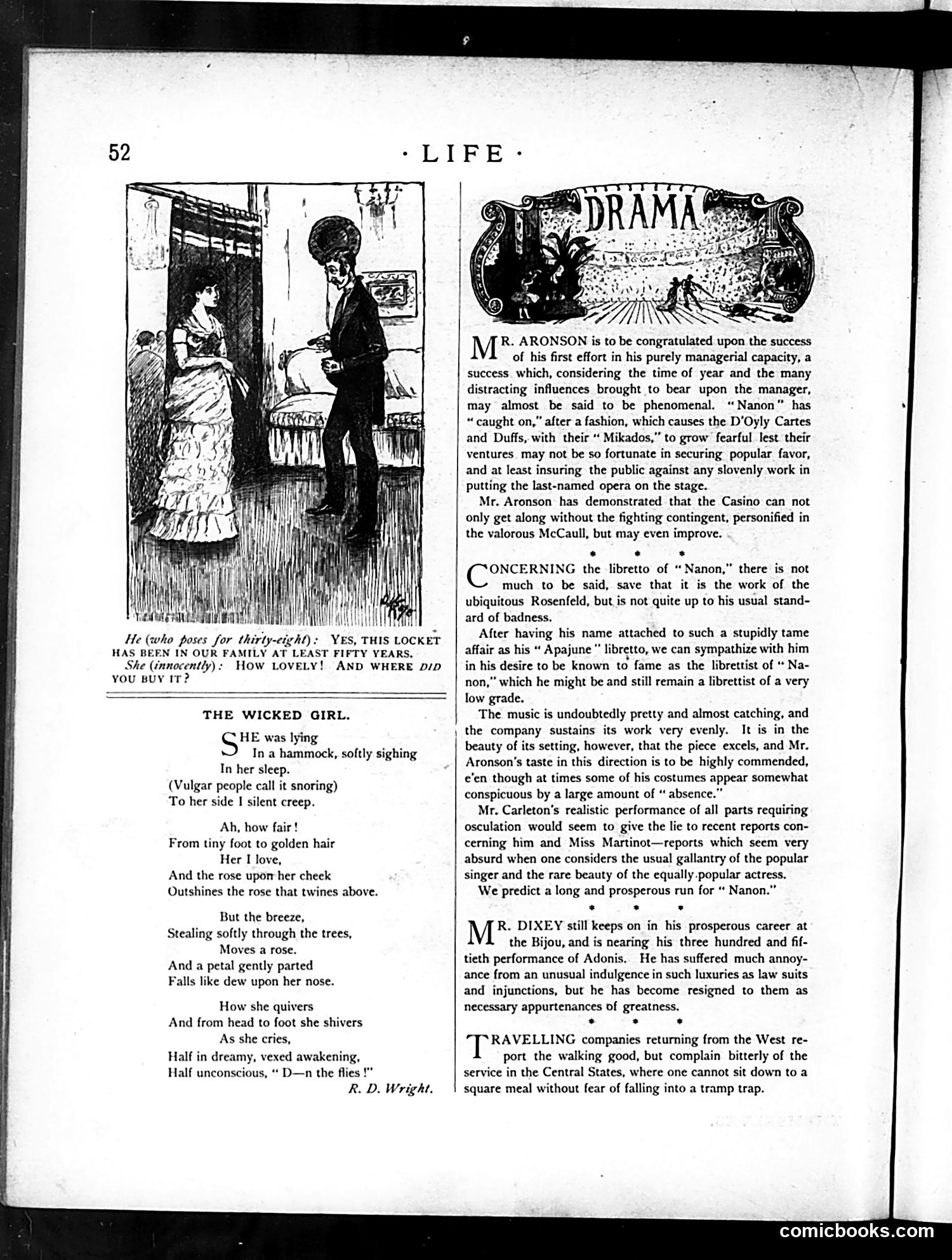
This page contains two distinct pieces of humor: **"The Wicked Girl" cartoon** (left): A sentimental poem about a man admiring his sleeping beloved, describing her delicate beauty in romantic detail—until she abruptly awakens and curses at a fly landing on her nose. The joke satirizes the gap between idealized romantic fantasy and crude reality; the woman's unladylike outburst deflates the flowery sentimentality entirely. **"Drama" section** (right): Theater reviews praising the opera "Nanon" and its manager Aronson's competent production, while gently mocking the librettist Rosenfeld's generally poor work and the performer Carleton's reputation. The reviews discuss the show's music, costumes, and cast with the insider gossip typical of period theater criticism. The page demonstrates *Life's* blend of literary humor and entertainment commentary for a cultured audience familiar with contemporary theater.
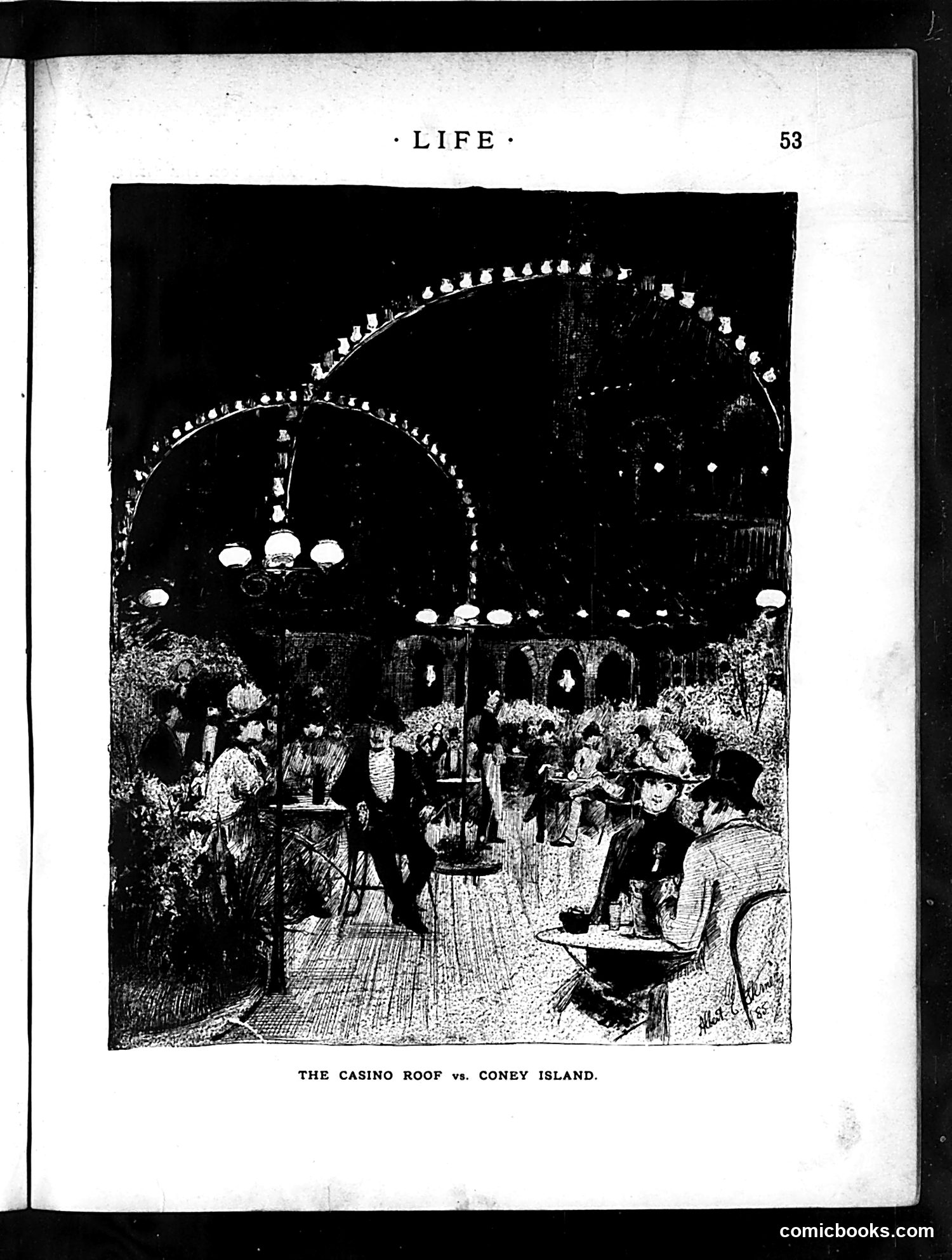
This illustration depicts "The Casino Roof vs. Coney Island"—a satirical comparison of two popular leisure destinations for New York City residents. The image shows an elegant, ornate indoor casino or entertainment venue with decorative arched ceilings, electric lights, and well-dressed patrons in refined surroundings. The contrast implied by the title suggests this upscale establishment is being compared unfavorably or humorously against Coney Island, the public beach amusement area known for more democratic, rowdy, working-class entertainment. The satire likely critiques either the pretension of the casino's genteel atmosphere versus the authentic pleasures of Coney Island's mass-market amusements, or conversely, mocks the supposedly "vulgar" Coney Island crowds. Without additional context, the exact angle of the joke remains unclear, but it reflects early 20th-century anxieties about class divisions in American recreation.
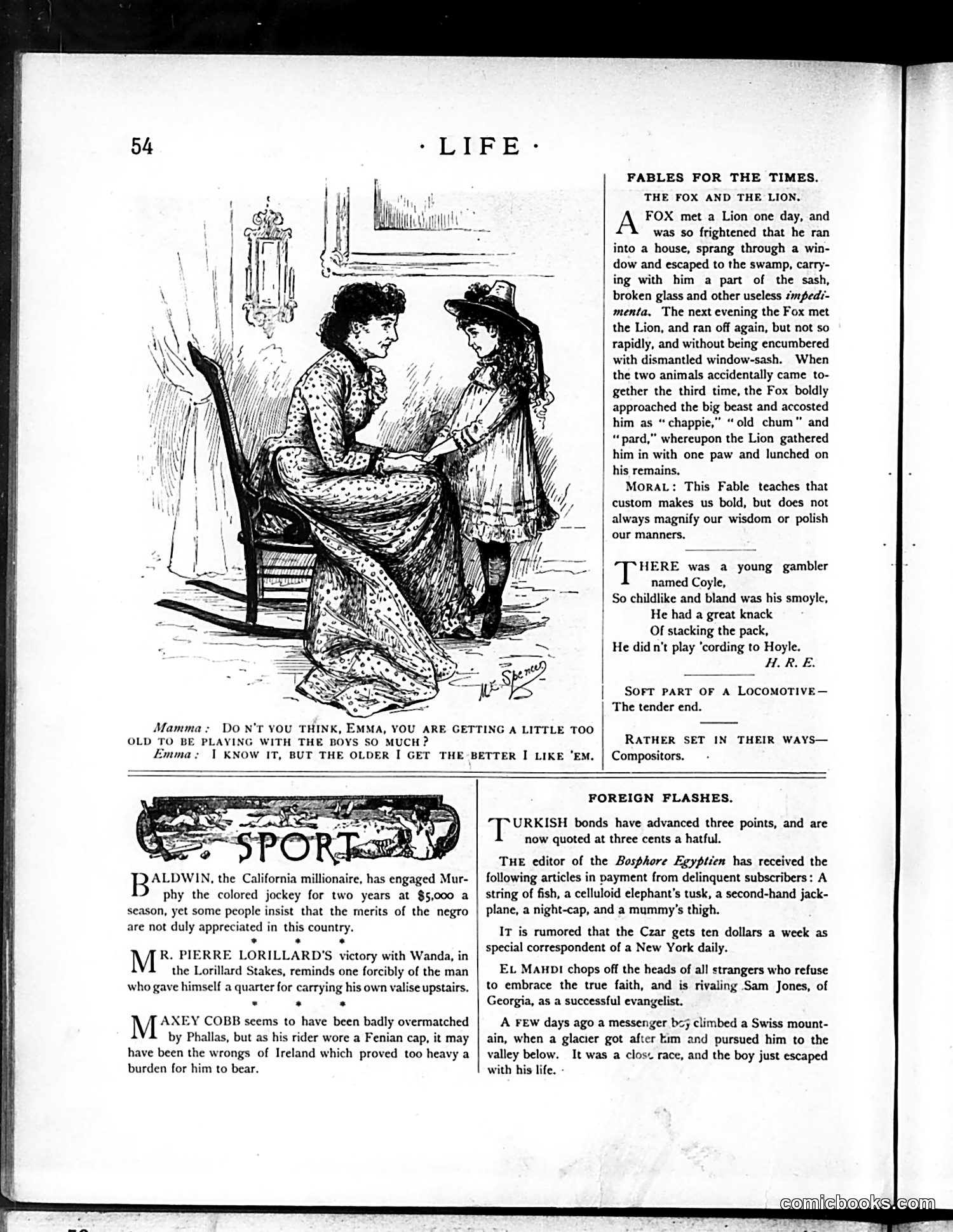
The main cartoon depicts a mother cautioning her daughter Emma about spending too much time with boys. Emma's reply—that she likes older boys better as she gets older—is the joke: a cheeky double entendre suggesting romantic/physical interest rather than innocent friendship. Below are short satirical pieces: "The Fox and the Lion" mocks how familiarity breeds false confidence (the fox becomes bold through repeated encounters, leading to disaster). The moral warns that custom doesn't confer wisdom. The "SPORT" section contains brief jabs at contemporary figures: Baldwin hiring an expensive Black jockey while Blacks lack full social acceptance; Lorillard winning races through inherited advantage; and a dig at boxer Maxey Cobb's loss (the "Fenian cap" reference mocks Irish grievances as an excuse). "Foreign Flashes" satirizes international absurdities: Turkish financial collapse, Egyptian poverty, Czarist Russia, and the Mahdi's fanaticism—all presented as humorous oddities for American readers.
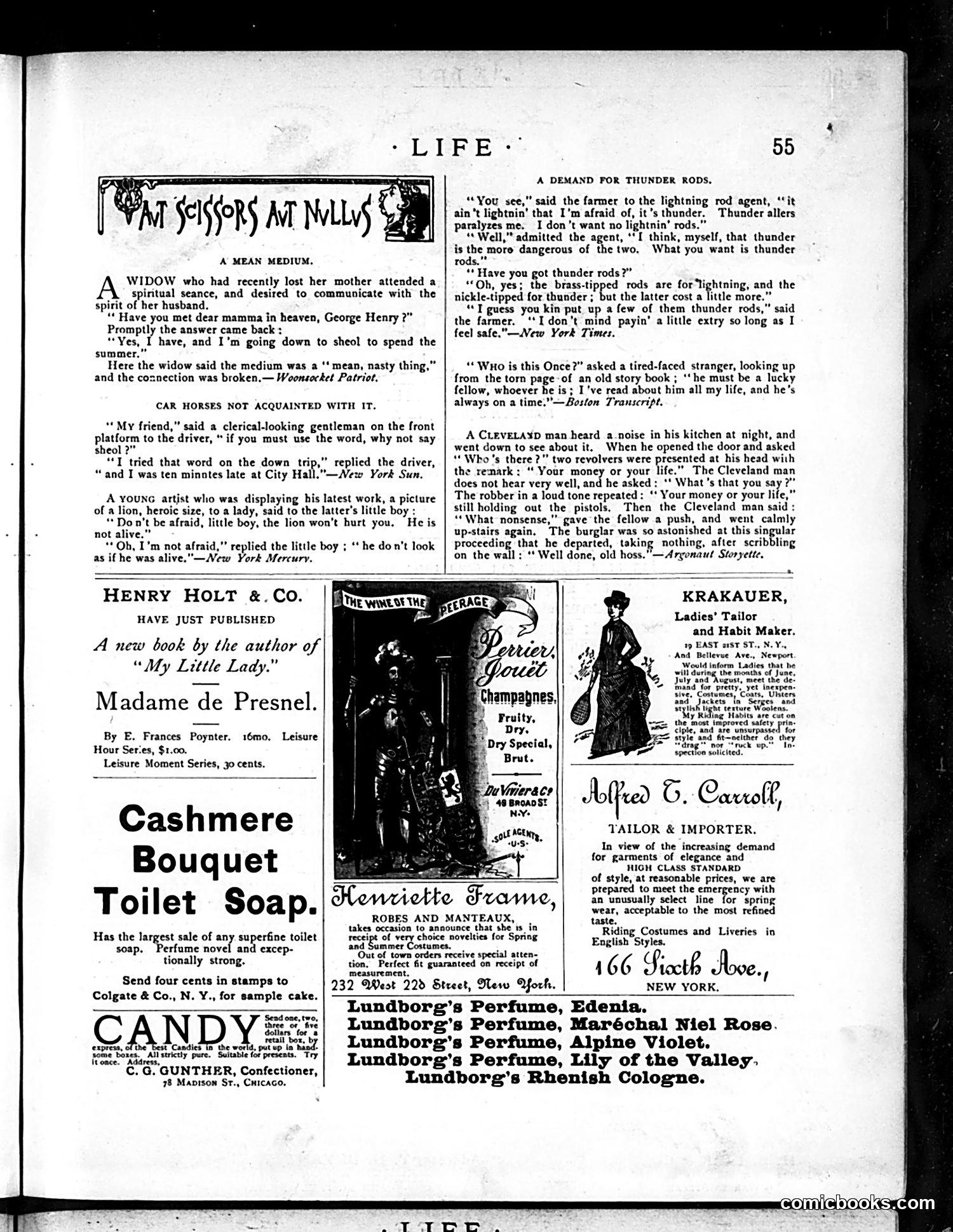
This page contains four humorous anecdotes satirizing common American foibles and communication mishaps: **"A Mean Medium"** mocks spiritualism's popularity. A widow seeking contact with her deceased husband through a séance finds the "spirit" crude (mentioning "sheol"/hell), revealing the medium as a fraud exploiting grief. **"Car Horses Not Acquainted With It"** jokes about religious propriety. A streetcar driver tried substituting the Hebrew word "sheol" for a vulgar oath to sound refined, but lost time—implying that elevated language doesn't actually change crude meaning, just its appearance. **"A Young Artist"** offers gentle humor about a child's blunt honesty: the boy isn't frightened by the realistic lion painting because it looks dead. **"A Demand for Thunder Rods"** satirizes rural gullibility. A farmer fears thunder (not lightning) and agrees to pay extra for non-existent "thunder rods"—a salesman's fictional upsell to a credulous customer. The page is primarily humorous filler with advertisements below, typical of Life's satirical commentary on American speech, beliefs, and social pretensions.
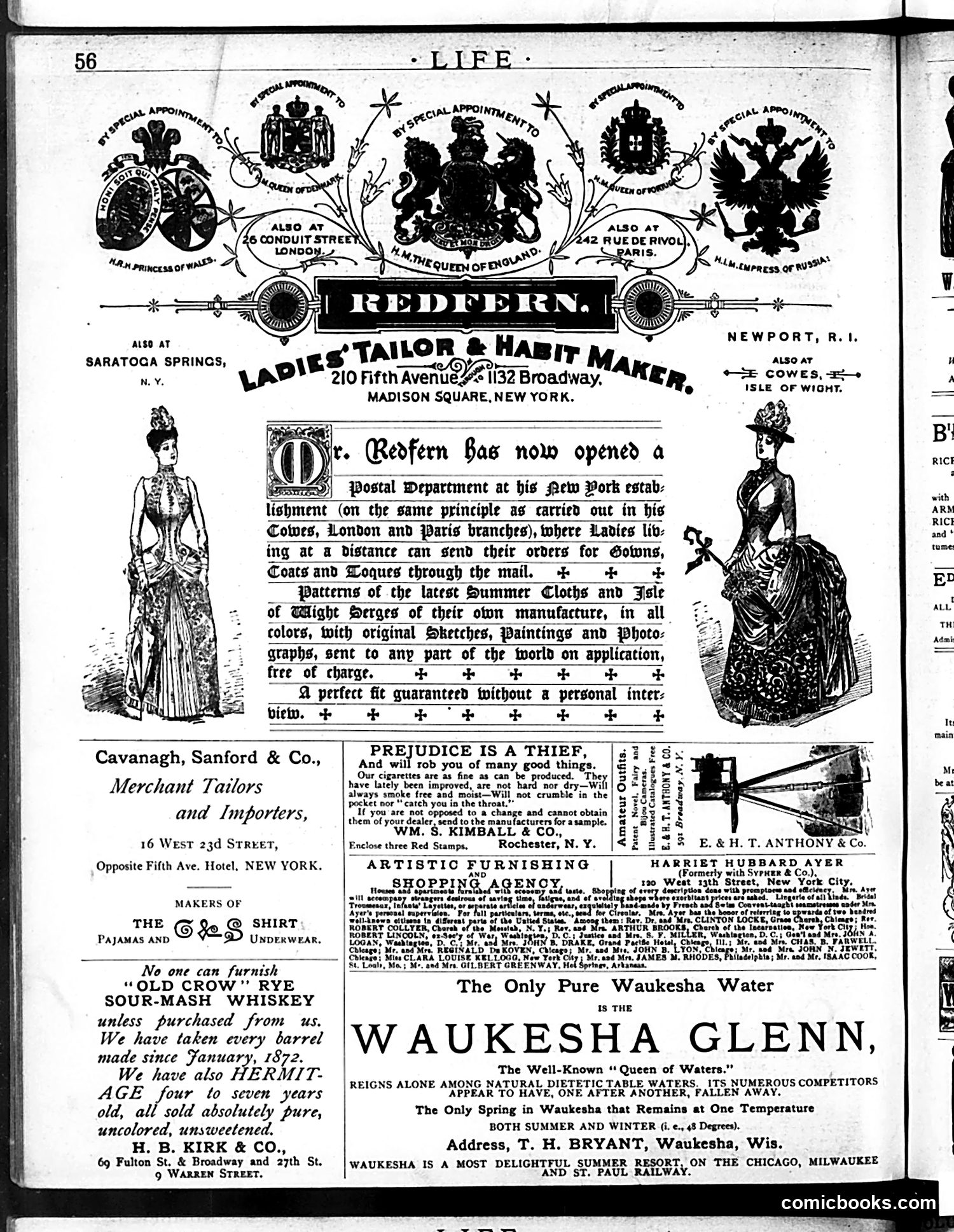
This page is primarily **advertising**, not political satire or comics. It features luxury goods and services aimed at wealthy Americans in the late 19th/early 20th century. The dominant advertiser is **Redfern**, a high-end ladies' tailor with branches in London, Paris, and Cowes (a fashionable English resort). The illustrations show fashionable women in elaborate period dress. Redfern's key innovation: mail-order service—allowing distant clients to order custom clothing via postal department, with patterns and sketches sent free. Other advertisers target similar affluent consumers: merchant tailors, premium whiskey ("Old Crow"), fine water (Waukesha Glenn), photography equipment, and cigars. The small text block "Prejudice Is a Thief" appears to be a moralistic aphorism promoting a Rochester cigar brand—suggesting consumers shouldn't prejudicially reject unfamiliar products. There is **no political cartoon** on this page; it's a commercial publication designed to generate revenue through high-end advertising.
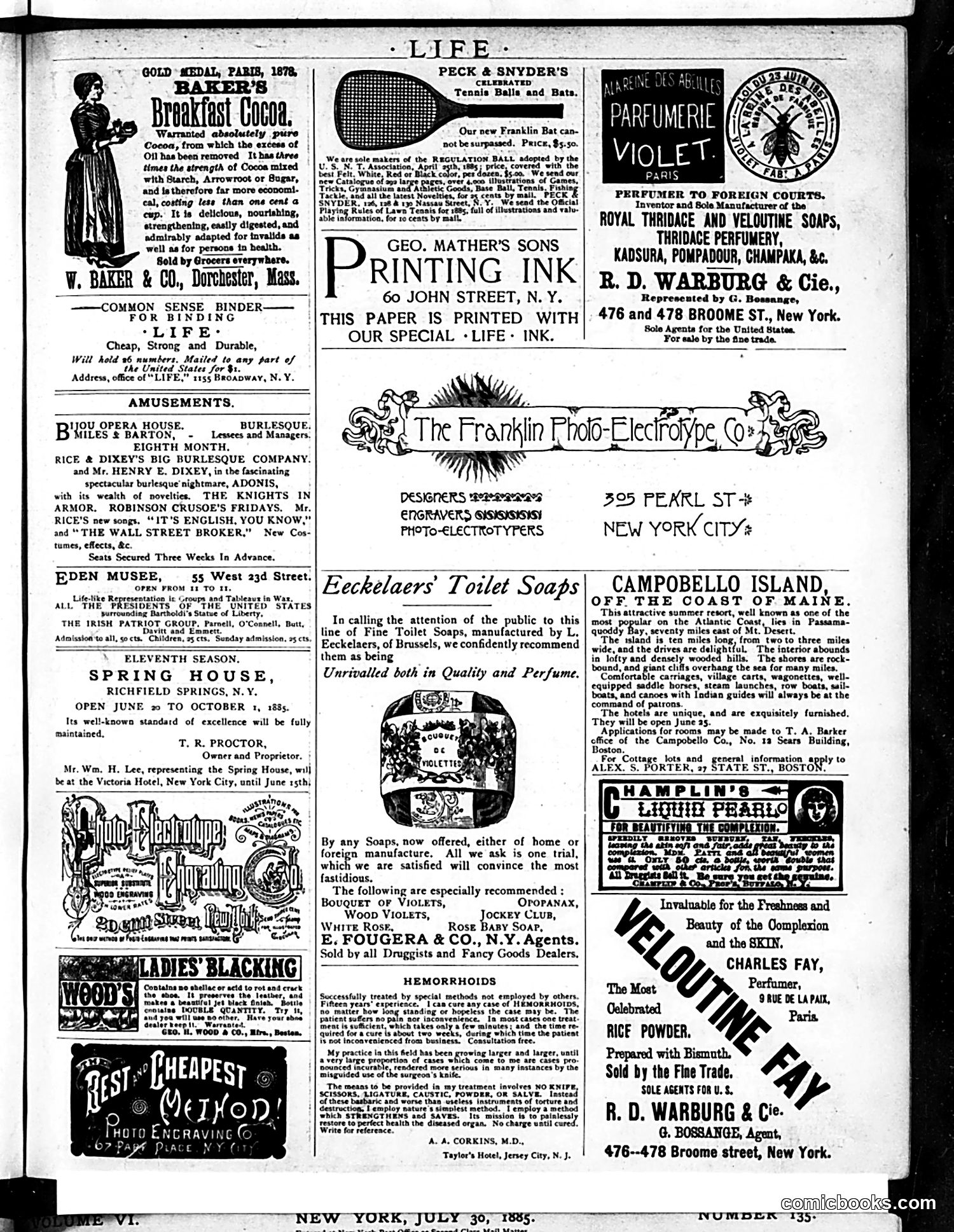
This is primarily an **advertising and announcements page** rather than a satirical cartoon page. It contains: **Notable advertisements:** - Baker's Cocoa (top left) — emphasizing purity and economy - Printing ink company promoting that *Life* magazine itself is printed with their product - Perfume and soap advertisements (Warburg, Eeckelaers) - Tennis equipment by Peck & Snyder - Patent medicines and personal care products **Amusement listings** promoting NYC theaters, including Rice & Dixey's burlesque show "Adonis" and the Eden Musée wax museum (which featured presidential figures and Irish political figures like Parnell). **No political satire is evident** on this page. It appears to be a standard commercial page from *Life*'s early era, when the magazine subsidized editorial content through extensive advertising. The page reflects 1880s consumer culture and entertainment venues.
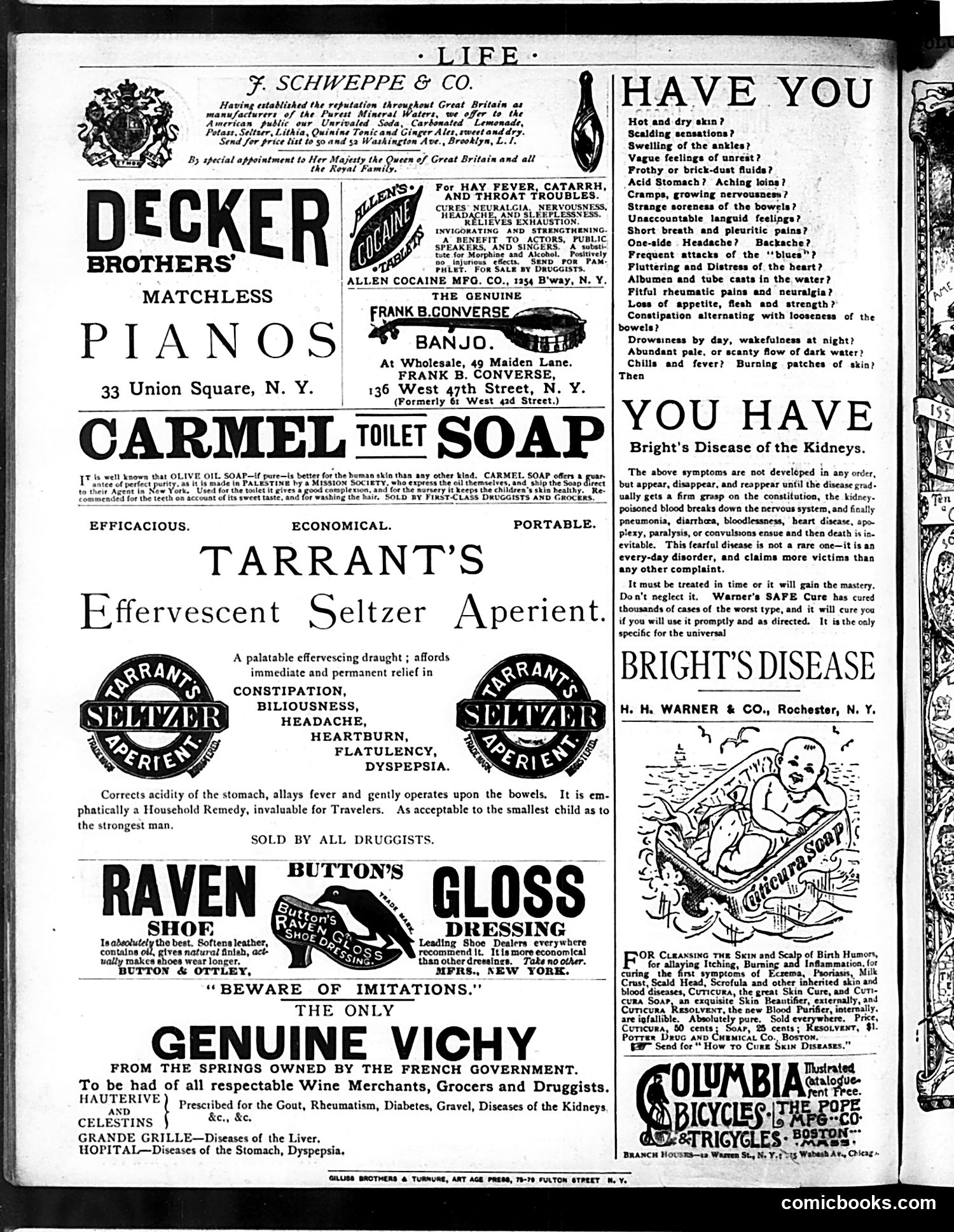
This page is primarily **advertising**, not political satire. It contains vintage patent medicine and consumer product ads from Life magazine's early era. Notable elements: **The ads promote dubious "cures":** Warner's "SAFE Cure" claims to treat Bright's Disease (kidney failure) through a mysterious tonic. The symptom checklist ("Have You...") is designed to make readers self-diagnose serious illnesses. This reflects the **pre-FDA era** when such claims were unregulated. **Other products advertised** include Allen Cocaine (then legal, marketed for hay fever), Tarrant's Seltzer (digestive aid), and various shoe polishes and soaps—typical consumer goods of the period. **The significance:** This page documents how Americans were sold expensive, ineffective treatments for genuinely serious diseases. The exploitative marketing (especially the symptom list designed to frighten readers into buying) represents a major public health problem of the era that eventually prompted government regulation. There is **no political cartoon** visible on this page—only commercial advertising.