
Life, 1885-07-23 · page 5 of 16
Life — July 23, 1885 — page 5: what you’re looking at
What you’re looking at
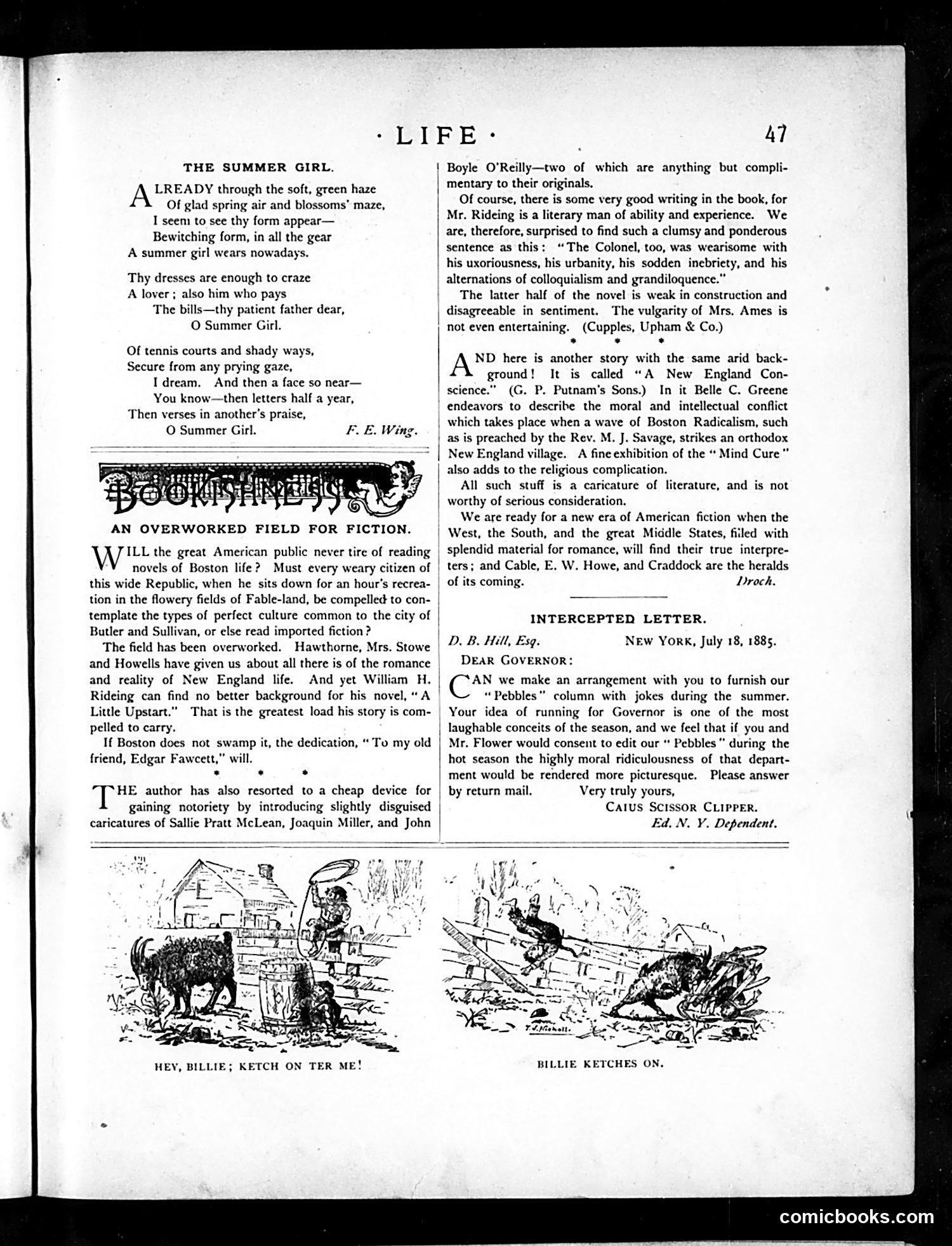
This page contains two main sections: **"The Summer Girl" poem** by F.E. Wing describes fashionable young women of the era in idealized terms—their light clothing, freedom from scrutiny, and leisurely pursuits like tennis. **"An Overworked Field for Fiction"** critiques American literary fiction, noting Boston's dominance in the novel market. The author argues regional American settings (West, South, Middle States) offer untapped material for future writers like Cable, Howe, and Craddock. **Two cartoon sketches** at bottom show a character named Billie—likely a domestic servant or farmhand—in comedic situations ("Hey, Billie; Ketch on Ter Me!" and "Billie Ketches On"). These appear to be humorous vignettes about working-class mishaps. The "Intercepted Letter" is satirical correspondence mocking the idea of running moral content in a summer publication.
📄 Transcribed text from this page (OCR, searchable)
Machine-transcribed from the original scan — historical spelling and the odd misread are preserved.
- LIFE: THE SUMMER GIRL. LREADY through the soft, green haze Of glad spring air and blossoms’ maze, I seem to see thy form appear— Bewitching form, in all the gear A summer girl wears nowadays. Thy dresses are enough to craze A lover ; also him who pays The bills—thy patient father dear, O Summer Girl. Of tennis courts and shady ways, Secure from any prying gaze, I dream. And then a face so near— You know—then letters half a year, Then verses in another's praise, O Summer Girl. FE. Wing. 4] Boyle O'Reilly—two of which are anything but compli- mentary to their originals. Of course, there is some very good writing in the book, for Mr. Rideing is a literary man of ability and experience. We are, therefore, surprised to find such a clumsy and ponderous sentence as this: “The Colonel, too, was wearisome with his uxoriousness, his urbanity, his sodden inebriety, and his alternations of colloquialism and grandiloquence.” The latter half of the novel is weak in construction and disagreeable in sentiment. The vulgarity of Mrs. Ames is not even entertaining. (Cupples, Upham & Co.) . . . ND here is another story with the same arid back- ground! It is called “A New England Con- science.” (G. P. Putnam's Sons.) In it Belle C. Greene endeavors to describe the moral and intellectual conflict which takes place when a wave of Boston Radicalism, such | as is preached by the Rev. M. J. Savage, strikes an orthodox New England village. A fine exhibition of the “ Mind Cure” | also adds to the religious complication. All such stuff is a caricature of literature, and is not | worthy of serious consideration, AN OVERWORKED FIELD FOR FICTION. ILL the great American public never tire of reading novels of Boston life? Must every weary citizen of this wide Republic, when he sits down for an hour's recrea- tion in the flowery fields of Fable-land, be compelled to con- | template the types of perfect culture common to the city of | Butler and Sullivan, or else read imported fiction ? | The field has been overworked. Hawthorne, Mrs. Stowe and Howells have given us about all there is of the romance and reality of New England life. And yet William H. | Rideing can find no better background for his novel, “A Little Upstart.” That is the greatest load his story is com- pelled to carry. If Boston does not swamp it, the dedication, “To my old | friend, Edgar Fawcett,” will. HE author has also resorted to a cheap device for caricatures of Sallie Pratt McLean, Joaquin Miller, and John gaining notoriety by introducing slightly disguised | | D. B. Hill, Esq. We are ready for a new era of American fiction when the West, the South, and the great Middle States, filled with splendid material for romance, will find their true interpre- ters; and Cable, E, W. Howe, and Craddock are the heralds of its coming. Droch. INTERCEPTED LETTER. New YorK, July 18, 1885. DEAR GOVERNOR: AN we make an arrangement with you to furnish our “Pebbles” column with jokes during the summer. Your idea of running for Governor is one of the most laughable conceits of the season, and we feel that if you and Mr. Flower would consent to edit our “ Pebbles" during the hot season the highly moral ridiculousness of that depart- | ment would be rendered more picturesque. Please answer by return mail. Very truly yours, Calus SctssOR CLIPPER. Ed. N. Y. Dependent. HEY, BILLIE; KETCH ON TER ME! BILLIE KETCHES ON, comicbooks.com