
Life, 1885-07-23 · page 6 of 16
Life — July 23, 1885 — page 6: what you’re looking at
What you’re looking at
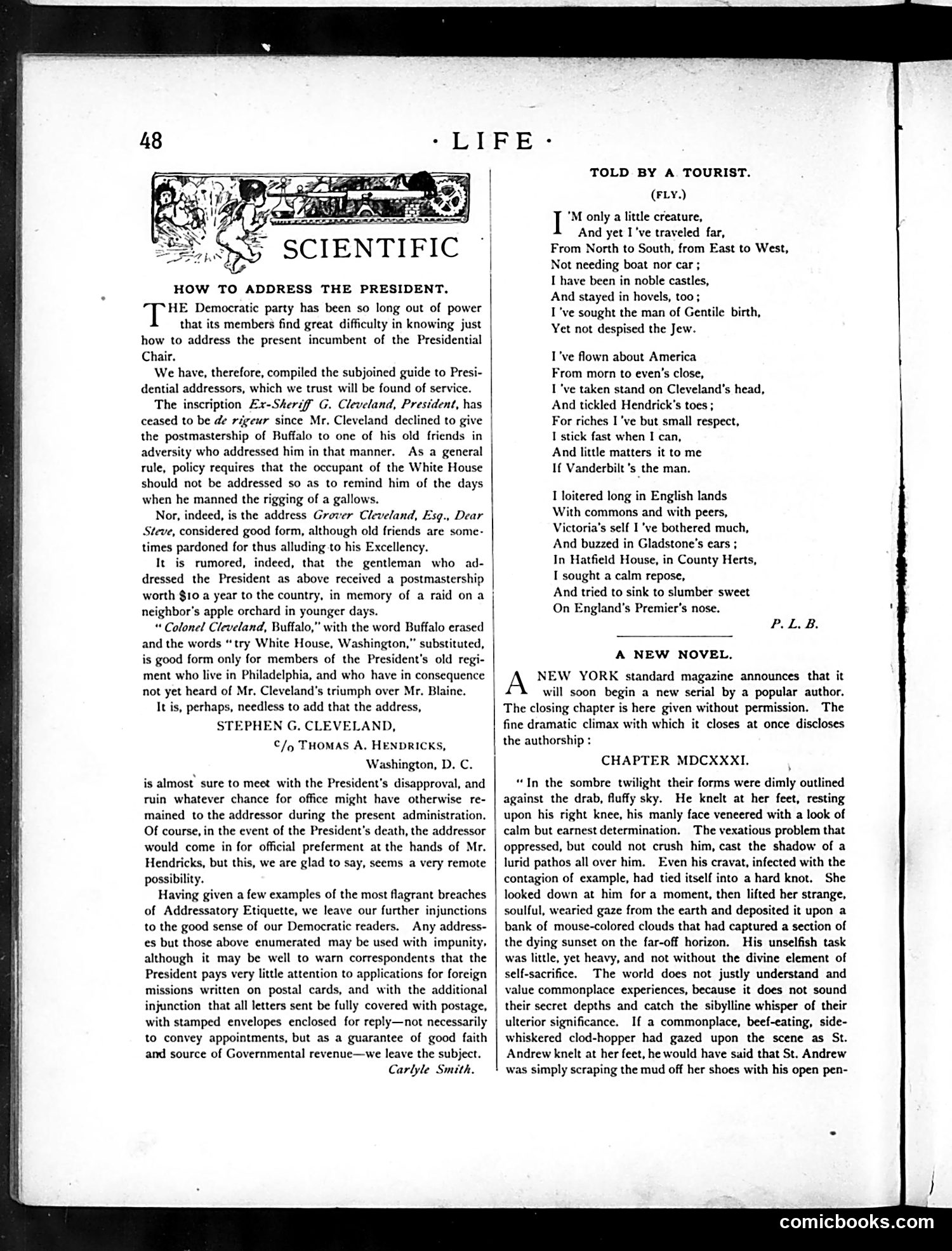
This page contains a satirical article titled "How to Address the President," mocking Democratic Party members' supposed confusion about properly addressing President Cleveland. The humor derives from suggesting they've been out of power so long they've forgotten protocol. The satire proposes absurd alternative addresses like "Colonel Cleveland, Buffalo" (referencing Cleveland's Buffalo roots) and critiques a postmaster who allegedly sent Cleveland a postcard worth $10 to the country as a "memory of a raid on a neighbor's apple orchard"—likely alluding to some embarrassing incident in Cleveland's past. The piece satirizes Democratic incompetence and clumsiness while simultaneously poking fun at Cleveland himself, suggesting he's an unconventional figure requiring unusual addressal procedures.
📄 Transcribed text from this page (OCR, searchable)
Machine-transcribed from the original scan — historical spelling and the odd misread are preserved.
HOW TO ADDRESS THE PRESIDENT. HE Democratic party has been so long out of power that its members find great difficulty in knowing just how to address the present incumbent of the Presidential Chair. We have, therefore, compiled the subjoined guide to Presi- dential addressors, which we trust will be found of service. The inscription Ex-Sheriff G. Cleveland, President, has ceased to be de rigeur since Mr. Cleveland declined to give the postmastership of Buffalo to one of his old friends in | adversity who addressed him in that manner. As a general rule, policy requires that the occupant of the White House should not be addressed so as to remind him of the days when he manned the rigging of a gallows. Nor, indeed, is the address Grover Cleveland, Esg., Dear Steve, considered good form, although old friends are some- times pardoned for thus alluding to his Excellency. It is rumored, indeed, that the gentleman who ad- dressed the President as above received a postmastership worth $10 a year to the country, in memory of a raid on a j neighbor's apple orchard in younger days. “ Colonel Cleveland, Buffalo,” with the word Buffalo erased and the words “try White House, Washington,” substituted, is good form only for members of the President's old regi- ment who live in Philadelphia, and who have in consequence not yet heard of Mr. Cleveland's triumph over Mr. Blaine. It is, perhaps, needless to add that the address, STEPHEN G. CLEVELAND, C/g THOMAS A, Washington, D. C. is almost sure to meet with the President's disapproval, and ruin whatever chance for office might have otherwise re- mained to the addressor during the present administration. Of course, in the event of the President's death, the addressor | would come in for official preferment at the hands of Mr. Hendricks, but this, we are glad to say, seems a very remote possibility. Having given a few examples of the most flagrant breaches of Addressatory Etiquette, we leave our further injunctions to the good sense of our Democratic readers. Any address- es but those above enumerated may be used with impunity, although it may be well to warn correspondents that the President pays very little attention to applications for foreign missions written on postal cards, and with the additional injunction that all letters sent be fully covered with postage, with stamped envelopes enclosed for reply—not necessarily to convey appointments, but as a guarantee of good faith and source of Governmental revenue—we leave the subject. Carlyle Smith. TOLD BY A TOURIST. (FLY.) 'M only a little creature, And yet I ve traveled far, From North to South, from East to West, Not needing boat nor car ; I have been in noble castles, And stayed in hovels, too; I've sought the man of Gentile birth, Yet not despised the Jew. I've flown about America From morn to even’s close, I've taken stand on Cleveland's head, And tickled Hendrick’s toes ; For riches I ve but small respect, I stick fast when I can, And little matters it to me If Vanderbilt's the man. I loitered long in English lands With commons and with peers, Victoria's self I've bothered much, And buzzed in Gladstone's ears ; In Hatfield House, in County Herts, I sought a calm repose, And tried to sink to slumber sweet On England's Premier's nose. A NEW NOVEL, NEW YORK standard magazine announces that it will soon begin a new serial by a popular author. The closing chapter is here given without permission. The fine dramatic climax with which it closes at once discloses the authorship : CHAPTER MDCXXXI. “In the sombre twilight their forms were dimly outlined against the drab, fluffy sky. He knelt at her feet, resting upon his right knee, his manly face veneered with a look of calm but earnest determination. The vexatious problem that oppressed, but could not crush him, cast the shadow of a lurid pathos all over him, Even his cravat, infected with the contagion of example, had tied itself into a hard knot. She looked down at him for a moment, then lifted her strange, soulful, wearied gaze from the earth and deposited it upon a bank of mouse-colored clouds that had captured a section of the dying sunset on the far-off horizon. His unselfish task was little, yet heavy, and not without the divine element of self-sacrifice. The world does not justly understand and value commonplace experiences, because it does not sound their secret depths and catch the sibylline whisper of their ulterior significance. If a commonplace, beef-eating, side- whiskered clod-hopper had gazed upon the scene as St. Andrew knelt at her feet, he would have said that St. Andrew was simply scraping the mud off her shoes with his open pen- comicbooks.com