
A complete issue · 16 pages · 1885
Life — July 9, 1885
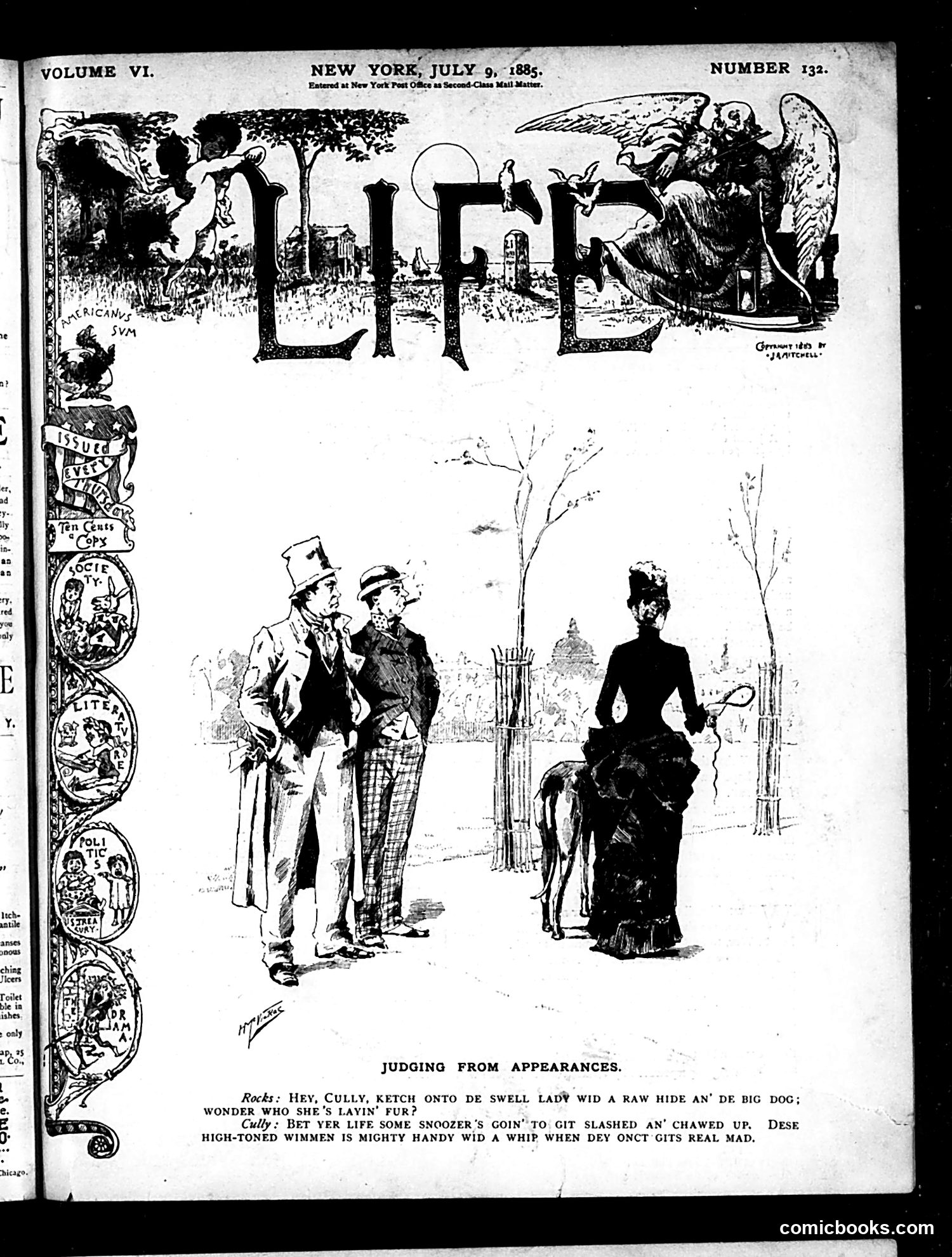
This satirical cartoon illustrates class prejudice and social assumptions. Two working-class men in shabby clothing (one identified as "Rocks" and "Cully") observe a well-dressed woman walking with a large dog. The joke—delivered in dialect—suggests they assume she's a "swell lady" of means, yet warns that appearances deceive: her fine clothing masks character flaws, and even respectable-seeming people are "mighty handy wid a whip." The satire critiques both the men's class-based assumptions and hypocritical social hierarchies of the Gilded Age, where wealthy people were presumed virtuous despite their actual behavior. The cartoon mocks both upward class bias and the reality that status didn't guarantee morality.
The page contains editorial commentary rather than a political cartoon. The text addresses several 1885 political issues: **Main Topics:** 1. **Mr. Buddensieck & Mr. Fish** - Praise for their rewards for virtue, with hopes Buddensieck will use "contract shoes and freestone gravel" responsibly in future work. 2. **Ferdinand Ward** - Expectation he'll face justice in New York, suggesting he wear "a nice fall suit of bed-ticking." 3. **San Francisco Chronicle's "Indian War"** - Criticism of the Chronicle's articles allegedly misrepresenting Native American conflicts, advocating the U.S. stop "warfare upon the defenceless tribes of the West." 4. **Cleveland Administration** - Commentary on President Cleveland's appointment of Edward L. Hedden as Port Collector, questioning why an executive officer was chosen over men of "conspicuous fitness." The satire targets political patronage and inconsistency.
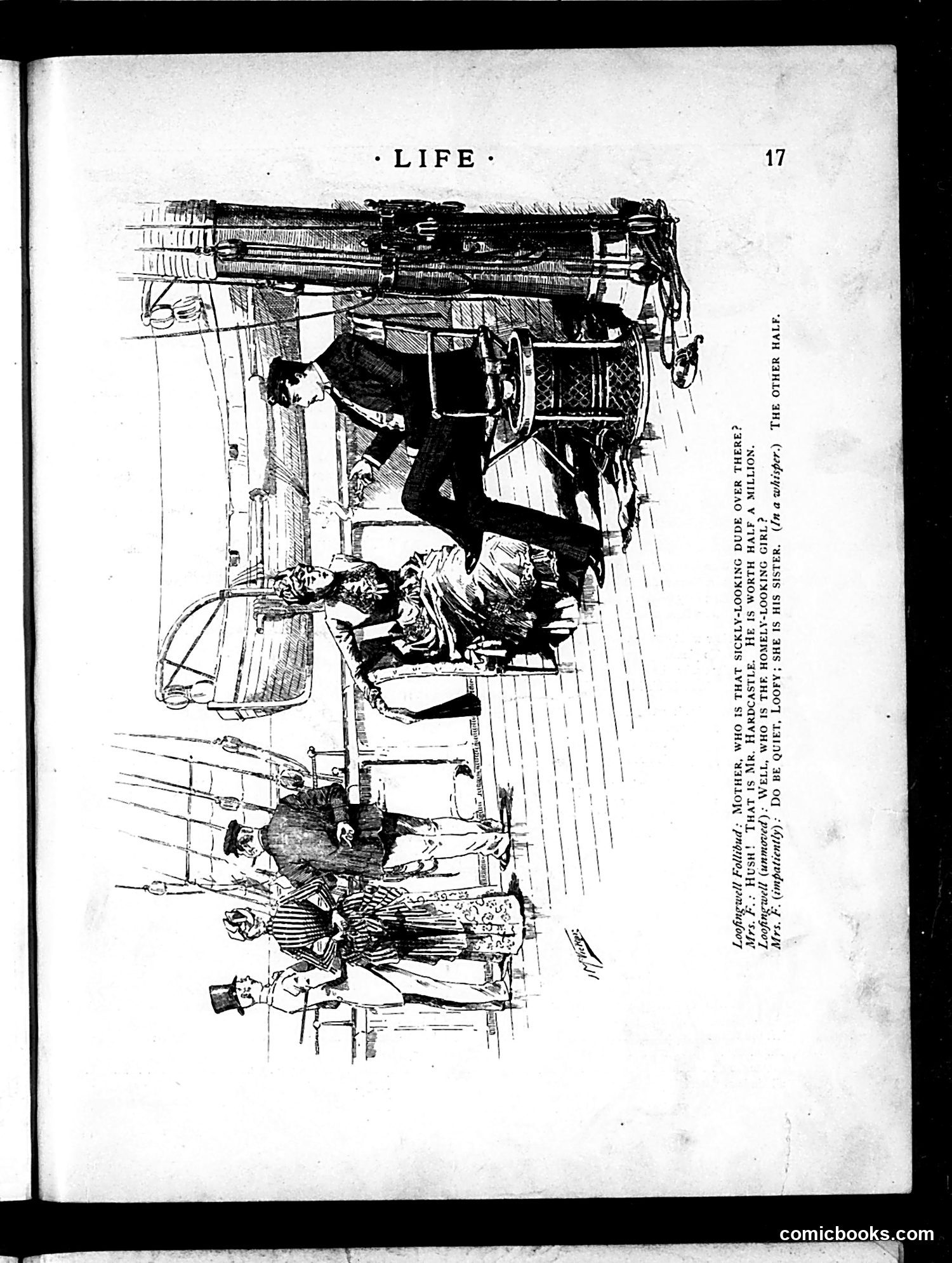
This page from *Life* magazine presents a satirical cartoon (rotated 90 degrees) depicting a domestic scene. The caption references "a millionaire" and discusses whether "he is worth half a million" and questions about his wife's expenditures and her looks being "the other half." The cartoon appears to satirize wealthy marriage dynamics, specifically mocking the financial disparity and the husband's perception that his wife's appearance justifies enormous spending. The scene shows what appears to be an elegantly dressed woman with an older man in formal attire, likely critiquing the transactional nature of marriages among the wealthy class and husbands' tendency to attribute their financial depletion to their wives' vanity and beauty maintenance. The satire targets both spousal spending habits and the commodification of women's appearance in high society.
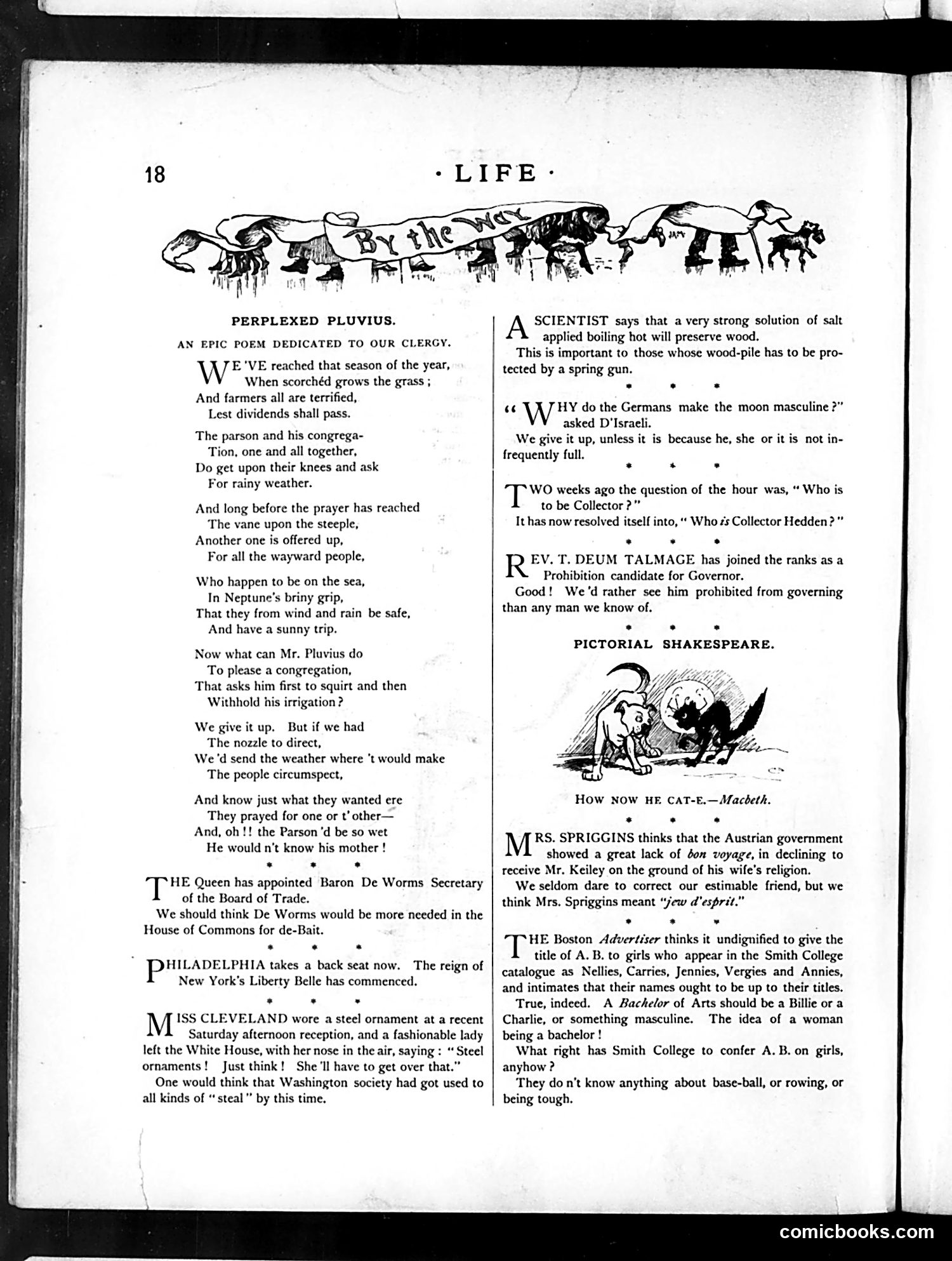
This page contains satirical commentary on early 20th-century American social and political issues: **"Perplexed Pluvius"** is a humorous poem about Pluvius (the Roman rain god) struggling to satisfy clergy prayers for rain during drought while farmers simultaneously curse wet weather. **Political Items** mock: - Baron De Worms' appointment as Trade Board Secretary (suggesting incompetence) - New York society's adoption of "steel ornaments" (unclear reference, possibly mocking nouveau riche fashion) - Philadelphia's social pretensions **"Pictorial Shakespeare"** caption "How now he cat-e" illustrates a pun on Macbeth, showing a cat with prey. **The Boston Advertiser critique** ridicules Smith College for conferring A.B. degrees on women, sarcastically questioning whether women should receive traditional academic credentials given they lack experience with "base-ball, or rowing." The page reflects era anxieties about women's education and changing social roles.
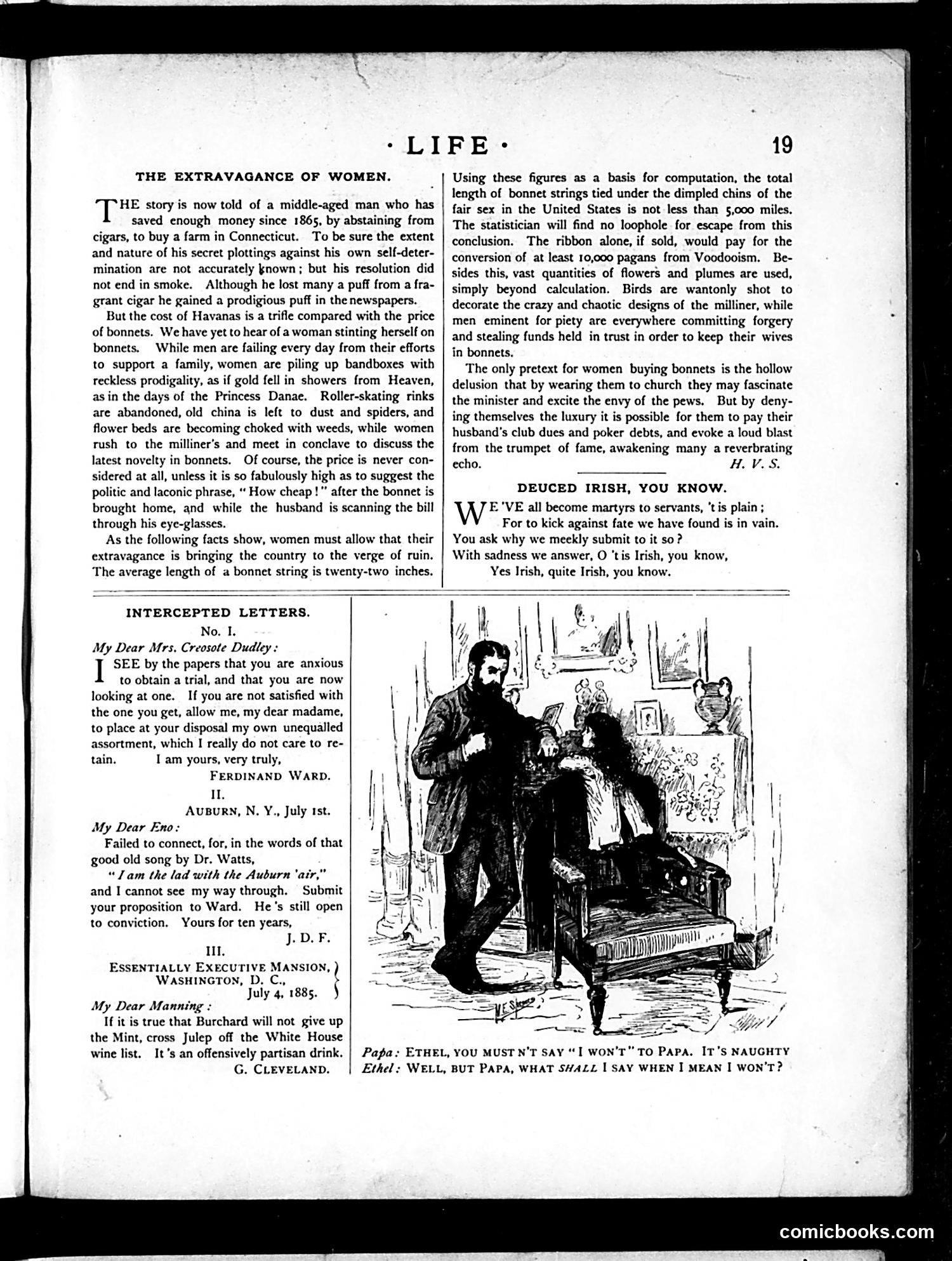
This page contains satirical commentary on women's fashion extravagance, particularly bonnets. The main article "The Extravagance of Women" criticizes how women spend excessive money on elaborate bonnets with long strings, claiming the average bonnet string measures twenty-two inches. The satire suggests women are bankrupting their families through frivolous purchases. The illustration shows a domestic scene where a father confronts his daughter about her refusal to obey him, with the caption implying children learn defiance from their mothers' independent spending habits. The "Intercepted Letters" section provides humorous correspondence about various topics, including Irish identity and political patronage under President Cleveland. Overall, the page mocks both female consumer culture and evolving gender dynamics of the 1880s.
This page contains primarily **literary content rather than political cartoons**. The main features are: 1. **"Couleur de Rose"** — A poem by Richard E. Burton about walking with someone named Rose, using rose imagery metaphorically. 2. **"The Literary and Political Products of Roosevelt's Ranch"** — A substantial article discussing Theodore Roosevelt's recent retreat to his Montana ranch following the Chicago Convention debates. It notes Roosevelt is considering accepting the Republican State Comptroller nomination, and praises his recently published book "Hunting Trips of a Ranchman," which details his hunting exploits. The page also includes a "Books Received" section and "European Echoes" gossip column covering international news. **No clear political cartoon is visible** on this page—it's primarily text-based editorial and literary content.
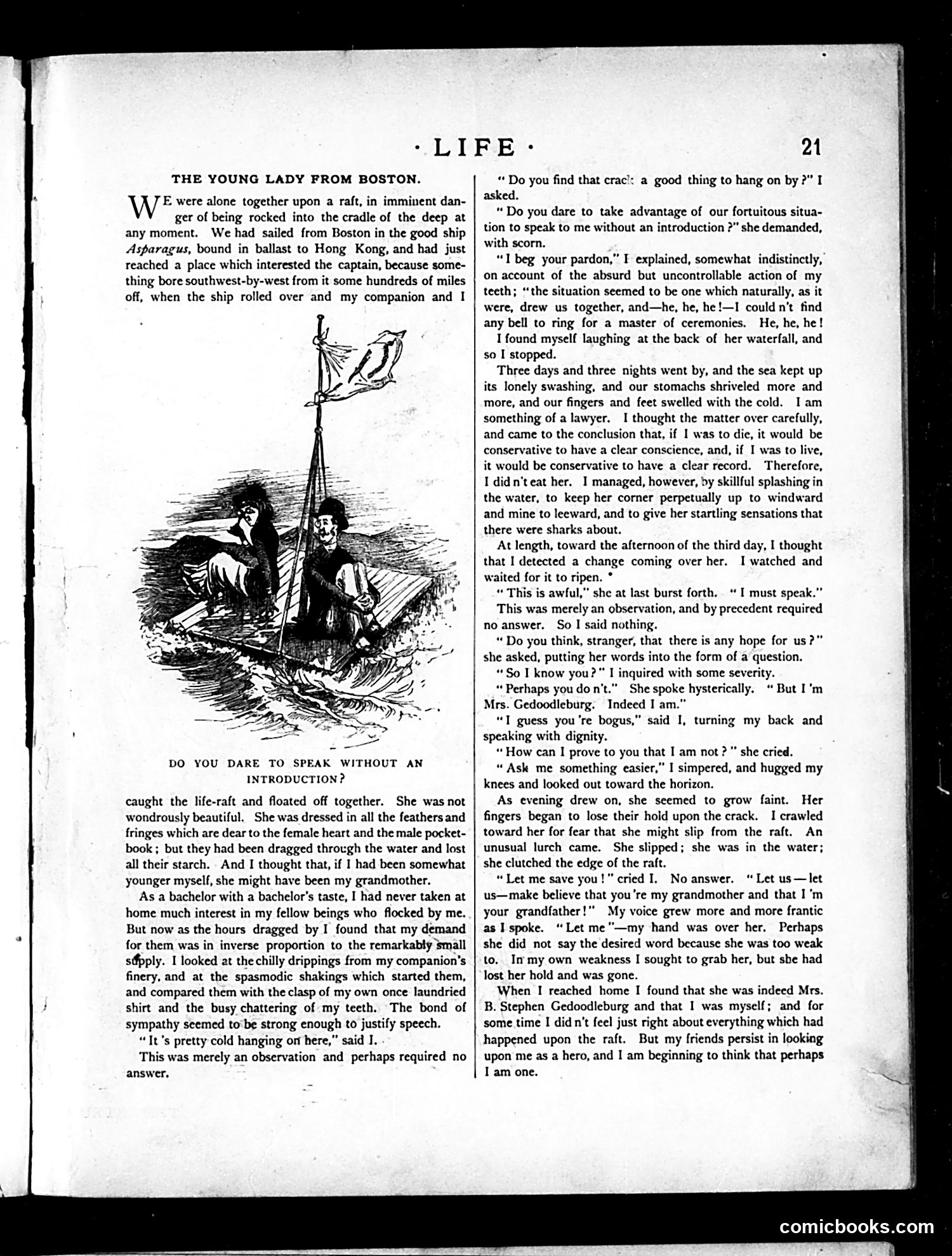
This page contains a serialized story titled "The Young Lady from Boston," illustrated with a wood engraving showing two figures on a raft at sea. The narrative describes a shipwreck survival scenario aboard the vessel *Asparagus*, where the narrator and a young woman from Boston find themselves adrift together. The accompanying illustration depicts the couple clinging to the raft amid rough waters. The text emphasizes their physical deterioration from cold and hunger over three days. The story appears to be a romantic adventure narrative rather than political satire—a common serial fiction format for Life magazine during this era. No specific political figures or events are referenced; instead, it's entertainment literature typical of 19th-century periodicals.
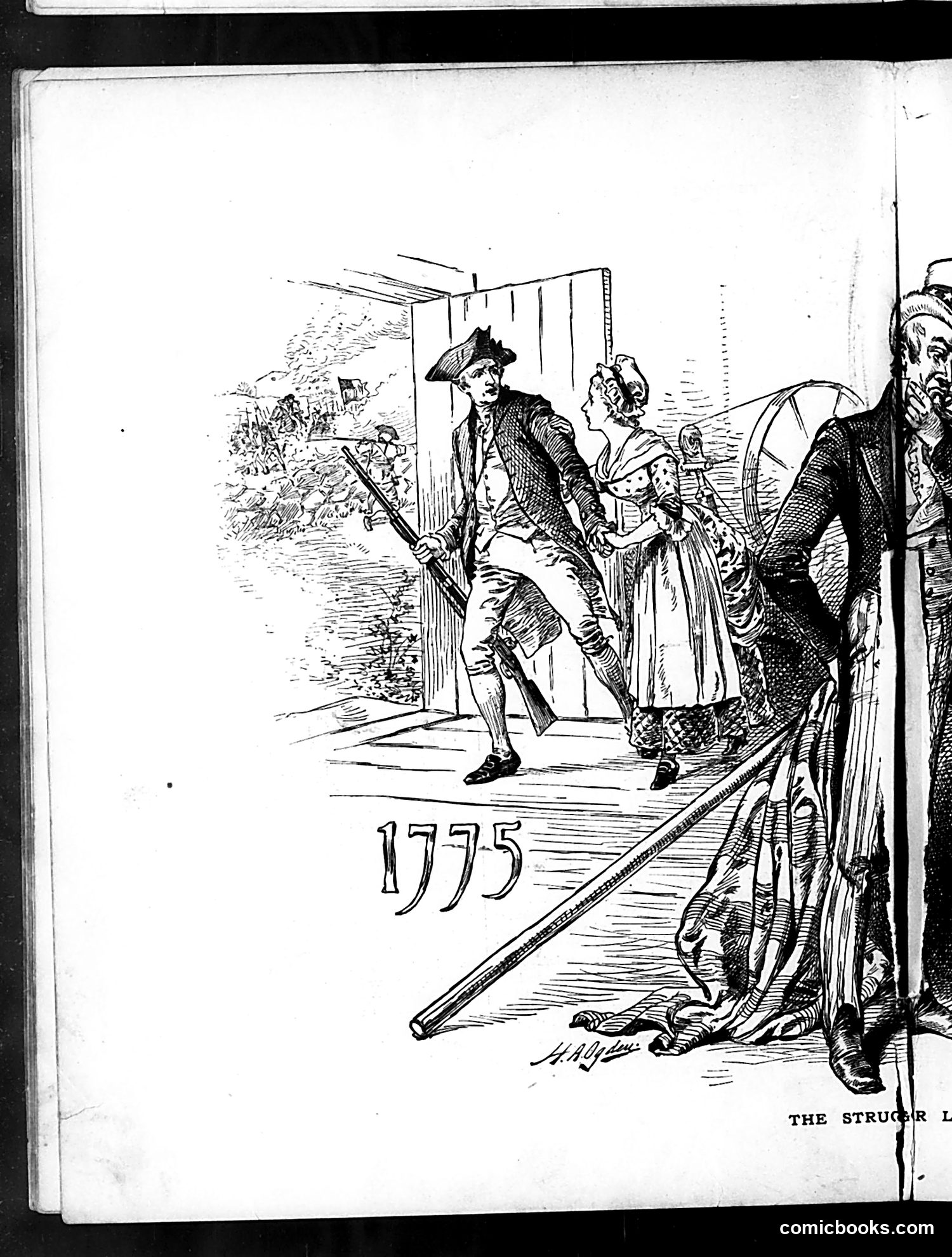
This historical illustration depicts the American Revolutionary War period. The date "1775" marks the conflict's beginning. The scene shows what appears to be a military or political confrontation, with figures in 18th-century dress—including a man in a tricorn hat and military coat (likely representing a colonial or British officer) gesturing toward armed conflict visible in the background. A woman and child are present, suggesting civilian involvement or displacement during the war. The partial caption "THE STRUGGL..." (likely "THE STRUGGLE") indicates this satirizes the Revolutionary conflict itself. The composition emphasizes the human cost—particularly to families—of the nascent American independence movement. Without seeing the full text, the exact satirical angle remains unclear, but Life magazine likely used this to comment on the Revolutionary War's societal disruption.
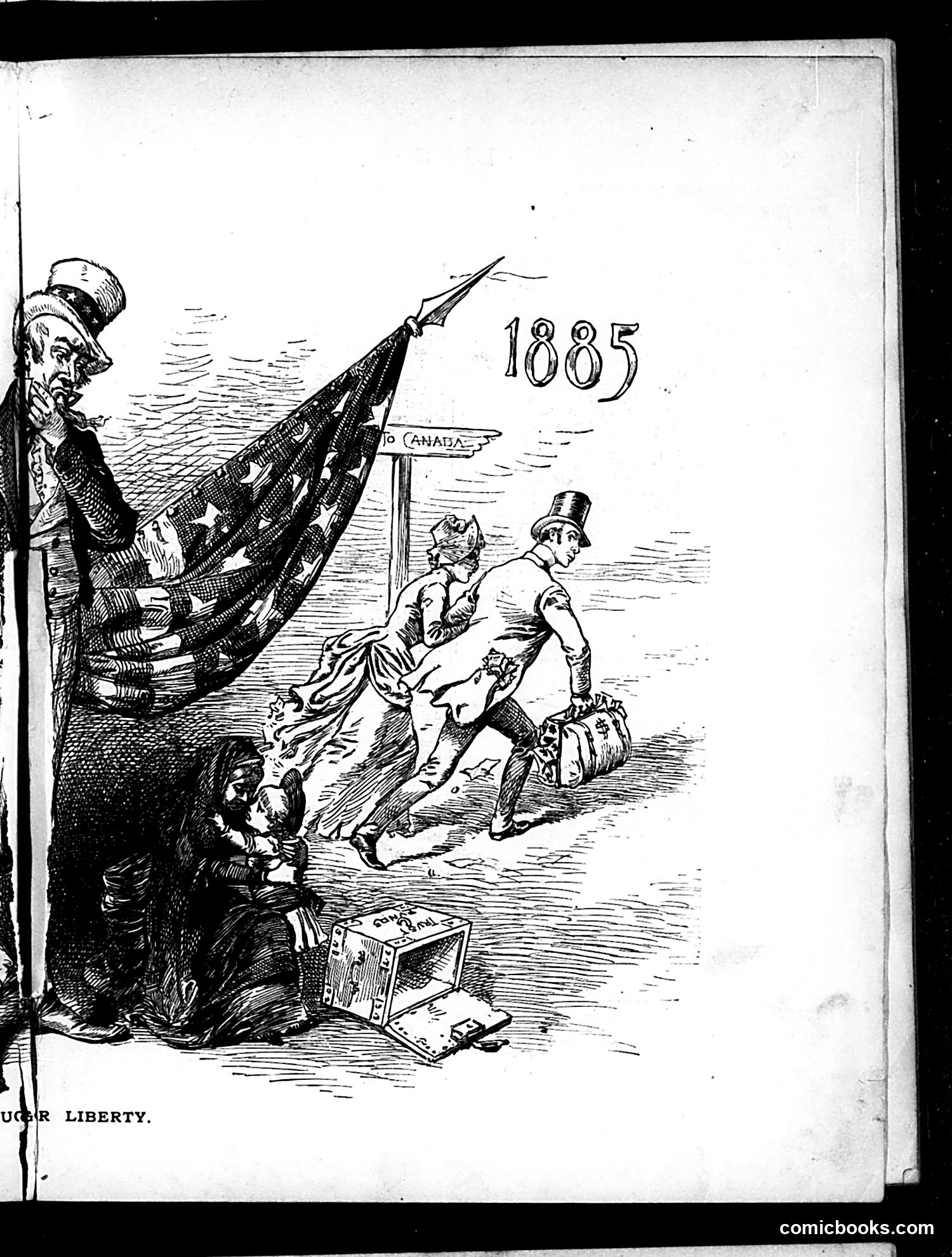
This satirical illustration depicts **Uncle Sam** (the bearded figure on the left, holding the Canadian flag) watching as two well-dressed figures—apparently representing **British and American interests**—lead away a woman and child, with baggage. The signpost reads "CANADA." The cartoon appears to criticize **American or British expansion into Canadian territory** around 1885. The woman and child likely represent Canada itself being "led away" or claimed by foreign powers. The scene suggests concerns about Canadian sovereignty and independence being compromised by larger nations' political or economic interests. The title "UNCLE LIBERTY" (visible at bottom) reinforces themes of freedom and independence, suggesting the cartoon protests threats to Canadian autonomy during this period of imperial competition.
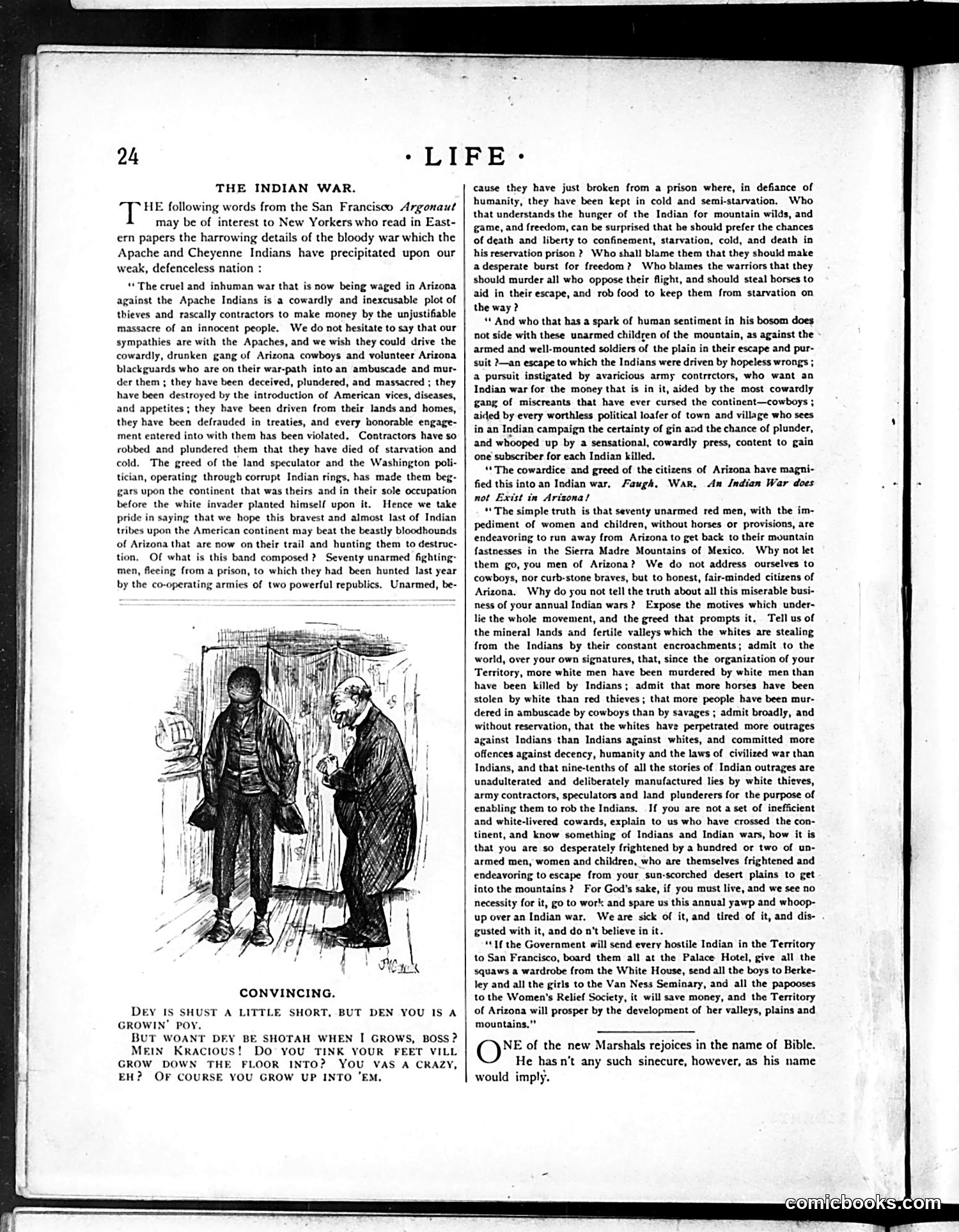
This Life magazine article sarcastically defends Apache and Cheyenne Indians fleeing Arizona reservations, reprinting a scathing critique from the San Francisco *Argonaut*. The piece attacks white Arizona settlers, military contractors, and politicians as the true villains—accusing them of starving, defrauding, and massacring Indigenous peoples to profit from "Indian wars." The accompanying cartoon titled "Convincing" depicts two figures in what appears to be a condescending conversation about growth, using exaggerated dialect ("SHUST," "TINK," "VILL"). The figures likely represent white settlers or authority figures patronizing or mocking Indigenous or immigrant perspectives—a visual joke reinforcing the article's theme that powerful groups cynically manipulate narratives for profit. The satire targets Arizona's economic and political establishment for manufacturing an "Indian War" that the *Argonaut* argues doesn't genuinely exist—merely a pretext for contractors and politicians to gain money and power while committing atrocities against desperate people.
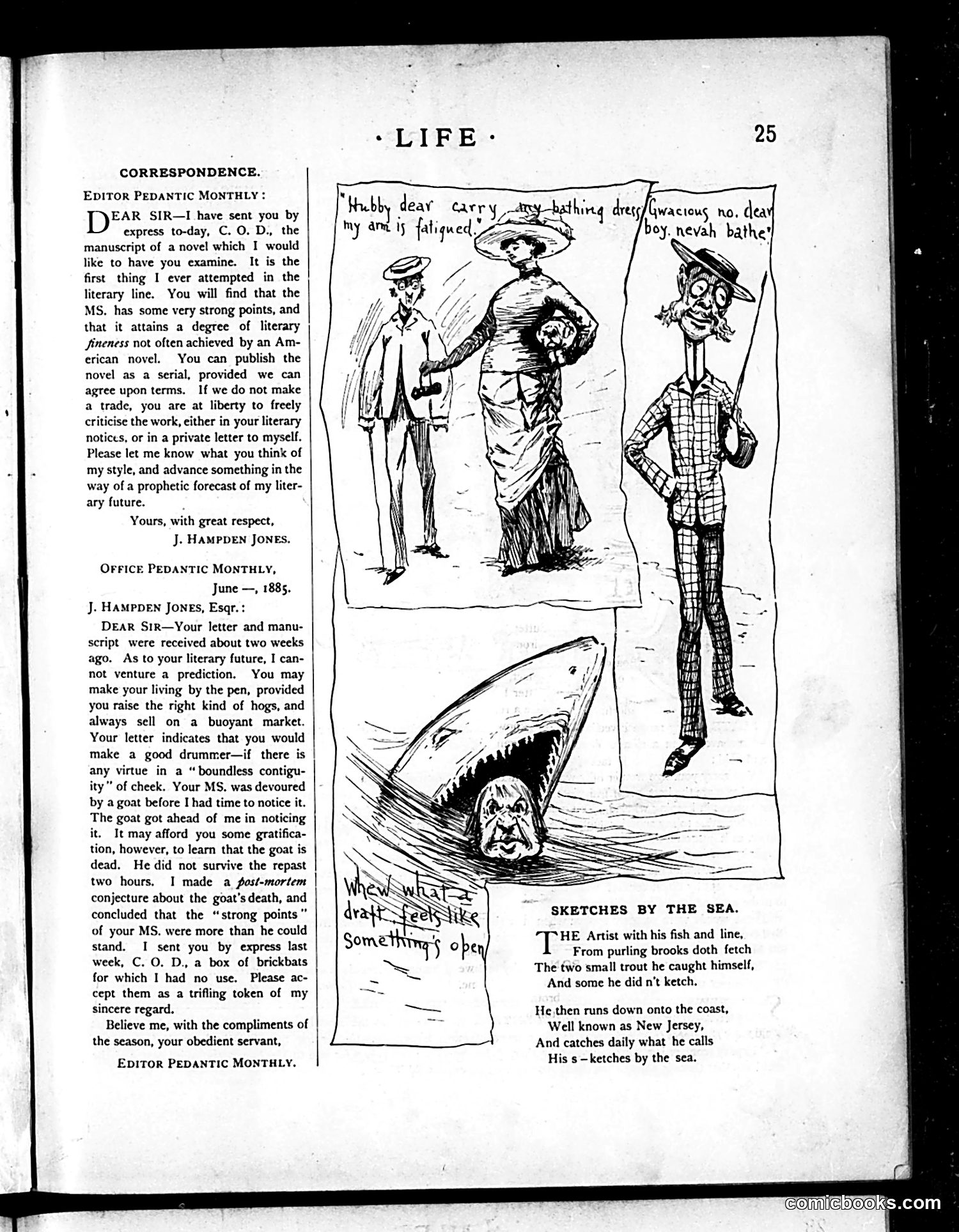
This 1885 *Life* magazine page contains two satirical pieces: **The Correspondence Section** mocks aspiring authors' entitlement. J. Hampden Jones submits a manuscript to "Pedantic Monthly," demanding publication terms while threatening to let them freely criticize if they refuse. The editor's response is brutal satire: he claims a goat ate the manuscript and died from it, sarcastically praising Jones's "boundless contiguity of cheek" (audacity), and sends back "brickbats" (insults) instead of payment. The joke targets writers who treat editors with arrogance while lacking proven talent. **"Sketches by the Sea"** is a visual pun. The four cartoon panels show a seaside artist claiming to catch fish and create "sketches by the sea"—but the wordplay reveals he's actually drawing or exaggerating his catches rather than honestly depicting them. This satirizes artistic pretension and the gap between claimed and actual accomplishment, likely referencing New Jersey's coast as a popular sketching destination for artists. Both pieces ridicule creative professionals' overconfidence.
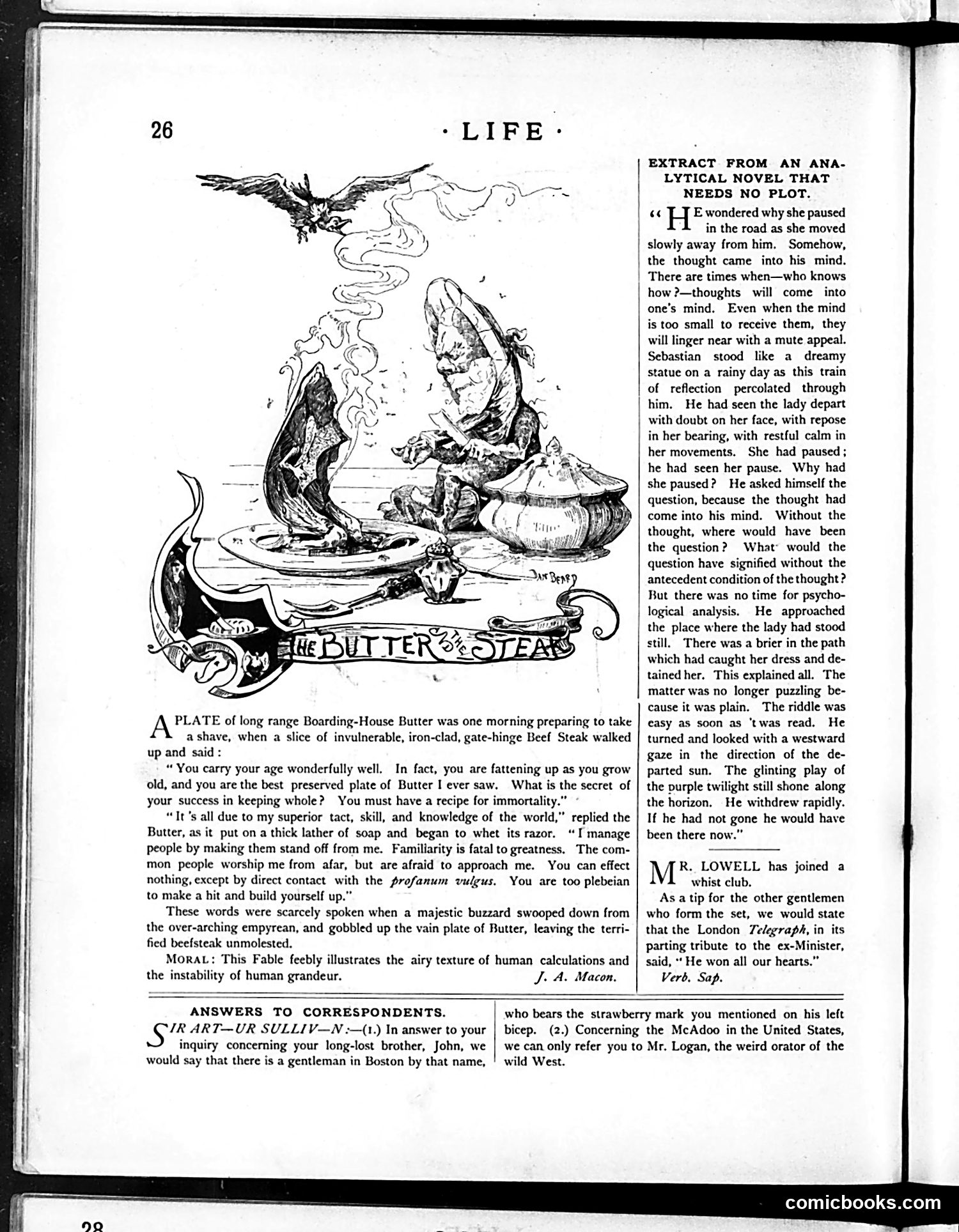
This is a satirical Aesop's-style fable mocking human vanity and social pretension. A pompous plate of boarding-house butter boasts to a beefsteak about its superiority, claiming success comes from maintaining distance and aloofness from common people ("profanum vulgus"—the vulgar masses). The butter preaches that familiarity breeds contempt. The joke: a buzzard swoops down and eats the butter anyway, leaving the humble beefsteak untouched. **The satire targets** the Victorian upper-class belief that maintaining social distance and exclusive superiority guarantees protection or success. The moral explicitly states it illustrates "the airy texture of human calculations and the instability of human grandeur"—essentially: pretension is fragile and meaningless in the face of fate. The page also includes parody of overwrought literary analysis (the "analytical novel" excerpt mocking psychological realism), plus period gossip about R. Lowell and whist clubs.
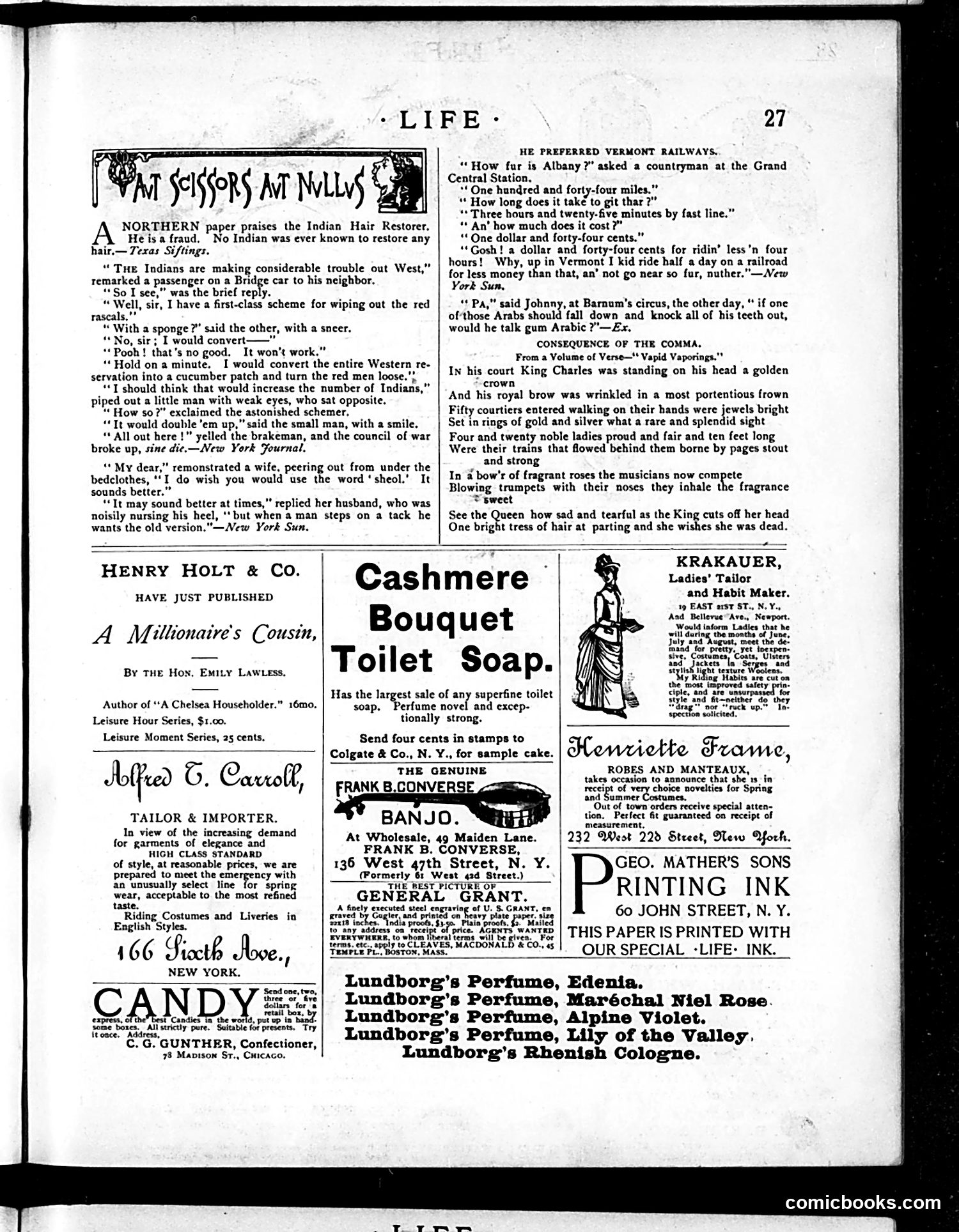
This page collects brief humorous anecdotes typical of 19th-century American satirical magazines. The cartoons mock various social types: **The Indian Hair Restorer anecdote** ridicules fraudulent patent medicines and racist stereotypes about Native Americans—the premise being that no Indian could restore hair, so claiming Indian heritage for a hair product is obviously a scam. **The Western reservation "scheme"** satirizes simplistic, often cruel proposed "solutions" to the "Indian problem," with the punchline playing on a misunderstanding: converting reservations to farms would increase Indians (like cucumbers multiplying). **The Vermont railways joke** contrasts rural frugality with urban rail prices, portraying the countryman as shrewd and unimpressed by city rates. **"Consequence of the Comma"** is a humorous poem about punctuation: missing commas create absurd imagery (King standing on his head, courtiers on hands, the Queen wishing she were dead after her husband cuts off her head—all because unclear syntax). The page is primarily **advertising**, with these jokes filling space between product advertisements.
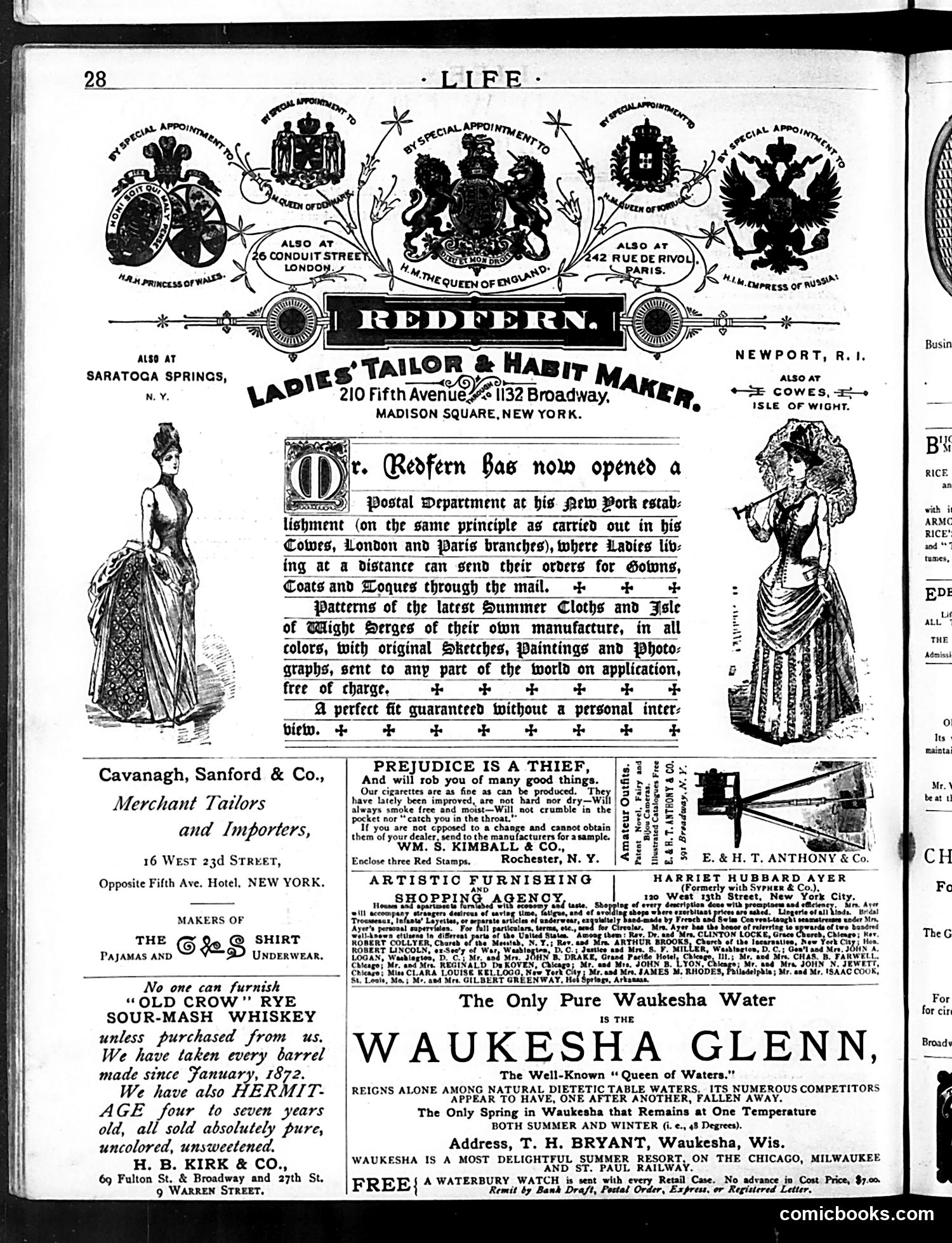
This page is primarily **advertising**, not satire or political commentary. It showcases luxury goods and services targeting wealthy Americans circa 1880s-1890s. **Key advertisements include:** - **Redfern**: A prestigious ladies' tailor with locations in London, Paris, Cowes, Newport, Saratoga Springs, and New York—offering mail-order fashion services with guaranteed fit - **Merchant tailors and whiskey distillers** targeting affluent customers - **Waukesha Glenn water**: Marketed as pure, medicinal spring water with temperature stability—a health product typical of the era's "patent medicine" trend - **Photography and shopping services** catering to the wealthy The two illustrated female figures in fashionable dress represent the target demographic: wealthy women with leisure time and disposable income for high-end clothing and luxury goods. The single satirical element is a small "**Prejudice is a Thief**" cigarette advertisement using moral messaging to sell a consumer product—ironic but not deeply political. Overall, this reflects **Gilded Age consumer culture** targeting America's wealthy elite.
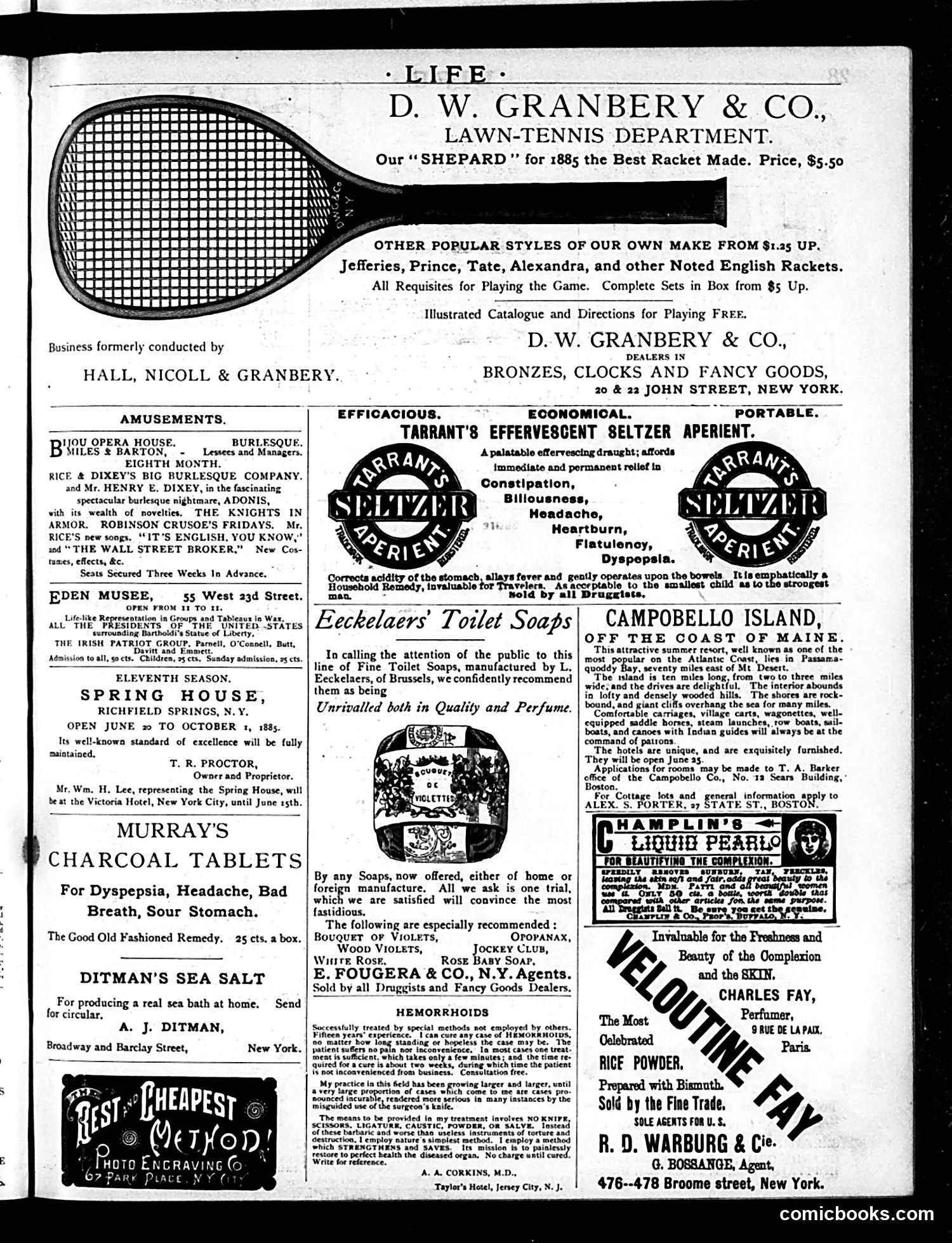
This is primarily a **commercial advertising page** from Life magazine's 1885 issue, not a political cartoon or satirical content. The page features: **Main advertiser**: D. W. Granbery & Co., selling lawn-tennis equipment (notably the "Shepard" racket for $5.50) and fancy goods. The large tennis racket illustration dominates the upper left. **Other advertisements** include: - Theater/burlesque entertainment listings - Patent medicines (Tarrant's Seltzer, Murray's Charcoal Tablets, Ditman's Sea Salt) - Imported Belgian toilet soaps - Medical services for hemorrhoid treatment - Perfume and powder products **Historical context**: This reflects the Gilded Age's commercialization of leisure (tennis was fashionable among the wealthy), the prevalence of patent medicines before FDA regulation, and advertising's early role in magazines. There is no discernible political satire or cartoon content on this page—it's a straightforward commercial vehicle, typical of how 19th-century magazines subsidized publication through extensive advertising.
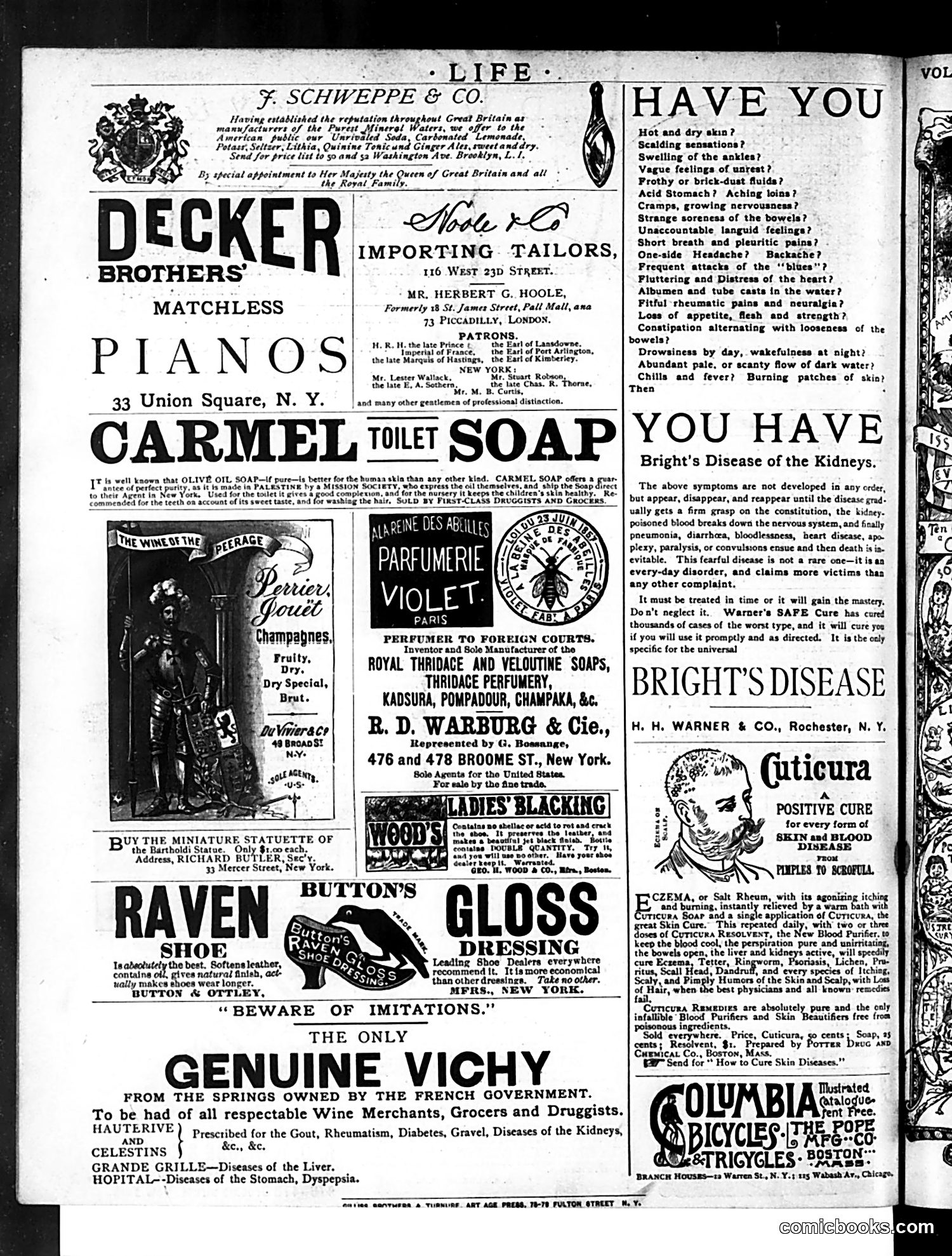
This page is primarily **advertising**, not political satire. It's a typical late 19th-century Life magazine advertisement section featuring luxury goods and patent medicines. **Key content:** The dominant ads promote high-end imports (pianos, tailoring, perfumes) targeting wealthy consumers, alongside dubious medical products. Most notable is the extended advertisement for **"Bright's Disease" cure** by H.H. Warner & Co., which lists symptoms of kidney disease and promises treatment. This exemplifies the era's **patent medicine fraud**—companies sold ineffective or harmful "cures" for serious ailments, exploiting public fear and medical ignorance. The symptom list itself was manipulative marketing designed to convince readers they had the disease. Also visible: soap ads claiming miraculous properties, shoe polish, and Vichy mineral water (genuinely French-sourced but marketed with exaggerated health claims). This page documents how unregulated 19th-century advertising preyed on consumer anxiety, a practice that prompted eventual FDA regulation.