
Life, 1885-07-09 · page 2 of 16
Life — July 9, 1885 — page 2: what you’re looking at
What you’re looking at
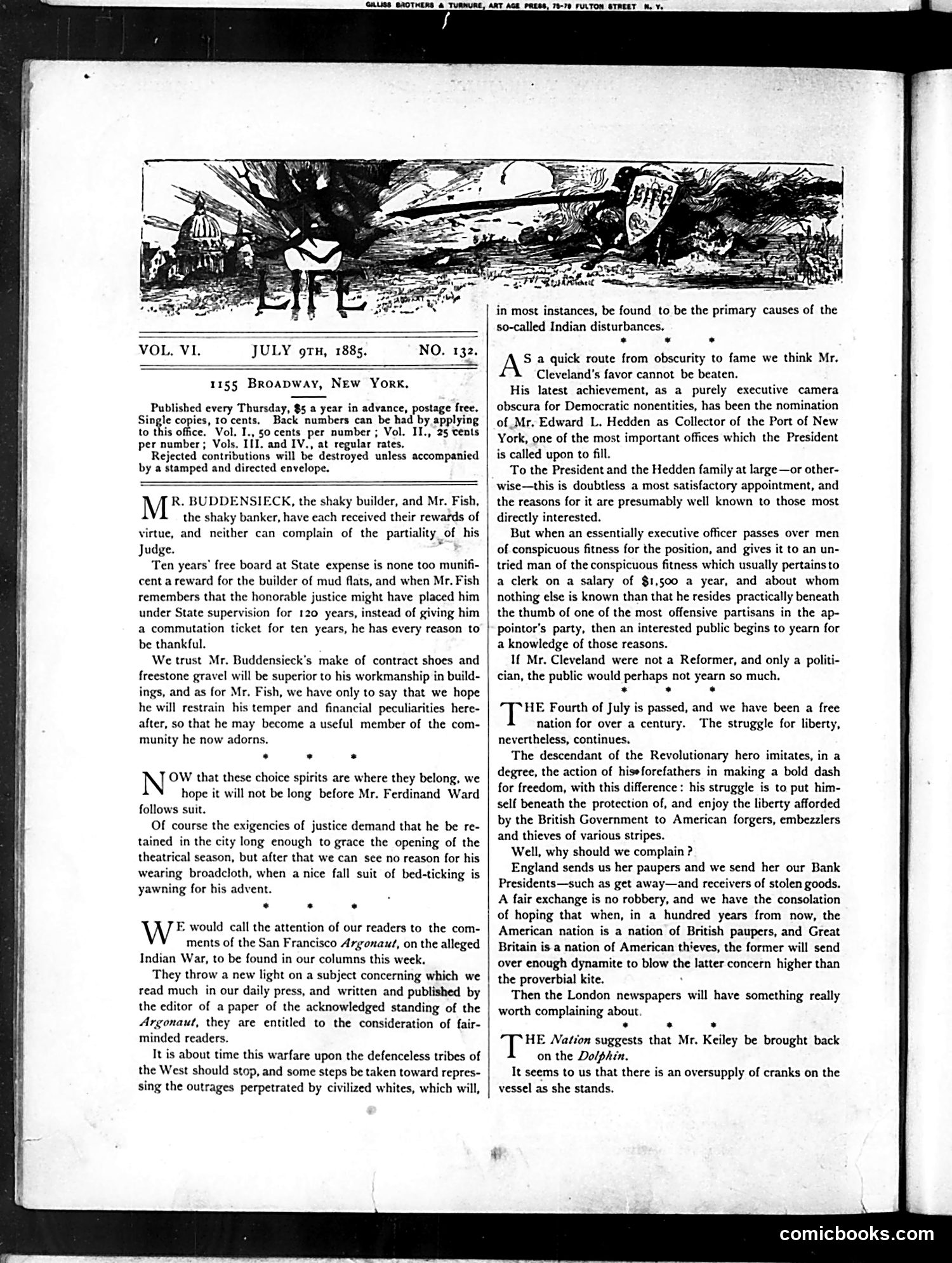
The page contains editorial commentary rather than a political cartoon. The text addresses several 1885 political issues: **Main Topics:** 1. **Mr. Buddensieck & Mr. Fish** - Praise for their rewards for virtue, with hopes Buddensieck will use "contract shoes and freestone gravel" responsibly in future work. 2. **Ferdinand Ward** - Expectation he'll face justice in New York, suggesting he wear "a nice fall suit of bed-ticking." 3. **San Francisco Chronicle's "Indian War"** - Criticism of the Chronicle's articles allegedly misrepresenting Native American conflicts, advocating the U.S. stop "warfare upon the defenceless tribes of the West." 4. **Cleveland Administration** - Commentary on President Cleveland's appointment of Edward L. Hedden as Port Collector, questioning why an executive officer was chosen over men of "conspicuous fitness." The satire targets political patronage and inconsistency.
📄 Transcribed text from this page (OCR, searchable)
Machine-transcribed from the original scan — historical spelling and the odd misread are preserved.
VOL. VI. _ JUL Y 9TH, 1885. NO. 1g2. 1155 Broapway, New York. Published every Thursday, $5 a year in advance, postage free. Single copies, 10 cents. Back numbers can be had by applying to this office. Vol. I., 50 cents per number ; Vol. II., 25 cents per number; Vols, IfI. and IV., at regular rates, Rejected contributions will be destroyed unless accompanied by a stamped and directed envelope. R. BUDD. the shaky banker, have each received their rewards of virtue, and neither can complain of the partiality of his Judge. ‘i Ten years’ free board at State expense is none too munifi- cent a reward for the builder of mud flats, and when Mr. Fish remembers that the honorable justice might have placed him under State supervision for 120 years, instead of giving him a commutation ticket for ten years, he has every reason to be thankful. We trust Mr. Buddensieck’s make of contract shoes and freestone gravel will be superior to his workmanship in build- ings, and as for Mr. Fish, we have only to say that we hope he will restrain his temper and financial peculiarities here- after, so that he may become a useful member of the com- munity he now adorns. . . . OW that these choice spirits are where they belong, we hope it will not be long before Mr. Ferdinand Ward follows suit. Of course the exigencies of justice demand that he be re- tained in the city long enough to grace the opening of the theatrical season, but after that we can see no reason for his wearing broadcloth, when a nice fall suit of bed-ticking is yawning for his advent. . . . E would call the attention of our readers to the com- ments of the San Francisco Argonaut, on the alleged Indian War, to be found in our columns this week. They throw a new light on a subject concerning which we read much in our daily press, and written and published by the editor of a paper of the acknowledged standing of the Argonaut, they are entitled to the consideration of fair- minded readers. It is about time this warfare upon the defenceless tribes of the West should stop, and some steps be taken toward repres- sing the outrages perpetrated by civilized whites, which will, GALIGS BROTHERS & TURNURE, ART AGE PRESS, 78-78 FULTON STREET KK. ¥. =NSIECK, the shaky builder, and Mr. Fish, | in most instances, be found to be the primary causes of the so-called Indian disturbances. . * * AS a quick route from obscurity to fame we think Mr. Cleveland’s favor cannot be beaten. His latest achievement, as a purely executive camera obscura for Democratic nonentities, has been the nomination of Mr, Edward L. Hedden as Collector of the Port of New York, one of the most important offices which the President is called upon to fill. To the President and the Hedden family at large—or other- wise—this is doubtless a most satisfactory appointment, and the reasons for it are presumably well known to those most directly interested. But when an essentially executive officer passes over men of conspicuous fitness for the position, and gives it to an un- tried man of the conspicuous fitness which usually pertains to a clerk on a salary of $1,500 a year, and about whom nothing else is known than that he resides practically beneath the thumb of one of the most offensive partisans in the ap- pointor’s party, then an interested public begins to yearn for a knowledge of those reasons. If Mr. Cleveland were not a Reformer, and only a politi- cian, the public would perhaps not yearn so much, * . . HE Fourth of July is passed, and we have been a free nation for over a century. The struggle for liberty, nevertheless, continues. The descendant of the Revolutionary hero imitates, in a degree, the action of hiseforefathers in making a bold dash for freedom, with this difference: his struggle is to put him- self beneath the protection of, and enjoy the liberty afforded by the British Government to American forgers, embezzlers and thieves of various stripes. Well, why should we complain ? England sends us her paupers and we send her our Bank Presidents—such as get away—and receivers of stolen goods. A fair exchange is no robbery, and we have the consolation of hoping that when, in a hundred years from now, the American nation is a nation of British paupers, and Great Britain is a nation of American thieves, the former will send over enough dynamite to blow the latter concern higher than the proverbial kite. Then the London newspapers will have something really worth complaining about . . . HE Nation suggests that Mr. Keiley be brought back on the Dolphin. It seems to us that there is an oversupply of cranks on the vessel as she stands. comicbooks.com