
Life, 1885-07-09 · page 7 of 16
Life — July 9, 1885 — page 7: what you’re looking at
What you’re looking at
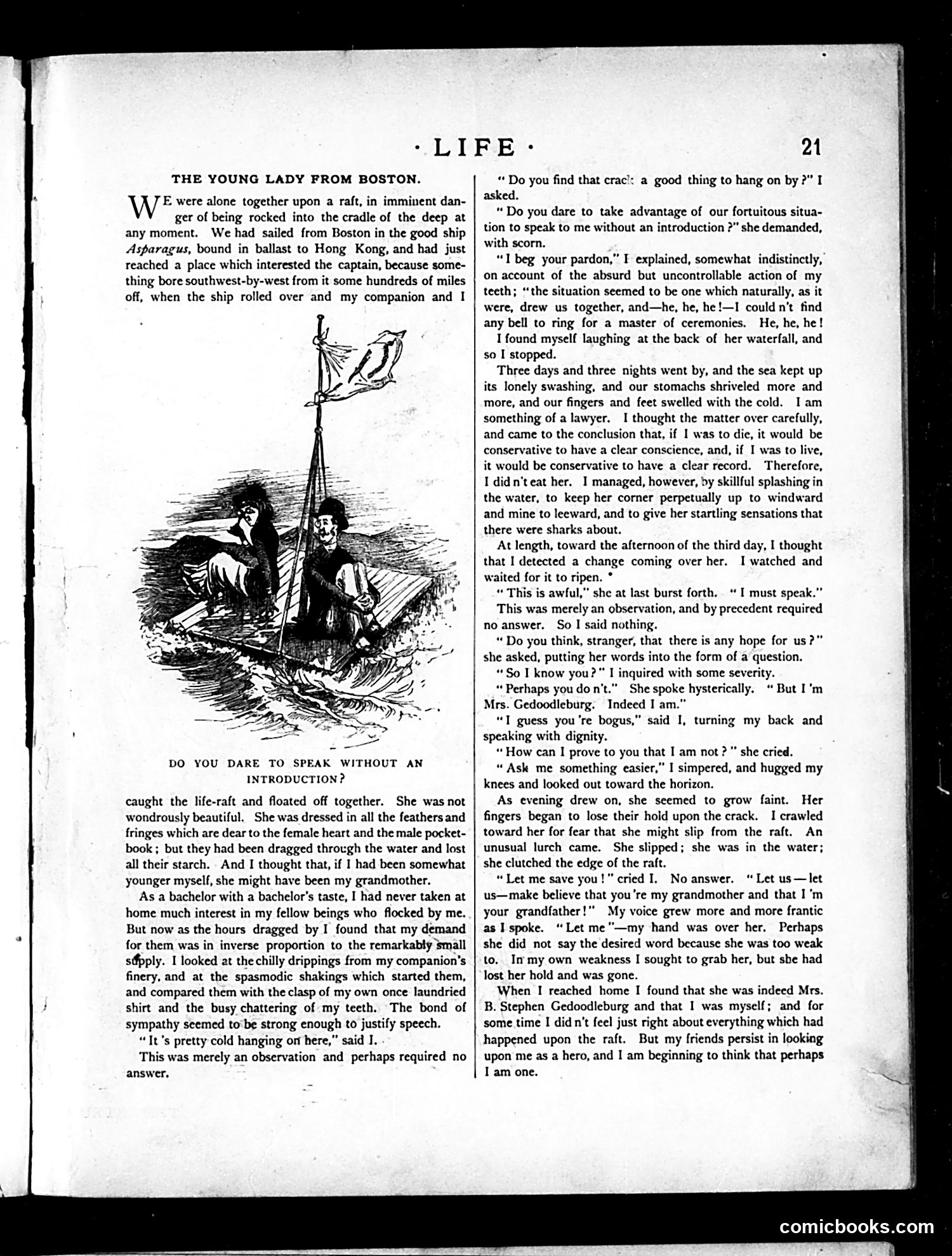
This page contains a serialized story titled "The Young Lady from Boston," illustrated with a wood engraving showing two figures on a raft at sea. The narrative describes a shipwreck survival scenario aboard the vessel *Asparagus*, where the narrator and a young woman from Boston find themselves adrift together. The accompanying illustration depicts the couple clinging to the raft amid rough waters. The text emphasizes their physical deterioration from cold and hunger over three days. The story appears to be a romantic adventure narrative rather than political satire—a common serial fiction format for Life magazine during this era. No specific political figures or events are referenced; instead, it's entertainment literature typical of 19th-century periodicals.
📄 Transcribed text from this page (OCR, searchable)
Machine-transcribed from the original scan — historical spelling and the odd misread are preserved.
> LIFE: THE YOUNG LADY FROM BOSTON. E were alone together upon a raft, in imminent dan- ger of being rocked into the cradle of the deep at any moment. We had sailed from Boston in the good ship Asparagus, bound in ballast to Hong Kong, and had just reached a place which interested the captain, because some- thing bore southwest-by-west from it some hundreds of miles off, when the ship rolled over and my companion and I DO YOU DARE TO SPEAK WITHOUT AN INTRODUCTION? caught the life-raft and floated off together. She was not wondrously beautiful. She was dressed in all the feathers and fringes which are dear to the female heart and the male pocket- book ; but they had been dragged through the water and lost all their starch. And I thought that, if I had been somewhat younger myself, she might have been my grandmother. As a bachelor with a bachelor's taste, I had never taken at home much interest in my fellow beings who flocked by me. But now as the hours dragged by I found that my demand for them was in inverse proportion to the remarkably small s@pply. I looked at the chilly drippings from my companion’s finery, and at the spasmodic shakings which started them, and compared them with the clasp of my own once laundried shirt and the busy chattering of my teeth. The bond of sympathy seemed to’be strong enough to justify speech. “It’s pretty cold hanging on here,” said I. This was merely an observation and perhaps required no answer, 21 “Do you find that crac!: a good thing to hang on by ?” I asked. “Do you dare to take advantage of our fortuitous situa- tion to speak to me without an introduction ?” she demanded, with scorn. “1 beg your pardon,” I explained, somewhat indistinctly, on account of the absurd but uncontrollable action of my teeth; “the situation seemed to be one which naturally, as it were, drew us together, and—he, he, he !—I could n’t find any bell to ring for a master of ceremonies. He, he, he! I found myself laughing at the back of her waterfall, and so I stopped. Three days and three nights went by, and the sea kept up its lonely swashing, and our stomachs shriveled more and more, and our fingers and feet swelled with the cold. Iam something of a lawyer. I thought the matter over carefully, and came to the conclusion that, if 1 was to die, it would be conservative to have a clear conscience, and, if I was to live, it would be conservative to have a clear record. Therefore, I didn'teat her. 1 managed, however, dy skillful splashing in the water, to keep her corner perpetually up to windward and mine to leeward, and to give her startling sensations that there were sharks about. At length, toward the afternoon of the third day, I thought that I detected a change coming over her. I watched and waited for it to ripen. ° “ This is awful,” she at last burst forth. “ I must speak.” This was merely an observation, and by precedent required no answer. So I said nothing. “Do you think, stranger, that there is any hope for us?” she asked, putting her words into the form of a question. “So I know you?” I inquired with some severity. “Perhaps you don't.” She spoke hysterically, “ But I'm Mrs. Gedoodleburg. Indeed I am.” “T guess you're bogus,” said I, turning my back and speaking with dignity. “How can I prove to you that I am not ?” she cried. “Ask me something easier,” I simpered, and hugged my knees and looked out toward the horizon. As evening drew on, she seemed to grow faint. Her fingers began to lose their hold upon the crack. I crawled toward her for fear that she might slip from the raft. An unusual lurch came. She slipped; she was in the water; she clutched the edge of the raft. “Let me save you!" cried I. No answer. “Let us—let us—make believe that you're my grandmother and that I'm your grandfather!" My voice grew more and more frantic as I spoke. “Let me"—my hand was over her. Perhaps she did not say the desired word because she was too weak to. Immy own weakness I sought to grab her, but she had lost her hold and was gone. When I reached home I found that she was indeed Mrs. B. Stephen Gedoodleburg and that I was myself; and for some time I didn’t feel just right about everything which had happened upon the raft. But my friends persist in looking upon me as a hero, and I am beginning to think that perhaps I am one. comicbooks.com