
A complete issue · 16 pages · 1885
Life — June 4, 1885
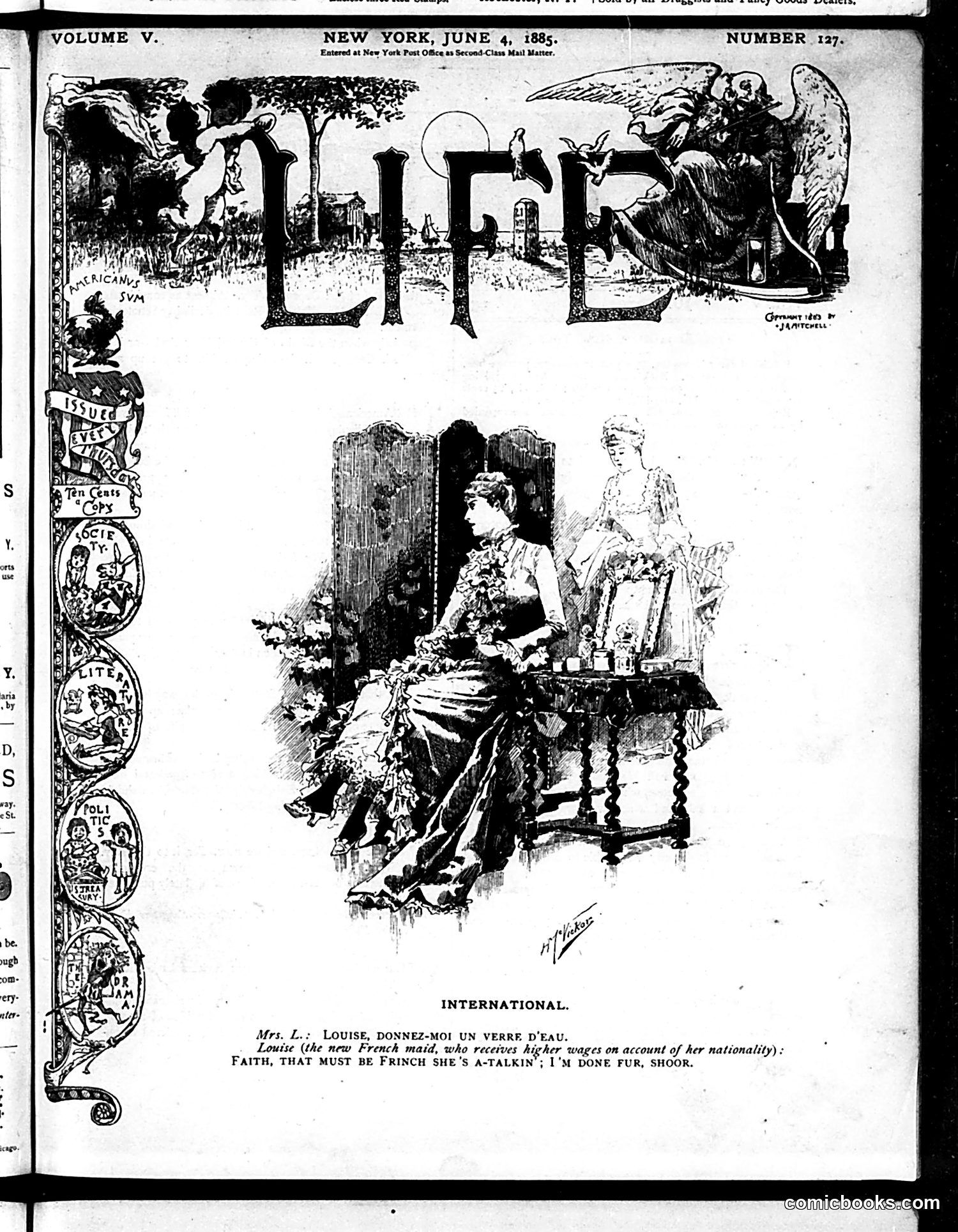
This page features a satirical cartoon titled "International" about a French maid named Louise. The caption indicates she receives higher wages due to her French nationality, prompting a sarcastic comment: "Faith, that must be French she's a-talkin', I'm done fur, Shoor." The humor targets xenophobic workplace discrimination—specifically, the preference for French domestic servants in wealthy American households during the 1880s. The joke appears to mock both the snobbish employers who paid premium wages for French staff and the Irish servant's frustration at being undervalued by comparison. The illustrated woman at her toilette embodies the fashionable French maid stereotype that made such positions coveted. This reflects Gilded Age tensions between immigrant groups competing for domestic service positions.
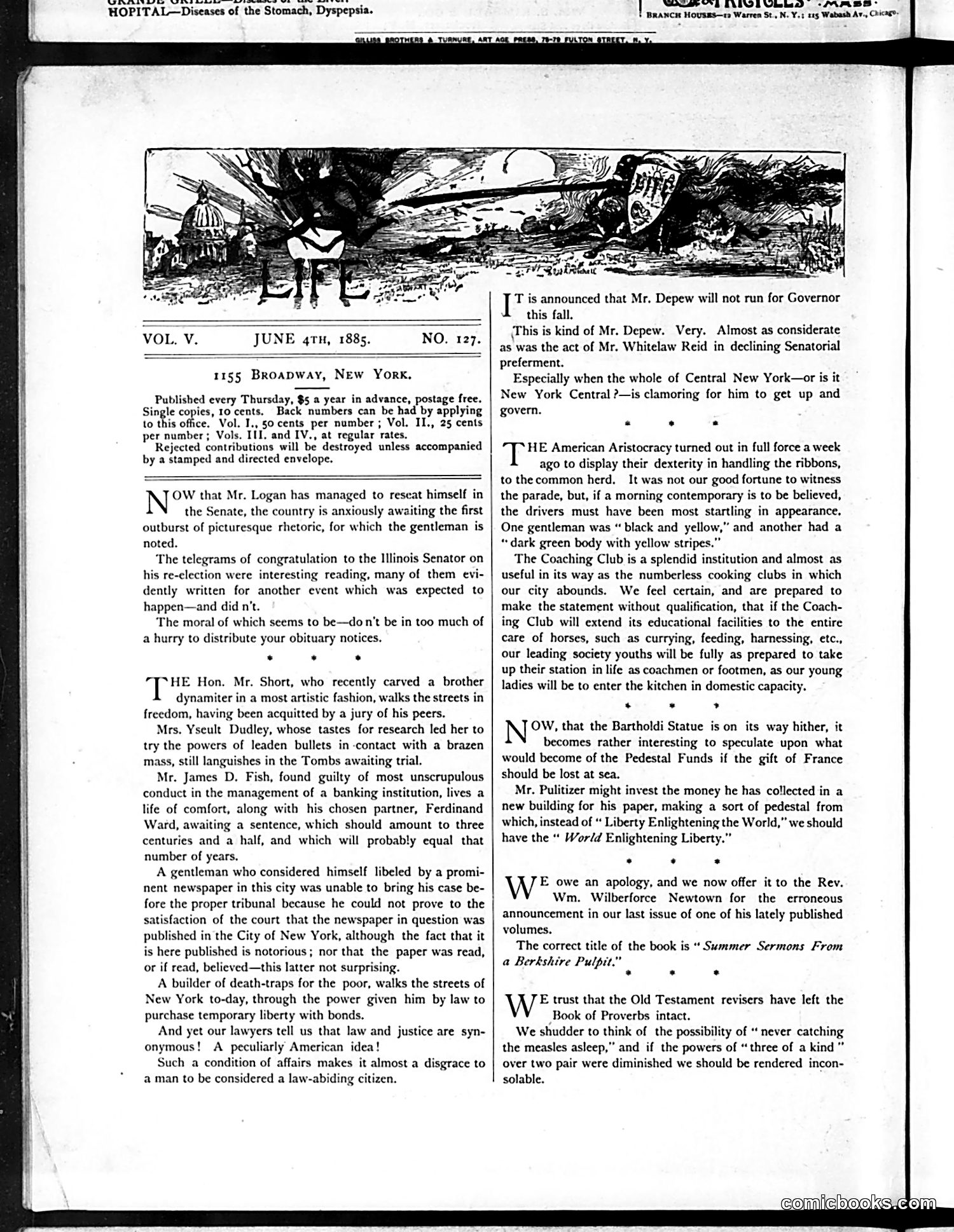
The page's masthead illustration depicts a figure labeled "LIFE" overlooking a landscape with classical architecture (suggesting democratic ideals). The text below addresses several political matters: 1. **Mr. Depew's decision not to run for Governor** - presented as admirably modest, comparable to Whitelaw Reid's earlier refusal of a Senate position. 2. **The American Aristocracy's parade** - satirizes wealthy New York society displaying themselves ostentatiously at a public event, with commentary on their absurdly decorated carriages ("dark green body with yellow stripes"). 3. **Various social criticisms** - including commentary on corrupt banking practices, frivolous libel suits, and the paradox of American law protecting the wealthy while allowing them to purchase "temporary liberty" through financial means. The satire targets inequality and hypocrisy among the privileged classes.
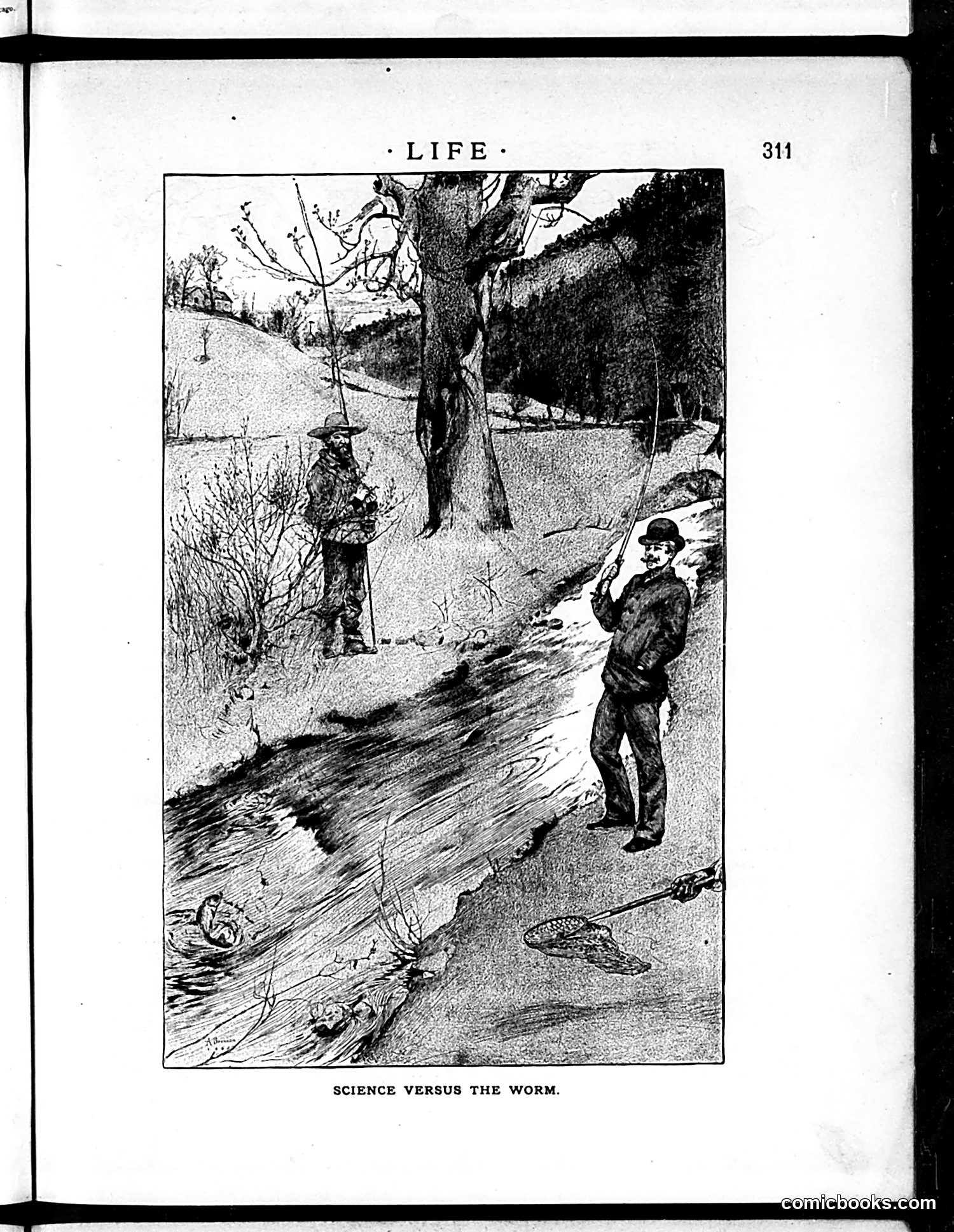
This cartoon depicts two fishermen by a stream with fishing rods. The caption "Science Versus the Worm" suggests a humorous commentary on fishing methodology—likely contrasting scientific or modern approaches to fishing with traditional bait-and-worm techniques. One figure appears to be using an elaborate or presumably scientific fishing method (possibly a fly rod or specialized equipment), while the other uses the simple, time-tested approach of a worm on a line. The joke appears to be about whether sophisticated, scientific methods actually outperform basic, traditional fishing techniques. This reflects early 20th-century American humor about the tension between technological progress and practical, conventional wisdom—a recurring theme in *Life* magazine's satire of the era.
This page contains brief satirical commentary items rather than a cartoon. The content mocks various contemporary figures and events: **Key References:** - England's military preparations ("run over to Herat") regarding colonial expansion - Mr. Gladstone (political figure) and his statements - J.D. Fish facing sentencing; the *Tribune* newspaper's coverage - References to the Boer War ("Bourbonism," "rebel Brigadier") - Edgar Fawcett's literary work on punctuation - A dig at Secretary of the Navy Whitney's budgetary choices **The Satire:** The items target political figures' inconsistencies, press sensationalism, and naval spending priorities. One quip suggests the Navy should learn lessons from the *Dolphin* ship—implying misplaced priorities in naval administration versus other government needs. The tone is characteristic of *Life*'s turn-of-century sharp social commentary on politics and public figures.
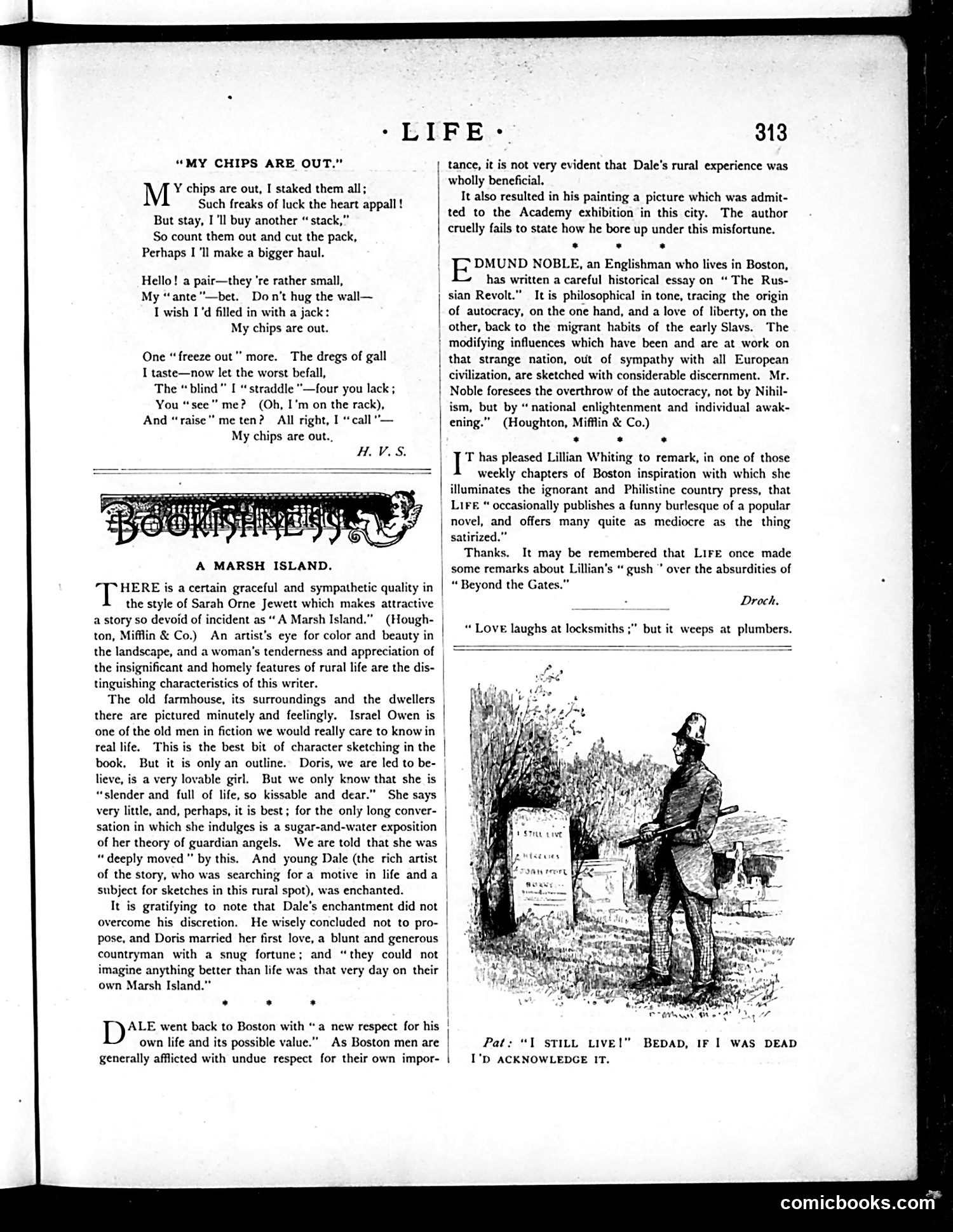
This page contains literary reviews and commentary rather than political cartoons. The main illustrated element shows a figure standing by a gravestone in a rural graveyard setting. The caption reads: "Pat: 'I STILL LIVE!' BEDAD, IF I WAS DEAD I'D ACKNOWLEDGE IT." This appears to be Irish-themed humor, using dialect ("Bedad," an Irish exclamation) and featuring what seems to be an Irish character. The joke plays on stubborn persistence—the figure insists on living despite appearing to be at a grave, suggesting an ironic commentary on Irish resilience or stubbornness. The page primarily reviews books including Sarah Orne Jewett's "A Marsh Island" and Edmund Noble's historical essay on the Russian Revolt.
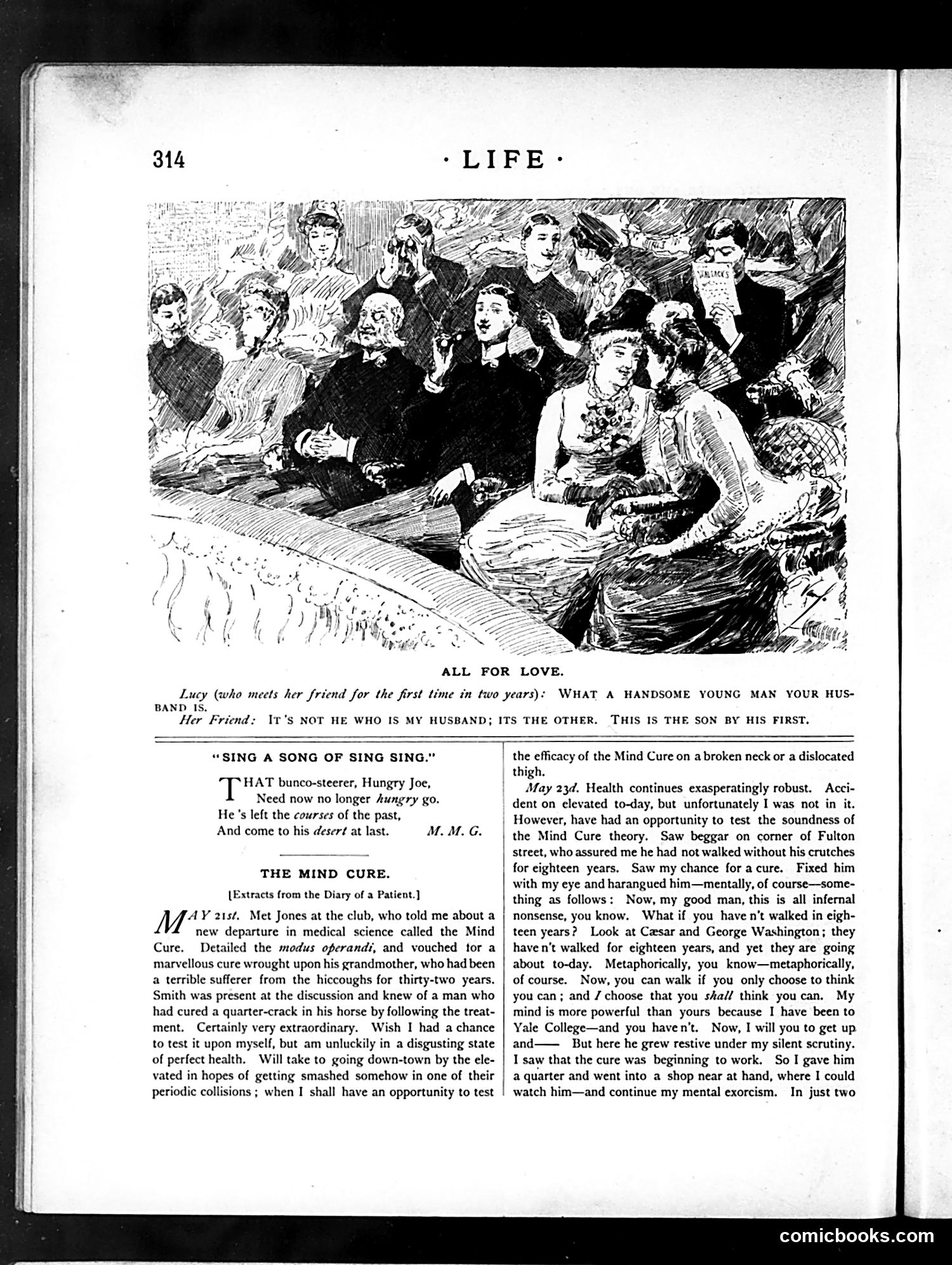
**Top Cartoon ("All for Love"):** A social satire depicting a woman (Lucy) introducing her new husband to friends, with the caption revealing he's actually her son from a previous relationship—not her actual spouse. The joke mocks Victorian-era social pretense and the awkwardness of blended family dynamics presented as romantic respectability. **"Sing a Song of Sing Sing" Section:** A brief humorous poem about "Hungry Joe" leaving prison ("Sing Sing"), referencing the famous New York penitentiary. **"The Mind Cure" Article:** An excerpt from a patient's diary describing mental healing techniques—the author claims to have cured someone's chronic condition through mental exercise and positive thinking, an early example of mind-cure pseudoscience popular in late 19th/early 20th century America.
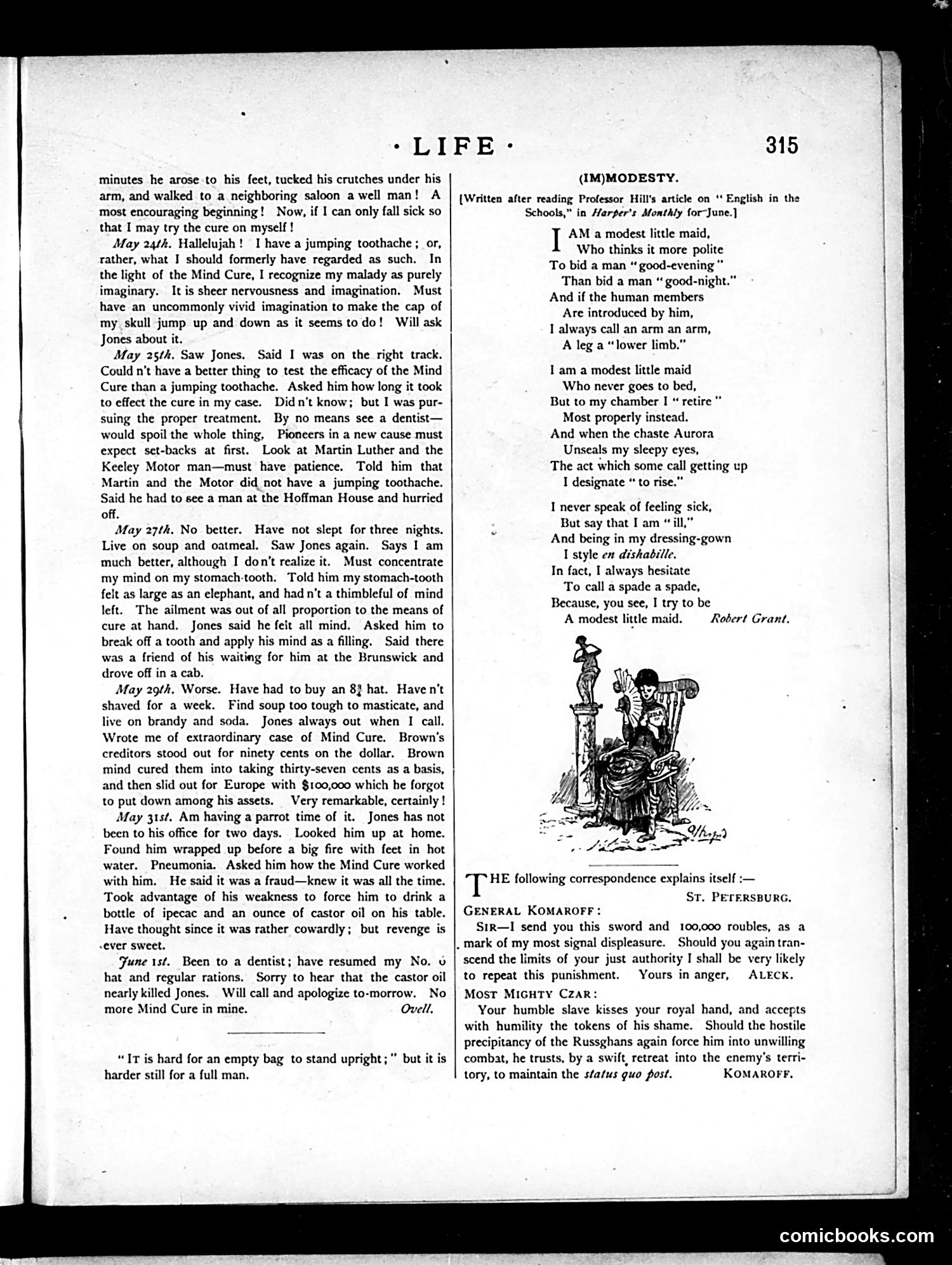
This page contains two distinct elements: **Left column:** A diary entry (dated May-June) describing someone's experience with "Mind Cure"—an alternative medical treatment popular in the late 19th century. The writer initially skeptical, eventually credits it with curing a toothache and other ailments. This appears to be satirizing the period's enthusiasm for pseudoscientific wellness trends. **Right side:** A poem titled "(IM)MODESTY" by Robert Grant, humorously describing a modest young woman's refined behavior and speech—a gentle satire on Victorian propriety and affected gentility. **Bottom:** A correspondence between "General Komaroff" and "The Mighty Czar" regarding a sword and roubles, appearing to reference Russian political tensions, though the specific historical context is unclear without additional dating information.
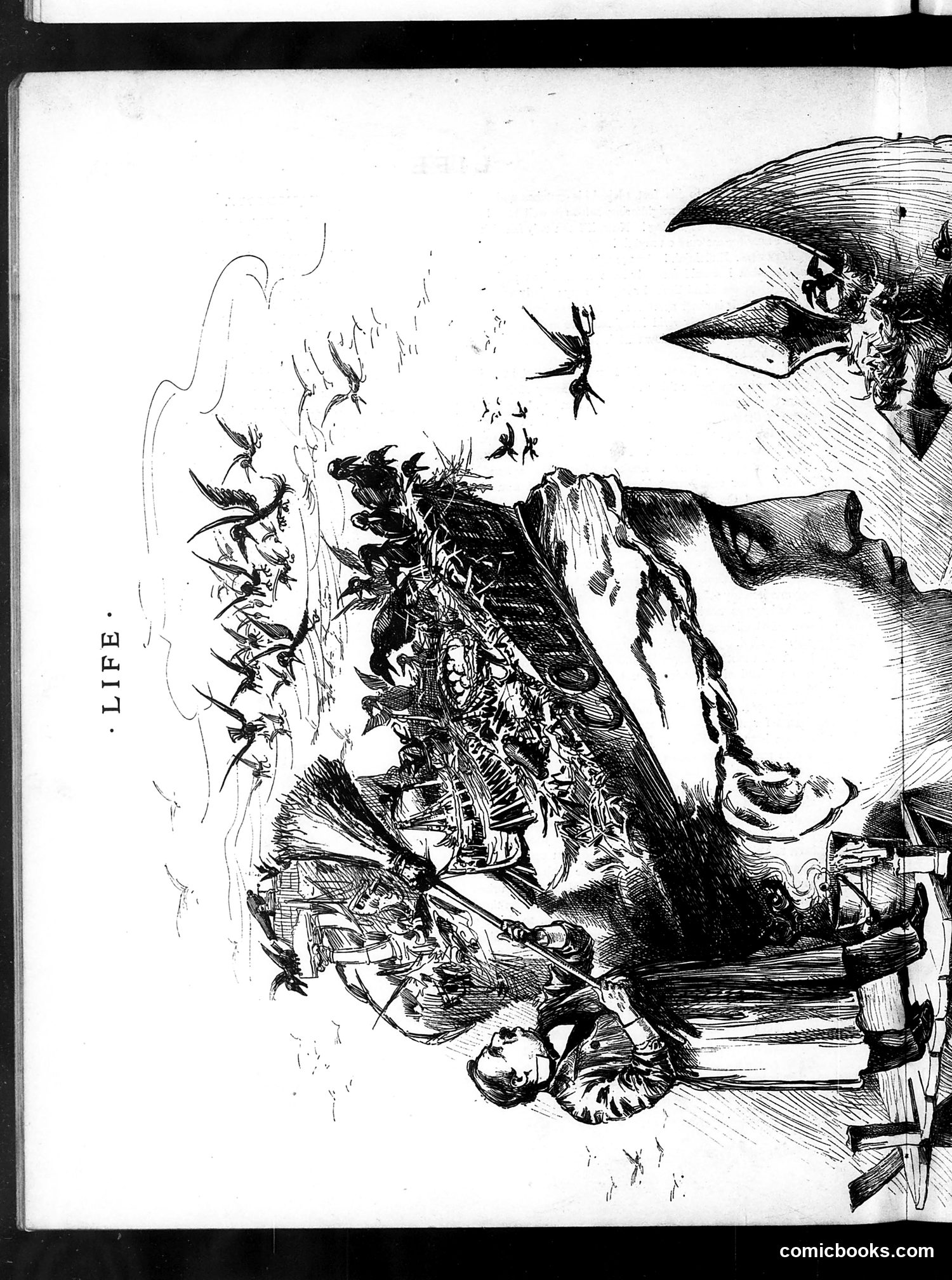
This appears to be a satirical illustration titled "LIBE" (likely "Liberty"), rendered in detailed black-ink sketch style. The image depicts a chaotic scene with multiple figures in apparent conflict or struggle. On the right stands a figure wearing a broad-brimmed hat, seemingly confronting or threatening a group of figures on the left who appear distressed or scattered. The composition suggests commentary on political liberty or freedom under threat. Without additional context or visible date/attribution, I cannot definitively identify the specific historical event, political figures, or crisis being referenced. The energetic, violent imagery indicates serious political satire rather than humor, typical of *Life* magazine's editorial commentary on contemporary American affairs.
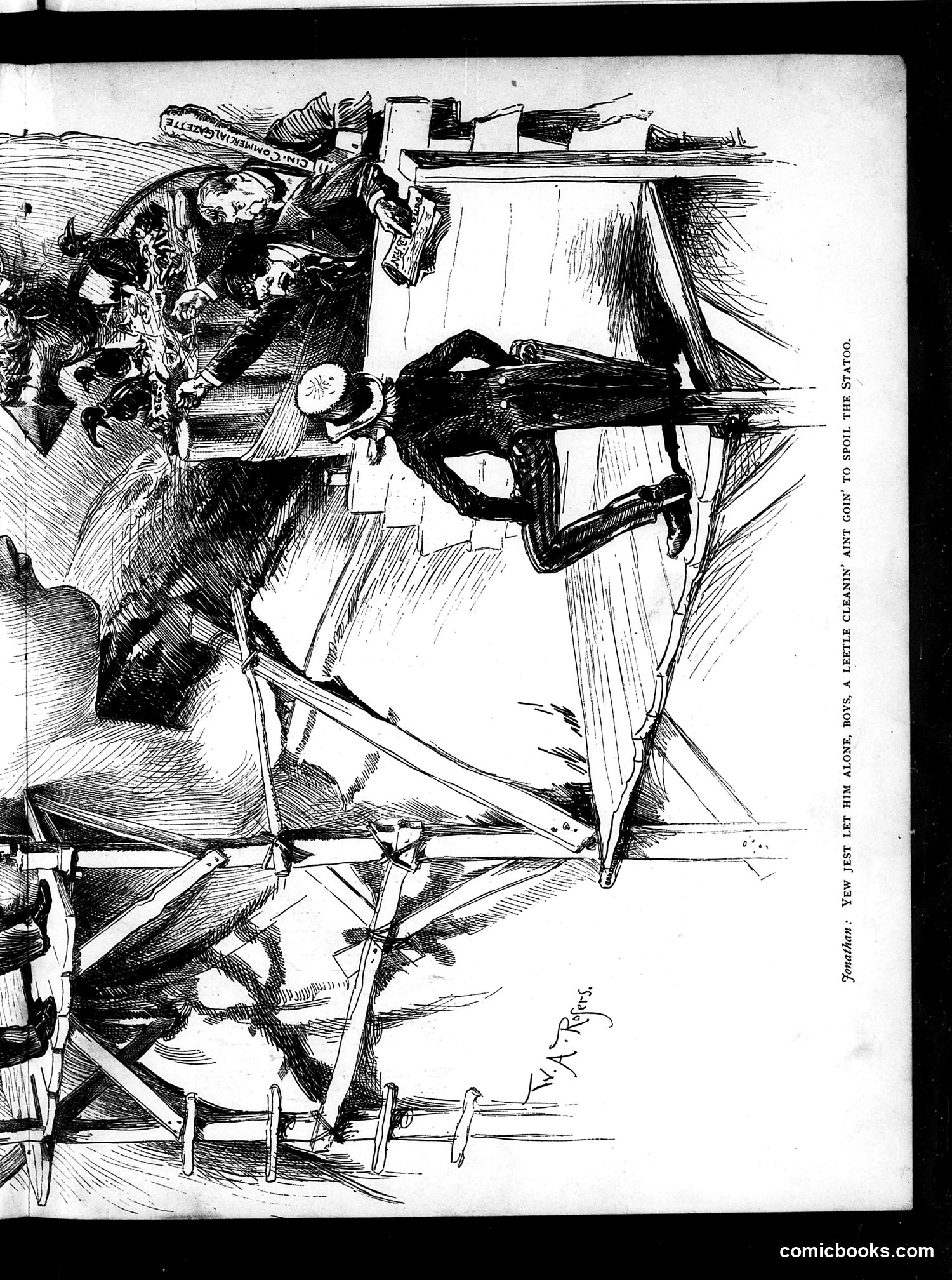
This is a satirical ink sketch showing a woman in Victorian-era dress being thrown or ejected from what appears to be a streetcar or public conveyance. The caption reads: "Perhaps you first let the ladies alight, a better cleanliness and go scroll here straitly" (OCR may have errors). The cartoon appears to satirize a social conflict—likely about gentlemanly conduct and public manners during the late 19th or early 20th century. It suggests tension between proper Victorian etiquette (allowing women to exit first) and the chaos or rudeness of modern urban transit. The exaggerated, disheveled state of the woman and the rough handling visible in the sketch emphasize the contrast between expected genteel behavior and actual street-level chaos, mocking either declining manners or the impracticality of strict social codes in crowded public spaces.
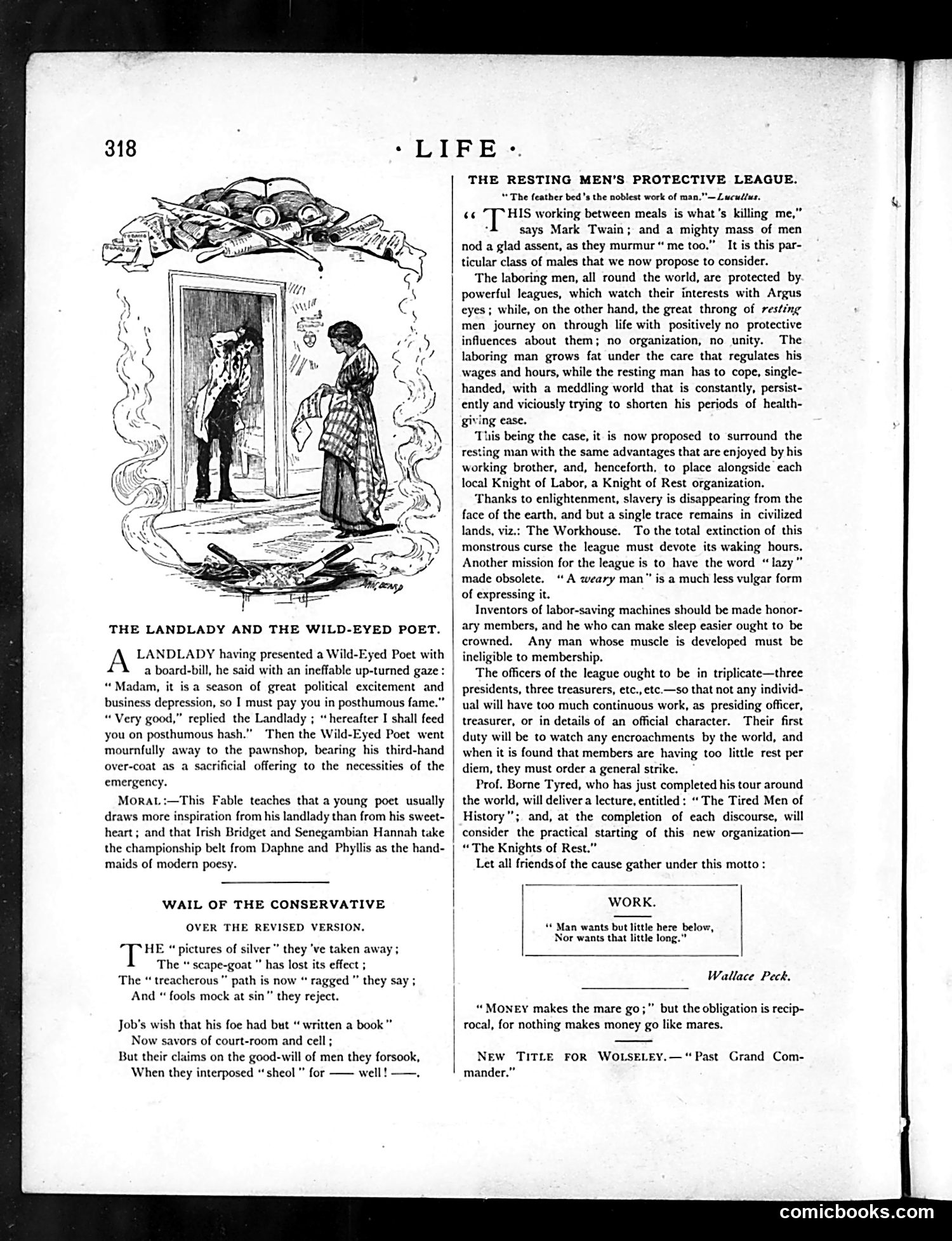
This Life magazine page contains three satirical pieces mocking various social issues: **"The Landlady and the Wild-Eyed Poet"** ridicules impoverished bohemian artists who offer excuses instead of payment. The starving poet claims he'll pay with "posthumous fame," so the landlady sarcastically agrees to feed him "posthumous hash"—worthless promises instead of real food. The satire targets romantic notions of struggling artistry. **"Wail of the Conservative"** attacks religious conservatives opposing a revised Bible translation, suggesting they're clinging to archaic language for tradition's sake rather than clarity. **"The Resting Men's Protective League"** is the main satire, mocking labor unions by proposing an opposite organization protecting the idle and lazy. It ironically praises idleness as a virtue, suggesting inventors of labor-saving devices deserve honors, and that muscular men should be expelled from membership. The satire critiques both excessive labor activism and social parasitism—suggesting that organizing to protect laziness is as absurd as the union movement itself appears to the author.
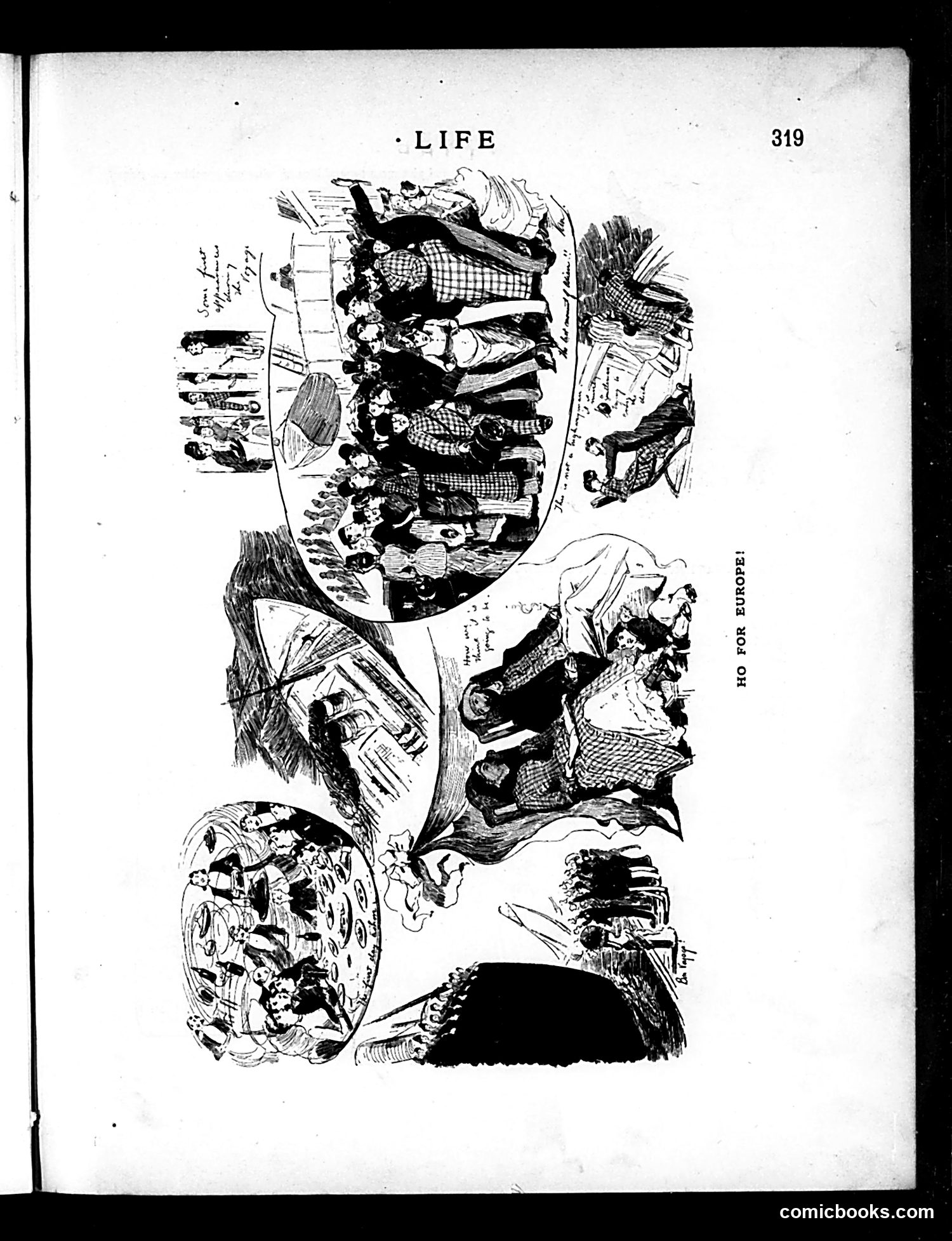
This page from *Life* magazine (page 319) contains multiple satirical sketches oriented sideways. The central image appears to show a crowd scene with numerous figures in period dress, possibly depicting a social gathering or public event. There are also smaller vignettes showing domestic or social situations. The text "HO FOR EUROPE!" appears on the right margin, suggesting the cartoons satirize European travel or emigration themes popular among Americans of that era. However, the OCR text is largely illegible, and without clearer captions or visible identifying text in the image, I cannot definitively identify the specific figures, events, or satirical points being made. The artistic style and layout suggest early-to-mid 20th century *Life* magazine content, but more context would be needed for accurate interpretation of the particular social or political commentary intended.
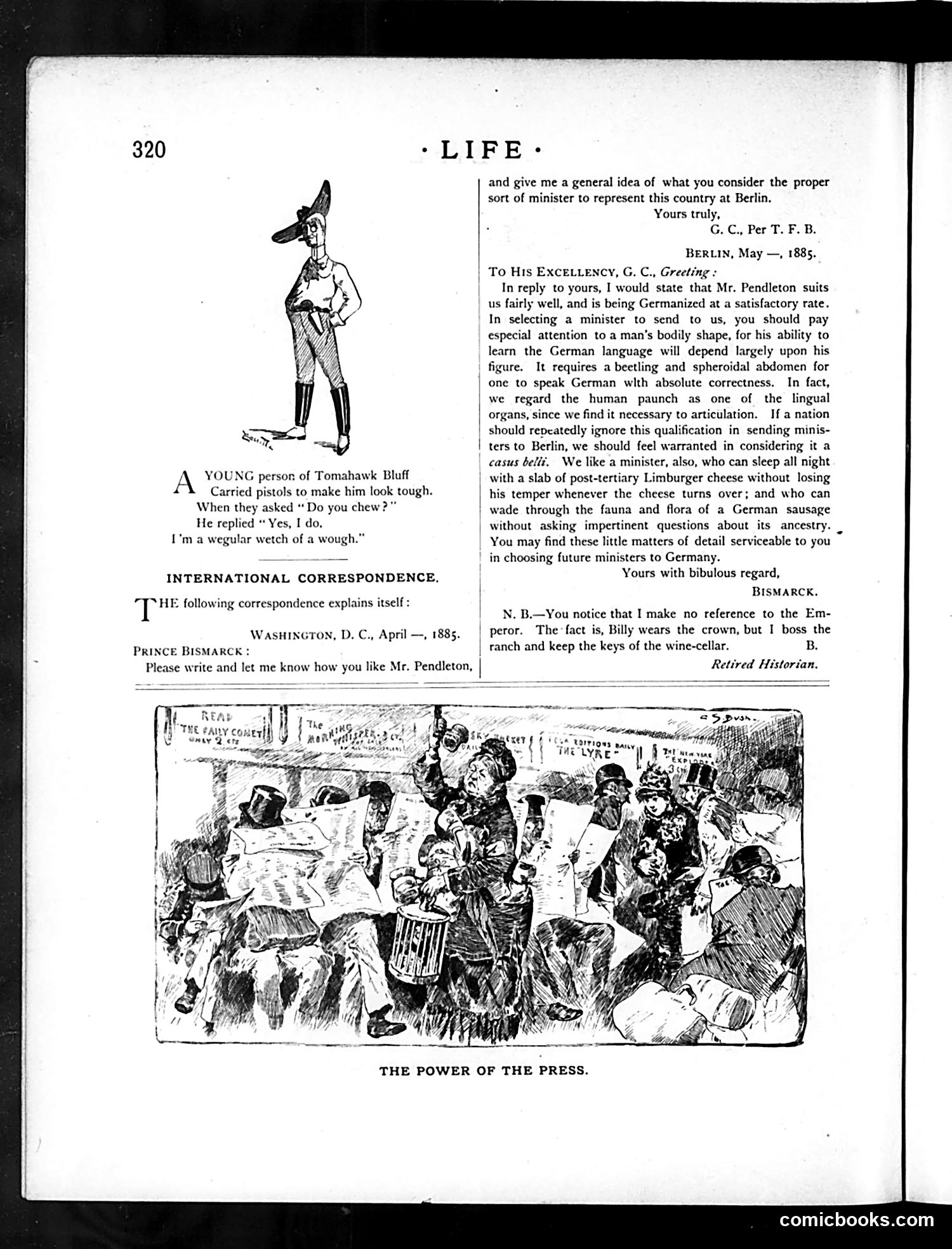
This 1885 *Life* magazine page satirizes diplomatic relations through a fake correspondence between Washington and Bismarck about U.S. Minister Pendleton in Berlin. **The Satire:** Bismarck's reply mockingly claims that speaking German requires a large belly—treating the "paunch" as a linguistic organ necessary for proper articulation. He jokingly threatens "casus belli" (cause for war) if America keeps sending slim ministers. He also humorously specifies that ideal diplomats must sleep through Limburger cheese and German sausages without complaint. **The Point:** The joke ridicules both German stereotypes (association with beer bellies and heavy foods) and the absurdity of diplomatic selection criteria. The postscript, where Bismarck claims real power over young Kaiser Wilhelm II ("Billy"), reflects contemporary awareness of Bismarck's dominance in German politics during the 1880s. **Visual Elements:** The top cartoon depicts a thin Tomahawk Bluff character claiming to be "a regular wretch of a wough"—likely complementing the written satire about American thinness versus German robustness. The bottom illustration labeled "The Power of the Press" shows journalists or newspaper men, likely referencing media influence on diplomacy.
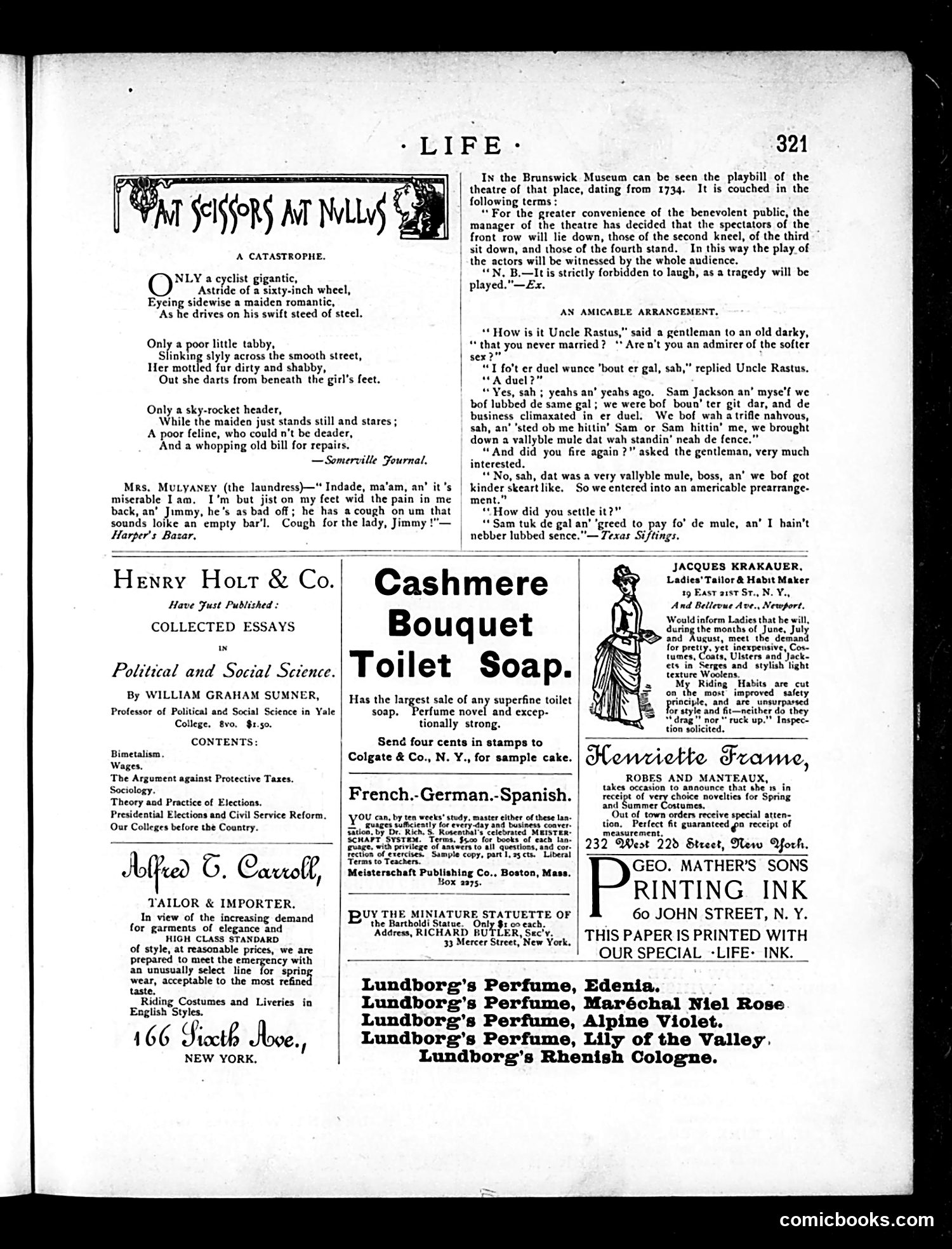
This page contains three brief humorous sketches typical of *Life* magazine's satirical format: 1. **"At Scissors at Nullus"** (top): Three comic poems about everyday mishaps—a cyclist distracted by a woman who hits a cat, a maid's clumsy accident, and a reckless driver. These are gentle domestic humor rather than political satire. 2. **"An Amicable Arrangement"** (center): A dialect-heavy joke featuring "Uncle Rastus," a Black character in period vernacular. Two men duel over a woman but accidentally kill a valuable mule instead, so the protagonist concedes and never loves again. The humor relies on racist caricature and stereotypical speech patterns common to era publications. 3. **Mrs. Mulvaney** (bottom): An Irish laundress complaining about poverty and illness—another ethnic stereotype sketch. The page is primarily **advertising** for books, tailoring, perfume, and soap. The satirical content reflects *Life*'s reliance on ethnic humor and stereotypes typical of 1880s-90s American magazines.
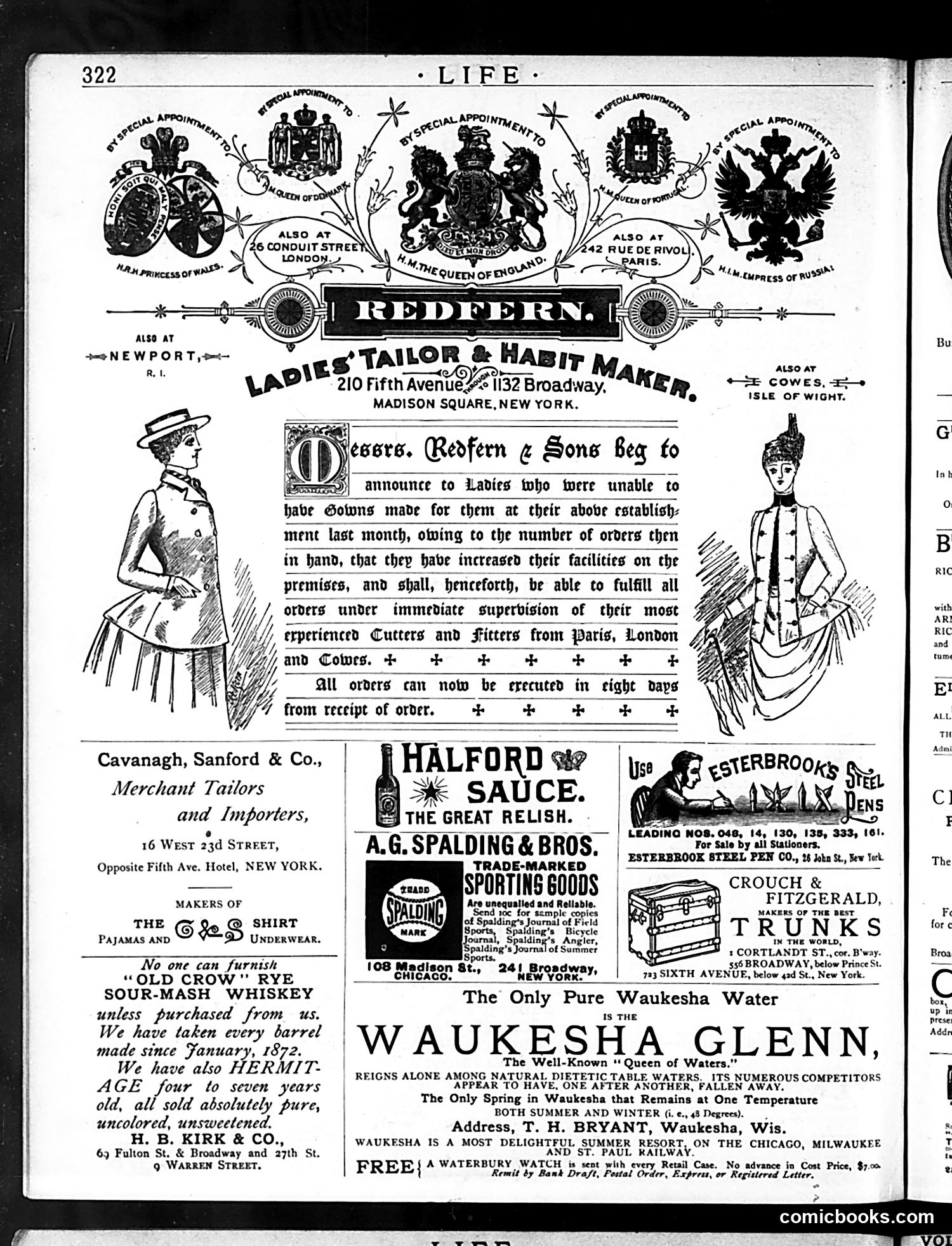
This page contains **no political cartoon or satire**. It is primarily **commercial advertising** from the Gilded Age, circa 1890s-1900s. The central content is a fashion notice from **Redfern & Sons**, a prestigious ladies' tailor with locations in London, Paris, and New York. They announce expanded capacity to fulfill custom dress orders within eight days—addressing complaints from wealthy clients who experienced delays due to high demand. The page is surrounded by period advertisements for luxury goods: custom tailoring, men's shirts, sporting equipment, whiskey, sauce, trunks, steel pens, and Waukesha spring water. Two fashion illustrations flank the Redfern announcement, depicting stylish women's clothing of the era. The content reflects the commercial landscape and consumer culture of affluent turn-of-the-century America, with no satirical commentary visible.
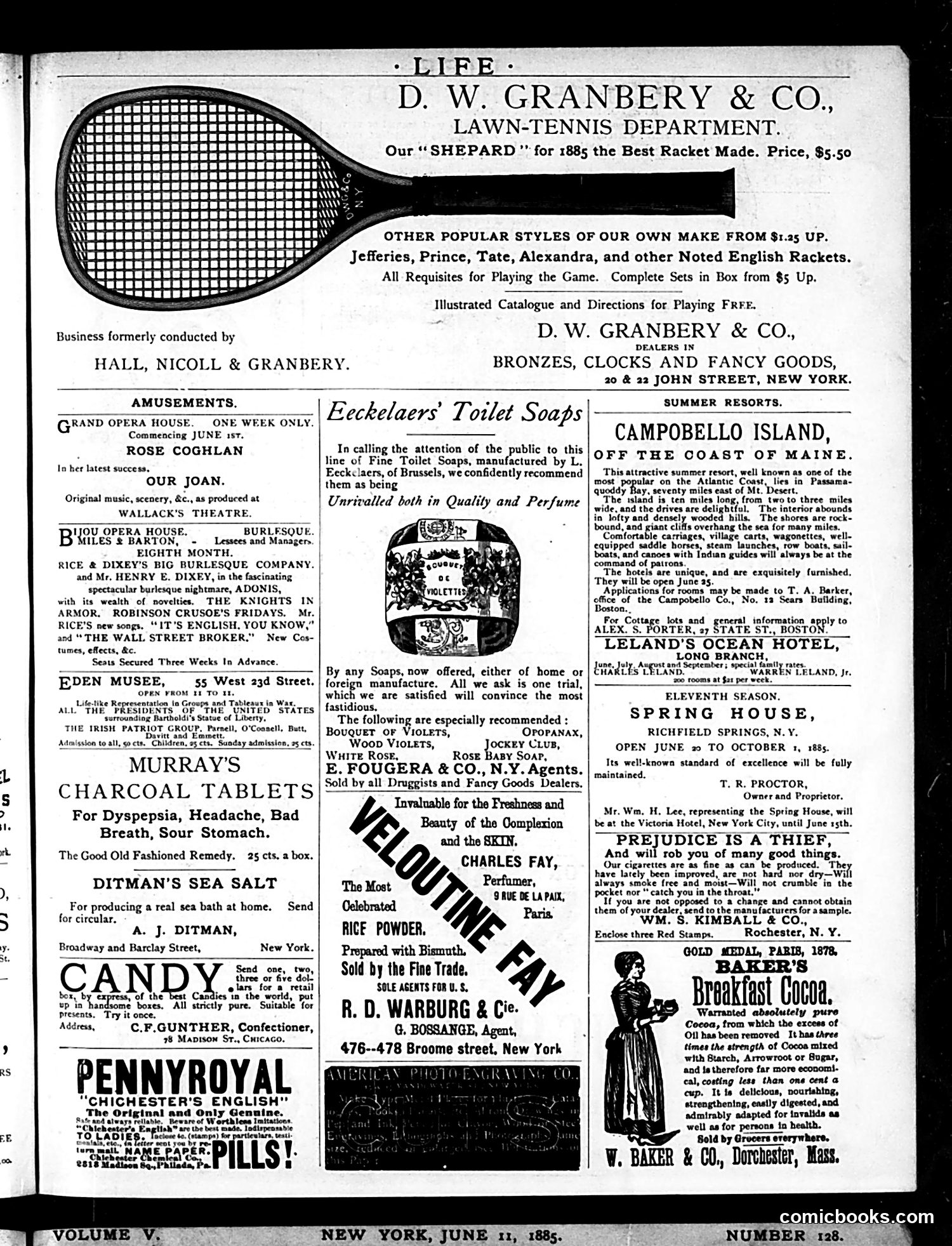
This is primarily an **advertising page** with no political cartoons or satirical content. The page consists almost entirely of commercial advertisements for products and services typical of 1880s America. Notable advertisements include: - **D.W. Granbery & Co.**: Tennis rackets and sporting equipment - **Theater listings**: Grand Opera House, Eden Musee (wax museum featuring Presidents and Irish patriots) - **Patent medicines**: Murray's Charcoal Tablets, Ditman's Sea Salt, Pennyroyal pills - **Toiletries**: Ecclelaers' Toilet Soaps, Rice Powder, Breakfast Cocoa - **Summer resorts**: Campobello Island, Maine; Spring House, New York The page reflects late Victorian consumer culture, with heavy promotion of dubious medicinal products and leisure activities for the affluent. The Eden Musee advertisement notably features wax figures of U.S. Presidents alongside Irish patriot figures (Parnell, O'Connell, Davitt, Emmett), suggesting contemporary interest in Irish independence politics. No satire or political commentary is evident.
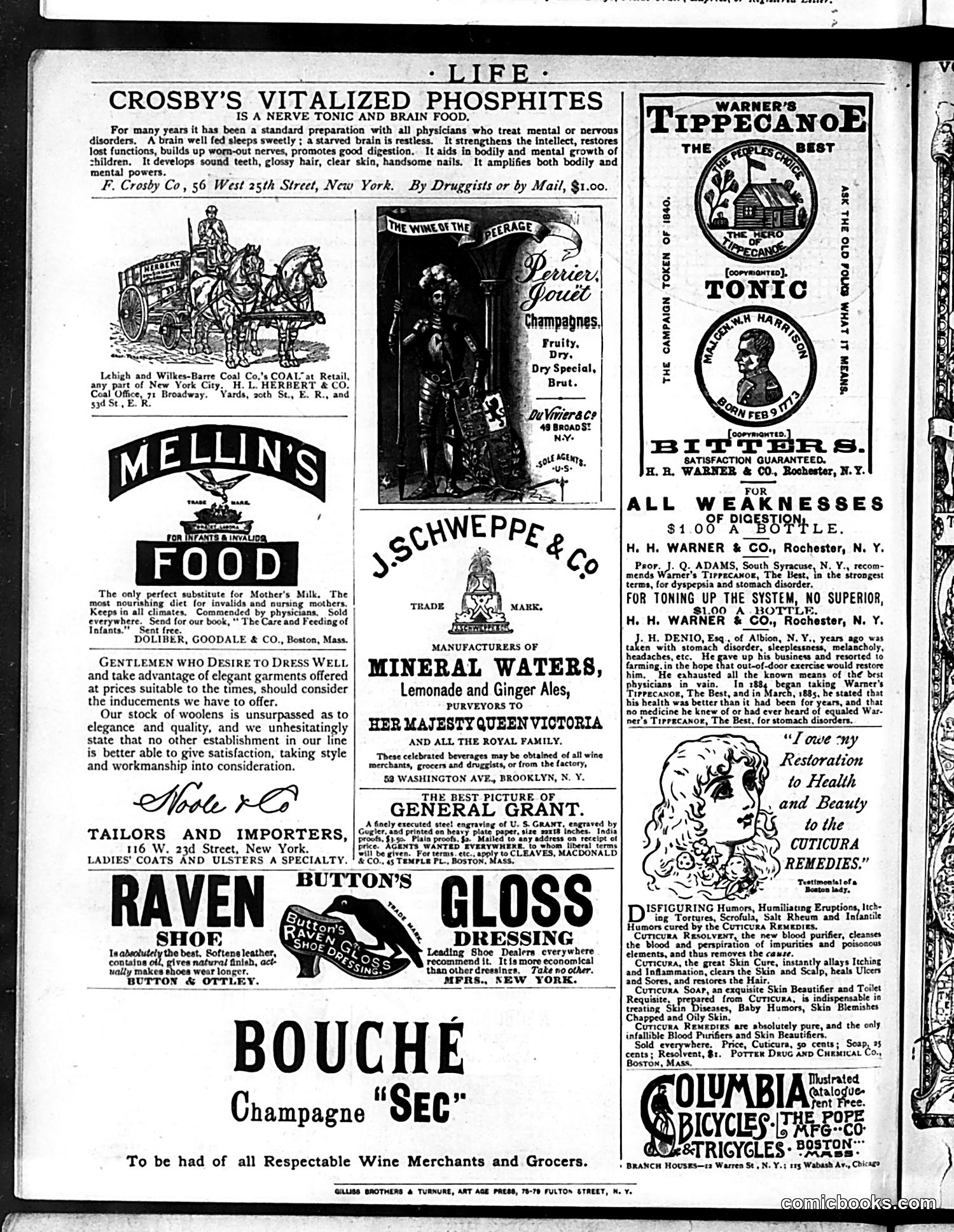
This is primarily an **advertisement page** from Life magazine, not a political cartoon. It showcases various patent medicines and consumer products typical of the late 19th century. The page features **nostrum ads** (dubious health products), including: - **Crosby's Vitalized Phosphites** — a "nerve tonic" claiming to cure mental disorders and build strong bodies - **Warner's Tippecanoe** — marketed for "all weaknesses" and stomach disorders - **Cuticura Remedies** — for skin conditions and "humors" These reflect the era's widespread belief in **patent medicines as cure-alls**, before FDA regulation. The ads use testimonials and pseudo-scientific language to market products of questionable efficacy. Also advertised: clothing, champagne, coal, baby formula, and bicycles — representing typical consumer goods. The page's satirical value lies not in explicit cartoon mockery, but in how Life *implicitly* critiques the gullibility of consumers who purchased these unregulated "remedies" based on exaggerated claims.