
Life, 1885-06-04 · page 5 of 16
Life — June 4, 1885 — page 5: what you’re looking at
What you’re looking at
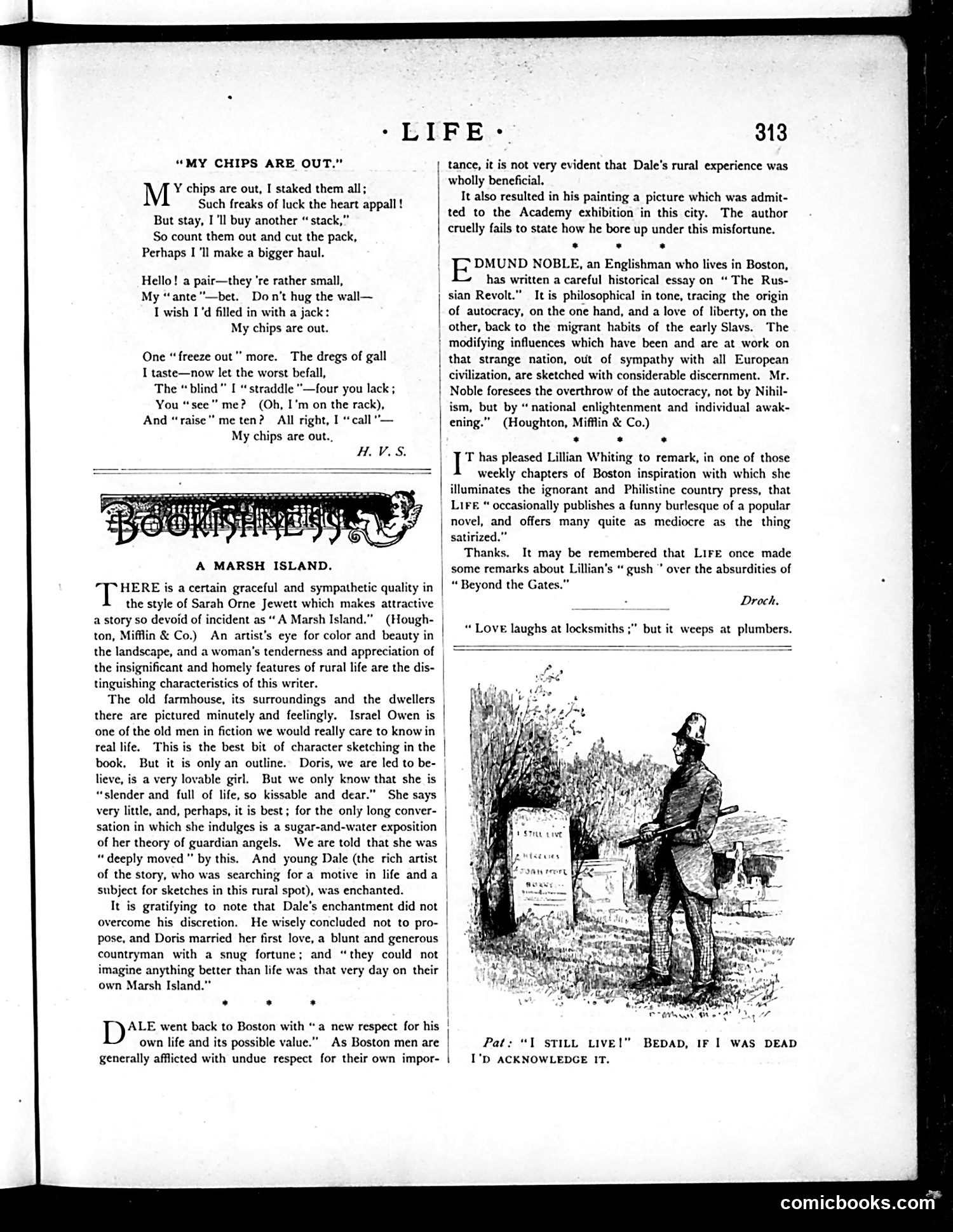
This page contains literary reviews and commentary rather than political cartoons. The main illustrated element shows a figure standing by a gravestone in a rural graveyard setting. The caption reads: "Pat: 'I STILL LIVE!' BEDAD, IF I WAS DEAD I'D ACKNOWLEDGE IT." This appears to be Irish-themed humor, using dialect ("Bedad," an Irish exclamation) and featuring what seems to be an Irish character. The joke plays on stubborn persistence—the figure insists on living despite appearing to be at a grave, suggesting an ironic commentary on Irish resilience or stubbornness. The page primarily reviews books including Sarah Orne Jewett's "A Marsh Island" and Edmund Noble's historical essay on the Russian Revolt.
📄 Transcribed text from this page (OCR, searchable)
Machine-transcribed from the original scan — historical spelling and the odd misread are preserved.
> LIFE:. “MY CHIPS ARE OUT.” Y chips are out, I staked them all; Such freaks of luck the heart appall ! But stay, I'll buy another “ stack,” So count them out and cut the pack, Perhaps I'll make a bigger haul. Hello! a pair—they ‘re rather small, My “ante ""—bet. Don’t hug the wall— I wish I'd filled in with a jack: My chips are out. One “freeze out more. The dregs of gall I taste—now let the worst befall, The “blind” I “ straddle "—four you lack ; You “see” me? (Oh, I'm on the rack), And “raise” me ten? All right, I “call "— My chips are out., A MARSH ISLAND. HERE is a certain graceful and sympathetic quality in the style of Sarah Orne Jewett which makes attractive a story so devoid of incident as “ A Marsh Island.” (Hough- ton, Mifflin & Co.) An artist's eye for color and beauty in the landscape, and a woman’s tenderness and appreciation of the insignificant and homely features of rural life are the dis- tinguishing characteristics of this writer. The old farmhouse, its surroundings and the dwellers there are pictured minutely and feelingly. one of the old men in fiction we would really care to know in real life. This is the best bit of character sketching in the book. But it is only an outline. Doris, we are led to be- lieve, is a very lovable girl. “slender and full of life, so kissable and dear.” She says very little, and, perhaps, it is best; for the only long conver- | sation in which she indulges is a sugar-and-water exposition of her theory of guardian angels. We are told that she was “deeply moved” by this. And young Dale (the rich artist of the story, who was searching fora motive in life anda subject for sketches in this rural spot), was enchanted. It is gratifying to note that Dale’s enchantment did not overcome his discretion. pose, and Doris married her first love, a blunt and generous countryman with a snug fortune; and “they could not imagine anything better than life was that very day on their own Marsh Island.” * * * PDA went back to Boston with “a new respect for his own life and its possible value.” As Boston men are generally afflicted with undue respect for their own impor- Israel Owen is | But we only know that she is | He wisely concluded not to pro- | 313 tance, it is not very evident that Dale's rural experience was wholly beneficial. It also resulted in his painting a picture which was admit- ted to the Academy exhibition in this city. The author cruelly fails to state how he bore up under this misfortune. . . . DMUND NOBLE, an Englishman who lives in Boston, has written a careful historical essay on “ The Rus- sian Revolt.” It is philosophical in tone, tracing the origin of autocracy, on the one hand, and a love of liberty, on the other, back to the migrant habits of the early Slavs. The | modifying influences which have been and are at work on that strange nation, out of sympathy with all European civilization, are sketched with considerable discernment. Mr. | Noble foresees the overthrow of the autocracy, not by Nihil- ism, but by “national enlightenment and individual awak- ening.” (Houghton, Mifflin & Co.) * * . T has pleased Lillian Whiting to remark, in one of those weekly chapters of Boston inspiration with which she illuminates the ignorant and Philistine country press, that LIFE “ occasionally publishes a funny burlesque of a popular | novel, and offers many quite as mediocre as the thing satirized.” Thanks. It may be remembered that LIFE once made some remarks about Lillian’s “ gush ’ over the absurdities of “ Beyond the Gates.” Droch. “ Love laughs at locksmiths ;” but it weeps at plumbers. Pat; “I STILL Live!” I'D ACKNOWLEDGE IT. BEDAD, IF | WAS DEAD comicbooks.com