
A complete issue · 16 pages · 1885
Life — May 28, 1885
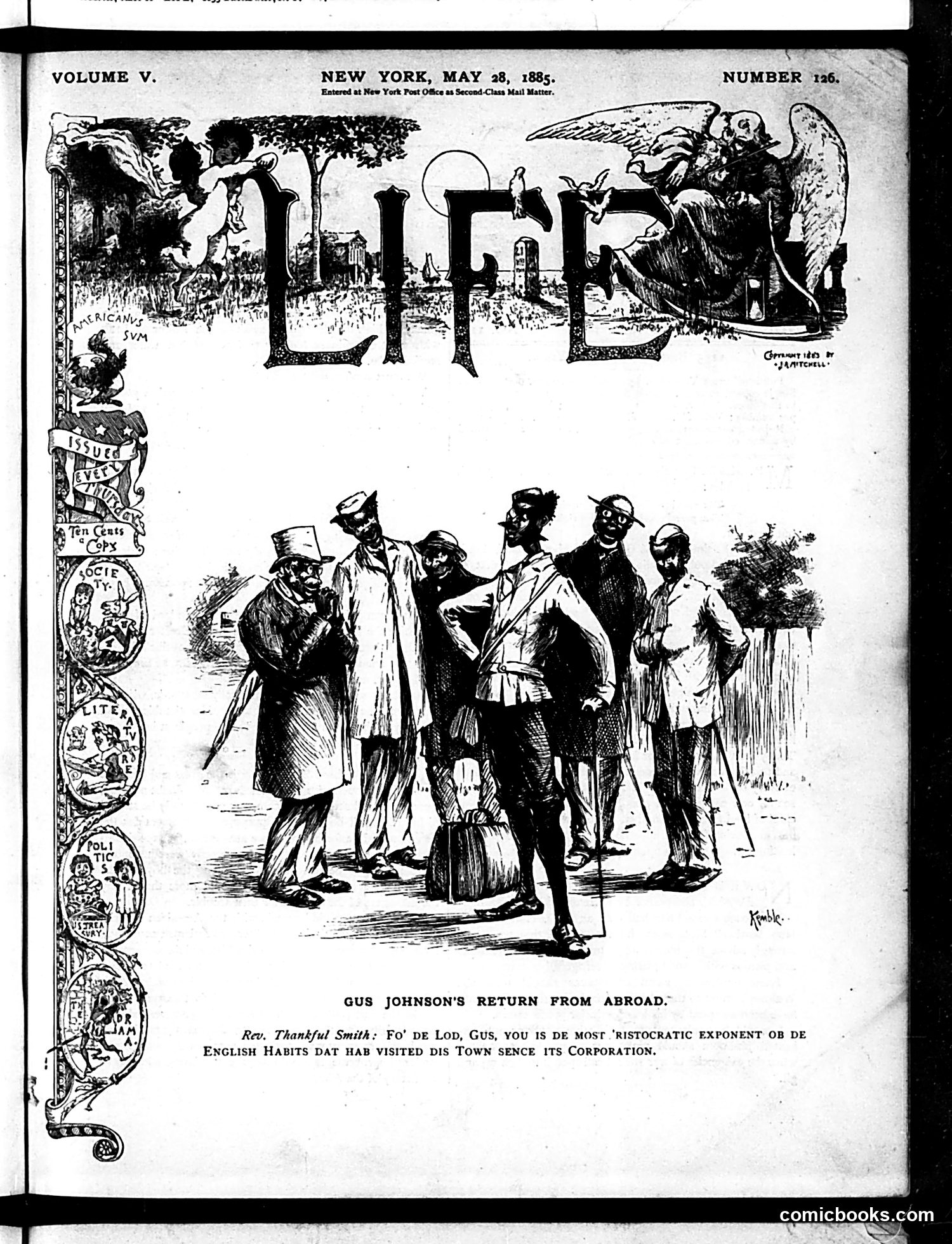
This 1885 *Life* cartoon satirizes a character named Gus Johnson returning from travel in England. The caption quotes Reverend Thankful Smith mocking Johnson as "de most 'ristocratic exponent ob de English habits dat hab visited dis Town since its Corporation." The satire targets social pretension—Johnson apparently adopted affected English mannerisms abroad and now displays them ostentatiously upon his return. The reverend's dialect-heavy speech (characteristic of period satire) suggests Johnson is ridiculous for aping European aristocratic behavior while remaining an American small-town resident. The gathering of onlookers appears to witness Johnson's affected performance, making him an object of community mockery for his transparent social climbing and borrowed affectations.
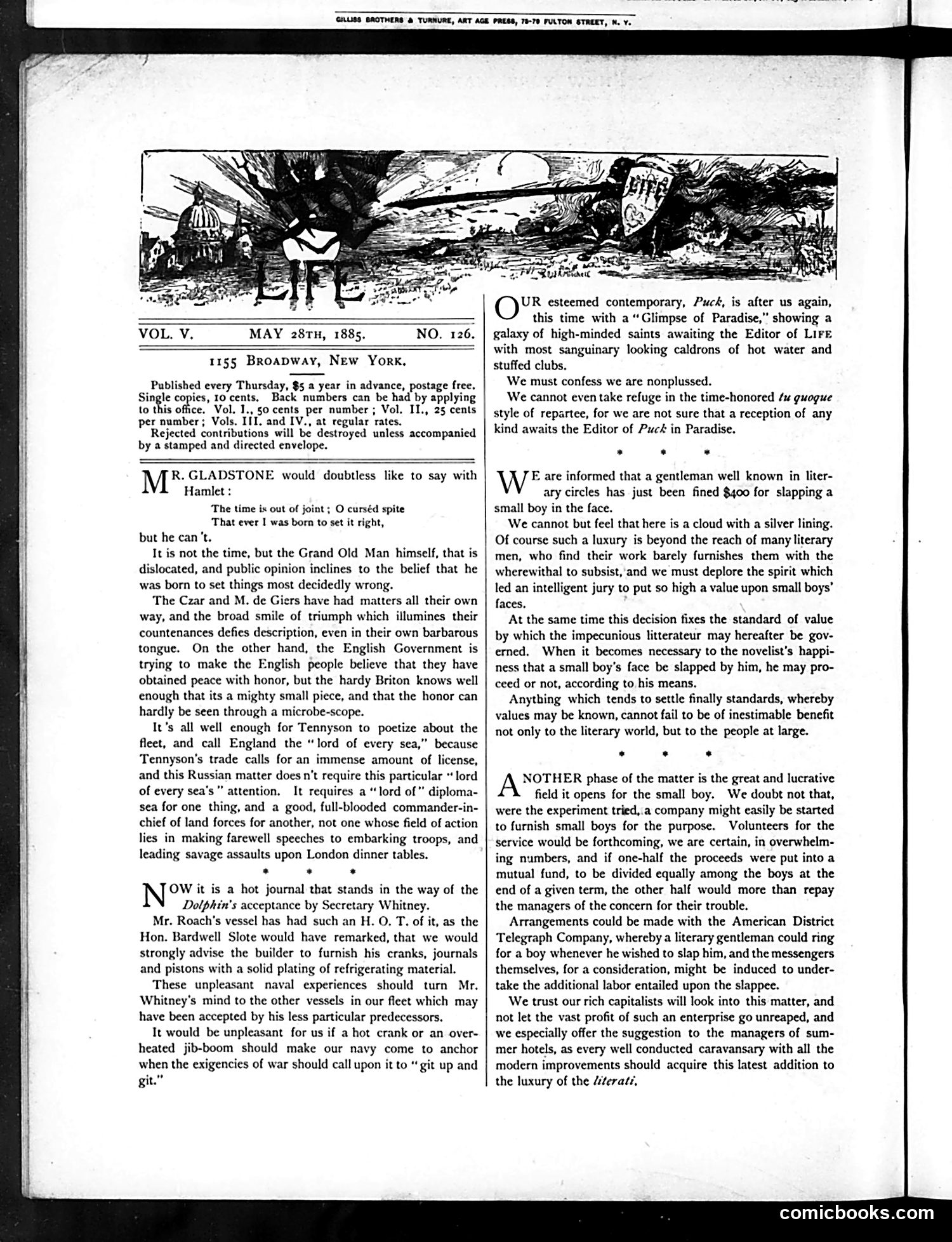
The page contains editorial commentary rather than cartoons. The visible illustration at top appears to be a decorative header showing a nighttime scene. The text mocks rival satirical magazine *Puck* for its sanctimonious editorial tone. Life's editors sarcastically criticize *Puck*'s self-righteous stance, suggesting the magazine presents itself as morally superior while lacking genuine insight. The remaining editorial sections discuss unrelated political matters: criticism of Mr. Gladstone's government, commentary on British foreign policy versus English public opinion, and discussion of a court case involving a boy being slapped—used to debate standards of social value and propriety. The tone is characteristic of 19th-century magazine rivalry, with *Life* positioning itself as the more honest, less pretentious satirical voice.
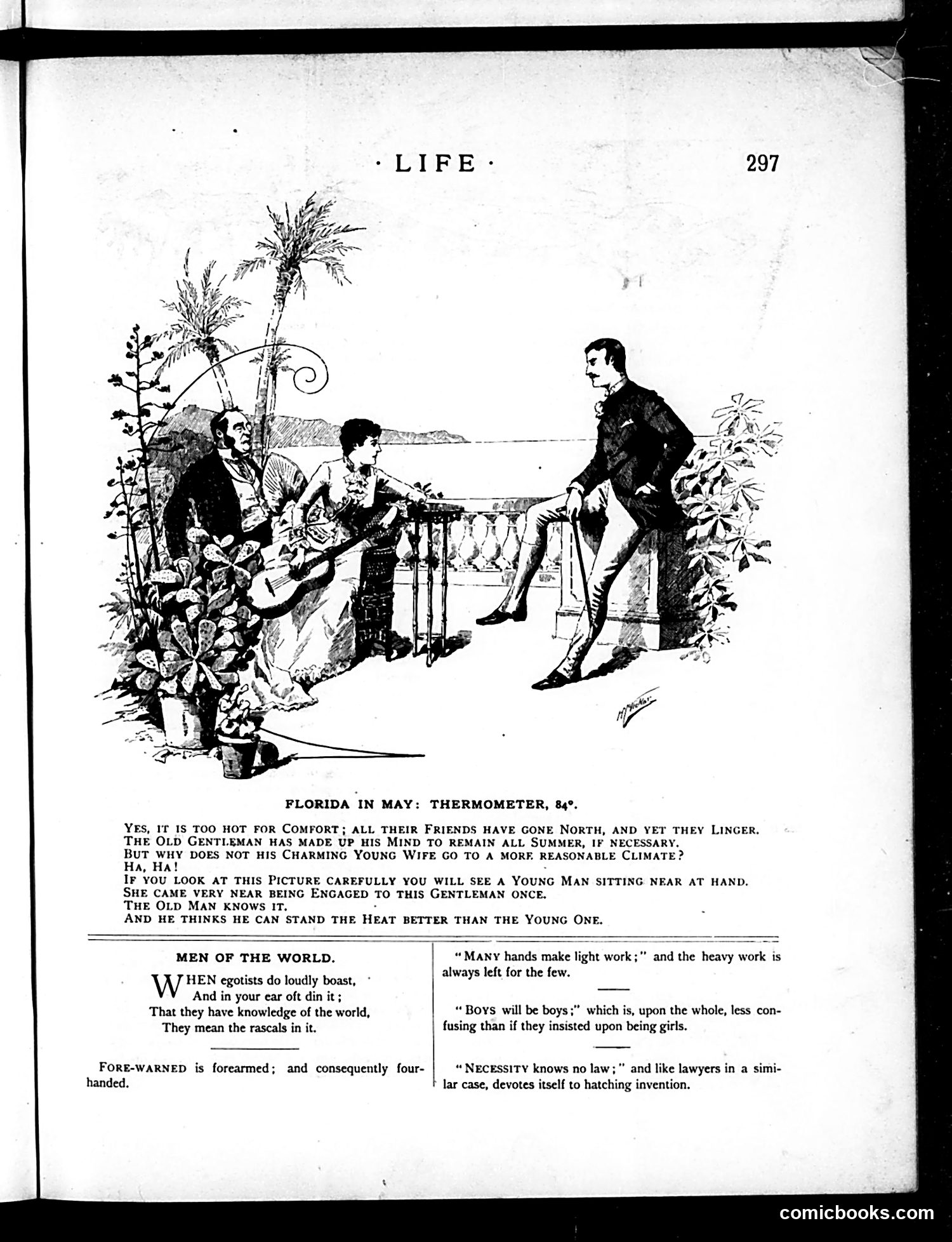
This page contains a satirical illustration titled "Florida in May: Thermometer, 84°" depicting three men in tropical Florida heat. The caption's humor hinges on contrasting attitudes toward summer climate: an older gentleman insists on staying in sweltering Florida despite friends departing north, while a younger married man seeks cooler locations with his wife. The illustration shows the young man appearing uncomfortable in the heat, while the older gentleman seems unbothered—suggesting masculine pride or stubbornness about enduring discomfort. The text below includes philosophical quips about human nature and gender differences ("Boys will be boys"). The satire mocks both masculine vanity and social class distinctions regarding leisure travel—a contemporary concern for early-20th-century American readership familiar with seasonal migrations among the wealthy.
The top of the page features a decorative header with animals and the text "BY THE WAY" — a standard satirical section header for Life magazine. The left column contains a poem titled "JUNE APPROACHETH," offering humorous seasonal observations about summer activities and weather in New York City, referencing locations like Central Park and Coney Island. The right column consists of brief satirical commentary on contemporary issues: Cleveland's difficulty appointing a Port Collector; criticism of Cleveland's handling of a "Tribune of the People" biographer; commentary on French political conditions; and discussion of labor disputes and police conduct in Yonkers. The bottom addresses biblical scholarship debates regarding Old Testament revisers' work on Solomon narratives. This appears to be a miscellaneous commentary page rather than single political cartoon.
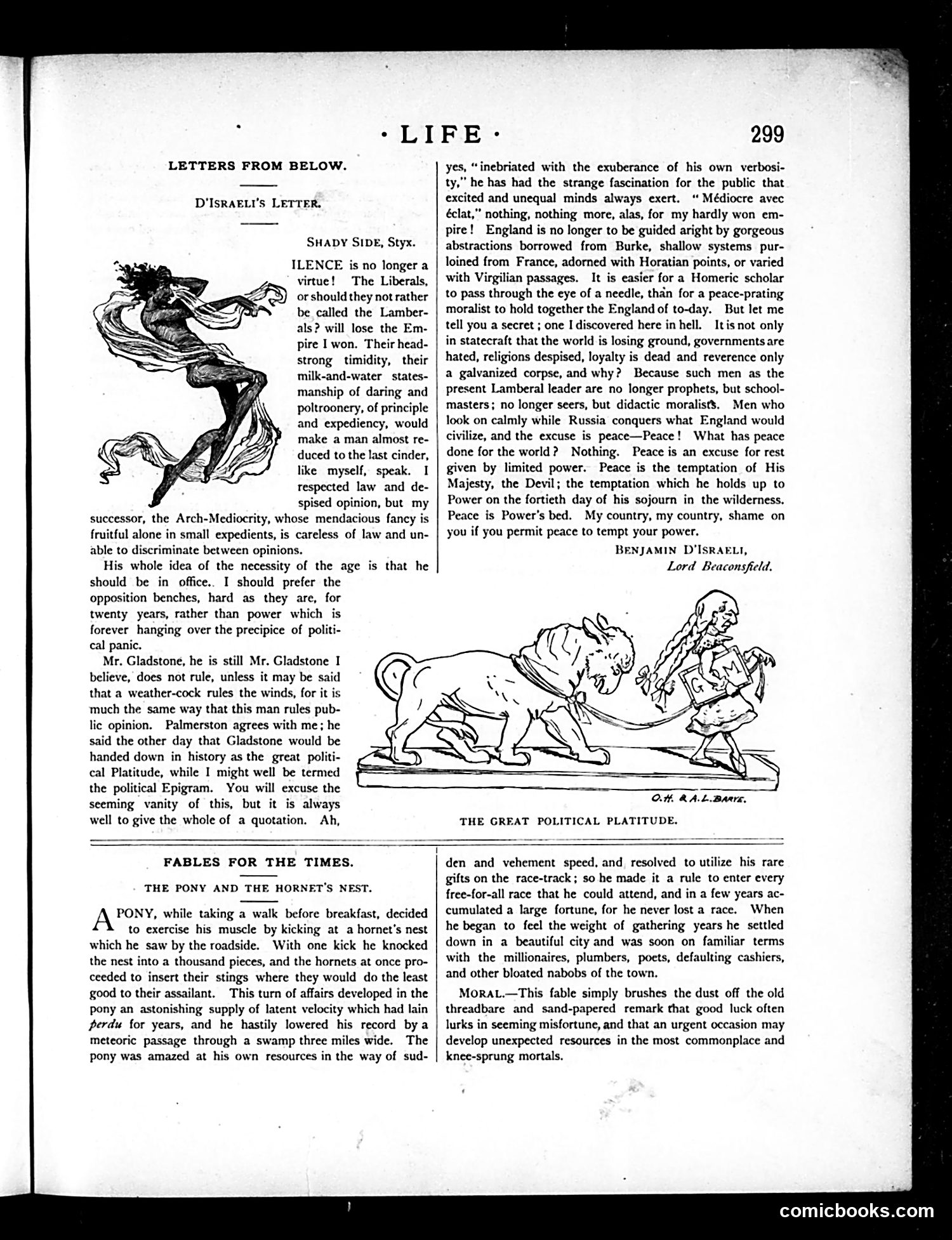
The cartoon depicts a large elephant (the Republican Party symbol) defecating on a small, cowering human figure labeled as a political opponent. The image illustrates D'Israeli's letter criticizing England's Liberal leadership under the Lambertsey (likely Palmerston), whom the author views as ineffectual. The satire targets what D'Israeli calls the "Great Political Platitude"—politicians who offer empty rhetoric and grand ideals (like peace) while wielding no real power. The elephant represents conservative political dominance literally trampling progressive opposition. The fable below reinforces this theme: apparent misfortune can reveal unexpected resources in ordinary people, contrasting with the platitudinous posturing of political elites.
This page contains literary criticism and book reviews rather than political cartoons. The main content includes: 1. **"At the Opera"** - A poem by T.A. Macon describing an opera attendee's experience, focusing on aesthetic observations rather than satire. 2. **"Dr. Hammond's Third Novel"** - A book review discussing William A. Hammond's novel "Mr. Oldmixon," praising its psychological depth and analysis of crime and heredity. The review emphasizes the work's literary merit and the author's background as a physician-writer. 3. **"Books Received"** - A listing of recently published titles across various genres. 4. **A brief anecdote** at bottom about a father teaching his son through corporal punishment. No political cartoons or satirical illustrations are present on this page.
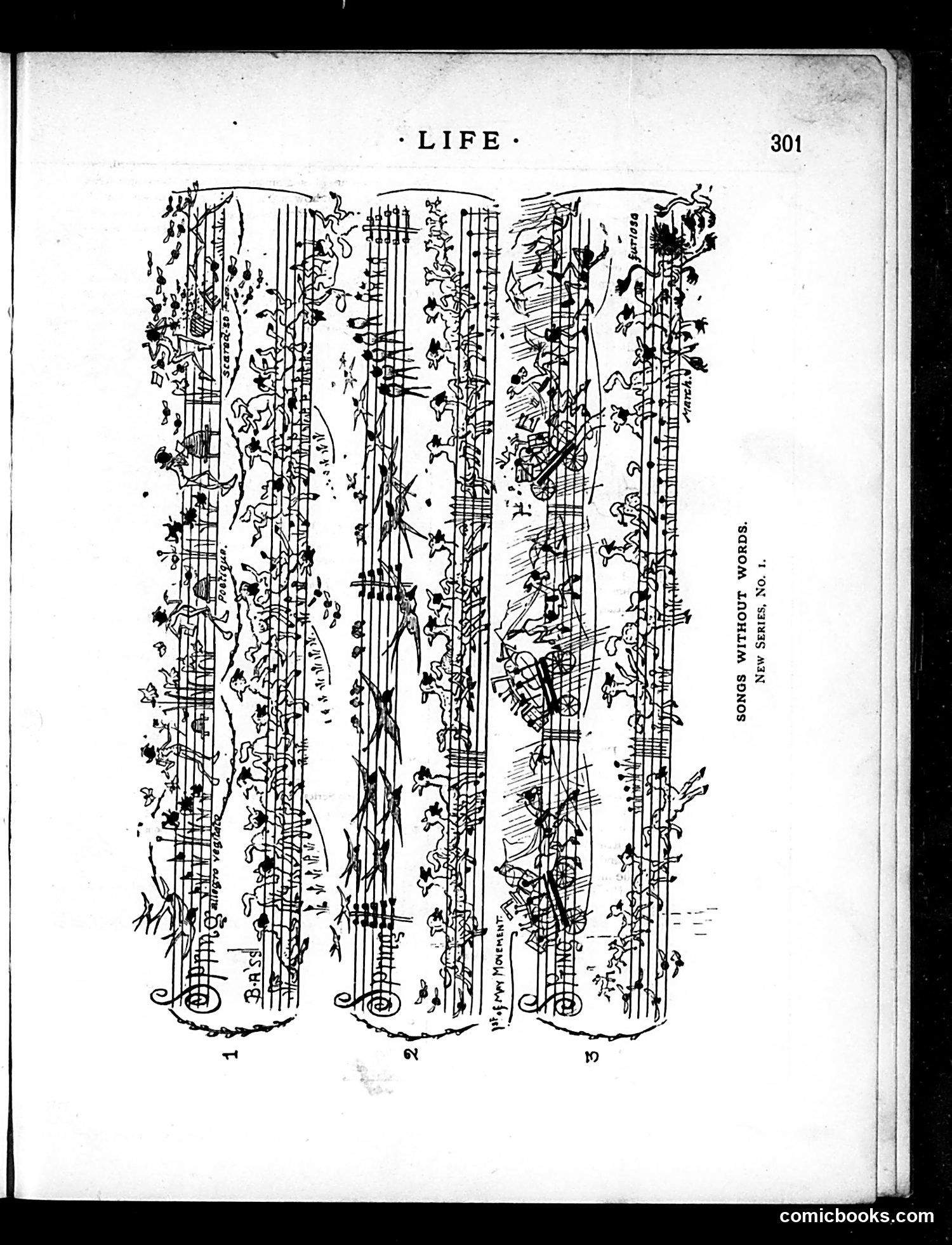
This page shows three vertical musical staff systems labeled "BOARDS WITHOUT WORDS" subtitled "New Series, No. 1." The image is a visual pun combining sheet music notation with illustrated figures performing various activities—climbing ladders, gesturing, interacting—all integrated into the musical staffs themselves. The joke appears to be a play on the term "boards" (theatrical stages) and "without words" (silent performance). Rather than traditional lyrics or narrative, the cartoon uses only musical notation and visual action to tell a story. This likely satirizes contemporary silent theater, vaudeville, or musical performance of the era, suggesting that elaborate physical comedy could replace conventional dialogue or plot. The specific satirical target remains unclear from the image alone.
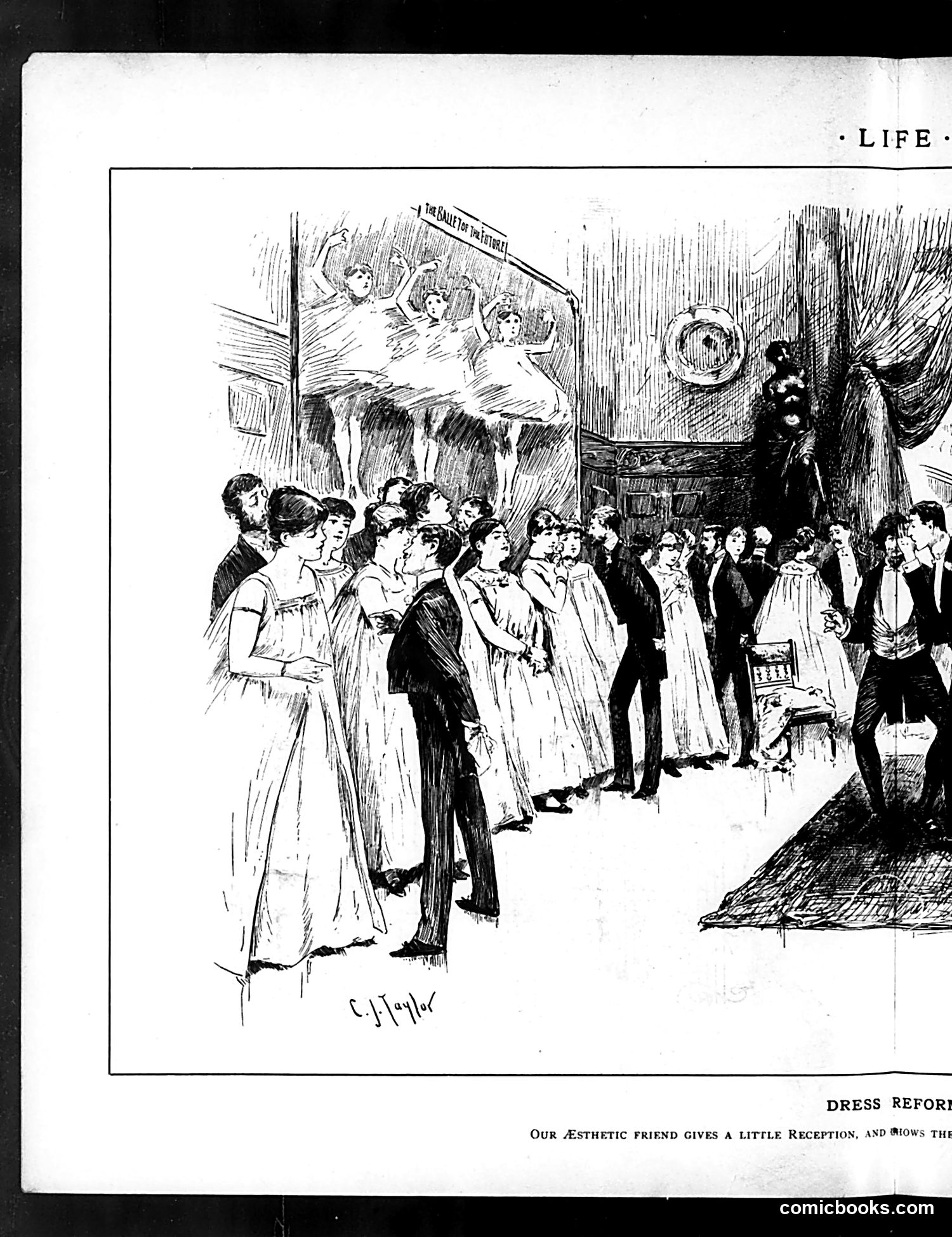
This satirical illustration depicts a social controversy from the late 19th or early 20th century regarding women's clothing reform. The caption reads "Our Aesthetic friend gives a little Reception, and Shows the Dresses" (text partially cut off). The cartoon mocks an "aesthetic" advocate—likely someone promoting looser, more practical women's clothing as an alternative to restrictive Victorian corsets and fashions. The illustration shows a gathering where women in flowing, loose gowns are displayed to observers, suggesting the reformer is promoting these garments. The satire appears to ridicule dress reformers as pretentious or eccentric, presenting their alternative clothing styles as objects of curiosity or mockery rather than legitimate practical improvements. This reflects the era's resistance to women's clothing reform movements.
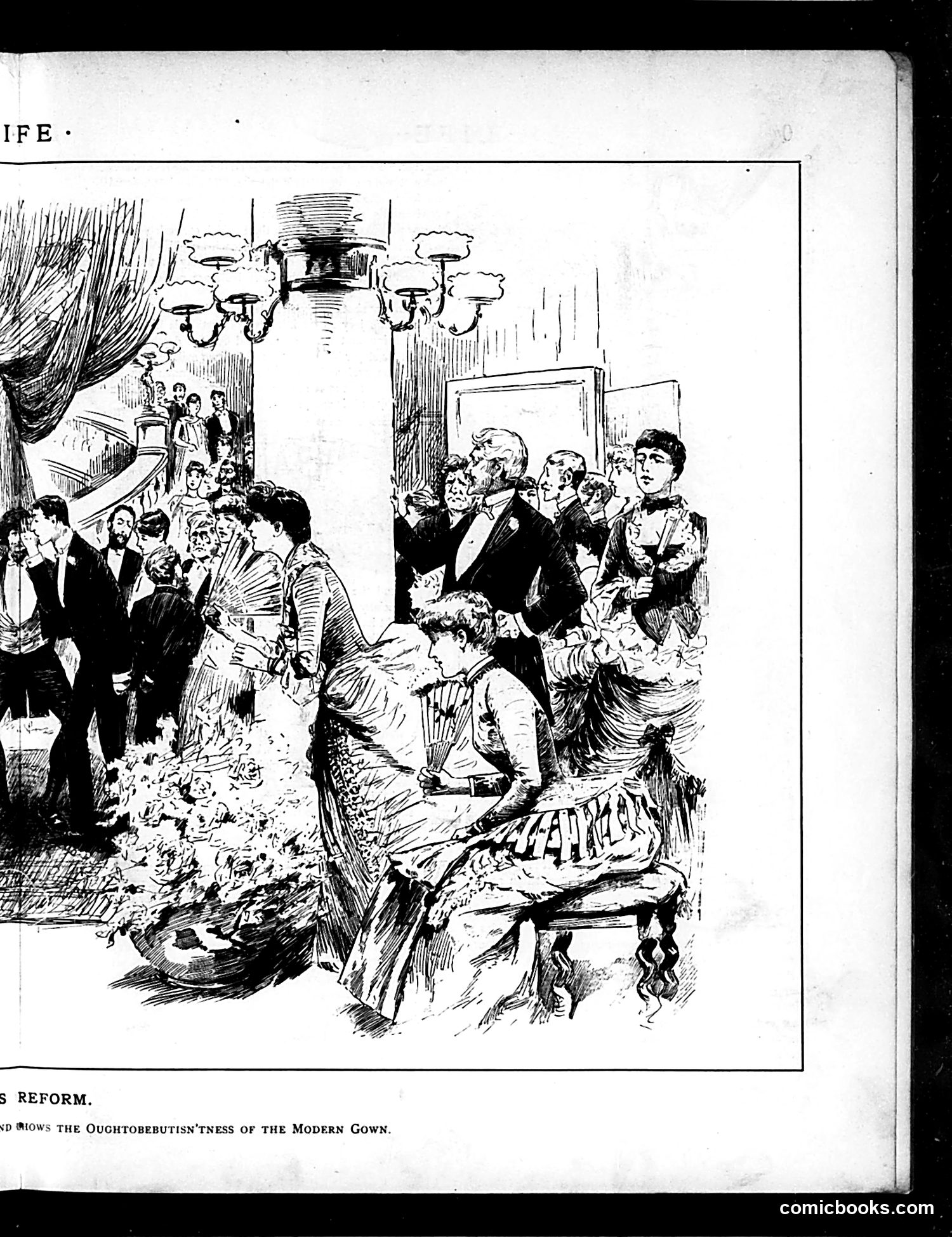
This cartoon satirizes late 19th/early 20th-century debates about women's fashion, specifically the excessively tight corsetry of the era. The caption references "reform" and critiques the "oughtobe-ness of the modern gown." The scene depicts an elegant social gathering where a woman seated prominently displays an extremely voluminous, billowing skirt—likely exaggerated for comedic effect. The standing figures around her appear shocked or disapproving, suggesting the cartoon mocks either: 1. The absurdity of contemporary fashion excess, or 2. Radical dress reform proposals that went too far in the opposite direction. The elaborate chandelier and formal setting emphasize the social pretension surrounding fashion anxieties. The satire likely targets fashion reformers or the impractical nature of women's clothing regardless of style choices.
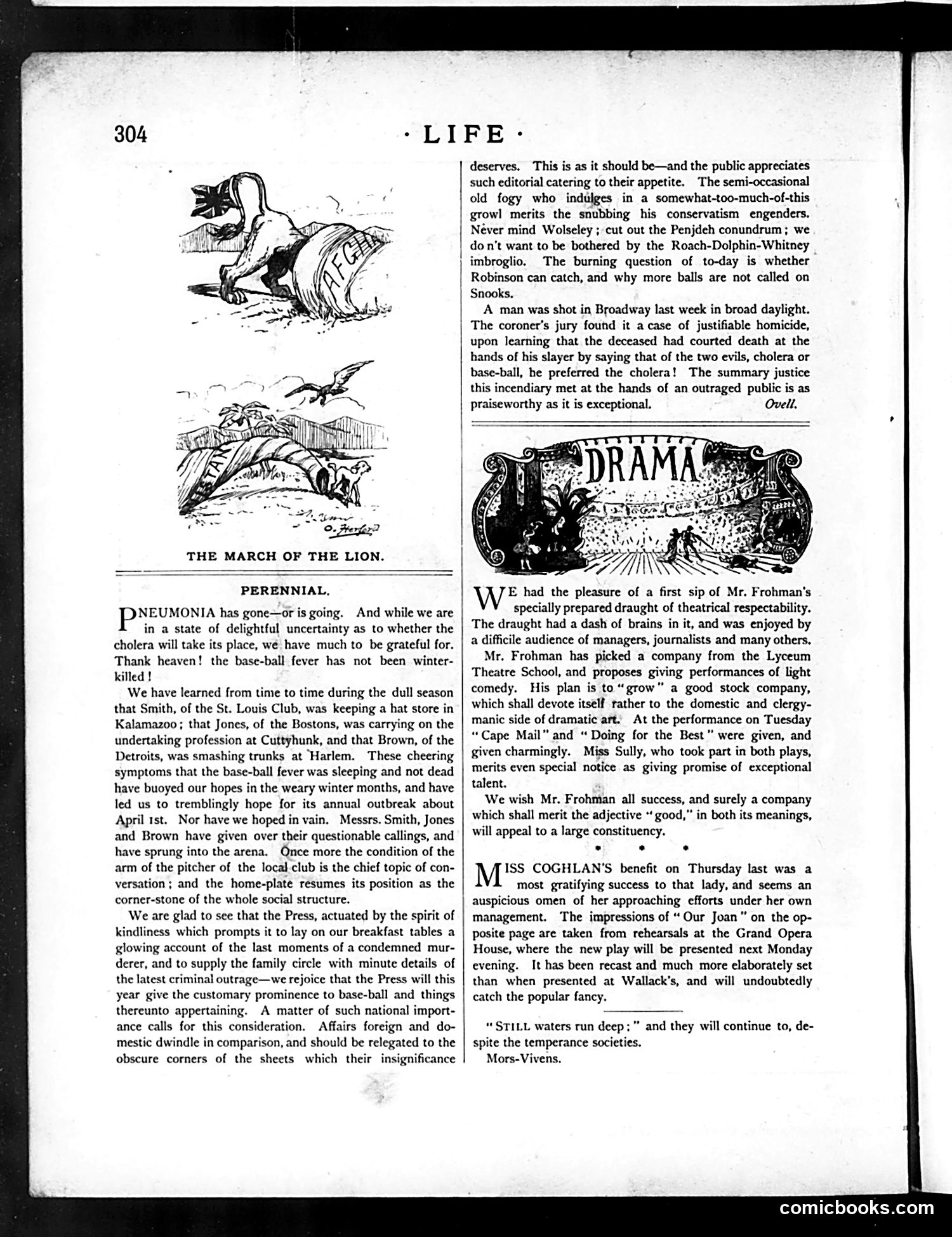
This page contains satirical baseball commentary wrapped in mock-serious social critique. The cartoons illustrate a lion (labeled "The March of the Lion") and appear decorative rather than politically specific. The text mocks American society's obsession with baseball, sarcastically praising newspapers for prioritizing baseball coverage over serious national and international affairs. It dismissively references real political issues—Wolseley (British military figure), the "Penjdeh conundrum" (Anglo-Russian Central Asian dispute), and the "Roach-Dolphin-Whitney imbroglio" (unclear local matter)—suggesting they deserve less attention than whether pitcher "Robinson can catch." A darkly humorous anecdote describes a man killed for preferring cholera to baseball, deemed "justifiable homicide" by the public. The page also reviews Mr. Frohman's new theatrical company and Miss Coghlan's benefit performance, typical Life magazine cultural coverage. The satire critiques American priorities and media sensationalism while celebrating baseball's grip on public consciousness.
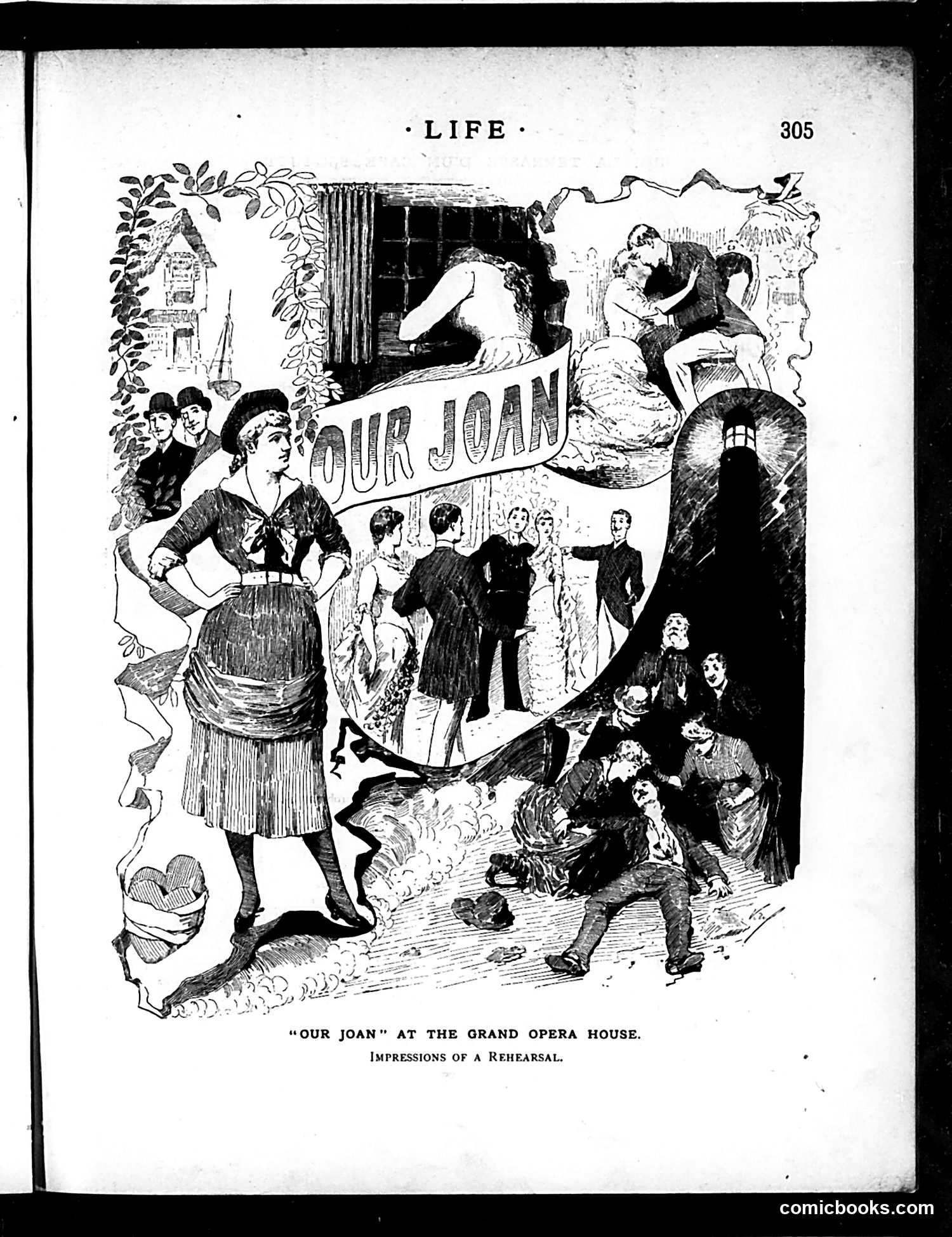
This satirical illustration depicts a theatrical rehearsal, likely for a production titled "Our Joan" (the banner visible in the image). The cartoon shows various figures in a performance space: a prominently featured woman in period costume on the left, performers on stage, and what appears to be an audience or cast members observing below. The satire appears to target theatrical production—possibly mocking amateur dramatics, overly ambitious productions, or the chaos of stage rehearsals. The subtitle "Impressions of a Rehearsal" suggests the humor lies in capturing the backstage disorder and pretension common to theater productions of the era. Without additional context about the specific production or date, the exact target remains unclear, though the general mockery of theatrical culture and its participants is evident.
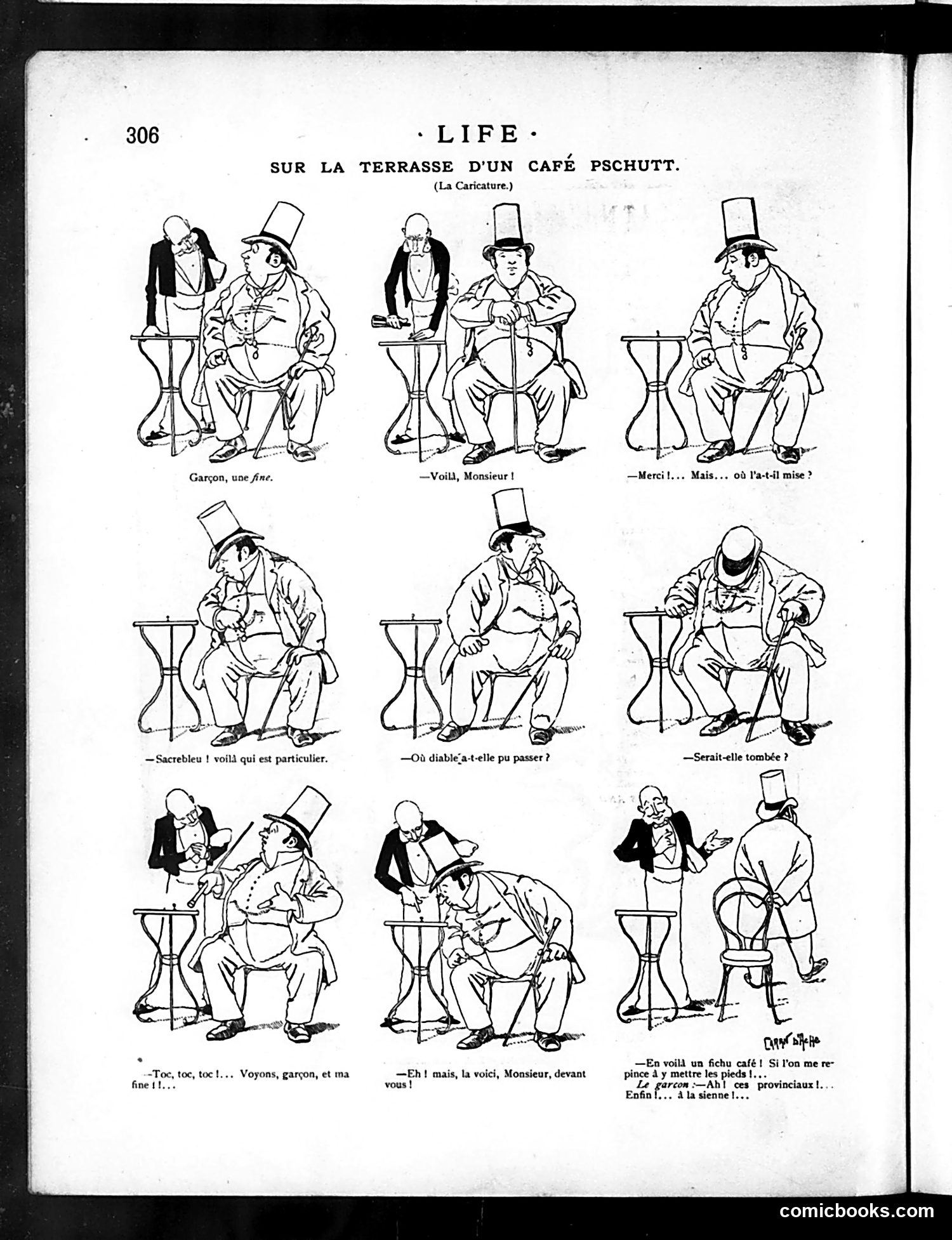
This is a French-language satirical comic from *Life* magazine showing "Life on the Terrace of a Pschutt Café" (Pschutt being a popular French beer brand). The nine-panel sequence depicts a conversation between a well-dressed Parisian waiter and a provincial customer at a café table. The humor centers on class and regional stereotypes: the customer complains about the café's quality ("What a lousy café!"), while the waiter dismissively remarks about provincial visitors ("Ah, these provincials!..."). The comic mocks the snobbish Parisian attitude toward country visitors and their perceived unsophistication. The exaggerated body language and costume (top hats) emphasize the social pretension on both sides of the encounter. It's typical satirical commentary on French urban-rural cultural divides of the period.
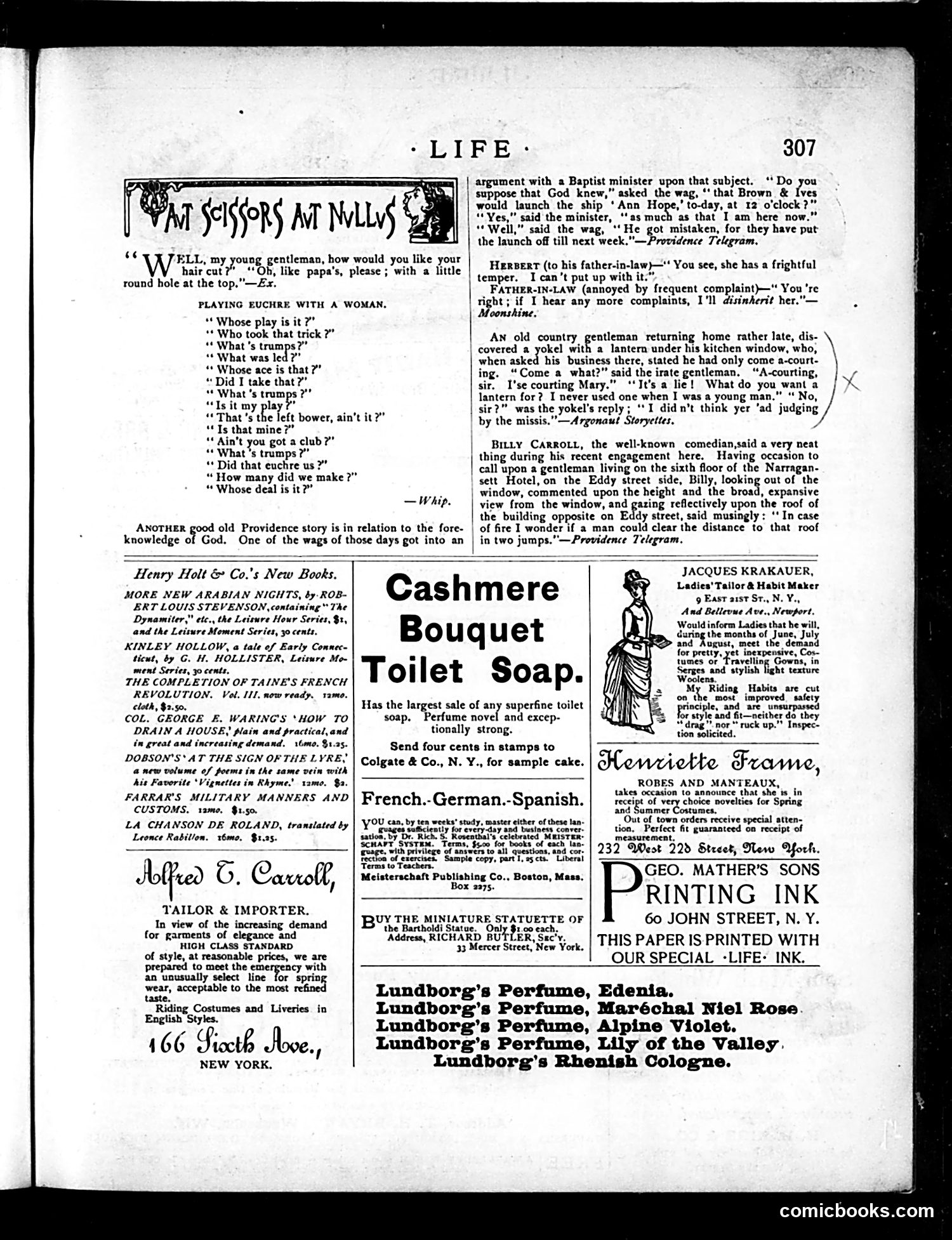
This page contains three main joke sections satirizing everyday social situations: **"Scissors at Nulls"** mocks a barber's predictable small talk—a young customer wants a haircut like his father's "with a little round hole at the top," implying the father is bald. **"Playing Euchre with a Woman"** lists repetitive questions card players ask during games, satirizing how women supposedly dominate conversation and distract from play. **"Providence Stories"** includes two anecdotes: one about predestination theology being debated regarding a ship launch, and another about a country yokel courting a girl with a lantern, which the girl's father misinterprets as suspicious. The page is primarily **advertisements** for books, tailoring services, perfume, soap, and language courses—typical of Life magazine's business model. The humor reflects late-19th-century American attitudes toward gender roles, rural/urban class differences, and domestic life.
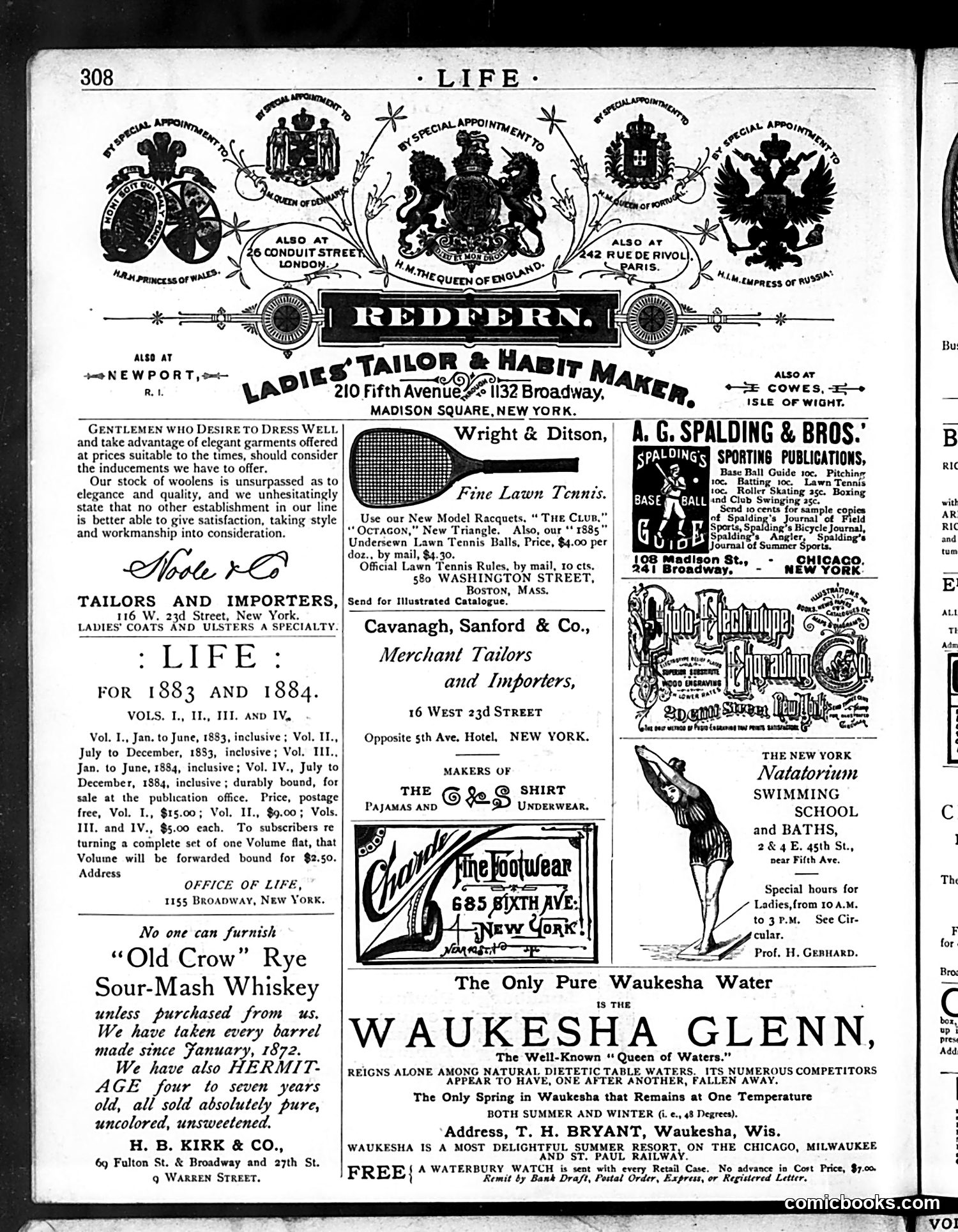
This is primarily a **commercial advertising page**, not a political cartoon or satirical content. The page consists entirely of advertisements for luxury goods and services aimed at wealthy Americans in the Gilded Age. Notable advertised goods include: - **Redfern**: High-end tailoring with locations in New York, Newport, and Paris—catering to America's elite social circuit - **Lawn tennis equipment**: Wright & Ditson promote "The Club" racquet and official rules, reflecting tennis's status as an exclusive upper-class sport - **Fine woolens and tailoring**: Multiple merchant tailors advertise bespoke services - **Waukesha Glenn water**: Mineral water marketed as a natural health product - **Swimming school**: Offering ladies' special hours, indicating gender-separated leisure activities The page reflects **no satire or political content**—it simply documents 1880s consumer culture among the wealthy: fashionable dress, athletic pursuits, and branded wellness products were status markers. The advertisements' emphasis on imported goods and exclusive locations reinforces class divisions of the era.
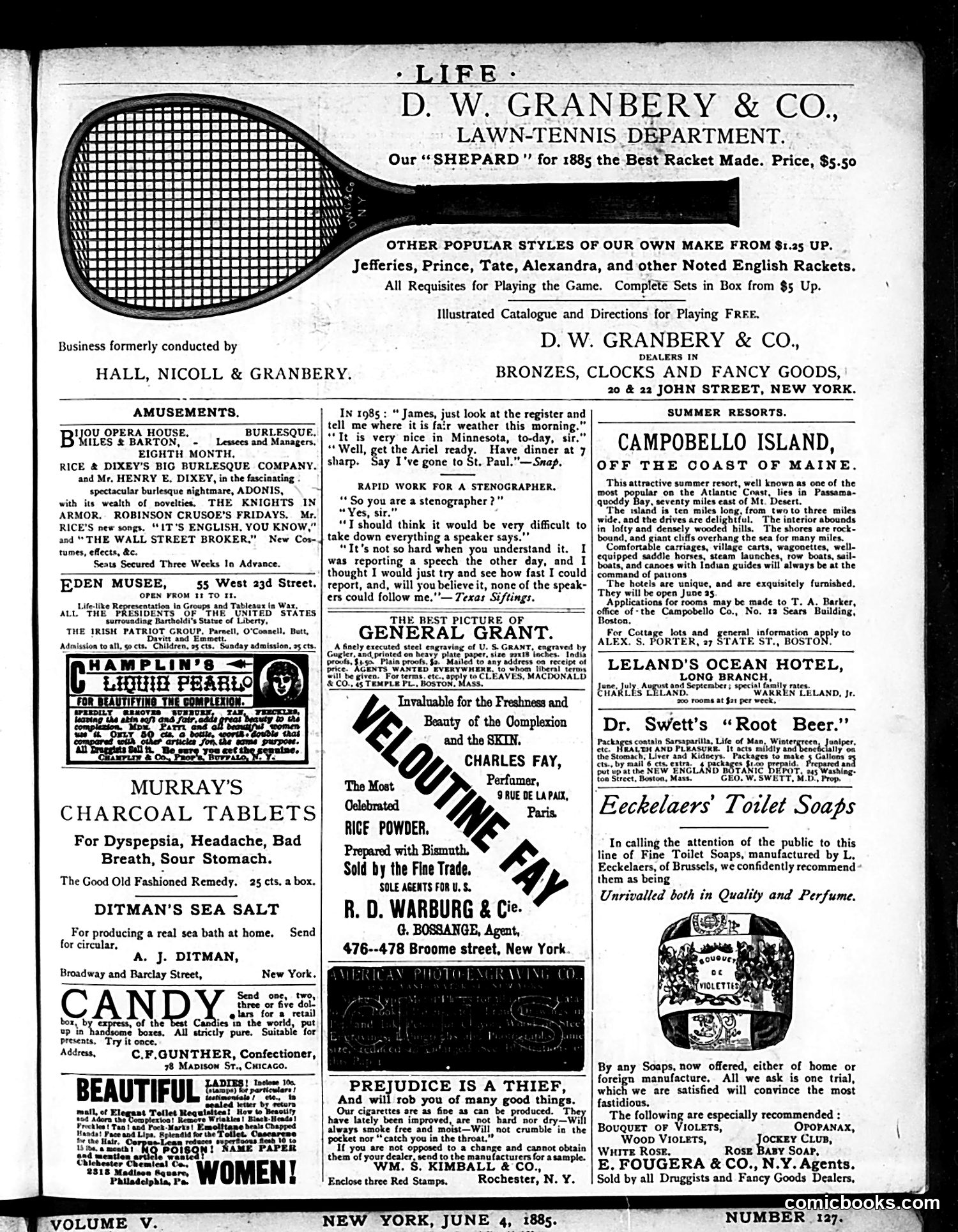
This is primarily an advertising page from Life magazine (June 4, 1885), with minimal satirical content. The page features commercial advertisements for lawn tennis equipment, theater productions, patent medicines, soaps, and cigarettes. The few humor pieces present are brief comedic anecdotes rather than political cartoons. One joke depicts a stenographer boasting he can write so fast that speakers cannot follow him—satirizing stenographic speed-writing competition of the era. Another brief sketch plays on Minnesota weather references and rail travel logistics. The advertisements themselves reflect 1885 consumer culture: Granbery & Co.'s tennis rackets ($5.50), burlesque theater productions, wax museums, charcoal digestive tablets, and cosmetics like "Heloutine" face powder. A notable ad for Kimball cigarettes uses "Prejudice is a Thief" as its slogan, attempting to overcome consumer resistance to the product. The page contains no identifiable political cartoons or caricatures of public figures.
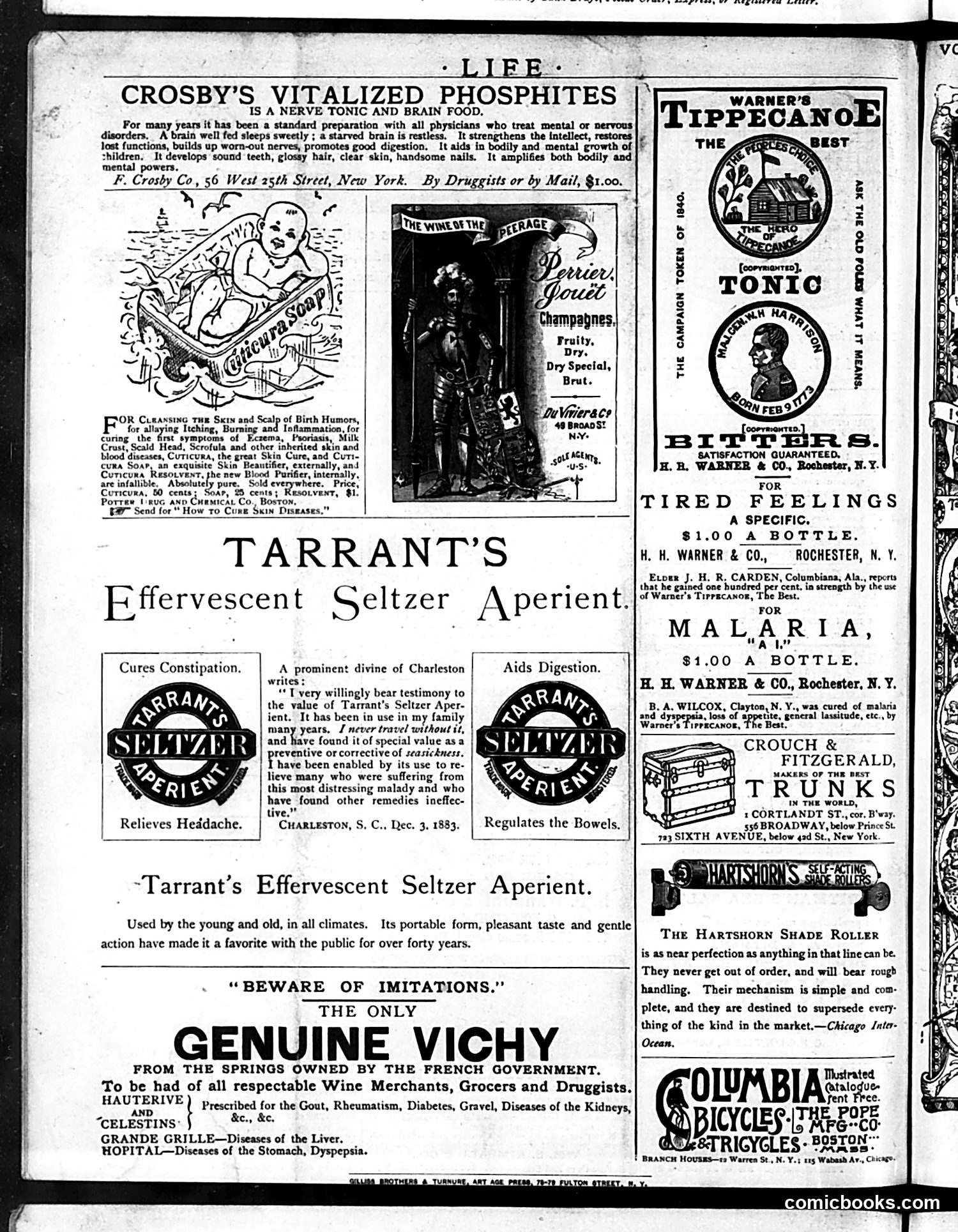
This page consists primarily of **patent medicine advertisements**—a common feature in late-19th-century American publications. There is no political cartoon or satire here; rather, it's a collection of commercial ads for dubious health products. The advertisements promote various remedies claiming to cure ailments ranging from constipation and malaria to "tired feelings" and skin diseases. Products like **Crosby's Vitalized Phosphites** (a "nerve tonic"), **Tarrant's Seltzer Aperient**, and **Warner's Tippecanoe** made extravagant medical claims without scientific basis. The page also advertises legitimate commercial goods—trunks, bicycles, and window shade rollers—interspersed with the medicine ads. For modern readers, this reflects an era before FDA regulation when unproven products could make any health claim. The testimonials from unnamed customers or clergy were typical marketing tactics. This represents a now-illegal but historically common form of commercial deception.