
Life, 1885-05-28 · page 6 of 16
Life — May 28, 1885 — page 6: what you’re looking at
What you’re looking at
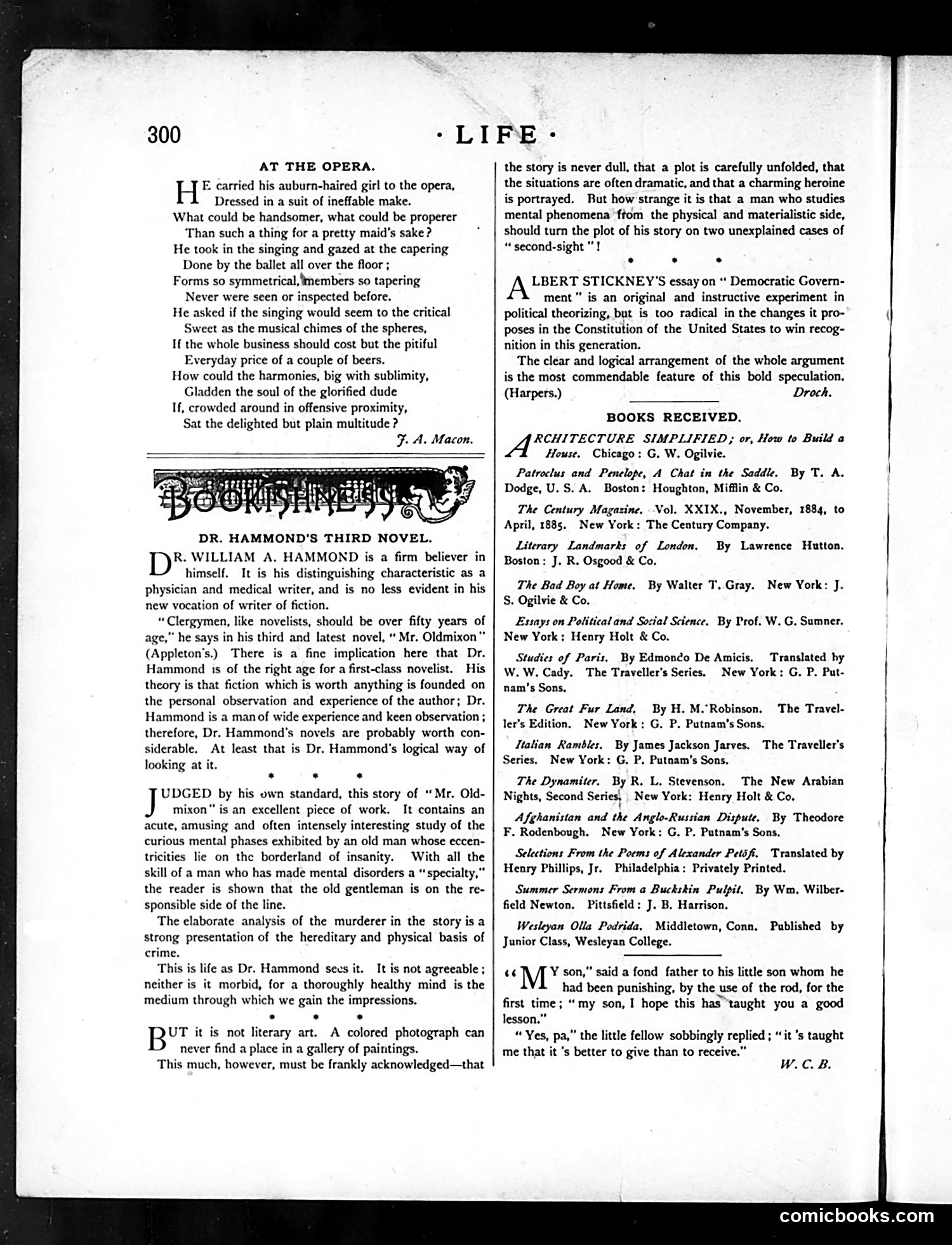
This page contains literary criticism and book reviews rather than political cartoons. The main content includes: 1. **"At the Opera"** - A poem by T.A. Macon describing an opera attendee's experience, focusing on aesthetic observations rather than satire. 2. **"Dr. Hammond's Third Novel"** - A book review discussing William A. Hammond's novel "Mr. Oldmixon," praising its psychological depth and analysis of crime and heredity. The review emphasizes the work's literary merit and the author's background as a physician-writer. 3. **"Books Received"** - A listing of recently published titles across various genres. 4. **A brief anecdote** at bottom about a father teaching his son through corporal punishment. No political cartoons or satirical illustrations are present on this page.
📄 Transcribed text from this page (OCR, searchable)
Machine-transcribed from the original scan — historical spelling and the odd misread are preserved.
300 AT THE OPERA. E carried his auburn-haired girl to the opera, Dressed in a suit of ineffable make. What could be handsomer, what could be properer Than such a thing for a pretty maid's sake? He took in the singing and gazed at the capering Done by the ballet all over the floor ; Forms so symmetrical, members so tapering Never were seen or inspected before. He asked if the singing would seem to the critical Sweet as the musical chimes of the spheres, If the whole business should cost but the pitiful Everyday price of a couple of beers. How could the harmonies, big with sublimity, Gladden the soul of the glorified dude If, crowded around in offensive proximity, Sat the delighted but plain multitude ? F. A. Macon, DR. HAMMOND'S THIRD NOVEL. R. WILLIAM A. HAMMOND is a firm believer in himself. It is his distinguishing characteristic as a physician and medical writer, and is no less evident in his new vocation of writer of fiction. “Clergymen, like novelists, should be over fifty years of age,” he says in his third and latest novel, “ Mr. Oldmixon” (Appleton’s.) There is a fine implication here that Dr. Hammond 1s of the right age for a first-class novelist. His theory is that fiction which is worth anything is founded on the personal observation and experience of the author; Dr. Hammond is a man of wide experience and keen observation ; therefore, Dr. Hammond's novels are probably worth con- siderable, At least that is Dr. Hammond's logical way of looking at it. . . . UDGED by his own standard, this story of “Mr. Old- J mixon” is an excellent piece of work. It contains an acute, amusing and often intensely interesting study of the curious mental phases exhibited by an old man whose eccen- tricities lie on the borderland of insanity. With all the skill of a man who has made mental disorders a “specialty,” the reader is shown that the old gentleman is on the re- sponsible side of the line. The elaborate analysis of the murderer in the story is a strong presentation of the hereditary and physical basis of crime. This is life as Dr. Hammond sevs it. It is not agreeable ; neither is it morbid, for a thoroughly healthy mind is the medium through which we gain the impressions. . . * UT it is not literary art. A colored photograph can never find a place in a gallery of paintings. This much, however, must be frankly acknowledged—that - LIFE: the story is never dull, that a plot is carefully unfolded, that the situations are often dramatic, and that a charming heroine is portrayed. But how strange it is that a man who studies mental phenomena ‘ftom the physical and materialistic side, should turn the plot of his story on two unexplained cases of “ second-sight "! . . . LBERT STICKNEY’S essay on ** Democratic Govern- ment” is an original and instructive experiment in political theorizing, but is too radical in the changes it pro- poses in the Constitution of the United States to win recog- nition in this generation, The clear and logical arrangement of the whole argument is the most commendable feature of this bold speculation. (Harpers.) Droch. BOOKS RECEIVED. RCHITECTURE SIMPLIFIED; or, How to Build a House, Chicago: G, W. Ogilvie. Patroclus and Penelope, A Chat in the Saddle, By T. A. Dodge, U.S. A. Boston: Houghton, Mifflin & Co. The Century Magazine, Vol. XXIX., November, 1884, to April, 1885, New York: The Century Company. Literary Landmarks of London. Boston: J. R. Osgood & Co, By Walter T..Gray. New York: J. By Lawrence Hutton. The Bad Boy at Home. S. Ogilvie & Co. Essays on Political and Social Science, By Prof. W. G. Sumner. New York: Henry Holt & Co. Studies of Paris, By Edmondo De Amicis. Translated by W. W. Cady. The Traveller's Series, New York: G. P. Put- nam’s Sons, The Great Fur Land, By H. M. Robinson. ler’s Edition, New York: G. P. Putnam's Sons. Malian Rambles, By James Jackson Jarves. The Traveller's Series. New York: G. P. Putnam's Sons. The Dynamiter. By R. L. Stevenson. The New Arabian Nights, Second Series New York: Henry Holt & Co, Afghanistan and the Anglo-Russian Dispute, By Theodore F. Rodenbough. New York: G. P. Putnam's Sons, Selections From the Poems of Alexander Petéfi. Translated by Henry Phillips, Jr. Philadelphia: Privately Printed. Summer Sermons From a Buckskin Pulpit, By Wm, Wilber- field Newton. Pittsfield: J. B. Harrison. The Travel- Wesleyan Olla Podrida. Middletown, Conn, Published by Junior Class, Wesleyan College. “cc Y son,” said a fond father to his little son whom he had been punishing, by the use of the rod, for the first time; “my son, I hope this has taught you a good lesson.” “Yes, pa,” the little fellow sobbingly replied ; “it’s taught me that it 's better to give than to receive.” WiC. B. comicbooks.com