
Life, 1885-05-28 · page 5 of 16
Life — May 28, 1885 — page 5: what you’re looking at
What you’re looking at
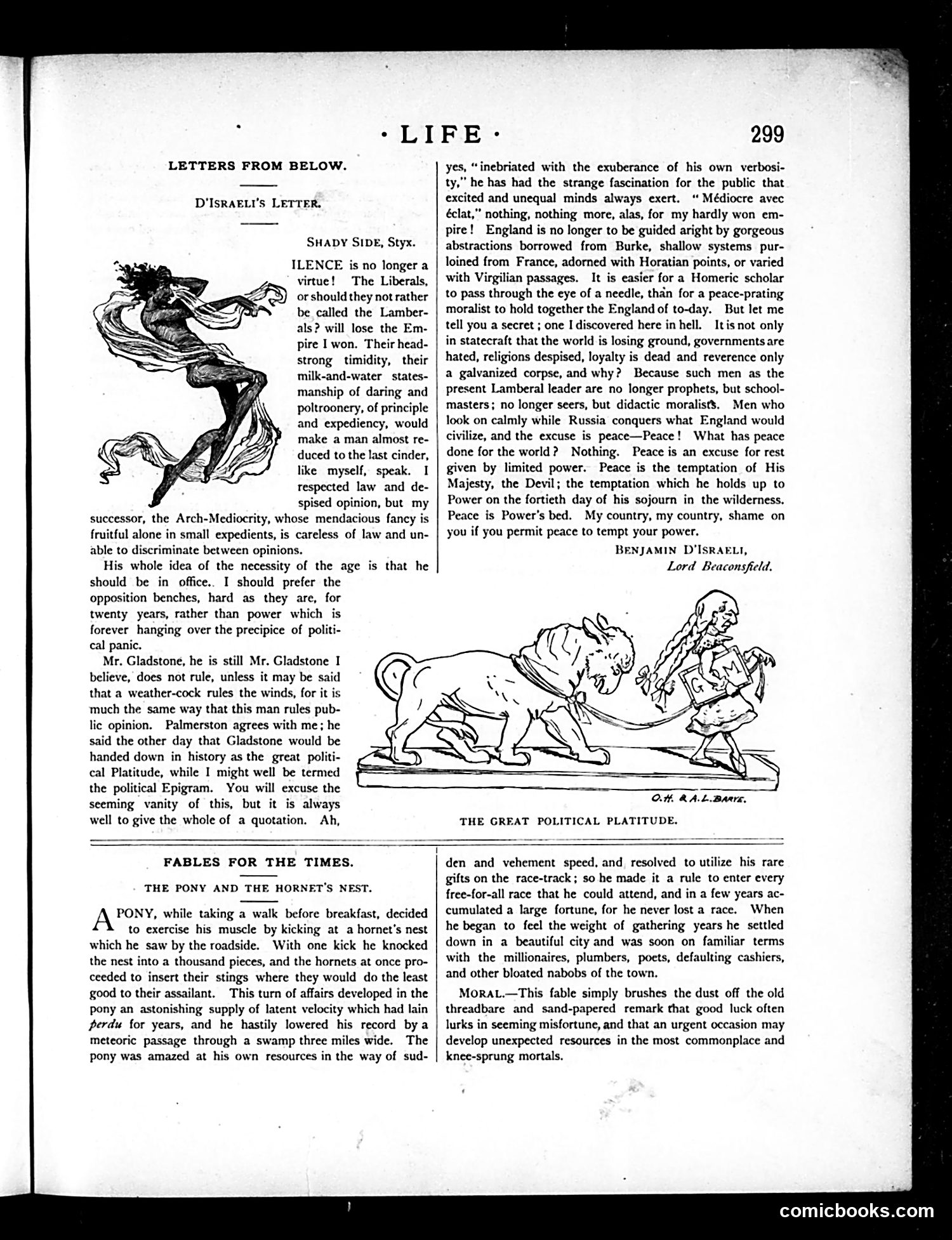
The cartoon depicts a large elephant (the Republican Party symbol) defecating on a small, cowering human figure labeled as a political opponent. The image illustrates D'Israeli's letter criticizing England's Liberal leadership under the Lambertsey (likely Palmerston), whom the author views as ineffectual. The satire targets what D'Israeli calls the "Great Political Platitude"—politicians who offer empty rhetoric and grand ideals (like peace) while wielding no real power. The elephant represents conservative political dominance literally trampling progressive opposition. The fable below reinforces this theme: apparent misfortune can reveal unexpected resources in ordinary people, contrasting with the platitudinous posturing of political elites.
📄 Transcribed text from this page (OCR, searchable)
Machine-transcribed from the original scan — historical spelling and the odd misread are preserved.
-LIFE: LETTERS FROM BELOW. D'IsRAELI’S LETTER. SHADY SIDE, Styx. ILENCE is no longer a virtue! The Liberals, or should they not rather be called the Lamber- als? will lose the Em- pire I won. Their head- | strong timidity, their milk-and-water states- | manship of daring and poltroonery, of principle and expediency, would make a man almost re- duced to the last cinder, like myself, speak. I respected law and de- spised opinion, but my successor, the Arch-Mediocrity, whose mendacious fancy is fruitful alone in small expedients, is careless of law and un- able to discriminate between opinions. His whole idea of the necessity of the age is that he should be in office. I should prefer the opposition benches, hard as they are, for twenty years, rather than power which is forever hanging over the precipice of politi- cal panic, Mr. Gladstone, he is still Mr. Gladstone I believe, does not rule, unless it may be said that a weather-cock rules the winds, for it is much the same way that this man rules pub- lic opinion. Palmerston agrees with me; he said the other day that Gladstone would be handed down in history as the great politi- cal Platitude, while I might well be termed 299 yes, “inebriated with the exuberance of his own verbosi- ty,” he has had the strange fascination for the public that excited and unequal minds always exert. “ Médiocre avec éclat,” nothing, nothing more, alas, for my hardly won em- pire! England is no longer to be guided aright by gorgeous abstractions borrowed from Burke, shallow systems pur- loined from France, adorned with Horatian points, or varied with Virgilian passages. It is easier for a Homeric scholar to pass through the eye of a needle, than for a peace-prating moralist to hold together the England of to-day. But let me tell you a secret ; one I discovered here in hell. It isnot only in statecraft that the world is losing ground, governments are hated, religions despised, loyalty is dead and reverence only a galvanized corpse, and why? Because such men as the present Lamberal leader are no longer prophets, but school- masters; no longer seers, but didactic moralist$. Men who look on calmly while Russia conquers what England would civilize, and the excuse is peace—Peace! What has peace done for the world? Nothing. Peace is an excuse for rest given by limited power. Peace is the temptation of His Majesty, the Devil; the temptation which he holds up to Power on the fortieth day of his sojourn in the wilderness. Peace is Power's bed. My country, my country, shame on you if you permit peace to tempt your power. BENJAMIN D'ISRAELI, Lord Beaconsfield. the political Epigram. You will excuse the seeming vanity of this, but it is always well to give the whole of a quotation. Ah, On, RAL.BARTE, THE GREAT POLITICAL PLATITUDE. FABLES FOR THE TIMES. THE PONY AND THE HORNET'S NEST. APO. while taking a walk before breakfast, decided to exercise his muscle by kicking at a hornet’s nest which he saw by the roadside. With one kick he knocked the nest into a thousand pieces, and the hornets at once pro- ceeded to insert their stings where they would do the least good to their assailant. This turn of affairs developed in the pony an astonishing supply of latent velocity which had lain perdu for years, and he hastily lowered his record bya meteoric passage through a swamp three miles wide. The pony was amazed at his own resources in the way of sud- den and vehement speed, and resolved to utilize his rare gifts on the race-track; so he made it a rule to enter every free-for-all race that he could attend, and in a few years ac- cumulated a large fortune, for he never lost a race. When he began to feel the weight of gathering years he settled down in a beautiful city and was soon on familiar terms with the millionaires, plumbers, poets, defaulting cashiers, and other bloated nabobs of the town, MoRAL.—This fable simply brushes the dust off the old threadbare and sand-papered remark that good luck often lurks in seeming misfortune, and that an urgent occasion may develop unexpected resources in the most commonplace and knee-sprung mortals. comicbooks.com