
A complete issue · 16 pages · 1885
Life — April 30, 1885
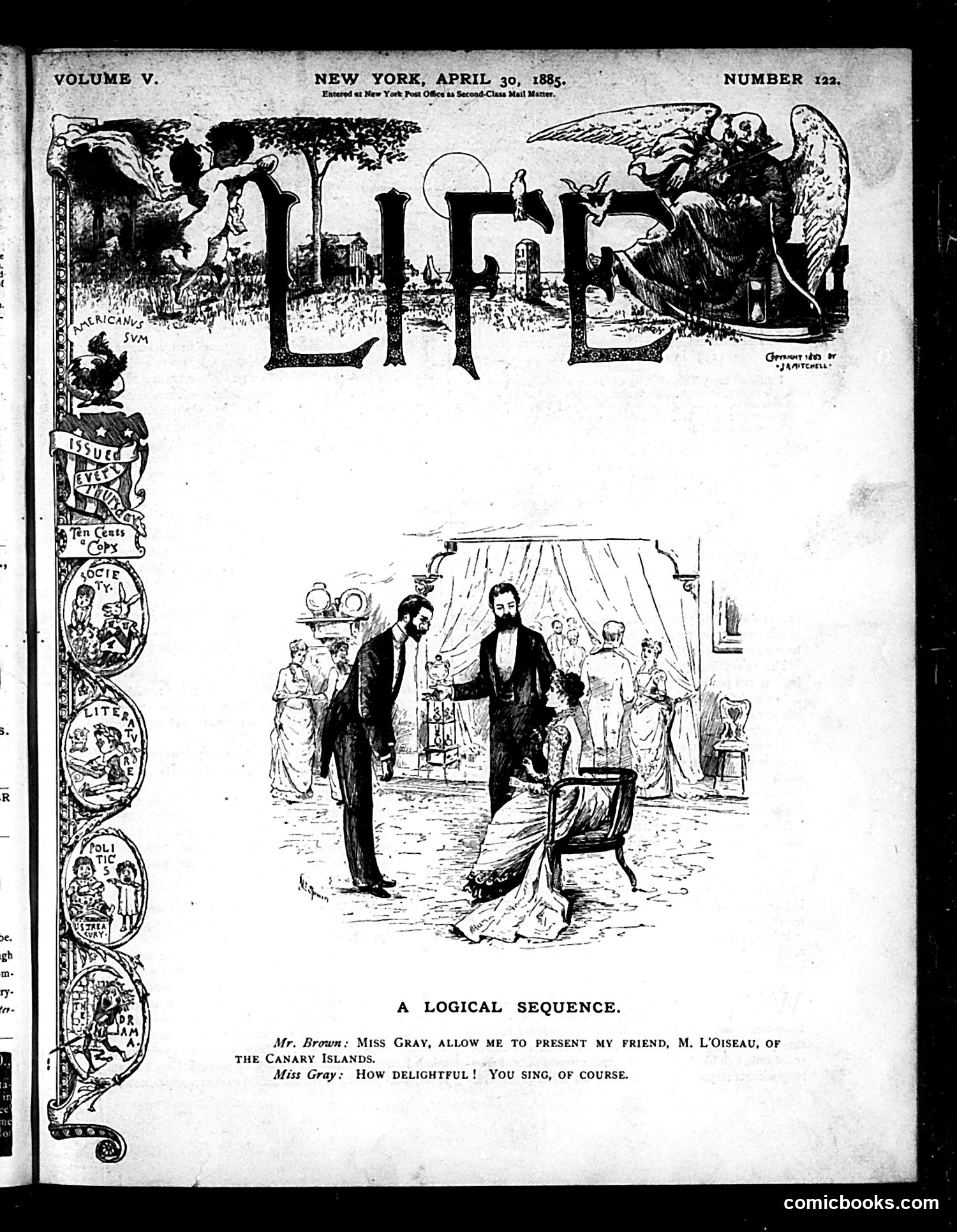
This cartoon satirizes social pretension and romantic courtship conventions of the 1880s. The sketch depicts a gentleman (Mr. Brown) introducing his friend M. L'Oiseau (whose name means "The Bird" in French—likely a satirical choice) to Miss Gray at what appears to be a formal social gathering. The humor lies in the "logical sequence" of the title: Miss Gray's enthusiastic response—"You sing, of course"—is presented as an absurdly predictable assumption. The satire mocks how Victorian society made assumptions about foreigners and how women were expected to possess decorative accomplishments like singing. The French name may also suggest mockery of Continental affectation among American high society.
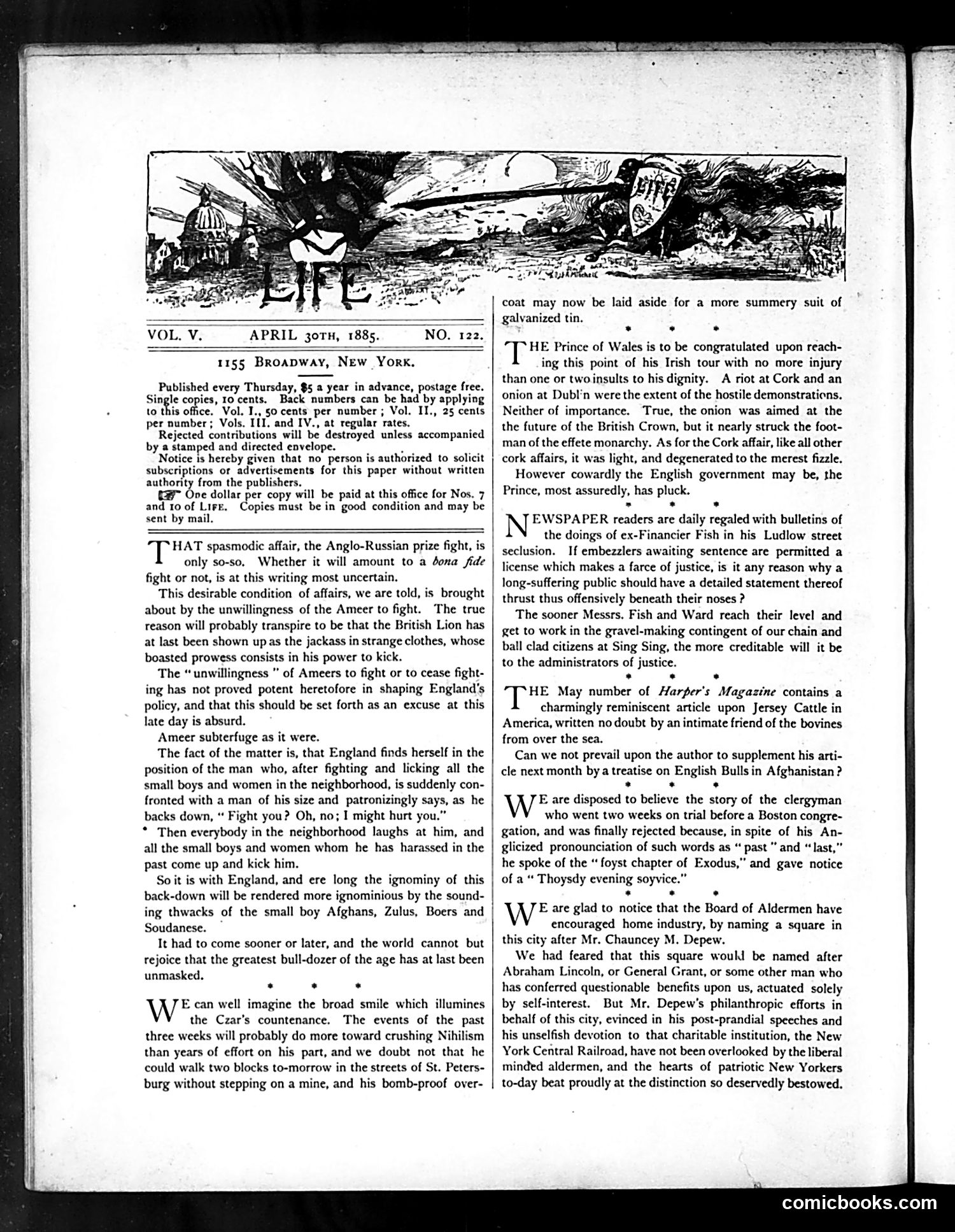
The page contains editorial commentary rather than cartoons. The masthead illustration depicts allegorical figures in a landscape, but lacks clear identification. The text discusses several contemporary issues: 1. **Anglo-Russian Prize Fight**: Commentary on geopolitical tensions, questioning whether conflict between Britain and Russia will materialize. 2. **Prince of Wales's Irish Tour**: References the Prince's visit to Ireland with minimal hostile incidents, contrasting with expectations. 3. **Ex-Financier Fish's Legal Troubles**: Discusses a scandal involving financial misconduct and justice delays. 4. **Depew Square Naming**: New York aldermen named a square after Chauncey M. Depew, a railroad executive and philanthropist, which the editors praise as recognizing legitimate civic achievement over naming it after Lincoln or Grant. The commentary reflects 1880s American political and social preoccupations.
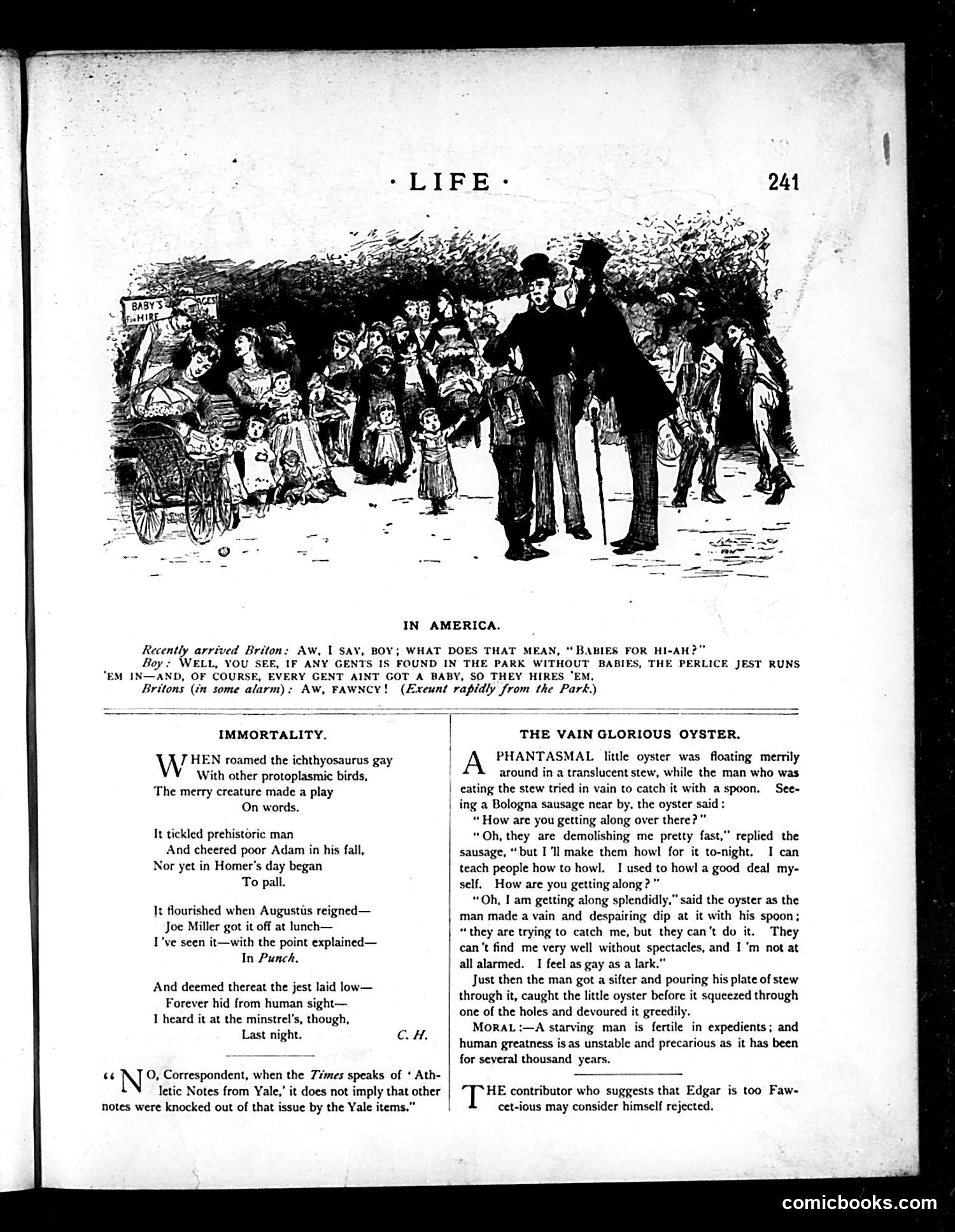
This cartoon satirizes American attitudes toward poor children. A recently arrived British visitor expresses shock at seeing babies left unattended in parks, asking what "babies for hi-ah?" means. An American responds that poor families cannot afford childcare, so police simply hire homeless children as temporary caretakers at minimal cost—a crude, exploitative solution presented as practical American pragmatism. The satire targets both American indifference to child welfare and the callousness of treating destitute children as a cheap labor resource. The cartoon contrasts British social concern with American economic expediency, suggesting America's approach to poverty is shockingly inhumane. The humor derives from the brutal honesty of the American character's matter-of-fact explanation.
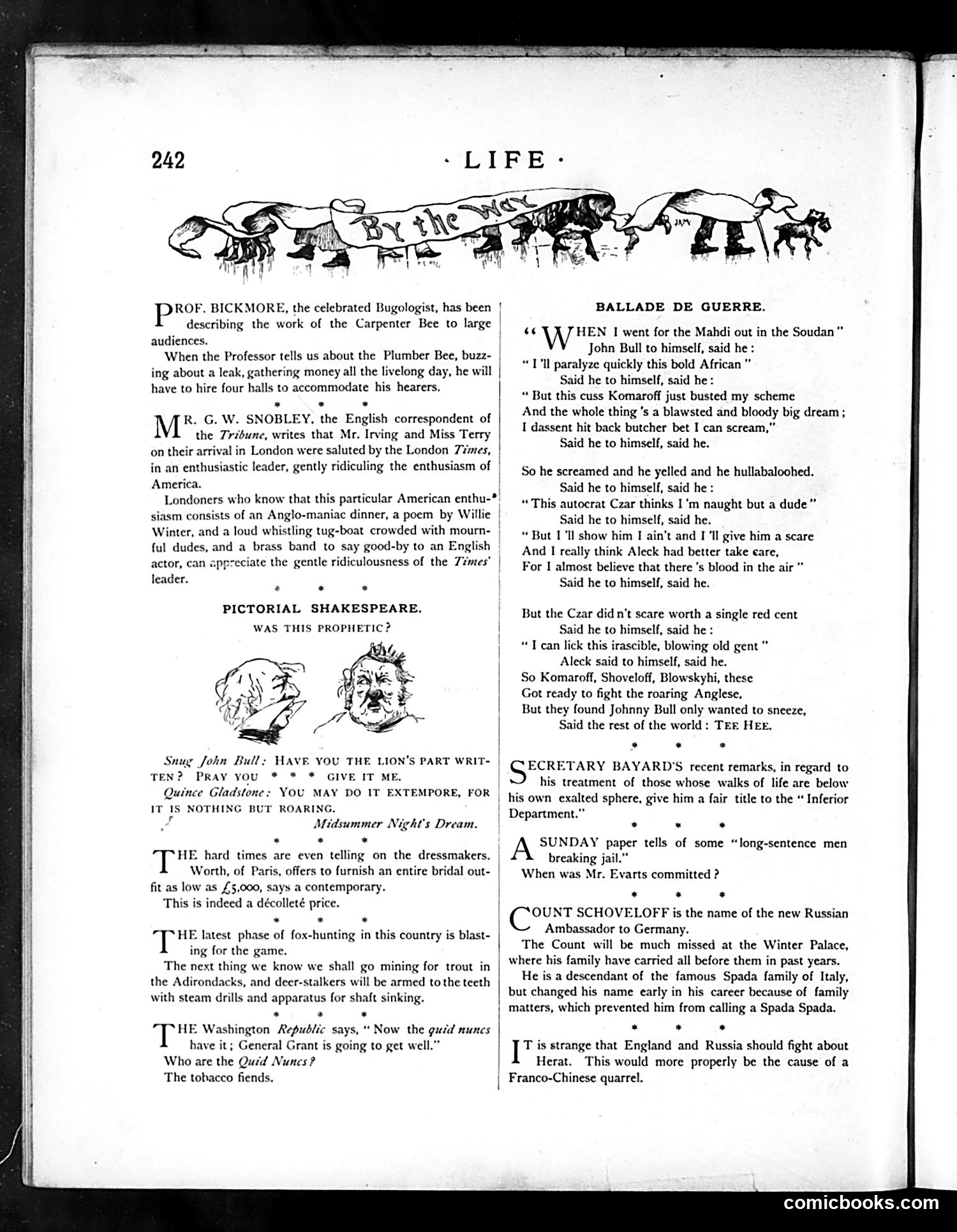
The page contains several unrelated satirical items rather than a unified cartoon. **"Pictorial Shakespeare"** features two caricatured heads with the caption questioning whether Shakespeare was "prophetic." The specific reference is unclear without additional context, though it appears to mock some contemporary figure by comparing them to Shakespeare. **"Ballade de Guerre"** is a poem attributed to John Bull satirizing military incompetence. It mocks an unnamed "Czar" (likely Russian leadership) and figures like "Komaroff" and "Shoveloff" for bungling military strategy against "Johnny Bull," suggesting British superiority in conflicts. The remaining items are brief satirical notes about contemporary topics: dressmakers' pricing, fox-hunting methods, and a joke about tobacco ("quid nunc").
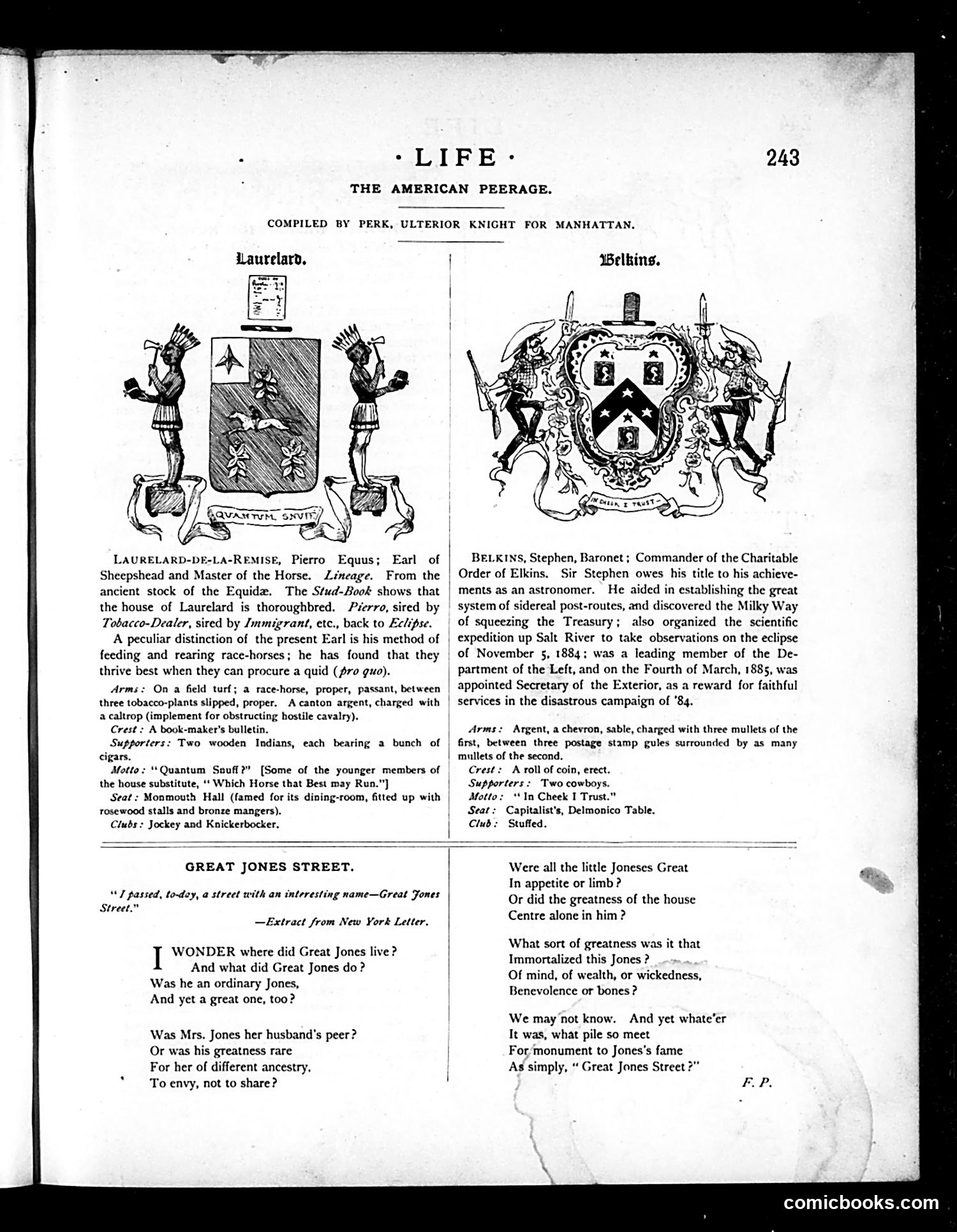
This page contains heraldic illustrations of two American aristocratic families—**Laurelard** and **Belkins**—presented as part of "The American Peerage," compiled by Perk for Manhattan society. The satire mocks the American obsession with inherited nobility and genealogical distinction. Each coat of arms includes humorous biographical details undermining the families' pretensions: Laurelard's entry references a "Tobacco-Dealer" ancestor and notes they "thrive best when they can procure a quid"; Belkins' includes astronomical and financial accomplishments suggesting self-made wealth rather than aristocratic tradition. The bottom section, "Great Jones Street," is an unrelated poem questioning what made a certain Jones worthy of having a street named after him—extending the satirical theme that American "greatness" lacks the traditional markers of European nobility.
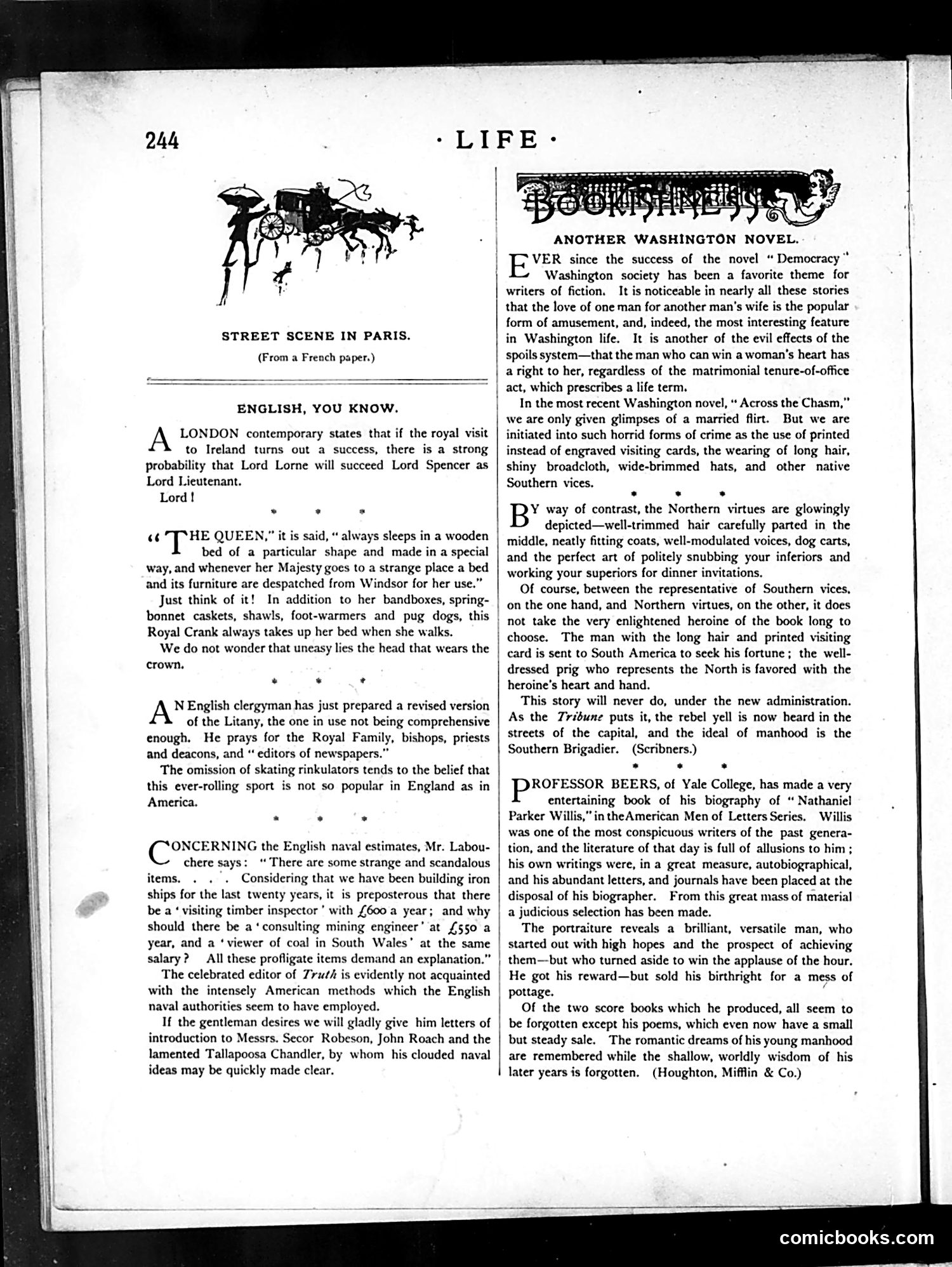
**The Cartoon:** The illustration labeled "STREET SCENE IN PARIS" (credited to a French paper) depicts a chaotic street scene with figures and a horse-drawn carriage. Without clearer detail, the specific satirical target is unclear, though it likely comments on Parisian urban life or social disorder of the period. **The Text Content:** This page primarily contains literary commentary rather than political satire. It discusses Washington D.C. novels, particularly critiquing how marital infidelity has become a tired trope in Washington fiction. The text contrasts Southern and Northern character depictions in these novels and reviews a biography of "Nathaniel Parker Willis" by Professor Beers of Yale College, noting Willis's forgotten literary legacy. The satire here targets literary conventions rather than political figures.
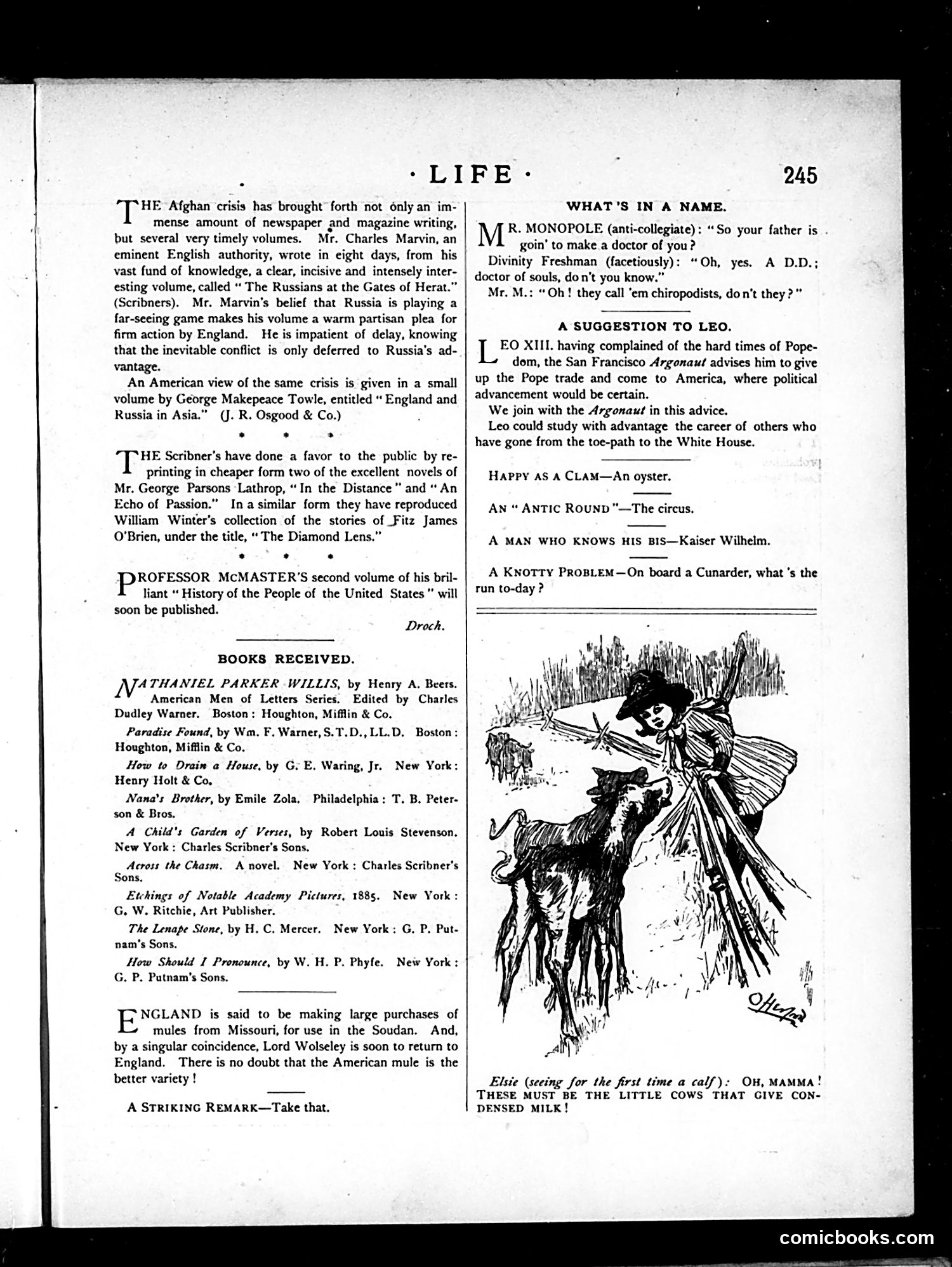
The main cartoon depicts a young child encountering a cow for the first time. The child exclaims "Oh, Mamma! These must be the little cows that give condensed milk!" This is a gentle joke mocking urban children's ignorance of farm life and animal husbandry. The humor lies in the child's literal misunderstanding—confusing actual dairy cows with the canned "condensed milk" product that would have been familiar to city-dwelling children but unfamiliar in its actual source. The satire targets the disconnect between urban consumers and agricultural reality, a common theme in early 20th-century American humor. The page's other content includes brief literary commentary and book reviews, typical of Life's satirical magazine format.
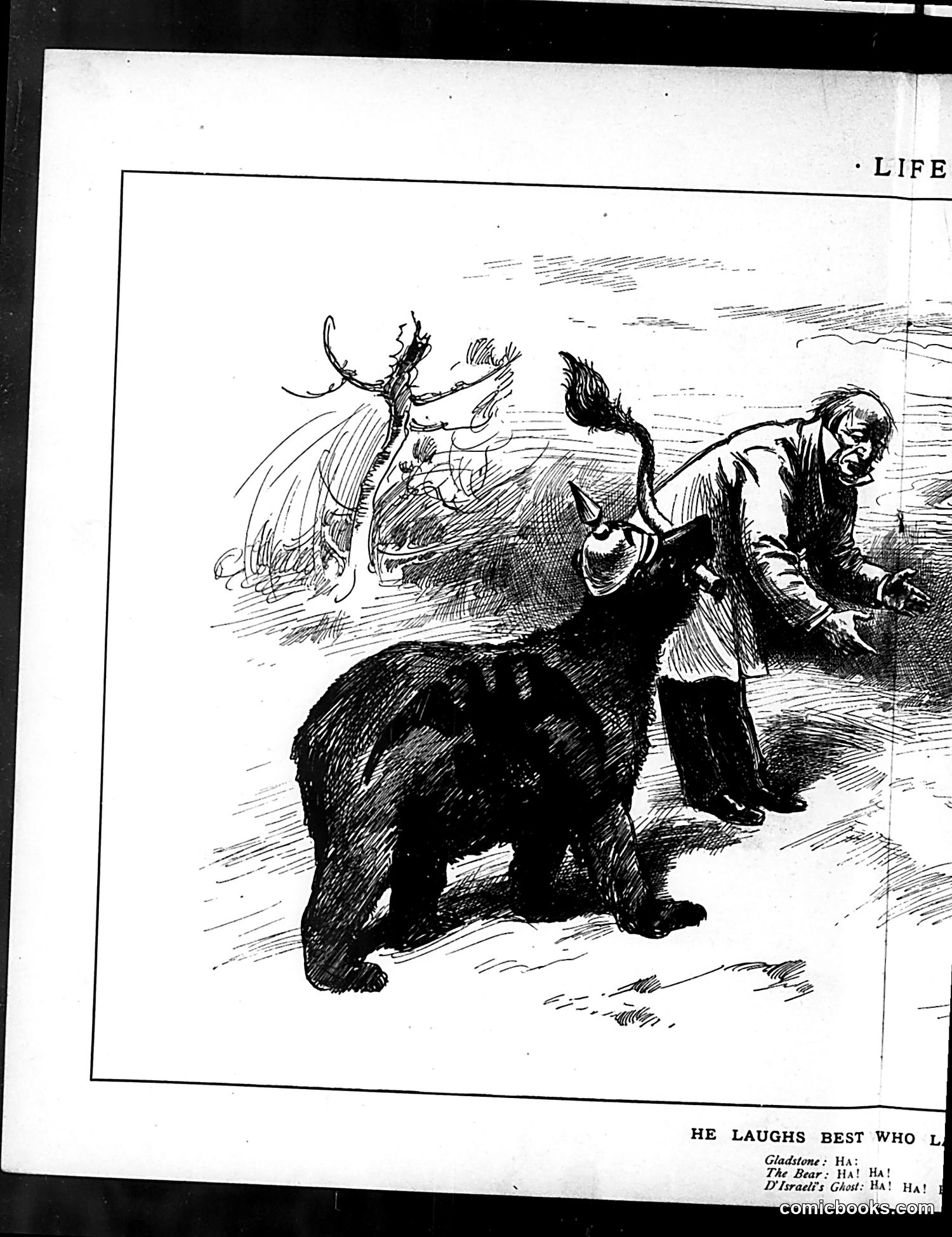
This appears to be a satirical cartoon from *Life* magazine featuring a man being chased or confronted by a large bear. The caption reads "HE LAUGHS BEST WHO LAUGHS LAST" with dialogue attribution to "Gladstone," "The Bear," and "D'Israeli's Ghost." The cartoon likely references 19th-century British political rivalry between William Gladstone and Benjamin Disraeli (D'Israeli), with "The Bear" probably representing Russia—a major geopolitical concern of that era. The satire suggests one political figure getting the last laugh over another regarding British-Russian relations or imperial competition. The ghostly reference to Disraeli implies commentary on his legacy or policies continuing to influence contemporary politics. Without the magazine's date, precise historical context remains unclear.
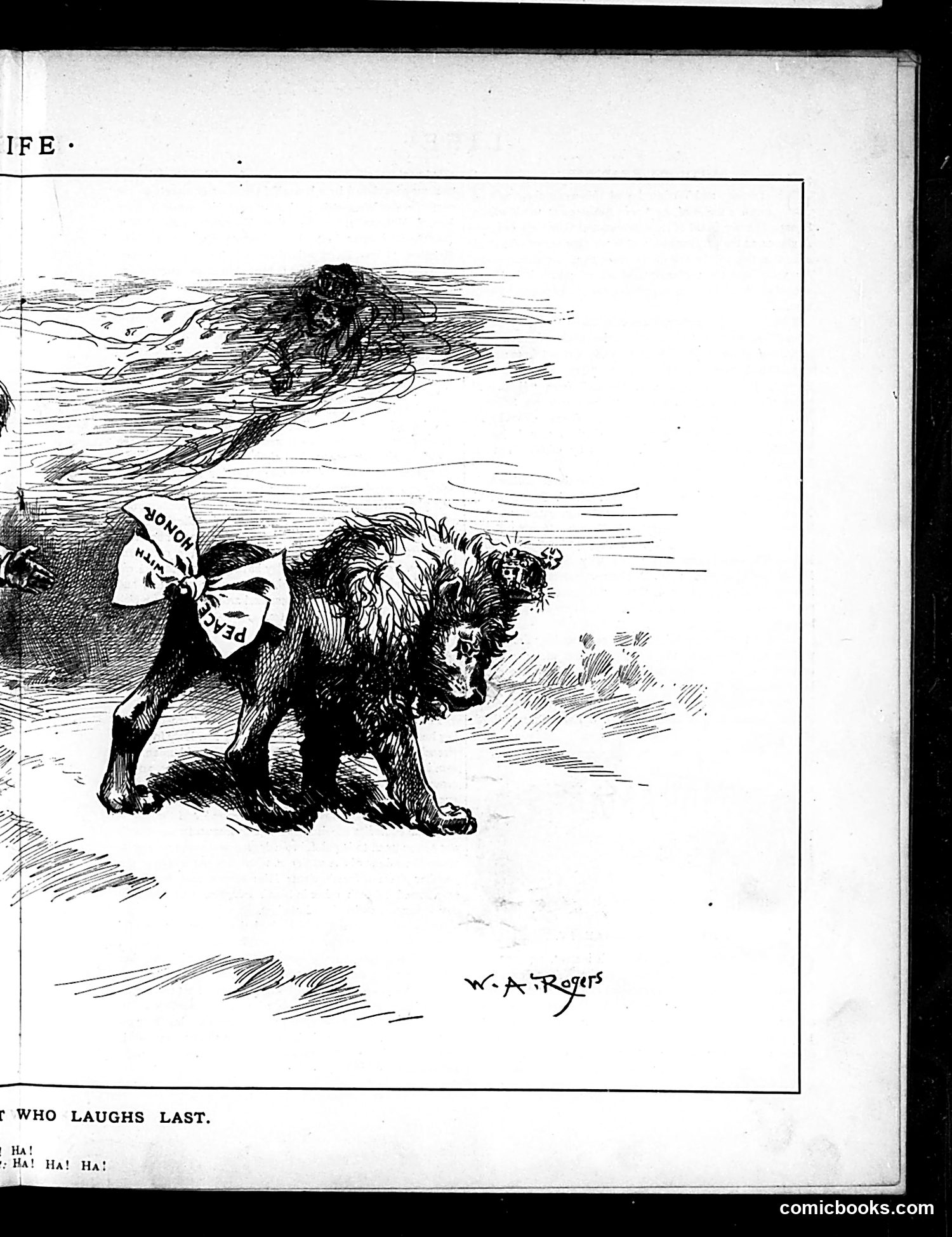
This is a political cartoon signed by W.A. Rogers showing a bear wearing a ribbon labeled "PEACE" and "HONOR." The bear appears to be a Russian caricature—a common symbol for Russia in early 20th-century American editorial cartooning. Above, a figure (likely representing another nation or force) looms menacingly in the sky. The cartoon likely comments on Russia's position following a military conflict, satirizing claims of achieving "peace" and "honor" while facing external threats or internal instability. The bear's anxious posture suggests vulnerability despite these proclaimed virtues. The page header reads "WHO LAUGHS LAST," indicating this is commentary on outcomes yet to be determined in an ongoing geopolitical situation, though the specific historical context requires additional dating information to identify precisely.
This page announces two cultural events in New York. The main content covers an **Authors' Readings series** at Madison Square Theatre benefiting the International Copyright League, featuring prominent American writers including Mark Twain, W.D. Howells, Joel Chandler Harris, and Oliver Wendell Holmes. The readings occur Tuesday and Wednesday; tickets cost two dollars. A secondary notice promotes a **Wilson Industrial School benefit performance** Wednesday evening at the University Club Theatre, featuring amateur theatrical pieces. The page also includes a brief theater review of **"Sealed Instructions"** at Madison Square Theatre, praising the actors' performances—particularly the female cast members—while critiquing the play's contrived plot resolution. There is a decorative "DRAMA" header illustration showing a theatrical stage scene, but no political satire or caricatures are present. This appears to be straightforward cultural journalism and event promotion typical of *Life* magazine's theatrical coverage.
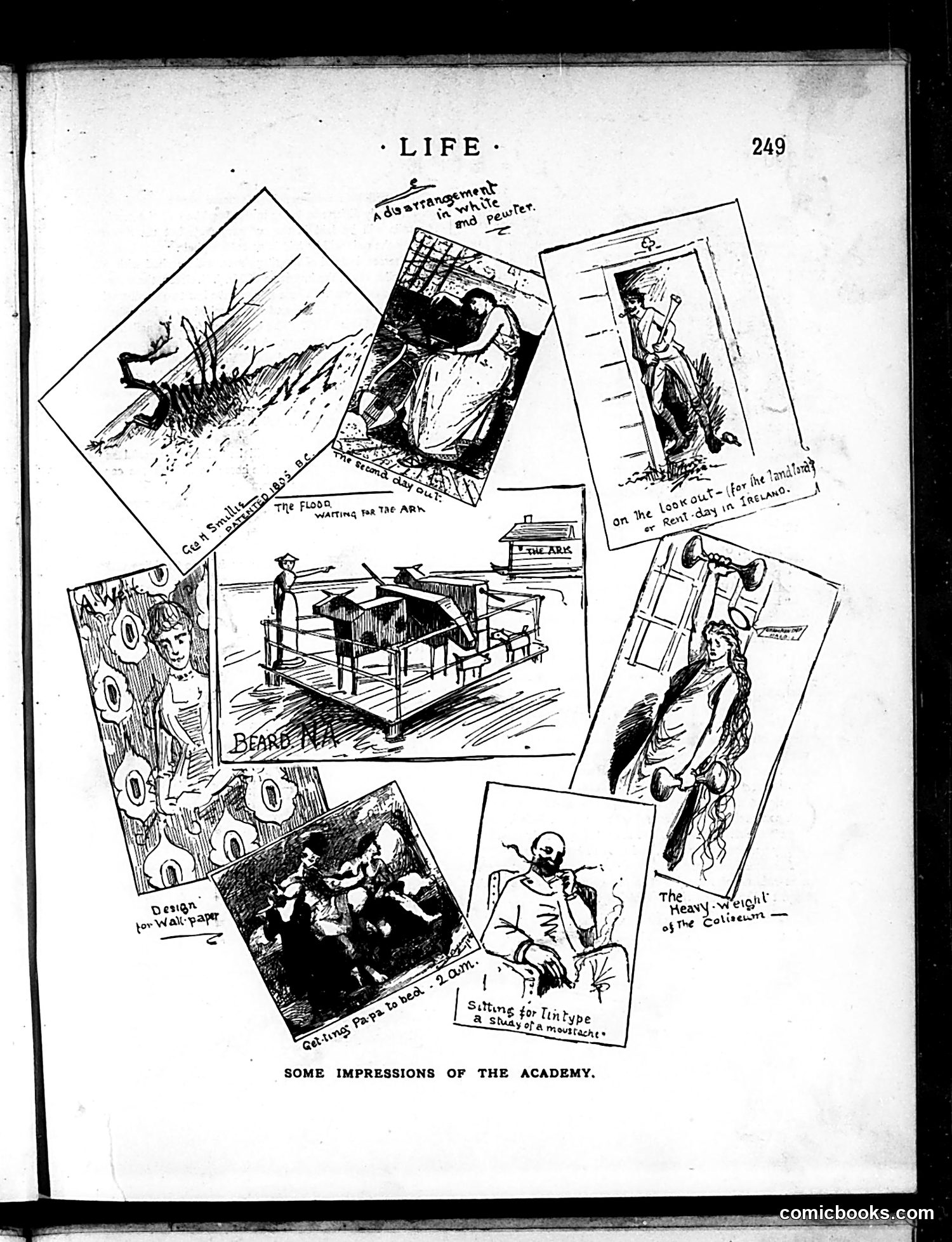
This page from *Life* magazine presents satirical sketches of an art academy, likely the National Academy of Design. The cartoons mock academic art training through humorous scenes: students struggling with figure drawing ("Sitting for Tintype: A Study of Boredom"), awkward life-drawing poses, and classroom mishaps like someone "waiting for the arm" to be drawn and students "on the lookout for landlord rent day in Ireland." The "Design for Wallpaper" sketch suggests academic work produced uninspired, commercialized results. The overall satire targets the academy's rigid teaching methods, pretentiousness, and the gap between artistic aspiration and pedestrian reality—a common critique of formal art institutions in early 20th-century American humor magazines.
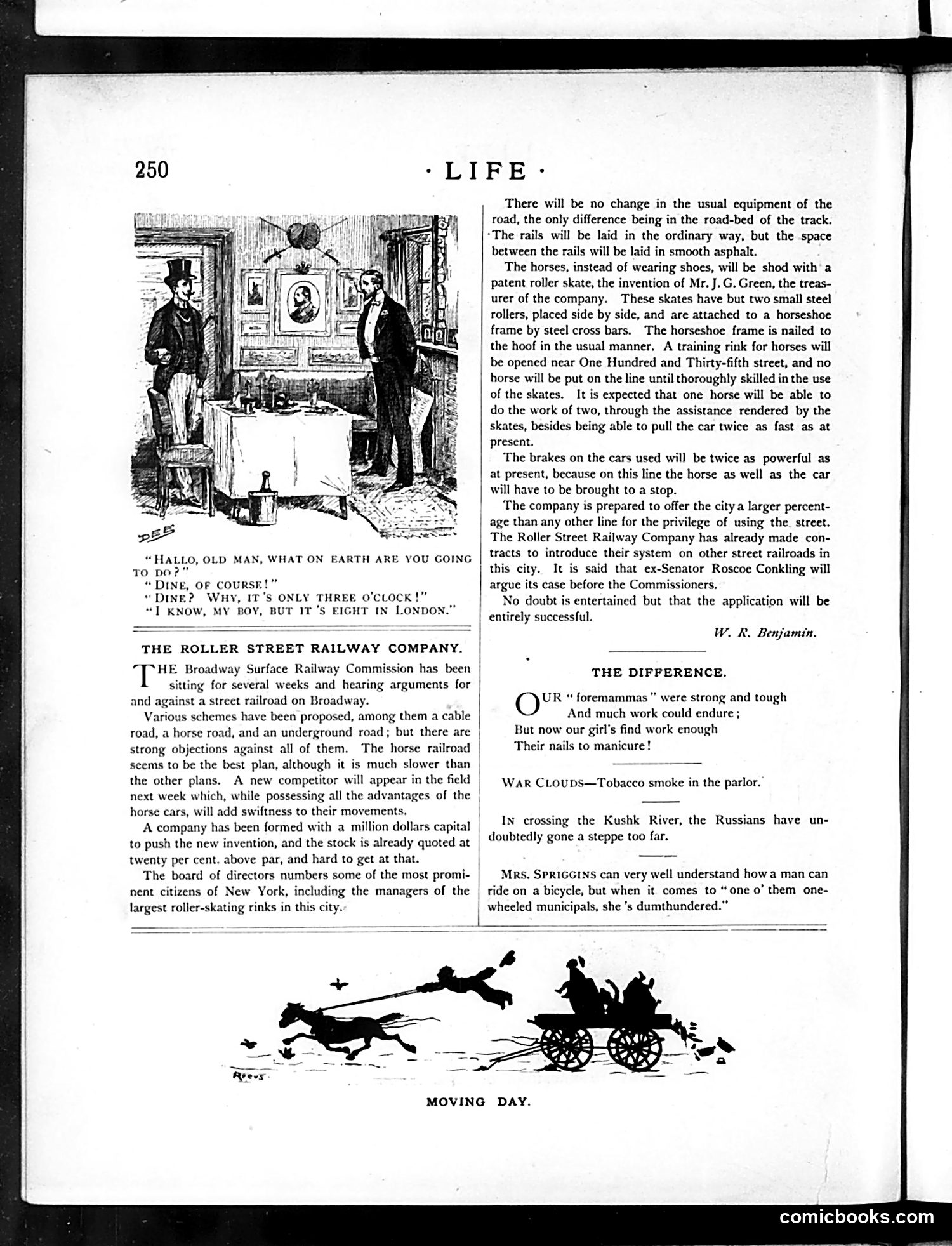
**Main Article: "The Roller Street Railway Company"** This is satirical commentary on a proposed New York street railway system. The scheme humorously proposes equipping horses with roller skates (the invention of company treasurer J.G. Green) to pull cable cars faster along Broadway. The article deadpans technical details—smooth asphalt between rails, a training rink for roller-skating horses, double-strength brakes—presenting an absurd idea with mock seriousness. The satire targets both the ridiculous "innovation" and the prominent New York citizens (including roller-skating rink managers and ex-Senator Roscoe Conkling) backing it. **Cartoon (top left):** Two men discuss plans; one claims it's 3 o'clock, the other insists it's 8 o'clock in London—a joke about time zones and absent-mindedness. **Other brief items:** "The Difference" contrasts strong historical "foremammas" with modern girls concerned only with manicures; other short jokes about smoking and bicycles.
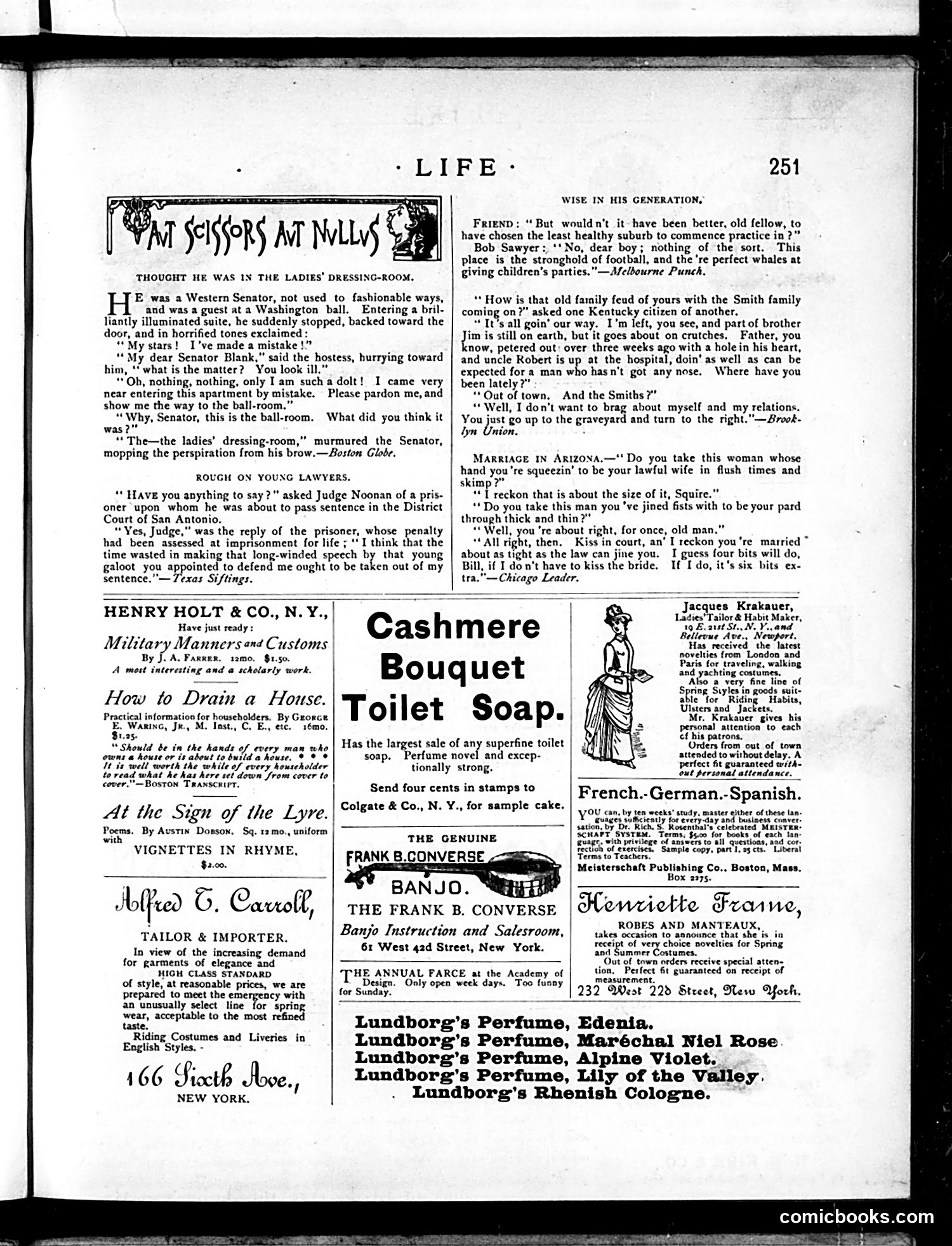
This page from *Life* magazine presents several brief comic anecdotes that satirize various American social types and regional characters: **"Scissors at Malls"** mocks an unsophisticated Western Senator visiting Washington society—he mistakes the crowded ballroom full of elaborately dressed women for a ladies' dressing room, exposing his unfamiliarity with fashionable urban conventions. **"Rough on Young Lawyers"** ridicules an inexperienced court-appointed defense attorney: a convict sentenced to life imprisonment complains that the lawyer's lengthy, ineffectual speech was worse than useless. **"Marriage in Arizona"** and **"Wise in His Generation"** employ crude frontier/rural humor. The first depicts a casual Arizona wedding with colloquial dialect. The second uses darkly comic understatement—a Kentucky man casually describes his family's violent feud with apparent victories (dead or crippled Smiths). These pieces typify period American humor: the "country rube" in the city, mocking both rural ignorance and urban pretension, plus exaggerated regional violence treated as comedic material. The satire targets social pretension and professional incompetence, while using dialect humor common to 19th-century American comics.
This is primarily an **advertising page** from Life magazine (1883), with minimal cartoon content. The page showcases period advertisements for tailors, whiskey, facial development courses, and mineral water—typical commercial fare for magazines of this era. The only notable satirical content appears in the "Before the Scenes" section, which presents a humorous contrast between theatrical dialogue and backstage reality. It mocks both pompous stage acting ("Down, slave, and beg my royal pardon!") and the crude, pragmatic behavior of actors offstage, who casually remove fake props and demand help with padding. This gentle satire exploits the gap between theatrical artifice and authentic human behavior—a recurring theme in period humor about the theater. The page otherwise reflects 1880s consumer culture: advertisements for ladies' tailors, riding habits, "facial development" courses (a dubious beauty treatment), and whiskey—catering to Life's affluent, urban readership.
This page is primarily **advertising and theater notices** with two brief humorous anecdotes rather than political cartoons. The **two stories** are period social humor: 1. **Captain Jerome incident**: A visiting captain asks Colonel Higginson if a pistol is loaded, it discharges and wounds him. The joke hinges on Higginson's exaggerated politeness—he apologizes gracefully despite the accident ("Not now, my dear Captain"). 2. **Mr. Greville at a séance**: An elderly skeptic attends a spiritualist gathering. The medium claims to see "a female form" blessing him (his deceased mother). Greville's deadpan responses—sighing at each revelation, then casually remarking he'll "take tea with her this evening"—mock both spiritualism's pretensions and the medium's earnestness. Both anecdotes ridicule Victorian social conventions: excessive politeness despite injury, and credulous belief in spiritualism. The humor is gentle, drawing-room satire typical of late 19th-century Life magazine's satirical approach to middle-class foibles.
This is primarily an **advertising page** from Life magazine, not a political cartoon. It contains no satirical content or social commentary. The page consists entirely of **patent medicines and commercial products** typical of the 1880s-90s era: - **Crosby's Vitalized Phosphites**: A "nerve tonic and brain food" claiming to treat mental disorders and improve intellect - **Warner's Tippecanoe**: A patent medicine for "general debility" and "mal-assimilation of food," with testimonials from supposedly cured patients - **Cuticura**: A skin treatment for eczema and other conditions - **Perrier Champagne**, carriages, bicycles, trunks, shade rollers, and tailoring services The advertisements exploit common anxieties of the era—nervousness, digestive problems, skin conditions—with unproven "cures." The testimonials from named individuals (Mrs. R.C. Battelle, Rev. J. Pire Powers) were typical marketing tactics designed to create false credibility. This reflects an unregulated patent medicine market before FDA oversight existed.