
Life, 1885-04-30 · page 3 of 16
Life — April 30, 1885 — page 3: what you’re looking at
What you’re looking at
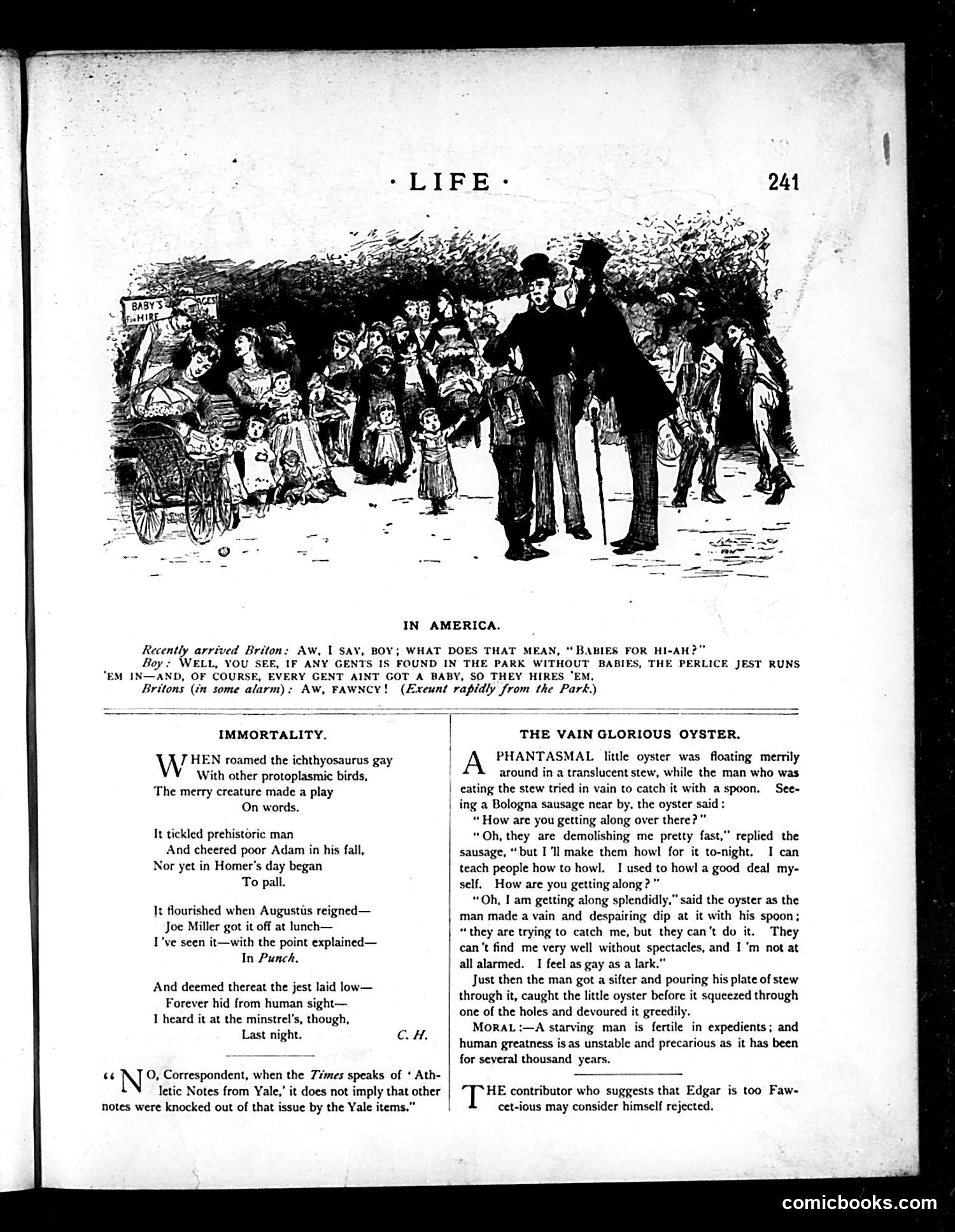
This cartoon satirizes American attitudes toward poor children. A recently arrived British visitor expresses shock at seeing babies left unattended in parks, asking what "babies for hi-ah?" means. An American responds that poor families cannot afford childcare, so police simply hire homeless children as temporary caretakers at minimal cost—a crude, exploitative solution presented as practical American pragmatism. The satire targets both American indifference to child welfare and the callousness of treating destitute children as a cheap labor resource. The cartoon contrasts British social concern with American economic expediency, suggesting America's approach to poverty is shockingly inhumane. The humor derives from the brutal honesty of the American character's matter-of-fact explanation.
📄 Transcribed text from this page (OCR, searchable)
Machine-transcribed from the original scan — historical spelling and the odd misread are preserved.
IN AMERICA. Recently arrived Briton: AW, | SAY, BOY; WHAT DOES THAT MEAN, “BABIES FOR HI-AH?” Boy: WELL, YOU SEE, IF ANY GENTS IS FOUND IN THE PARK WITHOUT BABIES, THE PERLICE JEST RUNS ‘EM IN—AND, OF COURSE, EVERY GENT AINT GOT A BABY, SO THEY HIRES "EM. Britons (in some alarm): AW, FAWNCY! IMMORTALITY. 7 HEN roamed the ichthyosaurus gay With other protoplasmic birds, The merry creature made a play On words. It tickled prehistoric man And cheered poor Adam in his fall, Nor yet in Homer's day began To pall. It flourished when Augustus reigned— Joe Miller got it off at lunch— I've seen it—with the point explained— In Punch, And deemed thereat the jest laid low— Forever hid from human sight— I heard it at the minstrel’s, though, Last night. CH. 6c“ O, Correspondent, when the 7¢mes speaks of ‘ Ath- letic Notes from Yale,’ it does not imply that other notes were knocked out of that issue by the Yale items.” (Exeunt rapidly from the Park.) | THE VAIN GLORIOUS OYSTER. | A PHANTASMAL little oyster was floating merrily around in a translucent stew, while the man who was eating the stew tried in vain to catch it with a spoon. See- ing a Bologna sausage near by, the oyster said : “How are you getting along over there?” “Oh, they are demolishing me pretty fast,” replied the sausage, “but I ‘ll make them howl for it to-night. I can teach people how to howl. I used to howl a good deal my- self. How are you getting along?" “Oh, I am getting along splendidly,” said the oyster as the man made a vain and despairing dip at it with his spoon; “ they are trying to catch me, but they can't do it. They can't find me very well without spectacles, and I ‘m not at | all alarmed. I feel as gay as a lark.” Just then the man got a sifter and pouring his plate of stew through it, caught the little oyster before it squeezed through one of the holes and devoured it greedily. MORAL :—A starving man is fertile in expedients; and human greatness is as unstable and precarious as it has been for several thousand years. HE contributor who suggests that Edgar is too Faw- cet-ious may consider himself rejected. comicbooks.com