
Life, 1885-04-30 · page 10 of 16
Life — April 30, 1885 — page 10: what you’re looking at
What you’re looking at
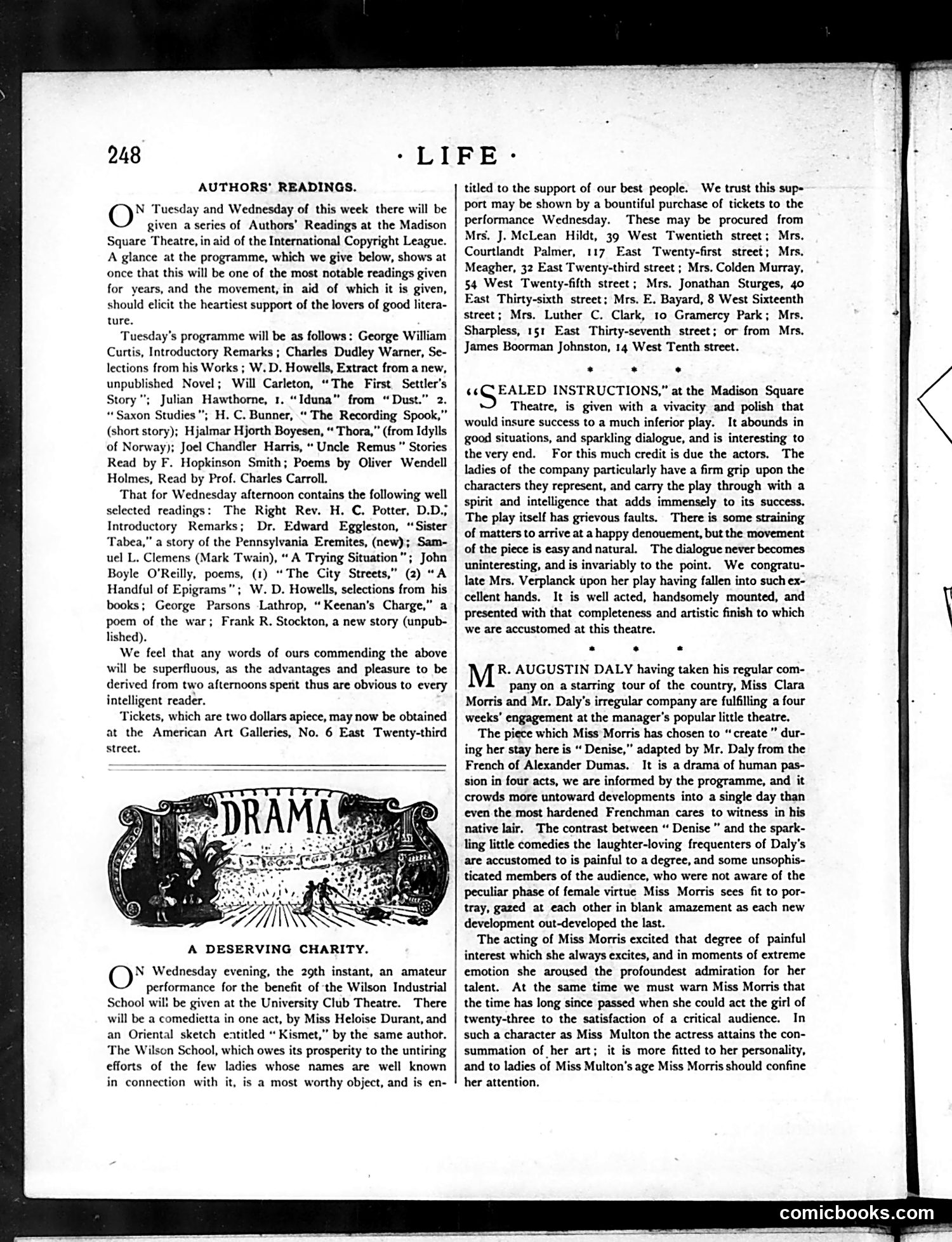
This page announces two cultural events in New York. The main content covers an **Authors' Readings series** at Madison Square Theatre benefiting the International Copyright League, featuring prominent American writers including Mark Twain, W.D. Howells, Joel Chandler Harris, and Oliver Wendell Holmes. The readings occur Tuesday and Wednesday; tickets cost two dollars. A secondary notice promotes a **Wilson Industrial School benefit performance** Wednesday evening at the University Club Theatre, featuring amateur theatrical pieces. The page also includes a brief theater review of **"Sealed Instructions"** at Madison Square Theatre, praising the actors' performances—particularly the female cast members—while critiquing the play's contrived plot resolution. There is a decorative "DRAMA" header illustration showing a theatrical stage scene, but no political satire or caricatures are present. This appears to be straightforward cultural journalism and event promotion typical of *Life* magazine's theatrical coverage.
📄 Transcribed text from this page (OCR, searchable)
Machine-transcribed from the original scan — historical spelling and the odd misread are preserved.
248 * LIFE: AUTHORS’ READINGS. N Tuesday and Wednesday of this week there will be given a series of Authors’ Readings at the Madison Square Theatre, in aid of the International Copyright League. A glance at the programme, which we give below, shows at once that this will be one of the most notable readings given for years, and the movement, in aid of which it is given, should elicit the heartiest support of the lovers of good litera- ture, Tuesday's programme will be as follows: George William Curtis, Introductory Remarks ; Charles Dudley Warner, Se- lections from his Works ; W. D. Howells, Extract from a new, unpublished Novel; Will Carleton, “The First Settler's Story"; Julian Hawthorne, 1. “Iduna” from “Dust.” 2. “Saxon Studies"; H. C. Bunner, “ The Recording Spook,” (short story); Hjalmar Hjorth Boyesen, “ Thora,” (from Idylls of Norway); Joel Chandler Harris, “ Uncle Remus” Stories Read by F. Hopkinson Smith; Poems by Oliver Wendell Holmes, Read by Prof. Charles Carroll. That for Wednesday afternoon contains the following well selected readings: The Right Rev. H. C. Potter, D.D.; Introductory Remarks; Dr. Edward Eggleston, “Sister Tabea,” a story of the Pennsylvania Eremites, (new); Sam- uel L. Clemens (Mark Twain), “ A Trying Situation”; John Boyle O'Reilly, poems, (1) “The City Streets,” (2) “A Handful of Epigrams"”; W. D. Howells, selections from his books; George Parsons Lathrop, “Keenan's Charge,” a poem of the war; Frank R. Stockton, a new story (unpub- lished). We feel that any words of ours commending the above will be superfluous, as the advantages and pleasure to be derived from two afternoons spent thus are obvious to every intelligent reader. Tickets, which are two dollars apiece, may now be obtained at the American Art Galleries, No. 6 East Twenty-third Street. A DESERVING CHARITY. O* Wednesday evening, the 29th instant, an amateur performance for the benefit of the Wilson Industrial School wil! be given at the University Club Theatre. There will be a comedietta in one act, by Miss Heloise Durant, and an Oriental sketch entitled “ Kismet,” by the same author. The Wilson School, which owes its prosperity to the untiring efforts of the few ladies whose names are well known in connection with it, is a most worthy object, and is en- titled to the support of our best people. We trust this sup- port may be shown by a bountiful purchase of tickets to the performance Wednesday. These may be procured from Mrs. J. McLean Hildt, 39 West Twentieth street; Mrs. Courtlandt Palmer, 117 East Twenty-first street; Mrs. Meagher, 32 East Twenty-third street ; Mrs. Colden Murray, 54 West Twenty-fifth street; Mrs. Jonathan Sturges, 40 East Thirty-sixth street; Mrs. E. Bayard, 8 West Sixteenth street; Mrs. Luther C. Clark, 10 Gramercy Park; Mrs. Sharpless, 151 East Thirty-seventh street; or from Mrs. James Boorman Johnston, 14 West Tenth street. * * . «6s EALED INSTRUCTIONS,” at the Madison Square Theatre, is given with a vivacity and polish that would insure success to a much inferior play. It abounds in good situations, and sparkling dialogue, and is interesting to the very end. For this much credit is due the actors. The ladies of the company particularly have a firm grip upon the characters they represent, and carry the play through with a spirit and intelligence that adds immensely to its success. The play itself has grievous faults. There is some straining of matters to arrive at a happy denouement, but the movement of the piece is easy and natural. The dialogue never becomes uninteresting, and is invariably to the point. We congratu- late Mrs. Verplanck upon her play having fallen into such ex- cellent hands. It is well acted, handsomely mounted, and presented with that completeness and artistic finish to which we are accustomed at this theatre. R. AUGUSTIN DALY having taken his regular com- pany on a starring tour of the country, Miss Clara Morris and Mr. Daly's irregular company are fulfilling a four weeks’ engagement at the manager's popular little theatre, The piece which Miss Morris has chosen to “create” dur- ing her stay here is “ Denise," adapted by Mr. Daly from the French of Alexander Dumas. It is a drama of human pas- sion in four acts, we are informed by the programme, and it crowds more untoward developments into a single day than even the most hardened Frenchman cares to witness in his native lair. The contrast between “ Denise” and the spark- ling little comedies the laughter-loving frequenters of Daly's are accustomed to is painful to a degree, and some unsophis- ticated members of the audience, who were not aware of the peculiar phase of female virtue Miss Morris sees fit to por- tray, gazed at each other in blank amazement as each new development out-developed the last. The acting of Miss Morris excited that degree of painful interest which she always excites, and in moments of extreme emotion she aroused the profoundest admiration for her talent. At the same time we must warn Miss Morris that the time has long since passed when she could act the girl of twenty-three to the satisfaction of a critical audience. In such a character as Miss Multon the actress attains the con- summation of her art; it is more fitted to her personality, and to ladies of Miss Multon’s age Miss Morris should confine her attention. comicbooks.com