
A complete issue · 16 pages · 1885
Life — April 23, 1885
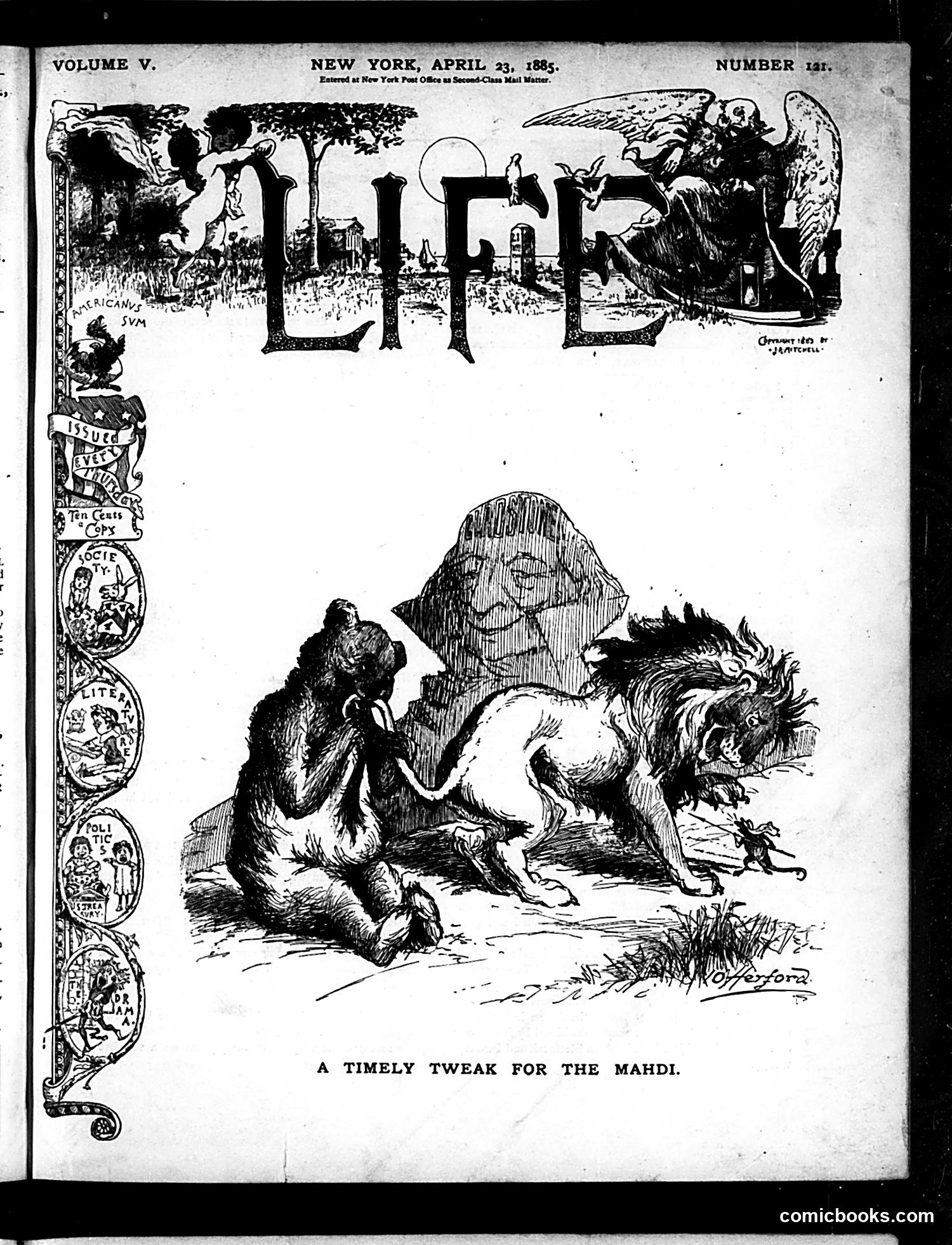
This 1885 *Life* magazine cartoon satirizes the Mahdi, a religious-political figure leading rebellion in Sudan against British-Egyptian colonial forces. The illustration shows the Mahdi (large turbaned head in background) being "tweaked" or mocked by two monkeys—a common visual metaphor in 19th-century satire for ridiculing foreign adversaries as subhuman or absurd. The joke mocks the Mahdi's authority and military threat as something trivial that even animals could undermine. This reflects British imperial attitudes dismissing colonial resistance as primitive or foolish. The "timely tweak" suggests the British viewed military action against the Mahdi as justified correction of an inferior opponent, typical of the racist colonial rhetoric of the era.
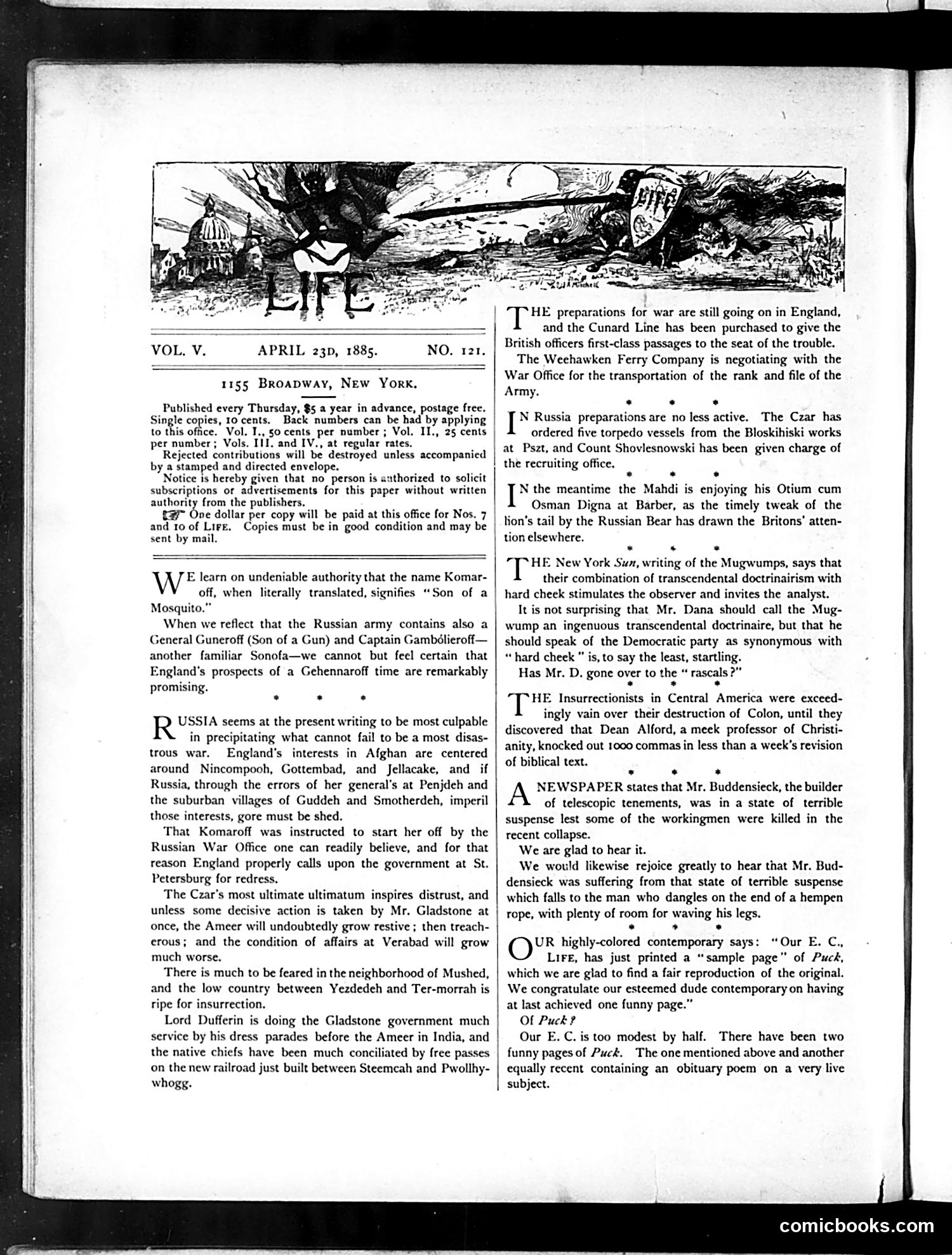
The masthead cartoon depicts a figure labeled "LIFE" in a dramatic landscape. The accompanying text discusses international tensions: British military preparations, Russian naval activity under the Czar, and conflicts in Central Asia (Afghanistan, Pendjeh). The satire criticizes Russia for aggressive expansion that threatens British interests. There's particular concern about General Komaroff and potential war. The piece suggests England should pressure the Russian government at St. Petersburg for redress, while warning that unless decisive action occurs, conflict ("a Gehenna-roff time") is likely. The cartoon likely personifies Life magazine itself as an observer of these dangerous geopolitical conflicts. The overall tone is alarmist about Russian imperial ambitions and their threat to British colonial interests.
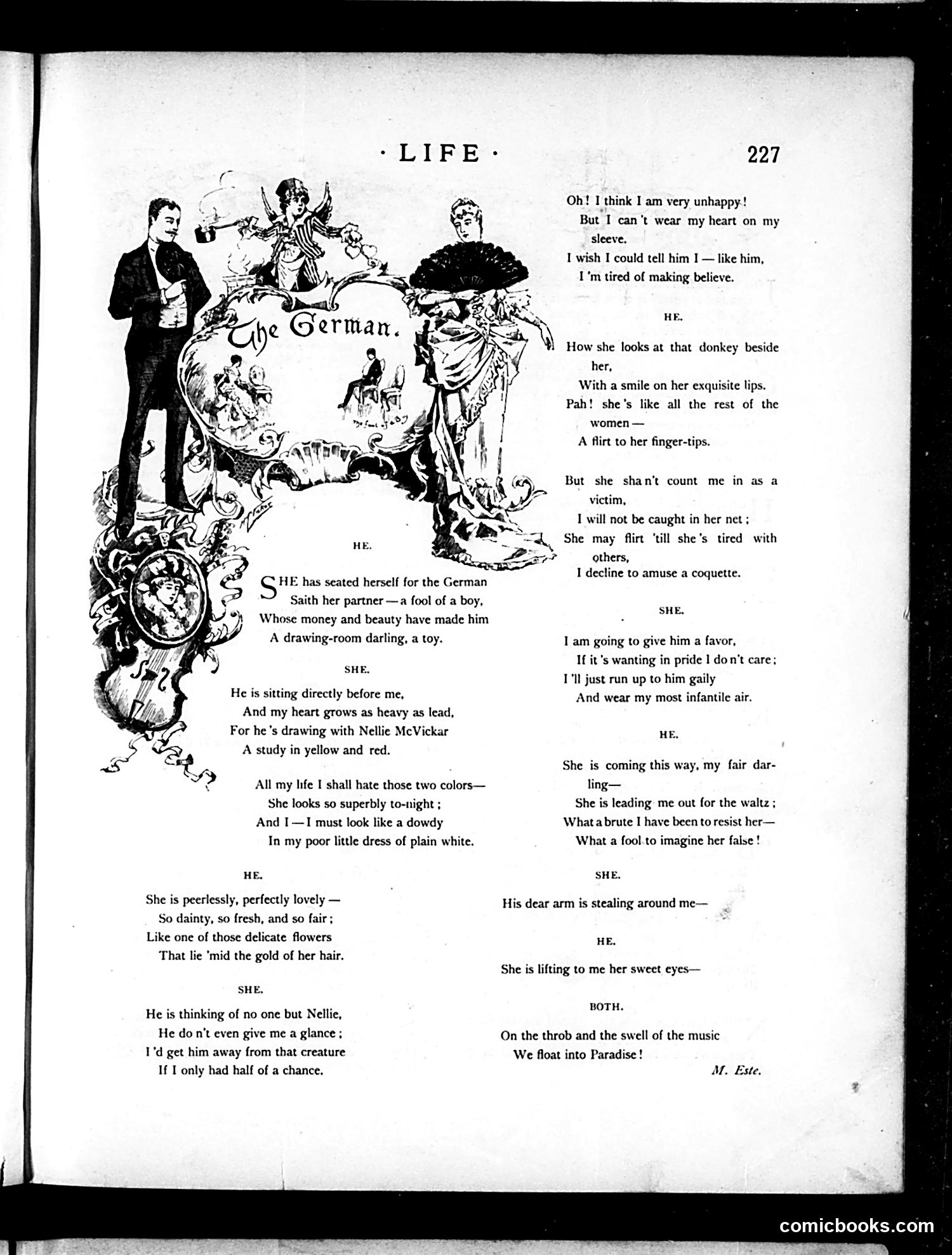
This page from *Life* magazine presents a satirical dialogue poem about romantic jealousy, illustrated with an ornate Art Nouveau design featuring the title "The German." The poem depicts a love triangle: a woman ("She") seated with her German partner, who is drawing Nellie McVickar in "yellow and red." The speaker expresses jealousy and resentment—she feels neglected and compares herself unfavorably to this other woman. The man dismisses her concerns, describing the other woman's beauty flirtatiously. The humor lies in the speaker's wounded pride and dramatic declarations of indifference masking clear distress. The "German" likely references the partner's nationality, common for ethnic humor in period *Life* magazine. The ornate illustration suggests this is light social satire about romantic rivalry among fashionable society figures.
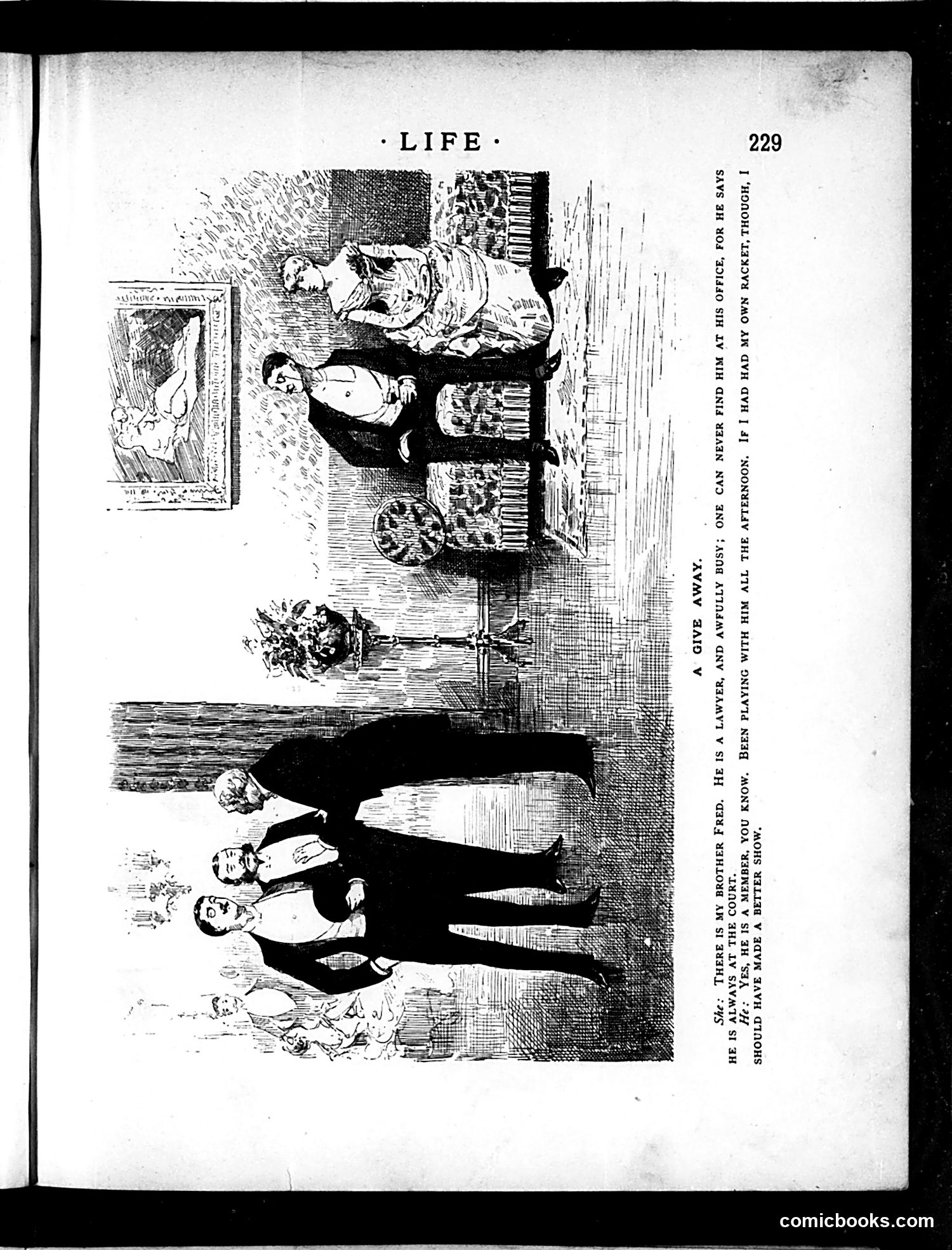
This page from *Life* magazine (page 229) contains a satirical cartoon about legal/political matters. The caption reads: "He is a lawyer, and apparently busy one can never find him at his office, for he says 'If I had bred my one basket I should have made a better show!'" The cartoon depicts a man (the lawyer) in his office, appearing disorganized or absent. The satire targets the common complaint about lawyers being unavailable or inaccessible despite their importance. The phrase about "one basket" suggests a critique of the lawyer's divided attention or scattered business practices—the implication being that if he concentrated his efforts, he'd be more successful or present for clients. This reflects era concerns about professional availability and accountability.
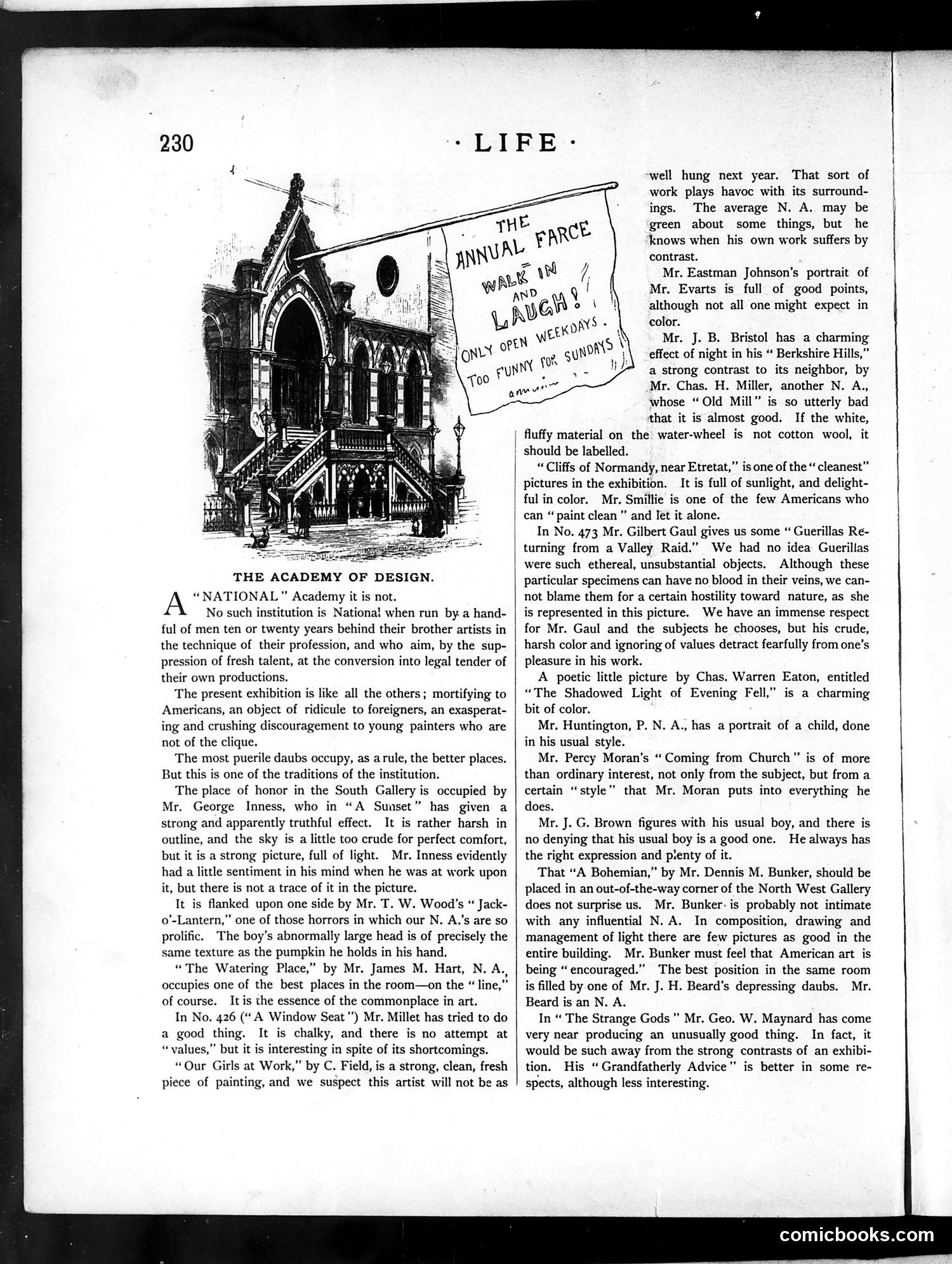
The main illustration shows a ornate theater building with a banner reading "THE ANNUAL FARCE / WALK IN / AND LAUGH / ONLY OPEN WEEKDAYS / TOO FUNNY FOR SUNDAYS." This is captioned "THE ACADEMY OF DESIGN." The satire critiques a national academy's art exhibition as a "farce"—suggesting the institution's judgment is poor and its shows are laughable rather than serious artistic venues. The joke that it's "too funny for Sundays" implies the work is so bad it's unintentionally comic. The accompanying text reviews specific paintings from this exhibition, harshly criticizing many works by National Academicians (N.A.s) while praising a few non-members, reinforcing the satirical point: the academy's official seal of approval means little; genuine talent often comes from outside establishment circles.
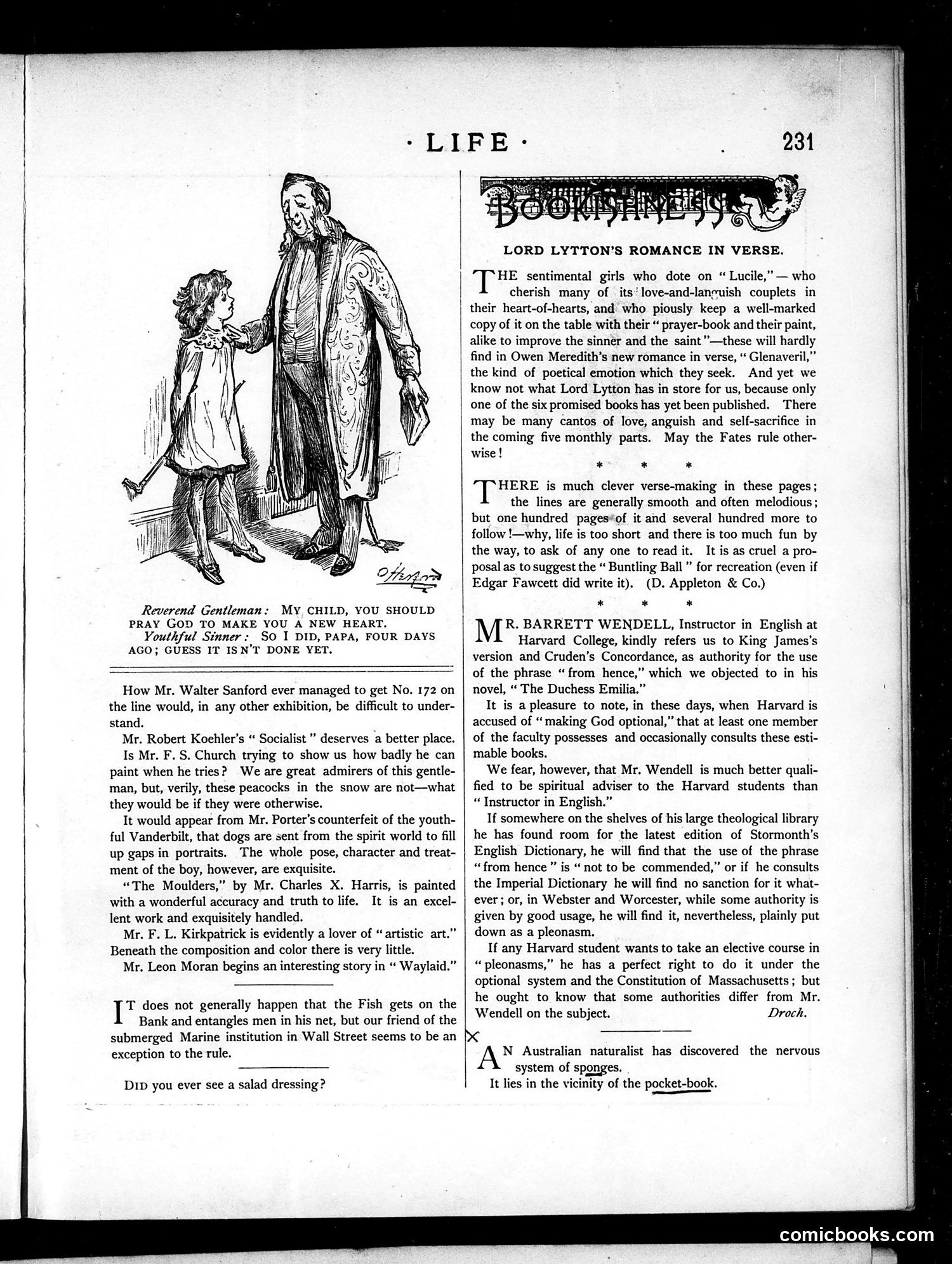
The main illustration shows a bearded clergyman addressing a young child, with the caption: "Reverend Gentleman: My child, you should pray God to make you a new heart. Youthful Sinner: So I did, Papa, four days ago; I guess it isn't done yet." This is a **satirical commentary on religious hypocrisy and childhood innocence**. The joke mocks both the reverend's pious moralizing and the child's literal-minded response. The child has earnestly followed religious instruction but finds no miraculous result, exposing the gap between spiritual promises and observable reality. The cartoon critiques how clergy dispense moral platitudes while children innocently expect literal fulfillment of religious teachings—a common satirical target of *Life* magazine's social commentary.
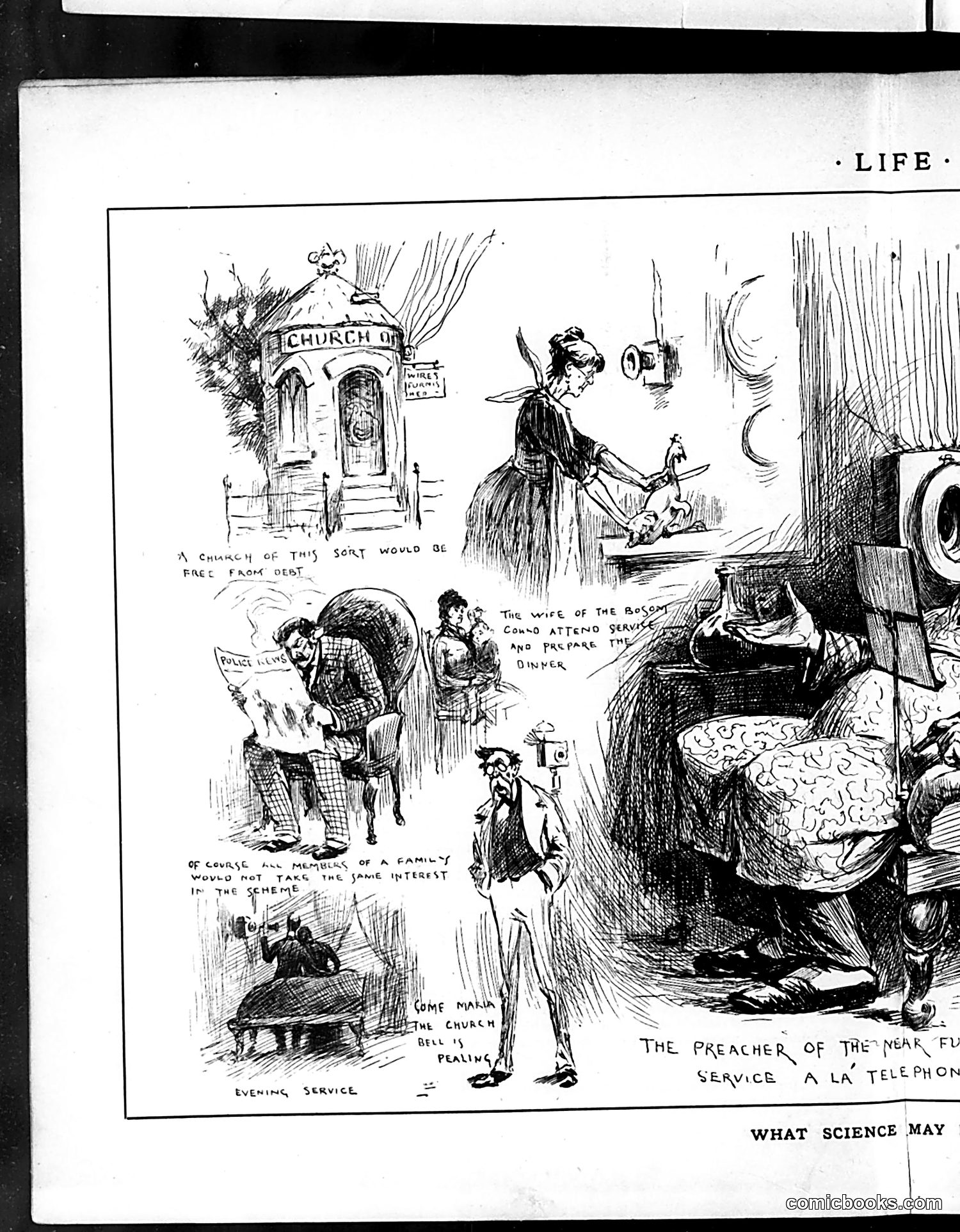
This satirical cartoon critiques the intersection of modern technology and religious life in early 20th-century America. The sketches show: 1. **Church debt relief** - A church offering a "price from debt" through modern means 2. **Sunday service via telephone** - A woman attending church remotely while handling domestic duties (preparing dinner, managing children) 3. **"Preacher of the year" conducting service via telephone** - Religious services delivered through technological convenience rather than in-person worship The satire mocks how industrialization and new technologies like the telephone were beginning to replace traditional communal religious practice. It suggests that convenience-driven modernization undermines the spiritual purpose of church attendance—community, commitment, and meaningful participation—reducing faith to a transactional, remotely-accessed service. The title "WHAT SCIENCE MAY" (partially visible) indicates concern about science's corrosive effect on traditional institutions.
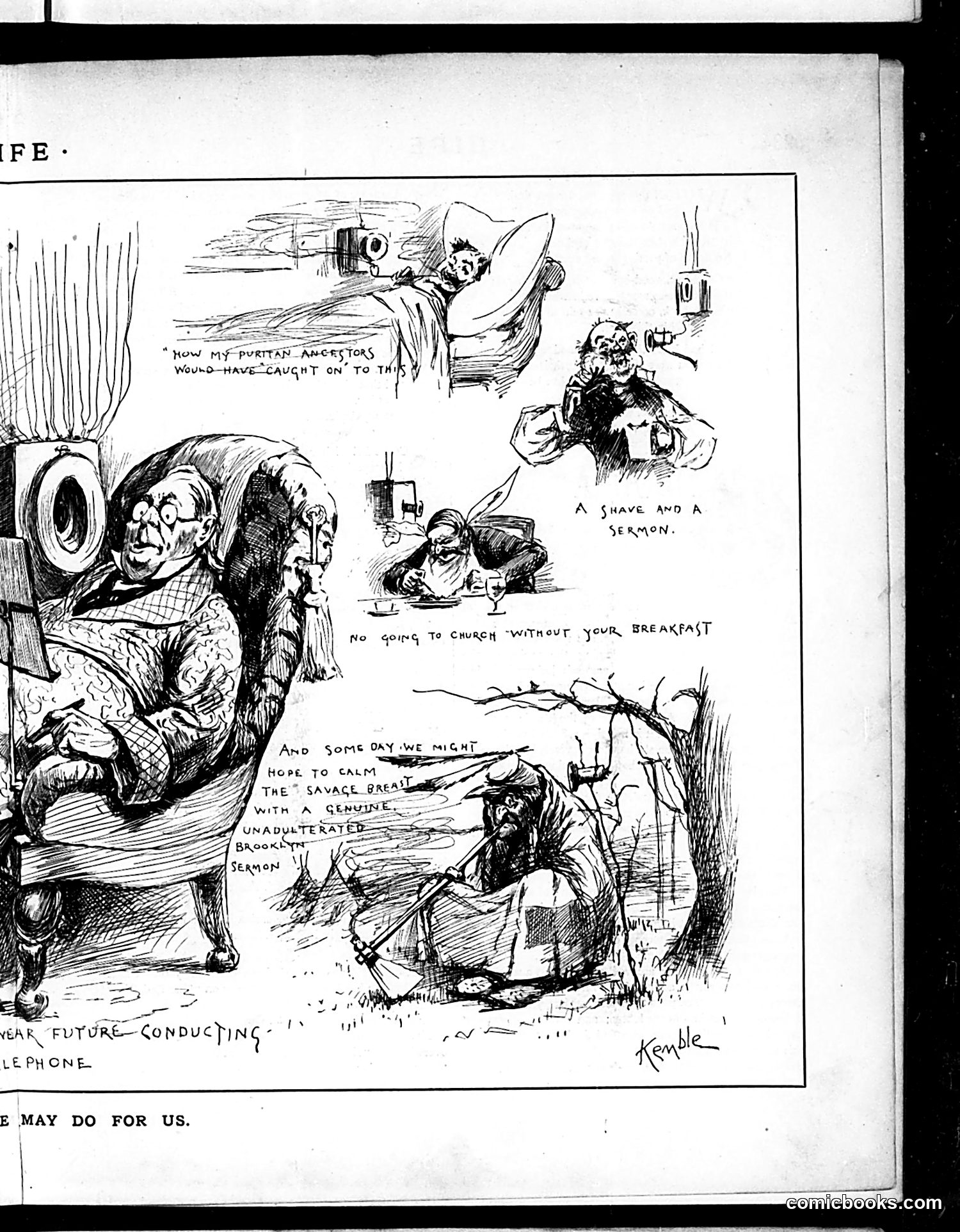
This appears to be a satirical cartoon by Kemble critiquing religious hypocrisy among Puritan ancestry Americans. The central figures are caricatured as descendants of Puritans engaged in worldly vices—the text reads: "How my Puritan ancestors would-have-caught on to this," accompanied by images of men smoking, drinking, and attending church services in contradictory ways. The satire mocks the gap between Puritan forebears' strict morality and their modern descendants' indulgences. Captions reference "A shave and a sermon" and "No going to church without your breakfast," suggesting religion has become routine rather than meaningful. The final panel references "savage bread with a genuine unadulterated Brooklyn sermon," implying commercial/urban American religion lacks authenticity compared to ancestral piety. The cartoon critiques moral decline and religious superficiality among modern Americans.
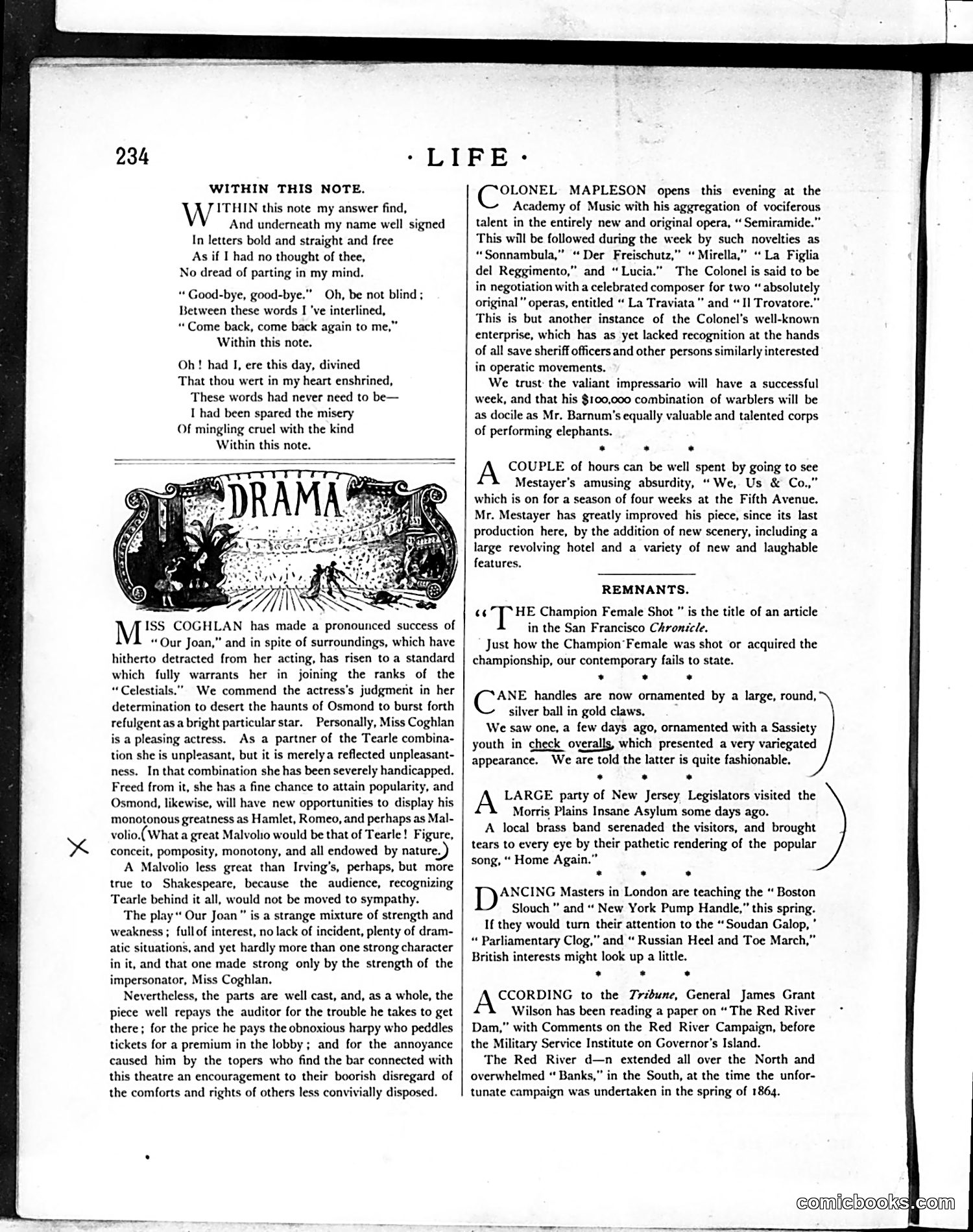
This page from *Life* magazine contains theatrical reviews and social commentary typical of the publication's satirical approach to 1860s-70s American culture. **Key Content:** The page opens with a sentimental love poem ("Within This Note"), then pivots to theater criticism. Miss Coghlan is praised for her role in "Our Joan," with the critic noting she's risen above her previous work despite being hampered by her partnership with actor Tearle (likely the Tearle theatrical family). The review backhands Tearle, suggesting he plays dramatic roles with mechanical monotony rather than genuine feeling. **Satirical Target:** Colonel Mapleson (opera impresario) receives mocking criticism for promoting "entirely new and original opera" while simultaneously staging established works. The barb comparing his $100,000 opera company to "Mr. Barnum's equally valuable and talented corps of performing elephants" equates his singers with circus acts—suggesting commercialism over artistry. The page reflects *Life*'s characteristic blend of entertainment coverage with pointed social satire about artistic pretension and theatrical commerce.
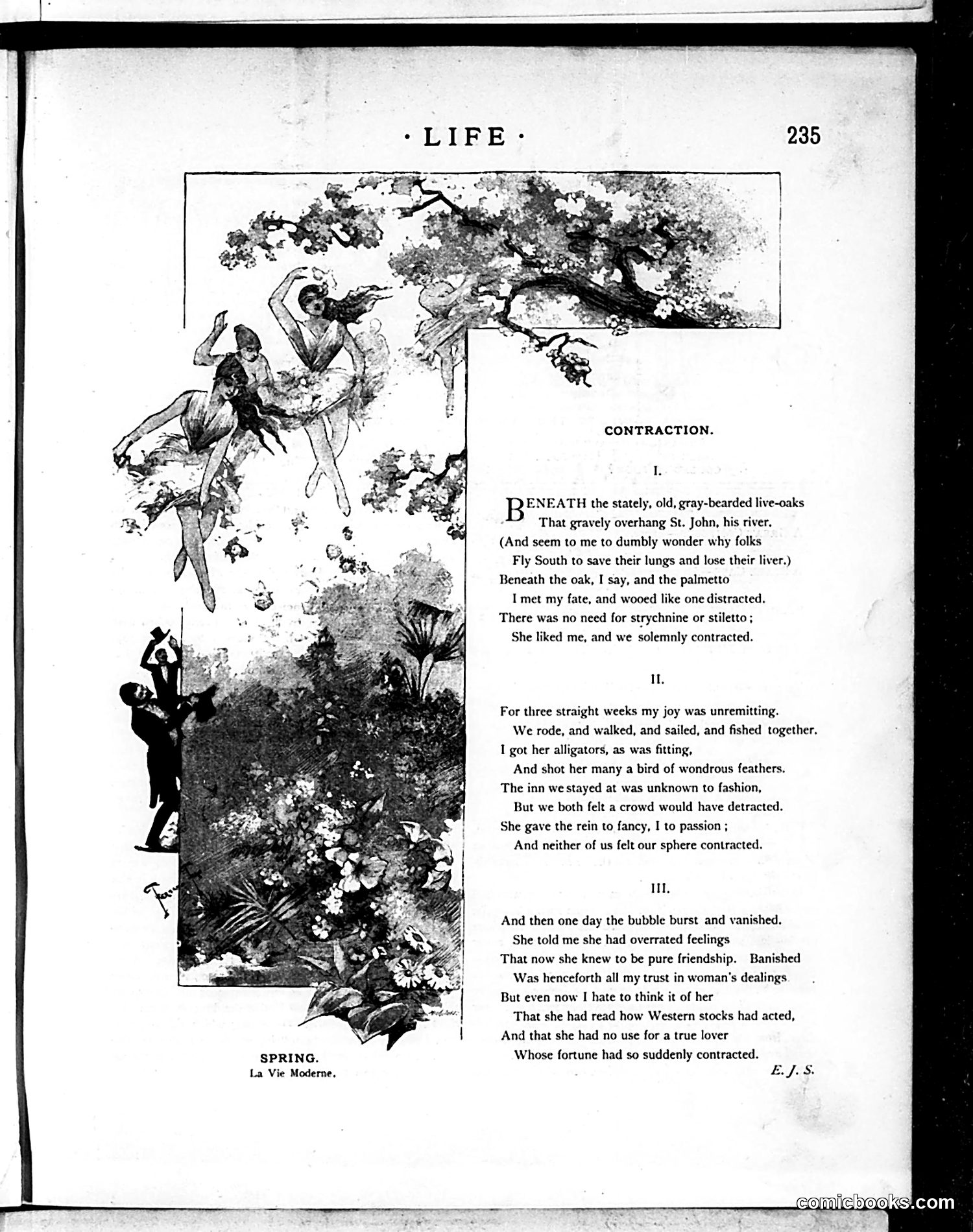
This page combines a decorative illustration titled "Spring" (credited to "La Vie Moderne," a French publication) with a three-part poem about romantic disappointment. The poem satirizes a romantic encounter in the American South (St. John's River, Florida). A man woos a woman beneath oak trees, and they enjoy an idyllic three-week courtship with outdoor activities. However, the relationship suddenly ends when she claims to have overrated her feelings. The satirical twist emerges in Part III: the real reason for the breakup is financial. She abandoned him after learning that "Western stocks had acted" poorly—his fortune has "contracted." The poem's repeated use of "contracted" (engagement, constricted circumstances, financial contraction) creates the central joke: her sudden shift from romantic passion to pragmatic self-interest reveals that her affection was merely mercenary. The satire targets women's supposed cupidity and the transactional nature of courtship among those concerned with wealth.
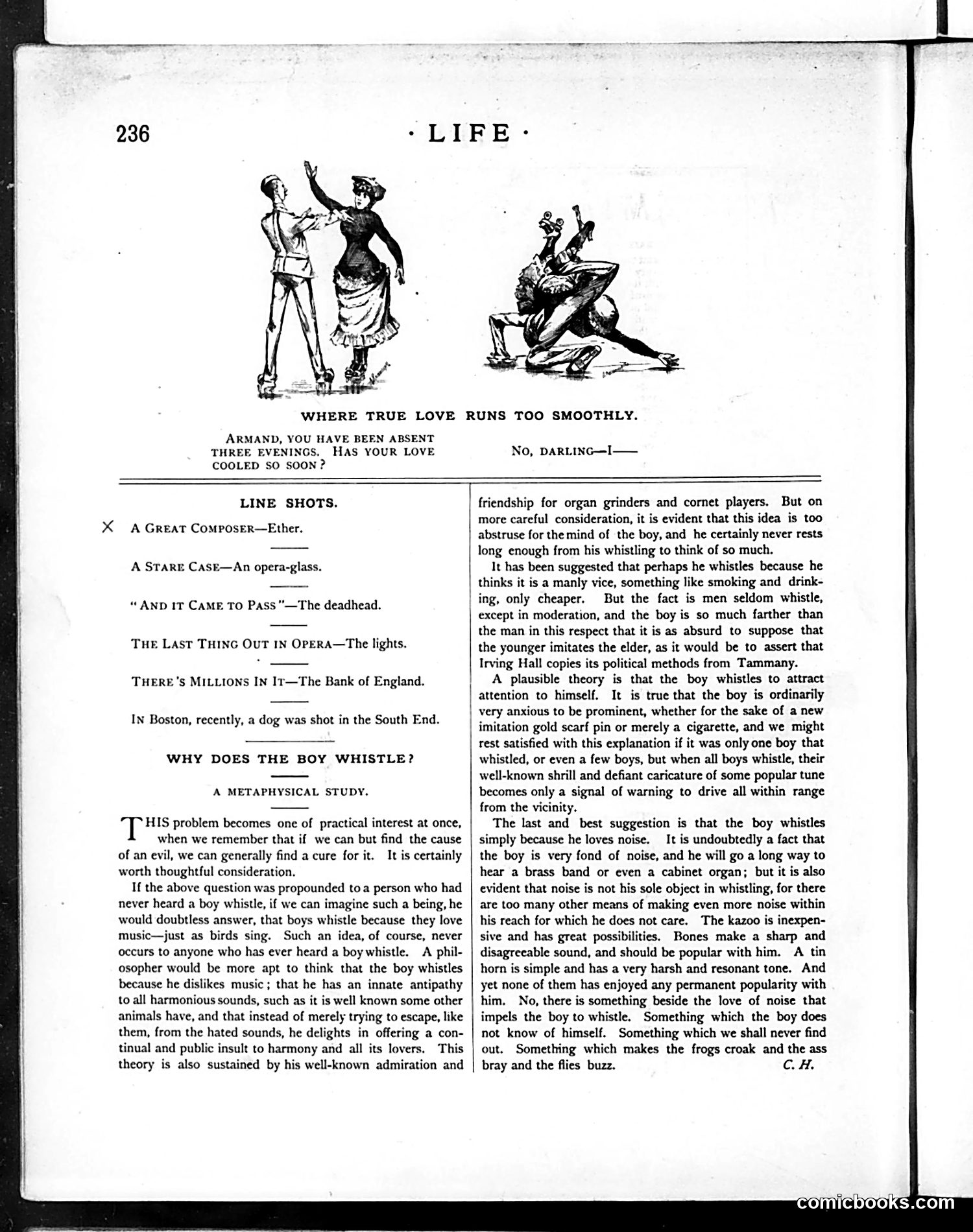
This page contains two separate satirical pieces from an early 20th-century American humor magazine. **Top Cartoon**: "Where True Love Runs Too Smoothly" depicts a romantic scene where a woman confronts her boyfriend Armand about his three-night absence, questioning whether his love has cooled. His response is cut off mid-sentence ("No, darling—I——"), creating humor through the awkward interruption—suggesting he cannot adequately explain himself. **Main Article**: "Why Does the Boy Whistle?" is a humorous philosophical essay analyzing why boys constantly whistle. The author systematically dismisses theories (they love music, imitate men, seek attention, love noise) before concluding that boys whistle from an instinctive impulse they themselves don't understand—"something which makes the frogs croak and the ass bray and the flies buzz." The essay gently mocks pseudo-intellectual over-analysis of simple human behavior. The "Line Shots" section contains brief satirical one-liners about opera, composers, and current events (a Boston dog shooting incident).
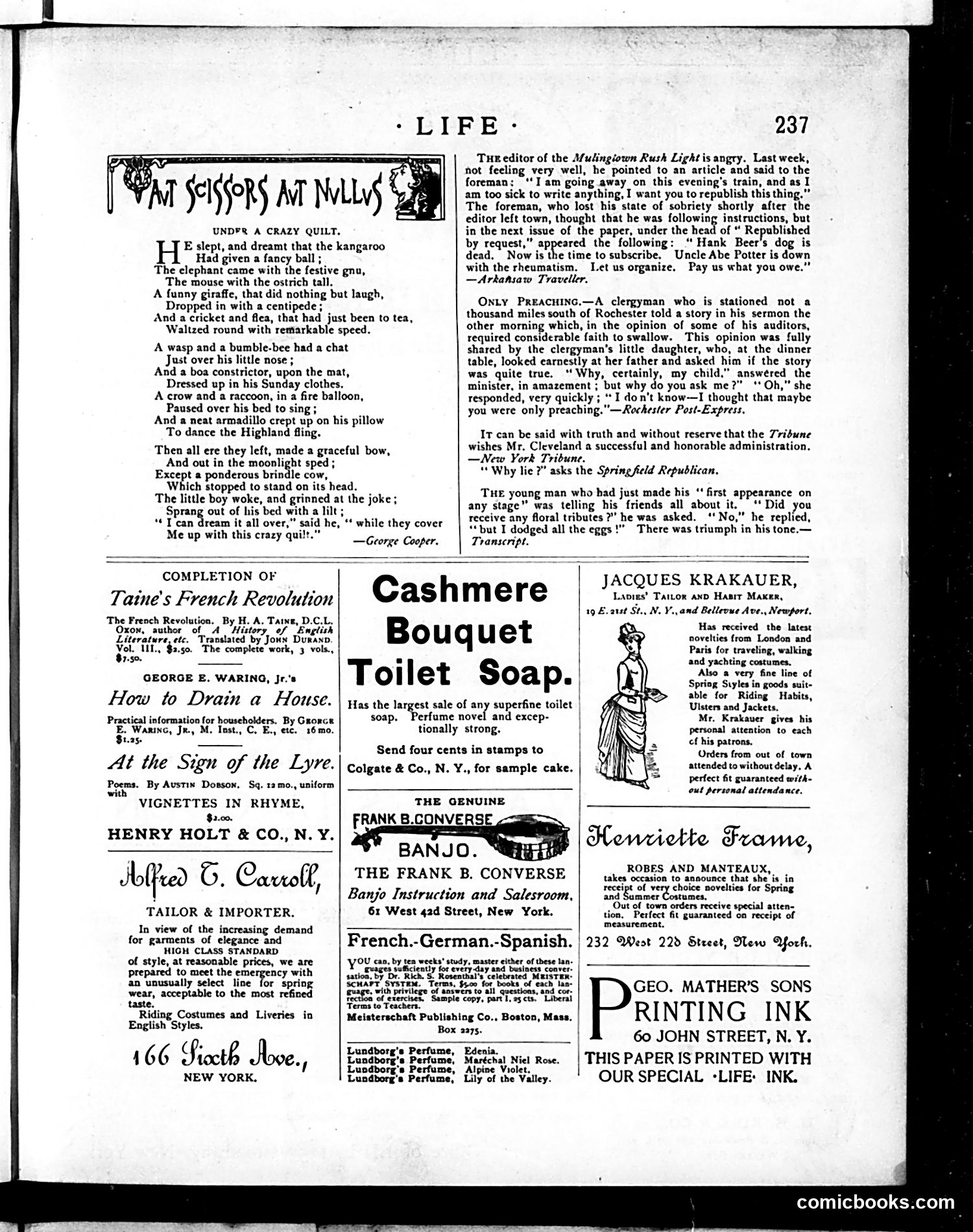
This page is primarily **advertisements and literary content** with minimal political satire. The main visual element is a whimsical poem titled "Under a Crazy Quilt" by George Cooper—a nonsensical verse about animals attending a fancy ball, featuring absurdist humor typical of 19th-century American comic literature. A child dreams of the ridiculous scene and wakes amused. The prose snippets are light satirical anecdotes: a drunk newspaper foreman republishes an old article by mistake; a minister's daughter innocently questions whether his sermon was "preaching" or "dodging truth." These mock human folly gently rather than targeting specific political figures. The remainder consists of book advertisements (Taine's French Revolution, guides on house drainage), product ads (Cashmere Bouquet Soap, perfume, banjos), and business cards for tailors and merchants—typical of Life's mixed content format. **No significant political cartoon or commentary appears on this page.**
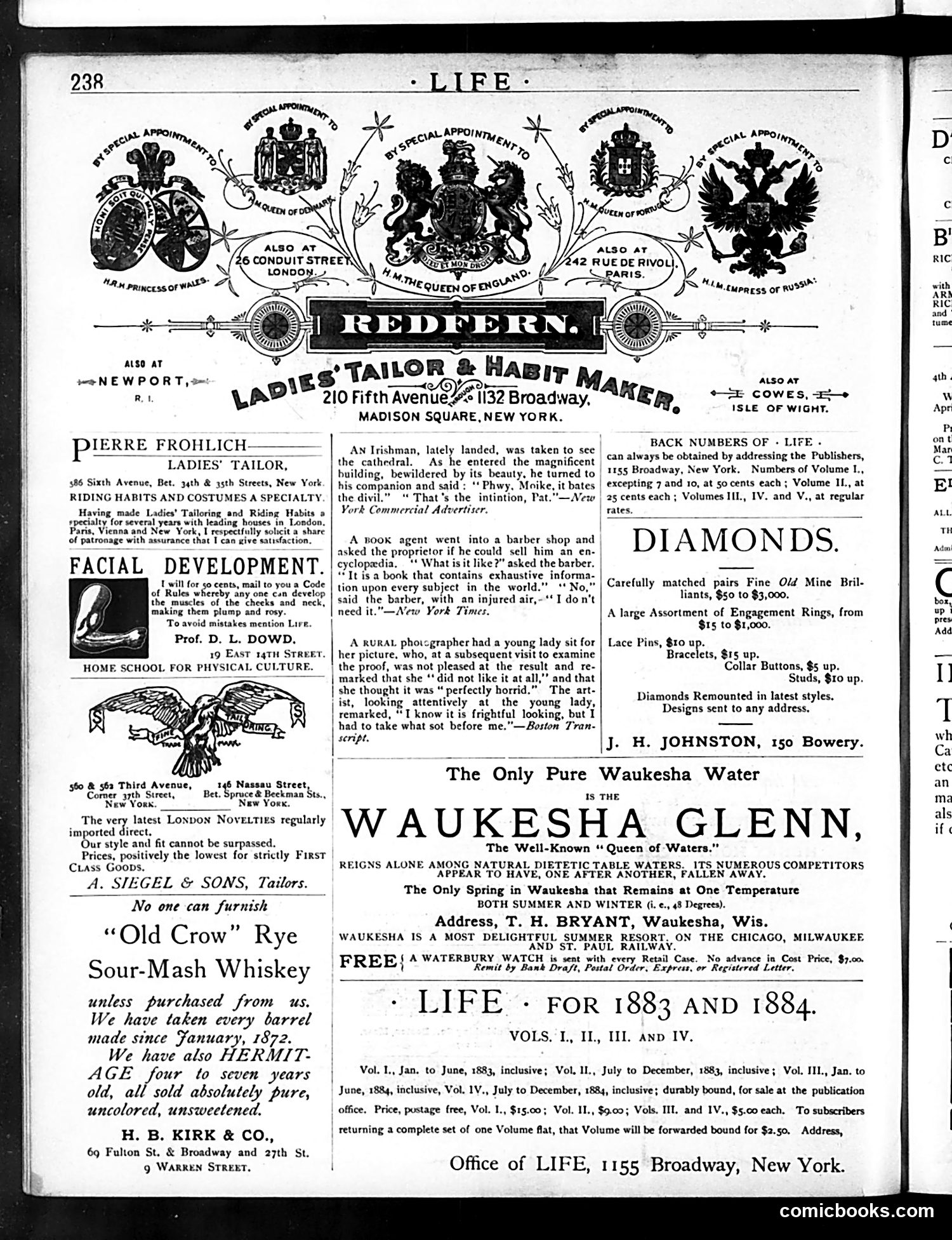
This page is **primarily advertisements** with three brief humorous anecdotes interspersed—typical of *Life* magazine's format during this period. ## The Humor/Satire Content: The three short jokes mock **immigrant naiveté and professional incompetence**: 1. **Irish immigrant** visiting a cathedral finds it overwhelmingly grand, thinking it surpasses even divine creation—playing on stereotypes of Irish immigrants' amazement at American scale and grandeur. 2. **Barber rejects encyclopedia** claiming he doesn't need exhaustive knowledge—satire of working-class anti-intellectualism and practical self-sufficiency. 3. **Photographer blames his subject** for a poor portrait, suggesting the young woman herself is "frightful looking"—humor at the photographer's rudeness and the woman's vanity. ## Advertisement Context: The page features high-end services (tailoring, diamonds, whiskey, mineral water) targeting wealthy New Yorkers, contrasting sharply with the working-class subjects of the jokes—reflecting *Life's* audience of educated, affluent readers who could appreciate this social humor.
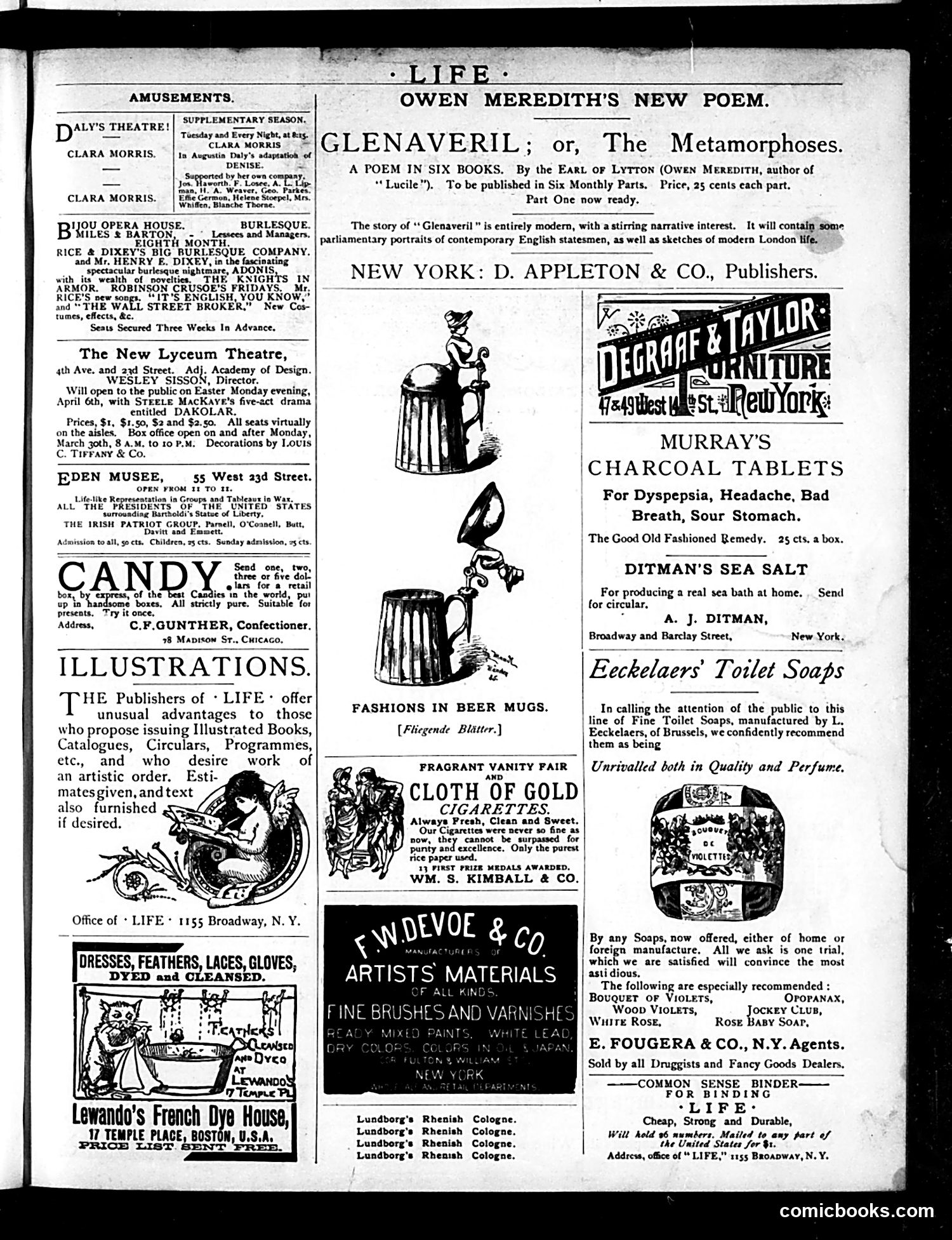
This is primarily an **advertising and announcements page** from Life magazine, with minimal satirical content. The page showcases: **Main Featured Content:** - Advertisement for Owen Meredith's new poem *Glenaveril*, described as modern with "parliamentary portraits of contemporary English statesmen" and London scenes - Multiple theatrical announcements (Clara Morris performances, burlesque shows, new Lyceum Theatre) **Advertisements include:** - Patent medicines (Murray's Charcoal Tablets, Ditman's Sea Salt) - Toiletries (Ecekelaers soaps, Lundborg's cologne) - Luxury goods (DeGraaf & Taylor furniture, cigarettes) - Services (French dye house, candy confectioner) **Visual Elements:** The beer mug fashion illustrations (captioned "Fashions in Beer Mugs" from *Fliegende Blätter*) appear to be the only satirical/humorous graphics—likely European cartoons depicting ornate drinking vessels as humorous fashion trends. The page reflects late 19th-century commercial culture rather than political satire.
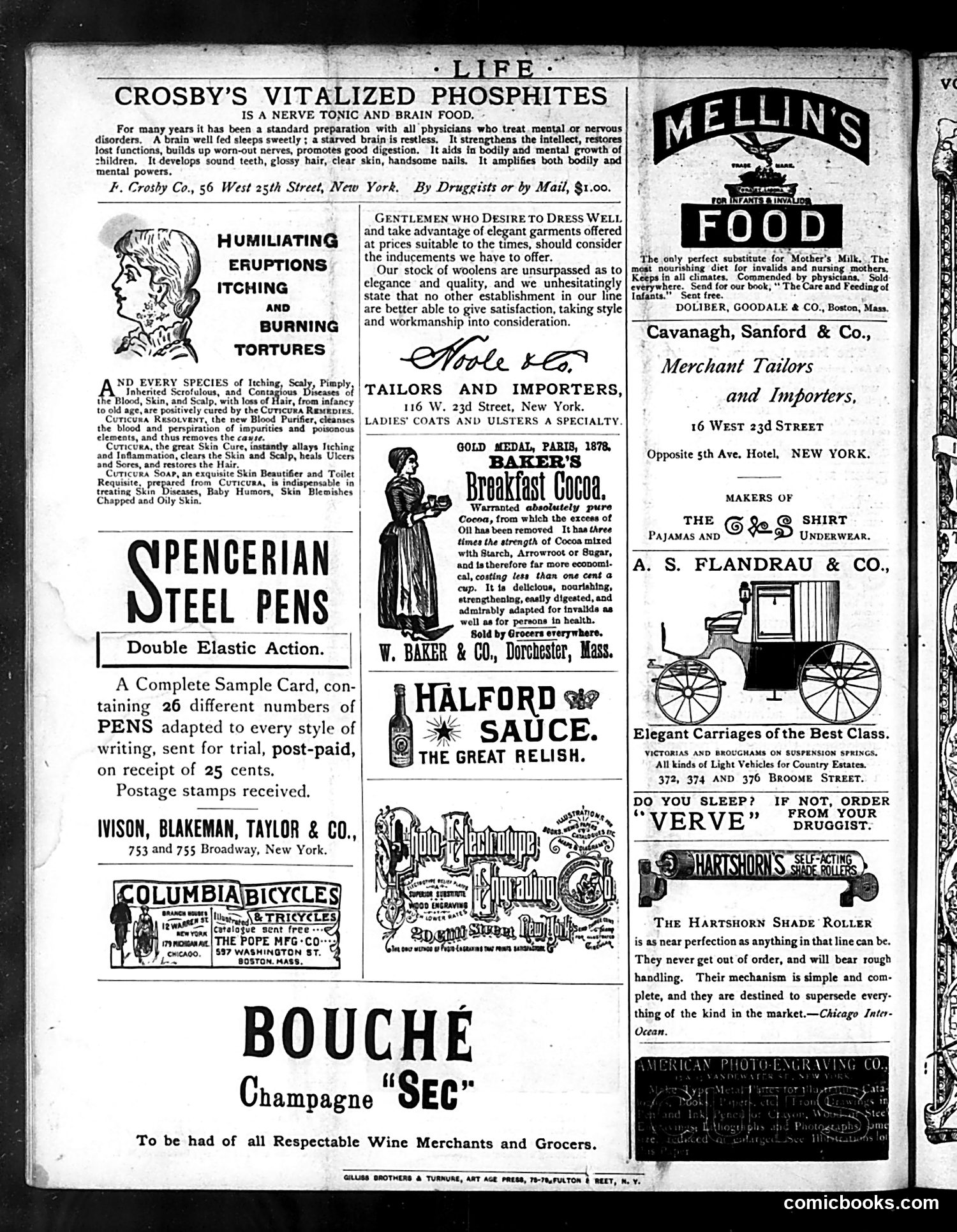
This is primarily an **advertising page** with no political cartoons or satire. The page showcases late 19th-century patent medicines and commercial goods typical of *Life* magazine's revenue model. Notable ads include: - **Crosby's Vitalized Phosphites**: A "nerve tonic" claiming to cure mental disorders and build intellect—representative of the era's unregulated medical claims - **Cuticura products**: Skin treatments for "scrofulous" conditions (syphilis-related diseases), using now-discredited medical terminology - **Baker's Breakfast Cocoa**: Legitimately marketed as nutritious food - **Verve**: A sleep aid from druggists, reflecting period anxiety about insomnia The ads collectively reveal **Victorian-era consumer culture**: gentlemen's tailoring, carriages, writing instruments, and patent medicines promising miraculous cures without scientific evidence. The medical ads particularly showcase how manufacturers exploited public health anxieties before FDA regulation (1906). This page has **historical rather than satirical value**, documenting what advertisers believed would persuade readers.