
Life, 1885-04-23 · page 7 of 16
Life — April 23, 1885 — page 7: what you’re looking at
What you’re looking at
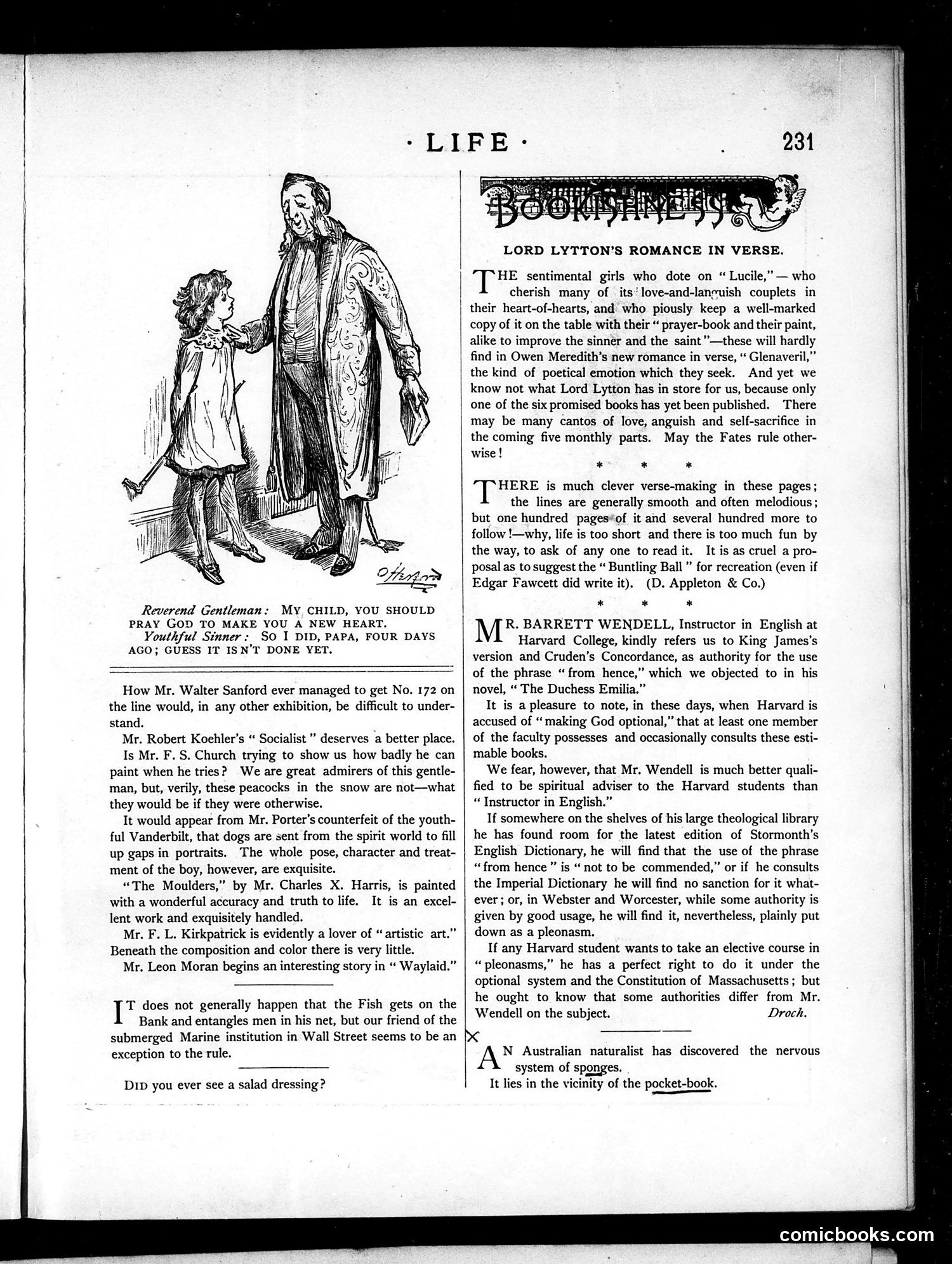
The main illustration shows a bearded clergyman addressing a young child, with the caption: "Reverend Gentleman: My child, you should pray God to make you a new heart. Youthful Sinner: So I did, Papa, four days ago; I guess it isn't done yet." This is a **satirical commentary on religious hypocrisy and childhood innocence**. The joke mocks both the reverend's pious moralizing and the child's literal-minded response. The child has earnestly followed religious instruction but finds no miraculous result, exposing the gap between spiritual promises and observable reality. The cartoon critiques how clergy dispense moral platitudes while children innocently expect literal fulfillment of religious teachings—a common satirical target of *Life* magazine's social commentary.
📄 Transcribed text from this page (OCR, searchable)
Machine-transcribed from the original scan — historical spelling and the odd misread are preserved.
Reverend Gentleman: MyY,CHILD, YOU SHOULD PRAY GOD TO MAKE YOU A NEW HEART. Youthful Sinner: SO 1 DID, PAPA, FOUR DAYS AGO; GUESS IT ISN’T DONE YET. How Mr. Walter Sanford ever managed to get No. 172 on the line would, in any other exhibition, be difficult to under- stand. Mr. Robert Koehler’s “ Socialist” deserves a better place. Is Mr. F. S. Church trying to show us how badly he can paint when he tries? We are great admirers of this gentle- man, but, verily, these peacocks in the snow are not—what they would be if they were otherwise. It would appear from Mr. Porter's counterfeit of the youth- ful Vanderbilt, that dogs are sent from the spirit world to fill up gaps in portraits. The whole pose, character and treat- ment of the boy, however, are exquisite. “The Moulders,” by Mr. Charles X. Harris, is painted with a wonderful accuracy and truth to life. It is an excel- lent work and exquisitely handled. Mr. F. L. Kirkpatrick is evidently a lover of “artistic art.” Beneath the composition and color there is very little. Mr. Leon Moran begins an interesting story in “ Waylaid.” T does not generally happen that the Fish gets on the Bank and entangles men in his net, but our friend of the submerged Marine institution in Wall Street seems to be an exception to the rule. Dip you ever see a salad dressing? LORD LYTTON’S ROMANCE IN VERSE. | HE sentimental girls who dote on “ Lucile,” — who cherish many of its! love-and-lanruish couplets in their heart-of-hearts, and who piously keep a well-marked copy of it on the table with their “ prayer-book and their paint, alike to improve the sinner and the saint””—these will hardly find in Owen Meredith’s new romance in verse, “ Glenaveril,” the kind of poetical emotion which they seek. And yet we know not what Lord Lytton has in store for us, because only one of the six promised books has yet been published. There may be many cantos of love, anguish and self-sacrifice in the coming five monthly parts. May the Fates rule other- wise! * * * HERE is much clever verse-making in these pages; the lines are generally smooth and often melodious ; but one hundred pages*of it and several hundred more to follow !—why, life is too short and there is too much fun by the way, to ask of any one to read it. It is as cruel a pro- posal as to suggest the “ Buntling Ball ” for recreation (even if Edgar Fawcett did write it). (D. Appleton & Co.) * * * R. BARRETT WENDELL, Instructor in English at Harvard College, kindly refers us to King James's version and Cruden’s Concordance, as authority for the use of the phrase “from hence,” which we objected to in his novel, “ The Duchess Emilia.” It is a pleasure to note, in these days, when Harvard is accused of “making God optional,” that at least one member of the faculty possesses and occasionally consults these esti- mable books. We fear, however, that Mr. Wendell is much better quali- fied to be spiritual adviser to the Harvard students than “ Instructor in English.” If somewhere on the shelves of his large theological library he has found room for the latest edition of Stormonth’s English Dictionary, he will find that the use of the phrase “from hence ” is “ not to be commended,” or if he consults the Imperial Dictionary he will find no sanction for it what- ever ; or, in Webster and Worcester, while some authority is given by good usage, he will find it, nevertheless, plainly put down as a pleonasm. If any Harvard student wants to take an elective course in “pleonasms,” he has a perfect right to do it under the optional system and the Constitution of Massachusetts; but he ought to know that some authorities differ from Mr. Wendell on the subject. Droch. i a N Australian naturalist has discovered the nervous system of sponges. It lies in the vicinity of the pocket-book. — comicbooks.com