
Life, 1885-04-23 · page 12 of 16
Life — April 23, 1885 — page 12: what you’re looking at
What you’re looking at
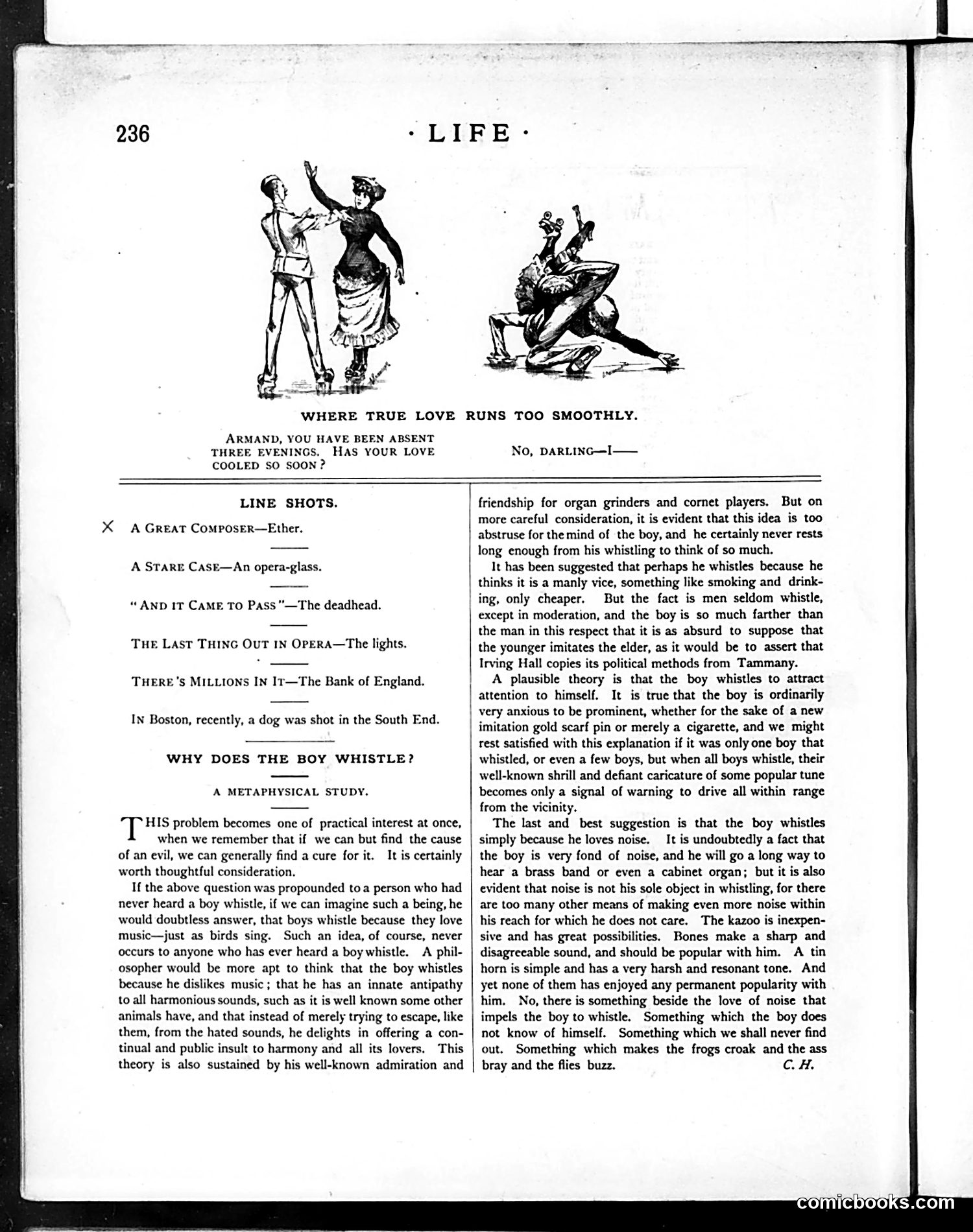
This page contains two separate satirical pieces from an early 20th-century American humor magazine. **Top Cartoon**: "Where True Love Runs Too Smoothly" depicts a romantic scene where a woman confronts her boyfriend Armand about his three-night absence, questioning whether his love has cooled. His response is cut off mid-sentence ("No, darling—I——"), creating humor through the awkward interruption—suggesting he cannot adequately explain himself. **Main Article**: "Why Does the Boy Whistle?" is a humorous philosophical essay analyzing why boys constantly whistle. The author systematically dismisses theories (they love music, imitate men, seek attention, love noise) before concluding that boys whistle from an instinctive impulse they themselves don't understand—"something which makes the frogs croak and the ass bray and the flies buzz." The essay gently mocks pseudo-intellectual over-analysis of simple human behavior. The "Line Shots" section contains brief satirical one-liners about opera, composers, and current events (a Boston dog shooting incident).
📄 Transcribed text from this page (OCR, searchable)
Machine-transcribed from the original scan — historical spelling and the odd misread are preserved.
WHERE TRUE LOVE RUNS TOO SMOOTHLY. ARMAND, YOU HAVE BEEN ABSENT THREE EVENINGS, HAS YOUR LOVE COOLED SO SOON? No, DARLING—I—— LINE SHOTS. A Great Composer—Ether. A STARE CaSE—An opera-glass. “ AND IT CAME TO PAS: ‘The deadhead. THE Last THING OuT IN OPERA—The lights. THERE'S MILLIONS IN It—The Bank of England. IN Boston, recently, a dog was shot in the South End. WHY DOES THE BOY WHISTLE? A METAPHYSICAL STUDY. T HIS problem becomes one of practical interest at once, when we remember that if we can but find the cause of an evil, we can generally find a cure for it. worth thoughtful consideration. If the above question was propounded toa person who had never heard a boy whistle, if we can imagine such a being, he would doubtless answer, that boys whistle because they love music—just as birds sing. Such an idea, of course, never occurs to anyone who has ever heard a boy whistle. A phil- osopher would be more apt to think that the boy whistles because he dislikes music; that he has an innate antipathy to all harmonious sounds, such as it is well known some other animals have, and that instead of merely trying to escape, like them, from the hated sounds, he delights in offering a con- tinual and public insult to harmony and all its lovers. This theory is also sustained by his well-known admiration and It is certainly | out. friendship for organ grinders and cornet players. But on more careful consideration, it is evident that this idea is too abstruse for the mind of the boy, and he certainly never rests long enough from his whistling to think of so much. It has been suggested that perhaps he whistles because he thinks it is a manly vice, something like smoking and drink- ing, only cheaper. But the fact is men seldom whistle, except in moderation, and the boy is so much farther than the man in this respect that it is as absurd to suppose that the younger imitates the elder, as it would be to assert that Irving Hall copies its political methods from Tammany. A plausible theory is that the boy whistles to attract attention to himself. It is true that the boy is ordinarily | very anxious to be prominent, whether for the sake of a new | imitation gold scarf pin or merely a cigarette, and we might rest satisfied with this explanation if it was only one boy that whistled, or even a few boys, but when all boys whistle, their well-known shrill and defiant caricature of some popular tune becomes only a signal of warning to drive all within range from the vicinity. The last and best suggestion is that the boy whistles simply because he loves noise. It is undoubtedly a fact that the boy is very fond of noise, and he will go a long way to hear a brass band or even a cabinet organ; but it is also evident that noise is not his sole object in whistling, for there are too many other means of making even more noise within his reach for which he does not care. The kazoo is inexpen- sive and has great possibilities. Bones make a sharp and disagreeable sound, and should be popular with him. A tin horn is simple and has a very harsh and resonant tone. And yet none of them has enjoyed any permanent popularity with him. No, there is something beside the love of noise that impels the boy to whistle. Something which the boy does not know of himself. Something which we shall never find Something which makes the frogs croak and the ass bray and the flies buzz. CH.