
Life, 1885-04-23 · page 6 of 16
Life — April 23, 1885 — page 6: what you’re looking at
What you’re looking at
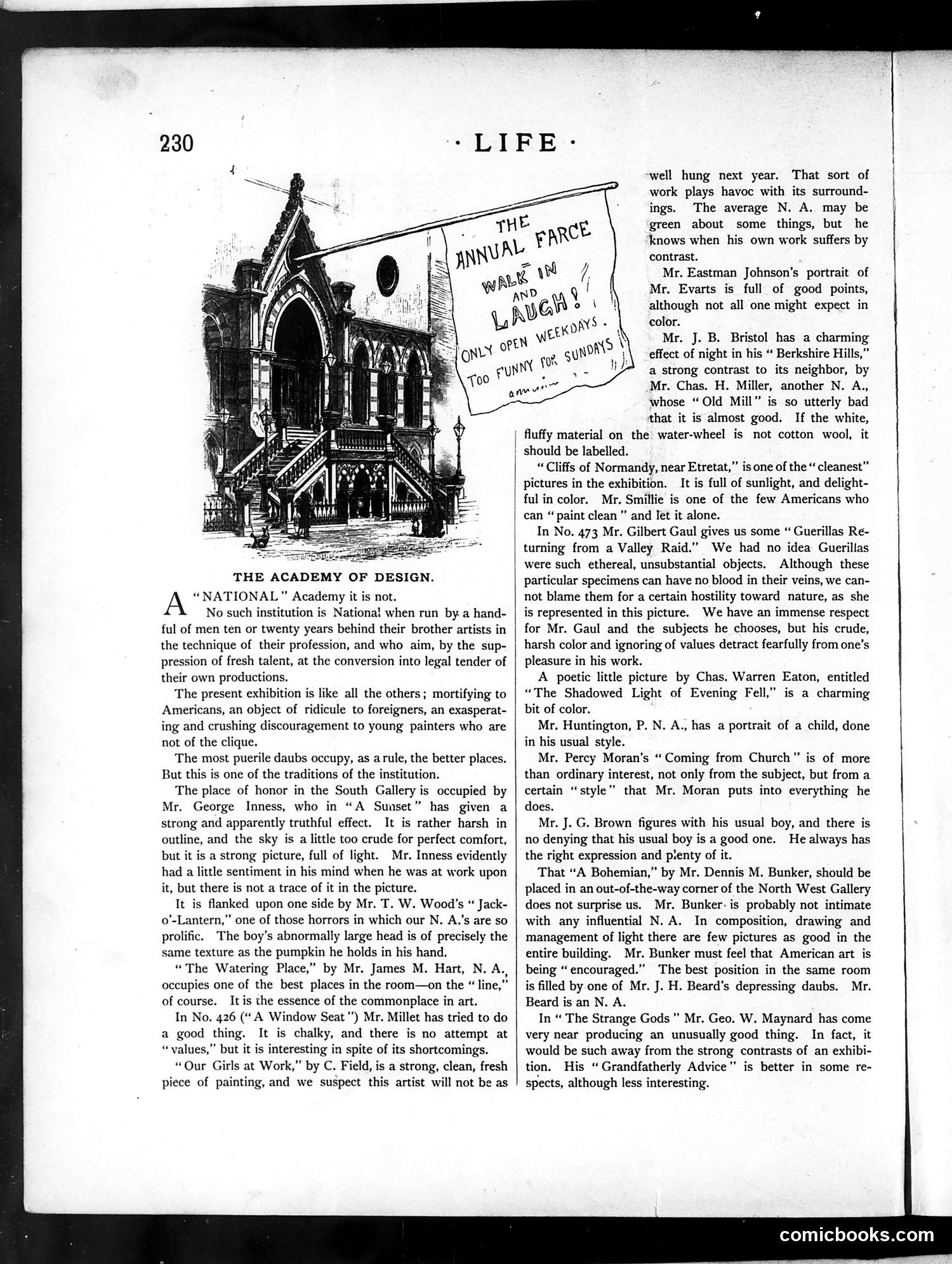
The main illustration shows a ornate theater building with a banner reading "THE ANNUAL FARCE / WALK IN / AND LAUGH / ONLY OPEN WEEKDAYS / TOO FUNNY FOR SUNDAYS." This is captioned "THE ACADEMY OF DESIGN." The satire critiques a national academy's art exhibition as a "farce"—suggesting the institution's judgment is poor and its shows are laughable rather than serious artistic venues. The joke that it's "too funny for Sundays" implies the work is so bad it's unintentionally comic. The accompanying text reviews specific paintings from this exhibition, harshly criticizing many works by National Academicians (N.A.s) while praising a few non-members, reinforcing the satirical point: the academy's official seal of approval means little; genuine talent often comes from outside establishment circles.
📄 Transcribed text from this page (OCR, searchable)
Machine-transcribed from the original scan — historical spelling and the odd misread are preserved.
THE ACADEMY OF DESIGN. A “NATIONAL” Academy it is not. No such institution is Nationa! when run by a hand- ful of men ten or twenty years behind their brother artists in the technique of their profession, and who aim, by the sup- pression of fresh talent, at the conversion into legal tender of their own productions. The present exhibition is like all the others; mortifying to Americans, an object of ridicule to foreigners, an exasperat- ing and crushing discouragement to young painters who are not of the clique. The most puerile daubs occupy, as arule, the better places. But this is one of the traditions of the institution. The place of honor in the South Gallery is occupied by Mr. George Inness, who in “A Sunset” has given a strong and apparently truthful effect. It is rather harsh in outline, and the sky is a little too crude for perfect comfort, but it is a strong picture, full of light. Mr. Inness evidently had a little sentiment in his mind when he was at work upon it, but there is not a trace of it in the picture. It is flanked upon one side by Mr. T. W. Wood's “ Jack- o’-Lantern,” one of those horrors in which our N. A.’s are so prolific. The boy’s abnormally large head is of precisely the same texture as the pumpkin he holds in his hand. “The Watering Place,” by Mr. James M. Hart, N. A. occupies one of the best places in the room—on the “ line,” of course. It is the essence of the commonplace in art. In No. 426 (“A Window Seat”’) Mr. Millet has tried to do a good thing. It is chalky, and there is no attempt at “values,” but it is interesting in spite of its shortcomings. “Our Girls at Work,” by C. Field, is a strong, clean, fresh piece of painting, and we suspect this artist will not be as well hung next year. That sort of work plays havoc with its surround- ings. The average N. A. may be green about some things, but he ‘knows when his own work suffers by contrast. Mr. Eastman Johnson’s portrait of Mr. Evarts is full of good points, although not all one might expect in color. Mr. J. B. Bristol has a charming effect of night in his “ Berkshire Hills,” a strong contrast to its neighbor, by Mr. Chas. H. Miller, another N. A., whose “Old Mill” is so utterly bad that it is almost good. If the white, | fluffy material on the’ water-wheel is not cotton wool, it | should be labelled. “ Cliffs of Normandy, near Etretat,” is one of the “cleanest” pictures in the exhibition. It is full of sunlight, and delight- | ful in color. Mr. Smillie is one of the few Americans who can “paint clean” and let it alone. In No. 473 Mr. Gilbert Gaul gives us some “ Guerillas Re- turning from a Valley Raid.” We had no idea Guerillas were such ethereal, unsubstantial objects. Although these particular specimens can have no blood in their veins, we can- not blame them for a certain hostility toward nature, as she is represented in this picture. We have an immense respect for Mr. Gaul and the subjects he chooses, but his crude, harsh color and ignoring of values detract fearfully from one’s pleasure in his work. A poetic little picture by Chas. Warren Eaton, entitled “The Shadowed Light of Evening Fell,” is a charming bit of color. Mr. Huntington, P. N. A., has a portrait of a child, done in his usual style. Mr. Percy Moran’s “Coming from Church” is of more than ordinary interest, not only from the subject, but from a certain “style” that Mr. Moran puts into everything he does. Mr. J. G. Brown figures with his usual boy, and there is no denying that his usual boy is a good one. He always has the right expression and pienty of it. That “A Bohemian,” by Mr. Dennis M. Bunker, should be placed in an out-of-the-way corner of the North West Gallery does not surprise us. Mr. Bunker: is probably not intimate with any influential N. A. In composition, drawing and management of light there are few pictures as good in the entire building. Mr. Bunker must feel that American art is being “encouraged.” The best position in the same room is filled by one of Mr. J. H. Beard’s depressing daubs. Mr. Beard is an N. A. In “ The Strange Gods ” Mr. Geo. W. Maynard has come very near producing an unusually good thing. In fact, it would be such away from the strong contrasts of an exhibi- tion. His “Grandfatherly Advice” is better in some re- spects, although less interesting. comicbooks.com