
Life, 1885-04-23 · page 10 of 16
Life — April 23, 1885 — page 10: what you’re looking at
What you’re looking at
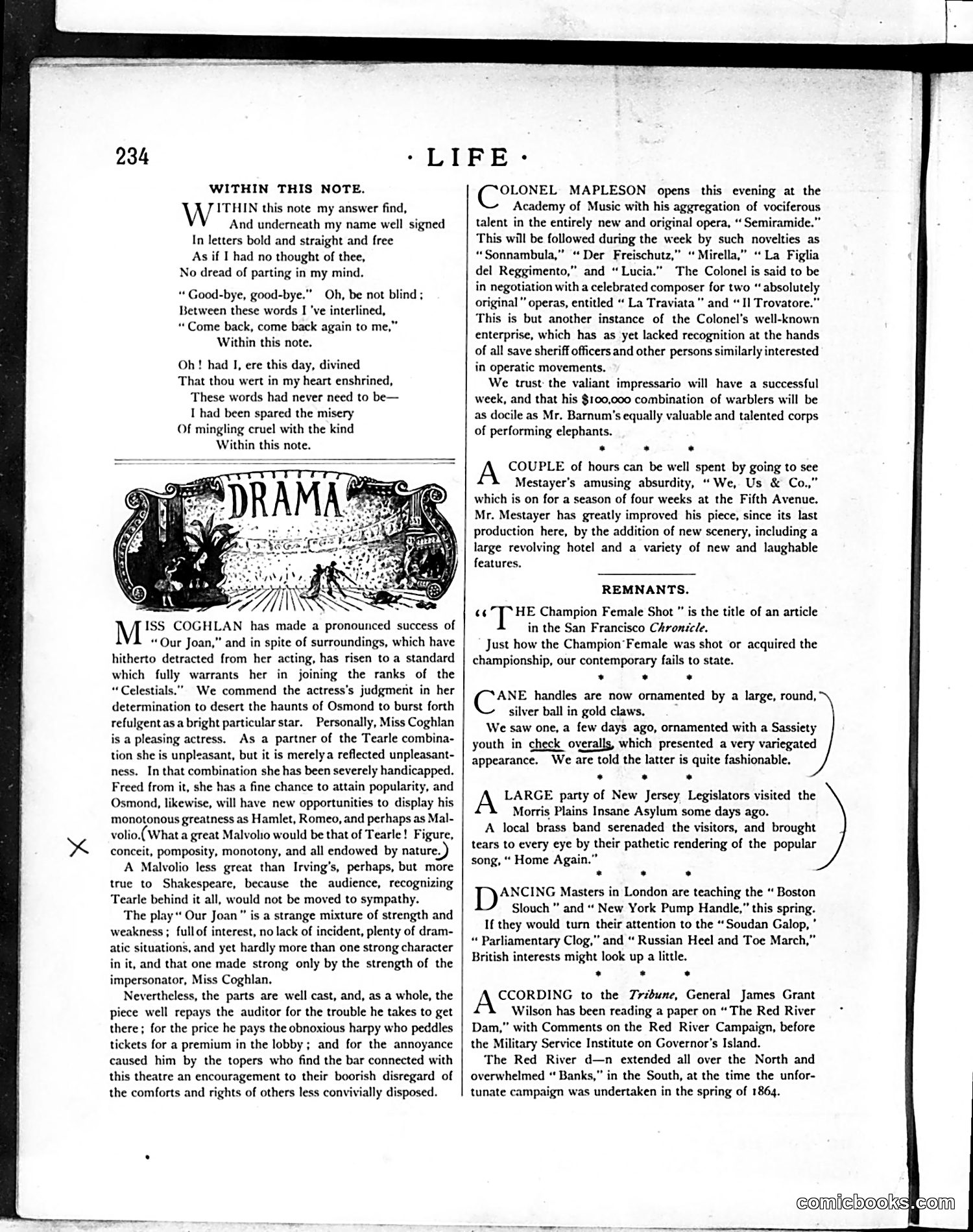
This page from *Life* magazine contains theatrical reviews and social commentary typical of the publication's satirical approach to 1860s-70s American culture. **Key Content:** The page opens with a sentimental love poem ("Within This Note"), then pivots to theater criticism. Miss Coghlan is praised for her role in "Our Joan," with the critic noting she's risen above her previous work despite being hampered by her partnership with actor Tearle (likely the Tearle theatrical family). The review backhands Tearle, suggesting he plays dramatic roles with mechanical monotony rather than genuine feeling. **Satirical Target:** Colonel Mapleson (opera impresario) receives mocking criticism for promoting "entirely new and original opera" while simultaneously staging established works. The barb comparing his $100,000 opera company to "Mr. Barnum's equally valuable and talented corps of performing elephants" equates his singers with circus acts—suggesting commercialism over artistry. The page reflects *Life*'s characteristic blend of entertainment coverage with pointed social satire about artistic pretension and theatrical commerce.
📄 Transcribed text from this page (OCR, searchable)
Machine-transcribed from the original scan — historical spelling and the odd misread are preserved.
* LIFE: WITHIN THIS NOTE. W ITHIN this note my answer find, And underneath my name well signed In letters bold and straight and free As if I had no thought of thee, No dread of parting in my mind. “Good-bye, good-bye.” Oh, be not blind ; Between these words I ‘ve interlined, “Come back, come back again to me,” Within this note. Oh! had I, ere this day, divined That thou wert in my heart enshrined, These words had never need to be— I had been spared the misery Of mingling cruel with the kind Within this note. SS COGHLAN has made a pronounced success of “Our Joan,” and in spite of surroundings, which have hitherto detracted from her acting, has risen to a standard which fully warrants her in joining the ranks of the “Celestials.” We commend the actress's judgment in her determination to desert the haunts of Osmond to burst forth refulgent asa bright particular star. Personally, Miss Coghlan is a pleasing actress. As a partner of the Tearle combina- tion she is unpleasant, but it is merely a reflected unpleasant- ness. In that combination she has been severely handicapped. Freed from it, she has a fine chance to attain popularity, and Osmond, likewise, will have new opportunities to display his monotonous greatness as Hamlet, Romeo, and perhaps as Mal- volio.(What a great Malvolio would be that of Tearle! Figure, conceit, pomposity, monotony, and all endowed by nature.) A Malvolio less great than Irving’s, perhaps, but more true to Shakespeare, because the audience, recognizing Tearle behind it all, would not be moved to sympathy. The play“ Our Joan” is a strange mixture of strength and weakness ; fullof interest, no lack of incident, plenty of dram- atic situations, and yet hardly more than one strong character in it, and that one made strong only by the strength of the impersonator, Miss Coghlan. Nevertheless, the parts are well cast, and, as a whole, the piece well repays the auditor for the trouble he takes to get there; for the price he pays the obnoxious harpy who peddles tickets for a premium in the lobby; and for the annoyance caused him by the topers who find the bar connected with this theatre an encouragement to their boorish disregard of the comforts and rights of others less convivially disposed. (GSEOREE MAPLESON opens this evening at the Academy of Music with his aggregation of vociferous talent in the entirely new and original opera, ‘‘ Semiramide.” This will be followed during the week by such novelties as “Sonnambula,” “Der Freischutz,” “Mirella,” “La Figlia del Reggimento,” and “Lucia.” The Colonel is said to be in negotiation with a celebrated composer for two “ absolutely original” operas, entitled “ La Traviata" and “II Trovatore.” This is but another instance of the Colonel's well-known enterprise, which has as yet lacked recognition at the hands of all save sheriff officers and other persons similarly interested in operatic movements. We trust the valiant impressario will have a successful week, and that his $100,000 combination of warblers will be as docile as Mr. Barnum’s equally valuable and talented corps of performing elephants. . . . A COUPLE of hours can be well spent by going to see Mestayer’s amusing absurdity, “We, Us & Co.,” which is on for a season of four weeks at the Fifth Avenue. Mr. Mestayer has greatly improved his piece, since its last production here, by the addition of new scenery, including a large revolving hotel and a variety of new and laughable features, REMNANTS. “c HE Champion Female Shot ” is the title of an article in the San Francisco Chronicle. Just how the Champion’Female was shot or acquired the championship, our contemporary fails to state. . . . ANE handles are now ornamented by a large, round, silver ball in gold claws. We saw one, a few days ago, ornamented with a Sassiety youth in check overalls, which presented a very variegated appearance. We are told the latter is quite fashionable. . . . LARGE party of New Jersey Legislators visited the Morris Plains Insane Asylum some days ago. A local brass band serenaded the visitors, and brought tears to every eye by their pathetic rendering of the popular song, “ Home Again.” * . . ANCING Masters in London are teaching the “ Boston Slouch ” and “ New York Pump Handle,” this spring. If they would turn their attention to the “Soudan Galop, * “ Parliamentary Clog,” and “ Russian Heel and Toe March,” British interests might look up a little. . . * CCORDING to the 7rtbune, General James Grant Wilson has been reading a paper on “ The Red River Dam,” with Comments on the Red River Campaign, before the Military Service Institute on Governor's Island. ‘The Red River d—n extended all over the North and overwhelmed “ Banks,” in the South, at the time the unfor- tunate campaign was undertaken in the spring of 1864.