
A complete issue · 16 pages · 1885
Life — April 9, 1885
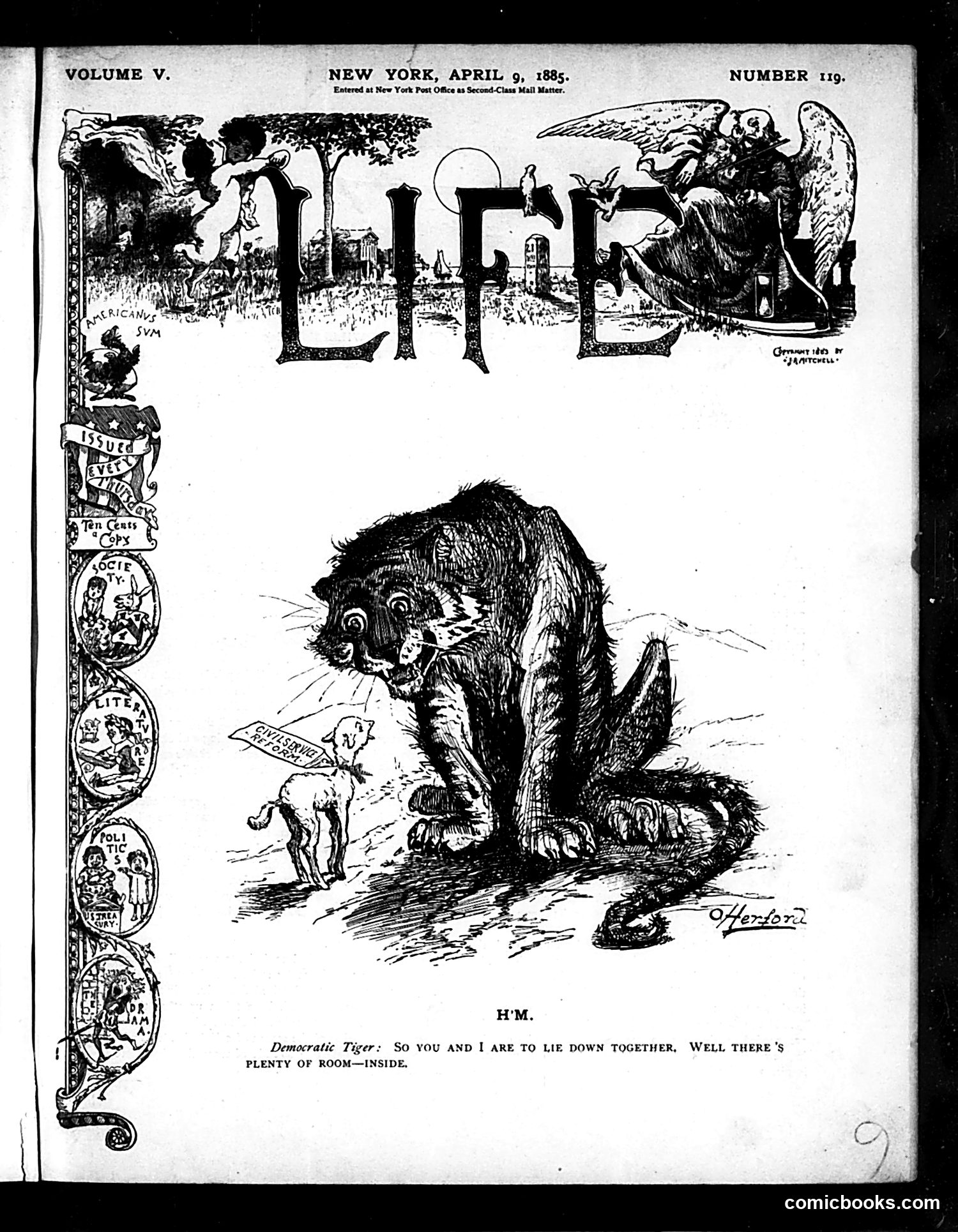
This cartoon depicts a large tiger (labeled "Democratic Tiger") confronting a smaller animal, with the caption: "So you and I are to lie down together. Well there's plenty of room—inside." The satire appears to reference post-Civil War political tensions between Democrats and Republicans. The "Democratic Tiger" represents the Democratic Party, while the smaller creature likely represents the Republican Party or a Republican political figure. The threatening phrase "plenty of room—inside" suggests the tiger intends to consume or absorb its rival, implying Democratic intentions to dominate or eliminate Republican political power. This reflects 1880s anxieties about which party would control post-Reconstruction America's political future.
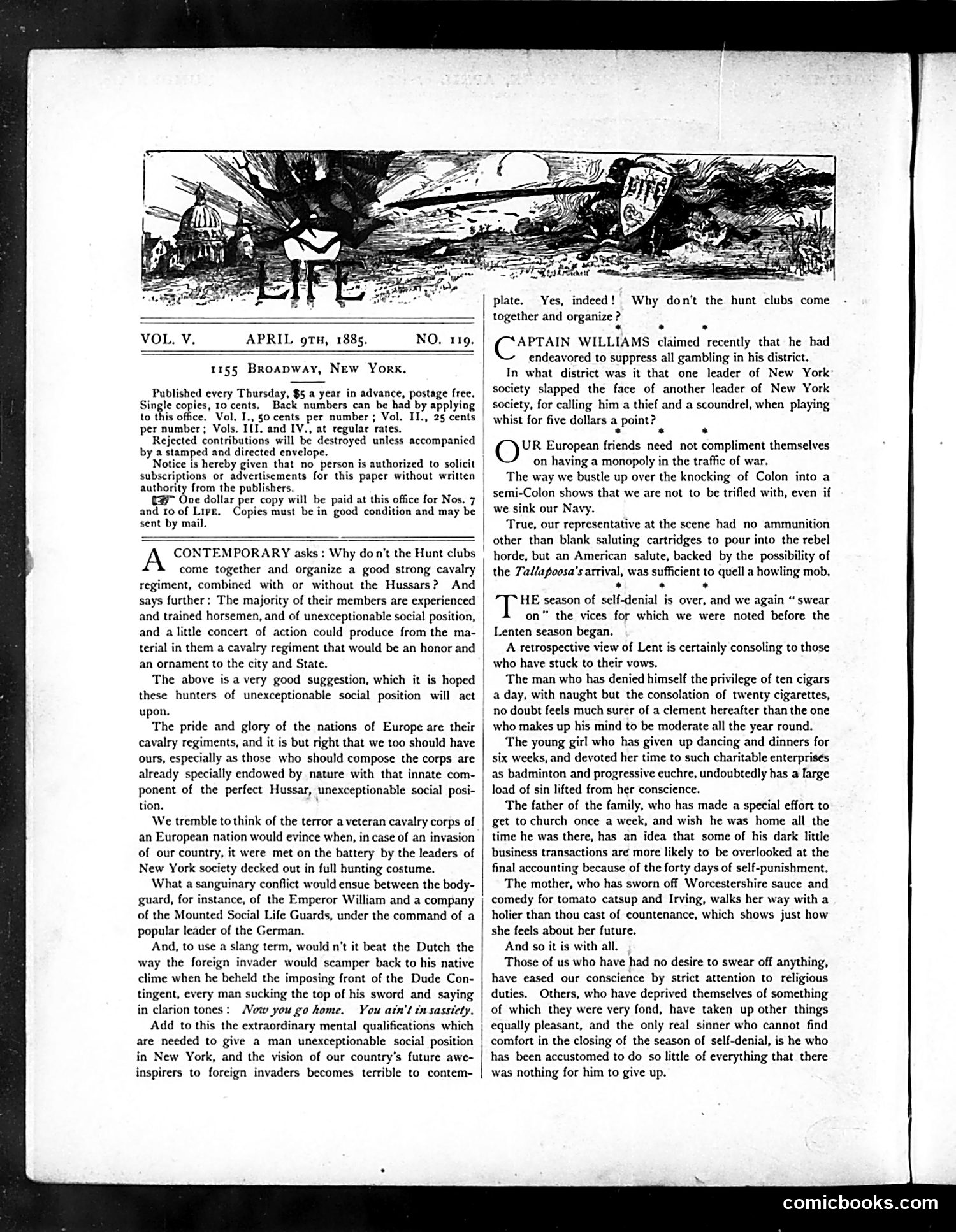
The page contains satirical editorial commentary rather than a cartoon. The main piece responds to a reader's suggestion that Hunt clubs organize a cavalry regiment to defend against invasion. The editors mock this proposal by sarcastically praising the "social position" of hunt club members, suggesting they lack military competence despite their elite status. They reference potential European invasion (likely German, given mention of "Emperor William") and ridicule the notion that wealthy New York society figures could serve as effective soldiers. The satire targets the gap between upper-class pretension and practical ability—implying that social standing and fox-hunting experience do not qualify one for actual military service or national defense.
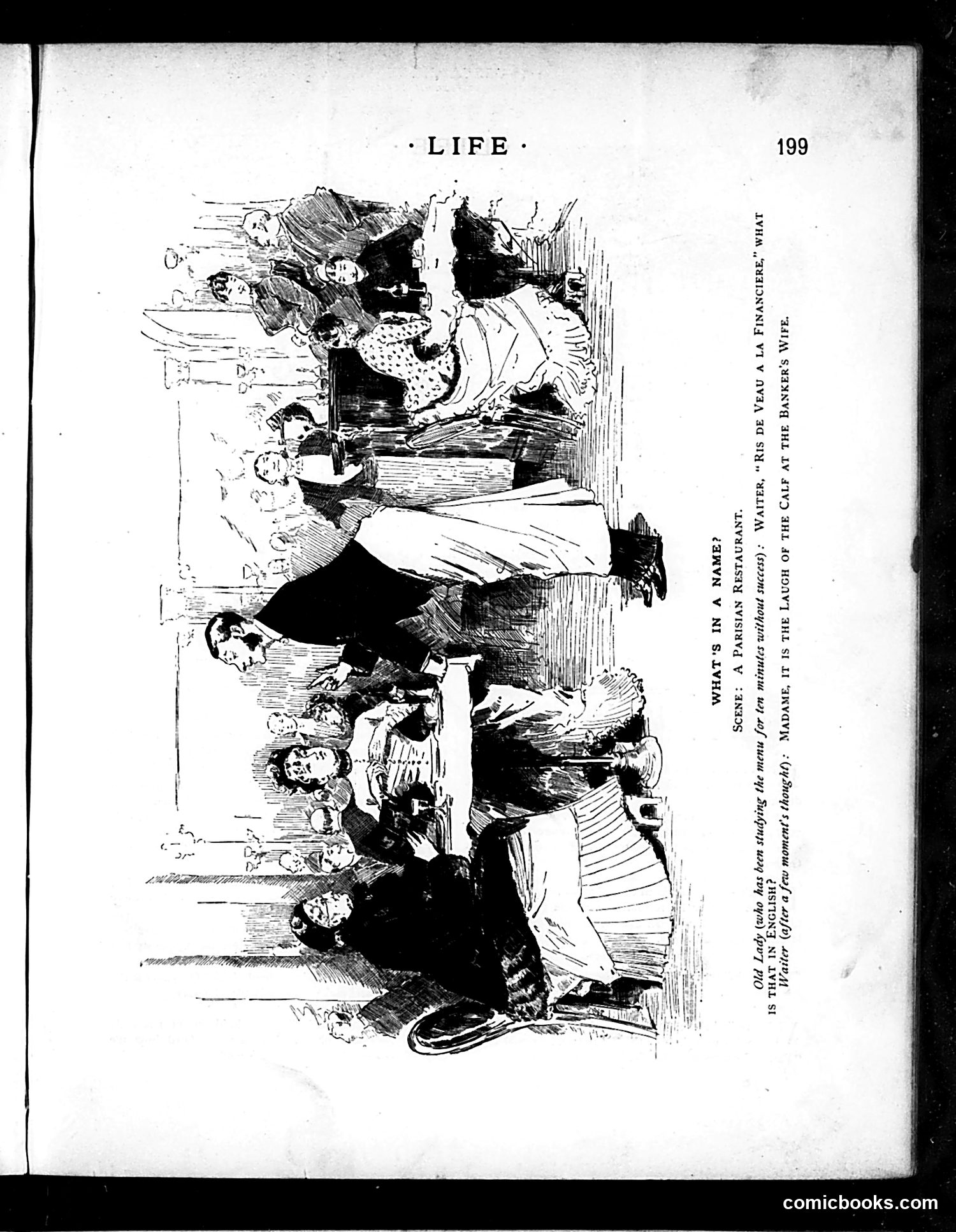
This page from *Life* magazine (page 199) contains a sketch titled "Weber's in a Jamb" depicting what appears to be a theatrical or domestic scene with multiple figures. The caption references "a Pension Restaurant" and mentions "Weber" and "the banker's wife," suggesting this is satire about a specific scandal or social situation involving these individuals. The sketch shows several people in what appears to be an awkward or compromising social gathering. Without clearer identification of the specific historical figures or scandal referenced, I cannot confidently identify which particular "Weber" or banking scandal this targets. The humor likely relies on contemporary knowledge of a specific society or theatrical event that would have been familiar to 1900s-era *Life* readers but requires additional historical context to fully explain.
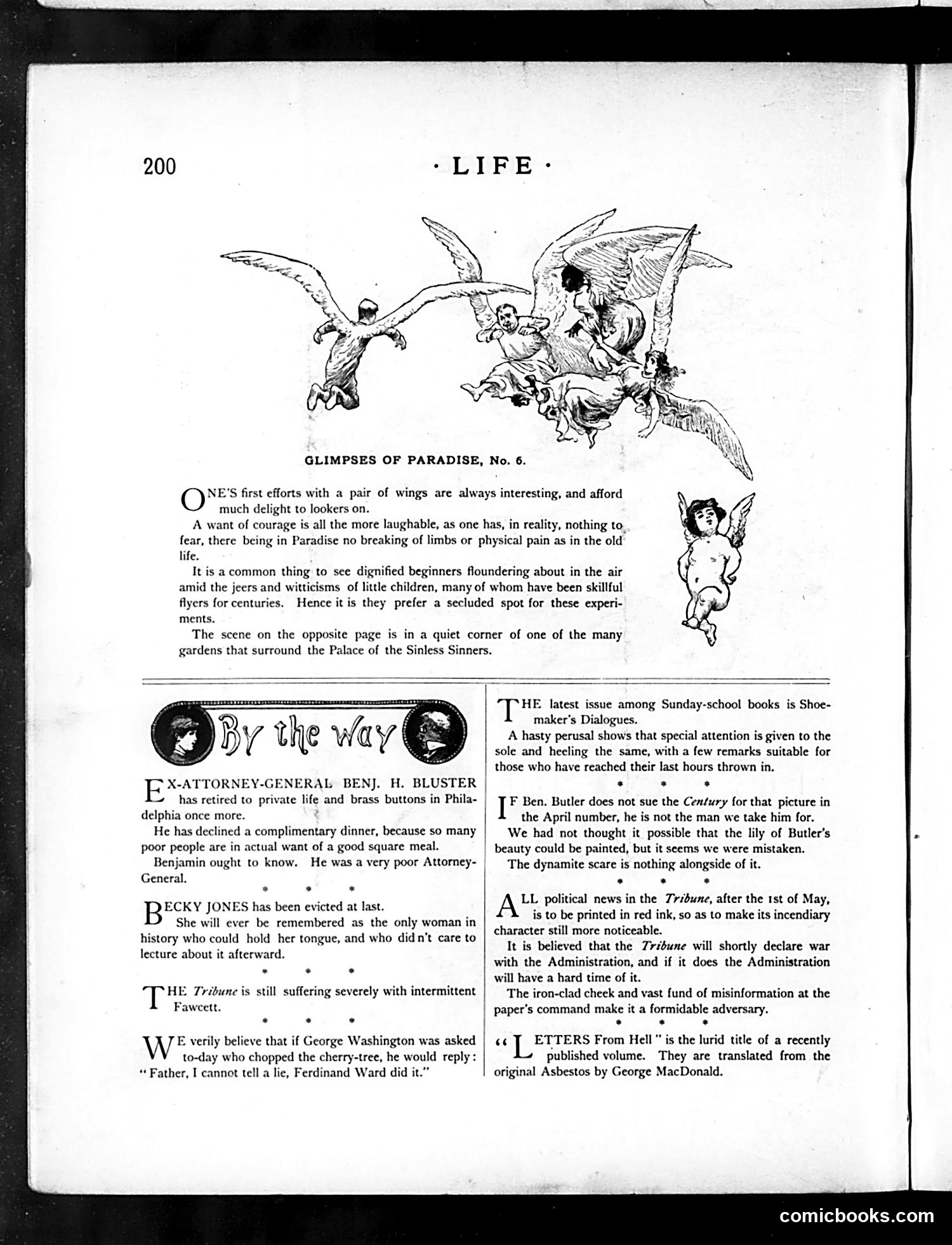
The main illustration depicts winged beginners awkwardly attempting flight in Paradise—some floundering comically in the air while children jeer. The accompanying text explains the satirical premise: in Paradise, there's "nothing to fear" and "no breaking of limbs or physical pain as in the old life," making the spectacle of dignified newcomers stumbling around harmlessly all the more ridiculous. The cartoon mocks the contrast between Paradise's supposed perfection and the undignified reality of learning to fly. It's gentle religious satire about human vanity and the gap between heavenly ideals and actual experience. The series apparently offered humorous vignettes of afterlife scenarios for Life magazine's readers.
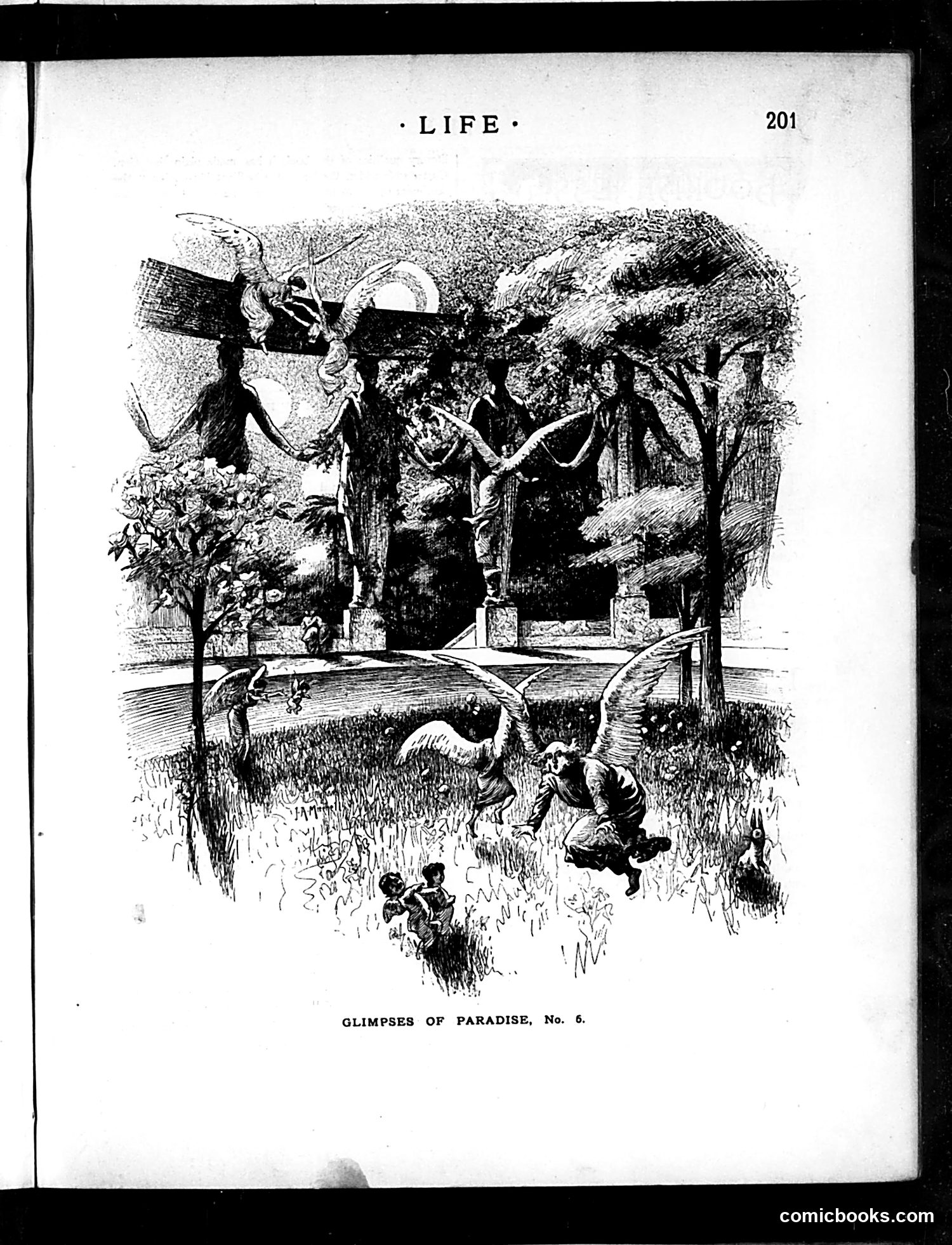
This satirical illustration from *Life* magazine depicts an idyllic pastoral scene with classical statuary and cherubs in a garden setting. The title "Glimpses of Paradise" suggests ironic commentary on an idealized vision. The detailed engraving shows cherubs playing in a manicured garden landscape with decorative urns, trees, and architectural elements. The contrast between the heavenly, perfect setting and the earthly figures suggests social satire—likely commenting on wealth, leisure, or class distinctions of the era. Without additional context about the specific issue date or accompanying articles, the precise satirical target remains unclear, though the romantic idealization of "paradise" appears to mock either aristocratic pretensions or contemporary social aspirations of the period.
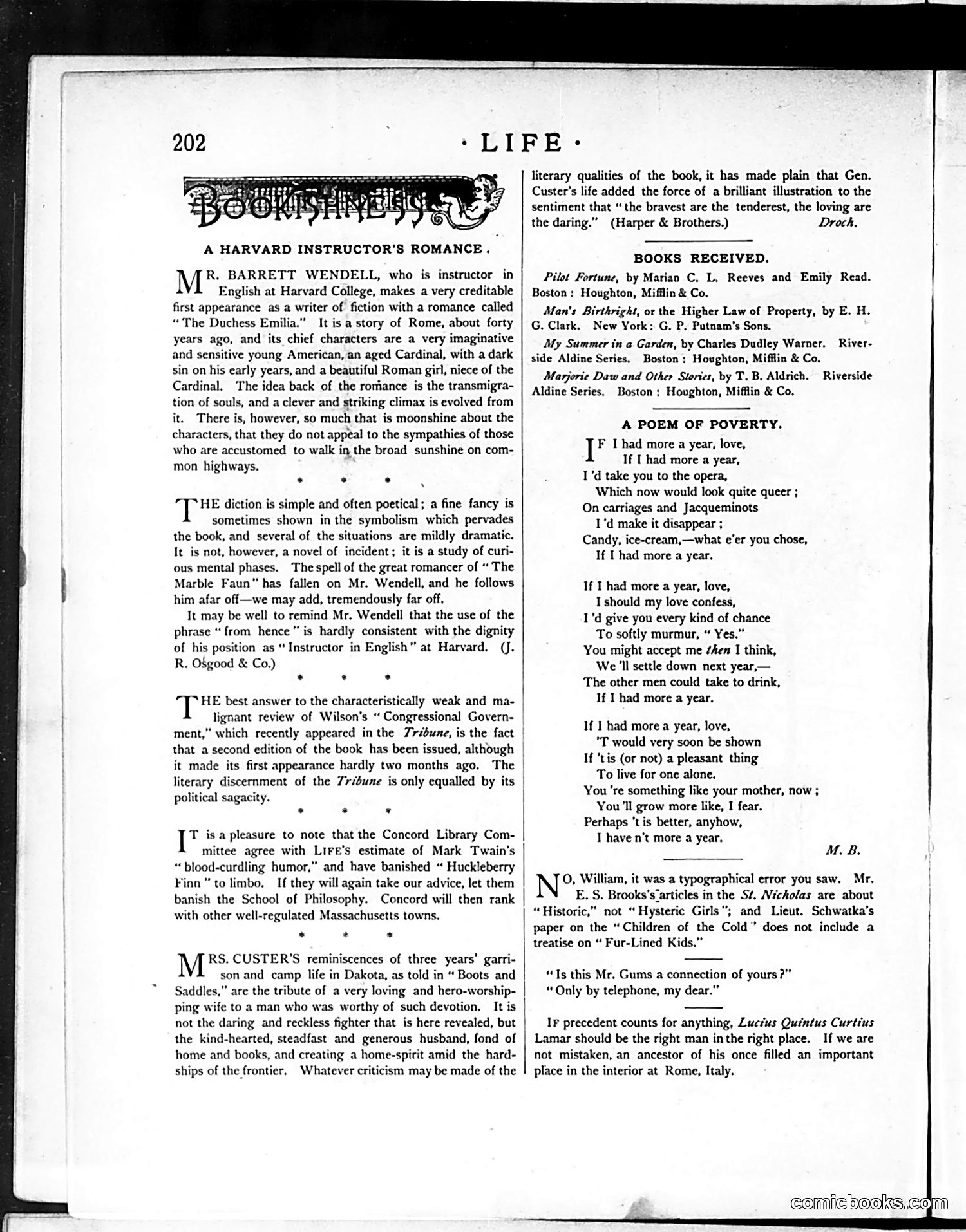
This page contains **literary reviews and commentary** rather than political cartoons. The content includes: 1. **"A Harvard Instructor's Romance"** — a review of M.R. Barrett Wendell's novel "The Duchess Smith," praising its imaginative characters and Roman setting, though noting its melodramatic qualities. 2. **"Books Received"** — a brief listing of recently published works. 3. **"A Poem of Poverty"** — a satirical poem (attributed to M.B.) about romantic poverty, using ironic humor to critique the romanticization of financial hardship in courtship. 4. **Editorial corrections and commentary** — brief notes addressing reader inquiries and discussing other publications. The page reflects *Life*'s role as a **literary and cultural commentary magazine**, focusing on books and intellectual discussion rather than political satire or visual humor.
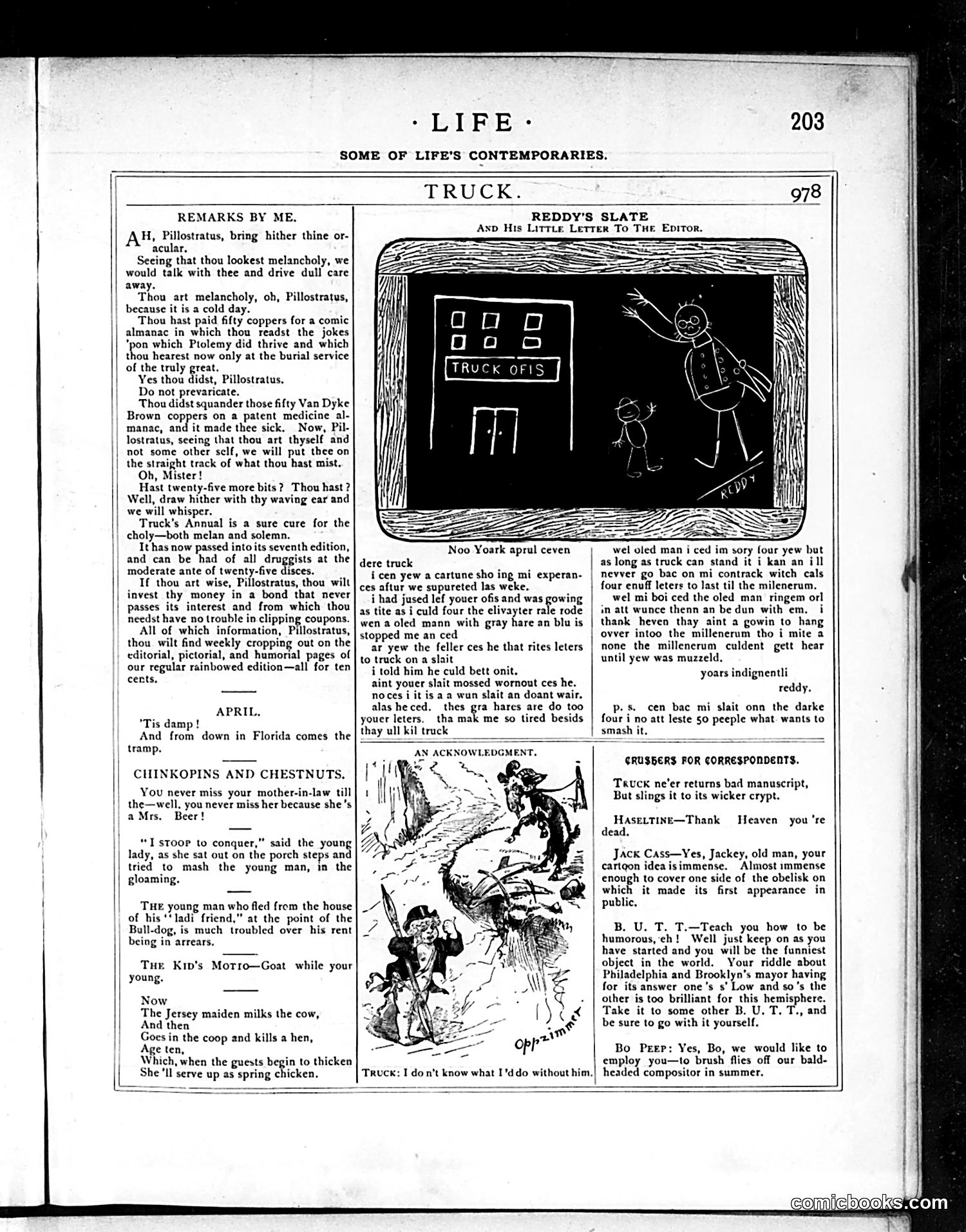
This page contains satirical poetry and reader submissions rather than political cartoons. "Truck" is a humorous poem mocking someone named Pillostratus for his melancholy disposition, suggesting he invest in dubious financial schemes as a "cure." The accompanying illustration shows a child's crude drawing of "Truck of is" (likely a truck), satirizing its poor quality. "Reddy's Slate" features a letter from a reader named Reddy describing an old man and a truck, written in deliberately poor dialect and grammar for comic effect. Below are reader submissions under "Crusgers for Correspondents," including rejections and humorous commentary on previous submissions. The page represents Life's satirical humor through wordplay, dialect humor, and mockery of everyday figures rather than political satire.
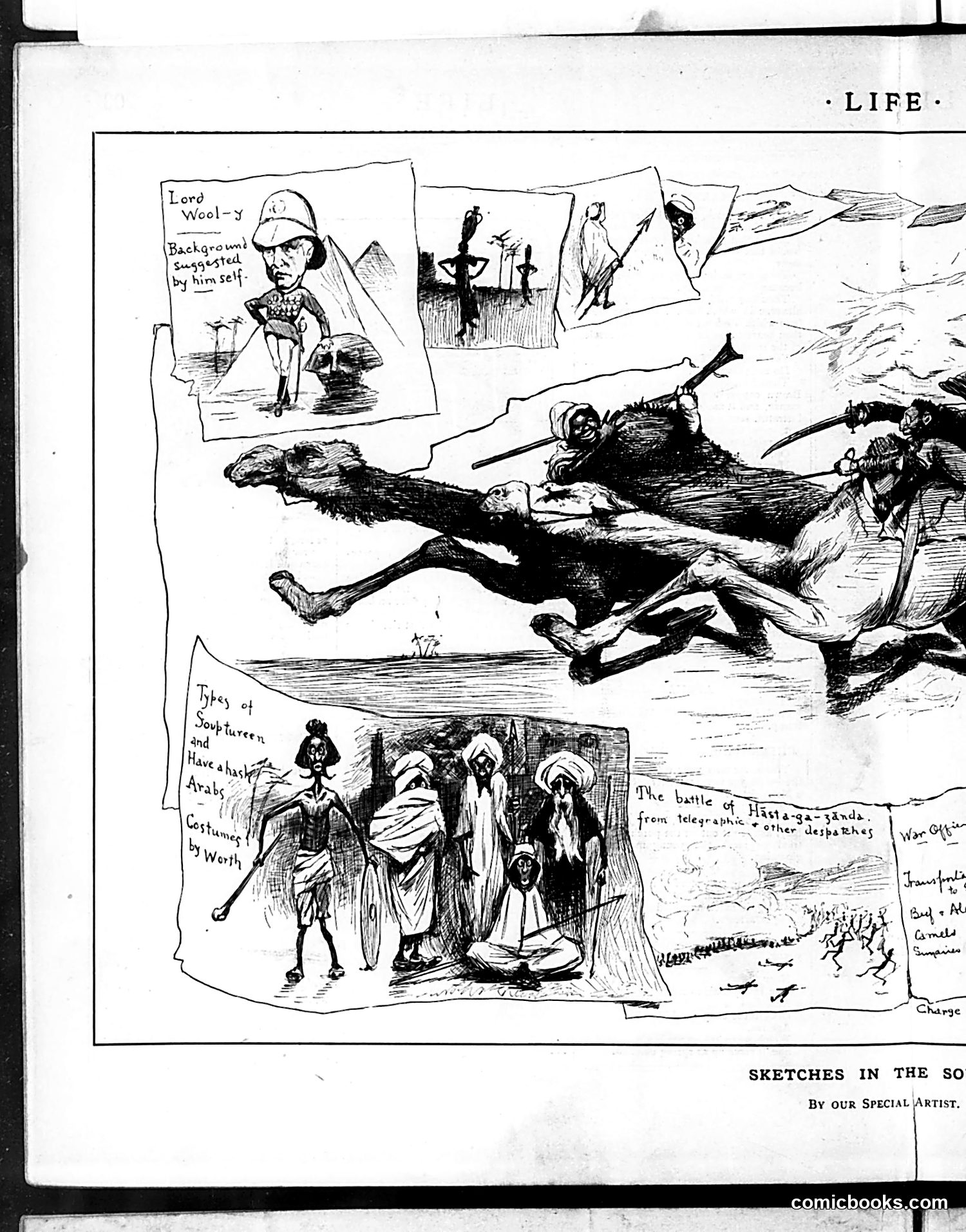
This page from *Life* magazine contains satirical war sketches by their special artist. The top panel depicts "Lord Wodely" (likely Lord Wolseley, a British military figure) who appears to have "backstabbed" himself—a commentary on military embarrassment or self-inflicted strategic failure. The central image shows a dramatic battle scene labeled "The battle of Taska-qa-Zanda," depicting intense combat. The lower panel shows Arab or Middle Eastern figures in traditional dress, with text referencing "tribes," "between," "Arabs," and "Westin," suggesting commentary on colonial military campaigns in North Africa or the Middle East. The overall tone appears critical of British military leadership and colonial ventures, using caricature and exaggeration typical of *Life's* satirical approach to current events.
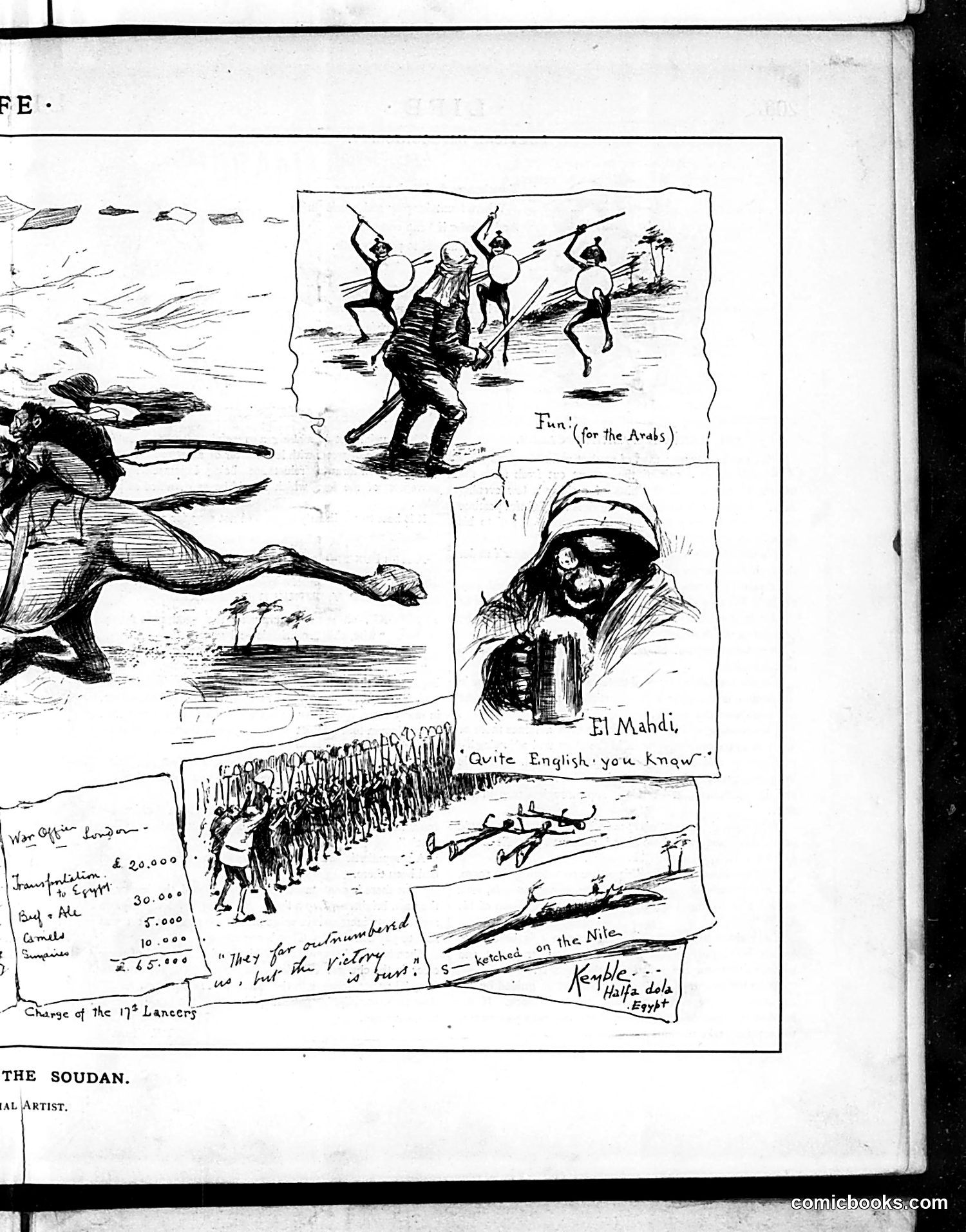
This page depicts scenes from the Mahdist War in Sudan. The sketches show: **"Fun (for the Arabs)"** - Appears to satirize British military entertainment or recreation during the conflict, showing soldiers with drums engaged in leisure activities. **"El Mahdi, 'Quite English, you know'"** - A caricatured portrait, likely mocking the Mahdi (Islamic religious leader fighting British colonial forces) with an ironic caption suggesting he adopts English mannerisms or speech. **"Charge of the 17th Lancers"** - References a cavalry unit's military action. **Bottom scene** - Shows troops advancing with caption "They got outnumbered us, but the victory is ours!" The page appears to satirize British colonial military campaigns in Sudan while depicting the conflict with period racial caricatures. The humor relies on British readers' familiarity with these distant colonial conflicts. Created by artist Kemble, it likely appeared during active British-Sudanese hostilities in the 1880s-90s.
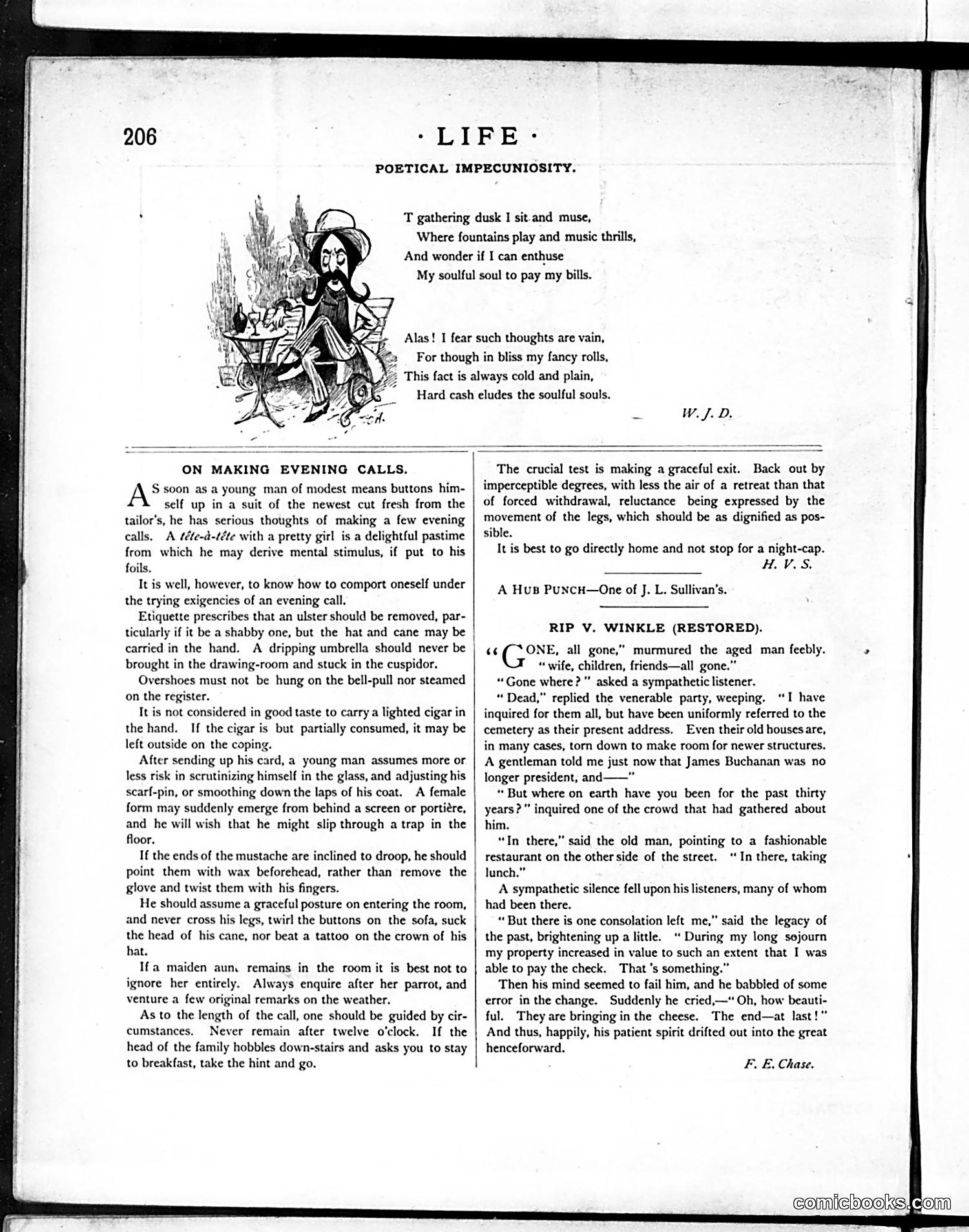
This sketch satirizes rapid social and political change in post-Civil War America. An elderly man emerges from 30 years of seclusion to find everything transformed: his family dead, old houses demolished, and James Buchanan (15th U.S. President, 1857-1861) no longer in office. The humor targets bewilderment at modernization—the man's reference to Buchanan dates him to the pre-war era. The "fashionable restaurant" replacing familiar landmarks symbolizes how commerce erases the past. His consolation that his property increased in value—despite personal loss—is darkly comic social commentary on how capitalism values real estate over human relationships and memory. The sketch riffs on Washington Irving's "Rip Van Winkle" (1819), which featured a man asleep for 20 years. Here, the adapted title suggests America itself has awakened to a radically different nation.
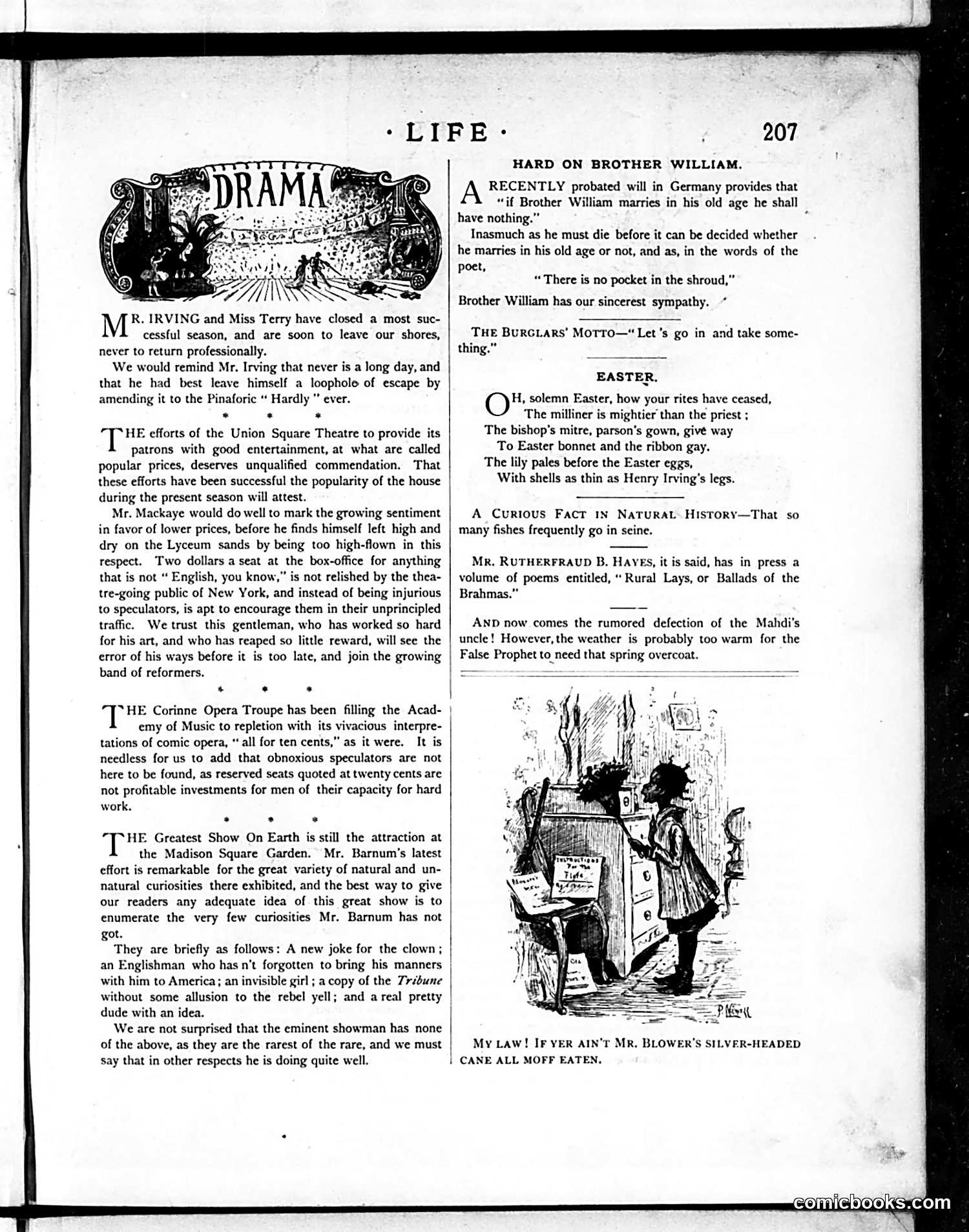
This page from the satirical magazine *Life* contains theatrical commentary and social humor typical of the 1880s. **Key Content:** The main illustration shows two figures examining what appears to be a damaged cane, captioned "My Law! If ver ain't Mr. Blower's silver-headed cane all moff eaten." This appears to be a sight gag about deterioration or decay. The text discusses theatrical figures: **Henry Irving** (a famous British actor) and Miss Terry closing their season; commentary on theater pricing at Union Square Theatre; and **P.T. Barnum's** "Greatest Show on Earth" at Madison Square Garden. **The Satire:** The pieces mock theatrical pretension, excessive ticket prices ("two dollars a seat"), and Barnum's carnival. A poem mocks Easter commercialism ("The milliner is mightier than the priest") and includes a jab at Irving's thin legs. References to "Rutherfraud B. Hayes" appear to satirize President Rutherford B. Hayes, and there's a joke about the Mahdi (Islamic religious leader). The humor relies on contemporary knowledge of these theatrical figures and political personalities.
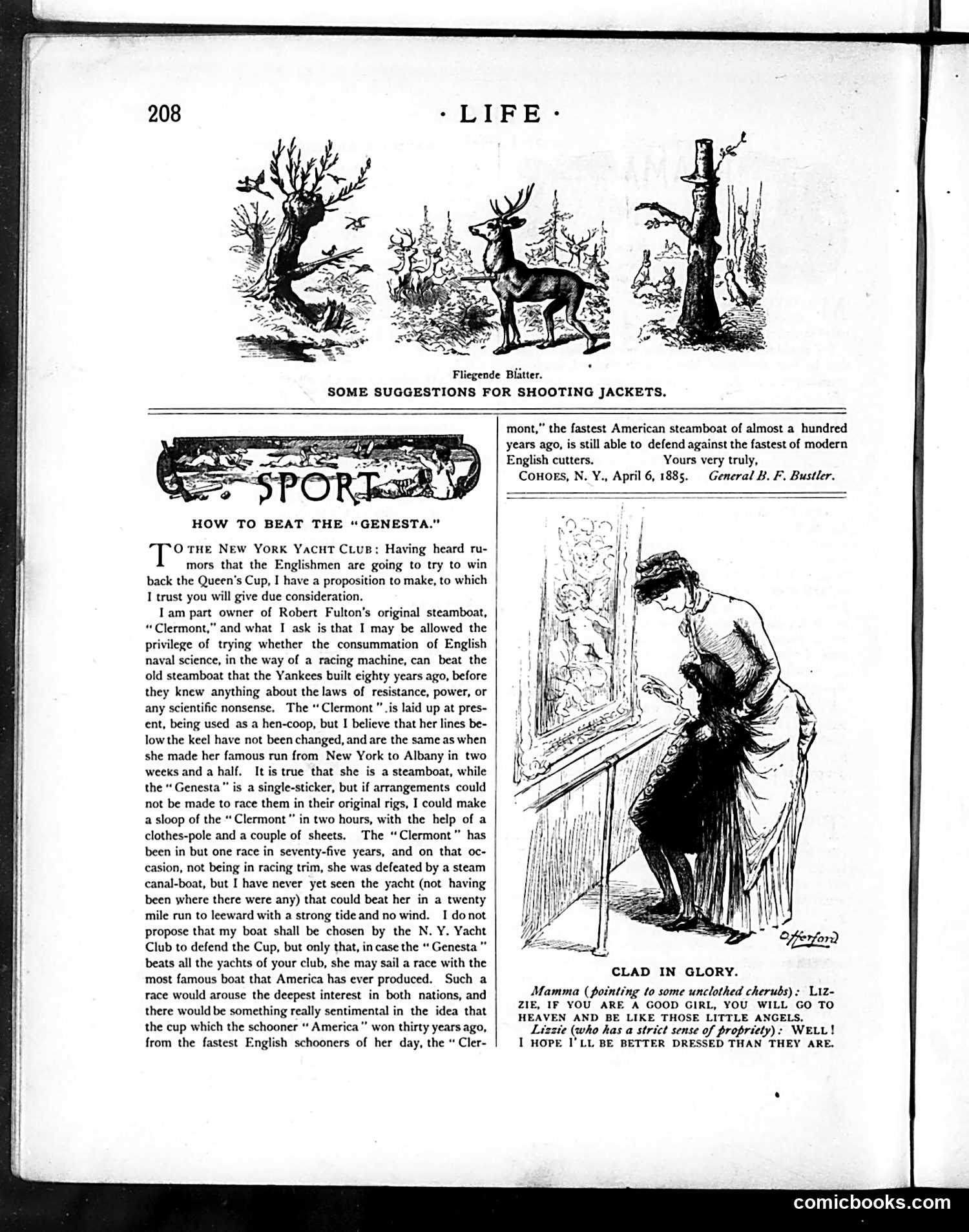
**Main Content: "How to Beat the Genesta"** This is a humorous letter proposing that the *Clermont*—Robert Fulton's historic 1807 steamboat, now used as a henhouse—race against the *Genesta*, a modern English racing yacht. The writer (General B.F. Bustler) suggests this as a patriotic rejoinder to English yacht-racing dominance. The joke satirizes American technological pride: an ancient, decrepit steamboat is pitched as America's secret weapon against cutting-edge British naval engineering. The piece mocks both American overconfidence in outdated technology and the national obsession with beating the English in competition. **Bottom Cartoon: "Clad in Glory"** A child (Lizzie) responds to her mother's promise that good girls become angels in heaven by expressing concern: she hopes to be "better dressed" than the depicted nude cherubs. The humor comes from the child's practical, propriety-conscious priorities overriding spiritual aspiration—a gentle satire on Victorian concerns with modesty and proper clothing.
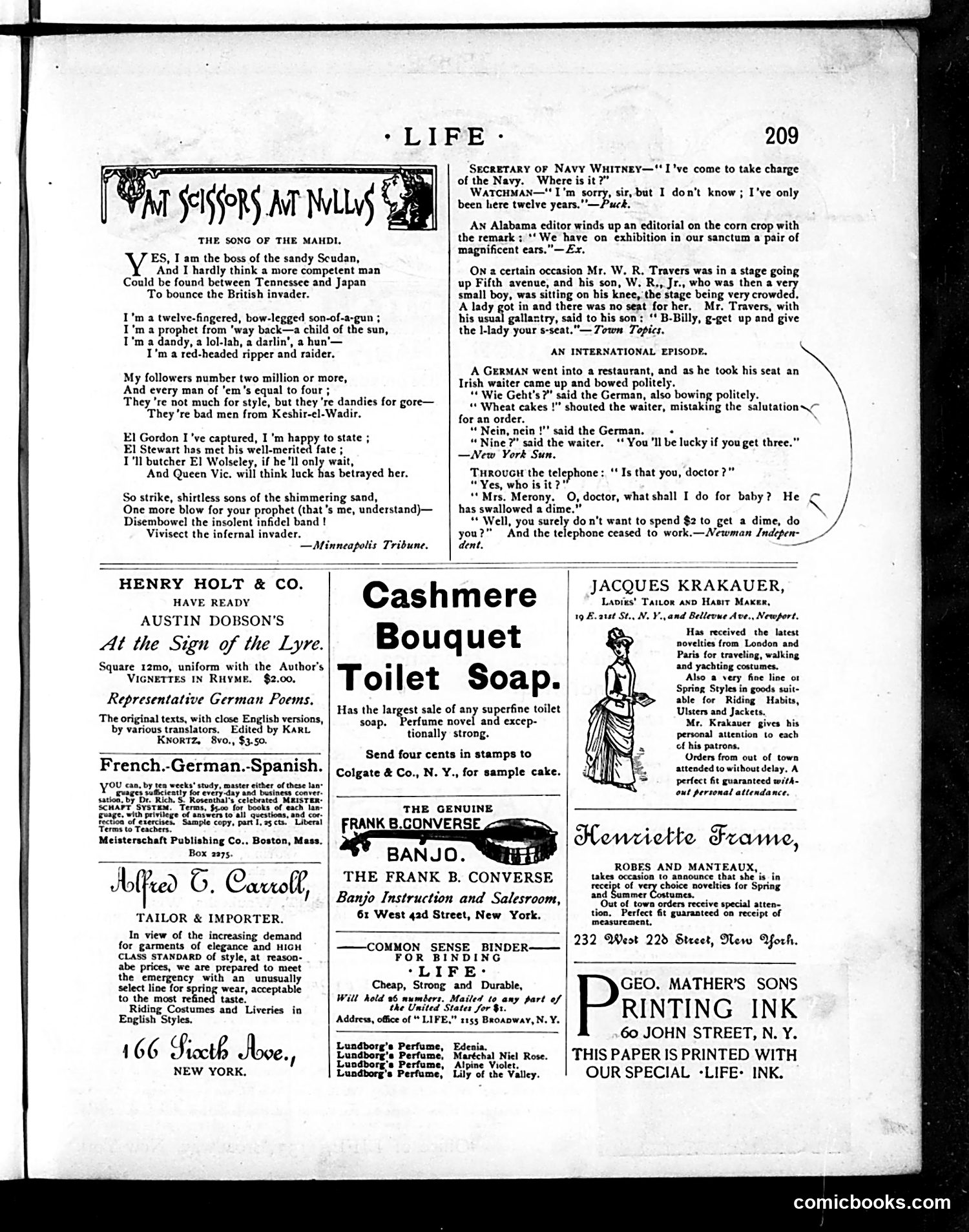
This page contains mostly **advertisements and humor snippets** rather than a major political cartoon. The primary content is "Scissors at Nulls," a poem from the Minneapolis Tribune mocking the **Mahdi of Sudan**—a religious leader who rebelled against British colonial forces in the 1880s. The poem presents the Mahdi's boastful self-description in absurdly grandiose terms ("twelve-fingered," "prophet," "child of the sun"), satirizing both his claims and the threat he posed to British imperial interests. References to "El Gordon," "El Stewart," and "El Wolseley" appear to reference British military figures involved in Sudan campaigns. Below are brief satirical anecdotes about American figures and mishaps—a navy secretary who doesn't know where the navy is, a German-Irish waiter miscommunication, and a doctor's curt response to a worried mother. The page is otherwise filled with **period advertisements** for books, clothing, perfume, and printing services, typical of Life's revenue model.
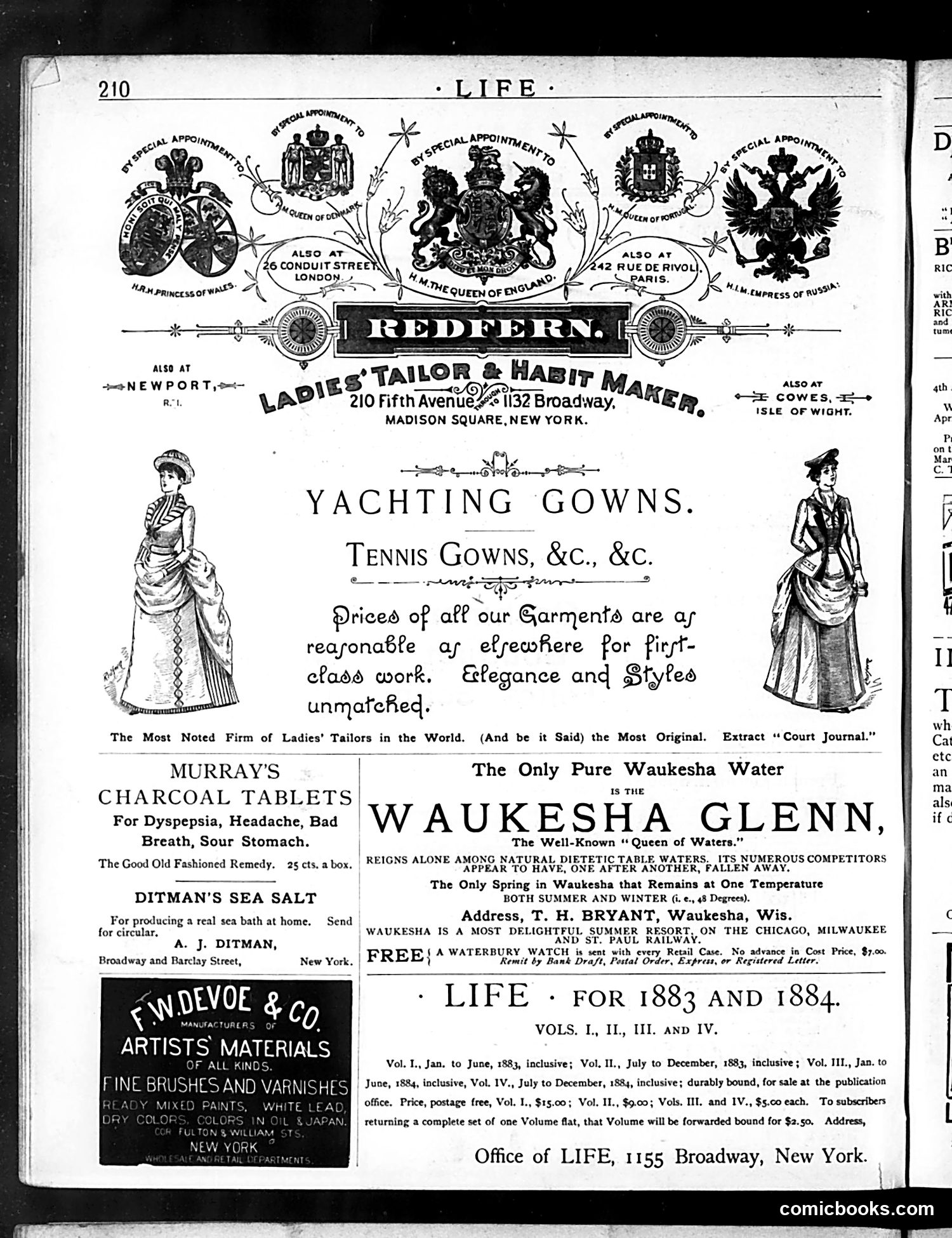
This is primarily an **advertising page** from Life magazine's early years, not a political cartoon. The content consists of period advertisements and subscription information. The **top section** advertises Redfern, a prestigious London-based ladies' tailor with locations in Paris and New York. The ornate heraldic crests (including references to royalty—"H.R.H. Princess of Wales," "H.M. The Queen of England") emphasize the shop's elite clientele and international prestige. The accompanying fashion illustrations show fashionable women in yachting and tennis wear. The **lower advertisements** promote typical 1880s remedies: Murray's Charcoal Tablets for digestive complaints, Ditman's Sea Salt bath products, F.W. Devoe & Co. artist materials, and Waukesha Glenn mineral water—a Wisconsin spring water marketed as a health cure. The **bottom section** announces subscription rates for Life's bound volumes covering 1883-1884, priced at $15 for volume one and $5-9 for others. There is no apparent satire or political commentary on this particular page.
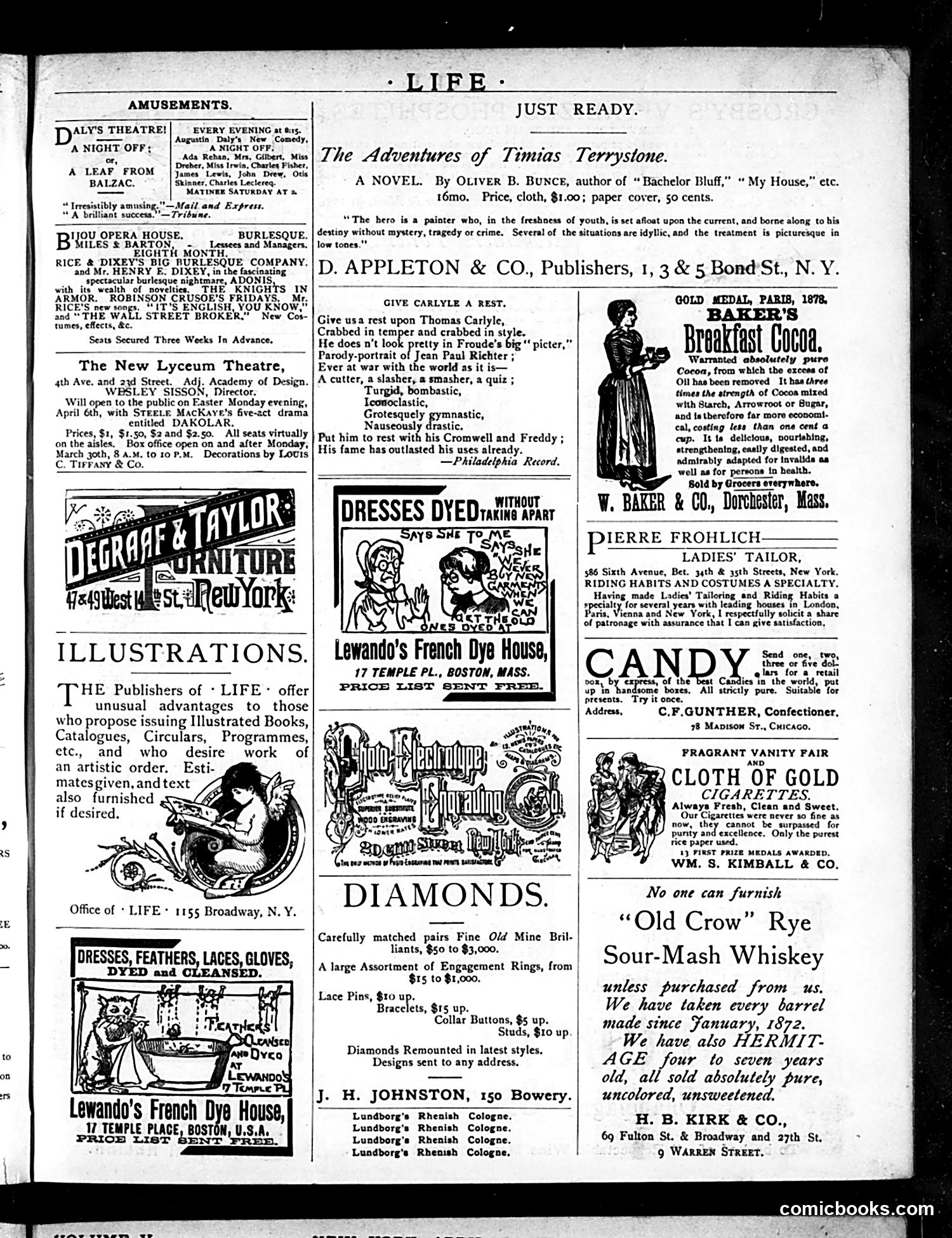
This page is primarily **advertisements and theatrical announcements** from *Life* magazine, with one notable satirical poem. The main satirical content is the poem **"Give Carlyle a Rest,"** which mocks the Scottish philosopher Thomas Carlyle. The piece complains that Carlyle is omnipresent in cultural discourse—appearing in biographies by James Froude (his executor), comparisons to other thinkers, and endless academic discussion. The poem ridicules Carlyle's writing style as "crabbed," "turgid," and "bombastic," suggesting readers are exhausted by his continued prominence even after death. This reflects 19th-century literary debates: Carlyle was hugely influential but also divisive—admired by some, detested by others for his difficult prose and dogmatic views. The satire captures *Life* magazine's irreverent stance toward cultural pretension. The rest of the page contains typical Victorian advertisements (dyes, diamonds, cocoa, cigarettes) and theater listings, reflecting how satirical magazines funded themselves through advertising.
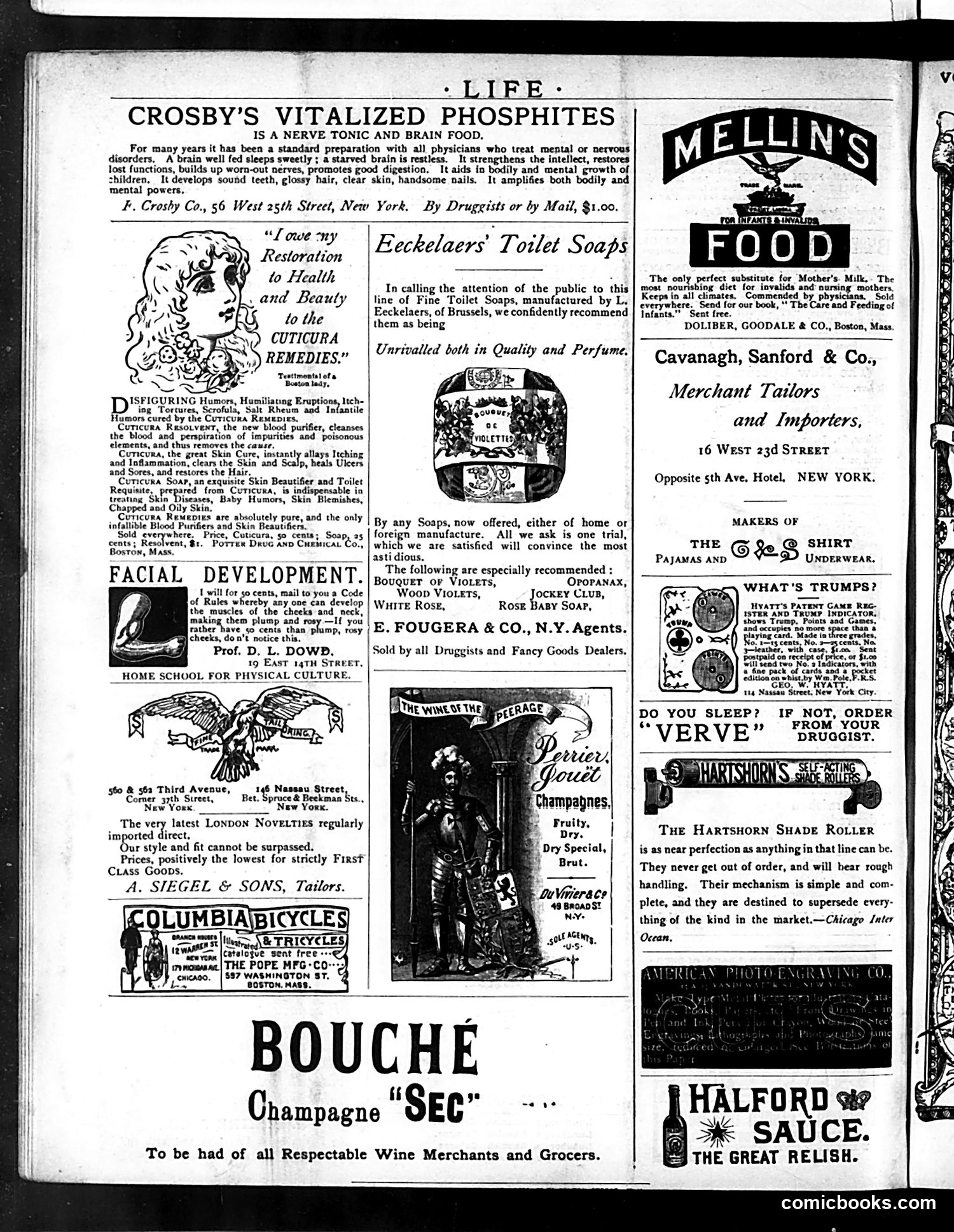
This page is primarily **advertising**, not political satire or cartooning. It contains roughly a dozen product advertisements typical of late 19th-century American magazines. The ads promote patent medicines and tonics (Crosby's Phosphites for "nerve" and brain strength, Cuticura remedies for skin conditions), personal grooming services (facial development, tailoring), household goods (soaps, champagne, sauce), and novelty items (bicycle parts, shade rollers, a card game indicator). The only visual element with potential satirical content is a small portrait labeled "Prof. D. L. Dowd" advertising facial muscle development via mail-order instructions for 50 cents. This represents the common late-Victorian practice of mail-order self-improvement schemes that promised physical transformation—often mocked as dubious or fraudulent. The page reflects the era's heavy reliance on dubious medical claims and direct-mail marketing to consumers.