
Life, 1885-04-09 · page 6 of 16
Life — April 9, 1885 — page 6: what you’re looking at
What you’re looking at
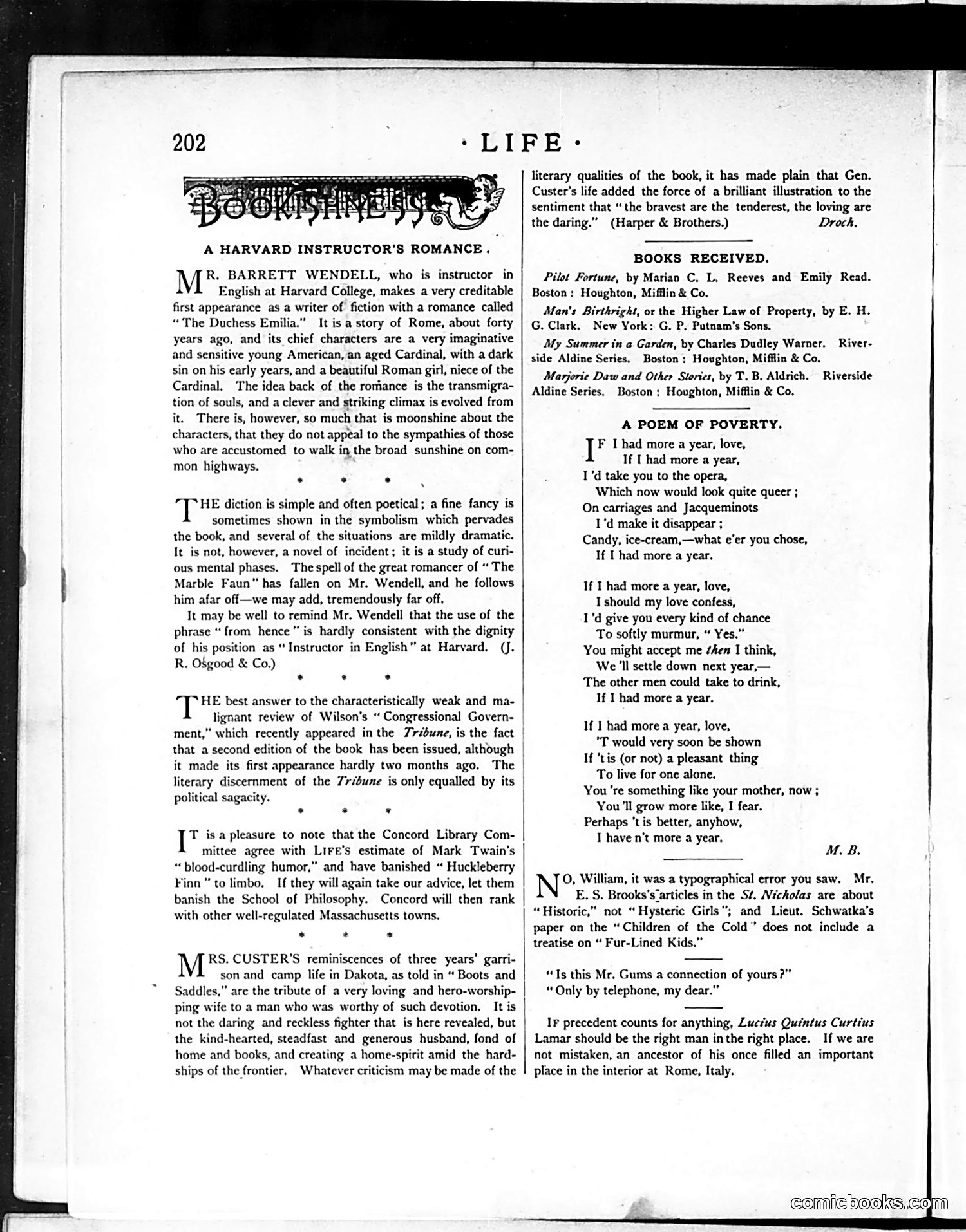
This page contains **literary reviews and commentary** rather than political cartoons. The content includes: 1. **"A Harvard Instructor's Romance"** — a review of M.R. Barrett Wendell's novel "The Duchess Smith," praising its imaginative characters and Roman setting, though noting its melodramatic qualities. 2. **"Books Received"** — a brief listing of recently published works. 3. **"A Poem of Poverty"** — a satirical poem (attributed to M.B.) about romantic poverty, using ironic humor to critique the romanticization of financial hardship in courtship. 4. **Editorial corrections and commentary** — brief notes addressing reader inquiries and discussing other publications. The page reflects *Life*'s role as a **literary and cultural commentary magazine**, focusing on books and intellectual discussion rather than political satire or visual humor.
📄 Transcribed text from this page (OCR, searchable)
Machine-transcribed from the original scan — historical spelling and the odd misread are preserved.
A HARVARD INSTRUCTOR'S ROMANCE. R. BARRETT WENDELL, who is instructor in English at Harvard College, makes a very creditable first appearance as a writer of fiction with a romance called “The Duchess Emilia.” It is a story of Rome, about forty years ago, and its chief characters are a very imaginative and sensitive young American, an aged Cardinal, with a dark sin on his early years, and a beautiful Roman girl, niece of the Cardinal. The idea back of the romance is the transmigra- tion of souls, and a clever and striking climax is evolved from it. There is, however, so much that is moonshine about the characters, that they do not appeal to the sympathies of those who are accustomed to walk in the broad sunshine on com- mon highways. . . . i peste diction is simple and often poetical ; a fine fancy is sometimes shown in the symbolism which pervades the book, and several of the situations are mildly dramatic. It is not, however, a novel of incident; it is a study of curi- ous mental phases. The spell of the great romancer of “ The Marble Faun” has fallen on Mr. Wendell, and he follows him afar off—we may add, tremendously far off. It may be well to remind Mr. Wendell that the use of the phrase “from hence" is hardly consistent with the dignity of his position as “Instructor in English” at Harvard. (J. R. Ogood & Co.) HE best answer to the characteristically weak and ma- lignant review of Wilson's “ Congressional Govern- ment,” which recently appeared in the Zrbune, is the fact | that a second edition of the book has been issued, although it made its first appearance hardly two months ago. The literary discernment of the 7rsbune is only equalled by its political sagacity. I" is a pleasure to note that the Concord Library Com- mittee agree with Lire’s estimate of Mark Twain's “ blood-curdling humor,” and have banished “ Huckleberry Finn ” to limbo. banish the School of Philosophy. Concord will then rank with other well-regulated Massachusetts towns. . . * . . * RS. CUSTER’S reminiscences of three years’ garri- son and camp life in Dakota, as told in “ Boots and Saddles,” are the tribute of a very loving and hero-worship- ping wife to a man who was worthy of such devotion. It is not the daring and reckless fighter that is here revealed, but the kind-hearted, steadfast and generous husband, fond of home and books, and creating a home-spirit amid the hard- ships of the frontier. Whatever criticism may be made of the If they will again take our advice, let them | ‘LIFE: literary qualities of the book, it has made plain that Gen. Custer's life added the force of a brilliant illustration to the sentiment that “the bravest are the tenderest, the loving are the daring.” (Harper & Brothers.) Droch, BOOKS RECEIVED. Pilot Fortune, by Marian C. L. Reeves and Emily Read. Boston : Houghton, Mifflin & Co. Man's Birthright, or the Higher Law of Property, by E. H. G. Clark, New York: G. P, Putnam's Sons. My Summer in a Garden, by Charles Dudley Warner. side Aldine Series, Boston: Houghton, Mifflin & Co. Marjorie Daw and Other Stories, by T. B. Aldrich. Aldine Series. Boston : Houghton, Mifflin & Co. River- Riverside A POEM OF POVERTY. F I had more a year, love, If | had more a year, I'd take you to the opera, Which now would look quite queer ; On carriages and Jacqueminots I'd make it disappear ; Candy, ice-cream,—what e’er you chose, If I had more a year. If I had more a year, love, I should my love confess, I'd give you every kind of chance To softly murmur, “ Yes.” You might accept me ¢hen I think, We'll settle down next year— The other men could take to drink, If | had more a year. If I had more a year, love, ’T would very soon be shown Tf ‘tis (or not) a pleasant thing To live for one alone. You 're something like your mother, now ; You'll grow more like, I fear. Perhaps ‘tis better, anyhow, I have n't more a year. M.B. O, William, it was a typographical error you saw. Mr. E. S. Brooks’sarticles in the St. Nicholas are about “Historic,” not “Hysteric Girls"; and Lieut. Schwatka’s paper on the “Children of the Cold” does not include a | treatise on “ Fur-Lined Kids.” “Ts this Mr. Gums a connection of yours?” “Only by telephone, my dear.” IF precedent counts for anything, Lucius Quintus Curtius Lamar should be the right man inthe right place. If we are not mistaken, an ancestor of his once filled an important place in the interior at Rome, Italy. comichooks.