
A complete issue · 16 pages · 1885
Life — March 19, 1885
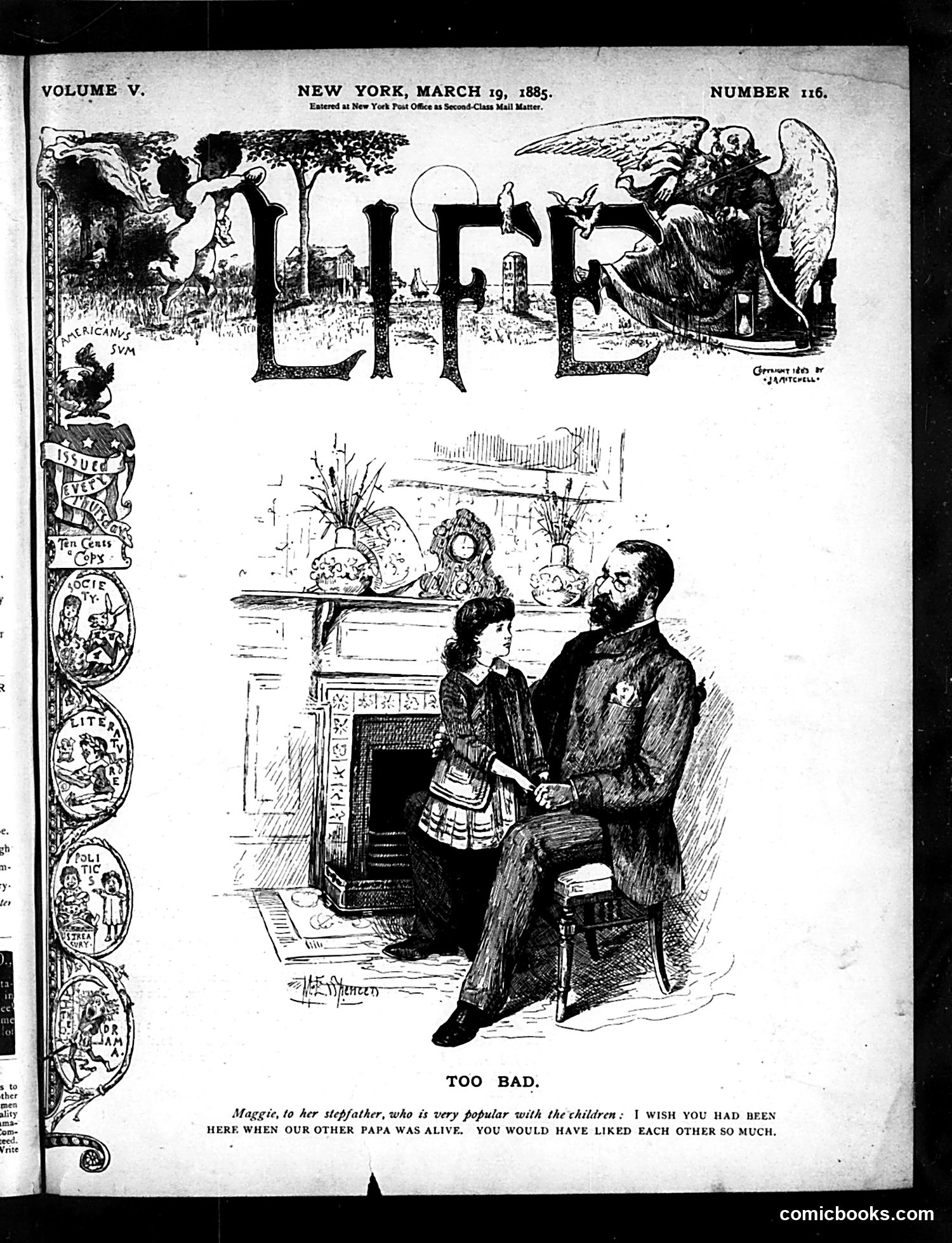
This page contains a single cartoon titled "Too Bad," depicting a domestic scene. A bearded man sits with a woman, saying to her: "Maggie, to her stepfather, who is very popular with the children: I wish you had been here when our other papa was alive. You would have liked each other so much." The satire appears to target remarriage and blended families. The caption's sentiment—wishing the new stepfather could have met the deceased biological father—is presented as darkly humorous because such a meeting is impossible. The joke likely mocks either the awkwardness of remarriage dynamics or suggests naive, contradictory thinking about family relationships. The woman's name "Maggie" and the domestic setting suggest this addresses working or middle-class family situations common in 1880s America.
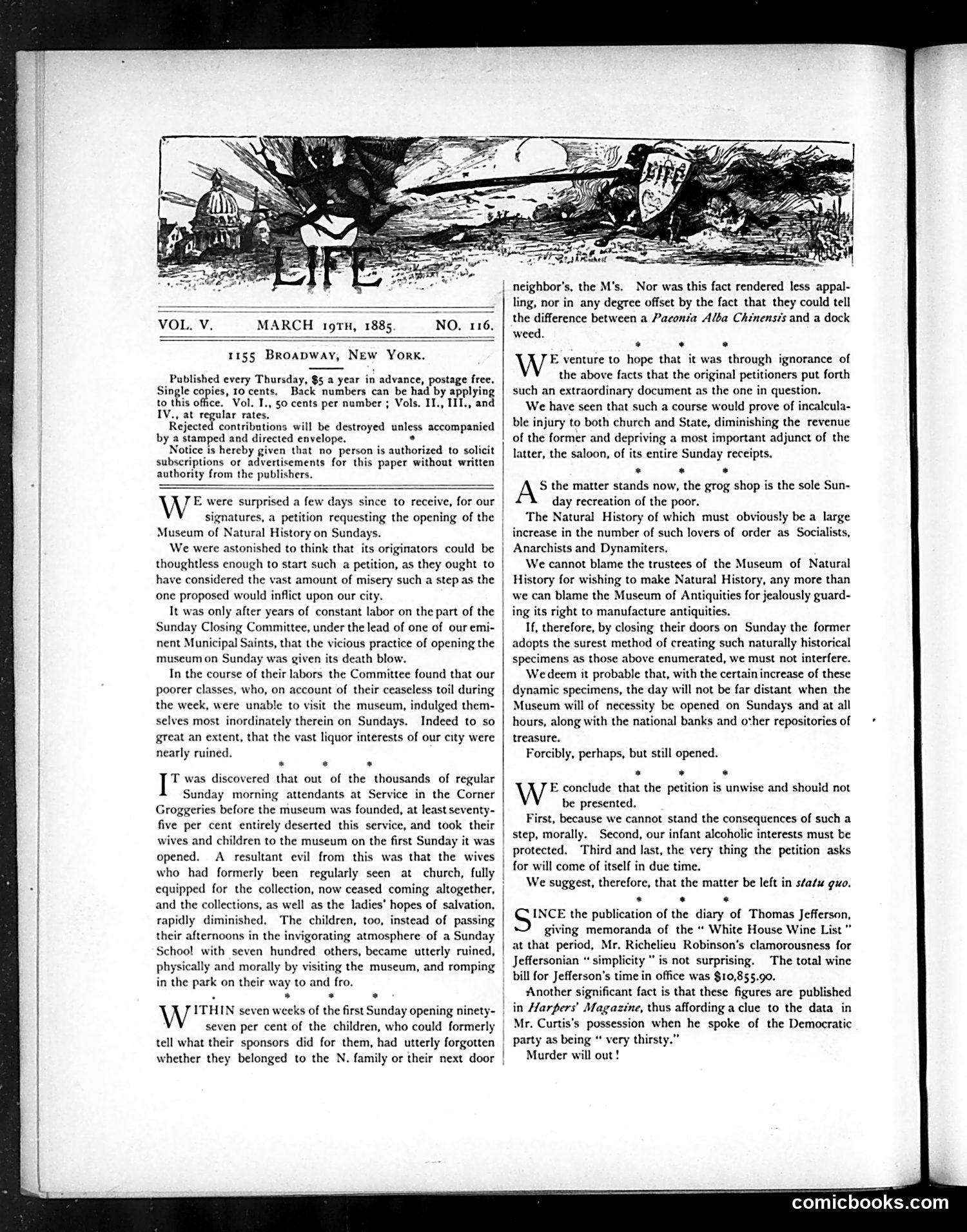
The banner illustration depicts "LIFE" as a allegorical figure surveying a landscape, likely representing the magazine's editorial perspective on current events. The article debates whether the American Museum of Natural History should open on Sundays. The text reveals this was a contentious issue: working-class families wanted Sunday access to cultural institutions (their only free day), but religious groups and the wealthy opposed Sunday operations on moral grounds. The satirical point: the magazine argues the petition to keep the museum closed is "unwise," mocking those prioritizing religious doctrine over public benefit. The text notes that closing museums actually harms poor families while protecting saloons' Sunday profits—suggesting hypocrisy in the opposition's morality.
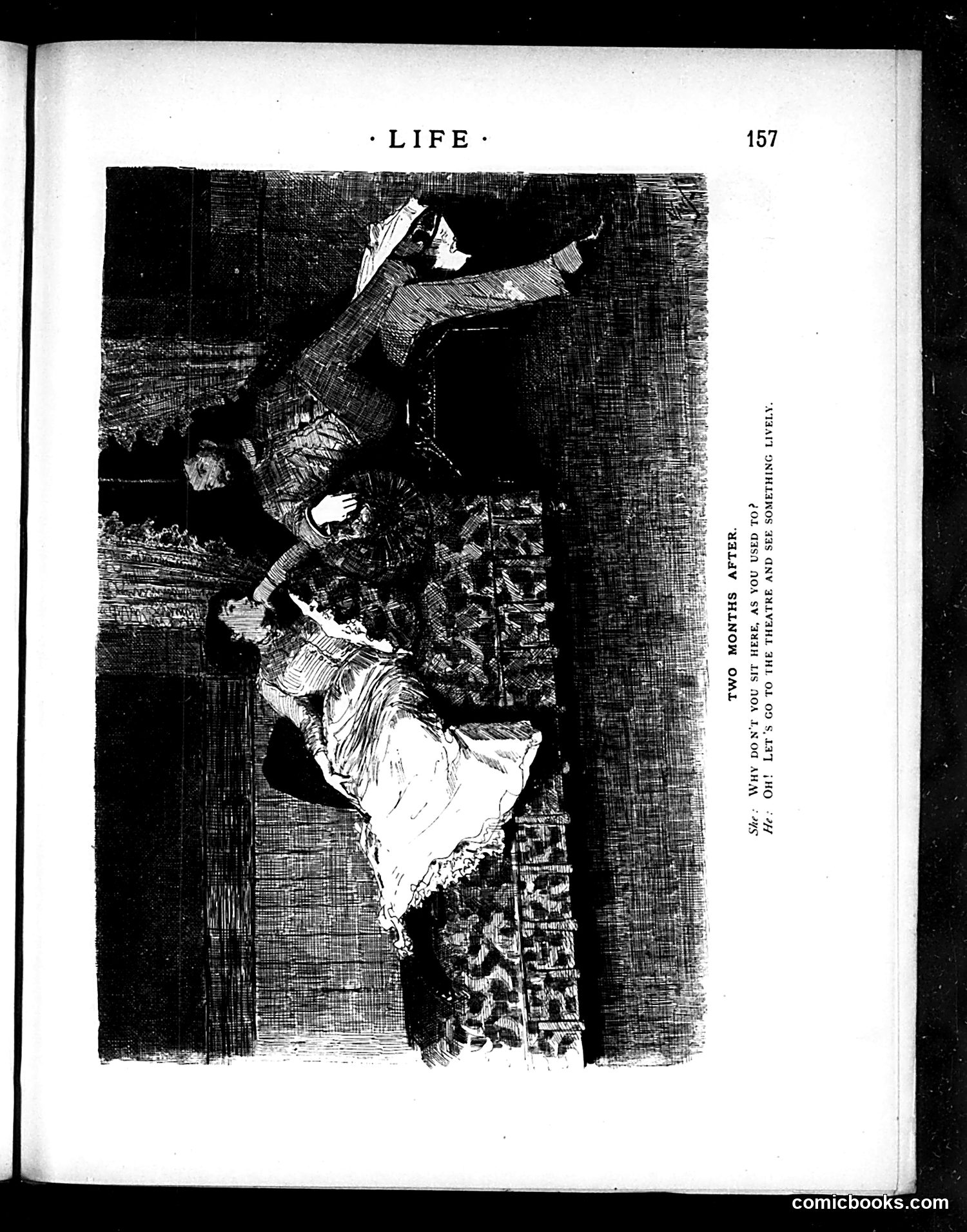
This appears to be a satirical illustration from *Life* magazine titled "Two Months After." The caption reads: "She: 'Why can't you sit here a while and see something pretty?' He: 'Oh let's go to the theater and see something clever.'" The cartoon depicts a couple in what appears to be a domestic scene—a man standing restlessly while a woman sits. The satire targets gender dynamics and differing aesthetic preferences: the woman wants to appreciate natural beauty or domestic leisure, while the man dismisses it as boring, preferring commercial entertainment ("the theater"). This reflects early-20th-century social commentary about marital relationships, male disinterest in domestic contentment, and perhaps class or cultural attitudes about "highbrow" versus "lowbrow" entertainment. The humor derives from the fundamental incompatibility in their desires and values.
This page contains brief satirical notes rather than cartoons. The content includes: **"By the Way" section:** Commentary on naval matters, mentioning the *Falstaff* and coal barges kept afloat during wartime, credited to W.E. Chandler. **Social commentary:** Quick jabs at various figures—Mr. Ingersoll receiving hand-grenade fire extinguishers (unclear reference), gambler Bauer sent to the penitentiary, and criticism of "Von Bilowitz" (likely a German figure) having an "explosive name" during a period of international tension. **Right column:** Poetry titled "Two Pictures" comparing a grandmother's past restraint to present frivolity, and "Glimpses of Paradise" satirizing social pretension among the wealthy. The overall tone reflects wartime concerns and American social anxiety about class, morality, and German threats—typical Life magazine fare from the WWI era.
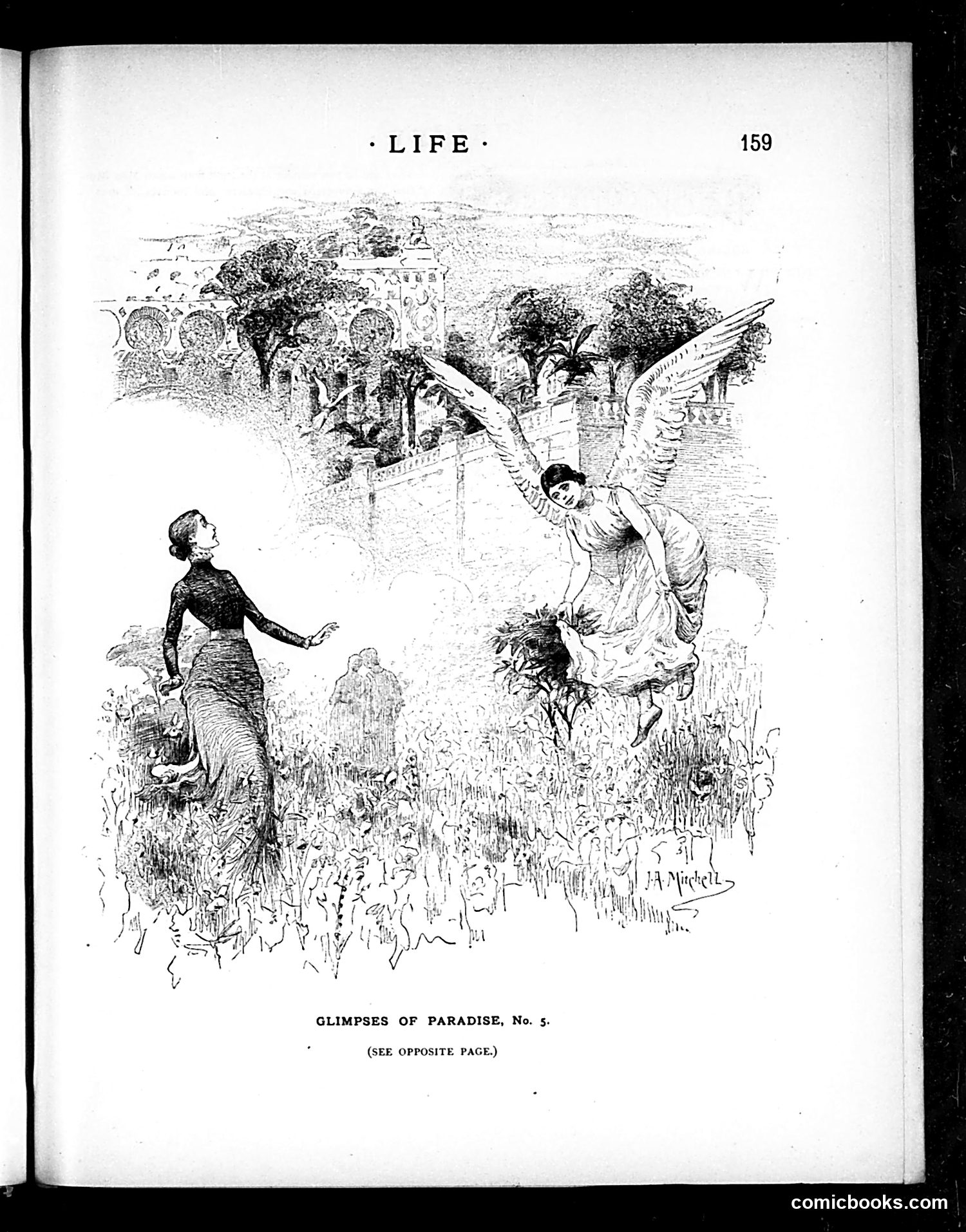
This illustration depicts a romantic scene in an idealized garden setting. A winged angelic or cupid-like figure descends from above toward a well-dressed couple in a pastoral landscape. The man gazes upward while the woman appears to acknowledge the supernatural visitor. Classical architectural elements—towers, walls, and cultivated grounds—suggest paradise or an Edenic garden. The title and composition suggest this is part of a satirical series about idealized romance and courtship. Without additional context from the opposite page (referenced in the text), the precise satirical target remains unclear, but Life magazine typically mocked sentimental Victorian romantic ideals and the gap between fantasy and reality in courtship and marriage.
This page contains **no political cartoon**. Instead, it features a "Bookshelf" section reviewing literature, particularly "A Carpet Knight" by Harford Fleming, a novel depicting Philadelphia high society's decadence. The reviewer describes the book as a cautionary tale about social excess—depicting "wild gayeties" and "scenes of social dissipation" in Philadelphia and other elite American cities. The text suggests the novel serves as social criticism, warning against moral decline among the upper classes. The page includes book advertisements and a poem titled "A Symphony in Pronounced Tints" by S.D. Osborne, unrelated to political commentary. This is a **book review section**, not satirical political commentary.
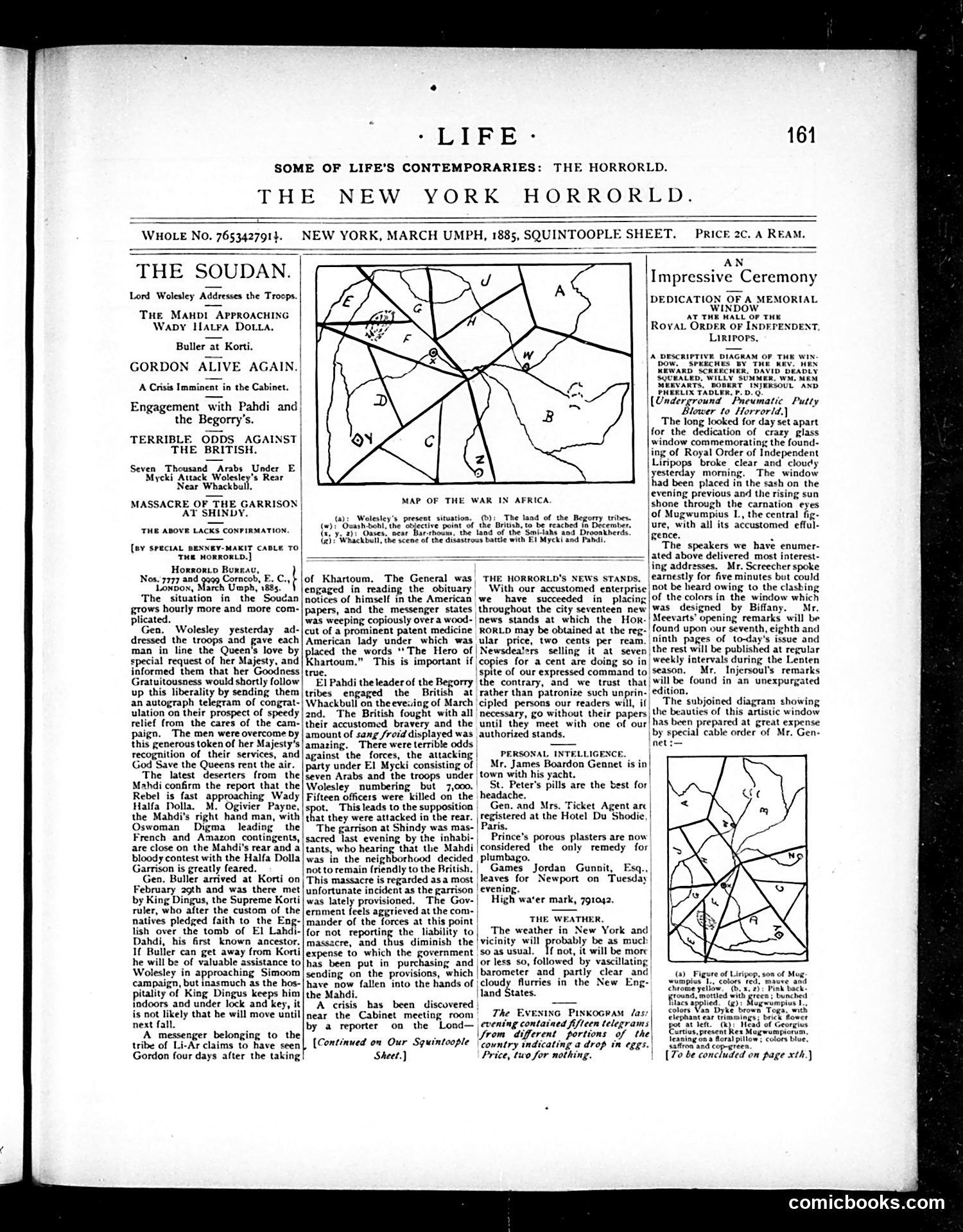
This page covers contemporary military and political news rather than satirical cartoons. The primary content concerns **the Sudanese conflict**, featuring: 1. **"The Soudan"** section reporting on Lord Wolseley's military campaign against the Mahdi (a religious leader in Sudan) 2. References to "Gordon Alive Again" and fighting at Khartoum 3. Maps showing the war in Africa and British military positions The right side contains an article about **"An Impressive Ceremony"**—a dedication of a memorial at the Hall of the Royal Order of Independent Liripoos, which appears to be satirical or humorous fraternal organization coverage. The page reflects 1880s British imperial interests in colonial conflicts, particularly the ongoing struggle for control in Sudan, presented as serious news rather than political satire.
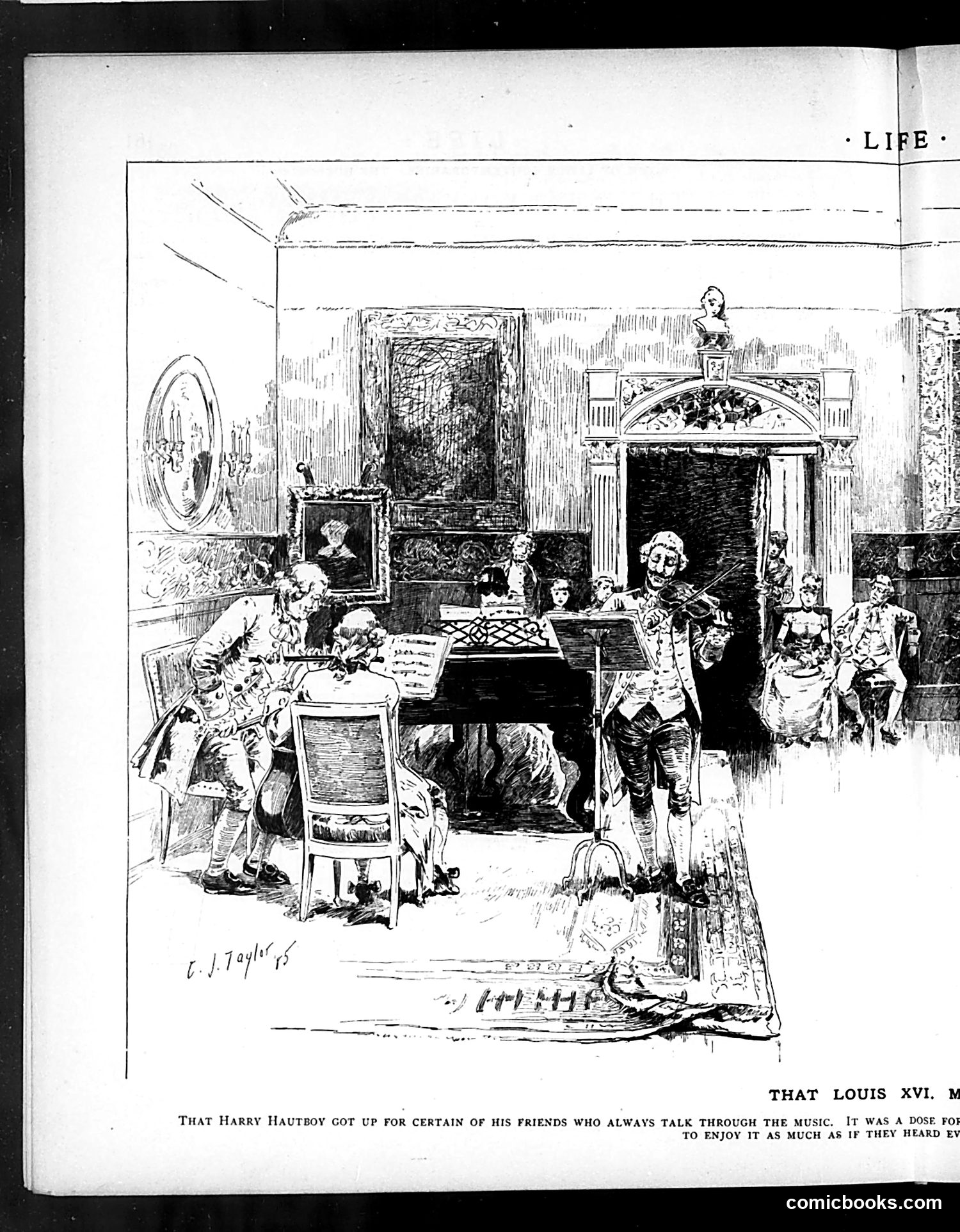
This cartoon satirizes a social problem among the wealthy: guests who talk loudly during musical performances. The caption identifies the subject as "Harry Hautboy" (a pun on "hautboy," an archaic term for oboe), who hosts musical evenings but finds certain friends persistently chatty. The scene depicts an elegant drawing room with a pianist performing while well-dressed attendees socialize—some listening, others conversing. The satire targets the rudeness of concertgoers who prioritize conversation over respecting the musicians and other audience members trying to enjoy the performance. This reflects turn-of-the-century upper-class etiquette concerns, when proper concert behavior was a mark of refinement. The cartoon mocks those lacking such social awareness despite their apparent wealth and education.
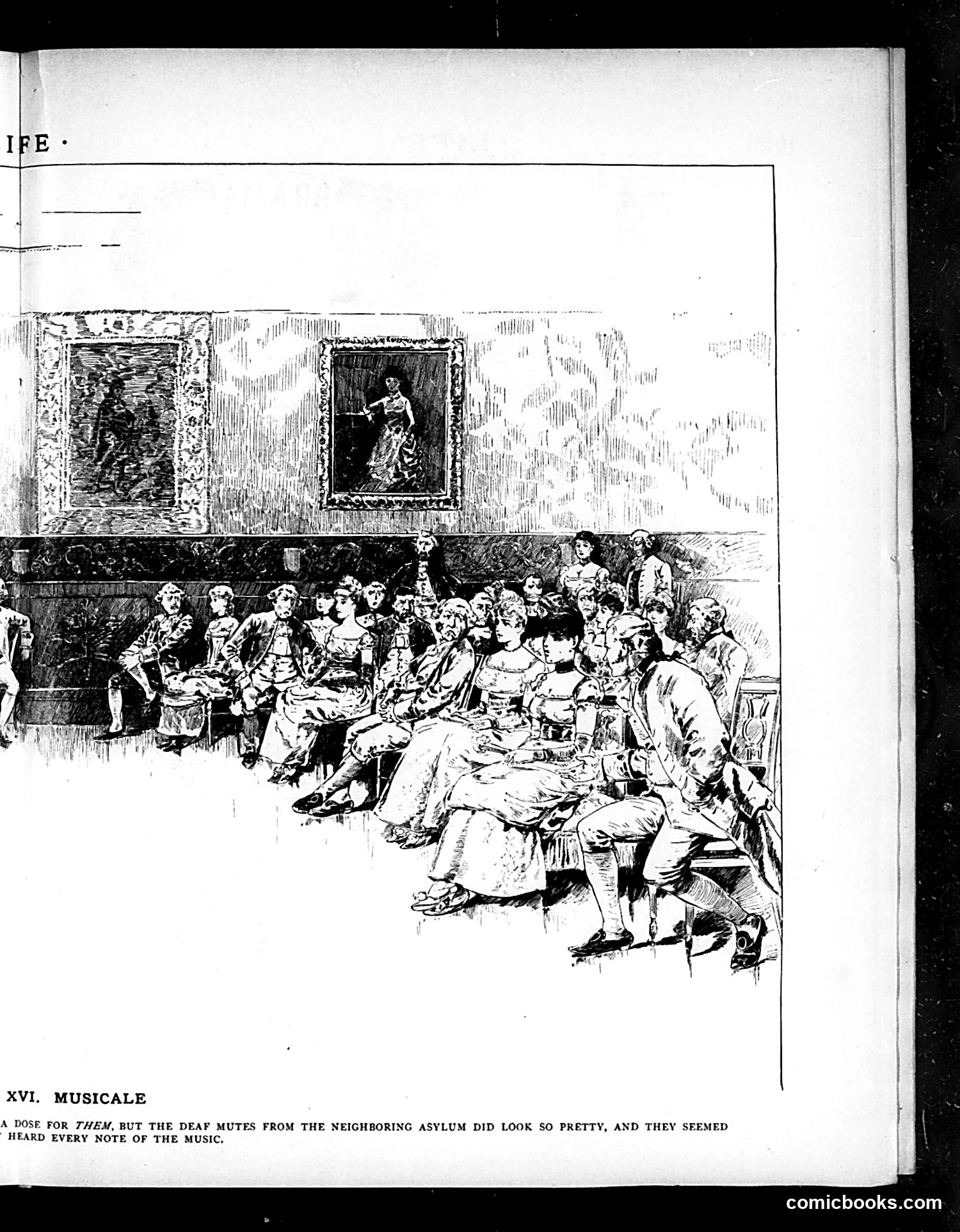
This illustration depicts a social gathering where wealthy or upper-class people attend a musical performance. The caption reads: "A dose for them, but the deaf mutes from the neighboring asylum did look so pretty, and they seemed to hear every note of the music." The satire targets the pretension and superficiality of high society. The joke suggests that even deaf individuals from an asylum—who cannot actually hear the music—appeared to enjoy the performance and seemed satisfied, implying the attendees' appreciation is equally superficial or performative. It mocks how upper-class social events prioritize appearance and status over genuine experience or substance. The contrast between the elegant gathered crowd and the ironic observation about deaf listeners who can't hear reveals the cartoon's criticism of hollow social conventions.
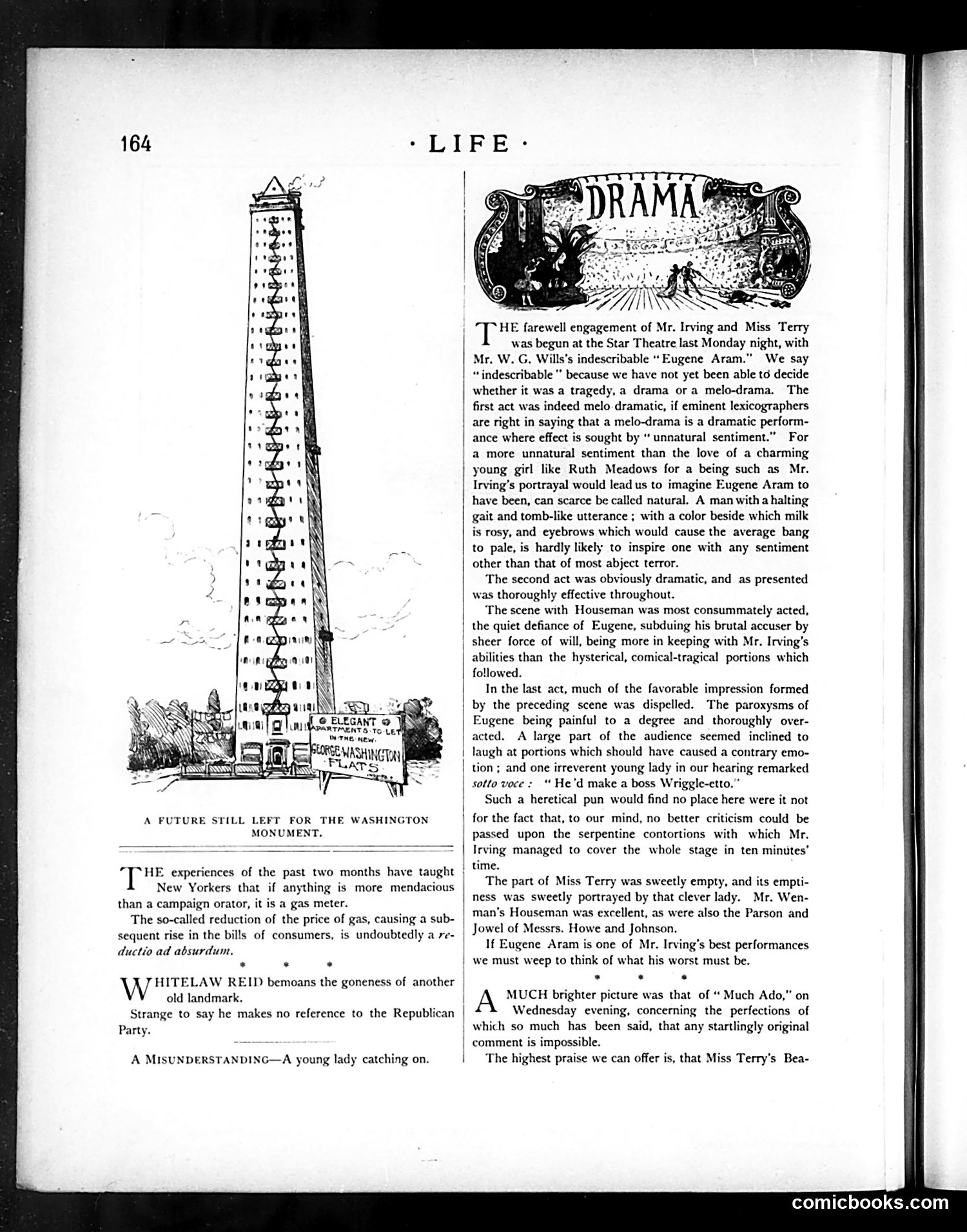
## The Washington Monument Cartoon The left illustration depicts a tall, skeletal building (the Washington Monument) alongside apartment buildings, captioned "A Future Still Left for the Washington Monument." This satirizes New York's rapid, aggressive urban development—the implication being that even iconic monuments may eventually be demolished or dwarfed by commercial construction. It's a commentary on unchecked real estate speculation and the erasure of historical landmarks. ## Gas Meter Satire The text mocks a gas company's claimed price reduction that actually *increased* consumer bills—a "reductio ad absurdum" (reduction to absurdity). This exposes deceptive corporate practices and the gap between advertised savings and actual costs, a consumer-fraud critique. ## Theater Reviews The bulk concerns actor Henry Irving's farewell performance in *Eugene Aram*. The reviewer savagely critiques Irving's pale, tomb-like appearance and exaggerated theatrical gestures, suggesting his performance is unintentionally comedic rather than tragic. The mention of "Wriggle-etto" is a pun mocking his contortions.
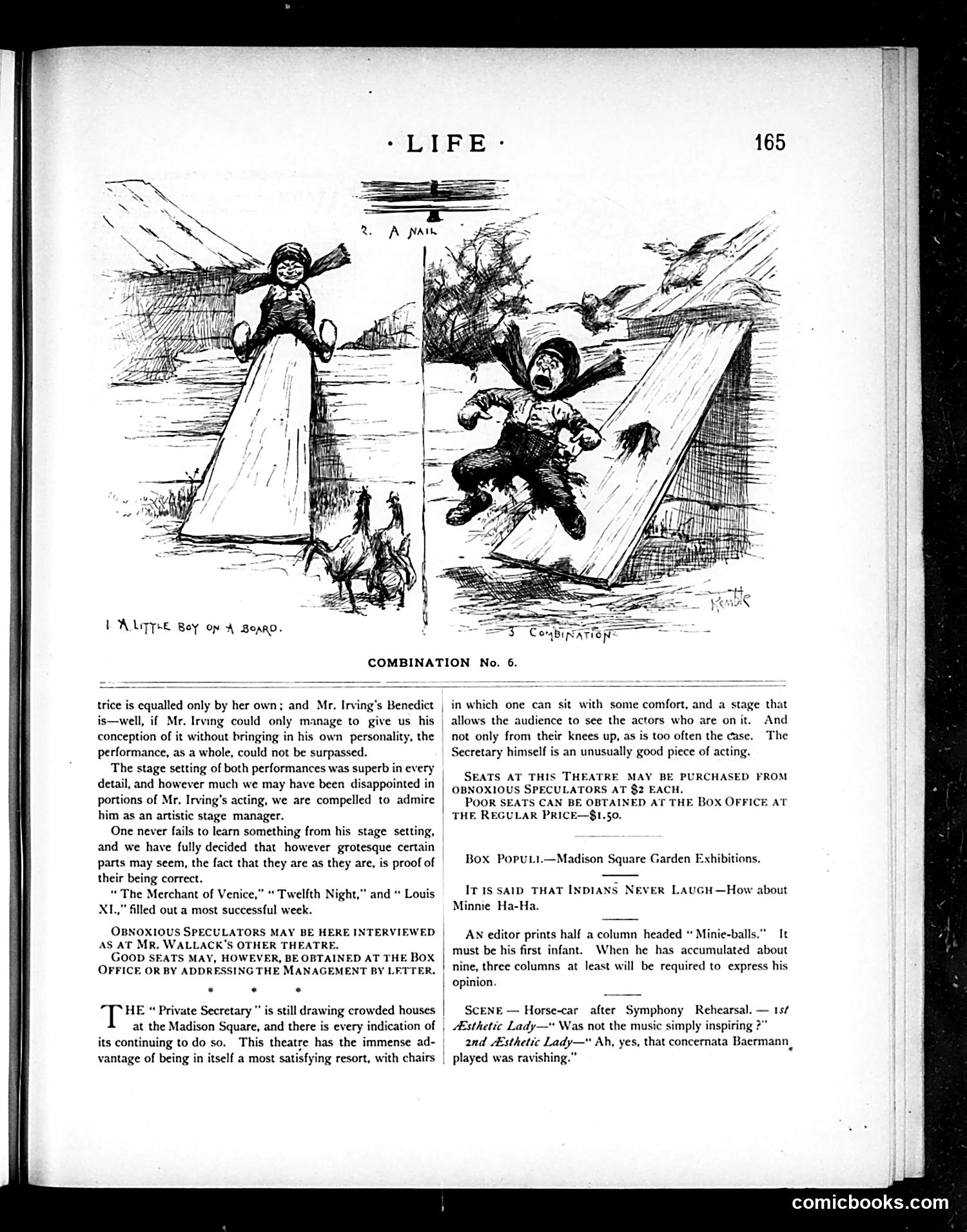
This page combines theatre reviews with satirical commentary. The top cartoon labeled "Combination No. 6" shows two children on playground slides labeled "A NAIL" and "COMBINATION," likely satirizing theatrical performances or social situations—though the specific reference is unclear from the image alone. The text reviews stage productions, praising Henry Irving's artistic direction while critiquing ticket scalping ("obnoxious speculators"). A running joke mocks high ticket prices: scalpers charge $2 while box office seats cost $1.50. Lower sections contain brief satirical items: one jokes about Native Americans never laughing (referencing "Minnie Ha-Ha," likely a period theatrical character); another mocks an editor's column about "Minie-balls" (Civil War ammunition); the final scene ridicules pretentious "aesthetic" theatergoers using affected language about classical music. The satire targets class stratification, theatrical fraud, and affectation—common Life magazine targets of the era.
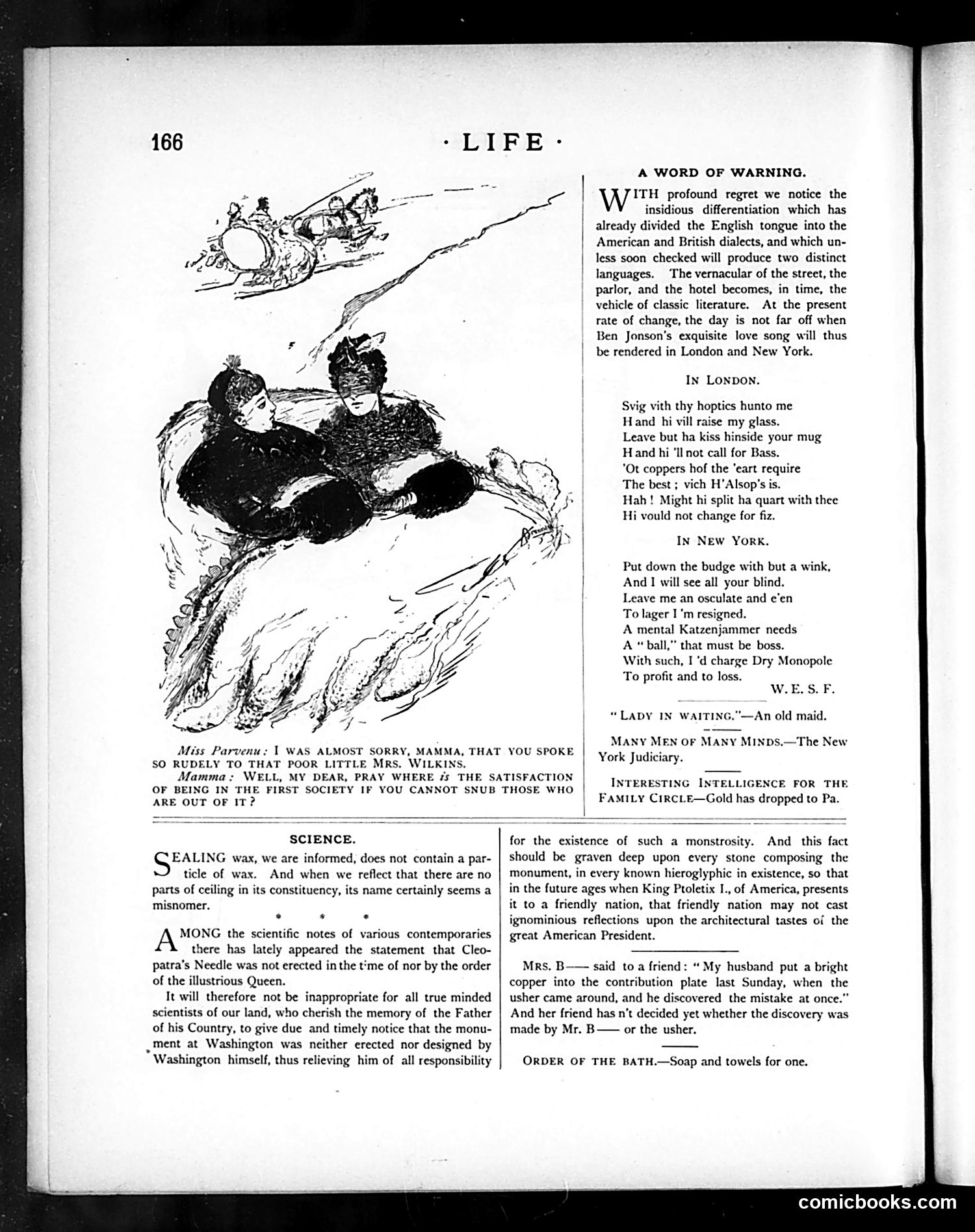
**The Main Cartoon** depicts a social satire about class pretension. "Miss Parvenu" (a newly rich person) apologizes to her mother for being rude to "poor little Mrs. Wilkins." The mother responds that maintaining "first society" status requires snubbing those outside it—the entire point of exclusive social membership is the ability to demean others. **"A Word of Warning"** satirizes diverging American and British English dialects. The piece humorously "translates" a Ben Jonson love poem into exaggerated cockney (London) and Americanized slang versions, predicting the languages will become mutually unintelligible. It's linguistic snobbery dressed as cultural anxiety. **"Science" Section** contains absurdist humor: sealing wax contains no wax; Cleopatra's Needle wasn't made by Cleopatra (obviously)—so perhaps Washington didn't design the Washington Monument either. The joke mocks pseudointellectual logic. **Minor Items** include puns ("Lady in Waiting"="old maid") and brief gossip anecdotes about social embarrassments.
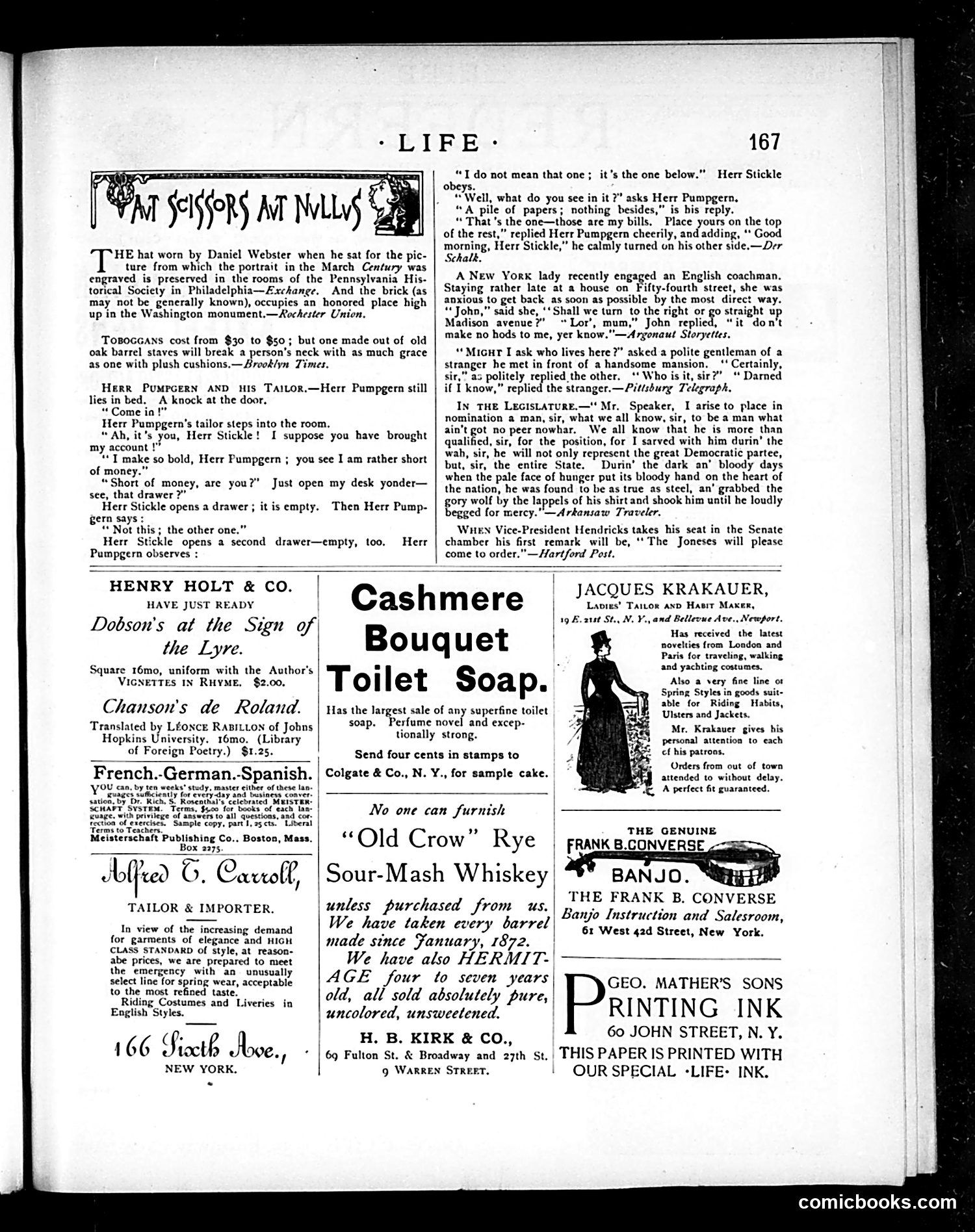
The main cartoon is a humorous sketch about debt avoidance titled "Herr Pumpgern and His Tailor." A chronically indebted man (Pumpgern) lies in bed while his tailor (Stickle) comes to collect payment. When asked where money is, Pumpgern directs the tailor through multiple empty desk drawers, finally pointing to one containing only unpaid bills—where he cheerfully tells Stickle to "place yours on top of the rest" before rolling over and dismissing him. **The joke:** The cartoon satirizes financial irresponsibility and the debtor's casual attitude toward mounting obligations. Pumpgern treats his accumulated debts as a joke rather than a serious problem, embodying a character type contemporary readers would recognize as a perpetual deadbeat. The page also contains several brief anecdotes mocking social pretension, linguistic incompetence, and political bluster—typical of Life's satirical humor. These are advertisements interspersed throughout, a common magazine format of the era.
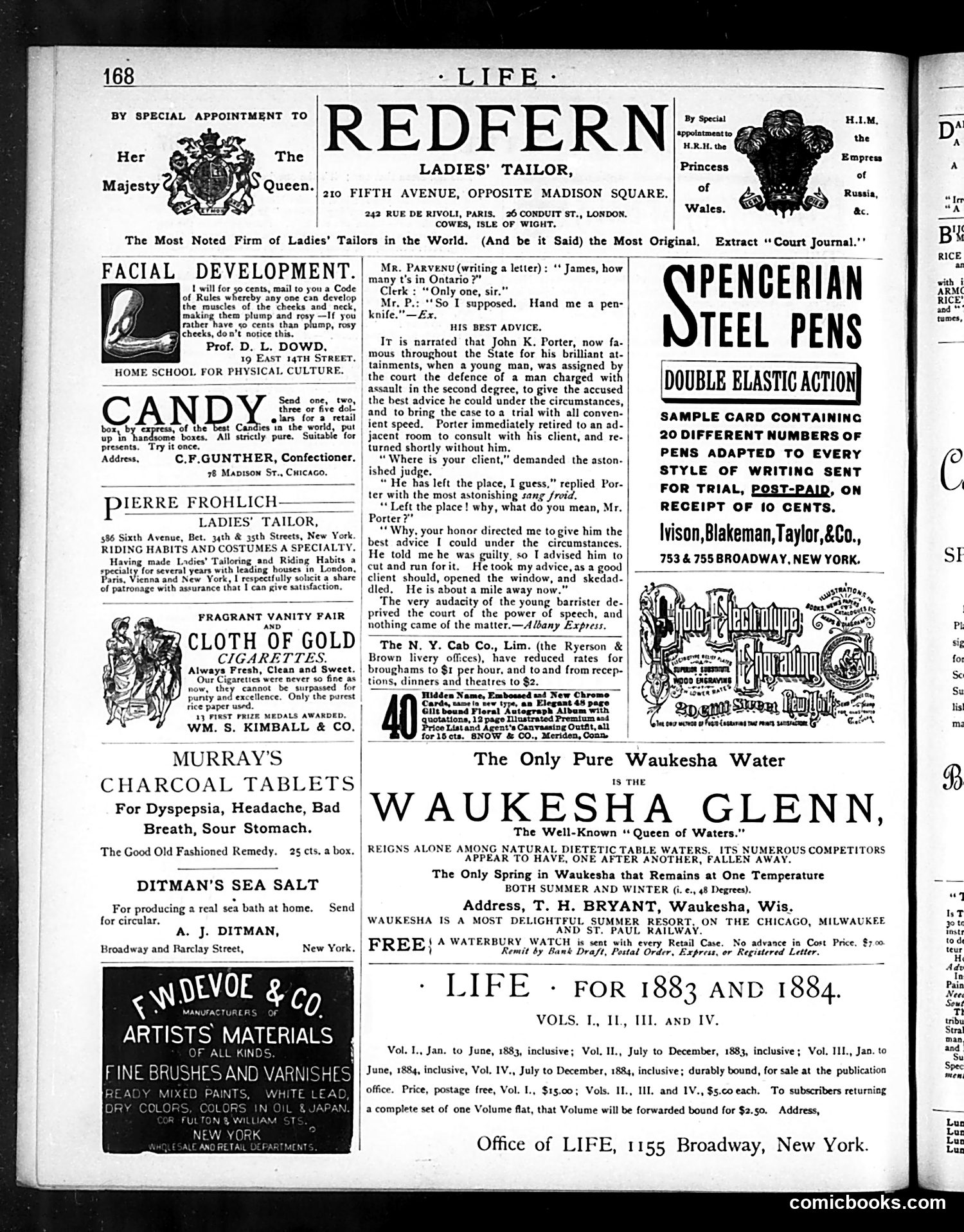
This page is primarily **advertisements and filler content** rather than political cartoons. The dominant elements are: **Main Features:** - Luxury goods ads (Redfern ladies' tailoring, Pierre Frohlich riding habits) - Patent remedies (Murray's charcoal tablets, Ditman's sea salt) - Consumer products (Spencerian steel pens, cigarettes, candies) **Humor Content:** The only substantive satirical item is a brief anecdote titled "HIS BEST ADVICE" about lawyer John K. Porter. The joke: Porter's client, guilty of assault, asks for legal advice. Porter tells him to flee through the window—then reports back that his client took his advice and ran. The humor relies on the absurdity of a lawyer publicly admitting he counseled a defendant to escape justice, leaving the judge speechless. This is gentle, genteel satire typical of *Life*'s era—poking fun at legal incompetence rather than addressing serious social issues. The anecdote satirizes either Porter's naiveté or audacious dishonesty, depending on interpretation. The page otherwise reflects *Life*'s primary function as a vehicle for advertising luxury goods to affluent readers.
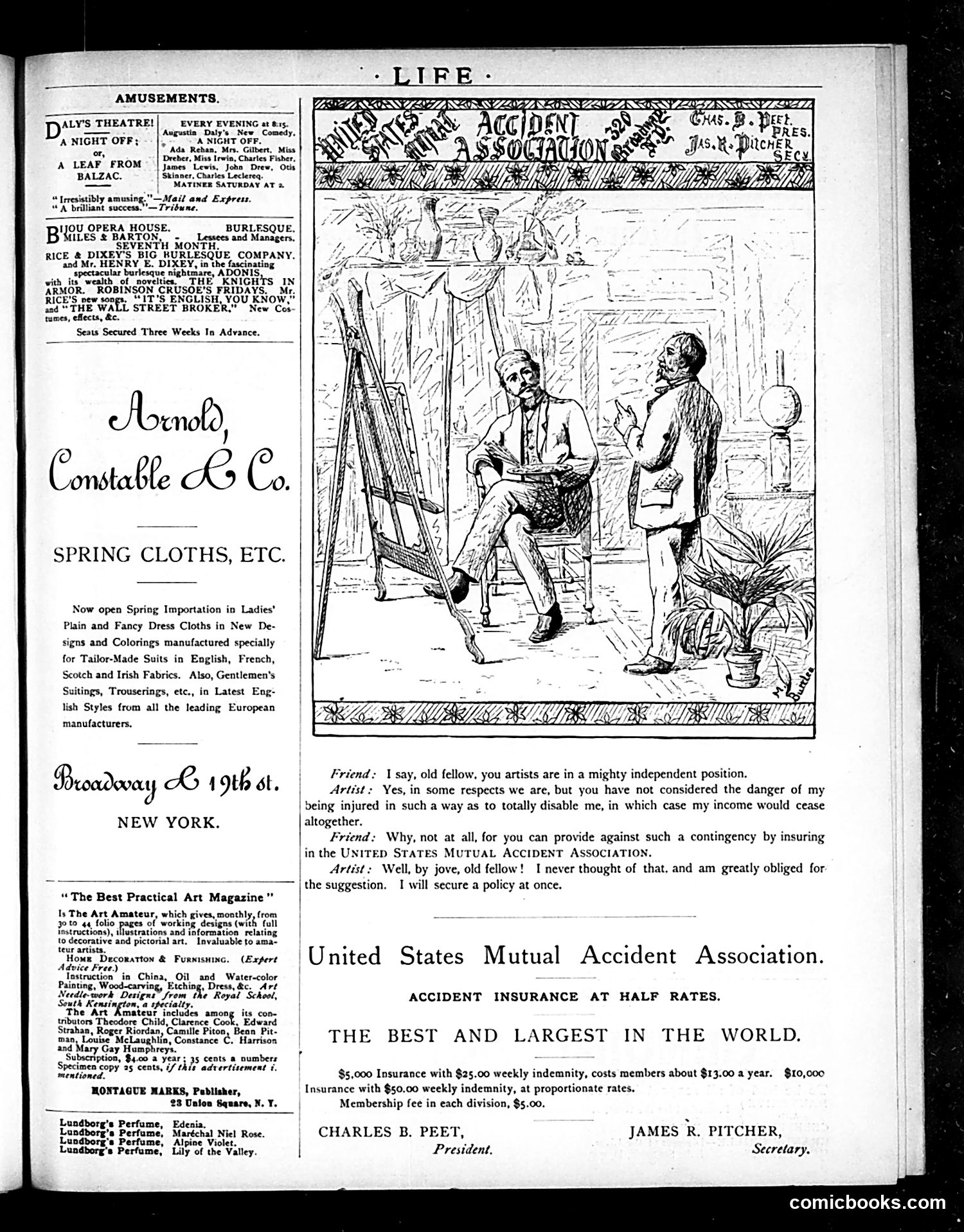
This page mixes theatrical advertisements with a single-panel cartoon promoting accident insurance. The cartoon depicts two men—labeled "Friend" and "Artist"—in conversation. The artist sits injured or disabled, unable to work, while his friend suggests he purchase insurance from the United States Mutual Accident Association to protect his income. The satire targets artists and independent workers of the era who lacked employer-provided benefits. The "mighty independent position" mentioned ironically highlights their vulnerability: self-employed creatives had no safety net if injured. The cartoon frames insurance as obvious common sense, using humor to sell the product to readers who, like artists, faced occupational risks without institutional protection. This was early promotional messaging for accident insurance, then a novel concept. The page otherwise contains theater listings and clothing advertisements typical of *Life* magazine's commercial content.
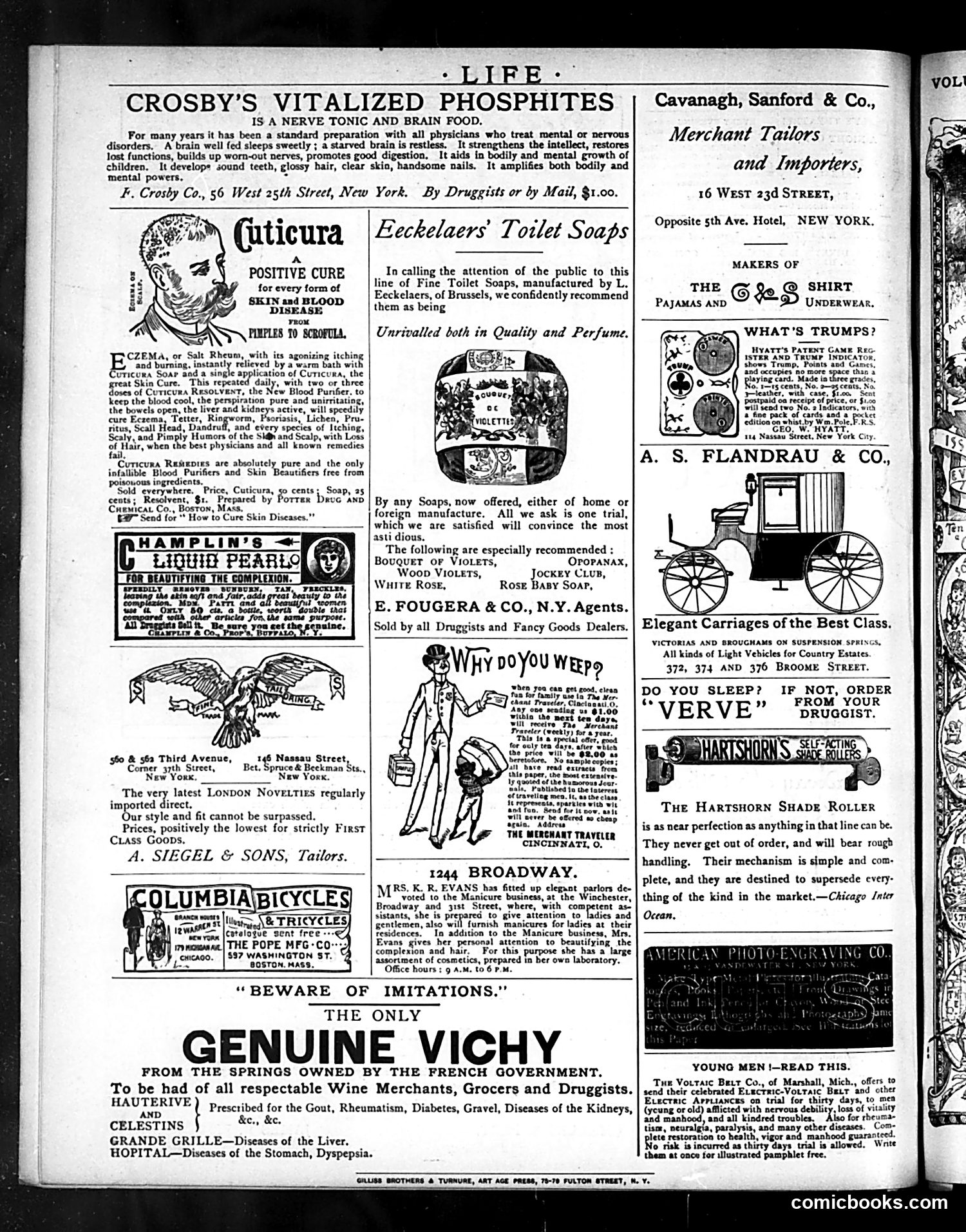
This page is primarily **advertising content** from a historical American magazine, not political satire or cartooning. It contains multiple product advertisements typical of the era, including: **Medical/Health Products**: Crosby's Vitalized Phosphites (nerve tonic), Cuticura remedies (skin disease treatments), Hamplin's Liquid Pearls (teeth cleaners), Eckelaers' Toilet Soaps, and Vichy water—all making expansive health claims typical of late 19th-century patent medicine advertising. **Services & Goods**: Tailor shops, bicycle manufacturers, carriage makers, shade rollers, and manicure services. **Advertising Conventions**: The page uses elaborate typography, illustrated product boxes, and testimonial-style copy claiming miraculous cures—standard for this era when medical claims were largely unregulated. The only marginally illustrative element is a small cartoon labeled "Why do you weep?" depicting a merchant traveler, which appears to be promotional material for commercial services rather than political commentary. This represents the monetization of mass-circulation magazines through advertising rather than editorial content.