
Life, 1885-03-19 · page 10 of 16
Life — March 19, 1885 — page 10: what you’re looking at
What you’re looking at
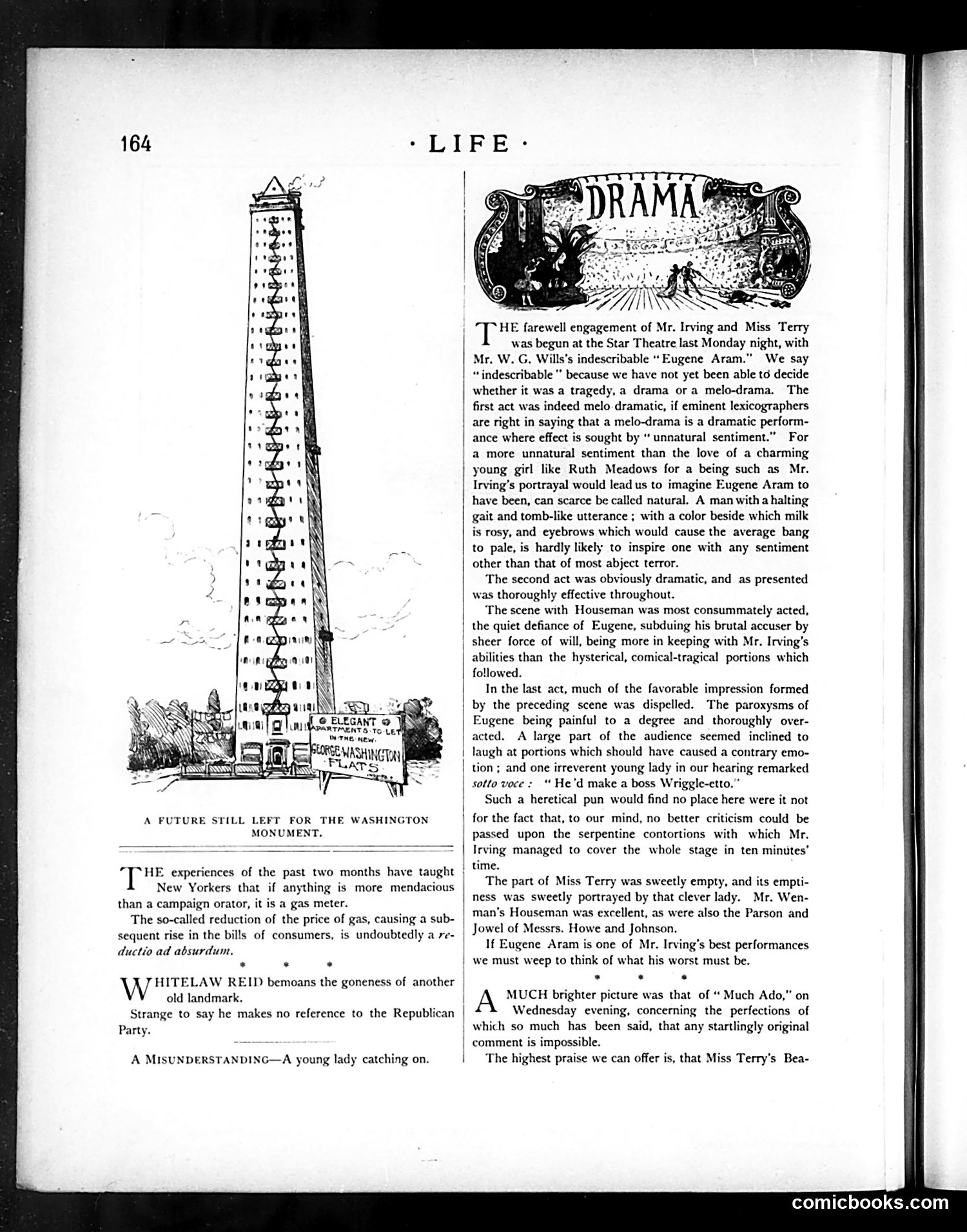
## The Washington Monument Cartoon The left illustration depicts a tall, skeletal building (the Washington Monument) alongside apartment buildings, captioned "A Future Still Left for the Washington Monument." This satirizes New York's rapid, aggressive urban development—the implication being that even iconic monuments may eventually be demolished or dwarfed by commercial construction. It's a commentary on unchecked real estate speculation and the erasure of historical landmarks. ## Gas Meter Satire The text mocks a gas company's claimed price reduction that actually *increased* consumer bills—a "reductio ad absurdum" (reduction to absurdity). This exposes deceptive corporate practices and the gap between advertised savings and actual costs, a consumer-fraud critique. ## Theater Reviews The bulk concerns actor Henry Irving's farewell performance in *Eugene Aram*. The reviewer savagely critiques Irving's pale, tomb-like appearance and exaggerated theatrical gestures, suggesting his performance is unintentionally comedic rather than tragic. The mention of "Wriggle-etto" is a pun mocking his contortions.
📄 Transcribed text from this page (OCR, searchable)
Machine-transcribed from the original scan — historical spelling and the odd misread are preserved.
{ G ELEGANT @ PARTMENT S-T0 LE: A FUTURE STILL LEFT FOR THE WASHINGTON MONUMENT. ’TCHE experiences of the past two months have taught | New Yorkers that if anything is more mendacious than a campaign orator, it is a gas meter. The so-called reduction of the price of gas, causing a sub- sequent rise in the bills of consumers, is undoubtedly a re- ductio ad absurdum. . . . HITELAW REID bemoans the goneness of another old landmark. Strange to say he makes no reference to the Republican Party. A MISUNDERSTANDING—A young lady catching on. i | sotto voce : HE farewell engagement of Mr. Irving and Miss Terry was begun at the Star Theatre last Monday night, with Mr. W. G, Wills’s indescribable “Eugene Aram.” We say “indescribable " because we have not yet been able td decide whether it was a tragedy, a drama ora melo-drama. The | first act was indeed melo-dramatic, if eminent lexicographers | are right in saying that a melo-drama is a dramatic perform- ance where effect is sought by “ unnatural sentiment.” For a more unnatural sentiment than the love of a charming young girl like Ruth Meadows for a being such as Mr. Irving’s portrayal would lead us to imagine Eugene Aram to have been, can scarce be called natural. A man witha halting gait and tomb-like utterance ; with a color beside which milk is rosy, and eyebrows which would cause the average bang to pale, is hardly likely to inspire one with any sentiment other than that of most abject terror. The second act was obviously dramatic, and as presented was thoroughly effective throughout. The scene with Houseman was most consummately acted, the quiet defiance of Eugene, subduing his brutal accuser by sheer force of will, being more in keeping with Mr. Irving’s abilities than the hysterical, comical-tragical portions which followed. In the last act, much of the favorable impression formed by the preceding scene was dispelled. The paroxysms of Eugene being painful to a degree and thoroughly over- acted. A large part of the audience seemed inclined to | laugh at portions which should have caused a contrary emo- tion ; and one irreverent young lady in our hearing remarked “ He'd make a boss Wriggle-etto.” Such a heretical pun would find no place here were it not for the fact that, to our mind, no better criticism could be passed upon the serpentine contortions with which Mr. Irving managed to cover the whole stage in ten minutes’ time. The part of Miss Terry was sweetly empty, and its empti- ness was sweetly portrayed by that clever lady. Mr. Wen- man’s Houseman was excellent, as were also the Parson and Jowel of Messrs. Howe and Johnson. If Eugene Aram is one of Mr. Irving’s best performances we must weep to think of what his worst must be. . . . MUCH brighter picture was that of “ Much Ado,” on Wednesday evening, concerning the perfections of which so much has been said, that any startlingly original comment is impossible. The highest praise we can offer is, that Miss Terry's Bea- comicbooks.com