
Life, 1885-03-19 · page 6 of 16
Life — March 19, 1885 — page 6: what you’re looking at
What you’re looking at
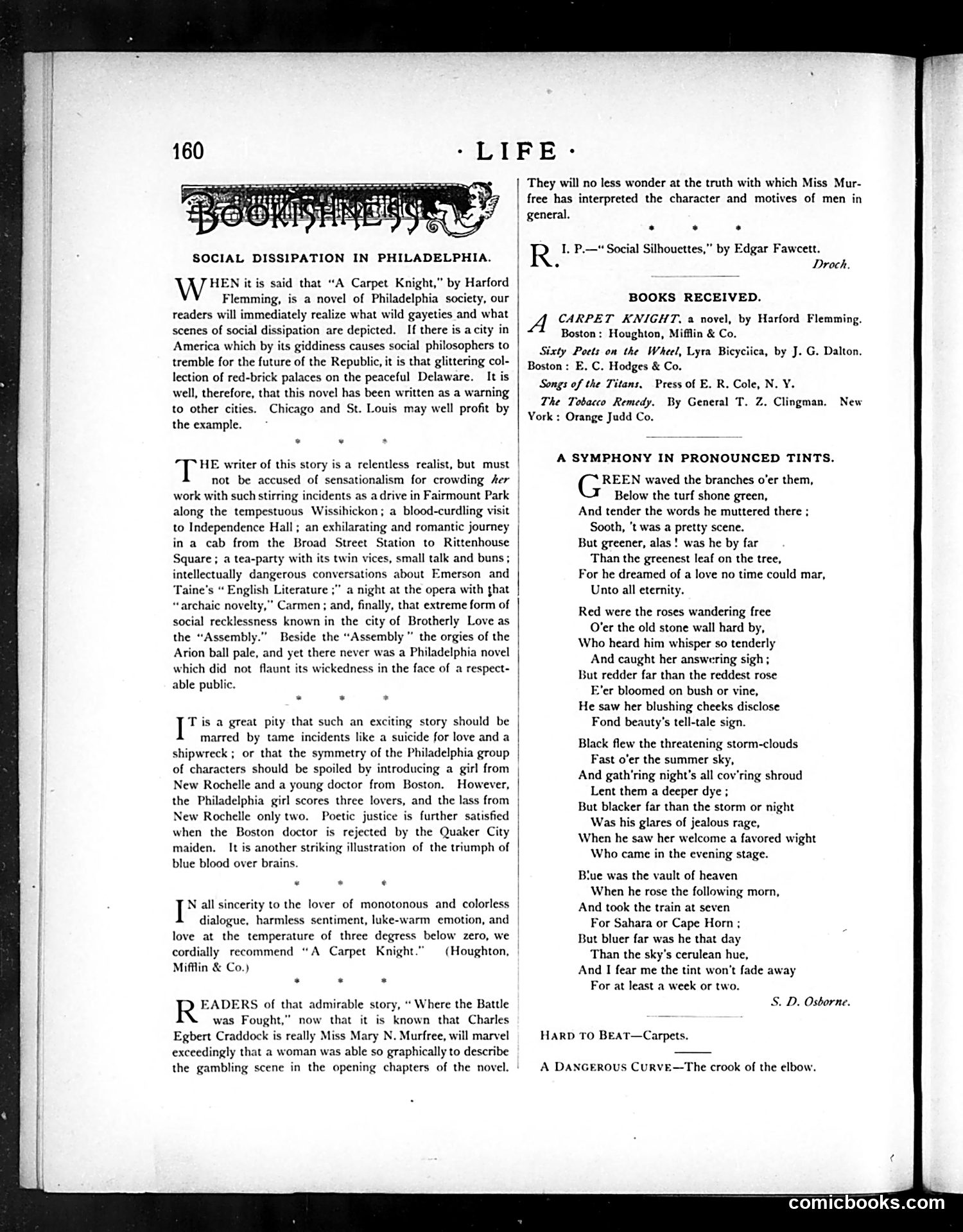
This page contains **no political cartoon**. Instead, it features a "Bookshelf" section reviewing literature, particularly "A Carpet Knight" by Harford Fleming, a novel depicting Philadelphia high society's decadence. The reviewer describes the book as a cautionary tale about social excess—depicting "wild gayeties" and "scenes of social dissipation" in Philadelphia and other elite American cities. The text suggests the novel serves as social criticism, warning against moral decline among the upper classes. The page includes book advertisements and a poem titled "A Symphony in Pronounced Tints" by S.D. Osborne, unrelated to political commentary. This is a **book review section**, not satirical political commentary.
📄 Transcribed text from this page (OCR, searchable)
Machine-transcribed from the original scan — historical spelling and the odd misread are preserved.
- LIFE: SOCIAL DISSIPATION IN PHILADELPHIA. HEN it is said that “A Carpet Knight,” by Harford Flemming, is a novel of Philadelphia society, our readers will immediately realize what wild gayeties and what scenes of social dissipation are depicted. If there is acity in America which by its giddiness causes social philosophers to tremble for the future of the Republic, it is that glittering col- lection of red-brick palaces on the peaceful Delaware. It is well, therefore, that this novel has been written as a warning to other cities. the example. Chicago and St. Louis may well profit by HE writer of this story is a relentless realist, but must not be accused of sensationalism for crowding Aer work with such stirring incidents as a drive in Fairmount Park along the tempestuous Wissihickon; a blood-curdling visit | to Independence Hall ; an exhilarating and romantic journey in a cab from the Broad Street Station to Rittenhouse Square ; a tea-party with its twin vices, small talk and buns; intellectually dangerous conversations about Emerson and Taine’s “ English Literature ;” a night at the opera with that “archaic novelty,” Carmen ; and, finally, that extreme form of social recklessness known in the city of Brotherly Love as the “Assembly.” Beside the “Assembly ” the orgies of the Arion ball pale, and yet there never was a Philadelphia novel which did not flaunt its wickedness in the face of a respect- able public. T is a great pity that such an exciting story should be marred by tame incidents like a suicide for love and a shipwreck ; or that the symmetry of the Philadelphia group of characters should be spoiled by introducing a girl from New Rochelle and a young doctor from Boston. However, the Philadelphia girl scores three lovers, and the lass from New Rochelle only two. Poetic justice is further satisfied when the Boston doctor is rejected by the Quaker City maiden. It is another striking illustration of the triumph of blue blood over brains. « . * all sincerity to the lover of monotonous and colorless | N I dialogue, harmless sentiment, luke-warm emotion, and love at the temperature of three degress below zero, we cordially recommend “A Carpet Knight.” (Houghton, Mifflin & Co.) R =ADERS of that admirable story, “ Where the Battle was Fought,” now that it is known that Charles Egbert Craddock is really Miss Mary N. Murfree, will marvel exceedingly that a woman was able so graphically to describe the gambling scene in the opening chapters of the novel. They will no less wonder at the truth with which Miss Mur- | free has interpreted the character and motives of men in general. . . . | R I. P.—“ Social Silhouettes,” by Edgar Fawcett. | . Droch. BOOKS RECEIVED. A CARPET KNIGHT, a novel, by Harford Flemming. Boston: Houghton, Mifflin & Co. Sixty Poets on the Wheel, Lyra Bicyciica, by J. G. Dalton. Boston : E. C. Hodges & Co. Songs of the Titans, Press of E. R. Cole, N. Y. The Tobacco Remedy. By General T. Z. Clingman. York : Orange Judd Co. New A SYMPHONY IN PRONOUNCED TINTS. REEN waved the branches o'er them, Below the turf shone green, And tender the words he muttered there ; Sooth, 't was a pretty scene. But greener, alas ! was he by far Than the greenest leaf on the tree, For he dreamed of a love no time could mar, Unto all eternity. Red were the roses wandering free O’er the old stone wall hard by, Who heard him whisper so tenderly And caught her answering sigh ; But redder far than the reddest rose E’er bloomed on bush or vine, He saw her blushing cheeks disclose Fond beauty’s tell-tale sign. Black flew the threatening storm-clouds Fast o'er the summer sky, And gath’ring night's all cov'ring shroud Lent them a deeper dye ; But blacker far than the storm or night Was his glares of jealous rage, When he saw her welcome a favored wight Who came in the evening stage. Biue was the vault of heaven When he rose the following morn, And took the train at seven For Sahara or Cape Horn ; But bluer far was he that day Than the sky's cerulean hue, And I fear me the tint won't fade away For at least a week or two. S. D. Osborne. HarD TO BEAT—Carpets. A DANGEROUS CURVE—The crook of the elbow. comicbooks.com