
Life, 1885-03-19 · page 2 of 16
Life — March 19, 1885 — page 2: what you’re looking at
What you’re looking at
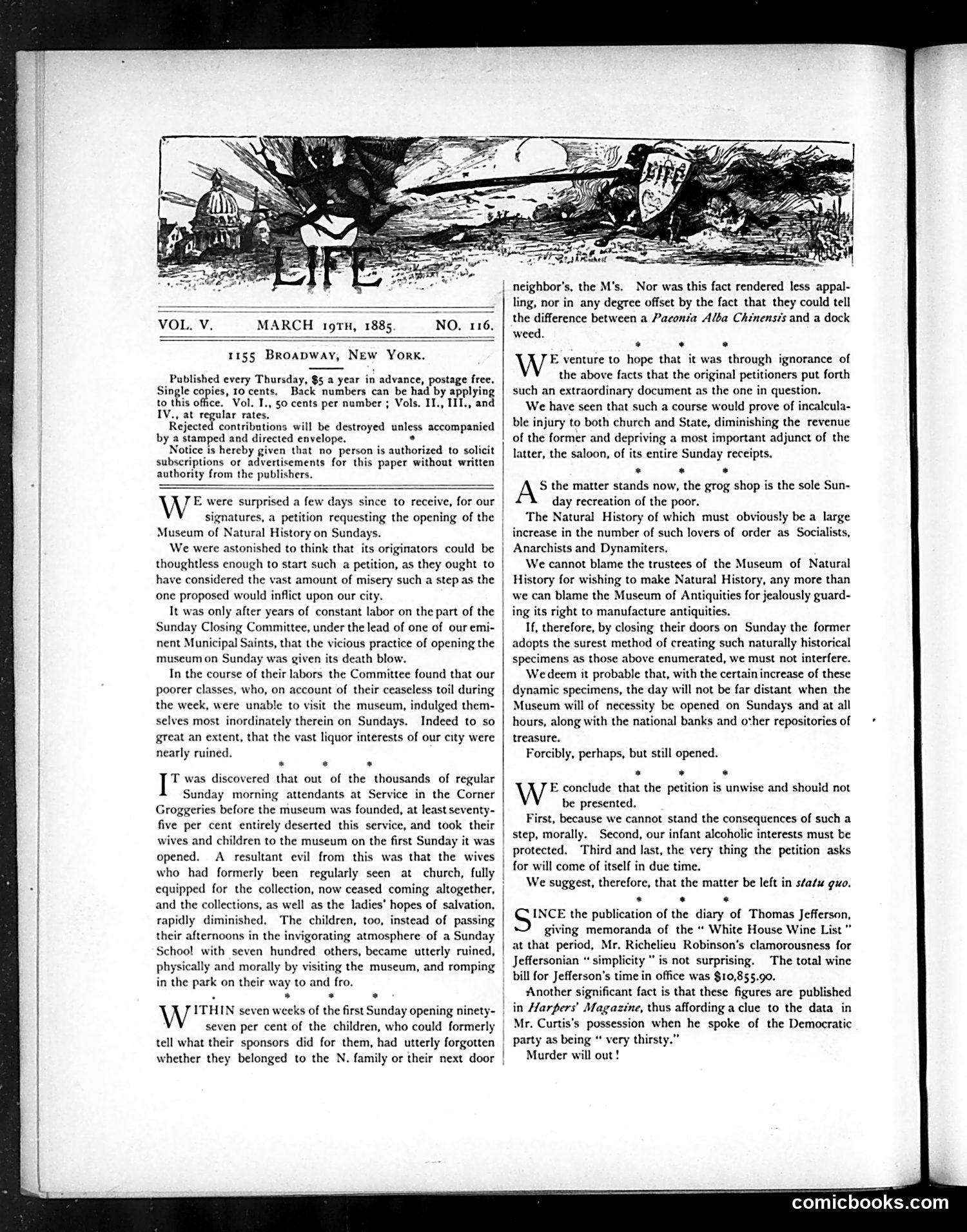
The banner illustration depicts "LIFE" as a allegorical figure surveying a landscape, likely representing the magazine's editorial perspective on current events. The article debates whether the American Museum of Natural History should open on Sundays. The text reveals this was a contentious issue: working-class families wanted Sunday access to cultural institutions (their only free day), but religious groups and the wealthy opposed Sunday operations on moral grounds. The satirical point: the magazine argues the petition to keep the museum closed is "unwise," mocking those prioritizing religious doctrine over public benefit. The text notes that closing museums actually harms poor families while protecting saloons' Sunday profits—suggesting hypocrisy in the opposition's morality.
📄 Transcribed text from this page (OCR, searchable)
Machine-transcribed from the original scan — historical spelling and the odd misread are preserved.
VOL. V. MARCH torn, 1885. NO. 116, 1155 Broapway, New York. Published every Thursday, $5 a year in advance, postage free. Single copies, ro cents, Back numbers can be had by applying to this ofhce. Vol. I., 50 cents per number ; Vols. II., III., and IV., at regular rates. Rejected contributions will be destroyed unless accompanied by a stamped and directed envelope. e Notice is hereby given that no person is authorized to solicit subscriptions or advertisements for this paper without written authority from the publishers, J E were surprised a few day nce to receive, for our signatures, a petition requesting the opening of the Museum of Natural History on Sundays. We were astonished to think that its originators could be thoughtless enough to start such a petition, as they ought to | have considered the vast amount of misery such a step as the one proposed would inflict upon our city. It was only after years of constant labor on the part of the Sunday Closing Committee, under the lead of one of our emi- nent Municipal Saints, that the vicious practice of opening the museum on Sunday was given its death blow. In the course of their labors the Committee found that our poorer classes, who, on account of their ceaseless toil during the week, were unable to visit the museum, indulged them- selves most inordinately therein on Sundays. Indeed to so great an extent, that the vast liquor interests of our city were nearly ruined. . . *. T was discovered that out of the thousands of regular Sunday morning attendants at Service in the Corner Groggeries before the museum was founded, at least seventy- five per cent entirely deserted this service, and took their wives and children to the museum on the first Sunday it was opened. A resultant evil from this was that the wives equipped for the collection, now ceased coming altogether, and the collections, as well as the ladies’ hopes of salvation, rapidly diminished. The children, too, instead of passing their afternoons in the invigorating atmosphere of a Sunday Schoo! with seven hundred others, became utterly ruined, physically and morally by visiting the museum, and romping in the park on their way to and fro. . . ° ITHIN seven weeks of the first Sunday opening ninety- seven per cent of the children, who could formerly tell what their sponsors did for them, had utterly forgotten whether they belonged to the N. family or their next door | neighbor's, the M’s. Nor was this fact rendered less appal- ling, nor in any degree offset by the fact that they could tell the difference between a Paconia Alba Chinens?s and a dock weed. . . . E venture to hope that it through ignorance of the above facts that the original petitioners put forth such an extraordinary document as the one in question. We have seen that such a course would prove of incalcula- ble injury to both church and State, diminishing the revenue of the former and depriving a most important adjunct of the latter, the saloon, of its entire Sunday receipts. . . . S the matter stands now, the grog shop is the sole Sun- day recreation of the poor. The Natural History of which must obviously be a large increase in the number of such lovers of order as Socialists, Anarchists and Dynamiters. We cannot blame the trustees of the Museum of Natural History for wishing to make Natural History, any more than we can blame the Museum of Antiquities for jealously guard- ing its right to manufacture antiquities. If, therefore, by closing their doors on Sunday the former adopts the surest method of creating such naturally historical specimens as those above enumerated, we must not interfere. Wedeem it probable that, with the certain increase of these dynamic specimens, the day will not be far distant when the Museum will of necessity be opened on Sundays and at all hours, along with the national banks and other repositories of treasure. Forcibly, perhaps, but still opened. * * . W E conclude that the petition is unwise and should not be presented. irst, because we cannot stand the consequences of such a step, morally. Second, our infant alcoholic interests must be protected. Third and last, the very thing the petition asks who had formerly been regularly seen at church, fully | for will come of itself in due time. We suggest, therefore, that the matter be left in s/atu guo. . . . INCE the publication of the diary of Thomas Jefferson, giving memoranda of the “ White House Wine List ” at that period, Mr. Richelieu Robinson's clamorousness for Jeffersonian “ simplicity” is not surprising. The total wine bill for Jefferson's time in office was $10,855.90. Another significant fact is that these figures are published in Harpers’ Magazine, thus affording a clue to the data in Mr. Curtis's possession when he spoke of the Democratic party as being “ very thirsty.” Murder will out! comicbooks.com