
A complete issue · 16 pages · 1885
Life — March 12, 1885
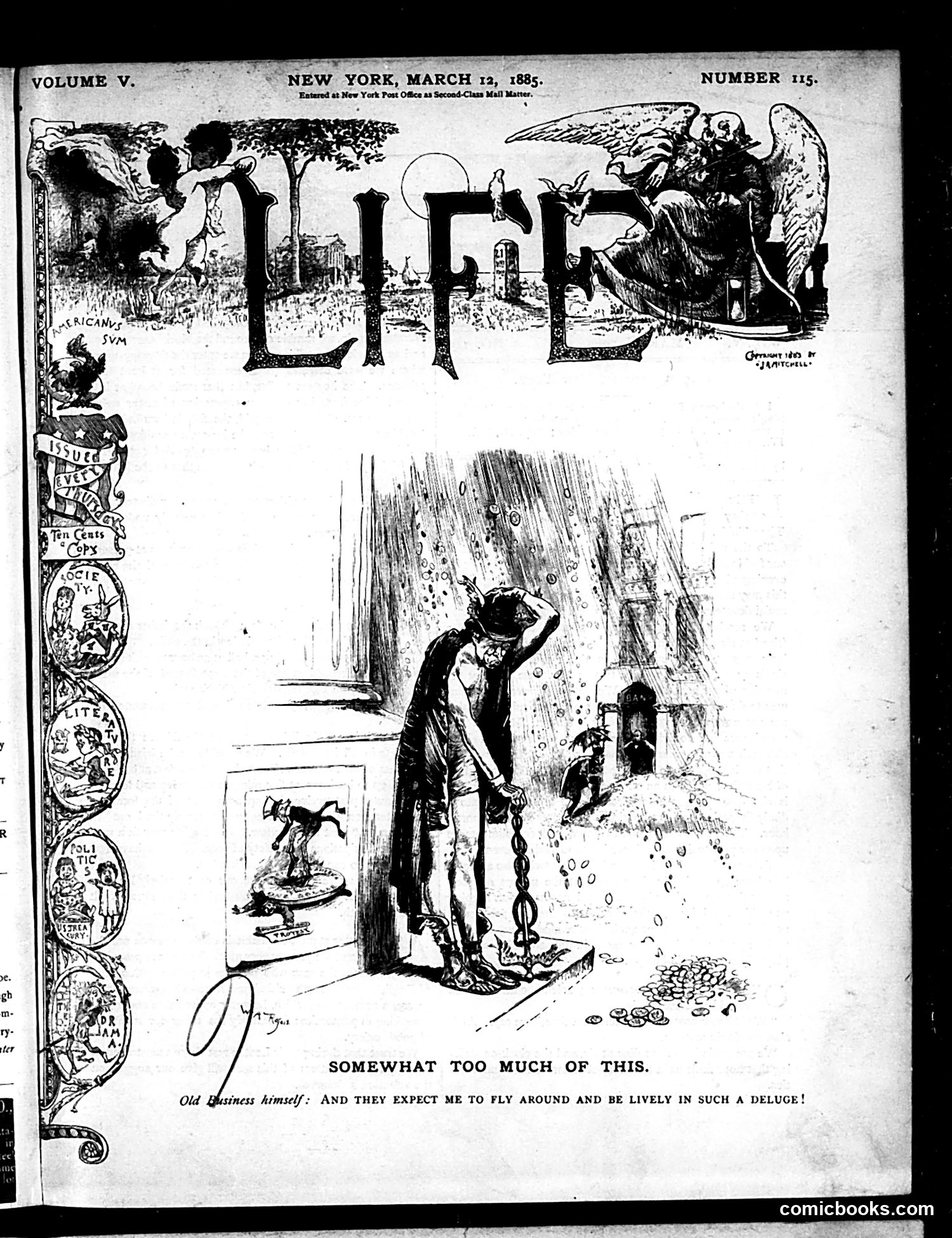
**The Cartoon: "Somewhat Too Much of This"** This satirical drawing depicts a disheveled, elderly businessman drowning in a deluge of coins and financial papers. The caption reads: "Old business himself: AND THEY EXPECT ME TO FLY AROUND AND BE LIVELY IN SUCH A DELUGE!" The satire targets American business culture's unrealistic expectations. The figure—representing "Old Business" personified—is overwhelmed by his own success and the excessive material accumulation it produces. Rather than celebrating wealth, the cartoon critiques the exhausting, dehumanizing nature of relentless commercial pursuit during the Gilded Age. The flood of money becomes burdensome rather than liberating, suggesting contemporary anxieties about capitalism's pace and demands on society.
This page satirizes American high-society dining customs and their pretensions toward English gentility. The article mocks the confusion among New York's wealthy about proper dinner hours—whether "six o'clock" means 6 PM or 7 PM—and critiques the absurdity of adopting English social conventions wholesale while remaining fundamentally American. The satire targets the contradiction of wealthy New Yorkers attempting to copy English aristocratic behavior (formal dinner timing, dress codes) while lacking the genuine refinement such customs supposedly represent. The author suggests American society should develop its own authentic customs rather than awkwardly imitating English ones, describing such imitation as a "crazy quilt mixture" that makes participants look foolish. The humor lies in exposing social pretension and class anxiety among the Gilded Age elite.
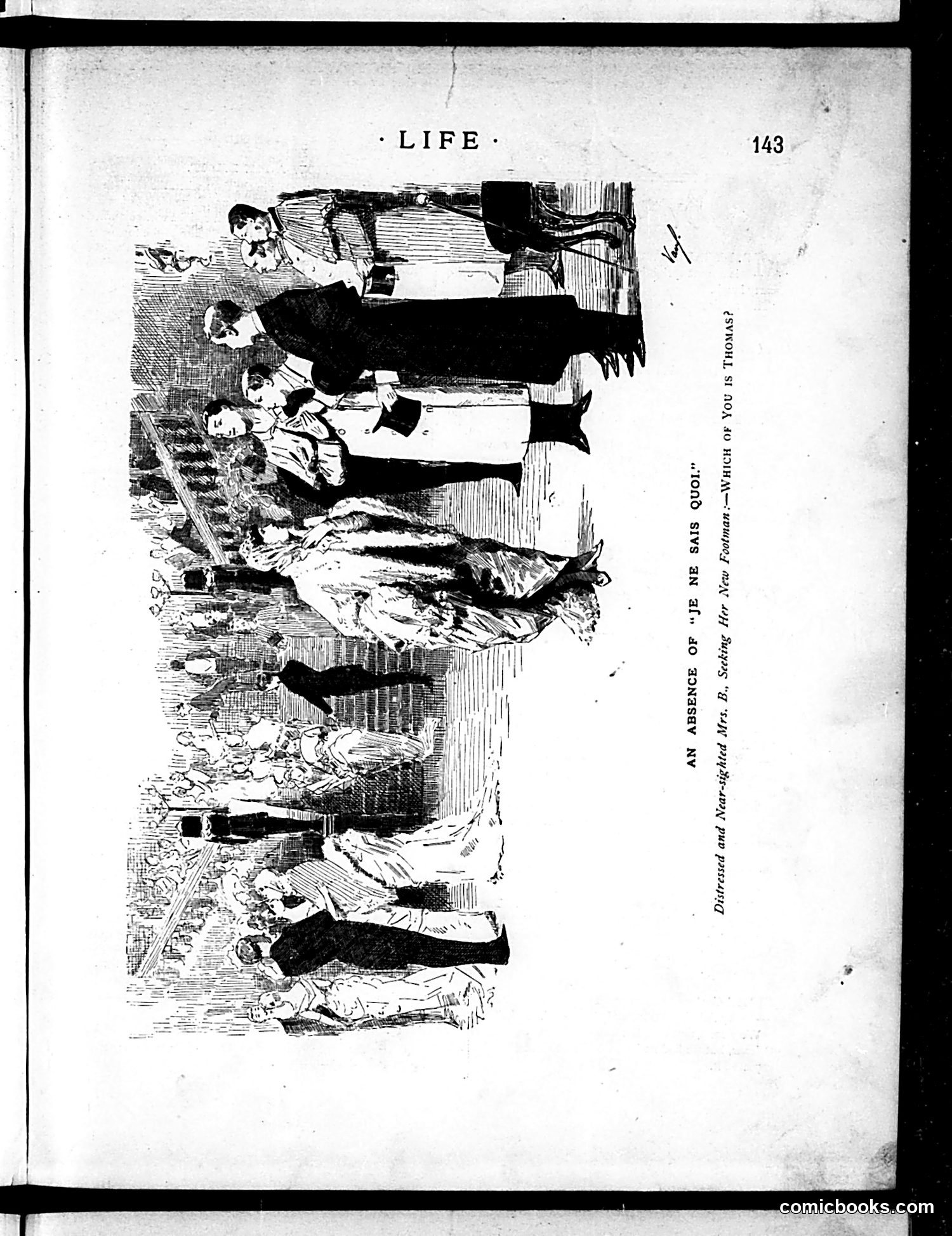
This page from *Life* magazine (page 143) contains a satirical illustration titled "An Absence of 'Up-be Sais Quoi?'" The caption indicates it's "Directed and Narrated by Mr. Z. Seeing the New Sherlock—Watson of Todays?" The cartoon appears to be a social satire showing multiple figures in what seems to be a public scene. The image is rotated 90 degrees, making it difficult to read definitively, but it depicts various well-dressed individuals in what appears to be commentary on contemporary social observation or detective work (the "Sherlock-Watson" reference suggests analyzing society). The specific satirical target—whether mocking amateur detectives, social climbers, or public behavior—remains unclear from the rotated presentation, though the title suggests commentary on identifying something ineffable or pretentious in modern society.
This page contains a satirical column titled "By the Way" with several brief commentary items rather than a cartoon. The items mock various public figures and social issues: Edgar Fawcett's *Bungling Ball* is praised; journalism lectures are announced; David Dudley Field objects to "villain" city names; and Captain Williams returns from duty. Most notably, the page critiques the "Sunday Closing League," which shut museums to poorer classes on Sundays—an elite gatekeeping practice. The magazine sarcastically celebrates when museums finally opened to working people. The right side contains "How a Pin Did It," an allegorical tale about a maiden named Eliza Jones in Gotham who becomes beautiful through artifice (a pin-shaped corset device). It satirizes vanity and artificial feminine beauty standards of the era.
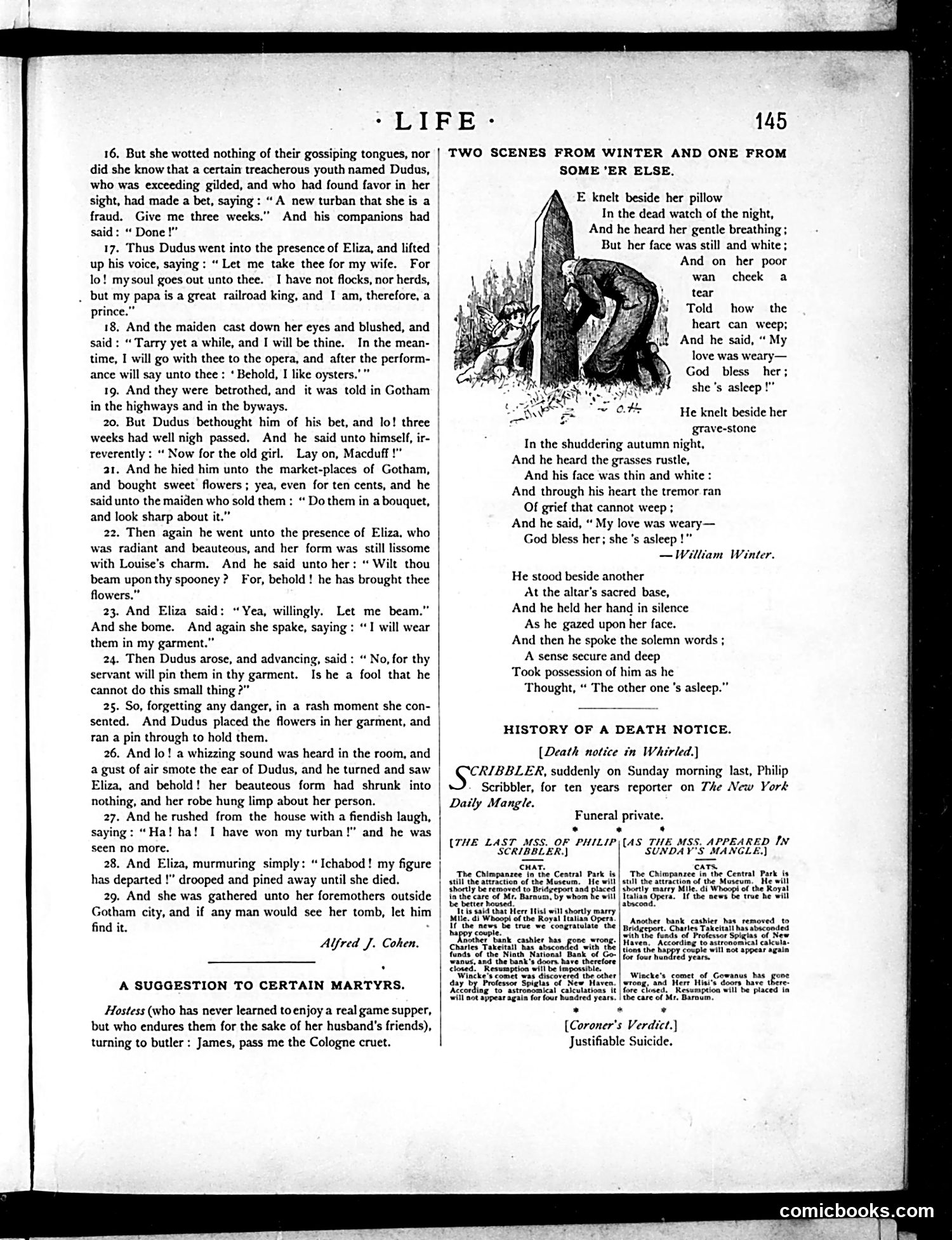
This page contains literary content rather than political cartoons. The main feature is "Two Scenes from Winter and One from Some'er Else" by William Winter—romantic poetry accompanied by an illustration showing a man kneeling beside a woman's grave at night. Below that is "History of a Death Notice," a brief satirical piece about Philip Scribbler, described as a ten-year reporter for *The New York Daily Mangle*. The satire mocks how death notices are written, with editorial notes about his obituary placement and funeral arrangements. At the bottom, "A Suggestion to Certain Martyrs" offers a humorous jab at hostesses who endure boring dinner parties for their husbands' social obligations, suggesting they hire a butler instead. The page focuses on social satire and sentimental literature rather than political commentary.
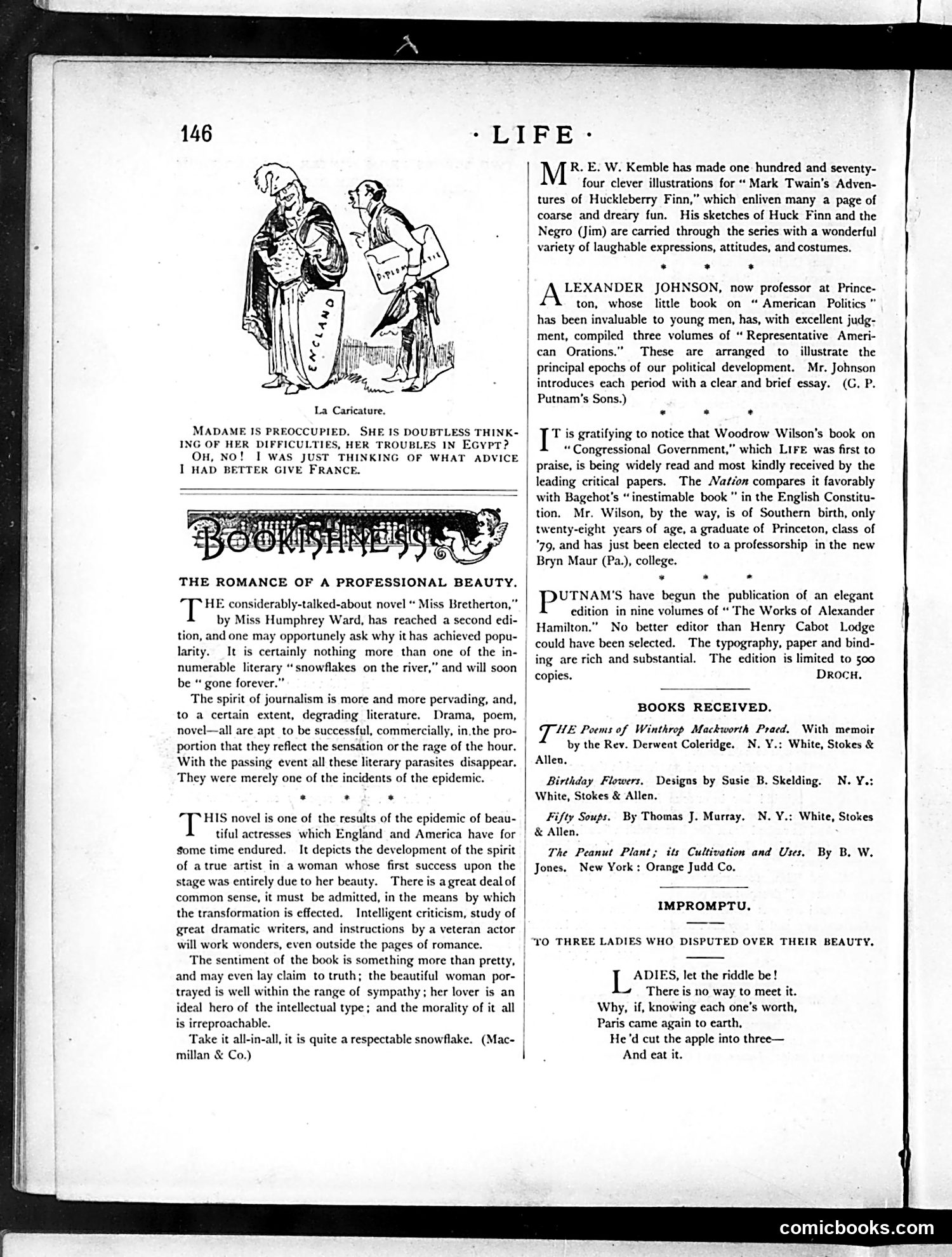
The cartoon titled "La Caricature" depicts two figures in historical dress engaged in conversation. The caption quotes one figure saying: "Madame is preoccupied. She is doubtless thinking of her difficulties in Egypt. Oh, no! I was just thinking of what advice I had better give France." This appears to be political satire about French colonial interests in Egypt during the late 19th or early 20th century. The figures likely represent France and another nation (possibly Britain, given the context of colonial rivalries). The joke hinges on the assumption that France constantly meddles in Egyptian affairs while pretending to offer disinterested advice to other nations. The illustration is credited as "La Caricature," suggesting it parodies French political cartoons or French political pretensions generally.
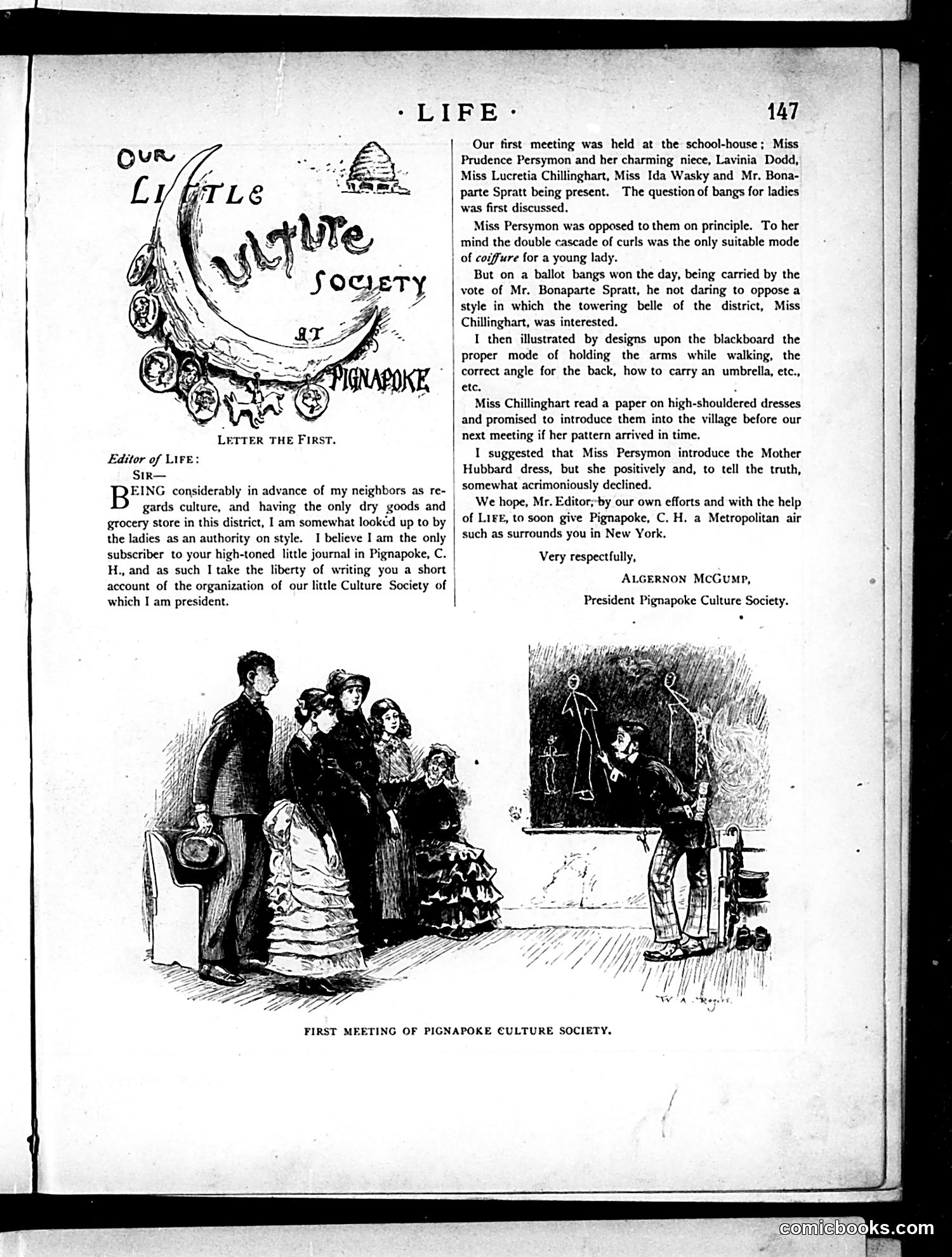
This page satirizes the "Pignapoke Culture Society," a fictional ladies' organization in Pignapoke, C.H. (Court House), through a letter from its president, Algernon McCump. The satire targets pretension: McCump claims his town rivals metropolitan centers in "culture," and boasts of having the only dry goods store and subscriber to *Life* magazine. The society's debates—whether ladies should wear bangs and high-shouldered dresses—are portrayed as trivial, provincial concerns presented with absurd gravity. The illustration shows a lecture demonstration on proper posture and fashion, mocking small-town attempts at sophistication. The humor lies in contrasting Pignapoke's genuine rusticity with its aspirations to New York-level cosmopolitanism, a common *Life* target during the Gilded Age.
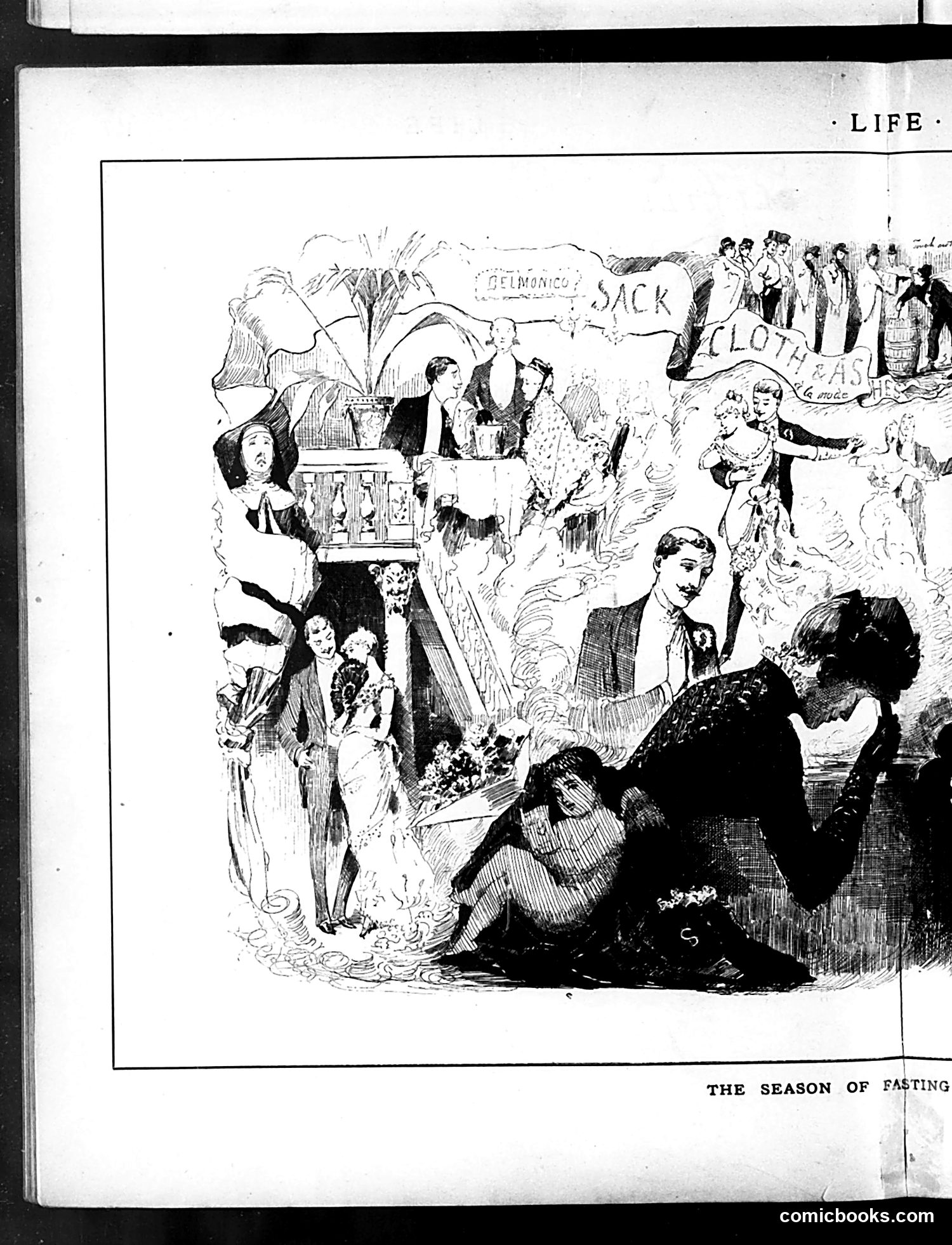
This satirical illustration depicts what appears to be a wealthy social gathering during a period of supposed economic constraint or rationing. The caption "The Season of Fasting" is ironic—the image shows affluent people dining and socializing lavishly while visible signs reading "SACK CLOTH" and references to fasting suggest the public was expected to practice austerity. The satire targets hypocrisy: while ordinary citizens were presumably fasting or economizing, the wealthy class continued indulging in luxury and feasting. The elaborate clothing, furnishings, and abundance of food visible in the scene contrast sharply with the caption's implication of self-denial. This likely references wartime rationing or a period of economic hardship when different social classes experienced vastly different standards of living—a common target of Life magazine's social criticism.
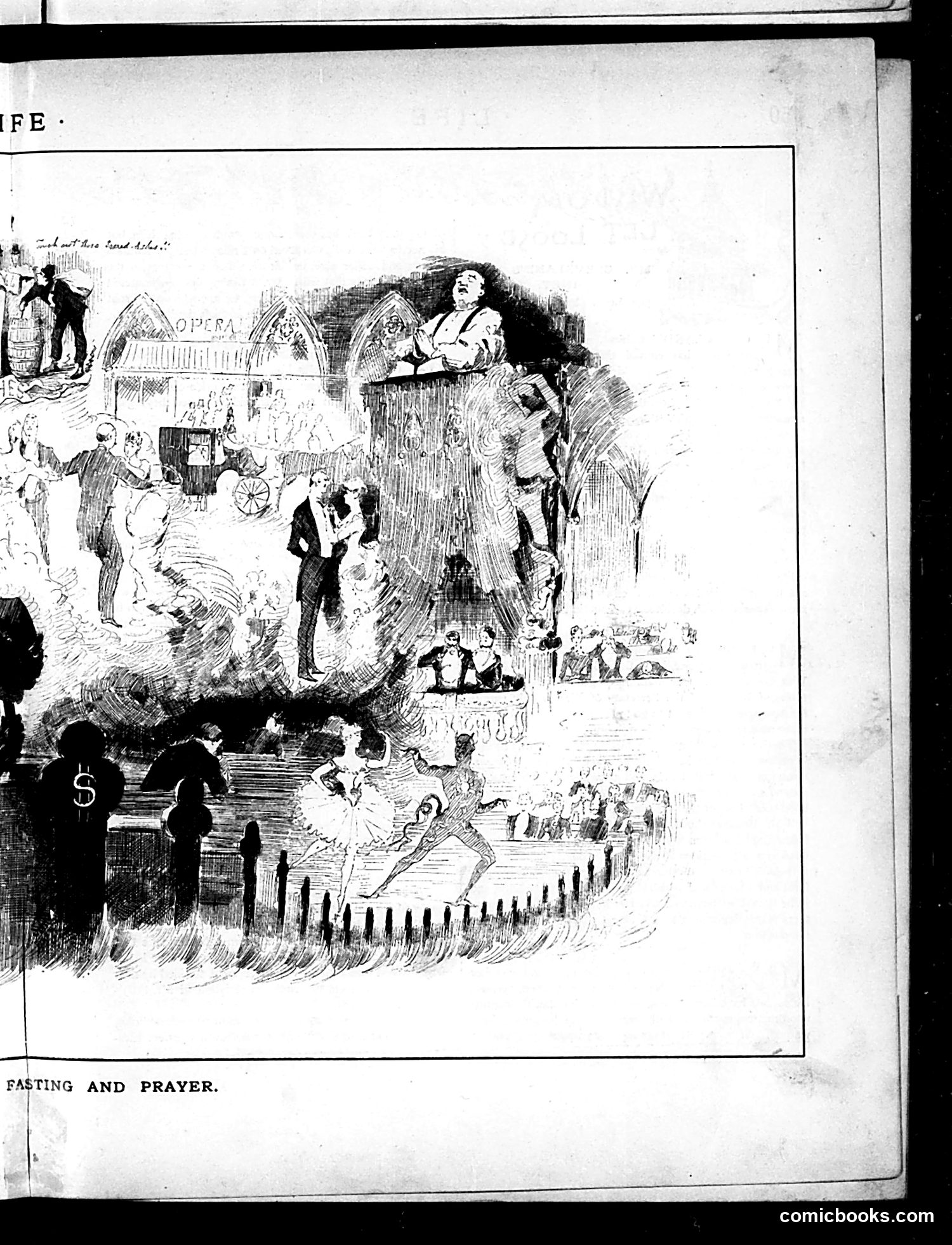
This satirical illustration depicts a religious procession or gathering at a cathedral, with the caption "Fasting and Prayer" suggesting commentary on religious observance and piety. The cartoon appears to contrast outward religious devotion with worldly concerns. A large figure dominates the upper right, while smaller figures below—including what appears to be opera-goers and fashionably dressed attendees—suggest that people profess religious observance while simultaneously indulging in secular entertainments and pleasures. The juxtaposition implies hypocrisy: the wealthy claim to practice self-denial and spiritual devotion while maintaining lavish social lives. The dollar sign visible in the lower left corner reinforces themes of materialism undermining genuine faith. This is typical Life magazine satire targeting the contradiction between professed religious values and actual behavior among the upper classes.
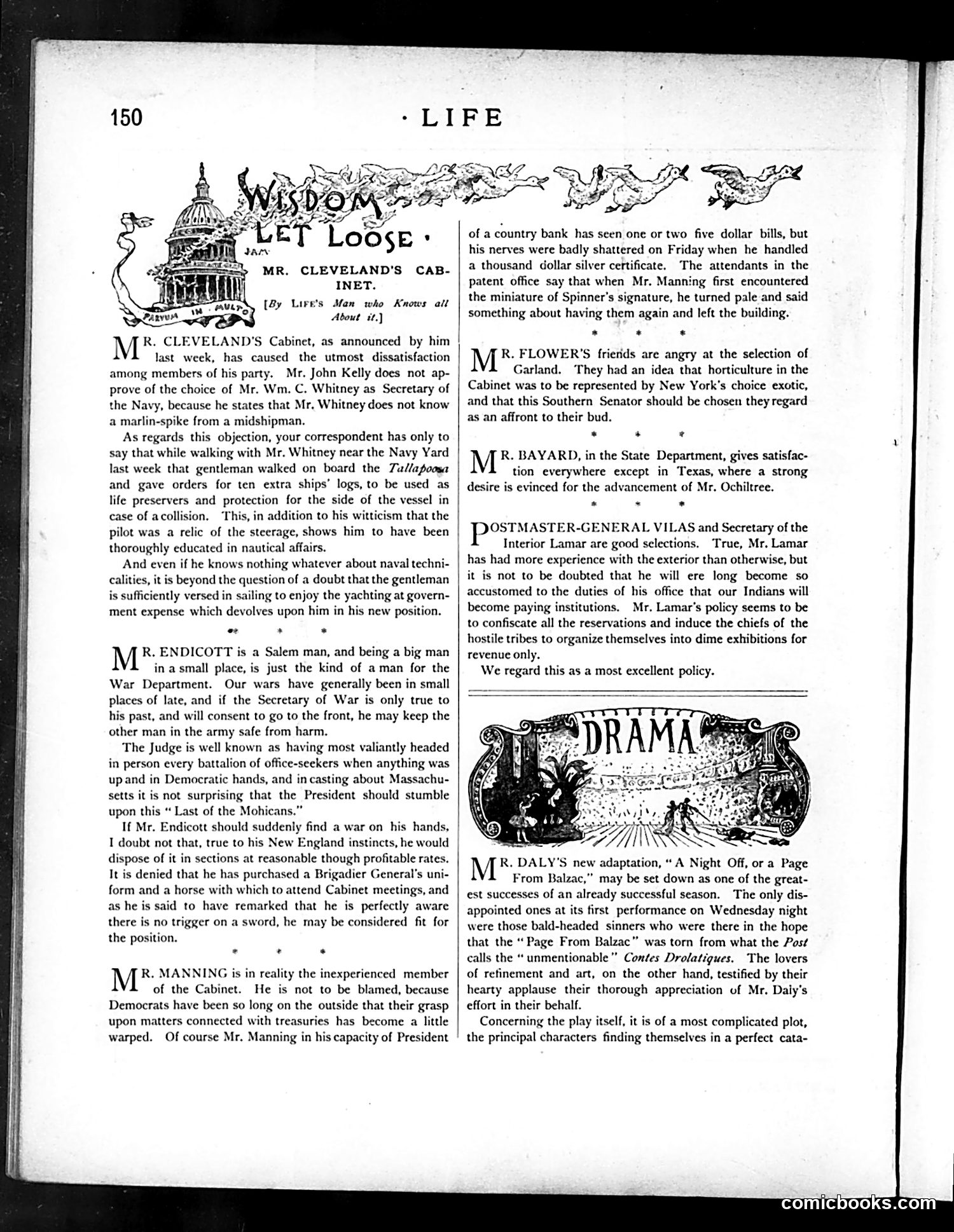
This 1885 satirical column attacks President Grover Cleveland's newly announced Cabinet appointments, mocking each selection's alleged incompetence: **William C. Whitney** (Navy Secretary) is ridiculed as nautically ignorant—the writer sarcastically claims Whitney ordered "ships' logs" as life preservers, suggesting he confuses nautical terminology. **Judge Endicott** (War Secretary) is a "Salem man" from a small place, implying he's provincially unprepared for national defense and will profit from war "at reasonable though profitable rates." **Manning** (Treasury Secretary) appears so inexperienced handling large currency that seeing Spinner's signature on a thousand-dollar bill made him "turn pale." The satire also targets **Garland** and other appointees as unqualified political cronies. The column's premise—that Cleveland filled his Cabinet with incompetent party loyalists rather than qualified professionals—reflects Gilded Age concerns about patronage appointments. The tone assumes readers share the author's partisan disapproval of Democratic governance after years out of power.
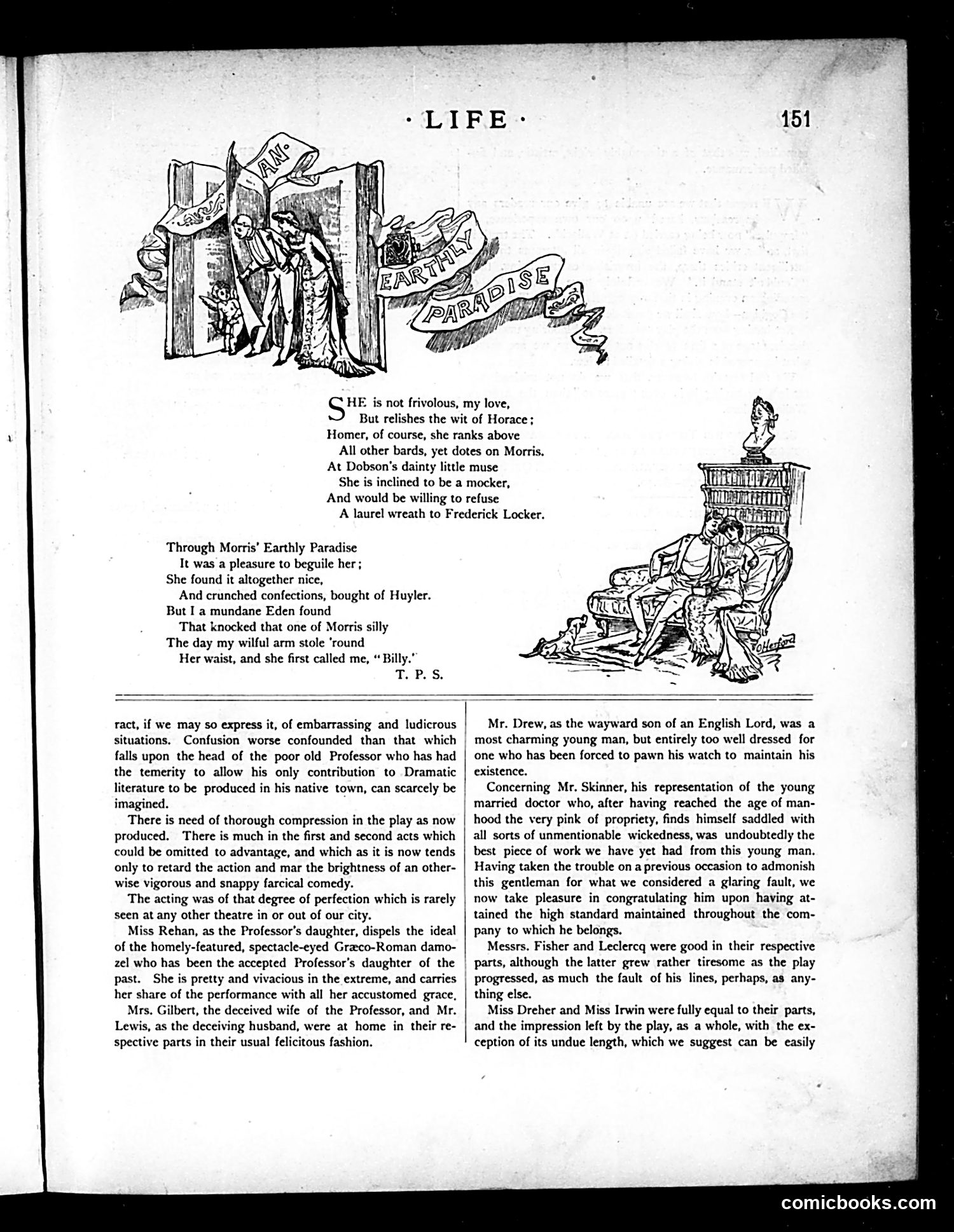
This page contains a romantic poem and theater review from Life's satirical section. **The Poem ("Earthly Paradise"):** A speaker boasts that his beloved, though intellectually sophisticated (admiring classical poets Homer and Horace, and contemporary writer William Morris), ultimately prefers his romantic attention. The joke plays on the contrast between high literary culture and simple domestic romance—she may appreciate Morris's "Earthly Paradise," but the speaker's own "mundane Eden" (stealing an arm around her waist) wins her heart. The intimate moment when she calls him "Billy" trumps all artistic pretension. **The Theater Review:** Below the poem, critics discuss a dramatic production featuring notable 19th-century actors (Miss Rehan, Mrs. Gilbert, Mr. Lewis, Mr. Drew, Mr. Skinner). The review praises performances while critiquing the script's length and the implausible costuming (a character supposedly pawning his watch shouldn't be "too well dressed"). This is straightforward theatrical criticism, not satire—evaluating the acting company's skill. The page juxtaposes romantic sentiment with professional performance criticism.
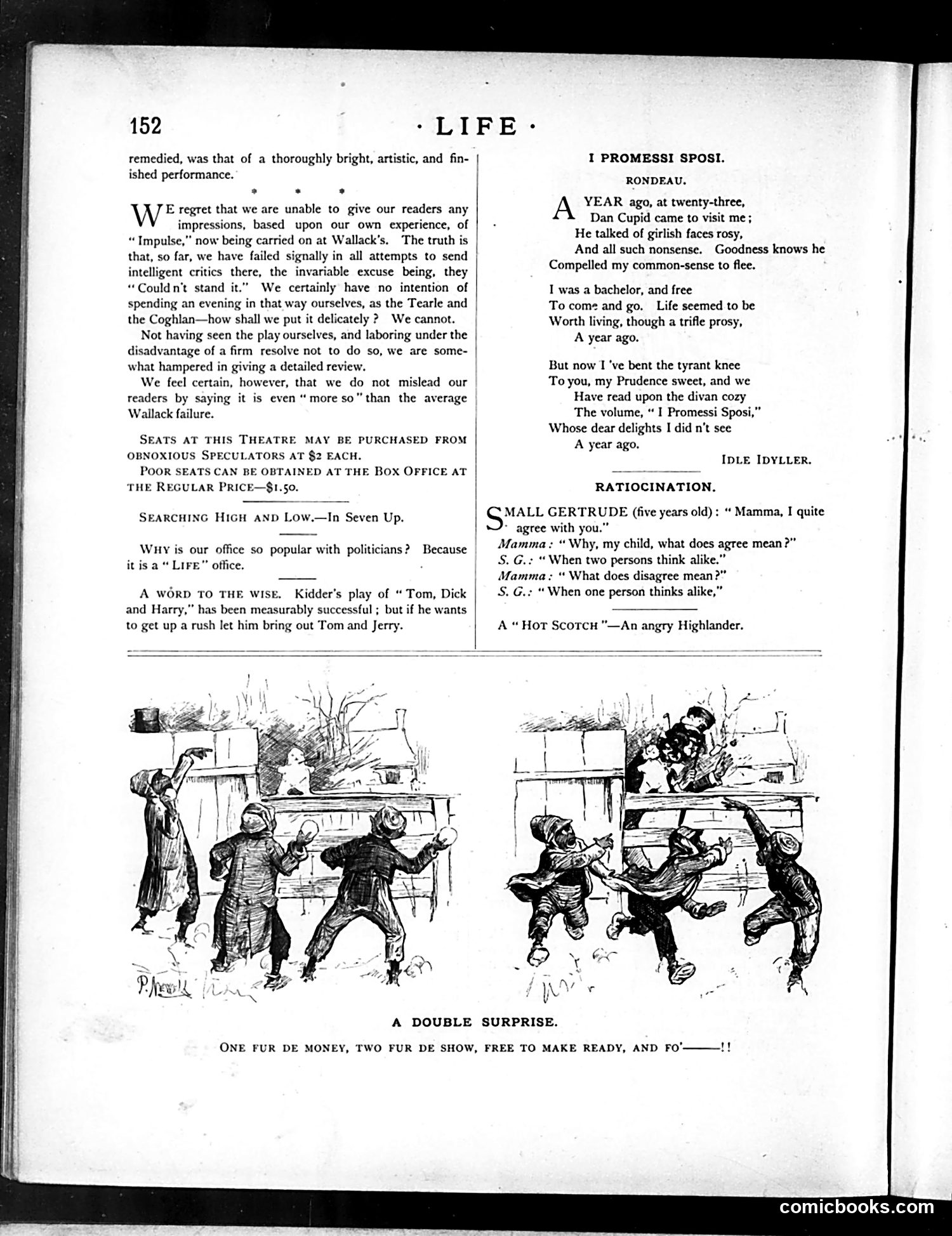
This page contains theater criticism and light humor pieces typical of Life's satirical format. **Theater Criticism Section:** Life's reviewer sarcastically admits inability to review "Impulse" at Wallack's Theatre because critics refuse to attend, calling it worse than typical Wallack failures. The joke mocks both the play's quality and speculators charging $2 for seats when box office prices are $1.50. A secondary jab suggests playwright Kidder should revive "Tom and Jerry" for commercial success. **Content Items:** - "I Promessi Sposi" (Rondeau): A romantic poem about how marriage to "Prudence" has made reading Manzoni's famous novel tedious - "Ratiocination": Wordplay humor where five-year-old Gertrude logically but incorrectly defines "disagree" as "one person thinks alike" - "A Double Surprise" (bottom illustration): Shows children in winter clothes playing, captioned with a pun about fur coats and theatrical preparation The page exemplifies Life's blend of theatrical criticism, light verse, and children's humor common to 1880s-90s American magazines.
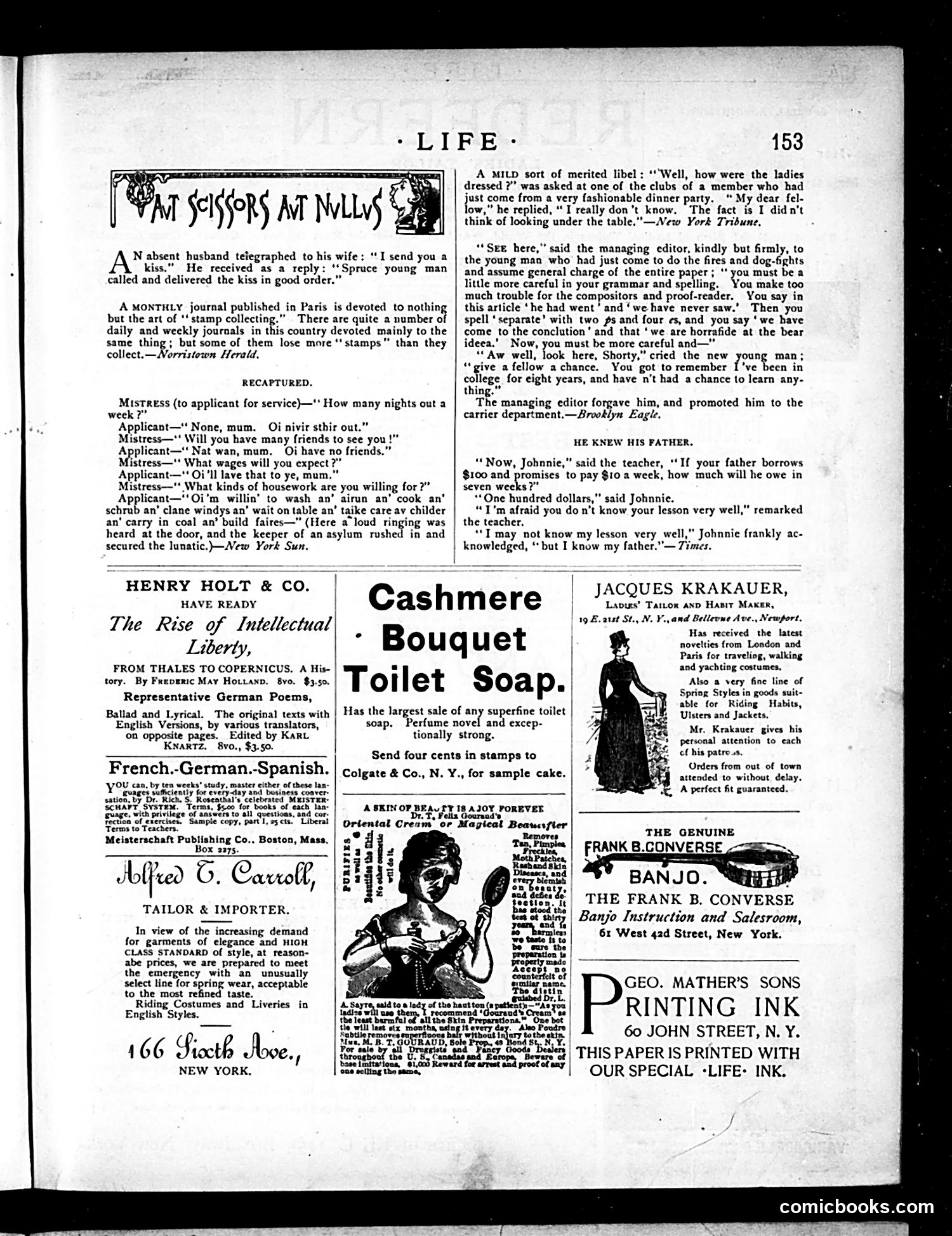
This page from *Life* magazine (an American satirical weekly) contains **short humorous anecdotes and advertisements** rather than a political cartoon. The humor pieces target **turn-of-the-century social absurdities**: a husband's telegraphed kiss delivered by a "spruce young man"; a journal devoted entirely to stamp collecting; an asylum keeper pursuing an overly-compliant housemaid applicant who claims to have no friends and no social life—implying her desperation appears insane to authorities; a newspaper editor promoting a grammatically-incompetent employee for accepting criticism; and a schoolboy who understands his father's character better than mathematics (suggesting fathers habitually default on debts). The **advertisements** hawk books, tailoring services, soap, and musical instruments—typical consumer goods of the era. The satire throughout reflects *Life*'s mock-genteel critique of working-class desperation, masculine irresponsibility, and journalistic mediocrity in contemporary American life.
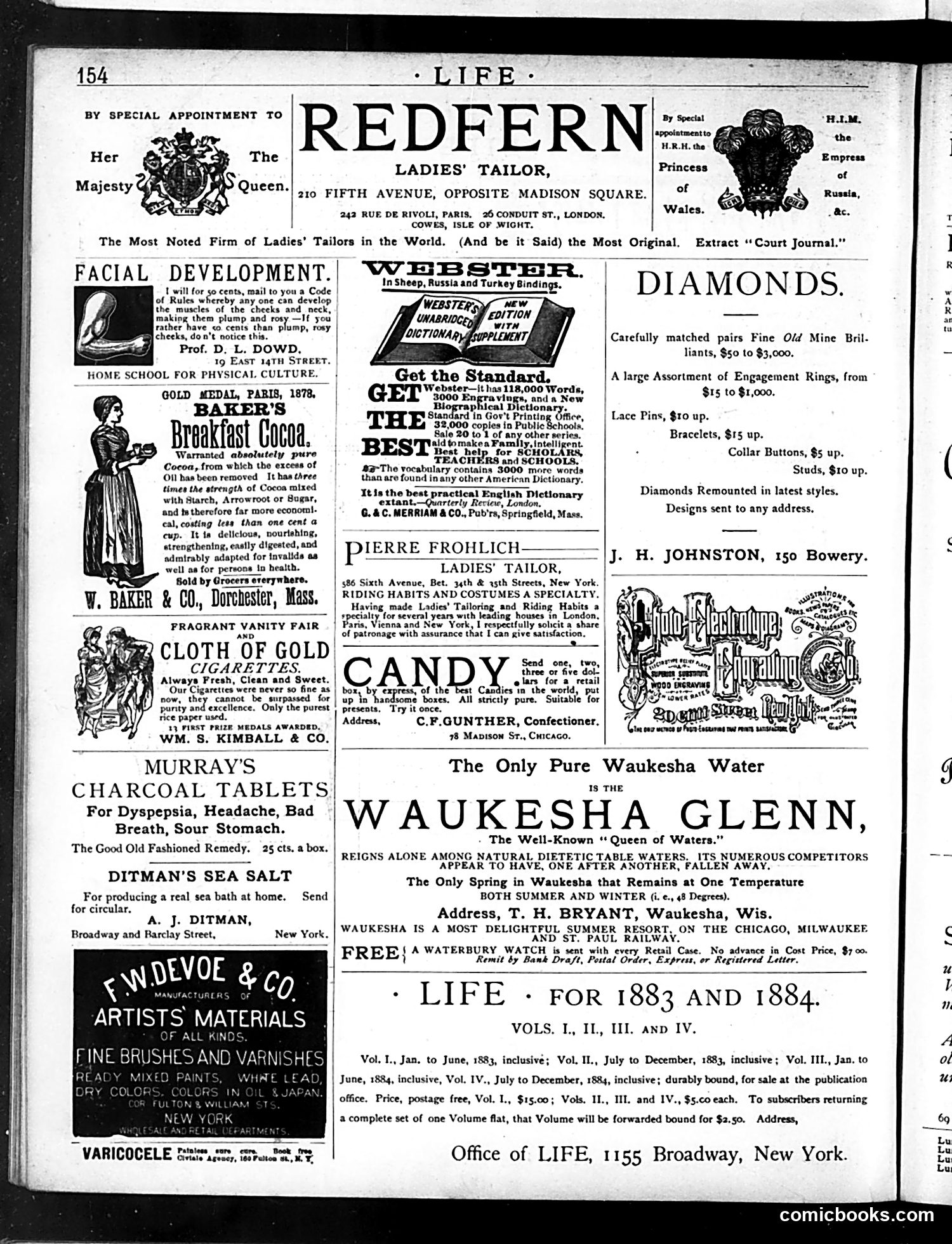
This is primarily a **Victorian-era advertisement page** with no political cartoons or satire. The page dates to approximately 1883-1884 (based on the final advertisement) and showcases period luxury consumer goods and services. **Key content includes:** - **Redfern**: A prestigious ladies' tailor with Royal patronage ("By Special Appointment to Her Majesty the Queen" and "the Empress of Russia") - **Breakfast Cocoa and Cigarettes**: Health/luxury products marketed with medical credibility claims - **Webster's Dictionary**: Educational advertising - **Diamonds and jewelry** (J.H. Johnston) - **Patent remedies**: Murray's Charcoal Tablets, Ditman's Sea Salt—reflecting the era's medical marketing practices - **Waukesha Glenn water**: A "pure" spring water marketed as having health benefits The page reflects Gilded Age consumer culture—emphasis on "purity," royal connections, scientific claims for common products, and luxury goods for wealthy readers.
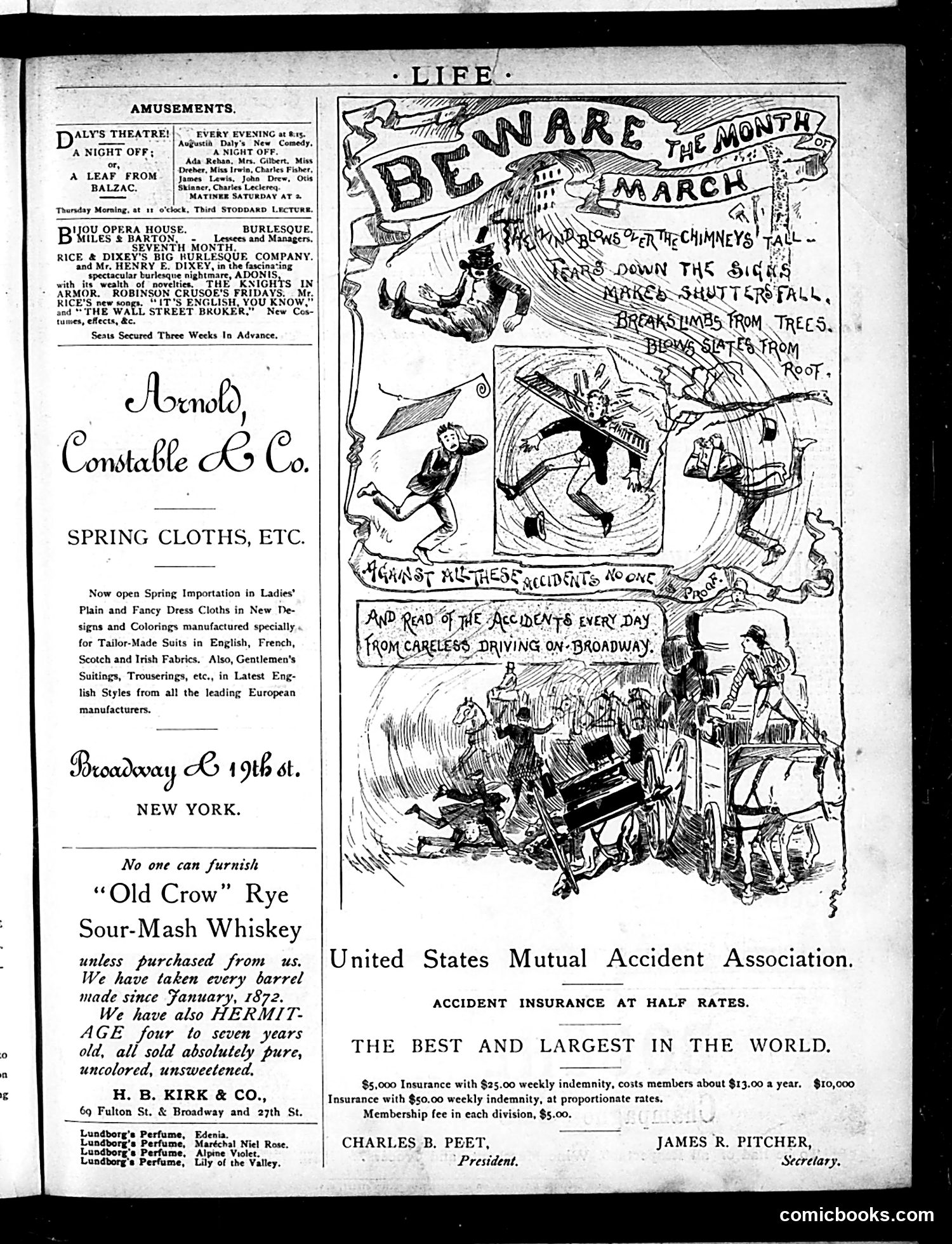
This page features a satirical cartoon warning about March's dangers. The illustrated narrative depicts various accidents associated with the spring month: chimneys collapsing, shutters falling, limbs breaking from trees, slate blowing from roofs, and careless driving accidents on Broadway causing collisions. The humor lies in personifying March as a chaotic, destructive force—literally illustrated as a mischievous figure causing mayhem. The cartoon lists "ALMOST ALL THE ACCIDENTS NO ONE THINKS OF" to underscore how March's unpredictable weather (wind, temperature changes, loose building materials) creates unexpected hazards. This serves as tongue-in-cheek advertising for the United States Mutual Accident Association displayed below, whose accident insurance offerings are positioned as practical protection against such March mishaps. The juxtaposition is effective: after showing ridiculous but plausible accidents, the insurance advertisement becomes timely and relevant to readers.
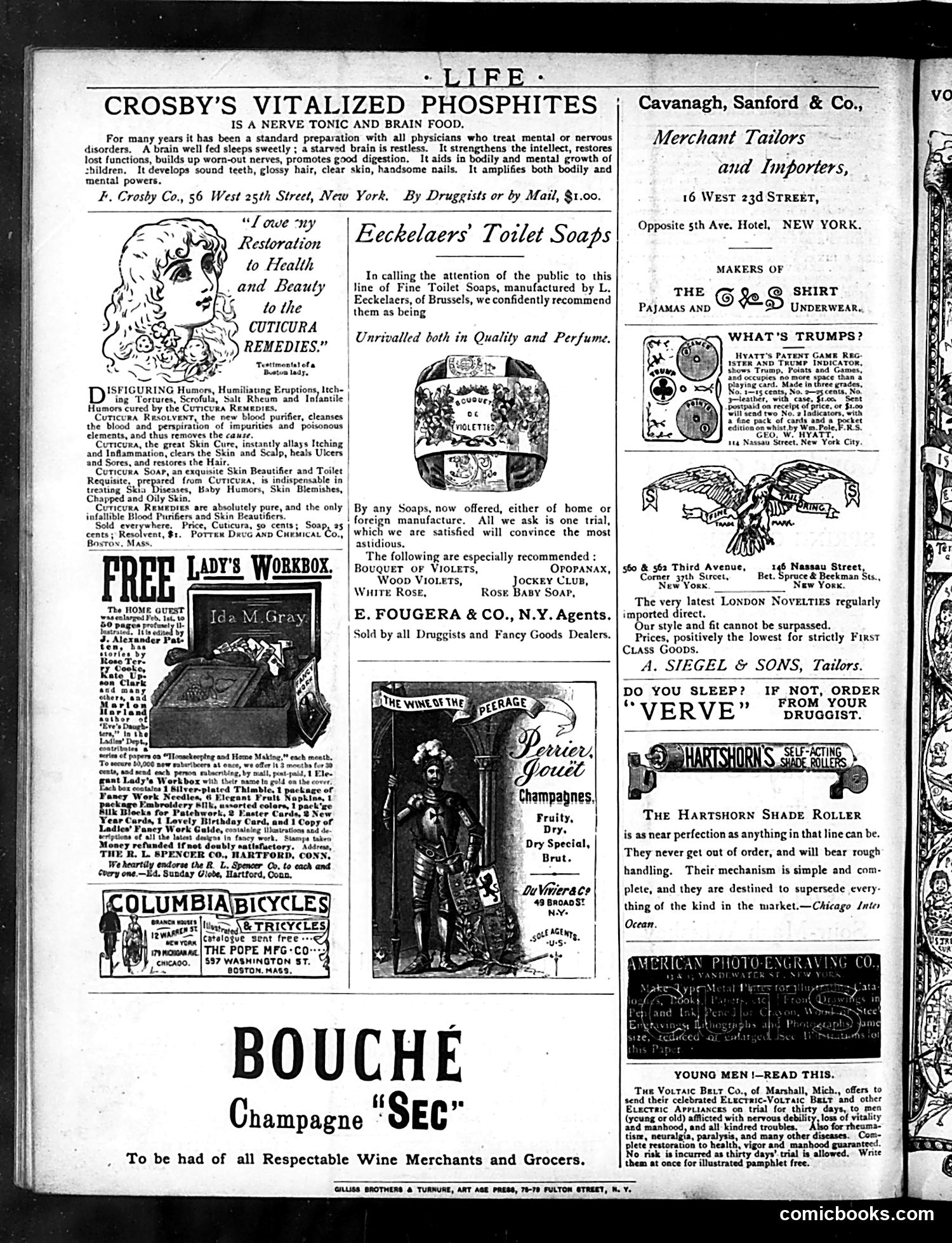
This page is primarily **advertisements** for patent medicines and consumer goods typical of the late 19th century. There are no political cartoons. The ads promote dubious health products: Crosby's Vitalized Phosphites (a "nerve tonic and brain food"), Cuticura remedies (for skin conditions), and Eeckelaers' toilet soaps. These reflect an era when unregulated patent medicines made extravagant medical claims without scientific basis. Notable is the "What's Trumps?" game indicator ad—a card-game device showing how commercialized leisure had become. The page also advertises Columbia bicycles, champagne, tailoring services, and shade rollers—showing the consumer culture of a prosperous American urban market around the 1890s. There is **no satirical content** visible; these are straightforward commercial advertisements presenting their products as solutions to health and lifestyle concerns.