
Life, 1885-03-12 · page 2 of 16
Life — March 12, 1885 — page 2: what you’re looking at
What you’re looking at
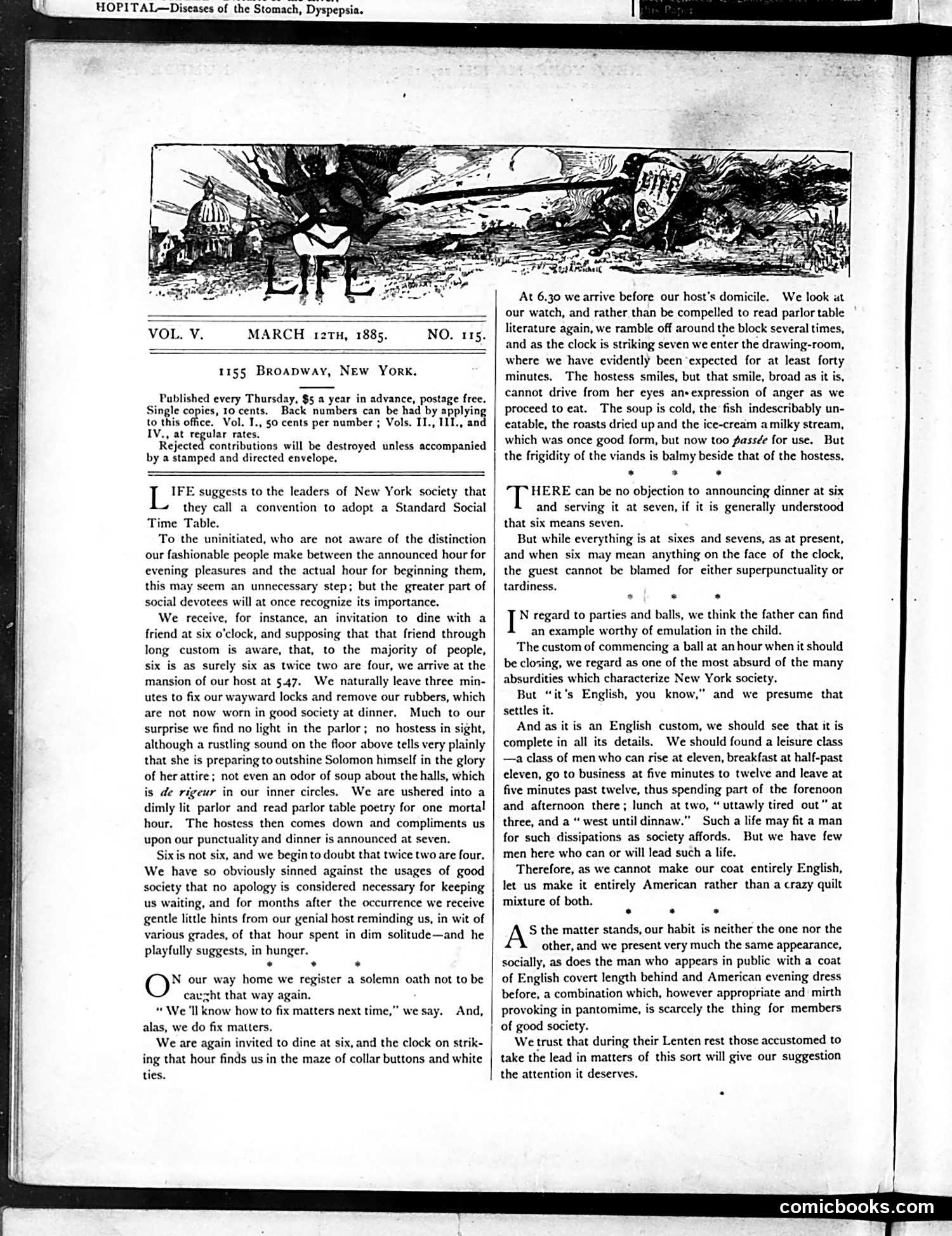
This page satirizes American high-society dining customs and their pretensions toward English gentility. The article mocks the confusion among New York's wealthy about proper dinner hours—whether "six o'clock" means 6 PM or 7 PM—and critiques the absurdity of adopting English social conventions wholesale while remaining fundamentally American. The satire targets the contradiction of wealthy New Yorkers attempting to copy English aristocratic behavior (formal dinner timing, dress codes) while lacking the genuine refinement such customs supposedly represent. The author suggests American society should develop its own authentic customs rather than awkwardly imitating English ones, describing such imitation as a "crazy quilt mixture" that makes participants look foolish. The humor lies in exposing social pretension and class anxiety among the Gilded Age elite.
📄 Transcribed text from this page (OCR, searchable)
Machine-transcribed from the original scan — historical spelling and the odd misread are preserved.
ee HOPITAL—Diseases of the Stomach, Dyspepsia. MARCH 12TH, 1885. NO. 115. 1155 Broapway, New York. Published every Thursday, $5 a year in advance, postage free. Single copies, 10 cents, Back numbers can be had by applyin to this office. Vol. I., 50 cents per number ; Vols. II., III., ant IV,, at regular rates. Rejected contributions will be destroyed unless accompanied by a stamped and directed envelope. IFE suggests to the leaders of New York society that they call a convention to adopt a Standard Social Time Table. To the uninitiated, who are not aware of the distinction our fashionable people make between the announced hour for evening pleasures and the actual hour for beginning them, this may seem an unnecessary step; but the greater part of social devotees will at once recognize its importance. We receive, for instance, an invitation to dine with a friend at six o'clock, and supposing that that friend through long custom is aware, that, to the majority of people, six is as surely six as twice two are four, we arrive at the mansion of our host at 5.47. We naturally leave three min- utes to fix our wayward locks and remove our rubbers, which are not now worn in good society at dinner. Much to our surprise we find no light in the parlor; no hostess in sight, although a rustling sound on the floor above tells very plainly that she is preparing to outshine Solomon himself in the glory of her attire; not even an odor of soup about the halls, which is de rigeur in our inner circles. We are ushered into a dimly lit parlor and read parlor table poetry for one mortal hour. The hostess then comes down and compliments us upon our punctuality and dinner is announced at seven. Six is not six, and we begin to doubt that twice two are four. We have so obviously sinned against the usages of good | society that no apology is considered necessary for keeping us waiting, and for months after the occurrence we receive gentle little hints from our genial host reminding us, in wit of various grades, of that hour spent in dim solitude—and he playfully suggests, in hunger. * , * O* our way home we register a solemn oath not to be caught that way again. “ We'll know how to fix matters next time,” we say. And, alas, we do fix matters. We are again invited to dine at six, and the clock on strik- ing that hour finds us in the maze of collar buttons and white ues, At 6.30 we arrive before our host's domicile. We look at our watch, and rather than be compelled to read parlor table literature again, we ramble off around the block several times, and as the clock is striking seven we enter the drawing-room, where we have evidently been expected for at least forty minutes. The hostess smiles, but that smile, broad as it is, cannot drive from her eyes an-expression of anger as we proceed to eat. The soup is cold, the fish indescribably un- eatable, the roasts dried up and the ice-cream amilky stream, which was once good form, but now too fassée for use. But the frigidity of the viands is balmy beside that of the hostess. . * . HERE can be no objection to announcing dinner at six and serving it at seven, if it is generally understood that six means seven. But while everything is at sixes and sevens, as at present, and when six may mean anything on the face of the clock, the guest cannot be blamed for either superpunctuality or tardiness. * . . N regard to parties and balls, we think the father can find an example worthy of emulation in the child. The custom of commencing a ball at an hour when it should be closing, we regard as one of the most absurd of the many absurdities which characterize New York society. But “it's English, you know,” and we presume that settles it. And as it is an English custom, we should see that it is complete in all its details. We should found a leisure class —a class of men who can rise at eleven, breakfast at half-past eleven, go to business at five minutes to twelve and leave at five minutes past twelve, thus spending part of the forenoon and afternoon there; lunch at two, “ uttawly tired out” at three, and a “ west until dinnaw.” Such a life may fit a man for such dissipations as society affords. But we have few men here who can or will lead such a life. Therefore, as we cannot make our coat entirely English, let us make it entirely American rather than a crazy quilt mixture of both. . * S the matter stands, our habit is neither the one nor the other, and we present very much the same appearance, socially, as does the man who appears in public with a coat of English covert length behind and American evening dress before, a combination which, however appropriate and mirth provoking in pantomime, is scarcely the thing for members of good society. We trust that during their Lenten rest those accustomed to take the lead in matters of this sort will give our suggestion the attention it deserves. comicbooks.com {