
Life, 1885-03-12 · page 11 of 16
Life — March 12, 1885 — page 11: what you’re looking at
What you’re looking at
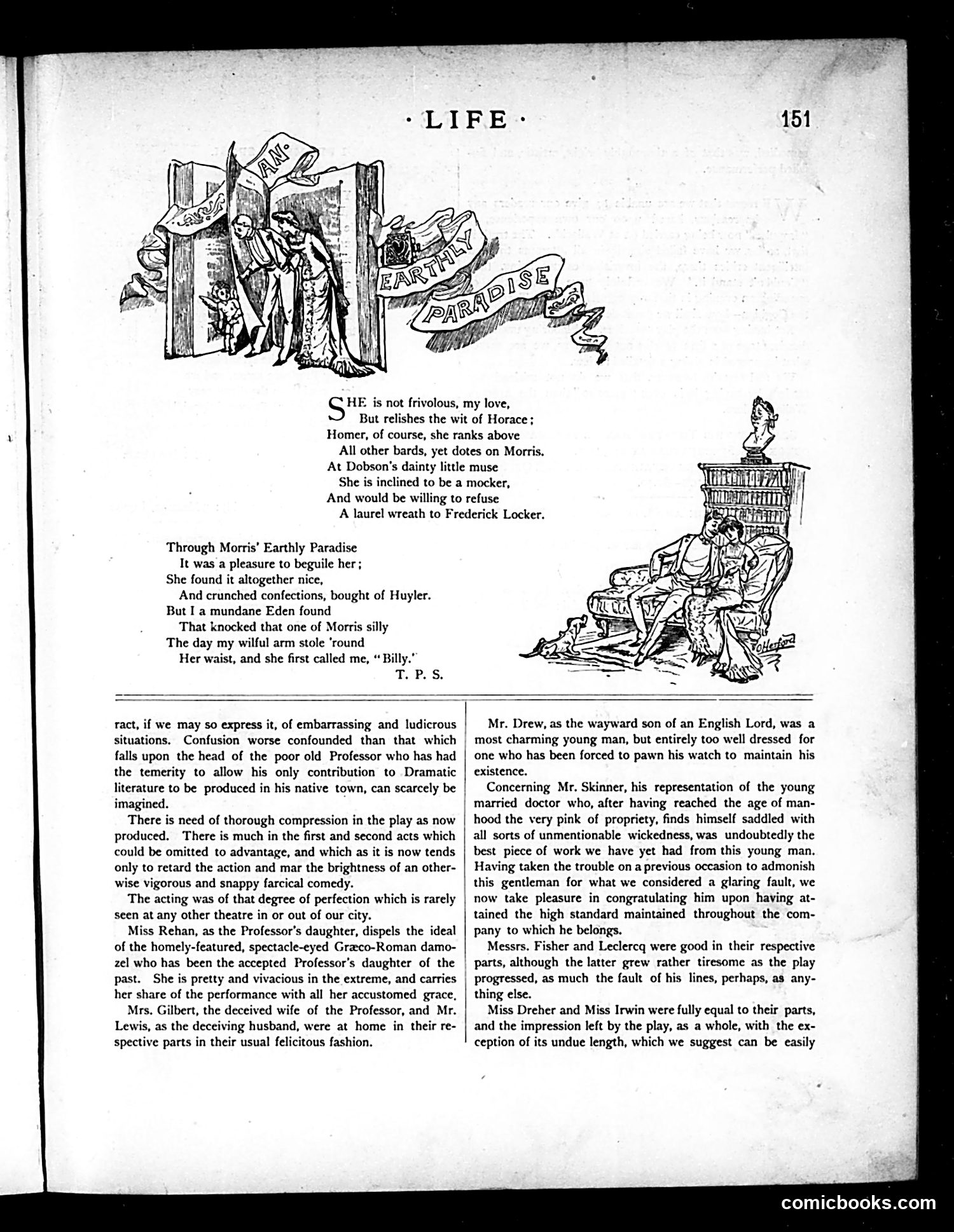
This page contains a romantic poem and theater review from Life's satirical section. **The Poem ("Earthly Paradise"):** A speaker boasts that his beloved, though intellectually sophisticated (admiring classical poets Homer and Horace, and contemporary writer William Morris), ultimately prefers his romantic attention. The joke plays on the contrast between high literary culture and simple domestic romance—she may appreciate Morris's "Earthly Paradise," but the speaker's own "mundane Eden" (stealing an arm around her waist) wins her heart. The intimate moment when she calls him "Billy" trumps all artistic pretension. **The Theater Review:** Below the poem, critics discuss a dramatic production featuring notable 19th-century actors (Miss Rehan, Mrs. Gilbert, Mr. Lewis, Mr. Drew, Mr. Skinner). The review praises performances while critiquing the script's length and the implausible costuming (a character supposedly pawning his watch shouldn't be "too well dressed"). This is straightforward theatrical criticism, not satire—evaluating the acting company's skill. The page juxtaposes romantic sentiment with professional performance criticism.
📄 Transcribed text from this page (OCR, searchable)
Machine-transcribed from the original scan — historical spelling and the odd misread are preserved.
HE is not frivolous, my love, But relishes the wit of Horace ; Homer, of course, she ranks above All other bards, yet dotes on Morris, At Dobson's dainty little muse She is inclined to be a mocker, And would be willing to refuse A laurel wreath to Frederick Locker. Through Morris’ Earthly Paradise It was a pleasure to beguile her; She found it altogether nice, And crunched confections, bought of Huyler. But I a mundane Eden found That knocked that one of Morris silly The day my wilful arm stole ‘round Her waist, and she first called me, “Billy.” T.. PB. S. ract, if we may so express it, of embarrassing and ludicrous situations. Confusion worse confounded than that which falls upon the head of the poor old Professor who has had the temerity to allow his only contribution to Dramatic literature to be produced in his native town, can scarcely be | | married doctor who, after having reached the age of man- imagined. There is need of thorough compression in the play as now produced. There is much in the first and second acts which could be omitted to advantage, and which as it is now tends only to retard the action and mar the brightness of an other- wise vigorous and snappy farcical comedy. The acting was of that degree of perfection which is rarely seen at any other theatre in or out of our city. Miss Rehan, as the Professor's daughter, dispels the ideal of the homely-featured, spectacle-eyed Graeco-Roman damo- zel who has been the accepted Professor's daughter of the past. She is pretty and vivacious in the extreme, and carries her share of the performance with all her accustomed grace, Mrs. Gilbert, the deceived wife of the Professor, and Mr. Lewis, as the deceiving husband, were at home in their re- spective parts in their usual felicitous fashion. Mr. Drew, as the wayward son of an English Lord, was a | most charming young man, but entirely too well dressed for one who has been forced to pawn his watch to maintain his existence, Concerning Mr. Skinner, his representation of the young hood the very pink of propriety, finds himself saddled with all sorts of unmentionable wickedness, was undoubtedly the best piece of work we have yet had from this young man, Having taken the trouble on a previous occasion to admonish | this gentleman for what we considered a glaring fault, we now take pleasure in congratulating him upon having at- tained the high standard maintained throughout the com- pany to which he belongs. Messrs. Fisher and Leclercq were good in their respective parts, although the latter grew rather tiresome as the play progressed, as much the fault of his lines, perhaps, as any- thing else. Miss Dreher and Miss Irwin were fully equal to their parts, and the impression left by the play, as a whole, with the ex- ception of its undue length, which we suggest can be easily comicbooks.com