
A complete issue · 22 pages · 1885
Life — February 12, 1885
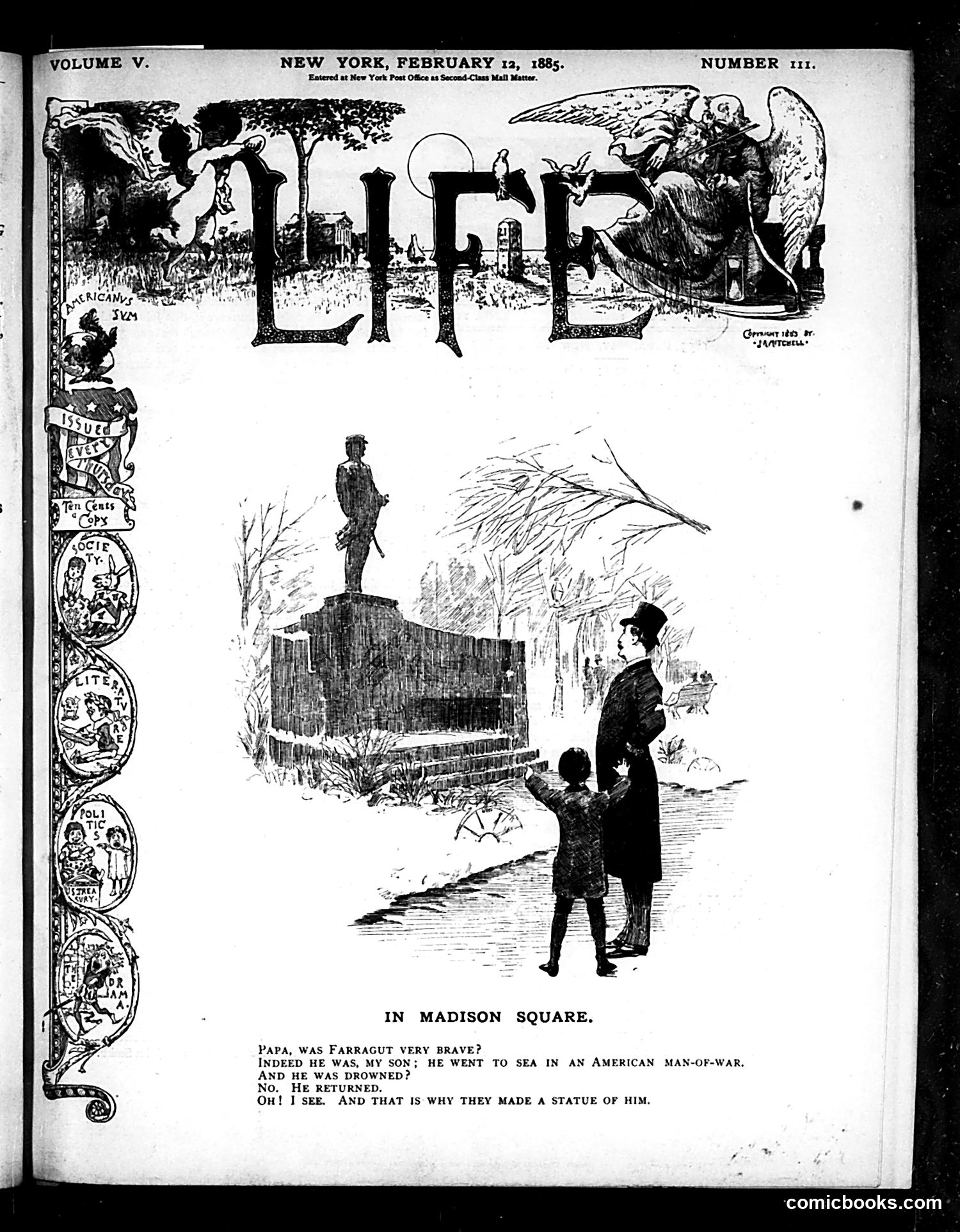
This cartoon depicts a father and child viewing a statue in Madison Square Park. The dialogue reveals the statue commemorates a man who died in an American naval battle ("man-of-war"). The father explains his son was brave and "went to sea" but "was drowned"—hence the statue honoring him. The satire appears to mock the practice of erecting public monuments to commemorate military deaths, particularly questioning whether drowning in naval combat warrants such grand commemoration. The image and text suggest irony about how societies memorialize tragedy through statuary, with the child's innocent question highlighting the absurdity: the man died, so they made a statue of him. The specific naval incident referenced remains unclear without additional context.
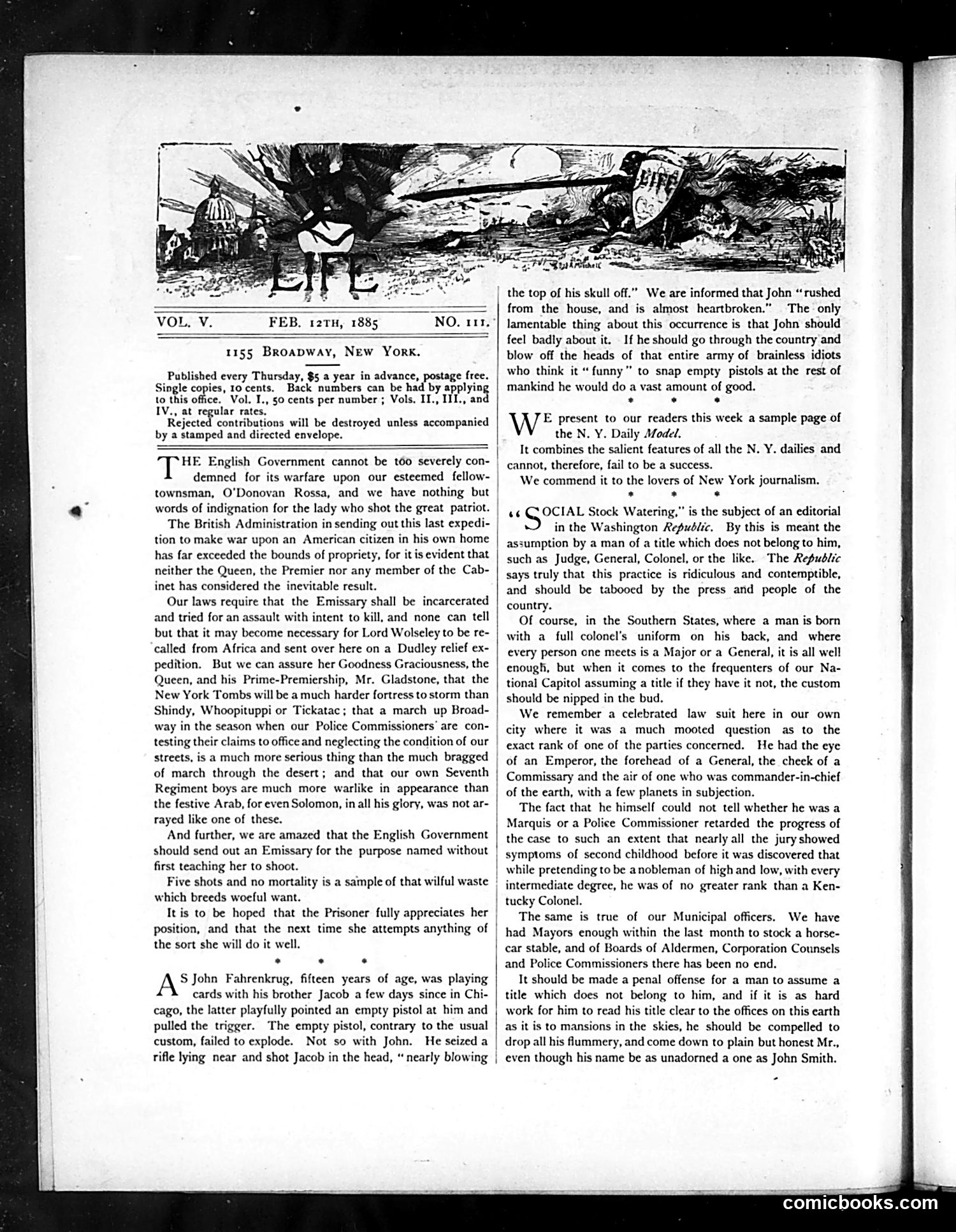
The header illustration shows a chaotic battlefield scene labeled "LIFE," depicting destruction and conflict. The page's main editorial content criticizes the British government's conduct in Ireland, specifically condemning the shooting of O'Donovan Rossa's widow by British forces during what appears to be a military or police action. The editors argue this demonstrates governmental recklessness toward American citizens. The text also includes a satirical anecdote about John Fahrenkrug, a fifteen-year-old boy in Chicago who mistakenly shot his brother Jacob with a rifle while playing—the gun failed to fire properly. The editors use this incident to mock what they view as senseless violence and poor judgment. The overall tone critiques both British imperial overreach and American negligence regarding weapons handling.
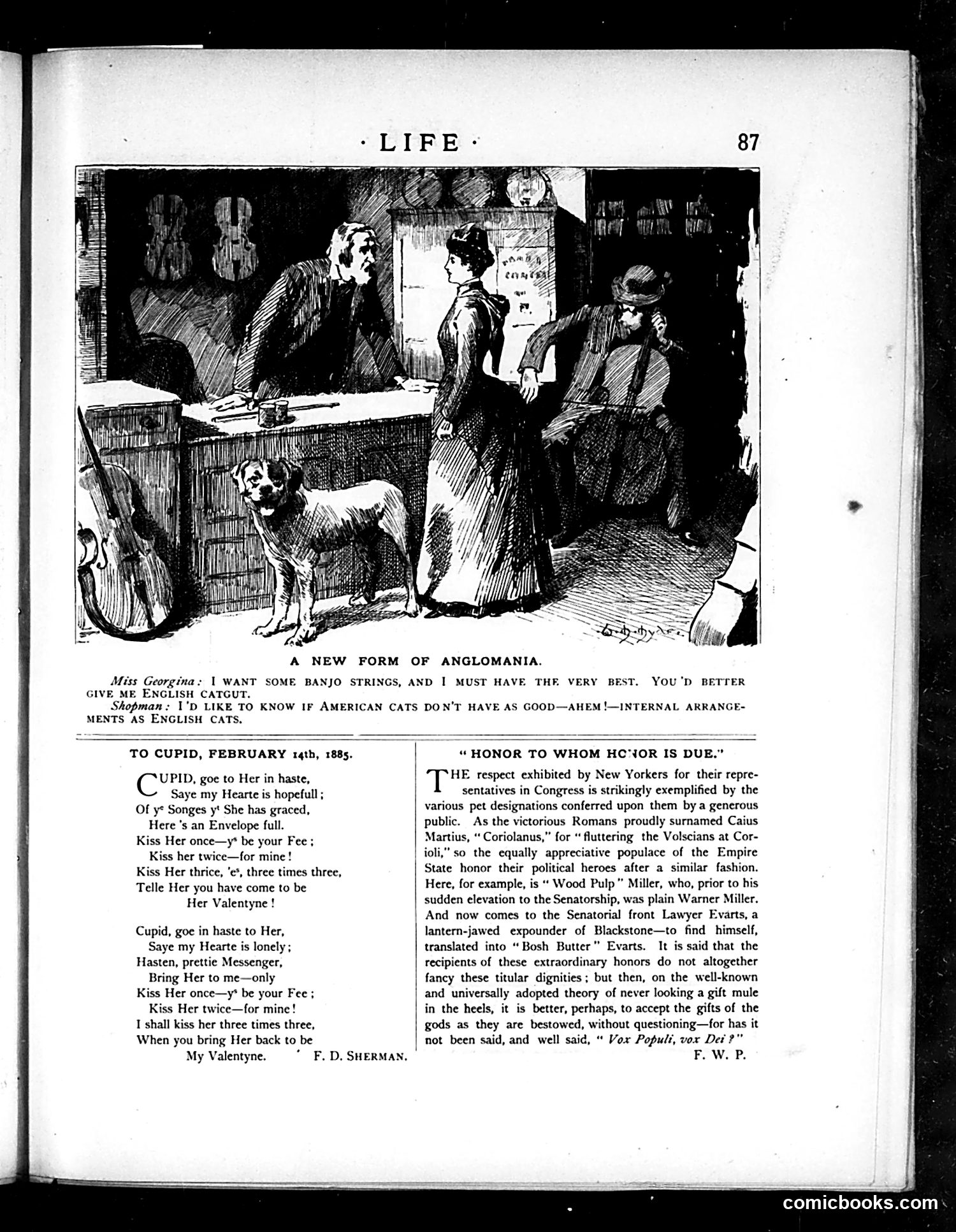
**The Cartoon "A New Form of Anglomania"** This satirical sketch mocks American pretension and snobbery toward English culture. A shop clerk assists a woman (Miss Georgina) seeking "banjo strings," insisting on English imports. The shopman responds with mock-British superiority, suggesting American cats are inferior to English ones—an absurd comparison that ridicules blind Anglophilia. The joke targets mid-19th century American anxiety about cultural sophistication: the assumption that anything English automatically outranks American equivalents. The dog in the scene may emphasize this absurdity. "Anglomania" refers to excessive admiration of English customs—a real social phenomenon among wealthy Americans of this era who eagerly adopted British tastes and mannerisms to signal status.
This page contains satirical commentary and biographical sketches rather than political cartoons. The "By the Way" column criticizes an unnamed contemporary for imprisoning an innocent man, suggesting systemic injustice in the legal system. The "Pocket Biographies" section includes sketches of Benjamin F. Butler, Oscar Wilde, and George B. McClellan—prominent 19th-century figures. The Wilde entry appears particularly satirical, noting his lectures on "store-clothes and high-art" and his hair-cutting, with the dismissive conclusion that "Mr. O'Wilde is not a fool"—suggesting ironic criticism of his pretensions. The boxed item "Rossa's Wounds Are Not Fatal" likely references a contemporary political figure or incident, though the specific context is unclear without additional historical documentation.
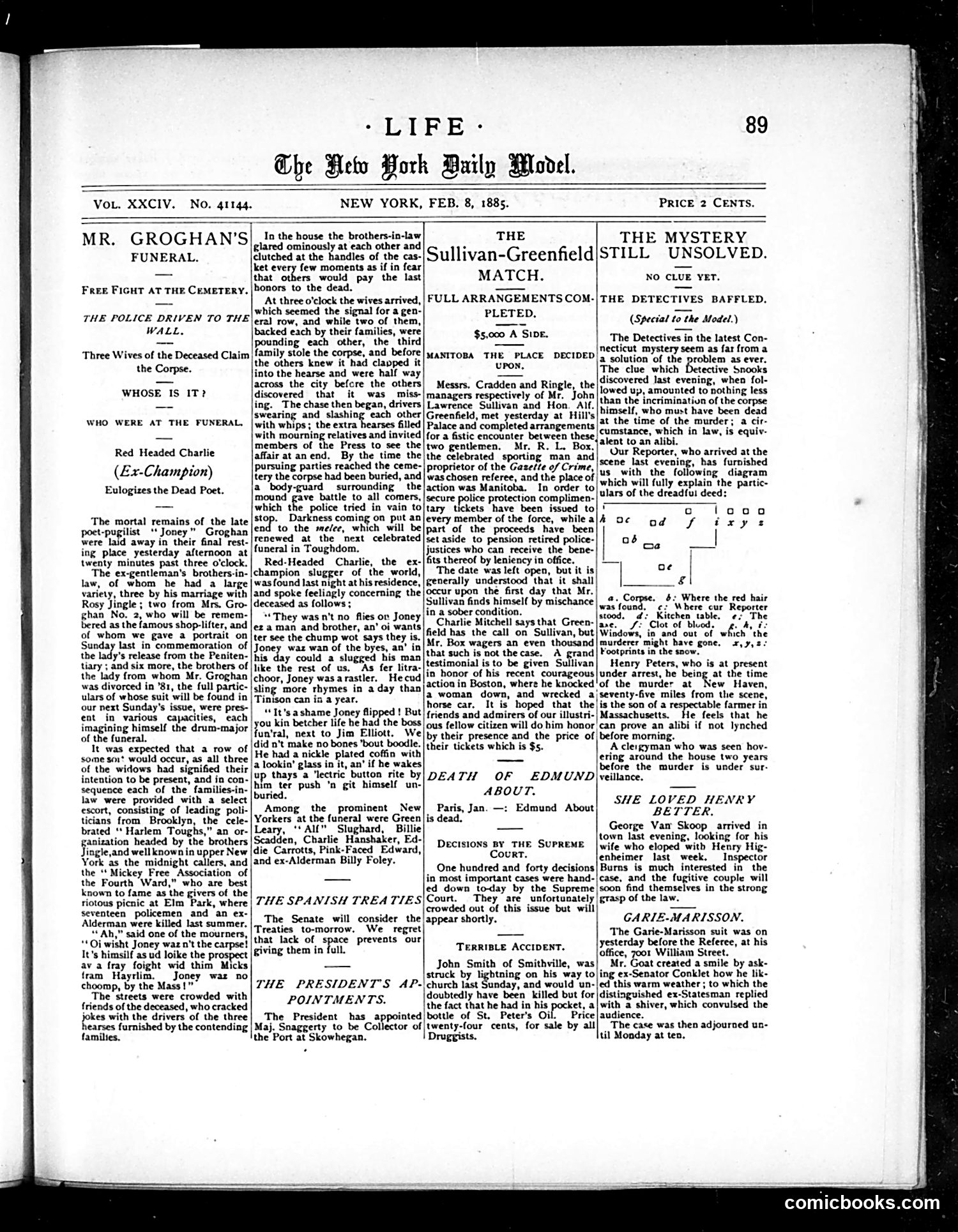
This page contains news briefs and society items rather than political cartoons. The content includes: **"Mr. Groghan's Funeral"** — reporting on a funeral attended by prominent New Yorkers, with details about the hearse procession and attendees like "Red Headed Charlie" and various named individuals. **"The Sullivan-Greenfield Match"** — announcing a sporting event in Manitoba between celebrated boxers, with ticket arrangements. **"The Mystery Still Unsolved"** — a brief about detectives investigating a murder case involving a discovered corpse. Additional items cover Spanish treaties, the President's appointments, a terrible accident involving lightning, and society gossip about an elopement. The page functions as a news digest rather than satirical commentary, typical of Life's mixed-content format during this period.
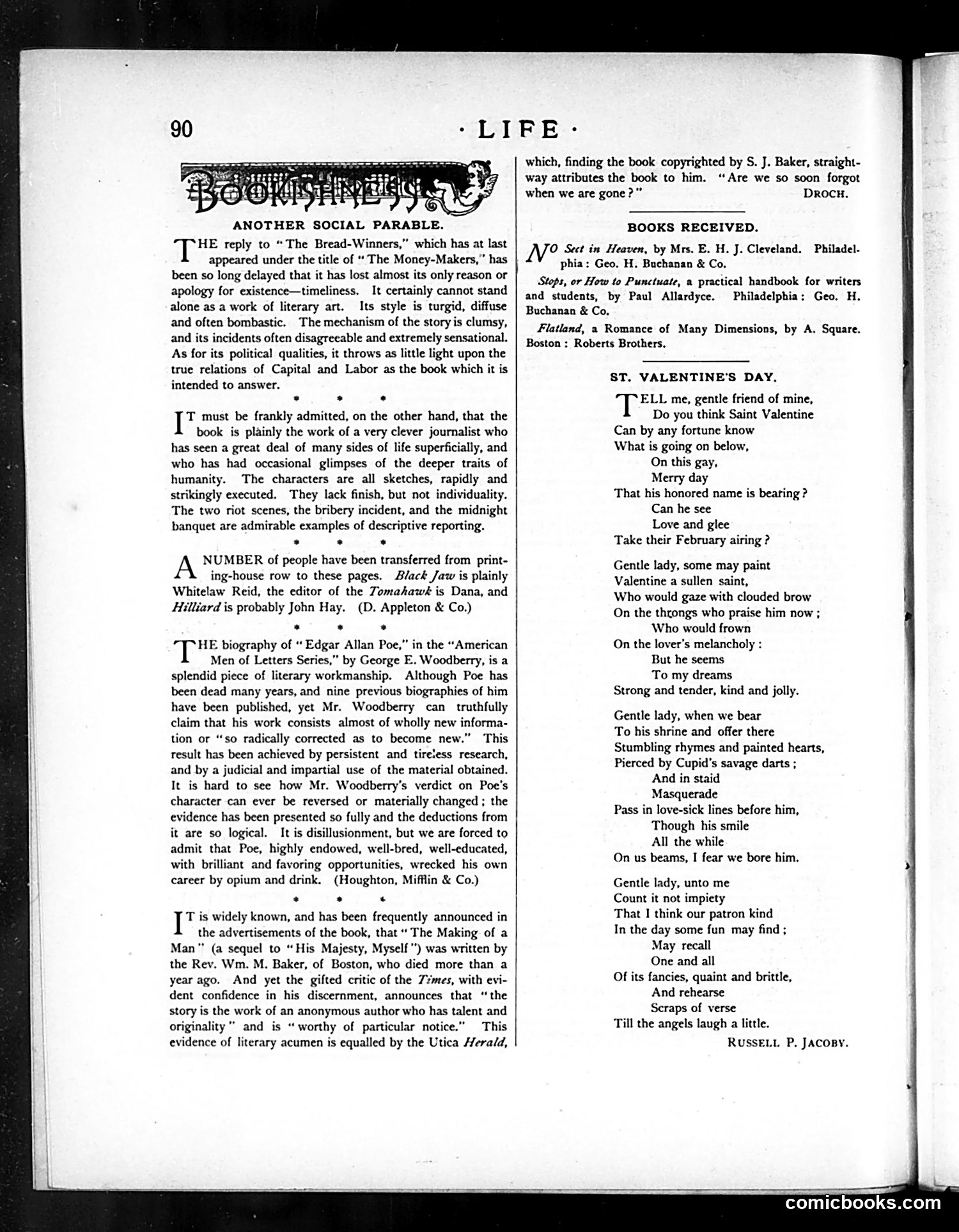
This page contains book reviews and literary criticism rather than political cartoons. The main content includes: **"Bookishly" section**: A critique of "The Bread-Winners," a novel about Capital and Labor relations. The reviewer criticizes it as poorly written—"turgid, diffuse and often bombastic"—despite acknowledging the author is a clever journalist with keen social observation. The characters are dismissed as mere sketches lacking individuality. **Books Received section**: Lists new publications including works on writing and romance. **"St. Valentine's Day" poem**: A lengthy romantic verse by Russell P. Jacoby. The page functions as literary commentary typical of Life magazine's satirical approach, critiquing both literary merit and social themes through book reviews rather than visual satire.
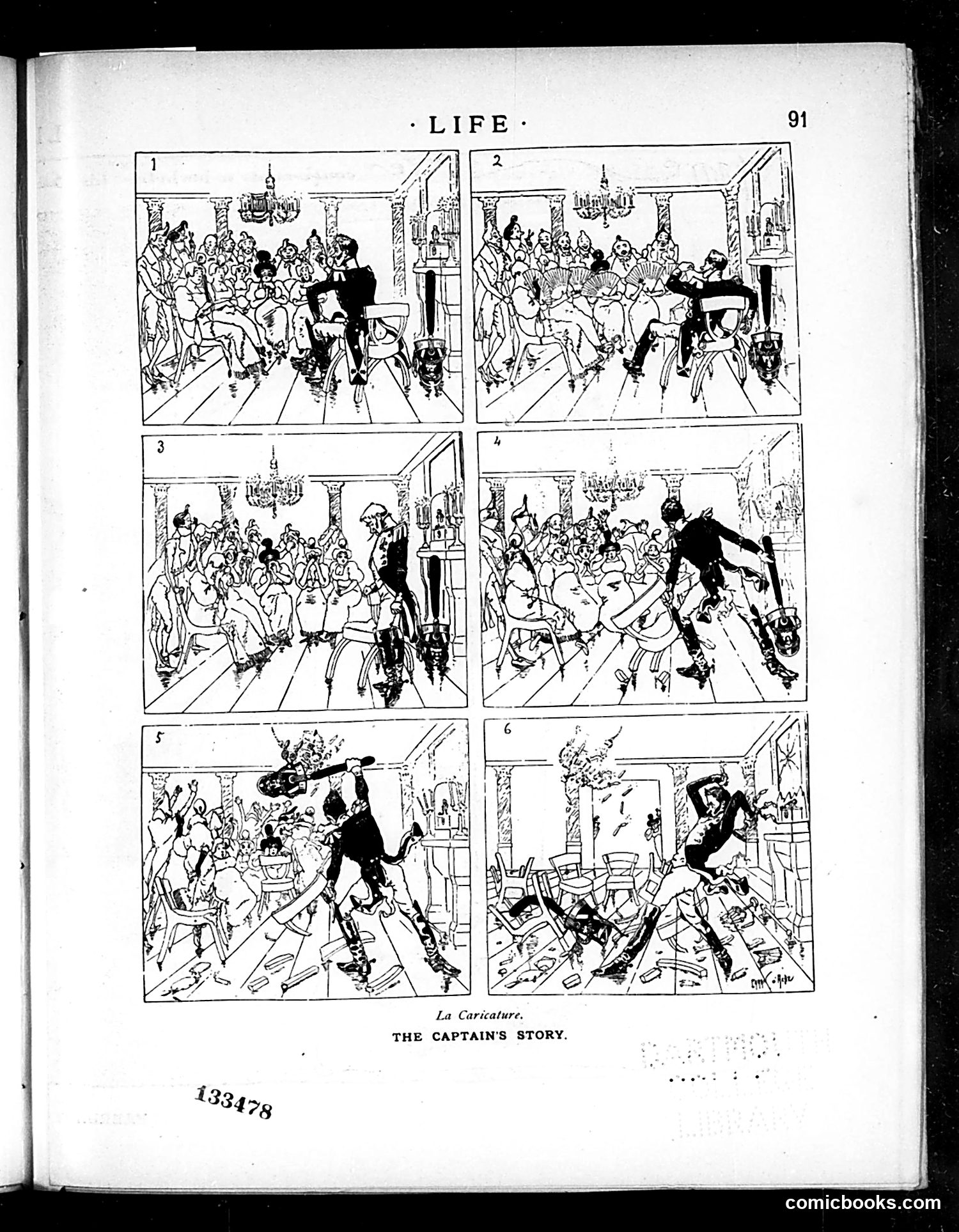
This six-panel comic strip titled "La Caricature" depicts a chaotic ballroom scene where a distinguished military officer (the "Captain") appears to be telling an increasingly wild story to an assembled crowd of elegantly dressed guests. The narrative progression shows the Captain's animated gesticulations becoming more extreme and frenzied across panels 1-6, culminating in complete physical pandemonium—with the Captain and guests tumbling about the ballroom floor amid overturned furniture. The satire likely mocks either a specific captain's notorious tall tales or more broadly critiques military braggadocio and the absurdity of officers embellishing their exploits. The guests' credulous attention gradually shifting to chaos humorously suggests the story's dubious veracity, with the visual escalation amplifying the joke about implausible narratives.
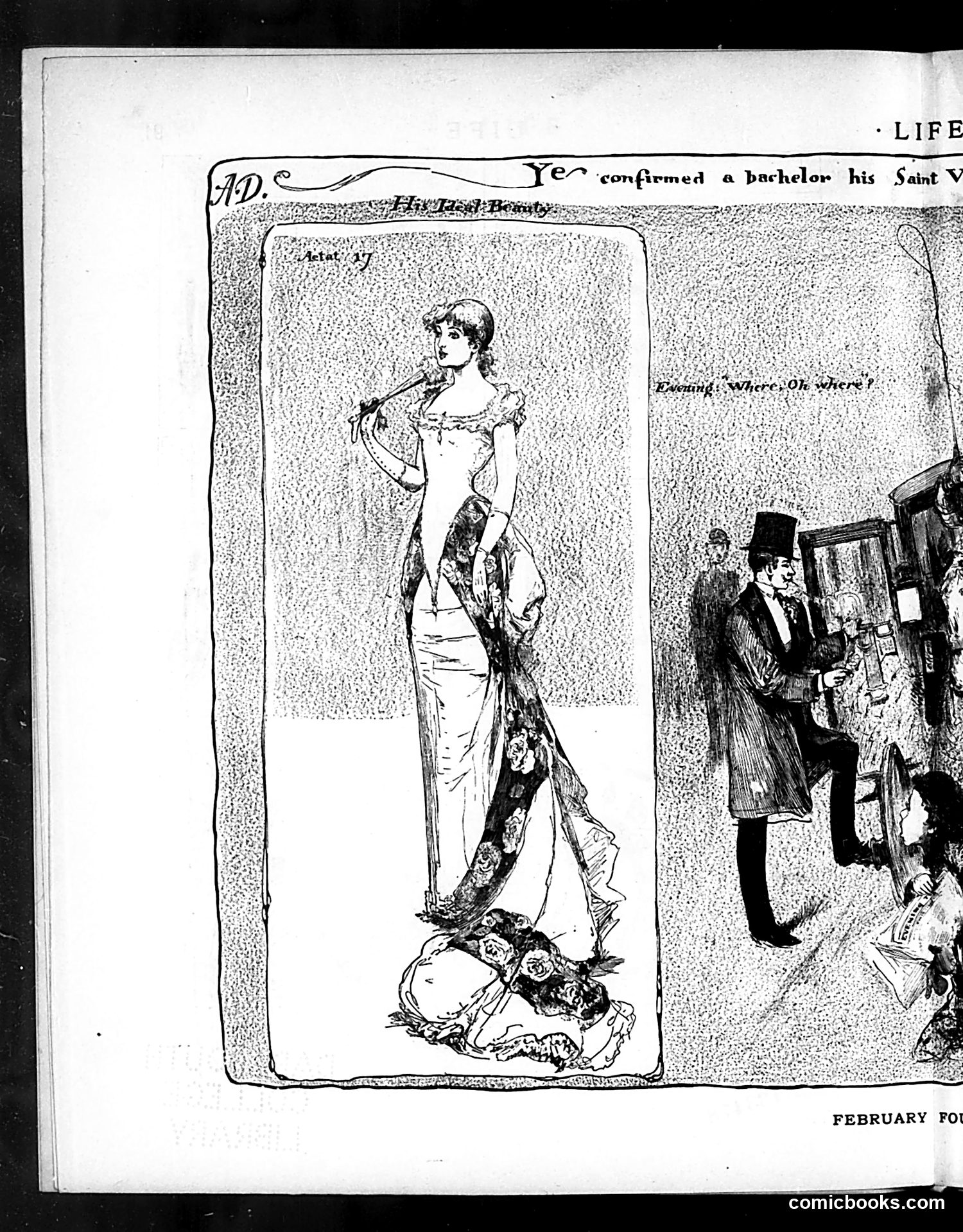
This page contains a satirical illustration depicting a fashionable woman in an elegant evening gown with ornate drapery, posed in a classic stance while holding a feathered fan. The caption references "His Last Beauty" and mentions confirming "a bachelor his Saint V[alentine's Day]" - suggesting satire about courtship and marriage prospects. On the right side, a separate scene shows formally dressed men in top hats, apparently at a social gathering or entrance, with text reading "Enough where oh where!" The overall satire appears to mock the marriage market and romantic pursuits of the Edwardian era - specifically targeting the performance of feminine beauty and desperation around finding eligible bachelors around Valentine's Day. The magazine used such illustrations to humorously critique social conventions around courtship and matrimony among the upper classes.
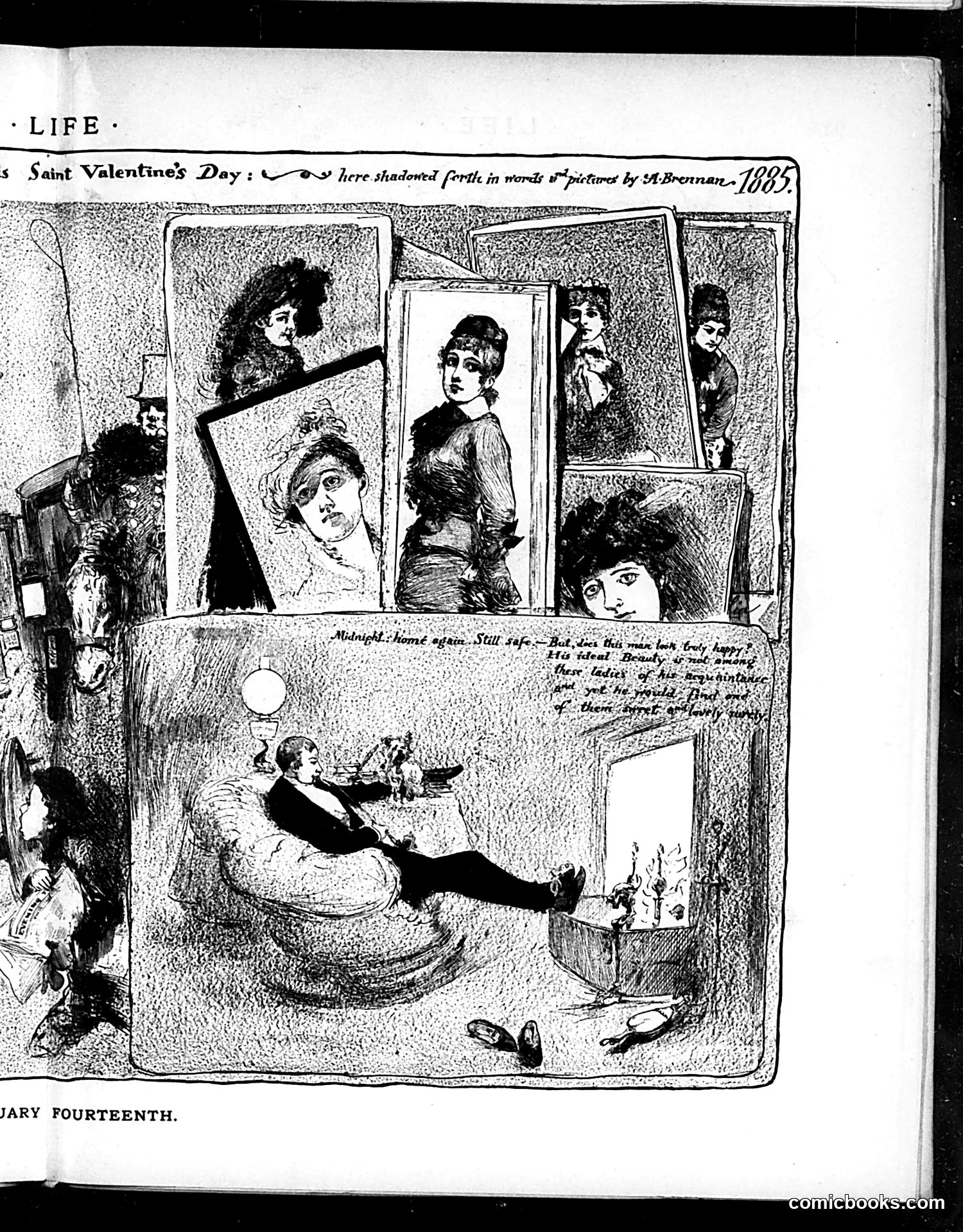
This illustration satirizes the romantic fantasies men entertain on Valentine's Day. The central figure—a man lounging contentedly in an armchair—daydreams about multiple idealized female faces displayed in frames above him, suggesting he entertains romantic notions about several women simultaneously. The satire targets male vanity and wishful thinking: the man appears blissfully imagining himself as a romantic ideal to various women, when the reality (suggested by his solitary, comfortable lounging position) is quite different. The framed portraits represent the gap between his romantic delusions and actual social reality. This reflects Victorian-era humor about courtship, bachelor fantasies, and the disconnect between male romantic aspirations and genuine romantic possibilities.
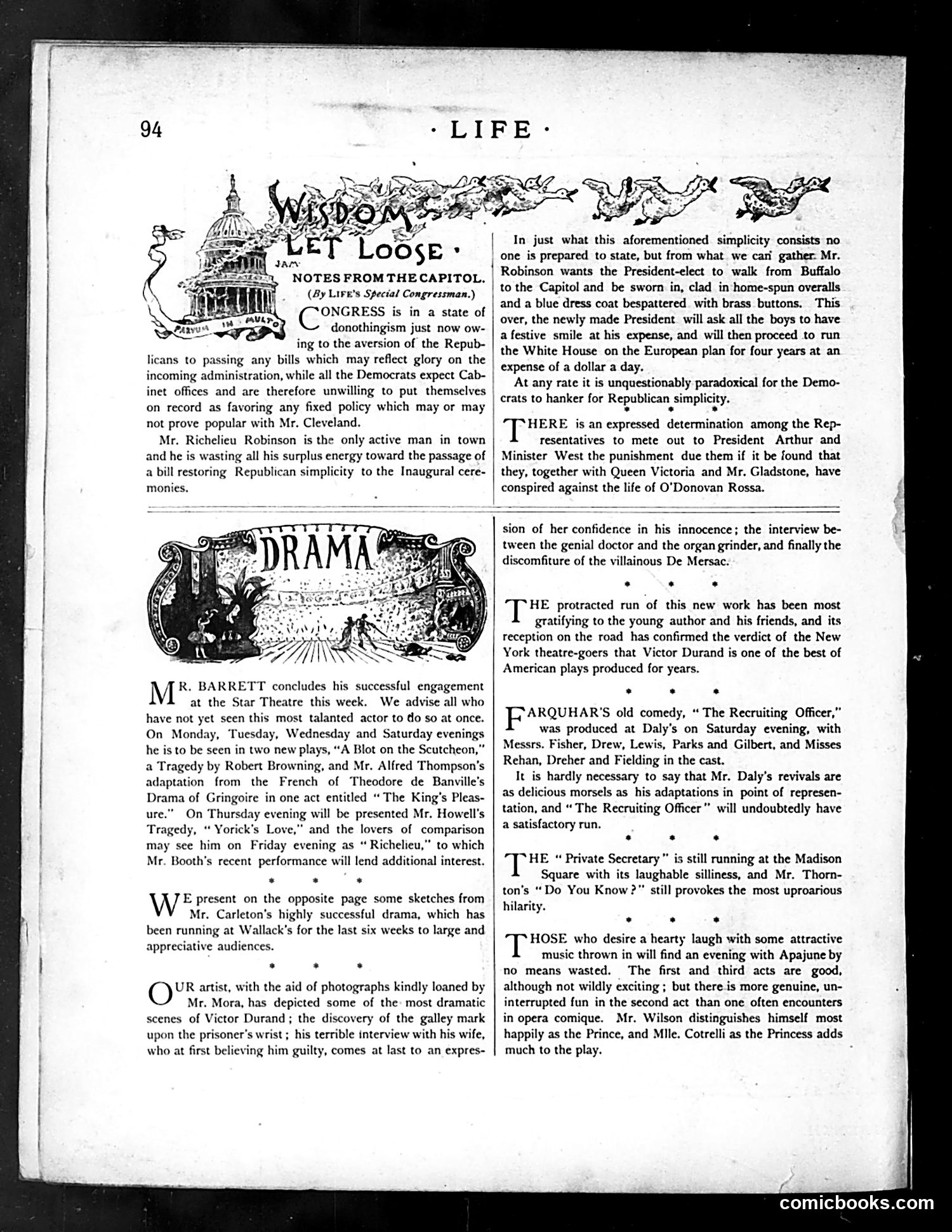
This 1883 *Life* magazine page contains political satire and theater reviews. **Political Content:** The "Wisdom Let Loose" section mocks congressional gridlock. Republicans and Democrats refuse to pass legislation—Republicans won't credit the incoming Cleveland administration, while Democrats expect Cabinet positions. The article ridicules Congressman Richelieu Robinson's push to restore "Republican simplicity" to presidential inaugurations (apparently proposing homespun clothing and dollar-a-day White House operations). The text notes this is ironic, since Democrats historically favor simplicity but are now contradicting this principle. A separate note references an investigation into whether President Arthur, Minister West, Queen Victoria, and Gladstone conspired against Irish-American activist O'Donovan Rossa's life—a reflection of 1880s tensions between Irish-Americans and the British government. **Theater Section:** The remainder consists of Broadway reviews praising actor Barrett and various dramatic productions, including Carleton's play showing at Wallack's Theatre.

I'm unable to provide a meaningful analysis of this page. The image is almost entirely black or severely underexposed, making it impossible to discern any cartoon figures, text, or visual details. While the OCR text indicates this is from Life magazine and the footer credits comicbooks.com, the actual content—whether cartoons, illustrations, or satirical commentary—is not visible in this reproduction. To properly analyze the political or social satire, I would need a clearer, higher-contrast version of the page that reveals the actual artwork and readable text.

I can see this is a mostly blank black page with only "comicbooks.com" visible in the lower right corner. The image appears to be either a back cover, blank page, or a scanning artifact from a Life magazine issue. Without visible cartoon content, text, or illustrations to analyze, I cannot identify any political figures, social references, or satirical commentary. The page does not contain sufficient visual or textual information to explain any historical context or meaning to a modern reader. To provide meaningful analysis of Life magazine's satire and humor, I would need a page with actual cartoon artwork or readable OCR text visible in the image.
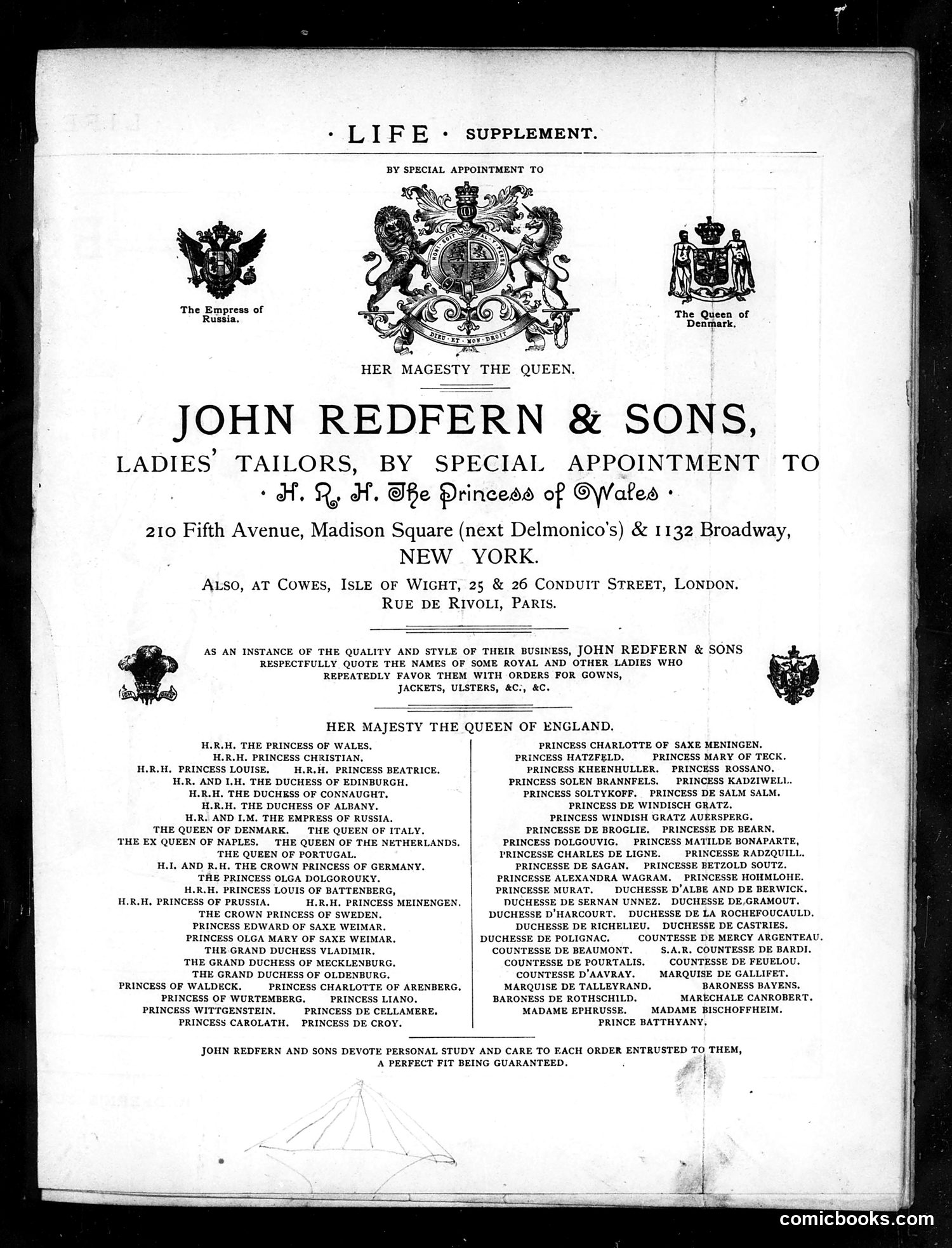
This is not a political cartoon but rather a **full-page advertisement** for an elite ladies' tailoring business. John Redfern & Sons, with locations in New York, London, and Paris, advertises their status as tailors to European royalty. The satire is subtle: by listing dozens of royal and aristocratic names—European queens, duchesses, princesses, and baronesses—the advertisement uses name-dropping as aspirational marketing. The implication is transparent: if you want to dress like royalty, use our services. The heraldic seals at the top invoke royal patronage. The exhaustive catalog of noble clients serves as both endorsement and social climbing opportunity for wealthy American clients who could afford such exclusive tailoring. This reflects the Gilded Age obsession with European aristocratic legitimacy and fashion authority.
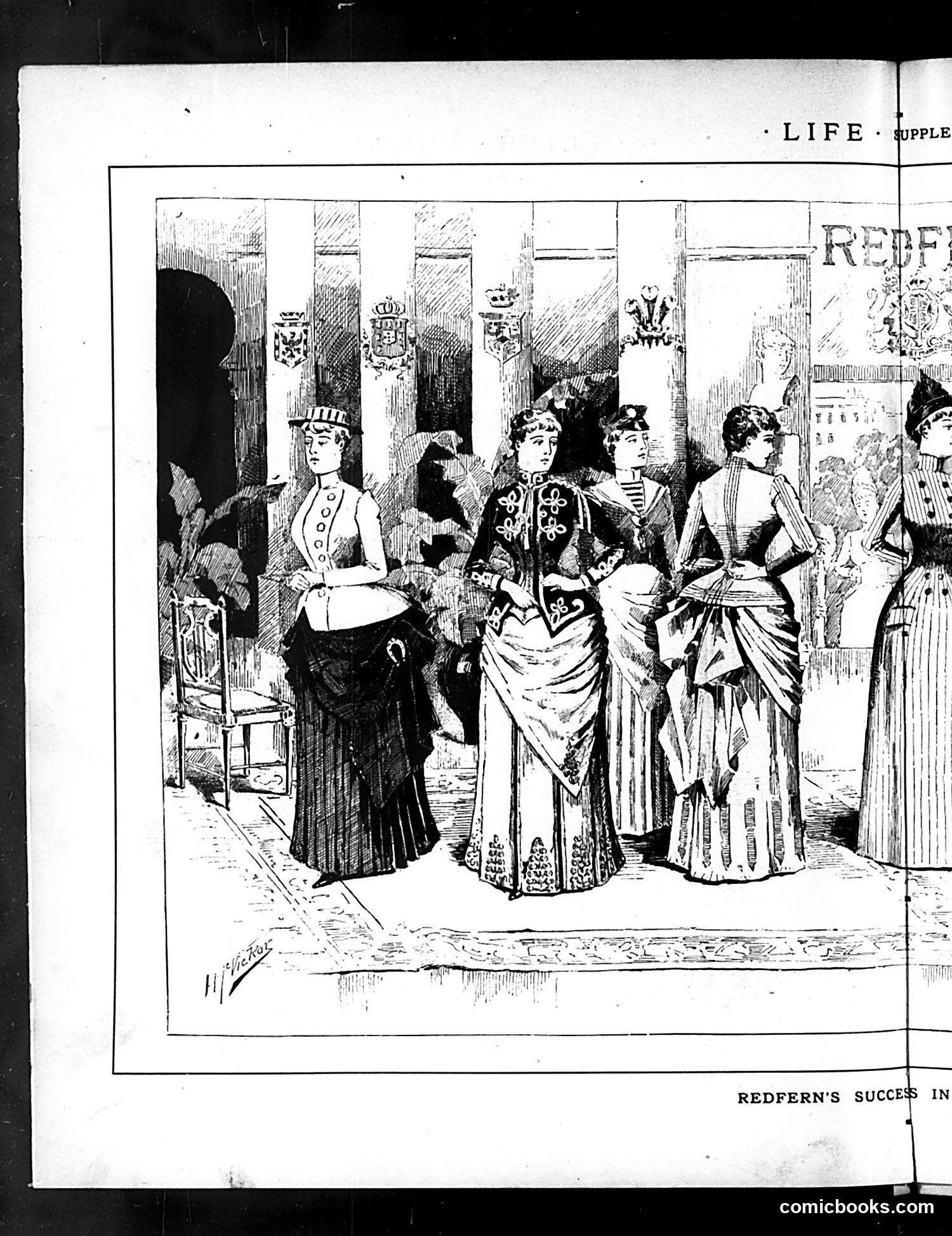
This page from *Life* magazine appears to show a satirical illustration titled "Redfern's Success In..." (the complete title is cut off). The image depicts several elegantly dressed women in late 19th or early 20th-century fashion, wearing elaborate gowns with ornate details and feathered hats, standing in what appears to be a formal interior setting with heraldic crests visible. The cartoon likely satirizes Redfern, a renowned French fashion designer of that era, mocking either his designs, his clients, or fashionable society's obsession with haute couture. The women's exaggerated poses and expensive clothing suggest commentary on wealth, status, or the absurdities of high fashion. Without the complete caption, the specific satirical target remains unclear, though it certainly critiques fashionable society or the designer's influence on women's clothing.
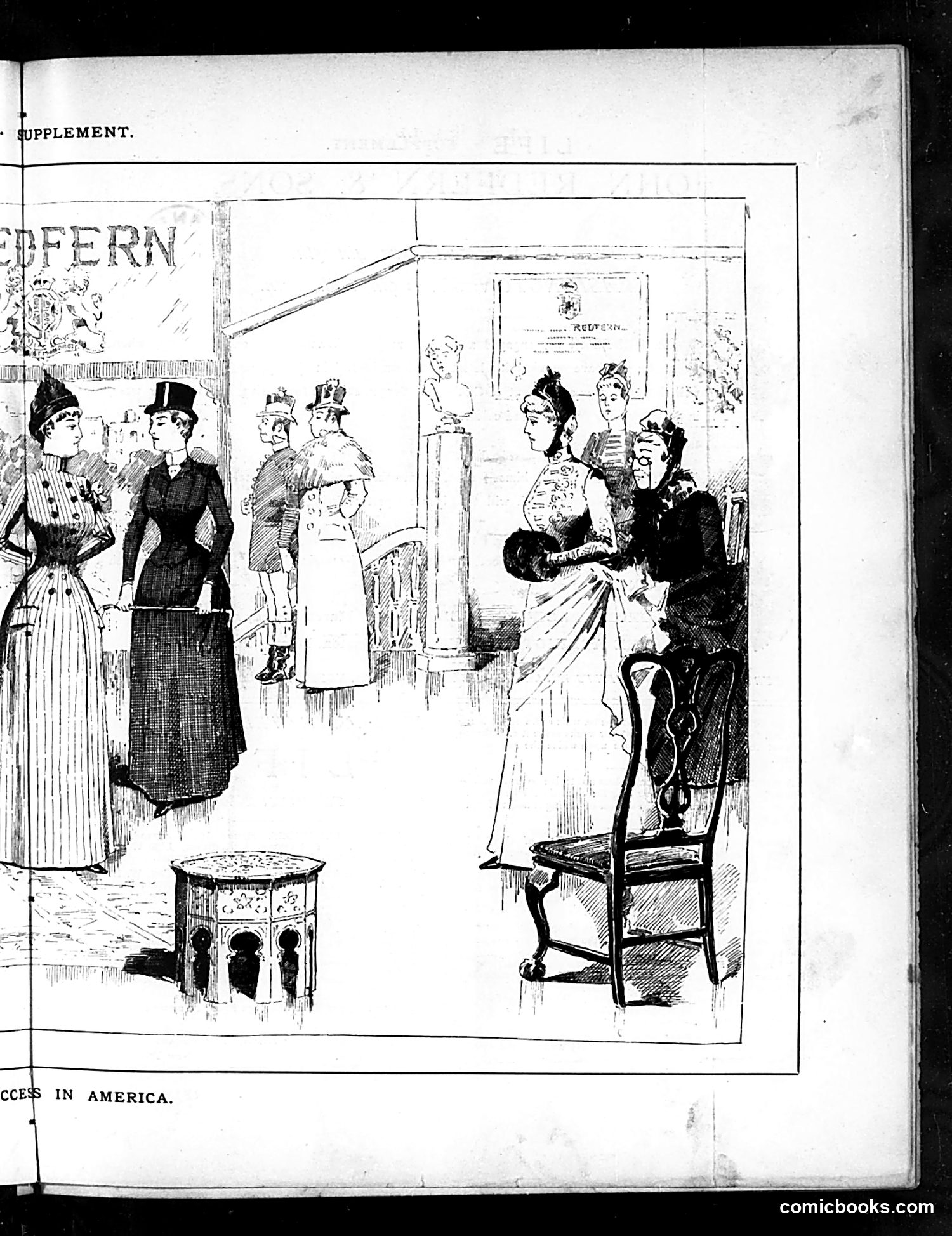
This is a black and white sketch from Life magazine's supplement section, titled "SUCCESS IN AMERICA" (partially visible as "CCES IN AMERICA"). The cartoon depicts a social scene in what appears to be an upscale interior—likely a reception or salon. On the left, two women in fashionable dress converse; on the right, a woman sits while being attended to by another figure. Additional figures in formal dress are visible in the background, some appearing to be military or official personnel based on their uniforms. The satire likely comments on American social climbing, high society, or the performance of respectability among the wealthy. The title "Success in America" suggests ironic commentary on what constitutes success—possibly mocking superficial status-seeking, social pretension, or the hollow nature of elite gatherings. Without clearer identifying details or captions, the specific targets remain unclear.
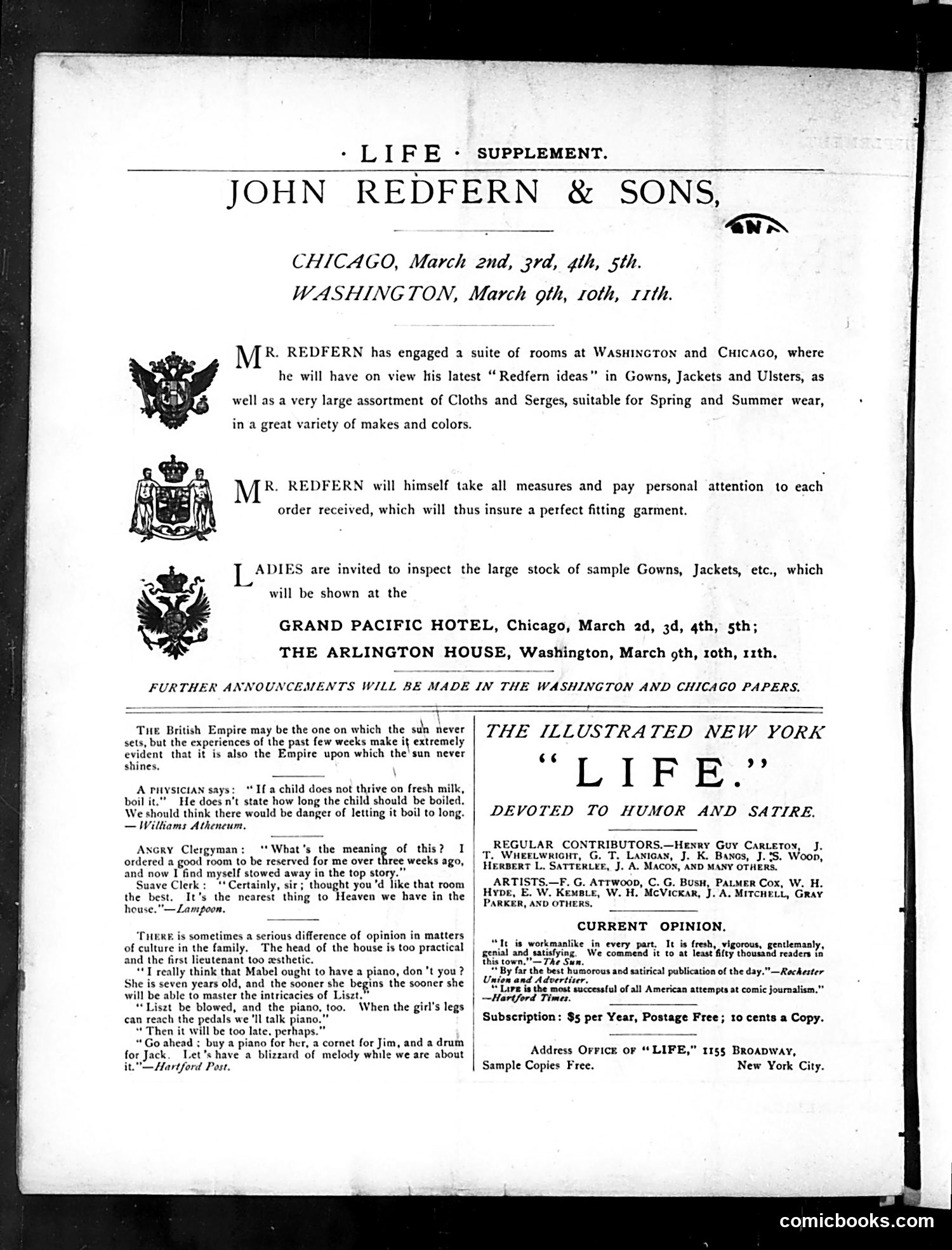
This is primarily a **Life magazine supplement page** from the late 19th century, dominated by advertising and publication information rather than political cartoons. **The Advertisement (Top):** John Redfern & Sons announces a fashion showroom tour, displaying spring/summer clothing in Chicago and Washington. Redfern, apparently a prominent tailor, promises personal fitting services and displays heraldic seals suggesting aristocratic or prestigious credentials. **The Humor Content (Bottom Half):** Several brief comedic anecdotes appear: - A joke about boiling milk for children (dark/absurdist humor) - A clergyman complaining about poor hotel accommodation (social satire about class/service) - A debate between a practical father and aesthetic mother over buying their young daughter a piano (satirizing Victorian gender expectations and cultural pretension) **The Magazine Promotion (Right):** Life advertises itself as a humor and satire publication, listing contributors and artists, with endorsements calling it "workmanlike" and "successful." The page reflects typical Victorian-era genteel humor—mildly absurdist, focused on domestic situations and class observations rather than sharp political commentary.
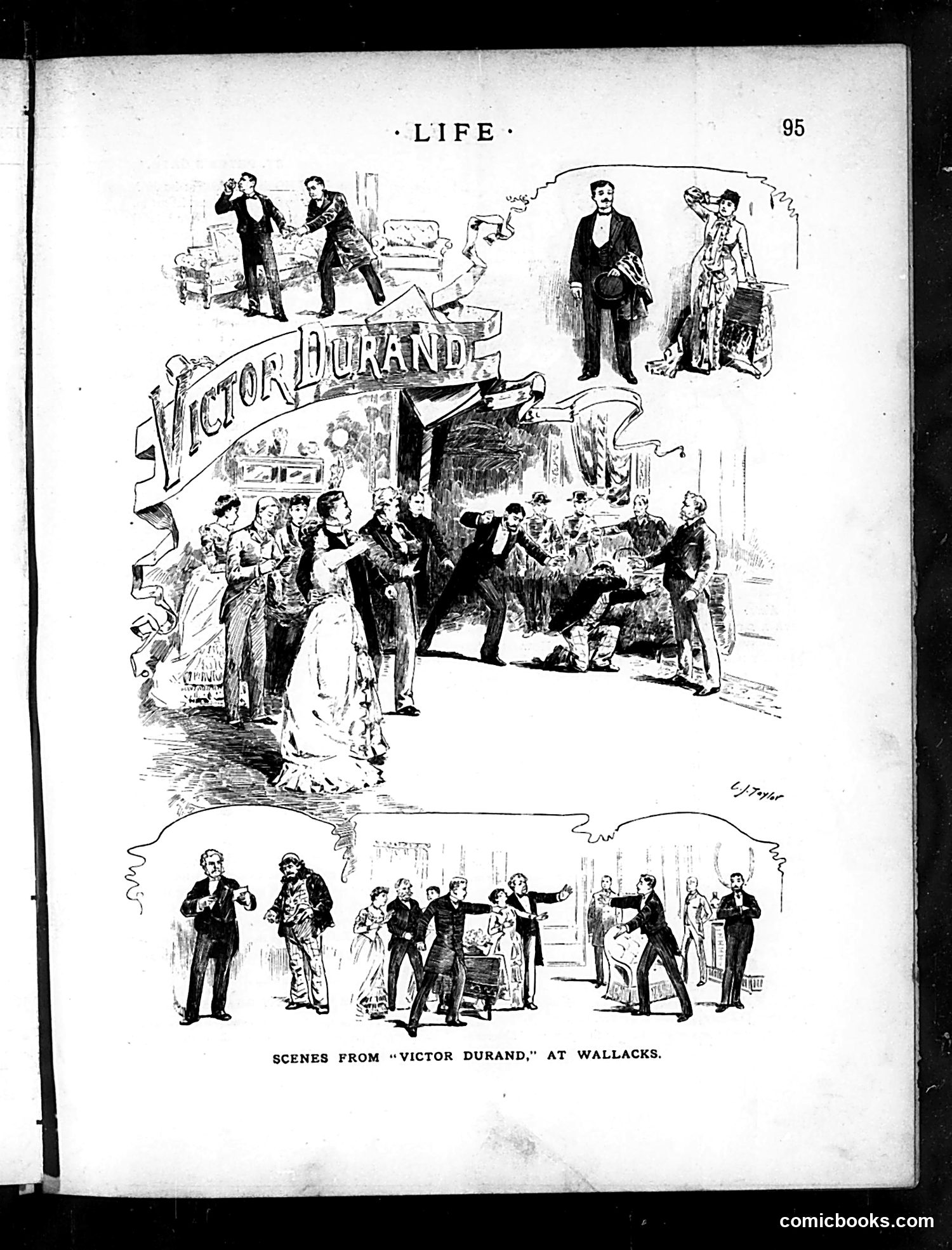
This page from *Life* magazine presents theatrical illustrations from a play called "Victor Durand" performed at Wallack's Theatre, a prominent New York venue. The sketches depict various dramatic scenes with well-dressed gentlemen and women in Victorian-era clothing engaged in what appears to be a melodrama. The central banner reading "VICTOR DURAND" frames multiple vignettes showing confrontations, emotional reactions, and theatrical gestures typical of period stage productions. Without additional context about the play's plot, the specific characters remain unidentified, but the illustrations document contemporary theatre culture and the melodramatic acting conventions of the era. The page serves as entertainment coverage rather than political satire.
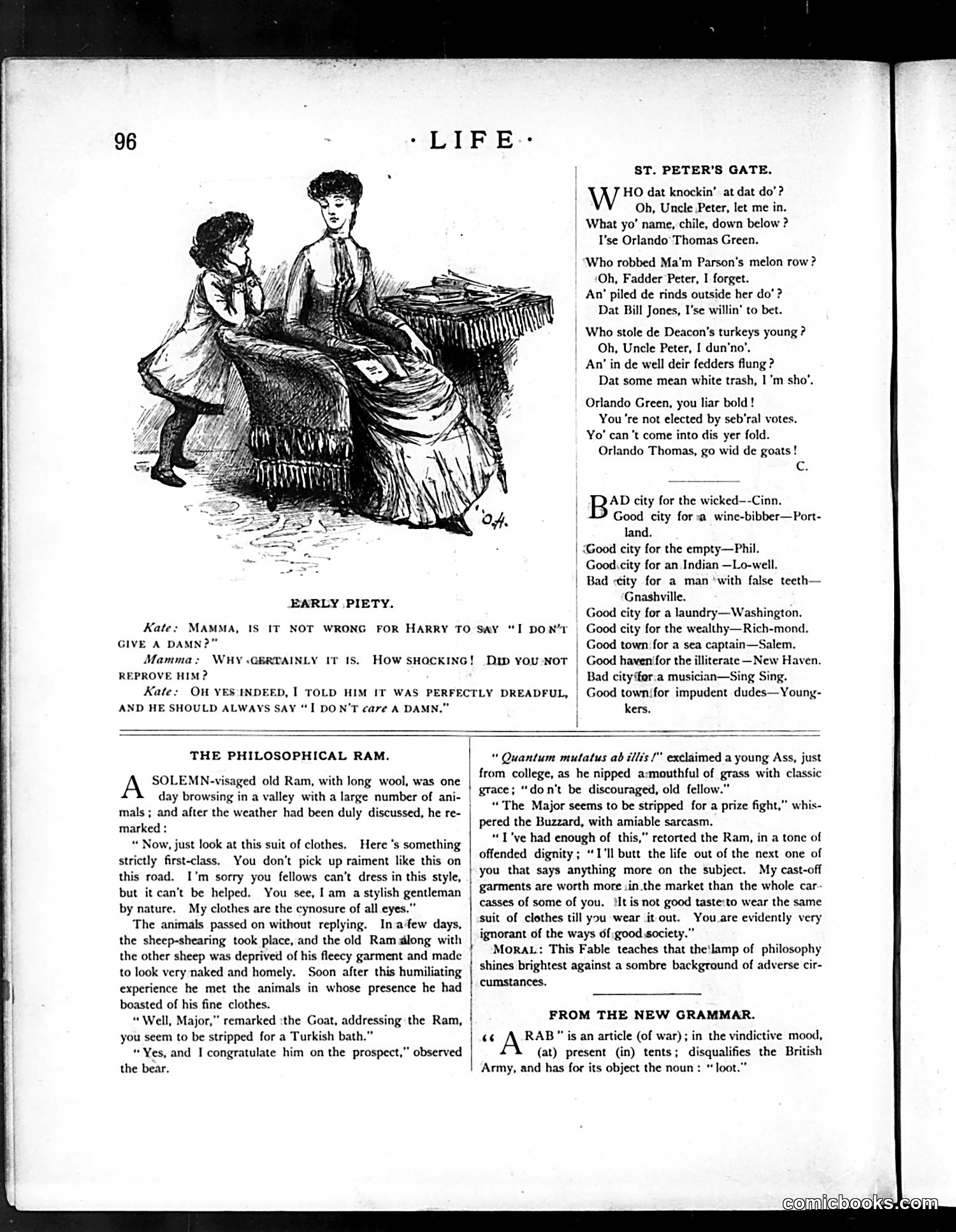
**"Early Piety"** satirizes Victorian parental hypocrisy. A mother scolds her daughter Kate for Harry saying "I don't give a damn," claiming it's "perfectly dreadful"—yet the mother herself uses the same phrase, revealing adults' double standards about propriety and profanity. **"St. Peter's Gate"** is a racist dialect piece depicting an African American man (Orlando Thomas Green) denied entry to heaven by St. Peter for various petty thefts and lies. The satire targets African Americans through minstrel-show stereotypes and dialect, presenting moral failings as racialized characteristics. **The pun section** offers city names matching character types (e.g., "Gnashville" for false teeth, "Sing Sing" for musicians)—wordplay typical of 19th-century humor magazines. **"The Philosophical Ram"** is a Aesop-style fable: a vain ram boasts of fine clothes; after shearing, he's humiliated but maintains his arrogance, claiming philosophy transcends circumstance. The moral critiques false dignity masking insecurity.
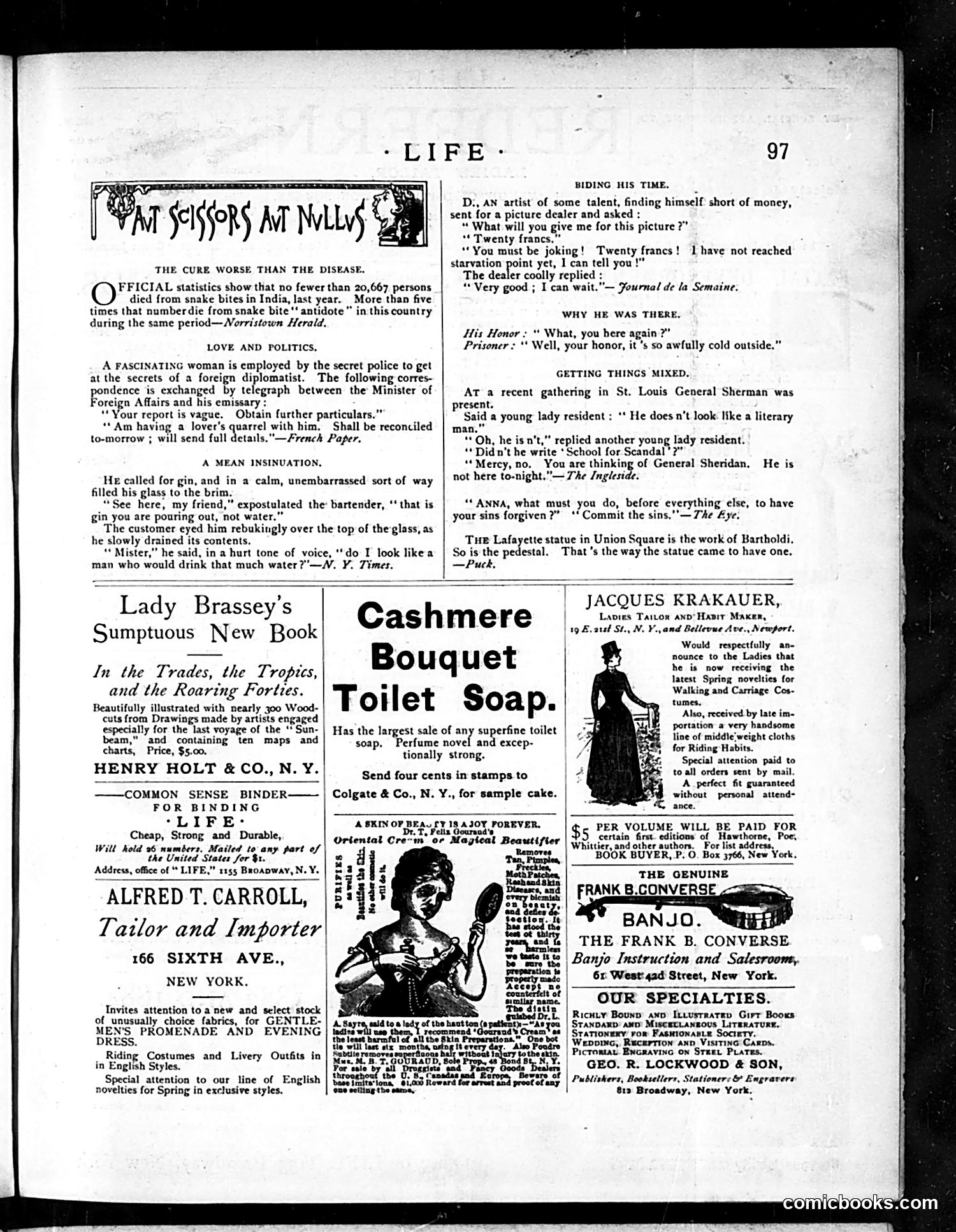
This page collects brief humorous anecdotes and satirical jabs at contemporary issues rather than political cartoons. **Key satirical pieces:** 1. **"The Cure Worse Than the Disease"** — Jokes that American "snake bite antidotes" kill five times more people than actual snake bites in India, mocking the era's dubious patent medicines. 2. **"Love and Politics"** — A diplomat's female spy seduces a foreign official for state secrets; the satirical "telegram exchange" shows how personal relationships entangle diplomacy. 3. **"A Mean Insinuation"** — A drunk defends pouring gin (not water) by claiming he doesn't look like a man who drinks "that much water" — subtle mockery of public drunkenness. 4. **"Getting Things Mixed"** — Partygoers confuse General Sherman with General Sheridan and misattribute Richard Brinsley Sheridan's play "School for Scandal" to him—satire of social ignorance. The page is largely **advertisements** (soap, tailors, books) mixed with these satirical vignettes reflecting Gilded Age concerns: dubious medicines, espionage, drinking culture, and social pretension.
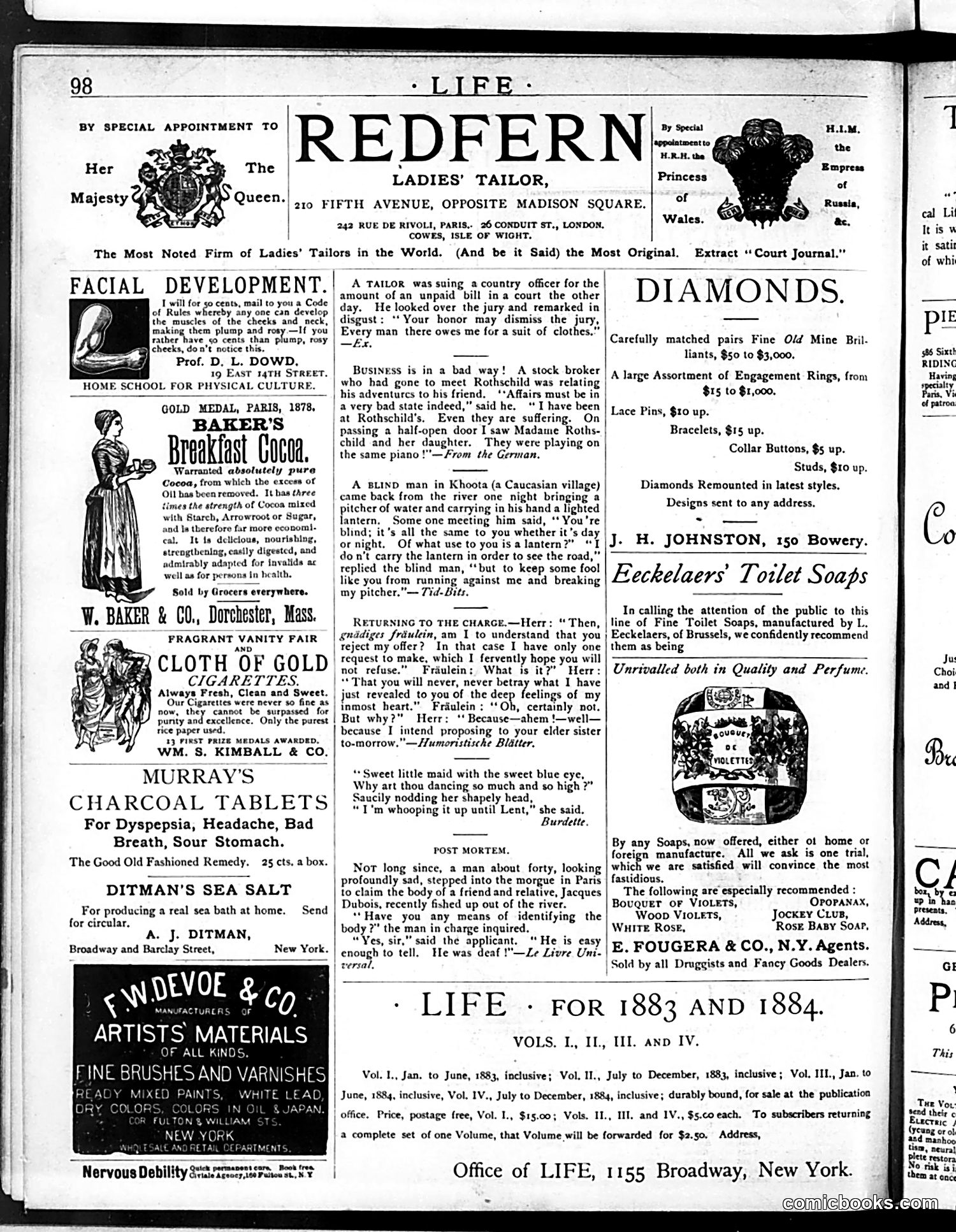
This page is primarily **advertisements and humor columns** rather than political satire. The content includes: **Advertisements**: Redfern Ladies' Tailor, Baker's Breakfast Cocoa, facial development courses, and various patent medicines (charcoal tablets, sea salt remedies). **Humor Pieces**: Four brief anecdotes that represent typical Victorian-era jokes: - A tailor suing a customer, discovering the entire jury owes him money - A banker visiting Rothschild during financial hardship - A blind man carrying a lantern to protect himself from foolish people - A rejected marriage proposal with a darkly comedic twist - A girl dancing until Lent (religious observance) These jokes rely on wordplay, class commentary (wealthy people struggling financially), and social observations rather than specific political references. The satire is genteel and domestic rather than political. The page demonstrates *Life* magazine's format as a venue for consumer advertising mixed with light comic material aimed at middle-class readers.
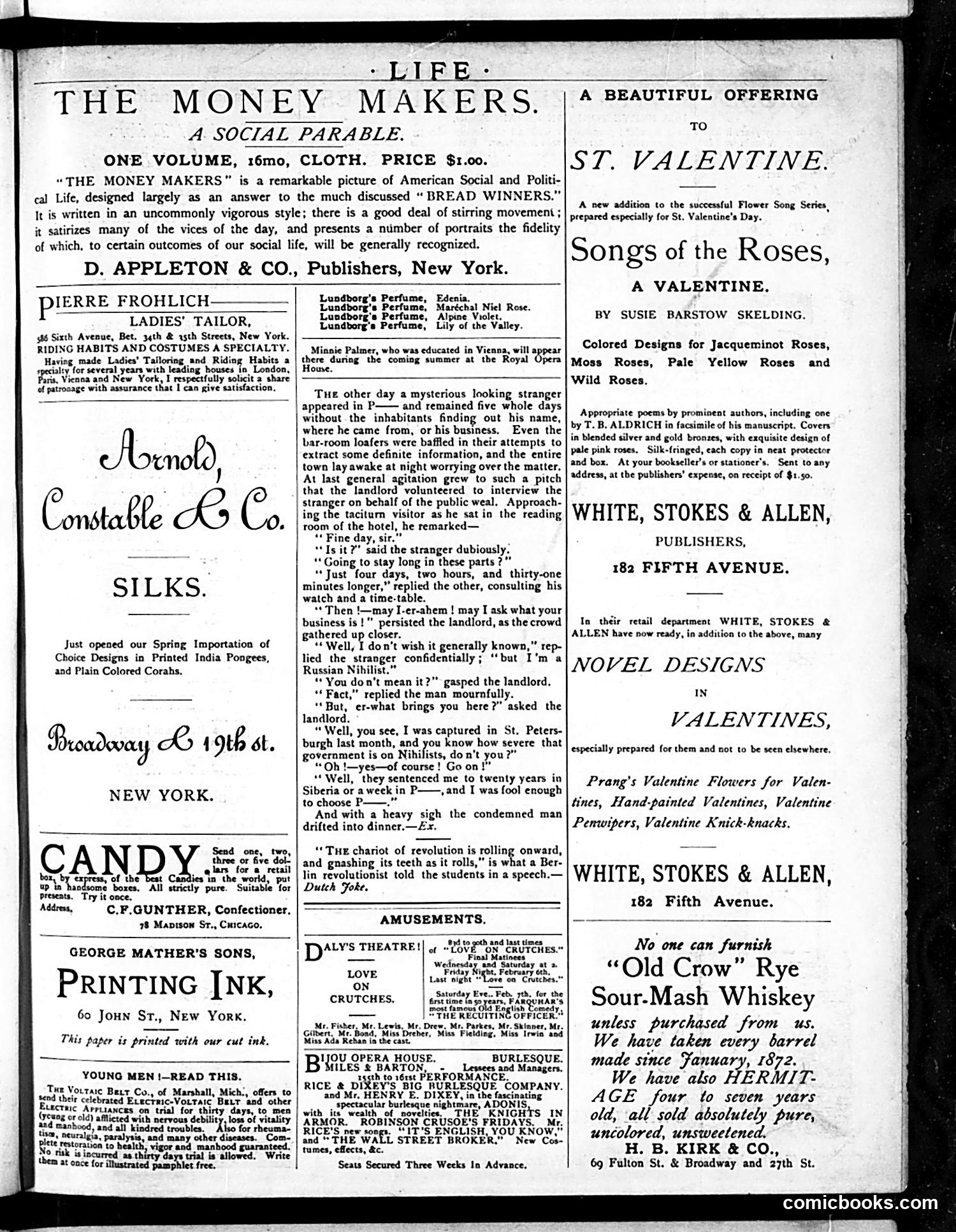
This is primarily an **advertising page** from Life magazine, not a political cartoon. The main content is a book advertisement for "The Money Makers," described as a "Social Parable" responding to the novel "The Bread Winners"—suggesting contemporary debate about American wealth and labor. The **only satirical content** is a short humorous anecdote about a mysterious stranger in a small town (labeled "P——") who claims to be a Russian Nihilist. The joke plays on American provincial curiosity and anxiety: townspeople obsessively try to uncover the stranger's identity, only to discover he's a political exile who chose exile in the boring small town over Siberia—implying the town is so tedious it rivals Siberian punishment. The reference to Russian Nihilists (anarchist radicals active in the 1870s-80s) would have resonated with contemporary readers' fears of radical foreign movements, though the humor deflates this anxiety through absurdity. The remainder consists of advertisements for tailoring, silk, candy, printing ink, and patent medicines.
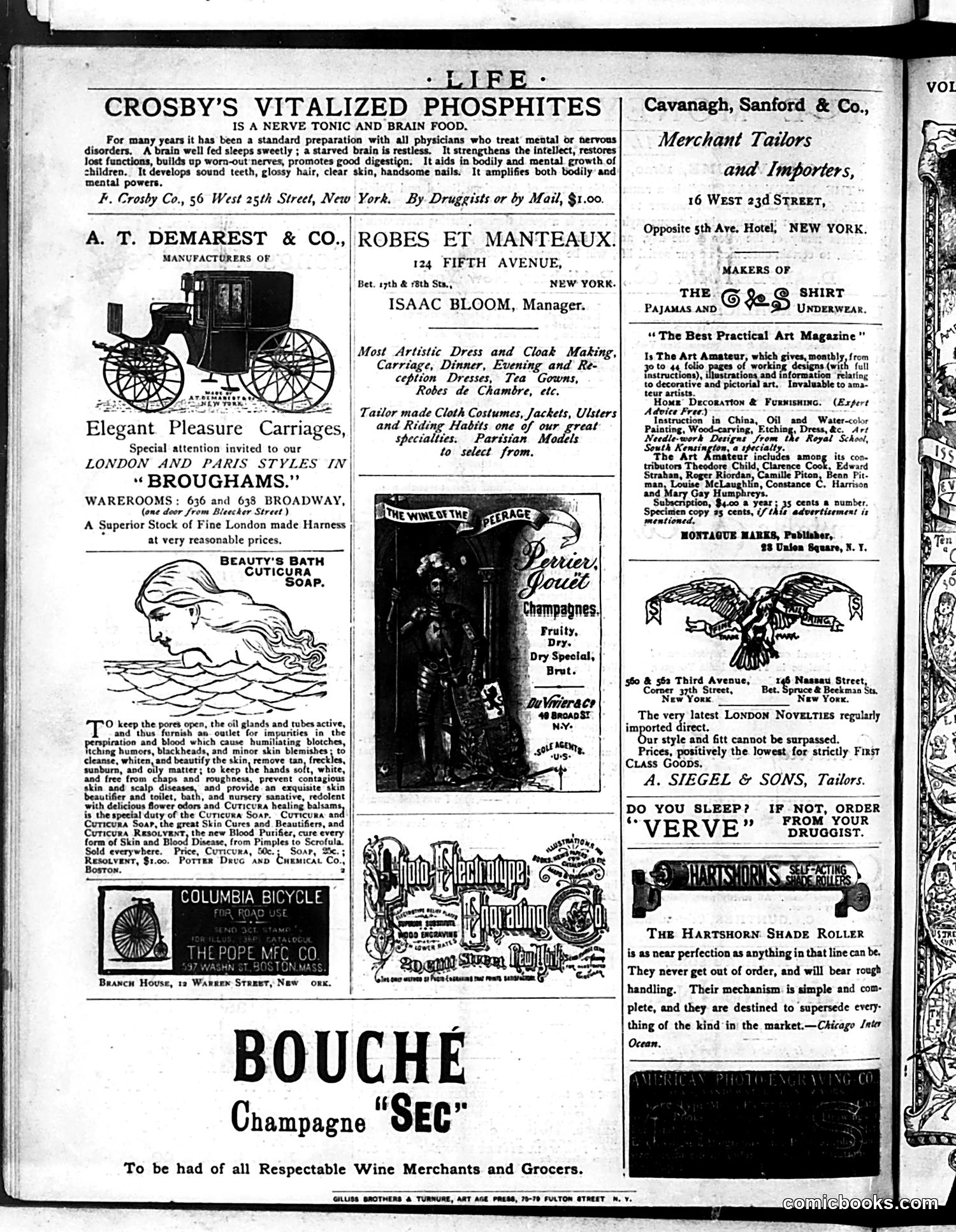
This page is **primarily advertising**, with no political cartoons or satirical editorial content visible. The advertisements reflect late 19th-century consumer products and services: patent medicines (Crosby's Phosphites nerve tonic, Beauty's Bath Cuticura Soap), luxury goods (carriages, clothing), and practical items (bicycles, shade rollers). The only visual element beyond ads is an ornamental illustration of a wine bottle labeled "Bouché Champagne 'Sec'" at the bottom—a straightforward product advertisement. The page demonstrates Life magazine's business model: satirical editorial content subsidized by advertising to affluent urban readers. The ads themselves—targeting anxieties about health, appearance, and status—offer insight into period concerns, but contain no satire or political commentary to decode. This is a commercial page, not an editorial one.