
Life, 1885-02-12 · page 6 of 22
Life — February 12, 1885 — page 6: what you’re looking at
What you’re looking at
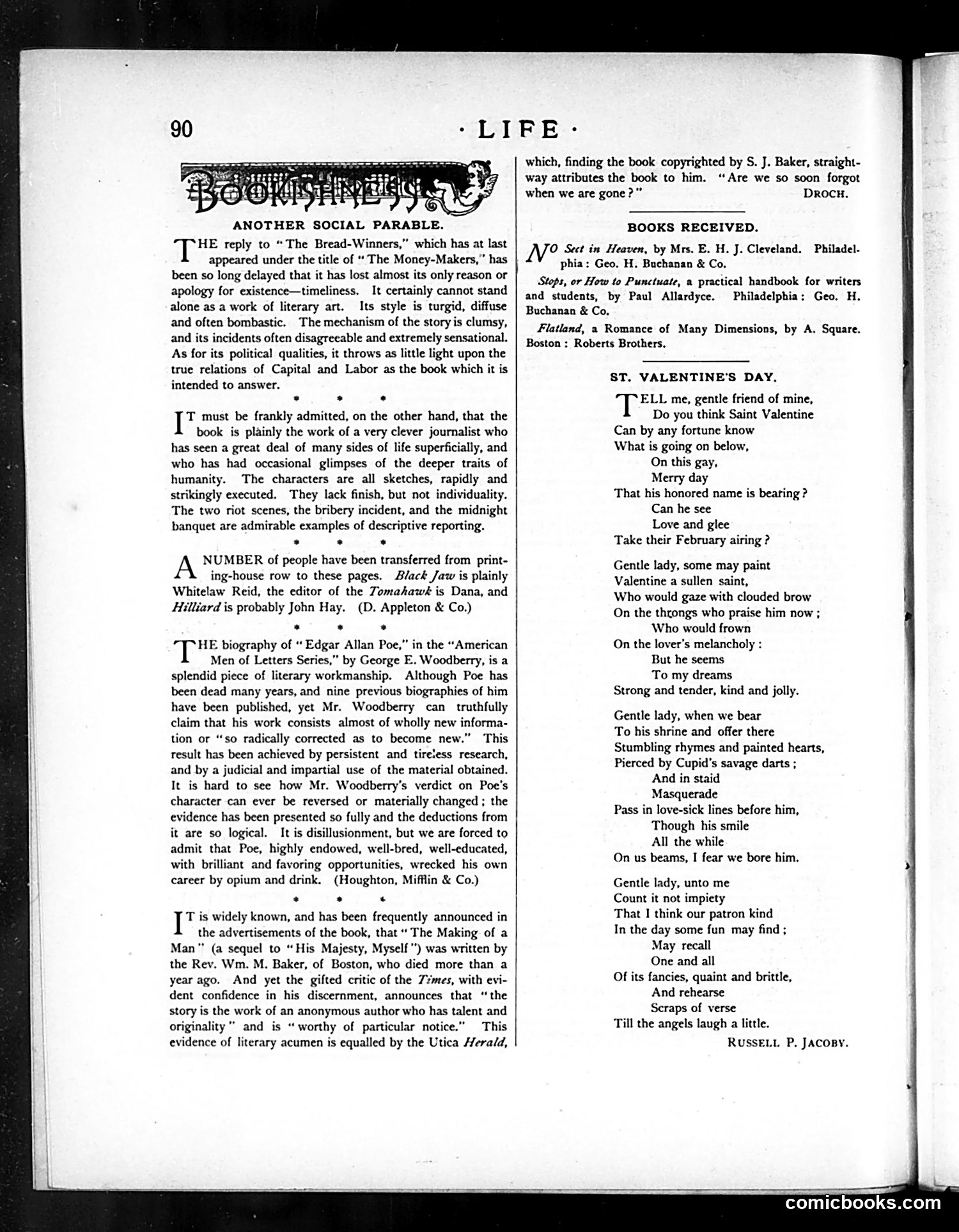
This page contains book reviews and literary criticism rather than political cartoons. The main content includes: **"Bookishly" section**: A critique of "The Bread-Winners," a novel about Capital and Labor relations. The reviewer criticizes it as poorly written—"turgid, diffuse and often bombastic"—despite acknowledging the author is a clever journalist with keen social observation. The characters are dismissed as mere sketches lacking individuality. **Books Received section**: Lists new publications including works on writing and romance. **"St. Valentine's Day" poem**: A lengthy romantic verse by Russell P. Jacoby. The page functions as literary commentary typical of Life magazine's satirical approach, critiquing both literary merit and social themes through book reviews rather than visual satire.
📄 Transcribed text from this page (OCR, searchable)
Machine-transcribed from the original scan — historical spelling and the odd misread are preserved.
- LIFE: ANOTHER SOCIAL PARABLE. HE reply to “The Bread-Winners,” which has at last appeared under the title of The Money-Makers,” has been so long delayed that it has lost almost its only reason or apology for existence—timeliness. It certainly cannot stand alone as a work of literary art. Its style is turgid, diffuse and often bombastic. The mechanism of the story is clumsy, and its incidents often disagreeable and extremely sensational. As for its political qualities, it throws as little light upon the true relations of Capital and Labor as the book which it is intended to answer. . . . T must be frankly admitted, on the other hand, that the book is plainly the work of a very clever journalist who has seen a great deal of many sides of life superficially, and who has had occasional glimpses of the deeper traits of humanity. The characters are all sketches, rapidly and strikingly executed. They lack finish, but not individuality. The two riot scenes, the bribery incident, and the midnight banquet are admirable examples of descriptive reporting. . . . NUMBER of people have been transferred from print- ing-house row to these pages. Black Jaw is plainly Whitelaw Reid, the editor of the Zomahawé is Dana, and Hilliard is probably John Hay. (D. Appleton & Co.) . . . HE biography of “ Edgar Allan Poe,” in the “American Men of Letters Series,” by George E. Woodberry, is a splendid piece of literary workmanship. Although Poe has been dead many years, and nine previous biographies of him have been published, yet Mr. Woodberry can truthfully claim that his work consists almost of wholly new informa- tion or “‘so radically corrected as to become new.” This result has been achieved by persistent and tireiess research, and by a judicial and impartial use of the material obtained. It is hard to see how Mr. Woodberry’s verdict on Poe's character can ever be reversed or materially changed ; the evidence has been presented so fully and the deductions from it are so logical. It is disillusionment, but we are forced to admit that Poe, highly endowed, well-bred, well-educated, with brilliant and favoring opportunities, wrecked his own career by opium and drink. (Houghton, Mifflin & Co.) . * * T is widely known, and has been frequently announced in the advertisements of the book, that “ The Making of a Man” (a sequel to “His Majesty, Myself") was written by the Rev. Wm. M. Baker, of Boston, who died more than a year ago. And yet the gifted critic of the 7rmes, with evi- dent confidence in his discernment, announces that “the story is the work of an anonymous author who has talent and originality” and is “worthy of particular notice.” This evidence of literary acumen is equalled by the Utica Herald, which, finding the book copyrighted by S. J. Baker, straight- way attributes the book to him. “Are we so soon forgot when we are gone?” Drocu. BOOKS RECEIVED. N°? Sect in Heaven, by Mrs. E. H. J. Cleveland. Philadel- phia: Geo. H. Buchanan & Co, Stops, or How to Punctuate, a practical handbook for writers and students, by Paul Allardyce. Philadelphia: Geo. H. Buchanan & Co, Flatland, 1 Romance of Many Dimensions, by A. Square. Boston : Roberts Brothers. ST. VALENTINE’S DAY. ELL me, gentle friend of mine, Do you think Saint Valentine Can by any fortune know What is going on below, On this gay, Merry day That his honored name is bearing ? Can he see Love and glee Take their February airing ? Gentle lady, some may paint Valentine a sullen saint, Who would gaze with clouded brow On the throngs who praise him now ; Who would frown On the lover's melancholy : But he seems To my dreams Strong and tender, kind and jolly. Gentle lady, when we bear To his shrine and offer there Stumbling rhymes and painted hearts, Pierced by Cupid’s savage darts ; And in staid Masquerade Pass in love-sick lines before him, Though his smile All the while On us beams, I fear we bore him. Gentle lady, unto me Count it not impiety That | think our patron kind In the day some fun may find ; May recall One and all Of its fancies, quaint and brittle, And rehearse Scraps of verse Till the angels laugh a little. RUSSELL P. JACOBY. comicbooks.com