
Life, 1885-02-12 · page 18 of 22
Life — February 12, 1885 — page 18: what you’re looking at
What you’re looking at
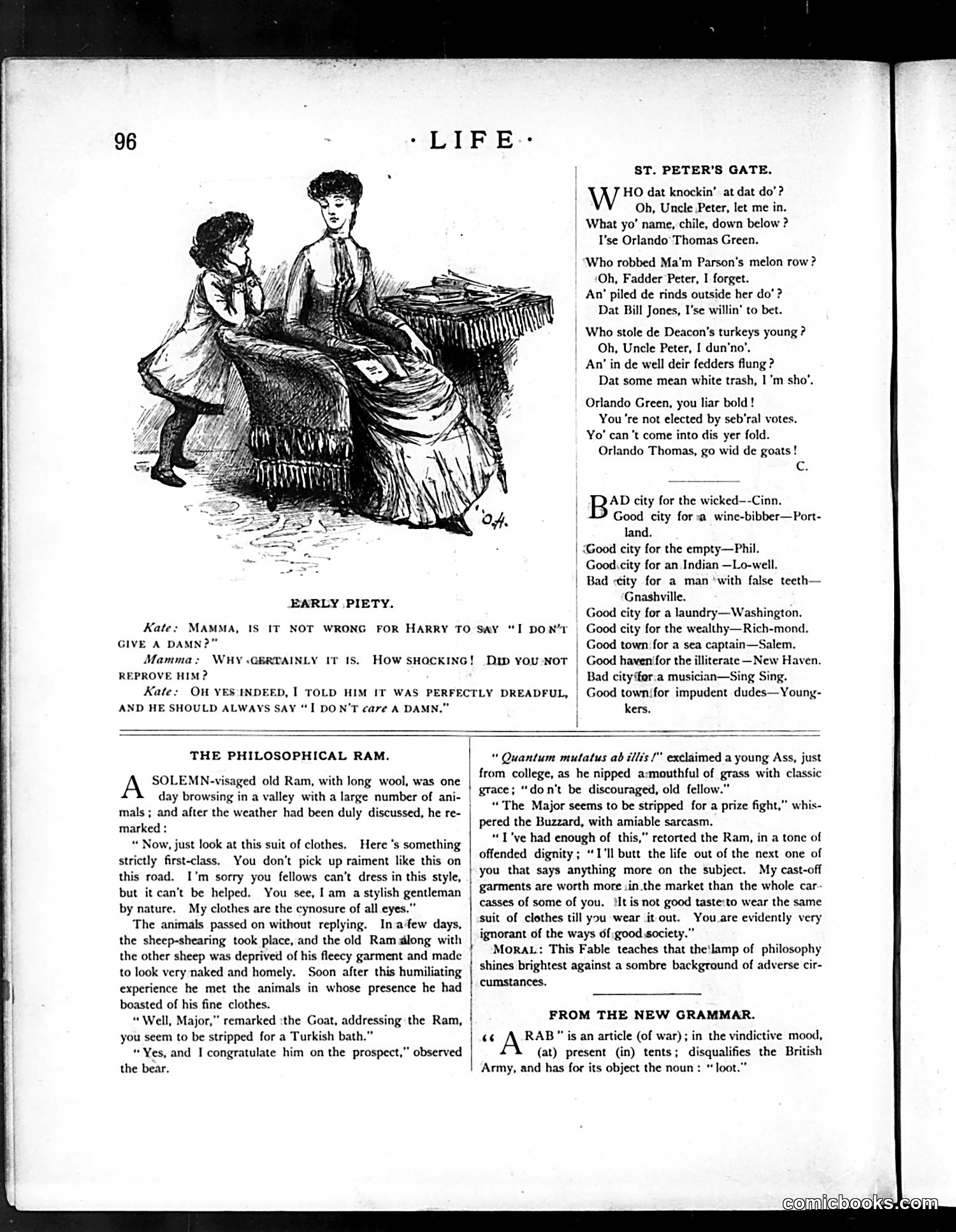
**"Early Piety"** satirizes Victorian parental hypocrisy. A mother scolds her daughter Kate for Harry saying "I don't give a damn," claiming it's "perfectly dreadful"—yet the mother herself uses the same phrase, revealing adults' double standards about propriety and profanity. **"St. Peter's Gate"** is a racist dialect piece depicting an African American man (Orlando Thomas Green) denied entry to heaven by St. Peter for various petty thefts and lies. The satire targets African Americans through minstrel-show stereotypes and dialect, presenting moral failings as racialized characteristics. **The pun section** offers city names matching character types (e.g., "Gnashville" for false teeth, "Sing Sing" for musicians)—wordplay typical of 19th-century humor magazines. **"The Philosophical Ram"** is a Aesop-style fable: a vain ram boasts of fine clothes; after shearing, he's humiliated but maintains his arrogance, claiming philosophy transcends circumstance. The moral critiques false dignity masking insecurity.
📄 Transcribed text from this page (OCR, searchable)
Machine-transcribed from the original scan — historical spelling and the odd misread are preserved.
EARLY PIETY. Kate: MAMMA, IS IT NOT WRONG FOR HARRY TO Say “I DON’I GIVE A DAMN? Mamma: REPROVE HIM? Kate: AND HE SHOULD ALWAYS SAY “I DON'T care A DAMN.” WHY <GERTAINLY IT IS. How SHOCKING! OH YES INDEED, I TOLD HIM IT WAS PERFECTLY DREADFUL, ST. PETER’S GATE. HO dat knockin’ at dat do’? Oh, Uncle Peter, let me in. What yo’ name, chile, down below ? I’se Orlando’ Thomas Green. ‘Who robbed Ma’m Parson's melon row? Oh, Fadder Peter, I forget. An’ piled de rinds outside her do’? Dat Bill Jones, I’se willin’ to bet. Who stole de Deacon's turkeys young ? | Oh, Uncle Peter, I dun‘no’. An’ in de well deir fedders flung ? Dat some mean white trash, I'm sho’, Orlando Green, you liar bold! You ‘re not elected by seb'ral votes. Yo’ can't come into dis yer fold. Orlando Thomas, go wid de goats ! c. AD city for the wicked—-Cinn. Good city for a wine-bibber—Port- land. ‘Good city for the empty—Phil. Goodkcity for an Indian —Lo-well. | Bad «city for a man ‘with false teeth— Gnashville. Good city for a laundry—Washington. Good city for the wealthy—Rich-mond. Good town for a sea captain—Salem. Good haven‘for the illiterate —New Haven. Bad city{fer.a musician—Sing Sing. Good townifor impudent dudes—Young- kers. Dw you Not THE PHILOSOPHICAL RAM. SOLEMN-visaged old Ram, with long wool, was one day browsing in a valley with a large number of ani- | mals ; and after the weather had been duly discussed, he re- marked : “ Now, just look at this suit of clothes. Here ‘s something strictly first-class. You don’t pick up raiment like this on this road. but it can’t be helped. You see, I am a stylish gentleman by nature. My clothes are the cynosure of all eyes.” The animals passed on without replying. Ina‘few days, the sheep-shearing took place, and the old Ram along with the other sheep was deprived of his fleecy garment and made to look very naked and homely. Soon after this humiliating experience he met the animals in whose presence he had boasted of his fine clothes. “ Well, Major,” remarked :the Goat, addressing the Ram, you seem to be stripped for a Turkish bath.” “Yes, and I congratulate him on the prospect,” observed the bear. I'm sorry you fellows can’t dress in this style, | you: that says anything more'on the subject. | garments are worth more..in.the market than the whole car- “ Quantum mutatus ab illis! exclaimed a young Ass, just | from college, as he nipped a:mouthful of grass with classic grace; “don’t be discouraged, old fellow.” “The Major seems to be stripped for a prize fight,” whis- pered the Buzzard, with amiable sarcasm. “T’ve had enough of this,” retorted the Ram, in a tone of offended dignity ; “I'll butt the life out of the next one of My cast-off casses of some of you. It is not good taste:to wear the same suit of clothes till you wear it out. You are evidently very ignorant of the ways df good society.” MoraL: This Fable teaches that the'lamp of philosophy shines brightest against a sombre background of adverse cir- cumstances. FROM THE NEW GRAMMAR. “cb RAB" is an article (of war); in the vindictive mood, (at) present (in) tents; disqualifies the British Army, and has for its object the noun : “loot.”