
A complete issue · 16 pages · 1885
Life — January 22, 1885
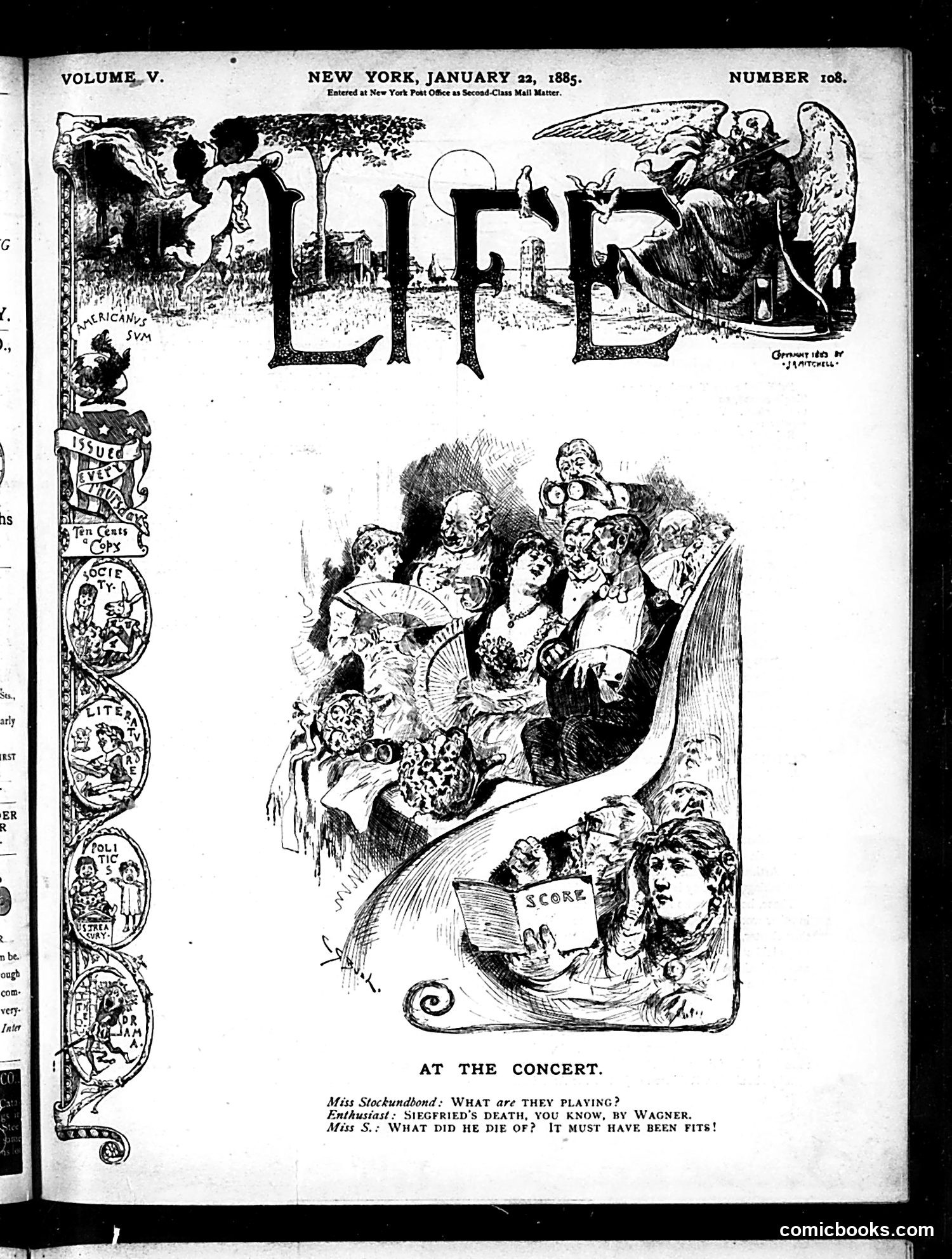
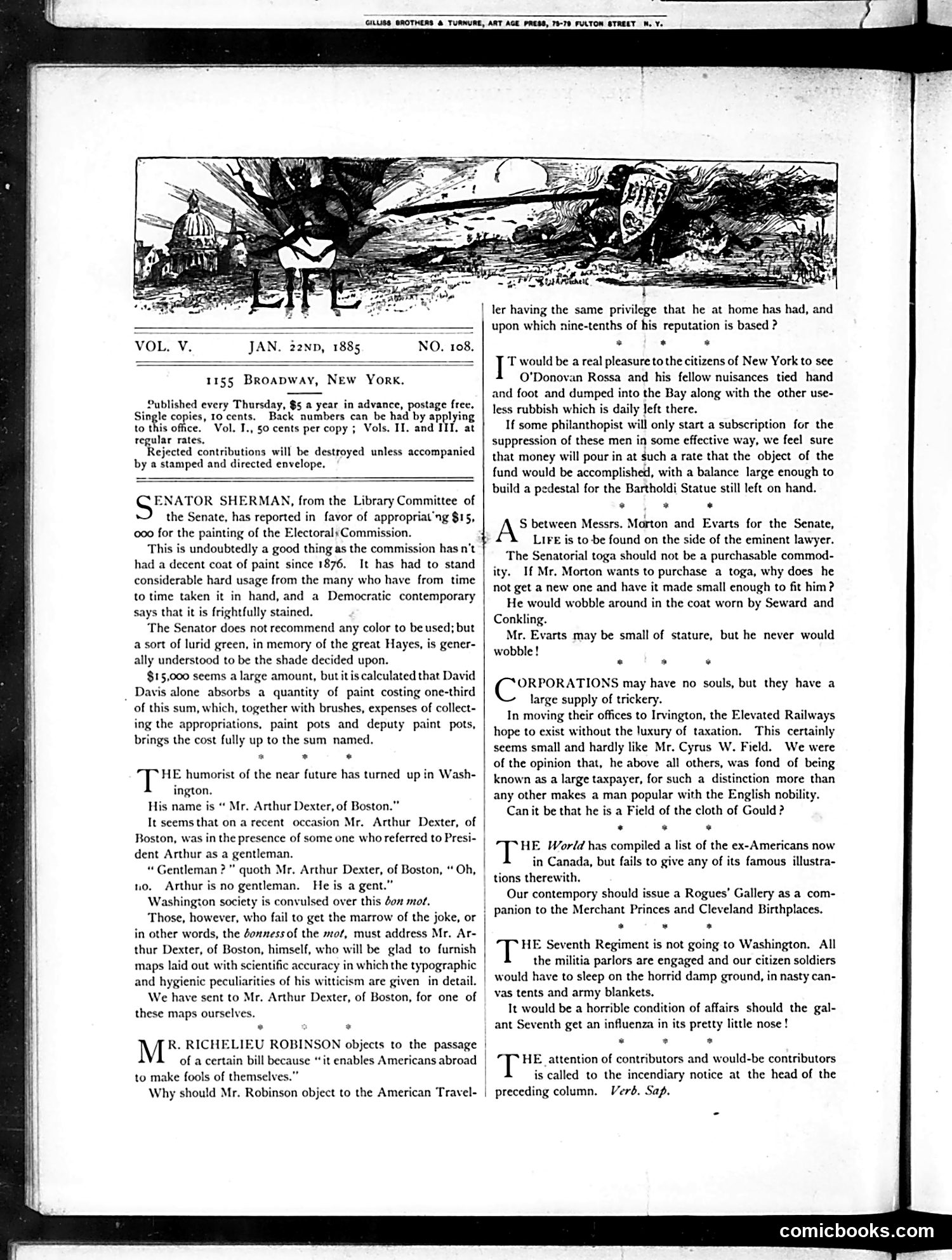
The page header cartoon depicts a figure seated at a desk beside what appears to be a classical building (likely the Capitol), with a large moon in the background—suggesting a nighttime scene of governmental work or contemplation. The textual content addresses political matters of 1885, including: - **Senator Sherman's Electoral Commission painting**: A $15,000 appropriation requiring repainting since 1876 - **Arthur Dexter of Boston**: A satirical piece about someone mistakenly called a "gentleman" in Washington society, mocking pretension - **Elevated Railways taxation dispute**: Corporations avoiding taxation while citizens bear the burden - **The Seventh Regiment**: Militia readiness concerns The satire targets governmental waste, social pretension, and corporate tax avoidance—recurring 1880s reform concerns.
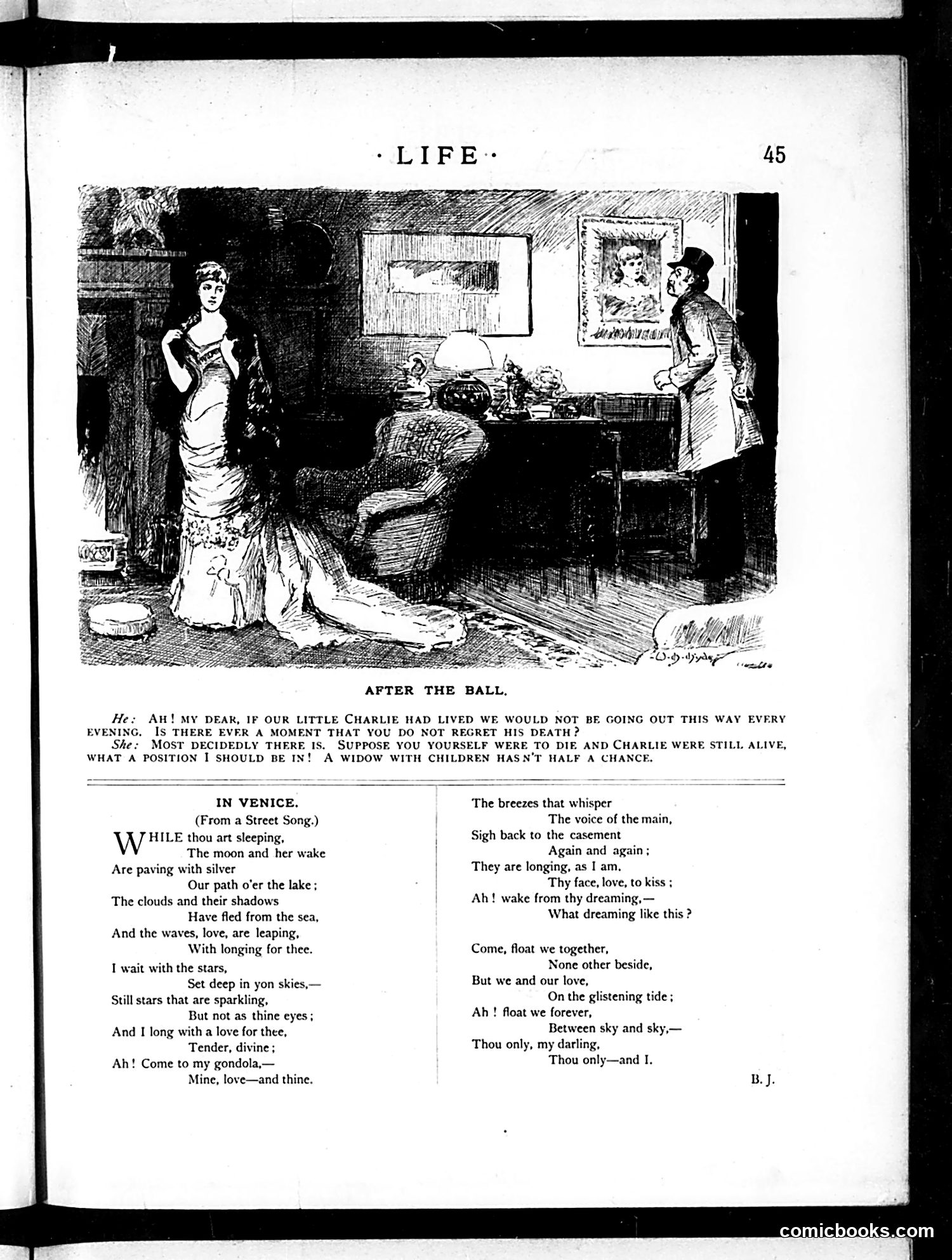
This cartoon depicts an upper-class couple after attending a formal ball. The woman wears an elaborate gown with a train; the man stands nearby in evening dress. The dialogue reveals their marital discord: he expresses regret about their deceased son "Charlie," saying they wouldn't need to attend social events nightly if he had lived. She responds bitterly, noting she "decidedly" regrets his death, and adds a cutting remark that a widow with children has little chance of remarriage—implying her husband's inattentiveness makes her feel trapped in the marriage. The satire targets the superficiality of high society life and unhappy marriages among the wealthy, where couples endure endless social obligations despite emotional distance. The cartoon critiques both marital discontent and the hollow nature of upper-class social ritual.
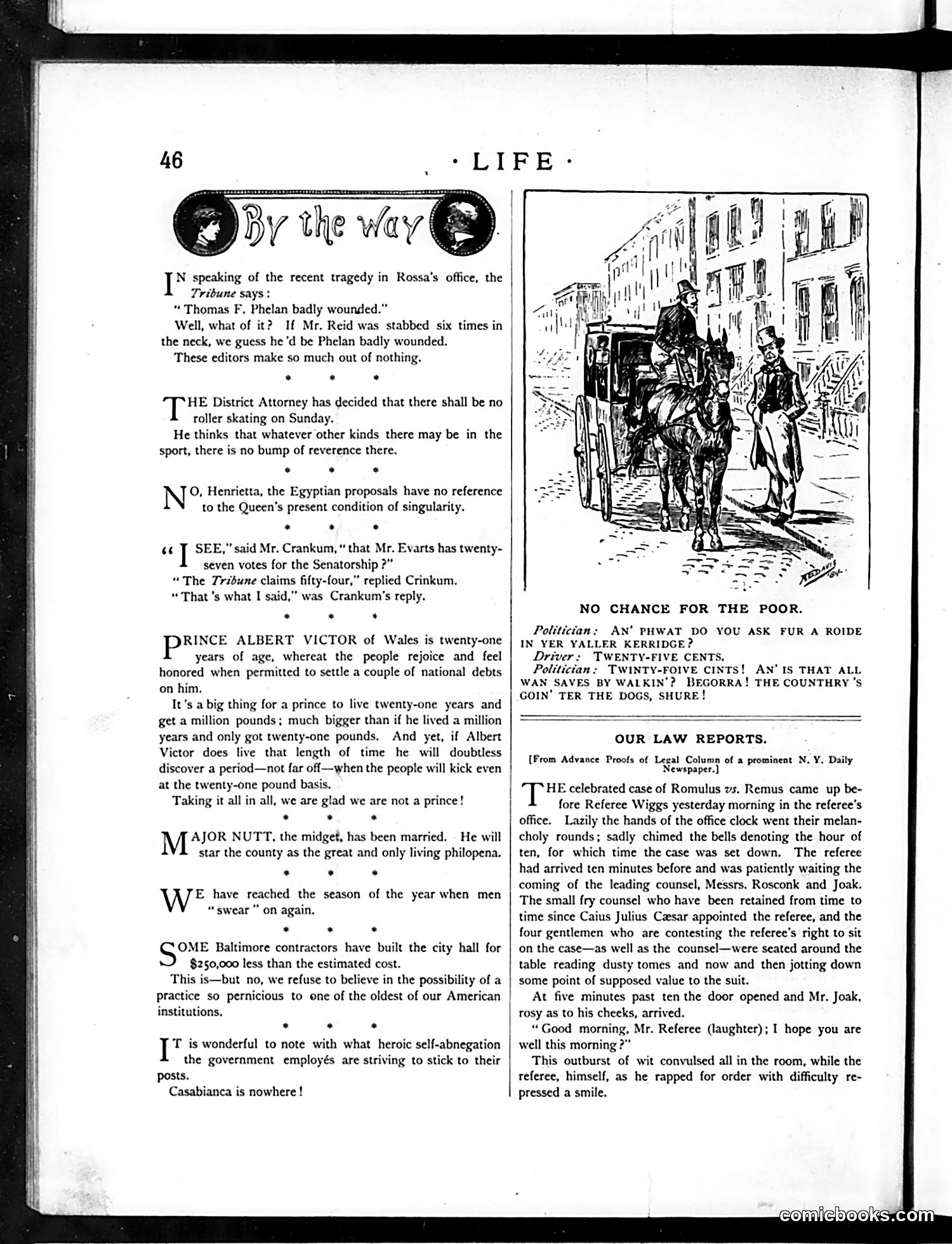
The cartoon depicts a politician refusing to give a poor person a ride in his carriage. The dialogue is a class-based joke: when the beggar asks for a ride to "Valley Kerridge," the politician demands payment ("twenty-five cents"), then dismissively suggests walking would save money. The punchline mocks upper-class hypocrisy—the politician pedantically calculates the poor man's savings while refusing basic charity. The satire targets the callousness of wealthy, politically-connected individuals toward the working poor. By having the politician invoke economic "efficiency" to justify denying aid, the cartoon critiques how the privileged rationalize indifference to poverty as practical wisdom rather than selfishness. The artwork style and page placement (in Life magazine's satirical section) confirm this is social commentary on class inequality.
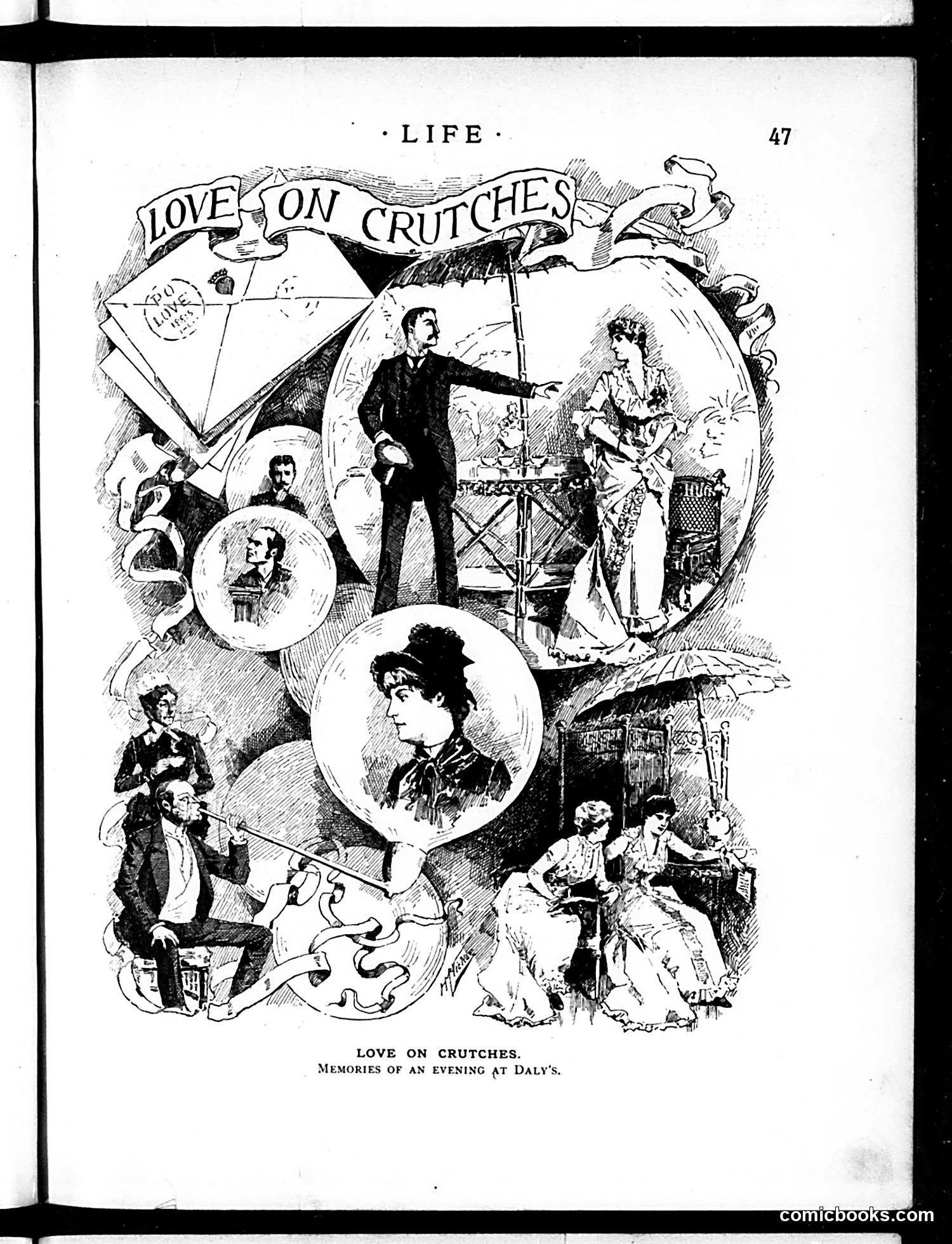
This satirical illustration from *Life* magazine depicts various romantic scenarios set around Daly's Theatre (a prominent New York venue). The title "Love on Crutches—Memories of an Evening at Daly's" suggests the humor derives from romance portrayed as physically awkward or unstable—hence "crutches." The composition shows multiple vignettes of courting couples in different poses and situations, arranged around circular portrait medallions. The imagery satirizes theatrical romance and fashionable courtship rituals of the era. The "crutches" metaphor likely mocks overly dramatic or dependent relationships typical of theatrical melodrama, which Daly's Theatre frequently staged. The detailed costumes and formal attire indicate this targets upper-class social pretension and theatrical affectation in romantic behavior.
This page contains two distinct sections: a legal anecdote and a book review. **The Legal Anecdote** describes a courtroom dispute between opposing counsel—Mr. Joak and Mr. Roscovck—over proper procedure. Mr. Joak makes a quip about "a tiger and a nipping air," which the referee finds irrelevant but humorous. The satire targets courtroom pomposity: lawyers debating procedural minutiae while the actual case's merit gets lost in legal formalism. **"The Culprit Fox"** is a brief moral tale about a fox imprisoned for disturbing poultry, then released. The moral notes that imprisonment doesn't reform all afflictions, satirizing contemporary assumptions about prison reform effectiveness. **"Scientific Doggerel"** reviews William C. Richards' poetry collection, mocking verses that advocate impractical solutions (storing gas in dollars). The satire ridicules pseudo-scientific poetry as pretentious hokum.
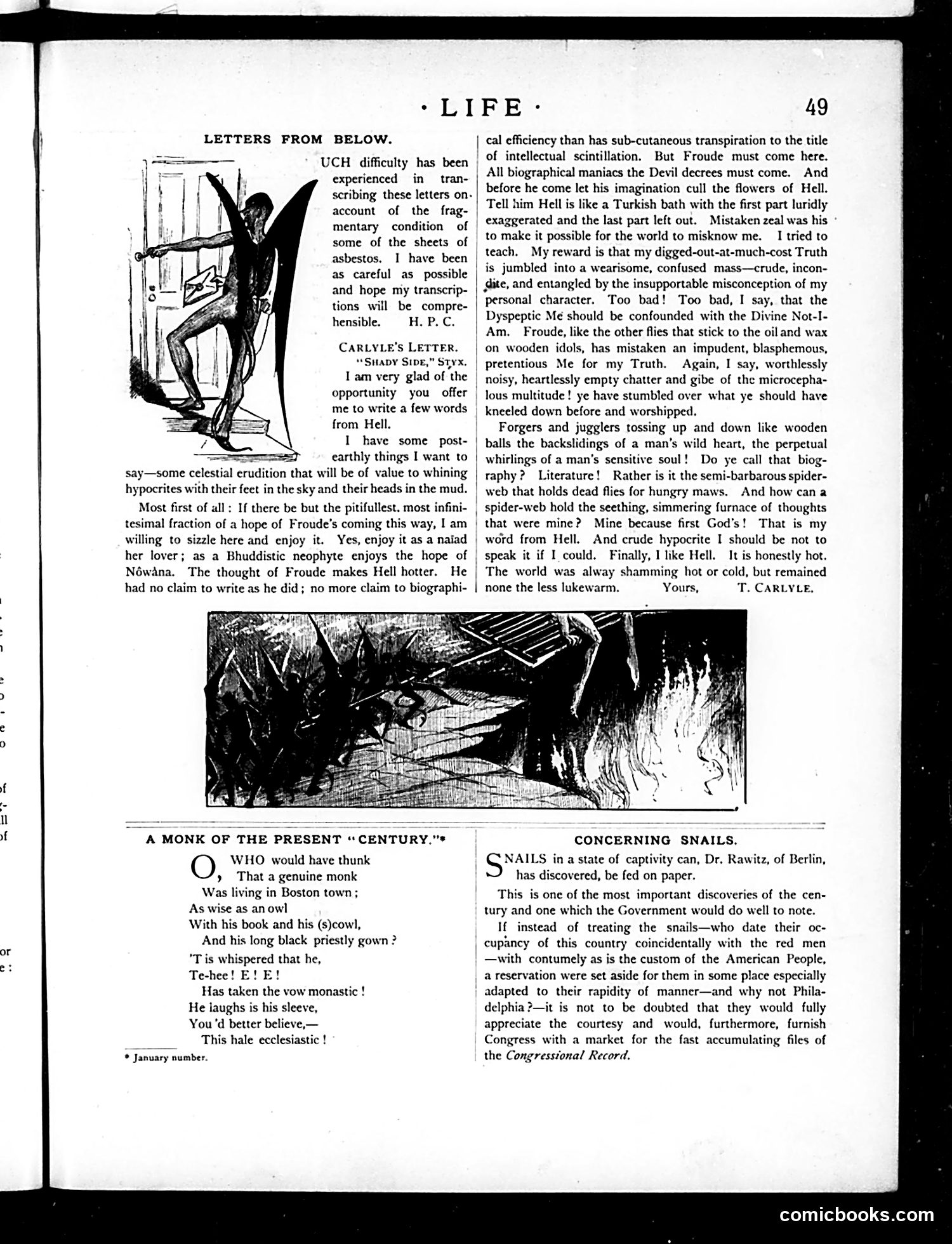
This page from *Life* magazine contains two distinct pieces of satire: **"Letters from Below"** features Carlyle's letter mocking romantic idealization of Hell and suffering. The accompanying illustration shows a skeletal figure, likely representing Death or a demon, in a doorway—visually reinforcing Carlyle's sardonic critique of those who romanticize damnation. **"A Monk of the Present 'Century'"** is a humorous poem mocking a contemporary monk living in modern times—suggesting irony in maintaining monastic vows while surrounded by nineteenth-century secular society. The poem's tone implies the monk is anachronistic and foolish. **"Concerning Snails"** briefly notes a German scientist's discovery that snails can be fed paper, with satirical commentary suggesting American Congress might commercialize this fact for bureaucratic efficiency—poking fun at governmental absurdity.
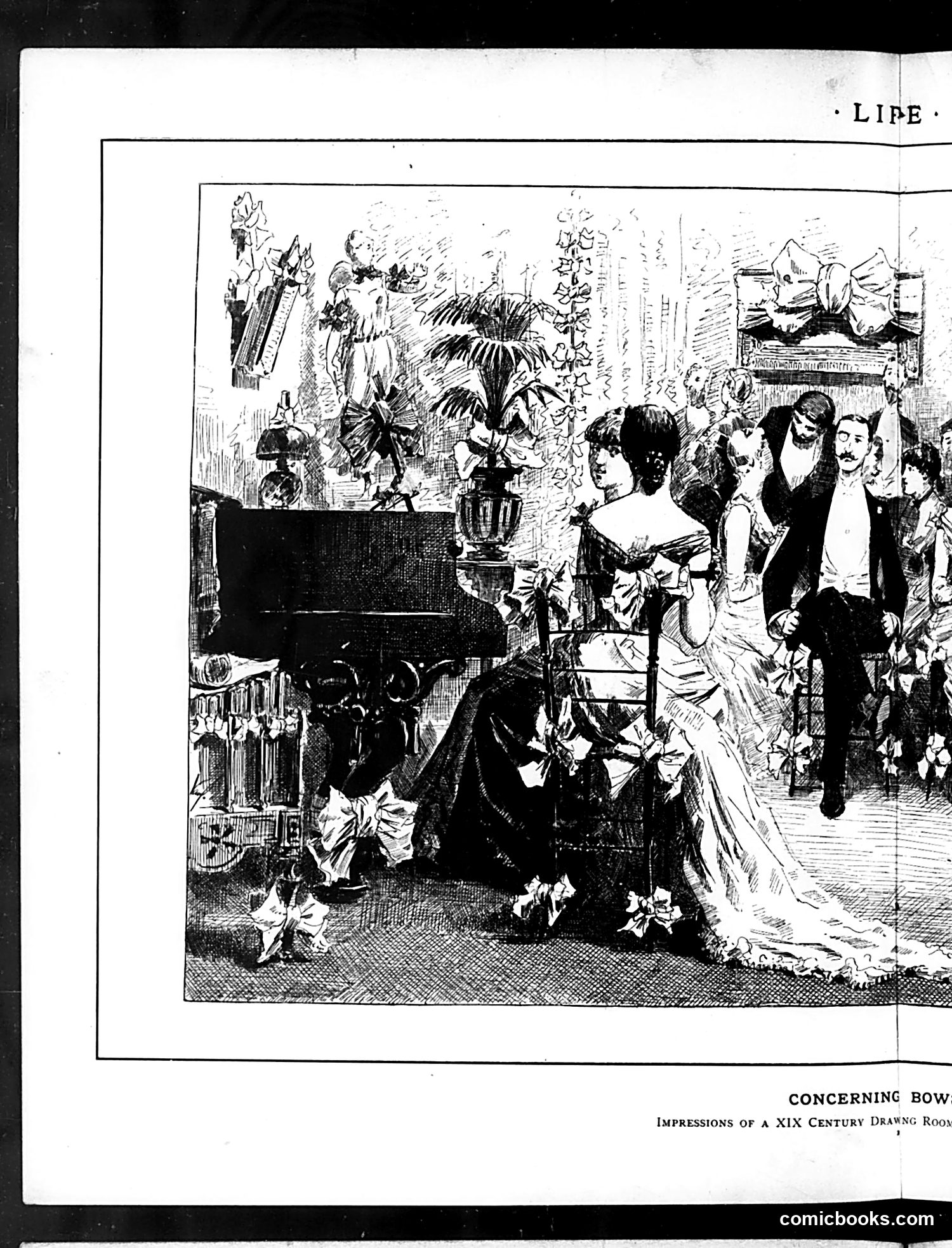
This is a satirical illustration titled "Concerning Bow" with the subtitle "Impressions of a XIX Century Drawing Room." The engraving depicts an elegant social gathering of well-dressed Victorian-era figures in what appears to be a fashionable drawing room or salon. The satire likely concerns the elaborate social etiquette and formality of 19th-century high society—specifically, the exaggerated importance placed on proper bowing and social protocol. The ornate decorations, formal dress, and crowded gathering suggest commentary on the superficiality or pretentiousness of such social conventions. However, without additional context about who the specific figures represent or what particular social situation is being mocked, the exact political or social target remains unclear from the image alone.
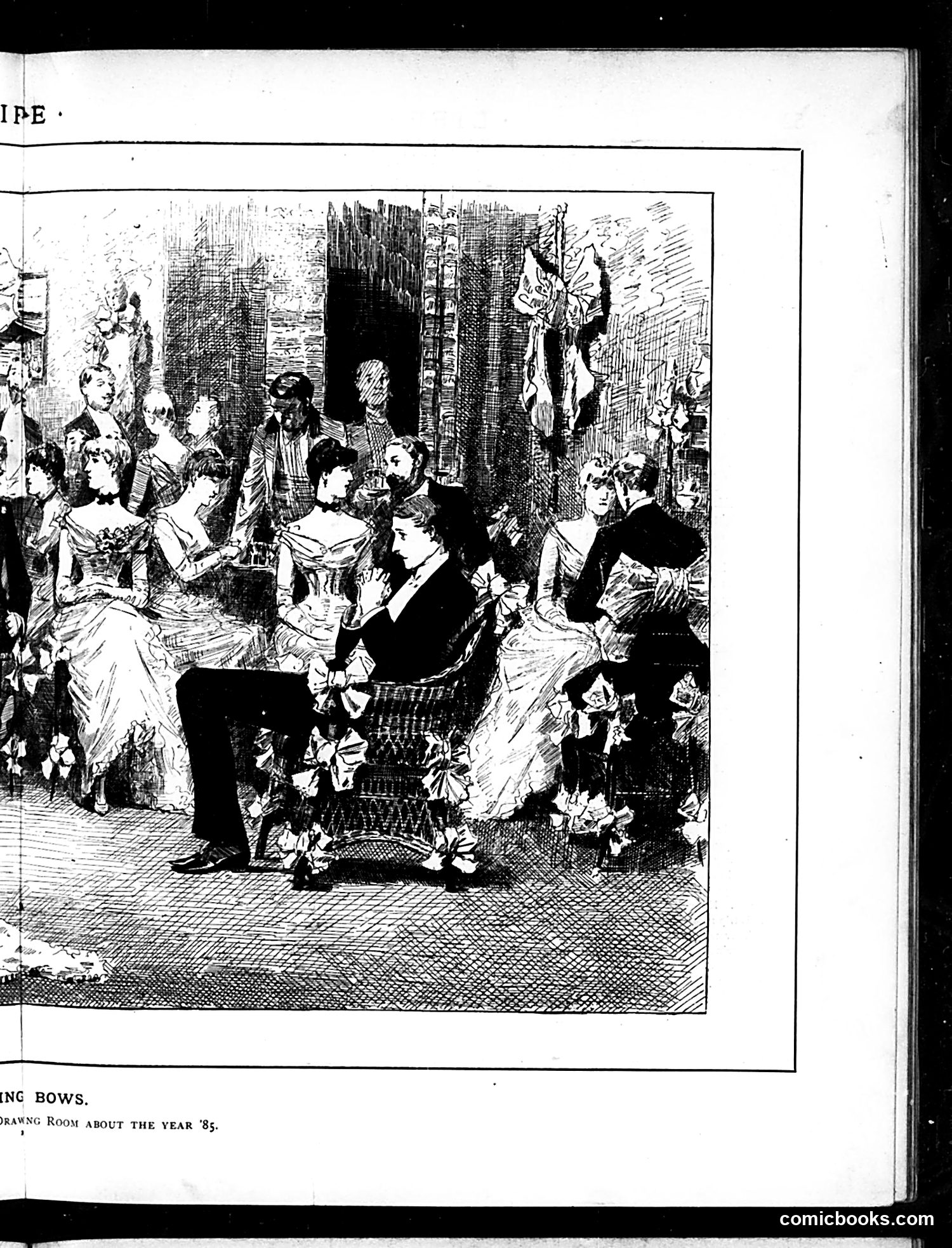
This appears to be a satirical drawing room scene titled "Drawing Room About the Year '85" (likely referring to 1885). The image depicts a formal Victorian social gathering with well-dressed men and women in an ornate interior. The satire likely comments on upper-class social conventions and courtship rituals of the 1880s era. The central male figure appears to be courting or conversing with seated women, while other guests observe—a common subject of Life magazine's social commentary. The elaborate dress, formal poses, and crowded nature of the scene suggest mockery of Victorian propriety and the artificiality of high society interactions. Without clearer caption text, the specific joke or political reference remains unclear, though it certainly satirizes contemporary aristocratic social pretensions.
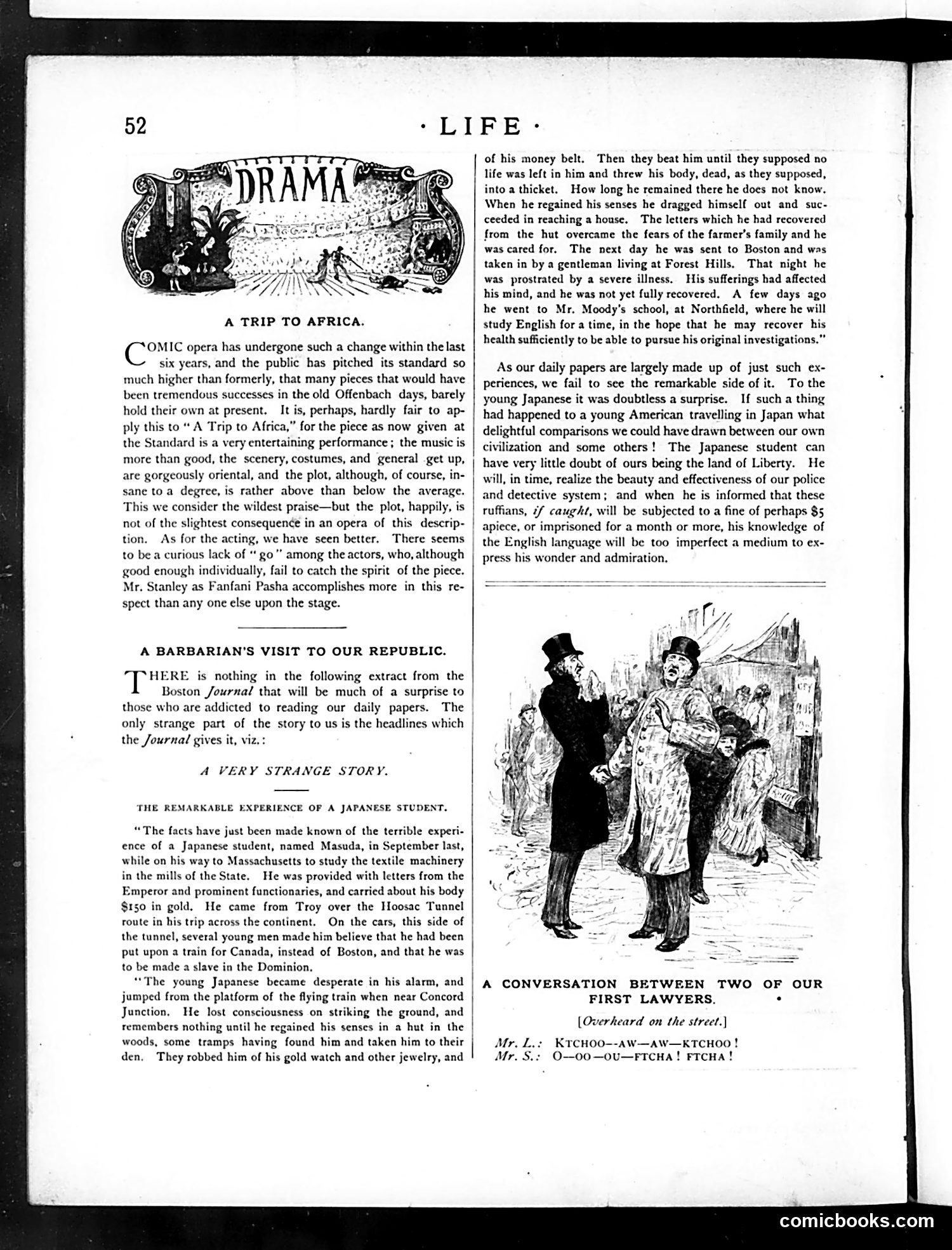
This page contains two distinct pieces of social satire: **"A Trip to Africa"** reviews a comic opera at the Standard Theatre, criticizing the production's weak acting despite adequate music and scenery. The reviewer praises only Mr. Stanley's performance as "Fanfani Pasha." **"A Barbarian's Visit to Our Republic"** is the more pointed satire. It reprints a Boston Journal account of a Japanese student (Masuda) who was robbed, beaten, and nearly killed by American con men and tramps during his 1882 journey to Massachusetts. The satire's bite lies in Life's observation that Americans would be outraged if a young American faced such treatment in Japan—yet consider this "not remarkable" when happening to a foreigner in America. The article sardonically notes that while the Japanese student learned "the beauty and effectiveness of our police and detective system," he also experienced American lawlessness firsthand. The piece critiques American hypocrisy: the nation prides itself on civilization while its actual treatment of foreigners reveals otherwise.
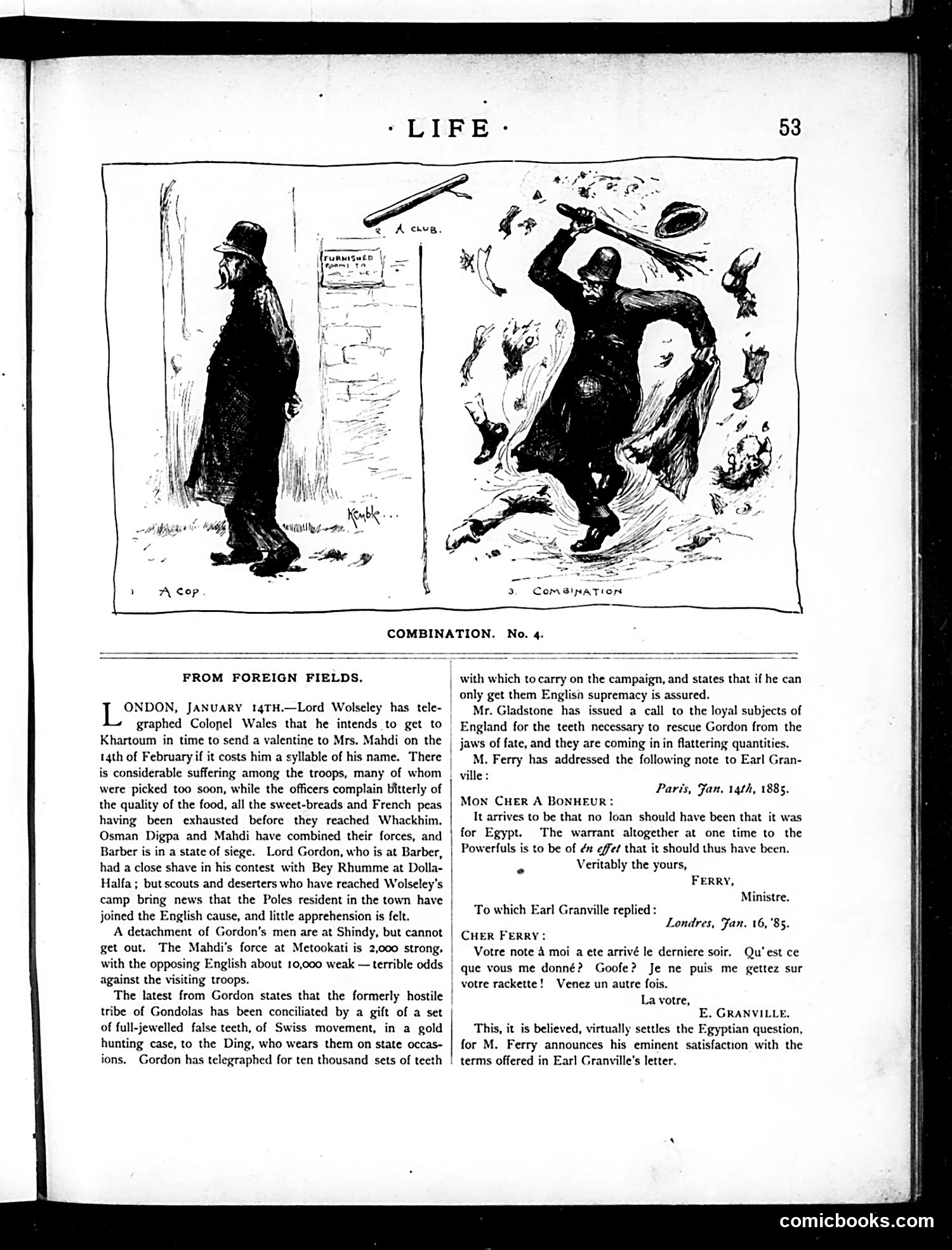
This is a satirical piece about the 1884-85 Sudan Campaign during the Mahdist War. The left cartoon shows a cop (police/authority), the right shows chaotic violence labeled "Combination"—likely depicting the messy military situation. The text mocks British military efforts to rescue General Gordon at Khartoum, trapped by forces under the Mahdi. The satire centers on absurd solutions: Gordon supposedly pacifies local tribes by distributing Swiss false teeth, then requests 10,000 more sets as if they're weapons. Prime Minister Gladstone issues a national appeal for teeth donations. The final section parodies diplomatic correspondence between French Foreign Minister Ferry and British Earl Granville, written in comically broken pseudo-French and English, reducing serious Egyptian/colonial disputes to nonsensical banter. The joke: presenting military strategy and diplomacy as equally ridiculous—false teeth as currency, teeth as military supplies, and incomprehensible diplomatic notes equally "settling" the Egyptian question.
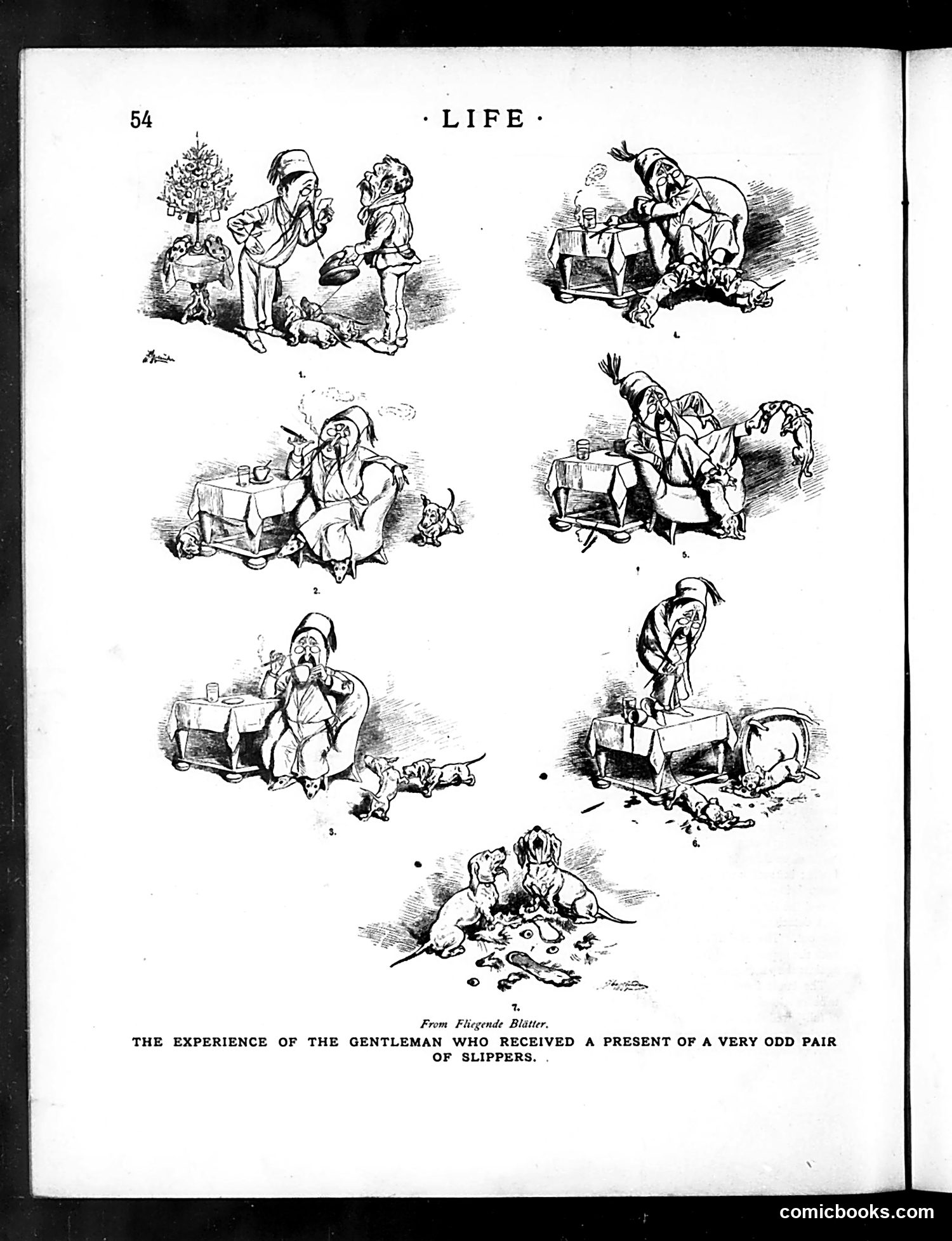
This is a sequential comic strip from *Fliegende Blätter* (a German satirical magazine) reprinted in *Life*. It depicts a gentleman receiving an unusual pair of slippers as a gift. The seven panels show his escalating misadventures as he attempts to use them: The slippers appear to have some magical or disruptive property—possibly oversized, animated, or otherwise uncontrollable. Each panel shows him struggling with increasingly chaotic situations: furniture breaking, items flying, his clothing becoming disheveled, and general domestic destruction. The satire mocks both the absurdity of impractical gifts and the gentleman's hapless attempts to manage an impossible situation. It's a straightforward physical comedy piece without apparent political commentary—simply illustrating the humorous chaos that ensues from receiving such a peculiar present.
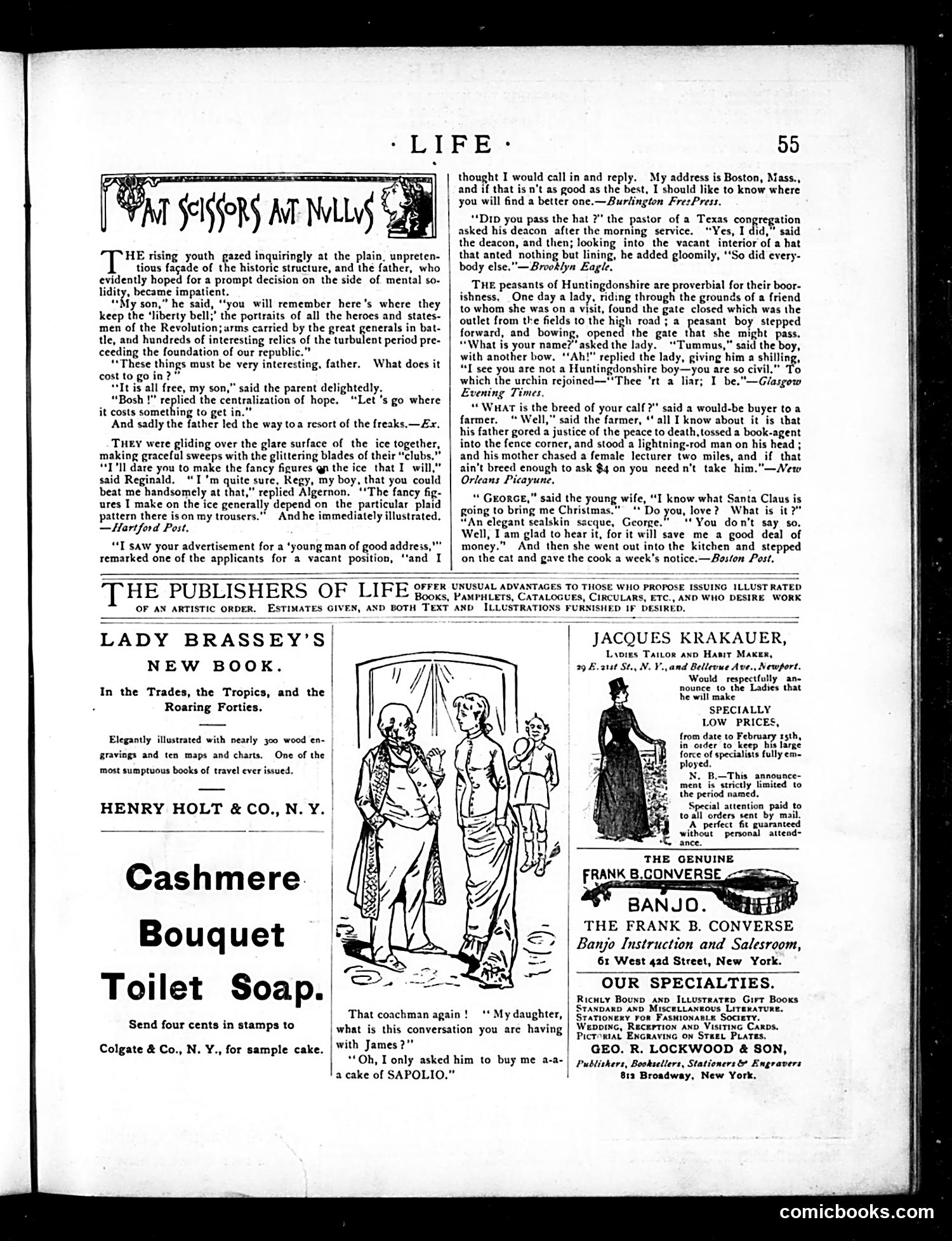
This page contains several brief satirical anecdotes typical of *Life* magazine's humor. The main cartoon (center-left) depicts a father leading his son away from Independence Hall—a historic, free monument—because the boy finds it uninteresting without paid admission. The satire mocks American youth's superficiality and consumerism: they value entertainment only if it costs money, rejecting cultural/historical significance. Other jokes target predictable targets: a job applicant's misunderstanding of "address" (location vs. manner); a deacon's empty church collection; a Huntingdonshire peasant's unexpected civility; a farmer's boastful calf; and a wife's materialistic Christmas expectations. The page is otherwise filled with period advertisements for books, soaps, clothing, and musical instruments. The satire reflects late-19th-century anxieties about American materialism and declining cultural appreciation among youth.
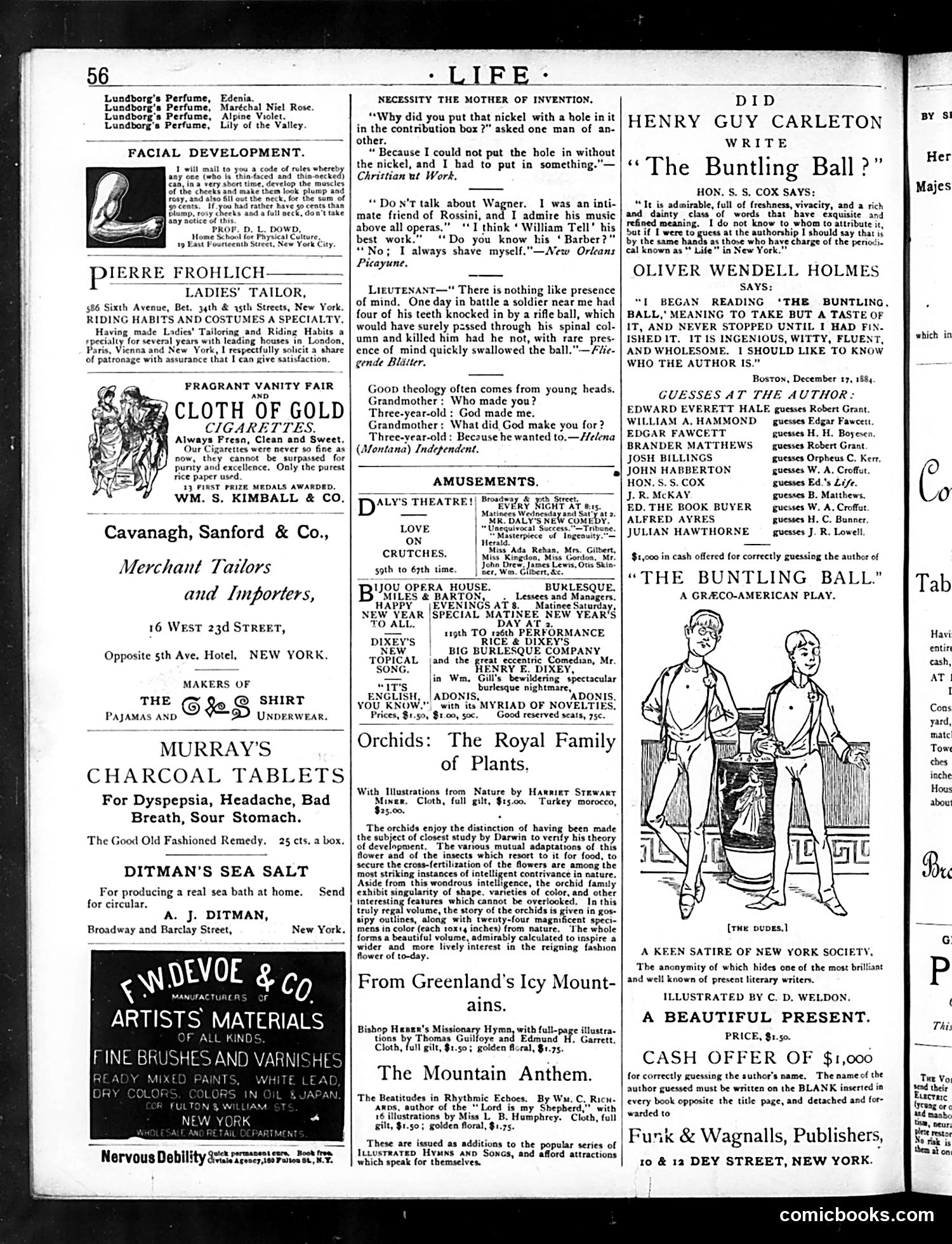
This page is primarily **advertising and miscellaneous content** rather than political satire. The main visual element shows two well-dressed gentlemen in what appears to be an illustration for "The Buntling Ball," a Greco-American play by Henry Guy Carleton. The page contains: **Humorous anecdotes** (brief jokes), including one mocking pretentious operagoers who confuse Rossini with Wagner, and another about a soldier who swallowed a bullet—these are gentle social satire on human vanity and absurdity rather than political commentary. **Extensive advertisements** for tailors, perfumes, cigarettes, theatrical productions (including Henry Dixey's "Adonis" burlesque), and remedies for dyspepsia. **Book advertisements**, including "Orchids: The Royal Family of Plants." The **"Buntling Ball" illustration** appears designed to promote the theatrical production, showing fashionable society figures, but without additional context, the specific satirical content of that play remains unclear from this page alone.
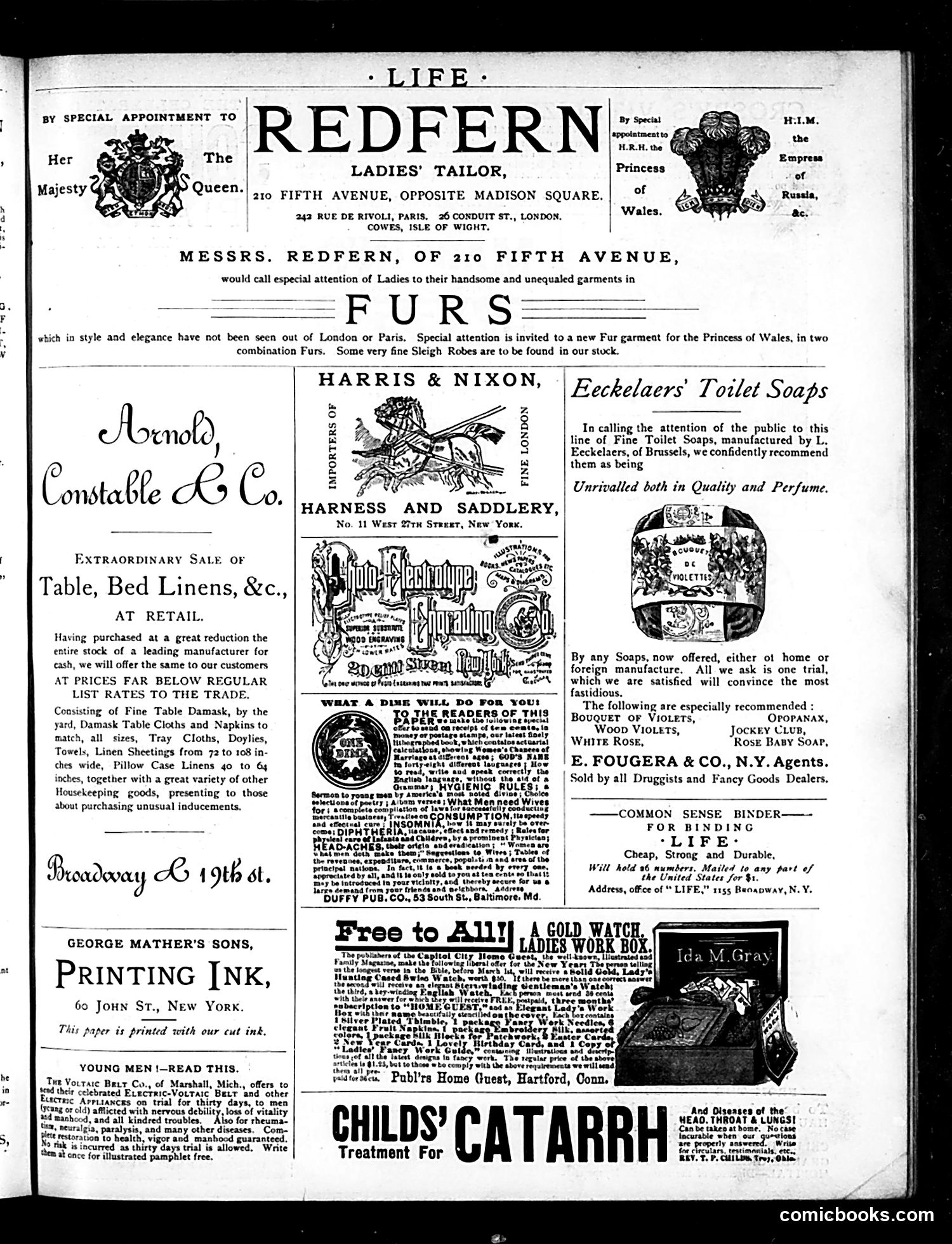
This page is primarily **advertisements with no political cartoons or satirical content**. The layout consists of luxury retail ads typical of a late-19th-century American magazine: Redfern (ladies' tailoring), Arnold Constable & Co. (linens), Harris & Nixon (harnesses), and various patent medicines and consumer goods. Notable is the prominent advertising of "Duffy's Malt Whiskey" with a large block claiming health benefits, and a "Voltaic Bath" ad promising to cure "nervous debility" and "loss of vitality and manhood"—typical snake-oil marketing of the era. There's also Childs' Catarrh Treatment and Eeckelaers' Toilet Soaps. The only potentially humorous element is an ad offering a "Free to All" Gold Watch, which appears to be a common mail-order gimmick. The page reflects Life's dual function: entertaining satirical content paired with profitable advertising revenue from merchants and patent medicine vendors.
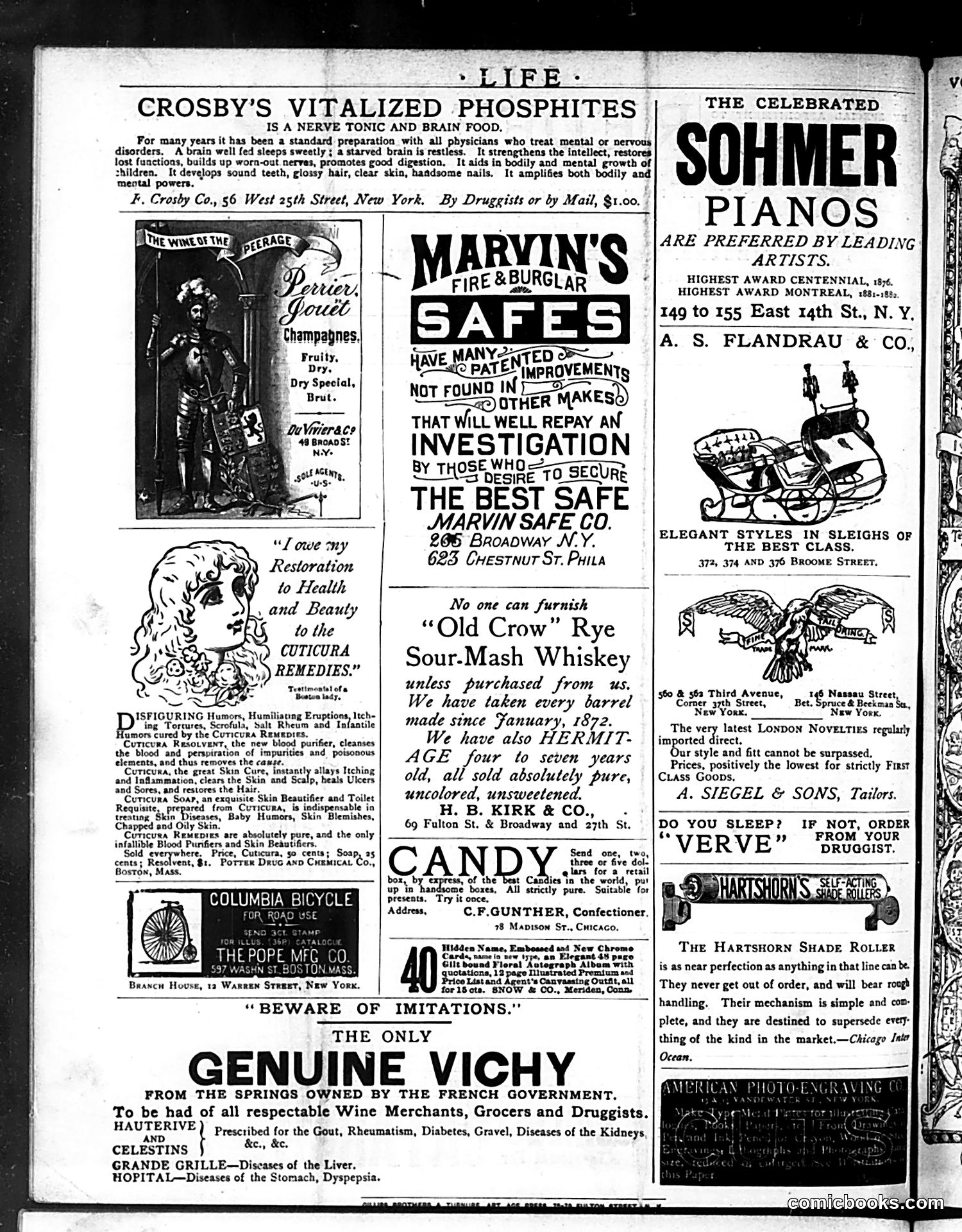
This is primarily an **advertisement page** from Life magazine, not a satirical cartoon. The page contains roughly a dozen product advertisements typical of late 19th-century American publications. The ads showcase patent medicines and consumer goods marketed with exaggerated health claims common to the era: - **Crosby's Vitalized Phosphites**: a "nerve tonic" claiming to cure mental disorders, insomnia, and poor digestion - **Cuticura Remedies**: skin treatments for humors and eruptions - **"Old Crow" Whiskey**: marketed as purely uncolored and unsweetened - **Genuine Vichy water**: mineral water prescribed for gout and kidney disease These advertisements reflect **pre-FDA regulation America**, when medicinal claims were largely unregulated. The repeated emphasis on "purity" and "genuine" products suggests contemporary concerns about counterfeits and adulteration. The page also includes luxury goods (Sohmer pianos, sleighs, tailoring services), reflecting Life's middle-to-upper-class readership. No political satire or cartoon commentary is evident here—this is straightforward commercial promotion.